Behavioral Health Practice Consulting: A 2026 Strategic Guide to Sustainable Growth

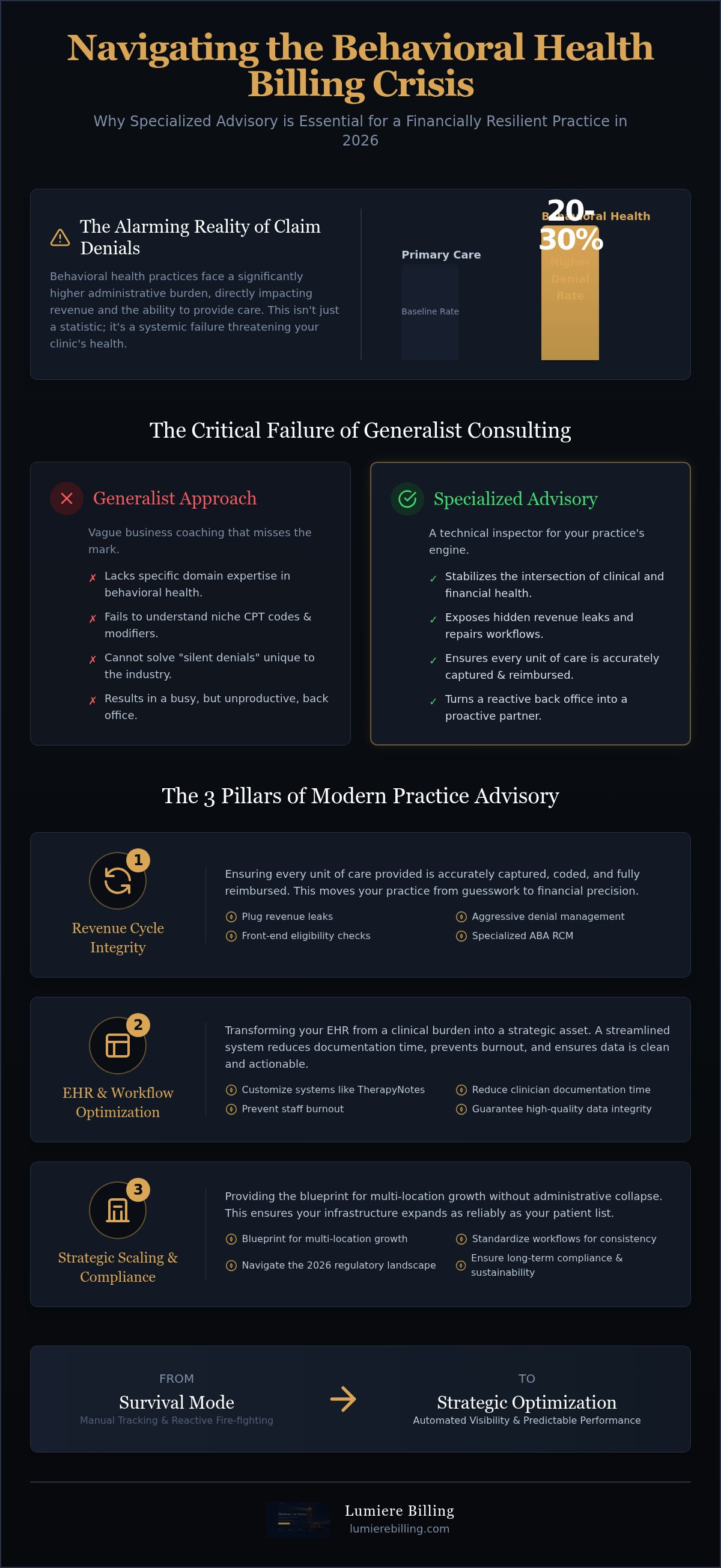
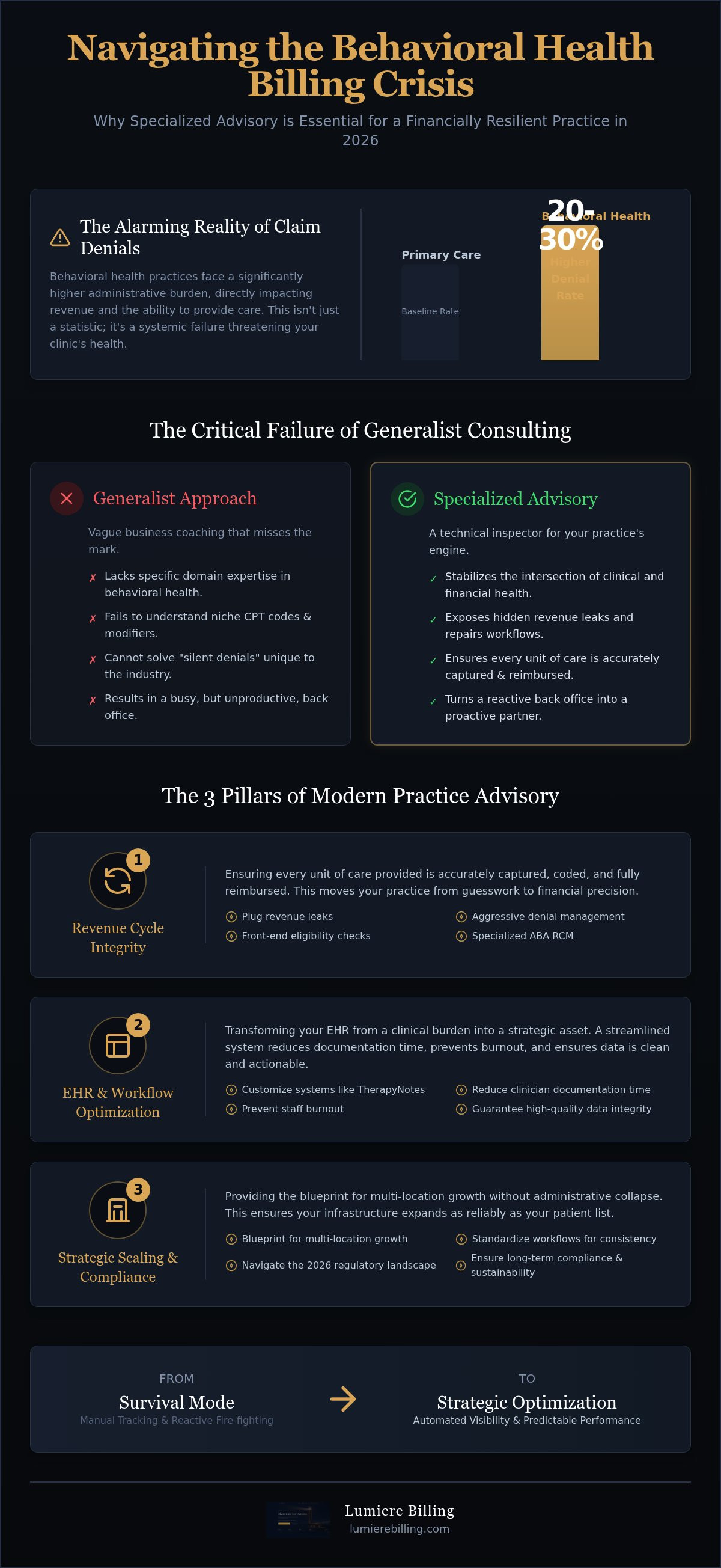
Behavioral health practices currently face denial rates that are 20% to 30% higher on average than primary care clinics. This isn't just a statistic; it's a systemic failure that threatens your ability to provide care. You've likely felt the weight of these "silent denials" or watched your team struggle under the burden of inefficient EHR workflows and mounting credentialing backlogs. Specialized behavioral health practice consulting addresses these fractures by replacing opaque administrative processes with visibility and insight.
We understand that clinical excellence is a liability if it isn't supported by a rigid, specialized financial infrastructure. This guide explores how Practice Advisory services act as a vigilant protector of your clinic's health by identifying revenue leaks and repairing broken operational systems. You'll discover verified strategies for revenue recovery and a clear roadmap for scaling your practice across multiple locations. We'll break down the 2026 Medicare updates and show you how to build a foundation that values precision over volume.
Key Takeaways
- Identify the critical failures of generalist consulting and why specialized advisory is required to navigate the intersection of clinical care and financial health.
- Discover how behavioral health practice consulting exposes "silent denials" and plugs revenue leaks through a rigorous operational audit framework.
- Master the three pillars of modern practice advisory to transform your EHR and RCM systems into strategic assets for growth.
- Learn the mechanics of scaling from a single clinic to a multi-location organization by centralizing administrative functions and standardizing workflows.
- Gain insight into how a dedicated advisory partner acts as a vigilant protector of your compliance and long-term sustainability.
What is Behavioral Health Practice Consulting in 2026?
Behavioral health practice consulting is the specialized advisory process that stabilizes the intersection of clinical delivery and financial sustainability. It's a technical discipline. In 2026, the industry has moved beyond simple management; it now requires a consultant to act as a mechanical inspector for your practice's back-office engine. They bring hidden systemic leaks into focus and repair the workflows that cause administrative friction. This isn't about vague business coaching or general leadership advice. It's about the mechanical integrity of your revenue cycle and the visibility of your operational data.
Generalist business consultants often fail behavioral health providers because they lack specific domain expertise. They don't understand the intricate requirements of specialized CPT codes or the proper application of modifiers that prevent denials in our niche. Without this level of focus, their advice can't solve the "silent denials" that plague modern practices. Specialized behavioral health practice consulting ensures that your administrative team isn't just busy, but productive and compliant. It turns a reactive back office into a proactive partner in patient care.
The Core Focus Areas of Specialized Advisory
A specialized advisor focuses on three critical pillars to ensure your clinic's long-term stability and growth:
- Revenue Cycle Integrity: This involves ensuring that every unit of care provided is accurately captured, coded, and fully reimbursed. It eliminates the guesswork that leads to aging AR.
- Operational Compliance: We help you navigate the 2026 regulatory environment, ensuring that your documentation meets payer standards without creating clinical friction for your providers.
- Strategic Scaling: We provide the blueprint for multi-location growth. This includes standardizing workflows so that your infrastructure expands as quickly as your patient list without an administrative collapse.
Why 2026 Demands a Data-Driven Approach
The 2026 environment is defined by increased payer scrutiny and rising operational costs. With the ongoing evolution of the Primary Care Behavioral Health Model and the strict requirements of mental health parity laws, manual tracking is a liability. You need automated visibility. Transitioning from manual spreadsheets to real-time data within your EHR allows you to spot trends before they become crises. This shift from survival mode to strategic optimization is the hallmark of a healthy, modern practice. Ultimately, specialized practice consulting serves as the essential bridge between clinical care and fiscal health.
The 3 Pillars of Modern Practice Advisory
Sustainable growth in behavioral health isn't a result of luck. It's the product of deliberate engineering. Modern behavioral health practice consulting rests on three foundational pillars that protect your clinic's financial and operational integrity. By focusing on these core areas, you move from a state of constant administrative fire-fighting to a model of scalable, predictable performance. It's about moving away from the opaque nature of traditional services toward a style that emphasizes visibility and insight.
Revenue Cycle Management Optimization
RCM is the heartbeat of your practice. It's the primary driver of health. Consulting in this area focuses on plugging the leaks in your revenue cycle by identifying systemic failures. Key focus areas include:
- Front-end eligibility and authorization verification.
- Aggressive back-end denial management.
- Specialized ABA revenue cycle management for pediatric clinics.
General medical billing tactics won't suffice in this niche. You need an aggressive strategy that treats every denial as a data point for system improvement. This proactive stance ensures that your practice remains financially resilient against shifting payer policies.
EHR Optimization and Workflow Audits
Software is often a source of frustration for clinicians. It doesn't have to be. Effective advisory turns your EHR from a burden into a strategic asset. We customize specialized behavioral health systems like TherapyNotes to fit your unique clinical workflows. This streamlining reduces documentation time and helps prevent clinician burnout. It also ensures the data you collect is clean and actionable. High-quality data integrity is the only way to generate meaningful mental health practice analytics that guide your expansion decisions. Visibility is the antidote to operational chaos.
Credentialing and Payer Strategy
Credentialing is more than paperwork; it's a growth lever. Proactive mental health provider credentialing opens doors to profitable payer contracts. Reviewing SAMHSA behavioral health data highlights the growing need for specialized services. This data gives you the leverage you need during contract negotiations. You must also vigilantly manage the provider re-credentialing process to prevent unbillable gaps. Keeping your provider rosters current is essential for maintaining network adequacy. If you're unsure where your current system is failing, proactive practice advisory can reveal the hidden cracks in your foundation.
Identifying Operational Leakage: The Audit Framework
A Practice Audit is the diagnostic baseline for any behavioral health practice consulting engagement. It's not a clinical review of patient outcomes; it's a mechanical inspection of your business's financial plumbing. While a clinical audit ensures care standards, a billing and operational audit identifies where your revenue is literally evaporating. Revenue leakage is the 'silent killer' of behavioral health clinics. Without a specialized audit, you're essentially operating in the dark, unaware of the systemic failures that prevent your practice from reaching its full potential.
The Anatomy of a Behavioral Health Billing Audit
Precision matters when dissecting a revenue cycle. We look at the high-friction points between care delivery and reimbursement that generalist auditors often overlook. A specialized audit focuses on the specific coding and authorization nuances unique to our field. We examine the following critical areas:
- Verification of insurance and prior authorization accuracy: Ensuring that authorizations aren't just present, but correctly mapped to the intended services.
- Audit of CPT code usage: Mastering the application of the 90837 code for psychotherapy and identifying improper modifier usage that triggers denials.
- Reconciliation of unit tracking: Verifying that unit utilization for ABA and intensive outpatient services matches authorized limits to prevent unbillable care.
Many practices rely on generic billing software that misses "silent denials." These are claims that aren't outright rejected but remain stuck in "pending" status or are paid at lower rates due to subtle coding errors. Our framework brings these hidden issues into focus, allowing for immediate repair of the workflow.
Red Flags vs. Green Flags in Practice Health
Data provides the visibility needed for operational mastery. We track specific Key Performance Indicators (KPIs) to determine if a practice is scaling or stalling. These metrics act as early warning signs for your back-office engine.
- Red Flag: Days in AR exceeding 45 days. This suggests a breakdown in claim follow-up or a significant backlog in the credentialing process.
- Red Flag: A denial rate above 10%. This is often a symptom of poor front-end eligibility verification or outdated coding practices.
- Green Flag: A clean claim rate above 98%. This indicates your administrative workflows are tight and proactive.
- Green Flag: Consistent unit utilization that perfectly aligns with authorized care plans.
Identifying these leaks is only the first step. Effective behavioral health practice consulting uses this data to rebuild your operational infrastructure. It moves your team from reactive fixes to a system of comprehensive oversight, ensuring that every unit of care is captured and paid. Once the leaks are plugged, your practice can finally shift its focus toward sustainable expansion.
Strategic Scaling: Moving from Solo to Multi-Location
Scaling a behavioral health practice is a mechanical challenge, not just a clinical one. Clinical excellence at a single site doesn't automatically translate to success across a group. Expansion is a risk. You must standardize every workflow to ensure consistent care and financial integrity. This is where behavioral health practice consulting provides the necessary structural blueprint. It moves your organization away from the "solo mindset" and toward a model of industrial precision.
Expanding across state lines or multiple counties introduces a "complexity tax." Different payer mixes, local regulations, and credentialing hurdles can quickly stall your momentum. Centralizing administrative functions is the only way to maintain control. It reduces overhead and ensures that your expansion is supported by data rather than guesswork. Relying on outsourced mental health billing allows you to scale rapidly without the burden of hiring and training a massive internal back-office team. It keeps your focus on the clinical expansion while experts protect your revenue cycle.
Building a Scalable Administrative Infrastructure
A scalable practice requires a centralized behavioral health RCM system. This ensures that billing data from every location flows into a single, visible dashboard. Visibility is non-negotiable. You need internal SOPs for intake and authorization tracking that remain identical across every site. To accelerate hiring and revenue generation, utilize CAQH enrollment services to streamline provider onboarding. This methodical approach prevents the administrative collapse that often follows unmanaged growth.
Financial Planning for Growth
Expansion requires deep visibility into your margins. You shouldn't just look at total revenue; you must analyze profit margins per clinician and per location. Data drives growth. Use analytics to predict cash flow needs during the inevitable credentialing "lag time" of a new site. Selecting the best credentialing services is critical for high-volume hiring. If your infrastructure isn't ready for the next ten locations, your current growth is a liability. Ensure your systems are built for expansion by engaging with professional practice advisory services today.
Lumiere Advisory: Specialized Consulting for Behavioral Health
Lumiere Billing rejects the generalist identity. We don't attempt to serve the broad medical community because we've mastered one specific craft. In an industry where generalist consultants often overlook the nuances of behavioral health, we position ourselves as a vigilant protector of your clinic’s financial health. We understand that your practice isn't just another business; it's a specialized clinical environment that requires a matching level of administrative mastery. Our behavioral health practice consulting is designed to bring hidden systemic issues into focus, replacing opaque processes with clarity and mechanical integrity.
We don't act as an outside voice offering surface-level advice. Instead, we function as a disciplined, behind-the-scenes extension of your team. This proactive partnership allows us to identify subtle failure points before they manifest as revenue loss. We're methodical and highly observant. We believe that your clinical excellence deserves a financial infrastructure that is equally robust. By integrating deeply into your operations, we ensure that every administrative gear is turning with precision, allowing you to focus entirely on patient outcomes.
The Lumiere Partnership Model
Our approach goes far beyond simple billing oversight. We provide strategic guidance on EHR selection and optimization, ensuring your platform works for your clinicians rather than against them. We maintain an obsessive focus on precision and denial prevention. This isn't just about submitting claims; it's about the total health of your revenue cycle. We provide transparency through customized KPI dashboards that offer real-time visibility into your practice's performance. You'll see exactly where your revenue stands, including:
- Real-time denial tracking and resolution status.
- Clinician productivity metrics and unit utilization.
- Payer-specific reimbursement trends and aging AR snapshots.
Your Next Steps to Practice Optimization
The transition from a struggling back office to a scalable organization begins with a clear understanding of your current data. We offer a low-friction entry point for providers who are ready to stop the "silent denials" that erode their margins. You can start by requesting your free behavioral health billing audit. This diagnostic review identifies the specific revenue leaks and workflow bottlenecks that are currently hindering your growth.
Once the audit is complete, we'll schedule a discovery call to review the findings and outline a roadmap for your practice's optimization. We'll help you identify the primary scaling hurdles that stand between your current operations and a multi-location expansion. Don't let administrative friction dictate your clinic's future. Protect your practice’s financial health with Lumiere Advisory and build the infrastructure your mission deserves.
Building Your 2026 Operational Legacy
Sustainable growth in the behavioral health sector requires more than clinical talent; it demands a rigid, specialized financial engine. You've seen how identifying operational leaks through a rigorous audit and centralizing administrative functions can transform a struggling clinic into a scalable organization. By prioritizing revenue cycle integrity and EHR optimization, you move away from the stress of "silent denials" and toward a model of total visibility. Specialized behavioral health practice consulting provides the mechanical oversight necessary to protect your mission while accelerating expansion.
At Lumiere Billing, we act as a vigilant protector of your clinic's health. Our partnership offers proven denial reduction strategies and comprehensive practice visibility tailored exclusively to your niche. Don't let administrative friction or credentialing backlogs stall your progress. It's time to bring your back-office systems into focus and secure the long-term viability of your practice.
Schedule Your Free Behavioral Health Billing Audit today to begin your journey toward operational mastery. Your commitment to patient care deserves a foundation built on precision and transparency. Success is within reach when your systems are as dedicated as your clinicians.
Frequently Asked Questions
What is the difference between a billing service and a practice consultant?
A billing service focuses on the transactional submission and follow-up of claims to secure reimbursement. In contrast, behavioral health practice consulting provides a strategic layer of oversight that addresses the root causes of administrative friction. While billing recovers what you've earned, a consultant analyzes your EHR workflows, documentation standards, and expansion plans to ensure your infrastructure can support long-term growth. It's the difference between fixing a symptom and repairing the entire engine.
How do I know if my behavioral health practice is ready for consulting?
You're ready for advisory services when your clinical success begins to outpace your administrative capacity. Common indicators include days in accounts receivable exceeding 45 days, frequent "silent denials" that your team can't explain, or clinicians reporting burnout due to documentation burdens. If you're planning to open a second location but lack standardized intake or authorization workflows, a consultant provides the structural blueprint needed to scale without collapsing under the complexity tax.
Can a consultant help me optimize my specialized behavioral health EHR?
Yes, specialized advisory focuses heavily on turning your EHR from a documentation burden into a strategic asset. We customize platforms like TherapyNotes to align with your specific clinical workflows and unit tracking requirements. This optimization ensures that your data is clean, which is essential for generating accurate analytics. Proper configuration reduces manual entry errors and prevents the authorization mismatches that frequently lead to preventable claim denials in intensive outpatient or ABA settings.
What are the most common operational leaks in a mental health group practice?
The most frequent leaks occur at the intersection of authorization and unit utilization. Many practices lose revenue through "silent denials" caused by incorrect modifier usage or failing to reconcile units provided against units authorized. Other common failures include front-end eligibility gaps where insurance coverage has lapsed and unmanaged credentialing delays. Identifying these leaks requires a mechanical inspection of your billing cycle to bring hidden systemic issues into sharp focus before they impact your cash flow.
How much does behavioral health practice consulting typically cost?
Professional fees for advisory services vary based on the scope of your project and the size of your organization. Most specialized firms offer different structures, such as fixed fees for a specific Practice Advisory engagement or percentage-based fees for ongoing revenue cycle management. Rather than a generic cost, consider the return on investment. Plugging a 15% revenue leak often pays for the consulting engagement many times over within the first year of operational optimization.
Does practice consulting include help with insurance credentialing?
Practice consulting includes a comprehensive review of your payer mix and enrollment status. We manage the entire credentialing and enrollment process, from initial applications to CAQH maintenance and provider re-credentialing. This ensures your clinicians are paneled with higher-reimbursing payers before they begin seeing patients. By maintaining accurate provider rosters, we help your practice avoid unbillable gaps that occur when network adequacy requirements or enrollment deadlines are missed during rapid team expansion.
Can a consultant help my clinic transition from solo to a group practice?
Transitioning from a solo practice to a group model is a primary focus of behavioral health practice consulting. This shift requires a complete overhaul of your administrative infrastructure. We help you develop standardized SOPs for intake, centralize your billing functions, and implement scalable RCM systems. This professional oversight prevents the "complexity tax" from eroding your profit margins as you add clinicians and locations, ensuring your growth remains both sustainable and compliant as you expand.
How long does it take to see results from a practice advisory engagement?
Initial visibility often happens within the first 30 days after a comprehensive billing audit. You'll see immediate results in denial prevention as we repair obvious workflow fractures and coding errors. However, systemic improvements like accelerating accounts receivable or successfully scaling to a new location typically take three to six months. This timeline allows for the full cycle of process implementation, team training, and the stabilization of new administrative habits across your entire organization.
Frequently Asked Questions
A billing service focuses on the transactional submission and follow-up of claims to secure reimbursement. In contrast, behavioral health practice consulting provides a strategic layer of oversight that addresses the root causes of administrative friction. While billing recovers what you've earned, a consultant analyzes your EHR workflows, documentation standards, and expansion plans to ensure your infrastructure can support long-term growth. It's the difference between fixing a symptom and repairing the entire engine.
You're ready for advisory services when your clinical success begins to outpace your administrative capacity. Common indicators include days in accounts receivable exceeding 45 days, frequent "silent denials" that your team can't explain, or clinicians reporting burnout due to documentation burdens. If you're planning to open a second location but lack standardized intake or authorization workflows, a consultant provides the structural blueprint needed to scale without collapsing under the complexity tax.
Yes, specialized advisory focuses heavily on turning your EHR from a documentation burden into a strategic asset. We customize platforms like TherapyNotes to align with your specific clinical workflows and unit tracking requirements. This optimization ensures that your data is clean, which is essential for generating accurate analytics. Proper configuration reduces manual entry errors and prevents the authorization mismatches that frequently lead to preventable claim denials in intensive outpatient or ABA settings.
The most frequent leaks occur at the intersection of authorization and unit utilization. Many practices lose revenue through "silent denials" caused by incorrect modifier usage or failing to reconcile units provided against units authorized. Other common failures include front-end eligibility gaps where insurance coverage has lapsed and unmanaged credentialing delays. Identifying these leaks requires a mechanical inspection of your billing cycle to bring hidden systemic issues into sharp focus before they impact your cash flow.
Professional fees for advisory services vary based on the scope of your project and the size of your organization. Most specialized firms offer different structures, such as fixed fees for a specific Practice Advisory engagement or percentage-based fees for ongoing revenue cycle management. Rather than a generic cost, consider the return on investment. Plugging a 15% revenue leak often pays for the consulting engagement many times over within the first year of operational optimization.
Practice consulting includes a comprehensive review of your payer mix and enrollment status. We manage the entire credentialing and enrollment process, from initial applications to CAQH maintenance and provider re-credentialing. This ensures your clinicians are paneled with higher-reimbursing payers before they begin seeing patients. By maintaining accurate provider rosters, we help your practice avoid unbillable gaps that occur when network adequacy requirements or enrollment deadlines are missed during rapid team expansion.
Transitioning from a solo practice to a group model is a primary focus of behavioral health practice consulting. This shift requires a complete overhaul of your administrative infrastructure. We help you develop standardized SOPs for intake, centralize your billing functions, and implement scalable RCM systems. This professional oversight prevents the "complexity tax" from eroding your profit margins as you add clinicians and locations, ensuring your growth remains both sustainable and compliant as you expand.
Initial visibility often happens within the first 30 days after a comprehensive billing audit. You'll see immediate results in denial prevention as we repair obvious workflow fractures and coding errors. However, systemic improvements like accelerating accounts receivable or successfully scaling to a new location typically take three to six months. This timeline allows for the full cycle of process implementation, team training, and the stabilization of new administrative habits across your entire organization.