In-House vs Outsourced Billing: Why Your Biller Fails

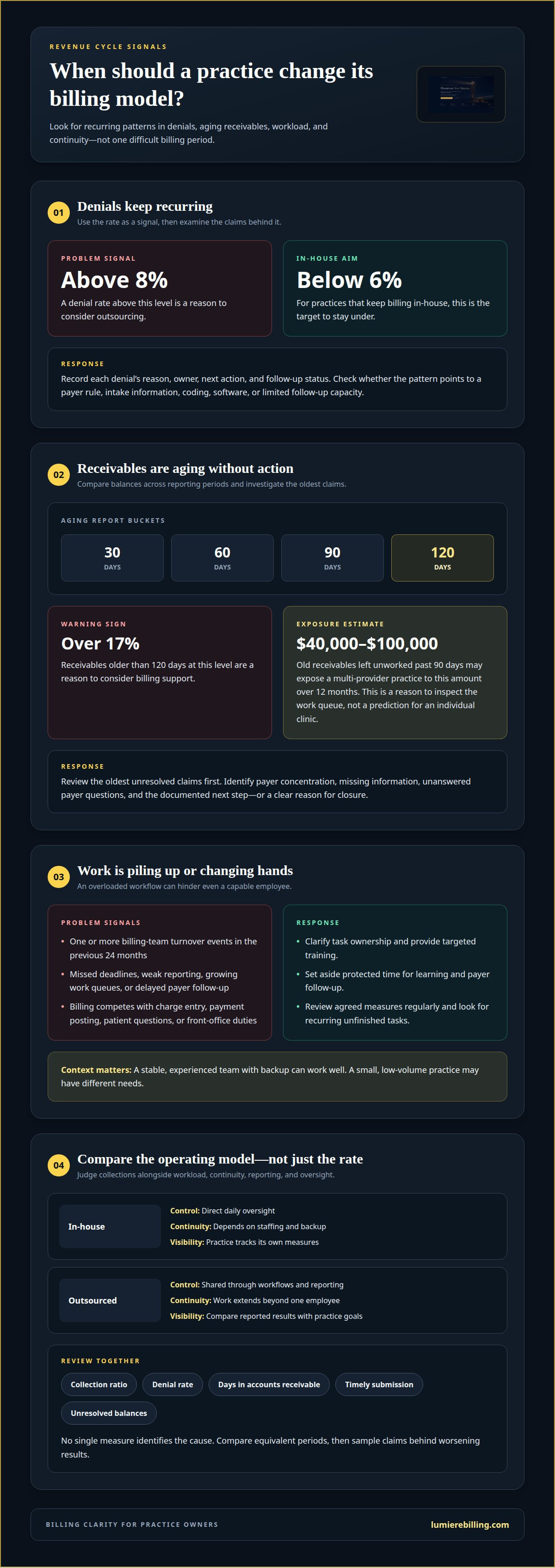
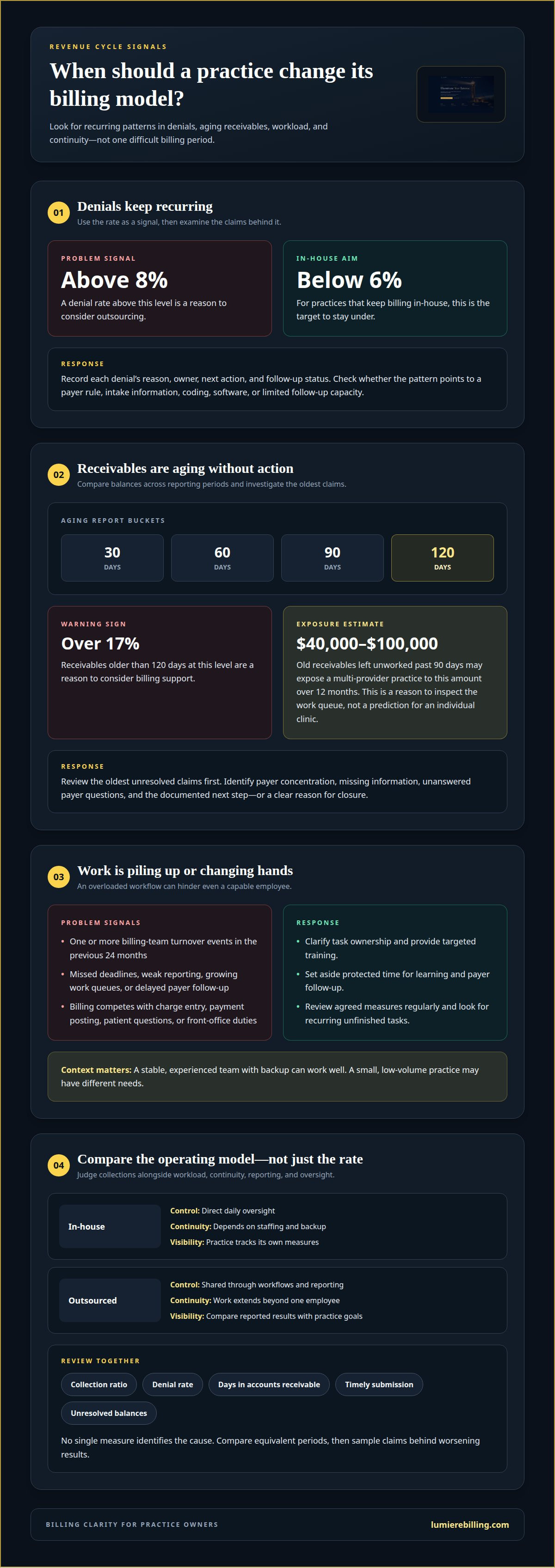
Billing trouble is often a revenue-cycle warning, not simply an individual performance issue. If you’re trying to understand why your in-house biller is underperforming, look for repeatable signals: a denial rate above 8% is a reason to consider outsourcing, while practices keeping billing in-house should aim to stay below 6%. One or more billing-team turnover events in the previous 24 months is another reason to reassess the model.
An overloaded biller may be juggling charge entry, payment posting, patient questions, and front-office duties, leaving too little time for payer follow-up. That does not automatically make in-house billing the wrong choice: a stable, experienced team with backup can work well, and a small, low-volume practice may have different needs.
This comparison explains which warning signs need attention, how aged receivables and denials can reveal workflow problems, and what changes when billing moves outside the practice. It also offers a practical way to weigh workload, continuity, reporting, and collections before deciding whether to strengthen the current setup or change the billing model.
Key Takeaways
- Use collection performance alongside the full cost of staffing and oversight to judge whether in-house billing is working.
- Track receivables by age and watch for denial patterns; growing backlogs can signal that follow-up is slipping.
- Assess whether denied and underpaid claims are being pursued consistently, not just recorded or written off.
- Compare the control and continuity of an internal team with the workload coverage and reporting of an outsourced model.
- Look for operational disruptions, such as turnover or competing front-office duties, that can interrupt claims and cash flow.
How to Know When to Change Your Billing Model
Compare collections, workload, continuity, and oversight before changing models. Look for recurring patterns rather than treating one difficult billing period as proof of failure.
In-House Collection Rate Benchmarks
To calculate the in-house collection rate needed to match a billing service, compare net collections over the same period and against the same payer revenue. In an illustrative comparison, a practice with $250,000 in monthly payer revenue needs an in-house collection rate of 91.0% to match the service scenario. The required rate shifts with revenue because fixed staffing costs weigh differently at different practice sizes.
A net collection ratio of at least 95% is a useful healthy-cycle marker. Treat it as a reference point, then assess the practice’s own trend and complete operating costs.
Billing Expertise and Payer Communication
Billing expertise shows up in accurate submissions, timely follow-up, and clear records of payer responses. To distinguish staff, software, payer, or front-desk issues, trace a sample claim from registration to remittance and note where information changes or work stops. Train billers on payer protocols, practice software, reporting tools, and escalation procedures. Provide current coding resources and protected time for learning.
Patterns matter: errors clustered around one payer may signal a rules or workflow issue, while repeated entry mistakes may point to training or software processes.
In-House Billing Performance Measures
Review collection ratio, denial rate, days in accounts receivable, timely submission, and unresolved balances together. No single measure identifies the cause. Compare equivalent periods, then sample claims behind worsening results. This can show whether delays stem from incomplete intake, coding issues, payer responses, or limited follow-up capacity.
To improve a struggling biller’s performance, clarify task ownership, provide targeted training, and review agreed measures regularly. A stable, experienced team with backup can make in-house billing workable for a small, low-volume practice.
Signs of an Underperforming Billing Model
Repeated missed deadlines, weak reporting, growing work queues, and delayed payer follow-up suggest the model needs attention. Billing may also compete with charge entry, payment posting, patient questions, or scheduling. Look for recurring unfinished tasks, not just isolated errors. An overloaded workflow can hinder even a capable employee.
Compare the options using the same criteria:
| Option | Control | Continuity | Performance visibility |
|---|---|---|---|
| In-house | Direct daily oversight | Depends on staffing and backup | Practice tracks its own measures |
| Outsourced | Shared through workflows and reporting | Work extends beyond one employee | Compare reported results with practice goals |
Choose the model that can sustain accurate claims, clear ownership, and consistent follow-up as workload changes.
Aged accounts receivable and denial-rate warning signs
An aging report shows whether unpaid claims are progressing or sitting without action. Review receivable age alongside denial patterns: a growing backlog may indicate missed follow-up, unresolved payer questions, or a handoff problem between billing and front-desk workflows.
Aged Receivables and Unworked Claims
Separate accounts receivable into 30-, 60-, 90-, and 120-day buckets, then compare each balance across reporting periods. Receivables older than 120 days exceeding 17% are a warning sign that a practice may need billing support. Review individual claims in that group: some may need payer research, corrected information, or another documented recovery step, while others may require a clear reason for closure.
A typical practice might find one payer contributes a large share of claims older than 90 days. That concentration directs attention toward the payer’s process and the practice’s follow-up history. Old receivables left unworked past 90 days are estimated to expose a multi-provider practice to $40,000-$100,000 over 12 months. Treat that estimate as a reason to examine the work queue, not as a prediction for an individual clinic.
Clean Claims and Receivables Reduction
Clean claims move through payer processing without avoidable corrections. To locate preventable delays, compare submitted claims with rejected or corrected claims, then group issues by payer, service, and source of missing information. Fixing a repeated intake or submission defect can prevent more balances from accumulating in the aging report.
Compare monthly correction patterns with changes in older receivables. If corrections decline but aged balances remain, follow-up after submission may be the bottleneck. If both worsen together, examine claim preparation and the registration-to-billing handoff instead of focusing only on collection activity.
Denial Management and Receivables Follow-Up
For every denial, record the reason, assigned owner, next action, and follow-up status. The appropriate response may involve correcting information, resubmitting, appealing, or documenting why no further step applies. Small billing teams may struggle to investigate denials and underpayments while managing daily tasks, leaving viable claims without timely attention.
Review the oldest unresolved claims first, then sort remaining work by payer response and required action. A behavioral-health billing partner should demonstrate accounts receivable days under 45 days. For behavioral-health practices with aging claims and limited follow-up capacity, Revenue Cycle Management can address claims and unresolved receivables within a specialized billing workflow.
Claim denials, underpayments, appeals, and write-offs
Denial work takes time, judgment, and a documented next action. Common causes include inaccurate patient or insurance details, missing information, coding inconsistencies, and duplicate claims. Compare the payer’s explanation with the submitted claim to determine what needs correction before assigning the work.
Denials and Claim Resubmissions
Review the stated reason for a denial before choosing a response. Correct a claim when the payer identifies a fixable error; use the applicable appeal or reconsideration process when disputing the decision. Resubmitting without addressing the reason can lead to another denial and leave the underlying issue unresolved.
For example, if the payer identifies a mismatch between a patient’s insurance details and the claim, compare the registration record with the information submitted. If the claim data matches, examine the payer’s explanation and supporting records. Record the action taken, submission date, and subsequent payer response so another staff member can continue the work.
Underpayments and Payer Disputes
An underpayment can be difficult to spot because the claim receives a payment rather than a denial. Compare the remittance details with the billed service and the payment expected under the practice’s applicable payer terms. Flag unexplained differences for review. Posting a payment as complete without examining the remaining balance can conceal unresolved reimbursement questions.
Payer disputes may require repeated communication and supporting documentation. Assign a staff member to maintain the dispute record, including payer contacts, documents sent, and outstanding questions. This differs from correcting a rejected claim: the main task is establishing why the payment decision differs from the practice’s records and pursuing the appropriate response.
Write-Offs and Billing Errors
A write-off should follow a documented review, not serve as a shortcut for clearing a difficult balance. Before closing a denied claim, record the payer’s reason, the correction or appeal considered, and why the practice chose its final action. This creates an audit trail and helps leaders distinguish an appropriate adjustment from an avoidable loss.
Use error patterns to identify where the process needs repair. Repeated patient-detail mismatches may point to registration handoffs; recurring coding discrepancies may call for focused training or review. If front-desk work regularly interrupts denial follow-up, assign clear coverage so payer responses and pending appeals remain visible. Small internal teams may struggle to pursue disputes while handling daily patient-facing duties, so review workload and ownership alongside individual performance.
In-House vs Outsourced Primary Care Billing: Which Is Better?
Compare the models by cost structure, operational capacity, continuity, and performance visibility. The better fit is the one that can keep claims moving as patient volume and administrative demands change.
Fixed Staffing Costs and Performance-Based Outsourcing
An in-house team has recurring staffing and operating costs, whether claim volume rises or collections fall. Outsourced billing is commonly priced as a percentage of collections, connecting the service cost to revenue collected rather than a fixed internal payroll. Compare the full workload and reported outcomes, not just the biller’s salary or the service’s fee structure.
For a fair comparison, include supervision, software, reporting tools, absence coverage, and time spent correcting errors. Also examine how each model handles coding questions and payer follow-up. Costs matter only in context of the work delivered.
In-House Operations and Revenue Cycle Efficiency
In-house billing gives practice leaders direct oversight and immediate access to staff. But when one employee also handles check-in, phones, or administrative duties, claim follow-up can lose priority. Outsourcing can shift claims work and accounts receivable follow-up away from front-office staff, giving them more capacity for patient-facing operations.
Revenue cycle outsourcing can add capacity when claims volume changes, without relying on one internal employee to absorb every task. Continuity still depends on clear workflows, data access, communication, and useful reporting. Compare how each model tracks claim status, denial reasons, and unresolved balances.
Denial follow-up is a practical point of comparison. A behavioral health revenue cycle team can pursue denied claims, underpayments, and unresolved accounts receivable, including appeals or reconsiderations when appropriate. In-house teams may offer closer day-to-day control, but competing duties can leave disputes waiting. Evaluate the actual workflow and who owns each next step.
Scalability also means handling turnover and absences without letting claim processing stall. A 2022 survey found that 90% of more than 200 healthcare CFOs and revenue-cycle executives reported billing or coding staff shortages. An outsourced model can provide operational capacity beyond one employee, while a well-staffed internal team may suit a practice with reliable backup and manageable volume.
Monitoring billing staff means balancing performance oversight with patient privacy and consistent employment practices. Focus routine reviews on work queues, claim status, and aggregate reporting. Limit access to patient information to what staff need for assigned tasks, and apply monitoring expectations consistently.
Choose in-house billing when direct oversight, experienced staff, and dependable coverage match the workload. Consider outsourcing when fixed staffing capacity, turnover, or follow-up demands disrupt revenue cycle operations.
Revenue cycle disruption
A billing problem rarely stays inside the billing office. At a primary care practice seeing 25 to 30 patients per provider per day, small errors can accumulate across registration, charge entry, claim submission, payment posting, and patient-balance billing. Each handoff creates another point where missing information or delayed work can interrupt the revenue cycle.
Turnover makes that chain more fragile. Healthcare billing staff turnover may reach 30-40 percent annually, leaving practices to redistribute work while hiring and training replacements. A typical practice might find that claims still enter the system, but insurance follow-up slows when experienced staff leave. The problem is continuity: pending work and payer-specific knowledge need clear ownership beyond one employee.
High volume adds pressure, especially when reimbursement per visit is low. If billing staff also answer phones or check patients in, routine duties can crowd out charge review, patient-balance statements, and unresolved claims. Delays carry forward: an unentered charge cannot be submitted, and a submitted claim without follow-up may remain unpaid. Leaders should map where each task waits, not just count claims submitted.
Use a short disruption review to find the break point:
- Capture: Compare completed visits with charges entered for the same work period.
- Submission: Review rejected or delayed claims by payer and reason.
- Follow-up: Identify unresolved claims without a documented next action.
- Coverage: Assign backup for billing tasks during absences or turnover.
These steps help distinguish a staffing gap from a workflow defect. If charges are missing, examine the handoff from clinical documentation to billing. If claims are submitted but stall, review payer follow-up and task ownership. If balances remain after insurance payments, assign responsibility for patient billing.
Automation may help with repetitive work, but it doesn’t replace oversight. Specialists estimated that 30-50% of routine billing work can be automated. Practices still need staff to review exceptions, address payer responses, and make sure automated workflows reflect actual processes. Outsourced billing can add capacity when internal staffing disruptions leave those tasks uncovered, while in-house teams can preserve direct oversight when they have reliable coverage.
The deciding factor is whether every stage has an owner, a visible status, and a next step. If disruption keeps recurring, a Free Billing Audit can help identify where claims and revenue cycle workflows are breaking down.
Lumiere Billing: Free Billing Audit
Lumiere Billing offers a Free Billing Audit for behavioral health practices seeking a clearer view of billing performance. The audit can help identify where claim workflows, denials, or follow-up need attention. It is a practical next step when internal reporting shows recurring gaps but the cause remains unclear.
After reviewing the issues, practices can consider whether Revenue Cycle Management or Practice Advisory fits their needs. Lumiere Billing specializes exclusively in behavioral health billing, making its services relevant to practices looking for support with their behavioral health revenue cycle.
Contact Lumiere Billing to discuss a Free Billing Audit.
Choose the Next Step for a Stronger Billing Operation
If you’re still asking why my in-house biller is underperforming, turn that concern into a focused review of the work itself. Identify where claims stall, which tasks lack clear ownership, and what support your team needs to keep the revenue cycle moving. This gives you a sounder basis for deciding whether to refine current workflows or make a broader change.
For behavioral health practices, Lumiere Billing offers a Free Billing Audit to bring billing issues into view. Revenue Cycle Management supports the ongoing claims process, while Credentialing & Enrollment addresses provider setup that affects payer participation. The right next step depends on what your review uncovers.
Bring your questions and billing concerns to a conversation with the team. Contact Lumiere Billing today to discuss your practice’s needs and move toward a clearer, more manageable billing operation.
Frequently Asked Questions
What are common reasons an in-house medical biller underperforms?
Underperformance often reflects a mix of workload, unclear ownership, insufficient training, and process obstacles. To diagnose why my in-house biller is underperforming, compare assigned duties with actual work queues and review claims from registration through payment. If similar errors recur across staff or payers, investigate the workflow before treating the problem as individual performance alone. A biller may submit claims accurately yet lack protected time for payer follow-up.
How do I measure medical billing staff productivity and accuracy?
Measure completed work and quality together. Track claims submitted, corrections required, payment-posting accuracy, unresolved follow-ups, and whether work meets payer filing windows. Pair production counts with a sample review of claim records and remittances: high submission volume can conceal avoidable errors. Compare equivalent work periods and account for differences in payer mix, provider volume, and assigned duties.
What are typical medical billing benchmarks for claim submission, denial rates, and days in accounts receivable?
Use payer filing deadlines for claim submission, because timely filing limits differ by plan and contract. The AAFP describes an industry-average denial rate of 5% to 10% for medical practices, with below 5% more desirable. For accounts receivable, track aging by payer and service date instead of relying on one average. An overall figure can hide a small group of severely delayed claims.
How should I audit an in-house biller’s claims, payments, and follow-up work?
Choose a sample that includes paid, denied, corrected, and unresolved claims. For each, compare encounter documentation, the charge, submitted claim, payer response, posted payment, and remaining balance. Check that follow-up notes show a specific action and outcome, not just a call attempt. Group findings by payer and error type; recurring patterns can reveal a training gap, unclear handoff, or inconsistent workflow.
How do in-house medical billing costs and performance compare with outsourcing?
Compare total internal operating costs with the work and reporting delivered by an outsourced service. Include payroll, benefits, software, supervision, absence coverage, and billing administration. Then compare collection performance, claim follow-up, and visibility into unresolved balances. In-house billing can suit a stable team with enough capacity; outsourcing may fit when the practice needs continuity or specialized revenue cycle support.
When should I use a performance improvement plan or replace an in-house biller?
Use a performance improvement plan when expectations are unclear, training could address the gap, and the biller is willing to follow a measurable work plan. If you’re asking why my in-house biller is underperforming, document specific examples, clarify responsibilities, provide coaching, and set review dates. Consider replacement when documented problems continue despite support or work remains incomplete. Before a staffing change, preserve continuity for open claims and pending follow-up.
Frequently Asked Questions
Underperformance often reflects a mix of workload, unclear ownership, insufficient training, and process obstacles. To diagnose why my in-house biller is underperforming, compare assigned duties with actual work queues and review claims from registration through payment. If similar errors recur across staff or payers, investigate the workflow before treating the problem as individual performance alone. A biller may submit claims accurately yet lack protected time for payer follow-up.
Measure completed work and quality together. Track claims submitted, corrections required, payment-posting accuracy, unresolved follow-ups, and whether work meets payer filing windows. Pair production counts with a sample review of claim records and remittances: high submission volume can conceal avoidable errors. Compare equivalent work periods and account for differences in payer mix, provider volume, and assigned duties.
Use payer filing deadlines for claim submission, because timely filing limits differ by plan and contract. The AAFP describes an industry-average denial rate of 5% to 10% for medical practices, with below 5% more desirable. For accounts receivable, track aging by payer and service date instead of relying on one average. An overall figure can hide a small group of severely delayed claims.
Choose a sample that includes paid, denied, corrected, and unresolved claims. For each, compare encounter documentation, the charge, submitted claim, payer response, posted payment, and remaining balance. Check that follow-up notes show a specific action and outcome, not just a call attempt. Group findings by payer and error type; recurring patterns can reveal a training gap, unclear handoff, or inconsistent workflow.
Compare total internal operating costs with the work and reporting delivered by an outsourced service. Include payroll, benefits, software, supervision, absence coverage, and billing administration. Then compare collection performance, claim follow-up, and visibility into unresolved balances. In-house billing can suit a stable team with enough capacity; outsourcing may fit when the practice needs continuity or specialized revenue cycle support.
Use a performance improvement plan when expectations are unclear, training could address the gap, and the biller is willing to follow a measurable work plan. If you’re asking why my in-house biller is underperforming, document specific examples, clarify responsibilities, provide coaching, and set review dates. Consider replacement when documented problems continue despite support or work remains incomplete. Before a staffing change, preserve continuity for open claims and pending follow-up.
Free billing audit
Find out what your billing is really costing you
We'll review your claims, denials and collections and show you exactly where revenue is leaking. Free, no obligation, no contract.
Schedule a Free Billing Audit