Mastering the Mental Health Provider Re-Credentialing Process: A 2026 Guide

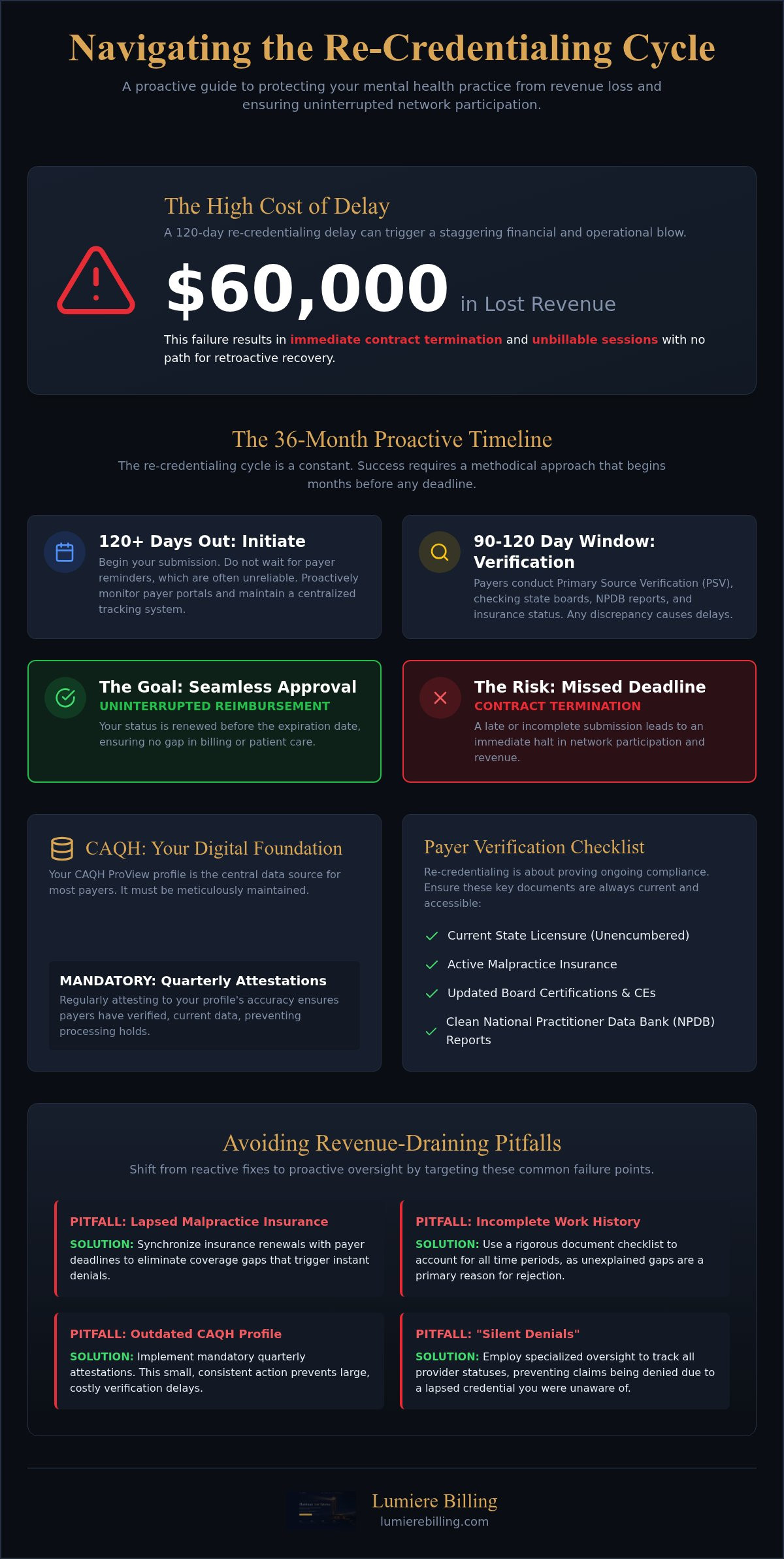
A 120-day delay in the mental health provider re-credentialing process can result in a staggering revenue loss of $60,000. For most behavioral health practices, this isn't just a minor administrative hurdle; it's a systemic leak that threatens the very foundation of your clinical operations. Missing a single deadline often means the immediate termination of your network participation, leaving you with unbillable sessions and no path for retroactive recovery. It's a high-stakes environment where the rules are often opaque and the timelines are unforgiving.
We understand the fear of seeing claims denied because of an expired credential or a missed CAQH attestation. You shouldn't have to choose between providing quality care and managing complex back-office logistics. This guide provides the clarity you need to navigate these complexities, ensuring your practice maintains uninterrupted reimbursement and total financial integrity. We'll outline a precise timeline for submissions, detail how to automate your expiration tracking, and provide a methodical breakdown of the 2026 standards to ensure zero disruptions in your revenue cycle. By shifting from reactive fixes to proactive oversight, you can protect your practice from the silent denials that drain your resources.
Key Takeaways
- Understand the 36-month re-credentialing cycle and why initiating your submission 120 days early is mandatory for uninterrupted reimbursement.
- Maintain your CAQH ProView profile with disciplined quarterly attestations to ensure insurance payers always have access to verified, current data.
- Streamline the mental health provider re-credentialing process by using a rigorous document checklist that targets high-risk failure points like work history gaps.
- Protect your revenue cycle from "silent denials" by synchronizing your malpractice insurance renewals with your specific payer deadlines.
- Learn how specialized oversight transforms re-credentialing from a periodic administrative crisis into a seamless component of your practice’s financial integrity.
The Strategic Importance of the Re-Credentialing Process
The mental health provider re-credentialing process is the systematic, periodic verification of a practitioner's qualifications by insurance payers. It's a standard safeguard designed to maintain clinical quality across networks. Per NCQA guidelines, this cycle typically recurs every 36 months. While initial enrollment opens the door to a payer's network, re-credentialing ensures that door remains unlocked. For behavioral health practices, this isn't a mere suggestion; it's a hard requirement for continued participation. It's the difference between a functioning practice and a sudden, total halt in operations.
Re-Credentialing vs. Initial Enrollment
The Credentialing process often feels like a one-time hurdle during practice startup. However, re-credentialing represents a shift from establishing a new contract to rigorous maintenance. Payers aren't looking to renegotiate terms during this phase. Instead, they're verifying ongoing compliance. They require updated evidence of:
- Current state licensure without encumbrances
- Active malpractice insurance with appropriate coverage limits
- Recent board certifications or continuing education credits
- Clean National Practitioner Data Bank (NPDB) reports
Initial enrollment is about potential; re-credentialing is about proof. It's the mechanical integrity of your practice being tested. This shift from "contracting" to "maintenance" requires a different level of vigilance. You're no longer proving who you are, but rather that you've remained the high-quality provider the payer originally contracted.
The Financial Risk of Missed Deadlines
The stakes are binary. You're either credentialed or you're unbillable. If a deadline passes without a successful re-attestation, payers will terminate your contract immediately. This creates a catastrophic gap in patient continuity. Patients may be forced to pay out-of-pocket or seek care elsewhere because your services are no longer covered. It's a failure of the care model that starts at the administrative desk.
From a business perspective, missing a single date can trigger months of denied claims. Major insurance carriers rarely allow backdating for missed re-credentialing windows. This makes proactive oversight a core pillar of behavioral health revenue cycle management. Without a validated status, your billing team is essentially working on claims that have no chance of being paid. This "unbillable status" is the primary risk factor for practice instability. It's a silent leak that can drain reserves faster than almost any other administrative failure.
A Step-by-Step Breakdown of the Re-Credentialing Cycle
The 120-day rule is the industry standard for a reason. Most commercial payers require 90 to 120 days to process a re-credentialing application from submission to committee approval. If you wait for a reminder, you've already lost the lead time necessary to prevent a lapse. The mental health provider re-credentialing process is a race against an expiration date that doesn't move. Success requires a methodical approach to data collection and submission. You aren't just filling out forms; you're verifying the ongoing viability of your practice's largest revenue streams.
Phase 1: The 120-Day Notification Window
Don't rely on physical mail. Insurance carriers often send expiration notices to outdated administrative addresses or let them get lost in general office sorting. Proactive practices monitor payer portals weekly for alerts. You must establish a centralized tracking system for your entire provider roster. If you're managing a group, individual expiration dates will be scattered. Missing one clinician's window can halt billing for an entire department. Ensuring your CAQH ProView profile is current before the payer even asks is the first step in maintaining the mechanical integrity of your enrollment status.
Phase 2: Data Verification and PSV
Once submitted, the payer enters the Primary Source Verification (PSV) phase. They don't take your word for it. They verify your standing with state boards and check NPDB reports for any new malpractice claims or disciplinary actions. For certain behavioral health facilities, especially those providing intensive outpatient or residential care, payers may mandate a site visit to verify safety standards. Peer references also play a critical role. You should ensure your listed colleagues are prepared to respond quickly. Any delay in their response becomes your delay in approval. This phase is where most applications stall due to incomplete work histories or missing signatures.
Phase 3: Final Approval and Contract Extension
Approval isn't the final step. You must verify that the new effective dates are correctly reflected in the payer's system. Check that your NPI and Tax ID associations haven't been decoupled during the update. Finally, update your internal EHR to match these payer-approved records. This closure ensures that when you submit a claim on day one of the new cycle, it doesn't bounce due to a "provider not found" error. If managing these moving parts feels like a drain on your clinical time, exploring specialized Credentialing & Enrollment services can provide the oversight needed to prevent these administrative failure points.
CAQH Maintenance: The Engine of Your Enrollment Status
CAQH ProView is the central repository for provider data in the United States. It functions as the primary source of truth for commercial payers. During the mental health provider re-credentialing process, insurance carriers pull your professional profile directly from this database to verify your current standing. If your profile is incomplete or the data is stale, the re-credentialing cycle stops immediately. This is where many practices experience "silent denials" where claims are rejected not because of clinical errors, but because the underlying credentialing engine has stalled. Maintaining data integrity between your CAQH profile and your behavioral health billing services records is vital for a seamless revenue cycle.
The Quarterly Attestation Workflow
Payers require you to re-attest to the accuracy of your CAQH information every 120 days. However, waiting until the final deadline is a high-risk strategy. We recommend a disciplined 90-day internal schedule to ensure no lapse occurs. A single missing month in your work history or an expired malpractice Certificate of Insurance (COI) will trigger an "Incomplete" status. When this happens, payers cannot pull your data, and your re-credentialing application will be rejected without further review. You must proactively upload new licensure and insurance documents as soon as they're issued. This keeps your profile in a "Review Complete" state, allowing payers to verify your credentials without administrative friction.
Linking CAQH to Payer Portals
Not all payers interact with CAQH in the same way. While major carriers like Aetna and UnitedHealthcare rely heavily on automated CAQH pulls, others may require supplemental data via their own proprietary portals. You must ensure your "Global Authorized" settings are correctly configured within CAQH ProView. If you don't grant broad access, a payer might be unable to view your updated documents even if you've uploaded them correctly. Troubleshooting these discrepancies requires a methodical eye. You should regularly cross-reference your CAQH data against specific payer rosters to ensure your NPI, Tax ID, and service locations are perfectly aligned. Discrepancies here are the most common cause of "provider not found" errors in claims processing. Precise data management is the only way to safeguard your practice from avoidable revenue leakage.
Avoiding Revenue Leakage: Common Re-Credentialing Pitfalls
Revenue leakage in behavioral health often stems from administrative mechanical failure. The mental health provider re-credentialing process is where these systemic leaks usually begin. When a clinician’s work history contains unexplained gaps of 30 days or more, the application doesn't just slow down; it hits a hard stop. Payers view these gaps as potential red flags, demanding detailed justifications that can add weeks to your timeline. Similarly, an expired malpractice Certificate of Insurance (COI) acts as an immediate kill-switch for your contract. If your coverage lapses for even 24 hours, your status as an "in-network" provider is legally voided, and every session held during that window becomes unbillable.
Another subtle failure point involves NPI Type 1 and Type 2 associations. During a re-credentialing update, it's common for the link between an individual provider's NPI and the practice's group NPI to become decoupled in the payer’s database. If these aren't meticulously re-verified, claims will process under the wrong entity, leading to a cascade of denials that can take months to untangle. This is the essence of the "Silent Denial." Your claims appear to be moving through the system, but they're actually accumulating in a black hole of administrative non-compliance.
Identifying Credentialing-Related Denials
Protecting your practice requires a vigilant eye on Claim Adjustment Reason Codes (CARC). Errors like CO-16 (missing information) or CO-22 (coordination of benefits/enrollment issues) often mask underlying credentialing lapses. These are classic behavioral health billing errors to avoid if you want to maintain a healthy cash flow. The cost of reprocessing these claims is high. Beyond the administrative labor, you face the reality that a 120-day delay in credentialing can result in a revenue loss of $60,000, with zero hope for retroactive recovery from most commercial carriers.
Managing Roster Changes for Group Practices
For group practices, the complexity is exponential. You're often managing the re-credentialing of veteran staff while simultaneously onboarding new clinicians. It's vital to distinguish between a "termination for cause" and an "administrative termination" due to a missed re-credentialing window. The latter is entirely preventable with better oversight. You must ensure your billing Tax ID remains active and correctly linked to every provider on your roster. If you lose track of which provider is in which phase of the cycle, your accounts receivable will suffer. To secure your practice’s financial future, consider integrating professional Revenue Cycle Management to act as a vigilant protector of your enrollment status.
Strategic Credentialing Management with Lumiere Billing
Managing the mental health provider re-credentialing process shouldn't be a source of practice-wide anxiety. At Lumiere Billing, we serve as a vigilant protector of your financial health, ensuring the mechanical integrity of your enrollment status remains intact. We don't just react to expiration dates; we anticipate them. By moving away from the opaque administrative service models of the past, we provide a proactive partnership that brings hidden systemic issues into sharp focus before they impact your cash flow. We operate as a disciplined extension of your team, possessing a level of focus that ensures your revenue cycle remains uninterrupted.
The Lumiere Advantage for Behavioral Health
Behavioral health is our singular focus. We possess a deep understanding of the specialized payer requirements for ABA and mental health practices, which often involve complex carve-out networks that generalist billers overlook. Our team performs comprehensive audits to identify existing revenue leakage within your current roster. We act as your dedicated advocates, handling all payer communication and follow-ups. This level of oversight borders on the obsessive, but it's what's required to navigate the 2026 insurance landscape. We ensure that every clinician on your roster is perfectly aligned with payer expectations, preventing the "silent denials" that often go unnoticed until it's too late to recover funds.
From Enrollment to Excellence
When you integrate specialized Credentialing & Enrollment with full Revenue Cycle Management, the result is a streamlined system that accelerates your accounts receivable. You gain the peace of mind that comes from knowing a methodical, behind-the-scenes operator is managing your quarterly CAQH attestations and document uploads. This transition allows you to move from an administrative burden to a pure clinical focus. Your time is better spent with patients than on hold with insurance committees or untangling work history discrepancies. We repair the broken systems that cause delays, ensuring your billing Tax ID and provider NPIs are always synchronized.
To begin repairing your practice's administrative leaks and optimizing your revenue, the first step is visibility. We invite you to request a Free Billing Audit. This specialized review will illuminate systemic gaps and provide a clear roadmap for achieving zero disruptions in your claims processing. Let us handle the complexities of the mental health provider re-credentialing process so you can lead your practice with total confidence and financial stability.
Securing Long-Term Practice Stability
Successfully navigating the mental health provider re-credentialing process requires more than just filling out forms. It demands a shift from reactive administrative fixes to a disciplined system of continuous data integrity. By maintaining a 120-day lead time and ensuring your CAQH profile is always in a "Review Complete" state, you protect your practice from the catastrophic revenue gaps caused by expired credentials. These administrative failure points are entirely preventable with the right level of vigilance and specialized oversight.
Don't let your accounts receivable suffer from silent denials or roster discrepancies. Our specialized behavioral health expertise and proactive CAQH management ensure that your enrollment status remains a source of stability rather than stress. We integrate denial prevention directly into your credentialing workflow, giving you the clarity needed to focus on clinical excellence. It's time to move beyond the opaque processes of the past and embrace a partnership built on transparency and precision. Secure your revenue with a professional Credentialing Audit from Lumiere Billing. Your financial health is the foundation of your mission, and we're here to help you protect it.
Frequently Asked Questions
How often do mental health providers need to be re-credentialed?
Commercial insurance payers typically require providers to be re-credentialed every three years. This 36-month cycle is the standard set by the National Committee for Quality Assurance (NCQA). However, Medicare operates on a different schedule, requiring revalidation every five years. It's vital to track these dates individually for every payer on your roster, as missing a single window can result in immediate contract termination and a complete halt in your practice's reimbursement.
What happens if I miss my re-credentialing deadline?
Missing a deadline leads to the immediate termination of your network participation. Once your credentials expire, you're considered an out-of-network provider, making your sessions unbillable to that payer. Most commercial carriers won't offer retroactive revenue recovery for the gap period. You'll have to undergo a full reinstatement process, which payers treat as a new application. This often takes 90 to 120 days, during which you cannot collect insurance payments for that carrier.
Is CAQH attestation the same thing as re-credentialing?
No, they're distinct but deeply interconnected processes. CAQH ProView is the central database where you store and attest to your professional data every 120 days. Re-credentialing is the specific review performed by an insurance payer every three years to verify your continued eligibility. If you fail to re-attest your CAQH profile, payers cannot access your updated documents. This stall in data flow is the most common reason the mental health provider re-credentialing process fails prematurely.
How long does the typical payer re-credentialing process take in 2026?
The typical timeframe for commercial payers ranges from 90 to 120 days in 2026. For specialized mental health carve-out networks, this timeline can extend to 180 days. Because payers require significant lead time for primary source verification and committee reviews, we recommend initiating your submission at least four months before your current credentials expire. Starting early is the only way to ensure your practice maintains the mechanical integrity of its cash flow without interruption.
Can I still see patients while my re-credentialing is pending?
You can continue seeing patients as long as your current credentials haven't reached their expiration date. If your re-credentialing is still "pending" after your old credentials expire, you're technically out-of-network. Any sessions held during this lapse are unbillable and won't be reimbursed retroactively. This is why proactive oversight is essential. You must confirm that the payer has approved your application and updated their internal system before your previous term officially ends.
What documents are required for a mental health provider re-credentialing application?
Payers require a comprehensive set of verified documents, including your current state license, board certifications, and a valid malpractice insurance Certificate of Insurance (COI). You must also provide a complete work history without gaps and contact information for peer references. For behavioral health facilities, you might need to submit updated facility licenses or safety accreditations. Ensuring these documents are perfectly aligned with your CAQH profile prevents the administrative friction that leads to application rejections.
Why did my claim get denied even though I am already paneled with the insurance?
Claims are often denied because of a "silent" lapse in the mental health provider re-credentialing process. Even if you were paneled last year, an expired CAQH attestation or a missed re-credentialing window will trigger an immediate billing block. Another common cause is the decoupling of your NPI and Tax ID in the payer's system during an update. These errors often hide in accounts receivable until a thorough audit brings the mechanical failure into focus.
Can a billing company handle my re-credentialing process?
Yes, a specialized revenue cycle management partner can manage the entire lifecycle of your credentials. At Lumiere Billing, we act as a vigilant protector of your enrollment status by handling CAQH attestations, document uploads, and direct payer follow-ups. This proactive approach removes the administrative burden from your clinical staff, allowing you to focus on patient care while we ensure your practice’s financial integrity remains secure through methodical, behind-the-scenes oversight and roster maintenance.
Frequently Asked Questions
Commercial insurance payers typically require providers to be re-credentialed every three years. This 36-month cycle is the standard set by the National Committee for Quality Assurance (NCQA). However, Medicare operates on a different schedule, requiring revalidation every five years. It's vital to track these dates individually for every payer on your roster, as missing a single window can result in immediate contract termination and a complete halt in your practice's reimbursement.
Missing a deadline leads to the immediate termination of your network participation. Once your credentials expire, you're considered an out-of-network provider, making your sessions unbillable to that payer. Most commercial carriers won't offer retroactive revenue recovery for the gap period. You'll have to undergo a full reinstatement process, which payers treat as a new application. This often takes 90 to 120 days, during which you cannot collect insurance payments for that carrier.
No, they're distinct but deeply interconnected processes. CAQH ProView is the central database where you store and attest to your professional data every 120 days. Re-credentialing is the specific review performed by an insurance payer every three years to verify your continued eligibility. If you fail to re-attest your CAQH profile, payers cannot access your updated documents. This stall in data flow is the most common reason the mental health provider re-credentialing process fails prematurely.
The typical timeframe for commercial payers ranges from 90 to 120 days in 2026. For specialized mental health carve-out networks, this timeline can extend to 180 days. Because payers require significant lead time for primary source verification and committee reviews, we recommend initiating your submission at least four months before your current credentials expire. Starting early is the only way to ensure your practice maintains the mechanical integrity of its cash flow without interruption.
You can continue seeing patients as long as your current credentials haven't reached their expiration date. If your re-credentialing is still "pending" after your old credentials expire, you're technically out-of-network. Any sessions held during this lapse are unbillable and won't be reimbursed retroactively. This is why proactive oversight is essential. You must confirm that the payer has approved your application and updated their internal system before your previous term officially ends.
Payers require a comprehensive set of verified documents, including your current state license, board certifications, and a valid malpractice insurance Certificate of Insurance (COI). You must also provide a complete work history without gaps and contact information for peer references. For behavioral health facilities, you might need to submit updated facility licenses or safety accreditations. Ensuring these documents are perfectly aligned with your CAQH profile prevents the administrative friction that leads to application rejections.
Claims are often denied because of a "silent" lapse in the mental health provider re-credentialing process. Even if you were paneled last year, an expired CAQH attestation or a missed re-credentialing window will trigger an immediate billing block. Another common cause is the decoupling of your NPI and Tax ID in the payer's system during an update. These errors often hide in accounts receivable until a thorough audit brings the mechanical failure into focus.
Yes, a specialized revenue cycle management partner can manage the entire lifecycle of your credentials. At Lumiere Billing, we act as a vigilant protector of your enrollment status by handling CAQH attestations, document uploads, and direct payer follow-ups. This proactive approach removes the administrative burden from your clinical staff, allowing you to focus on patient care while we ensure your practice’s financial integrity remains secure through methodical, behind-the-scenes oversight and roster maintenance.