Mental Health Provider Credentialing: 2026 Trends and Strategic Optimization

In 2026, the most significant threat to your practice's financial health isn't a lack of patients; it's a broken gatekeeper. Every hour a clinician spends in a session they cannot bill represents pure revenue leakage that most practices never recover. The traditional approach to mental health provider credentialing has evolved from a simple administrative task into a high-stakes strategic operation. If you're still treating CAQH updates and PECOS filings as back-office chores, you're likely leaving your revenue stream vulnerable to silent denials and stagnant enrollment queues. Precision is no longer optional.
You likely feel the frustration of seeing a full schedule while your bank account remains static due to inconsistent payer response times. It's exhausting to manage complex rosters while trying to provide quality clinical care. This guide will show you how to master the shifting behavioral health landscape to eliminate these delays and secure your practice's future. We'll explore the strategic optimization of your enrollment systems, the mechanics of "set and forget" roster maintenance, and the specific trends defining 2026. By the end, you'll have the framework to achieve maximum reimbursement through proper paneling and meticulous oversight.
Key Takeaways
- Understand how automated primary source verification is transforming the 2026 landscape and why manual tracking is no longer sufficient for modern practices.
- Learn to maintain CAQH ProView and PECOS as your practice’s single sources of truth to prevent administrative bottlenecks and unbillable clinical hours.
- Identify the hidden revenue leaks in DIY mental health provider credentialing and discover why a specialized behavioral health focus beats general medical billing approaches.
- Leverage the Counselor Compact and PSYPACT to scale your practice across state lines without falling into common multi-state enrollment traps.
- Implement a visibility first strategy that links enrollment status directly to your revenue cycle for a truly optimized, set and forget roster maintenance system.
The 2026 Landscape of Mental Health Provider Credentialing
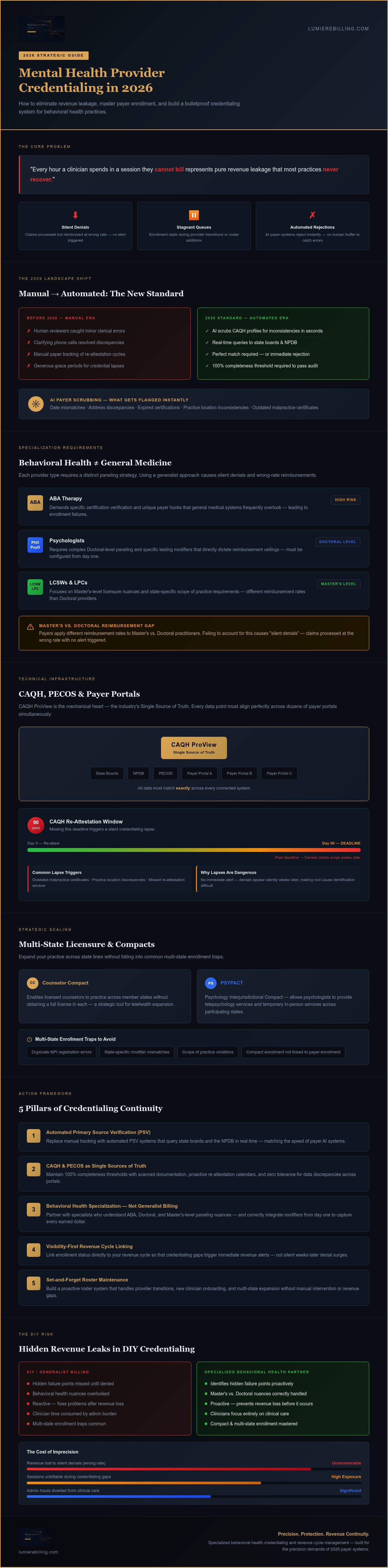
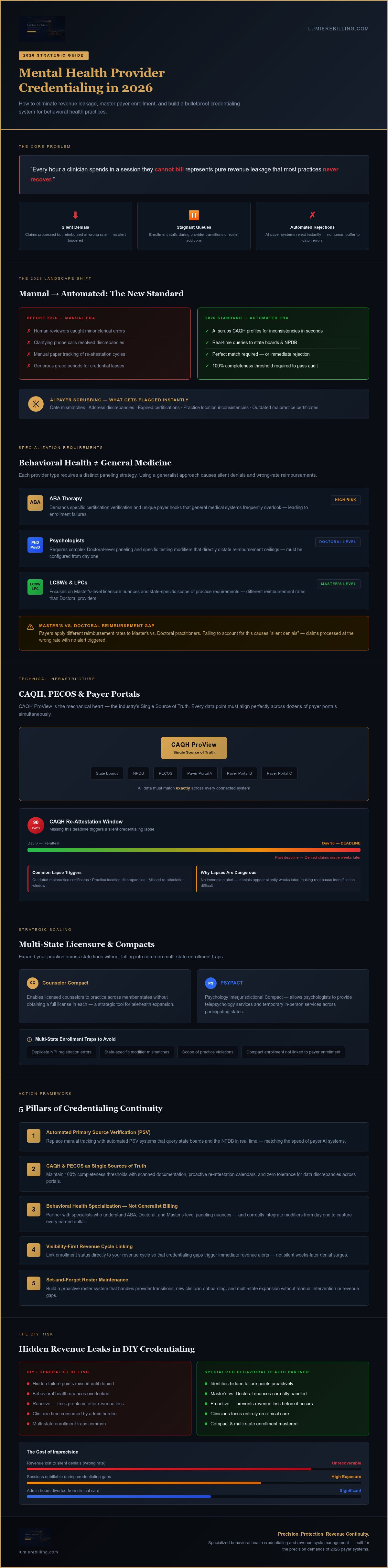
Think of mental health provider credentialing as the mechanical integrity check of your practice's revenue cycle. It isn't merely an administrative hurdle; it's the definitive revenue gatekeeper. By 2026, the landscape has shifted from manual verification to automated systems that prioritize precision over effort. If your credentials aren't verified with absolute accuracy, the gates remain closed, and your clinicians' time becomes unbillable. We view this process as a vigilant protector of your financial health, ensuring that every session is backed by a fully paneled provider.
The standard for 2026 is the rapid adoption of automated primary source verification (PSV). Major payers now use digital hooks to query state boards and the National Practitioner Data Bank (NPDB) in real time. This shift eliminates the human buffer that once allowed for minor clerical corrections during the review process. Now, the system either finds a perfect match or issues an immediate rejection. Practices must maintain "Credentialing Continuity" to avoid revenue gaps, especially during provider transitions or when adding new clinicians to the roster. A proactive approach prevents the silence of a stalled enrollment queue.
The Rise of AI in Payer Enrollment
Payers are increasingly deploying AI to scrub CAQH ProView profiles for even the slightest inconsistencies. In 2026, data integrity isn't just a goal; it's a requirement for survival. Digital applications are scanned for date mismatches, address discrepancies, and expired certifications within seconds. Manual errors that previously might have sparked a clarifying phone call now trigger automated rejections. This mechanical scrutiny demands a level of meticulous attention to detail that exceeds what most generalist billing companies can provide. You need a partner who sees these hidden failure points before the payer's algorithm does.
Behavioral Health Specialization Requirements
Behavioral health requires a more specialized approach than general medicine due to the intricate layers of licensure. Credentialing hurdles differ significantly between various provider types, each requiring a specific paneling strategy:
- ABA Therapy: Demands specific certification verification and unique payer hooks that general medical systems often overlook.
- Psychologists: Involves complex Doctoral level paneling and specific testing modifiers that dictate reimbursement ceilings.
- LCSWs and LPCs: Focuses on Master's level licensure nuances and state-specific scope of practice requirements.
You must navigate the nuances of paneling for Master's level versus Doctoral level practitioners, as payers often apply different reimbursement rates to each. Specific modifiers must be correctly integrated into the profile from day one. Failing to account for these nuances doesn't just delay enrollment; it causes "silent denials" where claims are processed but reimbursed at the wrong rate. Specialized mental health provider credentialing ensures your practice is paneled correctly to capture every dollar you've earned.
The Technical Mechanism: CAQH, PECOS, and Payer Portals
CAQH ProView serves as the mechanical heart of mental health provider credentialing. It's the industry's "Single Source of Truth" where every data point must align perfectly across dozens of disparate payer portals. Managing this isn't a one-time event; it's a constant cycle of meticulous maintenance. When your profile is out of sync, the entire revenue stream stalls. Specialized behavioral health revenue cycle management relies on this technical foundation to ensure claims aren't rejected before they're even reviewed. We bring these hidden data issues into focus before they can damage your practice's financial health.
Mastering the CAQH Re-Attestation Cycle
You need a fail-safe internal calendar to manage the 90-day re-attestation window. Missing this deadline is the fastest way to trigger a silent credentialing lapse. These lapses are dangerous because they don't always trigger an immediate alert; instead, they manifest as a sudden surge in denied claims weeks later. Common errors include outdated malpractice certificates or tiny discrepancies in practice locations that cause payers to pause your enrollment without notification. To survive a 2026 payer audit, your CAQH profile must maintain a 100% completeness threshold with scanned, legible copies of all primary source documents uploaded to the digital repository.
Medicare and Medicaid Enrollment Nuances
PECOS accuracy is the foundation for almost every secondary payer contract in behavioral health. For group practices, managing the interplay between the 855I (Individual) and 855R (Reassignment of Benefits) forms is critical. A single error in the reassignment logic can divert payments or cause enrollment to be suspended entirely. By 2026, Medicaid managed care organizations have tightened their credentialing requirements, often requiring providers to mirror their Medicare enrollment data exactly. Precision here is mandatory. We act as a vigilant protector of your enrollment status, ensuring your data remains consistent across every federal and state portal.
Group practices face the added complexity of roster maintenance. As clinicians join or leave, your payer portals must reflect these changes in real-time to prevent billing for providers who are no longer paneled under your tax ID. This mechanical oversight is where many practices fail; they treat roster updates as a reactive task rather than a proactive strategy. We function as a disciplined, behind-the-scenes operator to ensure your rosters remain pristine and your revenue flows without interruption. If you're concerned your current system lacks this level of focus, a specialized practice review can bring these hidden systemic leaks into focus.
In-House vs. Professional Credentialing Services
Deciding between in-house management and professional services is often framed as a cost-saving measure. It's a false choice. When you handle mental health provider credentialing internally, you aren't just paying for an office manager's time. You're paying for the clinical downtime of new hires who cannot bill for their services. By 2026, "Credentialing-as-a-Service" has emerged as the preferred model for scaling clinics. It shifts the burden from your administrative staff to a disciplined, behind-the-scenes operator. This professional oversight slashes the "Time to Revenue," ensuring new clinicians are billable as quickly as possible.
The Administrative Burden Audit
Calculate the true hourly cost of an office manager juggling 20 or more payer follow-ups. Each hour spent on hold with an insurance representative is an hour lost to practice development and patient care. Beyond the immediate salary costs, the risk of "Silent Denials" looms large. These occur when a provider's credentialing status lapses without notice, causing claims to be rejected silently in the background while the clinician continues to see patients. To avoid these systemic leaks, practices must focus on Mastering the Mental Health Provider Re-Credentialing Process. DIY efforts often lack the mechanical integrity needed to track these invisible failure points across multiple payers.
Specialist vs. Generalist: Why Niche Expertise Wins
General medical billing companies often treat mental health provider credentialing as an afterthought. They frequently miss the nuances of ABA therapy modifiers or the specific licensure requirements for LCSWs and psychologists. We act as a vigilant protector of your contracts, bringing hidden issues into focus before they affect your bottom line. Generalists focus on volume. We focus on precision. Our specialized approach provides total visibility into your enrollment pipeline, ensuring you never wonder about the status of an application or a contract. This level of obsessive focus is what separates a thriving practice from one struggling with avoidable revenue leakage.
Specialized firms understand that behavioral health isn't a sub-category of general medicine. It's a distinct field with its own regulatory rhythm. By partnering with a niche expert, you gain an advocate who understands the specific hurdles of mental health panels. We don't just submit forms; we manage the entire lifecycle of your provider's credentials to ensure maximum reimbursement through proper paneling. This partnership model replaces mere transactions with a methodical, result-oriented strategy.
Strategic Scaling: Multi-State Licensure and Compacts
Scaling a behavioral health practice across state lines used to be a regulatory nightmare. Today, interstate compacts like PSYPACT and the Counseling Compact have streamlined the licensure side of the equation. However, the mental health provider credentialing side remains complex. A compact privilege allows you to practice, but it doesn't automatically panel you with an insurance carrier in a new state. You must still navigate the specific enrollment hooks for each payer's regional branch. This is where many practices encounter systemic leaks. They assume the compact privilege is a universal key when it's actually just the first step in a multi-layered verification process.
By 2026, the rise of Telehealth-Only panels has added another layer of mechanical complexity. These panels often have different reimbursement rates and credentialing timelines than traditional brick-and-mortar contracts. Large groups must manage these distinctions with obsessive focus to prevent revenue leakage. If your providers are seeing patients in a compact state but your payer contract hasn't been updated to reflect that specific location, you are effectively providing pro-bono care. Precision in contract management is the only way to protect your practice's health.
Navigating Interstate Compacts
Compact licensure simplifies state-level paperwork but complicates payer paneling logic. You aren't just managing a single license anymore; you're managing a home state license and various privileges to practice in distant jurisdictions. Payer contracts must be explicitly amended to cover services rendered across these state lines. For 2026, the specific documentation required for compact-based enrollment includes a valid Authority to Practice Interjurisdictional Telepsychology (APIT) certificate or a state-issued compact privilege verification document. Without these precise digital records, your application will be flagged by automated payer scrubbing tools.
The Multi-Location Roster Challenge
Centralizing roster management is mandatory for practices expanding beyond five locations. Mismatches between NPI data and Tax IDs are the leading cause of enrollment delays during multi-state expansions. If one clinician is listed with an old practice address in a different state, the entire group's credentialing status can be jeopardized. Maintaining mechanical integrity across a national footprint requires a Visibility First approach. You need a system that tracks every expiration date and location update in real-time. If you want to secure your practice’s growth and eliminate these administrative bottlenecks, partner with a specialized mental health provider credentialing expert to audit your current multi-state strategy.
Optimizing Your Enrollment Pipeline with Lumiere Billing
Lumiere Billing doesn't treat mental health provider credentialing as an isolated administrative task. We view it as the mechanical foundation of your entire revenue cycle. If the enrollment pipeline is clogged, the rest of your financial system fails. Our integrated approach links every application directly to your billing workflow. This ensures that the moment a provider is paneled, claims are ready for immediate submission. We operate with a "Visibility First" philosophy. You'll never be left in the dark regarding an application's status or a payer's response time. We bring clarity to a process that is traditionally opaque.
We act as a disciplined extension of your team. This partnership allows your clinicians to focus on patient care while we maintain the mechanical integrity of your back-office operations. By 2026, the practices that thrive will be those that prioritize data integrity and proactive oversight. We move your practice away from the stress of administrative uncertainty and toward a future of sustained financial health. Precision isn't just our goal; it's our standard.
The Lumiere Credentialing Workflow
Our methodical process begins with a comprehensive audit of your current roster and payer contracts. We identify existing gaps, expired documents, and "silent denials" before they escalate into significant revenue losses. Once the foundation is set, we manage the entire lifecycle of your credentials with obsessive focus. Our workflow is designed to mirror a well-organized system, moving seamlessly from data collection to final approval.
- Initial Audit: We scrub your data for inconsistencies that trigger automated payer rejections.
- Active Maintenance: Our team handles 90-day CAQH re-attestations and PECOS updates on your behalf.
- Roster Management: We ensure your practice locations and provider lists are synchronized across all payer portals.
- Behavioral Health Focus: We leverage our expertise in ABA, psychology, and counseling to navigate complex modifier requirements.
Securing Your Financial Future
Identifying hidden leaks in your enrollment pipeline is the first step toward optimization. A Free Billing Audit provides the insight needed to uncover credentialing gaps that are currently draining your practice's resources. We don't just find problems; we implement refined countermeasures to repair broken systems. The long-term value of a specialized RCM partner lies in this proactive oversight. We ensure your practice is paneled correctly to capture every dollar you've earned. Let us bring your hidden issues into focus and secure your practice’s revenue stream for the long term.
Securing Your Practice in the New Era of Behavioral Health
By 2026, the margin for error in mental health provider credentialing has vanished. Automated payer scrubbing and the intricacies of interstate compacts demand a level of mechanical integrity that manual systems simply cannot match. You've learned that treating enrollment as a strategic revenue gatekeeper is the only way to prevent the silent denials that erode practice health. Success in this landscape requires a transition from reactive administration to proactive oversight.
Lumiere Billing stands as a vigilant protector of your financial interests. We specialize exclusively in behavioral health RCM, offering deep expertise in ABA, mental health, and psychiatry billing. Our transparent, percentage-based fee structure ensures we're fully invested in your practice's growth. It's time to move toward a model of total visibility and precision. Schedule Your Free Billing Audit with Lumiere Billing today to identify your enrollment gaps and secure your revenue stream. Your clinical work is vital; let us ensure your financial foundation is equally strong.
Frequently Asked Questions
How long does mental health provider credentialing take in 2026?
Mental health provider credentialing typically takes between 90 and 120 days in 2026. While automated primary source verification has accelerated some internal payer processes, the sheer volume of behavioral health applications keeps timelines extended. You shouldn't wait until a provider starts to begin this process. Initiating enrollment early is the only way to prevent clinicians from seeing patients for months without the ability to bill insurance for those services.
What is the difference between credentialing and contracting?
Credentialing is the mechanical verification of a provider's qualifications, while contracting is the legal agreement that establishes reimbursement rates. You can't have one without the other. Credentialing ensures you're fit to practice within a network; the contract is what actually allows you to submit claims and get paid. Most practices fail by finishing the verification but neglecting the final contract execution, leading to delayed revenue and systemic leaks.
Do I need to be credentialed with every insurance company?
No, you should focus on strategic paneling rather than universal enrollment. Being paneled with every payer often leads to administrative bloat and low-reimbursement contracts that drain your resources. Instead, analyze your local market and patient demographics to identify the top payers that offer the best rates. Specialized mental health provider credentialing focuses on quality partnerships over sheer volume to maximize your practice's financial health and long-term stability.
What is a CAQH profile and why is it important for therapists?
A CAQH ProView profile is the industry's digital repository for your professional data. It acts as the single source of truth for almost all major insurance carriers. For therapists, it's the foundation of the enrollment process. If your profile is incomplete or contains outdated malpractice insurance, every single one of your payer applications will stall. Meticulous maintenance of this digital record is mandatory for securing a consistent revenue stream.
Can I see patients while my credentialing application is pending?
You can see patients while pending, but you won't be able to bill their insurance as an in-network provider. This creates a massive risk of revenue leakage. If the application is eventually denied or the effective date is set later than expected, those sessions become unbillable. We advise waiting for a confirmed effective date before scheduling sessions to ensure your practice's financial health remains protected from avoidable losses and administrative debt.
What are the most common reasons for credentialing rejections in mental health?
Most rejections stem from minor data inconsistencies that trigger automated payer scrubbing tools. Common failure points for mental health provider credentialing include date mismatches on work history, illegible document scans, or discrepancies with state licensing boards. In 2026, AI-driven systems don't offer the benefit of the doubt. A single typo in an NPI or Tax ID can result in an immediate, automated rejection that resets your 90-day waiting period.
How often do I need to re-credential with insurance payers?
You generally need to complete a full re-credentialing cycle every three years; however, CAQH requires re-attestation every 90 days. These timelines are non-negotiable. If you miss a re-attestation window, your status can be deactivated, leading to silent denials where claims are rejected without warning. Maintaining a fail-safe internal calendar is the only way to manage these overlapping cycles and ensure your clinicians remain billable without any clinical downtime.
Is it better to outsource credentialing or keep it in-house?
Outsourcing to a behavioral health specialist is usually the superior choice for scaling practices. In-house staff often lack the obsessive focus required to track dozens of moving applications across multiple state lines. When you partner with a specialized firm, you gain a vigilant protector of your revenue cycle. This eliminates the administrative burden on your office manager and ensures your clinicians can focus entirely on providing high-quality care to their patients.
Frequently Asked Questions
Mental health provider credentialing typically takes between 90 and 120 days in 2026. While automated primary source verification has accelerated some internal payer processes, the sheer volume of behavioral health applications keeps timelines extended. You shouldn't wait until a provider starts to begin this process. Initiating enrollment early is the only way to prevent clinicians from seeing patients for months without the ability to bill insurance for those services.
Credentialing is the mechanical verification of a provider's qualifications, while contracting is the legal agreement that establishes reimbursement rates. You can't have one without the other. Credentialing ensures you're fit to practice within a network; the contract is what actually allows you to submit claims and get paid. Most practices fail by finishing the verification but neglecting the final contract execution, leading to delayed revenue and systemic leaks.
No, you should focus on strategic paneling rather than universal enrollment. Being paneled with every payer often leads to administrative bloat and low-reimbursement contracts that drain your resources. Instead, analyze your local market and patient demographics to identify the top payers that offer the best rates. Specialized mental health provider credentialing focuses on quality partnerships over sheer volume to maximize your practice's financial health and long-term stability.
A CAQH ProView profile is the industry's digital repository for your professional data. It acts as the single source of truth for almost all major insurance carriers. For therapists, it's the foundation of the enrollment process. If your profile is incomplete or contains outdated malpractice insurance, every single one of your payer applications will stall. Meticulous maintenance of this digital record is mandatory for securing a consistent revenue stream.
You can see patients while pending, but you won't be able to bill their insurance as an in-network provider. This creates a massive risk of revenue leakage. If the application is eventually denied or the effective date is set later than expected, those sessions become unbillable. We advise waiting for a confirmed effective date before scheduling sessions to ensure your practice's financial health remains protected from avoidable losses and administrative debt.
Most rejections stem from minor data inconsistencies that trigger automated payer scrubbing tools. Common failure points for mental health provider credentialing include date mismatches on work history, illegible document scans, or discrepancies with state licensing boards. In 2026, AI-driven systems don't offer the benefit of the doubt. A single typo in an NPI or Tax ID can result in an immediate, automated rejection that resets your 90-day waiting period.
You generally need to complete a full re-credentialing cycle every three years; however, CAQH requires re-attestation every 90 days. These timelines are non-negotiable. If you miss a re-attestation window, your status can be deactivated, leading to silent denials where claims are rejected without warning. Maintaining a fail-safe internal calendar is the only way to manage these overlapping cycles and ensure your clinicians remain billable without any clinical downtime.
Outsourcing to a behavioral health specialist is usually the superior choice for scaling practices. In-house staff often lack the obsessive focus required to track dozens of moving applications across multiple state lines. When you partner with a specialized firm, you gain a vigilant protector of your revenue cycle. This eliminates the administrative burden on your office manager and ensures your clinicians can focus entirely on providing high-quality care to their patients.