Mastering CAQH Enrollment: 2026 Behavioral Health Guide

Is your behavioral health practice's revenue sitting in a digital limbo because of a single missed attestation? For many providers, the transition to the DataSpring platform has turned an already tedious task into a source of systemic friction. You understand that credentialing is the invisible engine of your practice, yet the administrative weight of maintaining a profile often leads to unbillable sessions and stalled growth. Engaging professional CAQH enrollment services is no longer just a convenience; it's a strategic necessity to ensure your clinical expertise is matched by financial flow.
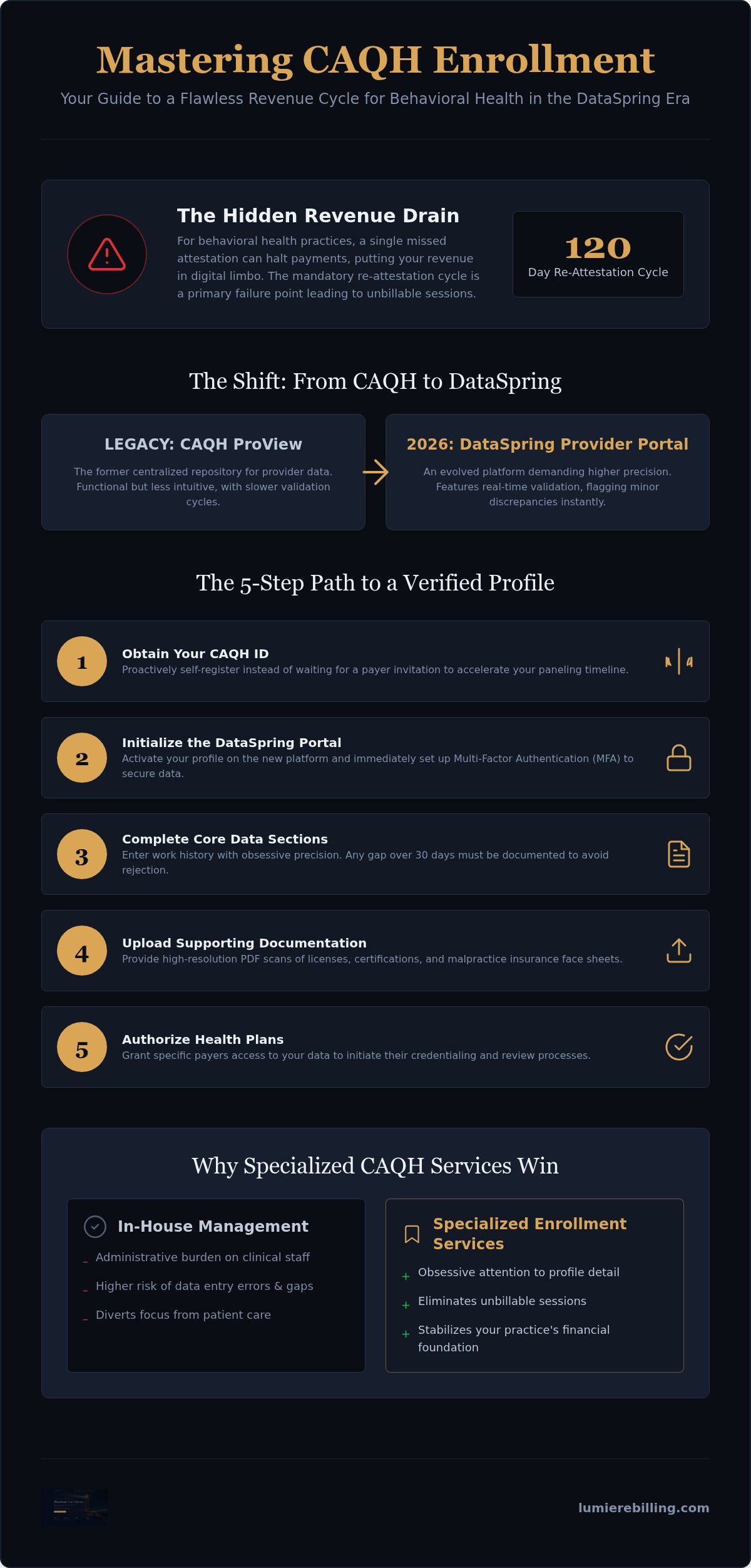
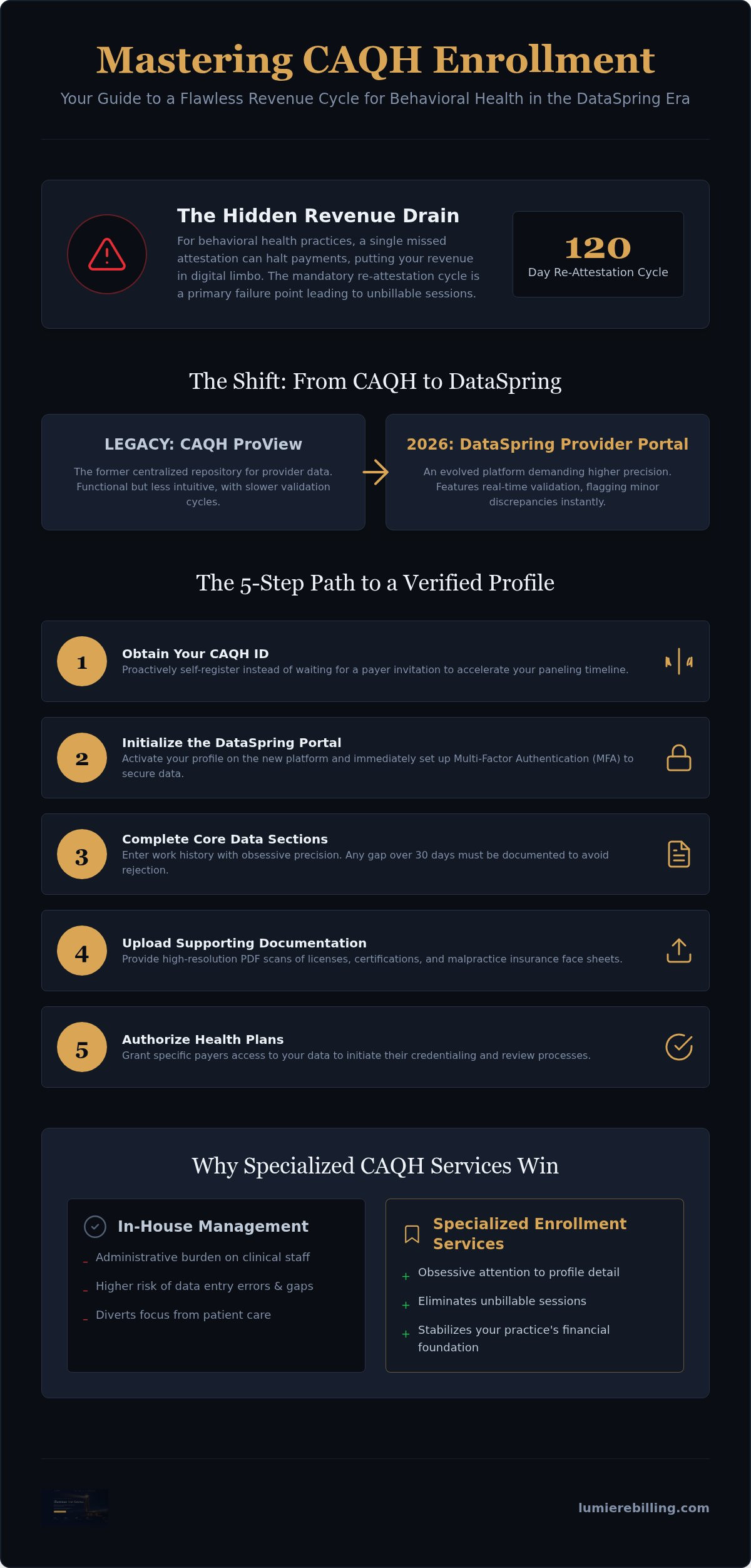
We recognize the frustration of watching insurance panels lag while your staff grapples with the 120-day re-attestation cycle or the latest Optum demographic mandates. This guide provides the clarity you need to master the CAQH Provider Data Portal, securing your identity against errors that trigger payment delays. You'll learn how to maintain a verified profile that satisfies rigorous payer audits and accelerates your path to reimbursement. We'll examine the specific requirements for 2026, from the DataSpring rebrand to the mechanical precision required for a seamless revenue cycle start.
Key Takeaways
- Navigate the 2026 transition to the DataSpring Provider Data Portal to maintain a visible and verified digital identity for all insurance panels.
- Master the 120-day re-attestation cycle to prevent an "Expired" status, which serves as a primary failure point for behavioral health revenue.
- Audit your professional documentation for mechanical precision, ensuring CVs are gap-free and certifications are current to meet stringent payer standards.
- Leverage specialized CAQH enrollment services to shift the administrative burden away from your clinical team while ensuring obsessive attention to profile detail.
- Connect profile accuracy directly to revenue cycle health to eliminate unbillable sessions and stabilize your practice’s financial foundation.
What are CAQH Enrollment Services in 2026?
Your CAQH profile is the bedrock of your practice's administrative life. Formally known as the Council for Affordable Quality Healthcare (CAQH), this entity acts as the centralized repository for provider data across the United States. In 2026, the organization rebranded to DataSpring, transitioning its legacy ProView system into the more robust CAQH Provider Data Portal (PDP). This platform isn't just a database; it's a living archive of your credentials, work history, and clinical certifications. Professional CAQH enrollment services ensure this data remains synchronized with payer expectations, preventing the friction that often stalls clinical operations.
Think of your CAQH ID as your digital passport for insurance credentialing. It's the primary tool that health plans use to verify your qualifications before they allow you to join their networks. Without a clean, active profile, you don't exist in the eyes of the major payers. They rely on this data to confirm you meet their standards. This makes the accuracy of your profile the difference between a thriving practice and a stalled revenue stream.
The Evolution from CAQH to DataSpring
The 2026 shift to the DataSpring brand signifies more than a cosmetic update. It represents a move toward enhanced data integrity and a more intuitive user experience for providers. The new portal interface streamlines data entry, yet it demands higher precision; minor discrepancies that used to pass through now trigger immediate flags. Fortunately, your existing CAQH ID migrates seamlessly into the DataSpring ecosystem. The core URL remains the same, but the internal logic now prioritizes real-time validation. This makes manual oversight more critical than ever. We've seen that providers who ignore these interface changes often face unexpected "expired" statuses that halt their billing cycles.
Why Behavioral Health Clinics Need Specialized Enrollment
Behavioral health practices, particularly those in the ABA and mental health sectors, face unique credentialing hurdles. High turnover rates and complex supervision structures mean your CAQH data must be updated constantly. A single error in your work history or a lapsed license can cause a cascade of denials. Because CAQH enrollment services are deeply tied to your overall behavioral health revenue cycle management, any profile inaccuracy leads to unbillable sessions. Beyond the money, accurate data ensures your practice appears correctly in patient directories. If a family can't find your correct location or specialty because of a CAQH lag, you lose the opportunity to provide care before the first appointment is even scheduled.
How to Navigate CAQH Enrollment: A Step-by-Step Guide
Navigating the CAQH Provider Data Portal requires more than a casual upload of documents; it demands a methodical approach to data integrity. For behavioral health practitioners, the process is the gateway to clinical viability. Whether you're starting a new practice or joining a group, following a structured sequence prevents the administrative bottlenecks that stall your revenue. Utilizing specialized CAQH enrollment services can transform this complex sequence into a streamlined asset for your practice.
- Step 1: Obtain Your CAQH ID. You can wait for a payer invitation or initiate proactive self-registration. Proactive registration is preferred for those seeking to accelerate their paneling timeline.
- Step 2: Initialize the DataSpring Portal. Log in to the renamed platform to activate your professional profile. Ensure you set up multi-factor authentication (MFA) immediately to protect your sensitive provider data.
- Step 3: Complete Core Data Sections. Enter your education, training, and work history with obsessive precision. Any gap in your timeline exceeding 30 days must be documented and explained to avoid immediate rejection.
- Step 4: Upload Supporting Documentation. Provide high-resolution scans of your licenses, certifications, and malpractice face sheets in the specified PDF formats.
- Step 5: Authorize Health Plans. Grant specific payers access to your verified data to trigger the credentialing review process.
Registration and Initial Profile Setup
The path you take to registration depends on your current contracting status. If a payer initiates the process, you'll receive a system-generated email with a unique ID; otherwise, you must register independently to secure your spot in the ecosystem. The "Primary Purpose" field must accurately reflect your intent to participate in insurance networks to ensure the system routes your data to the correct credentialing modules. If you feel overwhelmed by these initial steps, a professional billing audit can help identify where your current setup might be leaking potential revenue.
Managing Payer Authorizations Effectively
Authorizations are the valves that control who sees your data. You can choose "Global Authorization," which allows all participating health plans to view your profile, or "Specific Authorization," which limits access to payers you select manually. Behavioral health providers should often be selective with authorizations to maintain control over their network participation and prevent unsolicited credentialing attempts. Regularly audit your authorization log to track which payers have pulled your data, ensuring your digital identity remains secure and your paneling strategy stays on target. Effective CAQH enrollment services always include a strategy for these permissions to ensure your data works for you, not against you.
Required Documentation for Behavioral Health Providers
Precision is not optional. When you gather documents for your profile, you are building the mechanical foundation of your practice’s financial health. Generic guides often overlook the specificities of behavioral health, yet these details are where most applications fail. Effective CAQH enrollment services hinge on the quality of your source files; if the input is flawed, the output is a stalled revenue cycle. Your documentation must be current, high-resolution, and perfectly aligned with your clinical reality.
- Comprehensive Curriculum Vitae (CV): Your CV must be updated in a month/year format. It should account for every moment of your professional life since graduation.
- State Professional Licenses: Provide current, valid copies of all state licenses. Expired or soon-to-expire documents will trigger a profile "incomplete" status.
- Malpractice Insurance Face Sheets: Payers require proof of Professional Liability Insurance. Ensure the coverage amounts meet the specific minimums required by each health plan.
- W-9 and Organizational NPI (Type 2): For group practices, your individual data must link correctly to the organization's tax identity and Type 2 NPI.
Nuances for ABA and Mental Health Clinicians
Credentialing for BCBA and BCaBA providers requires a level of detail that standard medical guides ignore. You must include your specific board certifications and any specialized training, such as EMDR or DBT, within the specialized certifications section. This isn't just for show; it dictates your reimbursement rates and network tiering. Most importantly, your NPI taxonomy codes must match your CAQH profile exactly. A mismatch between your NPI registry and your DataSpring entry is a common failure point that leads to immediate credentialing rejections. We see this often in group practices where taxonomy codes are applied inconsistently across the team.
The "Gap in History" Trap
DataSpring utilizes a rigorous validation logic that flags any employment gap exceeding 30 days. This is a hard stop. If you transitioned between clinics or took time to establish a private practice, you must document that interval explicitly. Whether it was maternity leave, an educational sabbatical, or a simple career move, the portal requires a written explanation for the silence in your timeline. Don't leave these spaces blank. A proactive explanation prevents a manual reviewer from pausing your application. Our CAQH enrollment services prioritize this obsessive level of detail to ensure your profile moves through the system without human intervention or delay.
Maintaining Your Profile to Prevent Revenue Leakage
Setting up your profile is a one-time event; maintaining it is a perpetual discipline. The 120-day re-attestation cycle stands as the most critical maintenance task for any clinician. If you fail to re-verify your data within this window, DataSpring marks your profile as "Expired." Payers immediately lose access to your credentials. This administrative lapse often leads to avoidable behavioral health billing errors that stall your cash flow without warning. Consistent maintenance is also the primary driver of a successful mental health provider re-credentialing process, ensuring your periodic reviews are a formality rather than a crisis.
The Financial Cost of Data Decay
Data decay is a silent practice killer. When malpractice insurance face sheets expire in the portal, payers don't always notify you. Instead, they issue "silent denials," where claims are held or rejected based on outdated compliance data. Inaccurate practice addresses further exacerbate this by corrupting provider directories. This misdirects patient referrals and damages your reputation. DataSpring Sanctions Monitoring acts as a continuous automated sweep, alerting you to potential compliance flags before they compromise your standing with federal and private payers. Our specialized CAQH enrollment services eliminate these risks by providing the vigilant oversight your practice requires.
Roster Management for Large Behavioral Health Groups
Managing a few providers is manageable; managing dozens is a structural challenge. Large clinics must centralize their portal management to avoid desynchronized updates. By integrating provider roster management behavioral health strategies, you can sync DataSpring updates across your entire clinical team. We recommend setting internal alerts at the 90-day mark to beat the 120-day deadline. This proactive buffer ensures that unexpected documentation delays don't result in a lapsed profile. Precision in these updates is vital, especially since payers like Optum now mandate that all demographic changes occur exclusively through the portal. If you're struggling to keep your team's data current, a free billing audit can reveal exactly where your maintenance gaps are costing you money.
Why Specialized CAQH Enrollment Services Win
Practitioners are healers, not data entry clerks. The administrative friction of the DataSpring portal often pulls clinicians away from patient care, creating a choice between clinical focus and financial compliance. In-house management frequently suffers from fragmented oversight, where small errors in the portal lead to massive delays in the payer network. Choosing specialized CAQH enrollment services shifts this burden to experts who view your digital identity as a high-precision asset. We understand that in behavioral health, your revenue foundation is only as strong as your most recent attestation.
Generalist billing firms often treat credentialing as an afterthought. Lumiere Billing rejects this approach, positioning CAQH maintenance as a core component of our behavioral health billing services. We recognize the nuances of behavioral health coding and contracting that generalists miss. Whether it is ensuring your BCBA certifications are correctly tiered or verifying that your NPI taxonomy aligns with your specific clinical scope, we bring mechanical integrity to your profile. This specialized focus transforms your back office from a source of stress into a streamlined engine of growth.
Lumiere’s Proactive Partnership Model
Our model functions as a disciplined extension of your practice. We don't wait for a "denied" notice to check your profile status. Instead, we proactively monitor your 120-day re-attestation dates and audit every document for accuracy before it hits the portal. By integrating CAQH maintenance into our full revenue cycle management, we identify systemic leaks before they impact your cash flow. This meticulous auditing reduces the time-to-credentialing, allowing your new providers to start seeing patients and generating revenue weeks faster than the industry average. We handle the obsessive details so you can focus on clinical outcomes.
Next Steps: Securing Your Revenue Foundation
Securing your practice’s future starts with a clear view of your current standing. The transition to 2026 DataSpring standards requires an immediate audit of your existing profile to catch inconsistencies in work history or lapsed certifications. Don't let a "silent denial" be the first sign that your data has decayed. Prepare your documentation now to meet the heightened precision required by modern payers. To identify hidden credentialing-related revenue leaks in your practice, schedule a Free Billing Audit with Lumiere Billing today. We’ll bring your systems into focus and ensure your revenue cycle remains uninterrupted.
Secure Your Practice’s Financial Future
The shift to DataSpring in 2026 isn't just a name change; it's a call for mechanical precision in your provider data. Your practice’s revenue cycle depends on the integrity of your profile, from closing employment gaps to meeting the 120-day re-attestation deadline. Ignoring these details leads to silent denials and administrative stagnation. By utilizing specialized CAQH enrollment services, you replace systemic leaks with a robust, verified identity that payers respect. Our approach ensures that every credential is a bridge to reimbursement rather than a barrier to care.
Lumiere Billing operates as your vigilant protector, bringing hidden issues into focus before they stall your cash flow. We offer the obsessive detail required to navigate this complex landscape through vigilant credentialing oversight. Let Lumiere Billing handle your CAQH maintenance and RCM to benefit from specialized behavioral health experts and comprehensive billing audits. You focus on the clinical outcomes that change lives while we manage the systems that sustain your practice. Together, we can build a foundation that is both stable and scalable.
Frequently Asked Questions
What is the difference between CAQH and DataSpring?
DataSpring is the 2026 rebrand of the Council for Affordable Quality Healthcare (CAQH). While the organization changed its name to reflect a broader focus on data infrastructure, the core function remains the same. The legacy CAQH ProView system has evolved into the CAQH Provider Data Portal (PDP). Your credentials and CAQH ID migrate automatically, but the interface now emphasizes real-time validation and enhanced security protocols to ensure data integrity across the healthcare ecosystem.
How often do I need to re-attest my CAQH profile in 2026?
Providers must re-attest their profile every 120 days to remain active within the DataSpring system. This frequency is standard across the nation, with the exception of Illinois, where the cycle extends to 180 days. You'll receive automated notifications as the deadline approaches. Missing this window results in an "Expired" status, which immediately blocks payers from accessing your data and can lead to stalled reimbursements or out-of-network status.
Can a group practice manage CAQH for all its providers at once?
Yes, group practices can centralize the management of multiple provider profiles through a practice manager account. This allows administrative staff to oversee re-attestation dates and document uploads for the entire clinical team. However, each clinician must still have an individual CAQH ID and provide personal authorization for the practice to manage their data. Utilizing professional CAQH enrollment services can further streamline this process, ensuring that every roster update is executed with mechanical precision.
How long does the CAQH enrollment process typically take?
The timeline for CAQH enrollment generally spans three to six months from initial profile creation to final payer approval. While setting up the profile itself may take 15 to 25 hours of focused data entry, the subsequent verification and payer review cycles are what extend the duration. Factors such as document accuracy and the responsiveness of your primary sources, like universities and previous employers, significantly influence how quickly your profile reaches a verified state.
What happens if I miss my CAQH re-attestation deadline?
Missing the re-attestation deadline triggers an immediate change in your profile status to "Expired." When this happens, health plans can no longer pull your credentials for verification or directory updates. This lapse often results in "silent denials" of claims and may even lead to your removal from insurance panels. To avoid this, it's vital to treat the 120-day cycle as a non-negotiable administrative priority to maintain your practice’s financial health.
Is there a fee for providers to use the CAQH/DataSpring portal?
Accessing and maintaining a profile on the CAQH Provider Data Portal is free for healthcare providers. The organization is funded by the health plans and participating organizations that use the data for credentialing purposes. While the platform itself carries no direct cost, many practices invest in CAQH enrollment services to offset the significant internal staff time required for setup and ongoing maintenance, ensuring that no technical errors compromise their revenue cycle.
Does CAQH enrollment mean I am automatically credentialed with insurance?
No, CAQH enrollment is simply the first step in the credentialing process; it does not grant automatic network participation. The portal acts as a centralized data repository where payers go to collect the information they need for their own internal reviews. Once your profile is complete and authorized, you must still apply to each insurance panel individually. The payer will then use your DataSpring data to verify your qualifications before offering a contract.
What documents are required for BCBA CAQH enrollment?
BCBA providers must submit a comprehensive set of documents, including a month-year formatted CV, a current state license, and their national board certification from the BACB. Additionally, you must upload your malpractice insurance face sheet and proof of your highest degree. It is critical that your NPI taxonomy codes match your certifications exactly. Any discrepancy in these documents can trigger a manual review, extending the time it takes for you to begin billing.
Frequently Asked Questions
DataSpring is the new brand identity for the organization formerly known as the Council for Affordable Quality Healthcare. In 2026, the provider facing portal is officially called the CAQH Provider Data Portal, powered by DataSpring. While the name changed to reflect a shift toward data integrity and for profit operations, the core function remains the same. It acts as the industry's central repository for clinician credentials and practice information used by insurance payers.
You must re-attest your profile every 120 days to remain active and compliant. The only exception is for providers in Illinois, who follow a 180 day cycle. Failure to meet this deadline results in your profile being marked as Expired or Inactive. This status immediately halts any ongoing credentialing or re-credentialing efforts. Consistent monitoring is the only way to prevent these administrative gaps from stalling your practice revenue and patient access.
Yes, group practices can centralize management through the portal's practice manager module. This allows a single administrative entity to oversee multiple clinician profiles and track upcoming re-attestation dates. Utilizing specialized CAQH enrollment services is often the most efficient way to handle this at scale. It ensures that every provider on your roster maintains a clean, verified profile without placing the administrative burden on the clinicians themselves.
The initial profile setup usually takes between 1 to 3 hours for a clinician. After submission, document verification and profile activation typically take an additional 1 to 10 business days. However, the full timeline from profile creation to payer approval generally ranges from 90 to 180 days. This duration depends heavily on the accuracy of your submitted data and the specific health plan's internal processing speeds and network adequacy needs.
Missing the deadline causes your profile status to switch to Expired. Payers will immediately lose access to your verified data, which often triggers silent denials on your claims. You'll likely be dropped from provider directories, making it impossible for new patients to find your clinic. You must log in and re-attest immediately to restore access, but the damage to your revenue cycle and network status can take weeks to repair.
Access to the CAQH Provider Data Portal remains free for all healthcare providers. The costs associated with the system are paid by the participating health plans that pull your data for verification. However, many practices invest in professional CAQH enrollment services to manage the administrative labor. These services prevent the costly billing errors and credentialing delays that occur when a profile is managed incorrectly or neglected by busy clinical staff.
No, CAQH enrollment is only the first step in the credentialing process. The portal is a data repository, not a credentialing body itself. Once your profile is verified, you must still apply to individual health plans and authorize them to access your data. Each payer then performs its own independent review of your credentials, which can take an additional 60 to 120 days for commercial contracts to be finalized.
BCBAs must provide several specialized documents to complete their professional profile. These include a current month and year formatted CV, your state license, and your BACB certification. You also need a malpractice insurance face sheet with appropriate limits and a W-9 for your practice entity. Ensure your NPI taxonomy codes match your BCBA status exactly to avoid discrepancies that could lead to unbillable sessions or immediate payer rejections.