Best Credentialing Services for Mental Health Providers: 2026 Strategic Buyer’s Guide

How much revenue did your practice lose this month simply because a provider was stuck in a "pending" status? For many behavioral health leaders, the search for the best credentialing services for mental health providers is born from a need to stop systemic revenue leaks. You have clinicians ready to see patients, yet you're forced to delay care or provide unbillable sessions while waiting for a payer's signature. Most generalist firms treat enrollment as a clerical afterthought, leaving you with opaque application statuses and mounting frustration. It's a broken system that demands a more specialized, proactive approach to protect your bottom line.
You deserve a partner that treats your revenue cycle with mechanical integrity and provides a clear view into your enrollment pipeline. This 2026 strategic guide identifies top-rated partners that specialize in the nuances of behavioral health to accelerate your "in-network" status. We will examine how a dedicated credentialing and enrollment partner can eliminate CAQH errors, manage complex payer contracting, and protect your practice from the silent denials that stall growth. By the end of this guide, you will know exactly how to choose a partner that acts as a vigilant protector of your financial health.
Key Takeaways
- Discover why behavioral health credentialing requires specialized advocacy instead of simple clerical data entry to prevent enrollment stalls.
- Identify the best credentialing services for mental health providers by comparing specialized RCM partners against standalone software and generalist platforms.
- Utilize the "Precision Enrollment" framework to vet potential partners based on their ability to proactively manage your payer contracts.
- Build a zero-error CAQH profile using our readiness checklist to eliminate the administrative delays that lead to unbillable sessions.
- Learn how specialized enrollment oversight provides the visibility you need to protect your practice's financial health and mechanical integrity.
The Strategic Role of Mental Health Credentialing in 2026
In the landscape of 2026 practice operations, Credentialing is the formal verification process where insurance payers validate a provider's education, training, and clinical history. It isn't just a background check. It's the gatekeeper to your revenue. Selecting the best credentialing services for mental health providers is no longer a luxury; it's a defensive necessity for any growing practice. While general medicine often deals with standard physical health metrics, behavioral health requires a more meticulous level of oversight. Payers scrutinize mental health providers with a higher degree of skepticism, often requiring specific certifications or proof of supervision that generalist billing companies overlook. This meticulous verification is the foundational pillar of Behavioral Health Revenue Cycle Management. Without it, the entire financial structure of your practice remains unstable.
Why Generalist Credentialing Services Often Fail Therapists
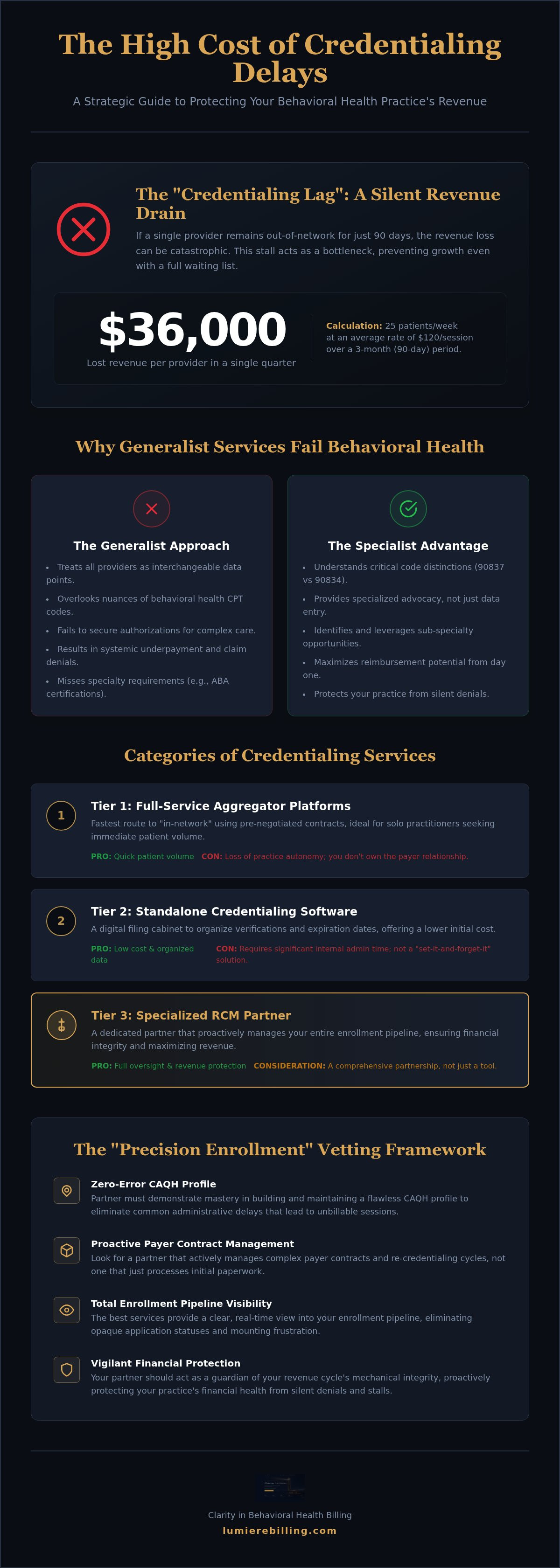
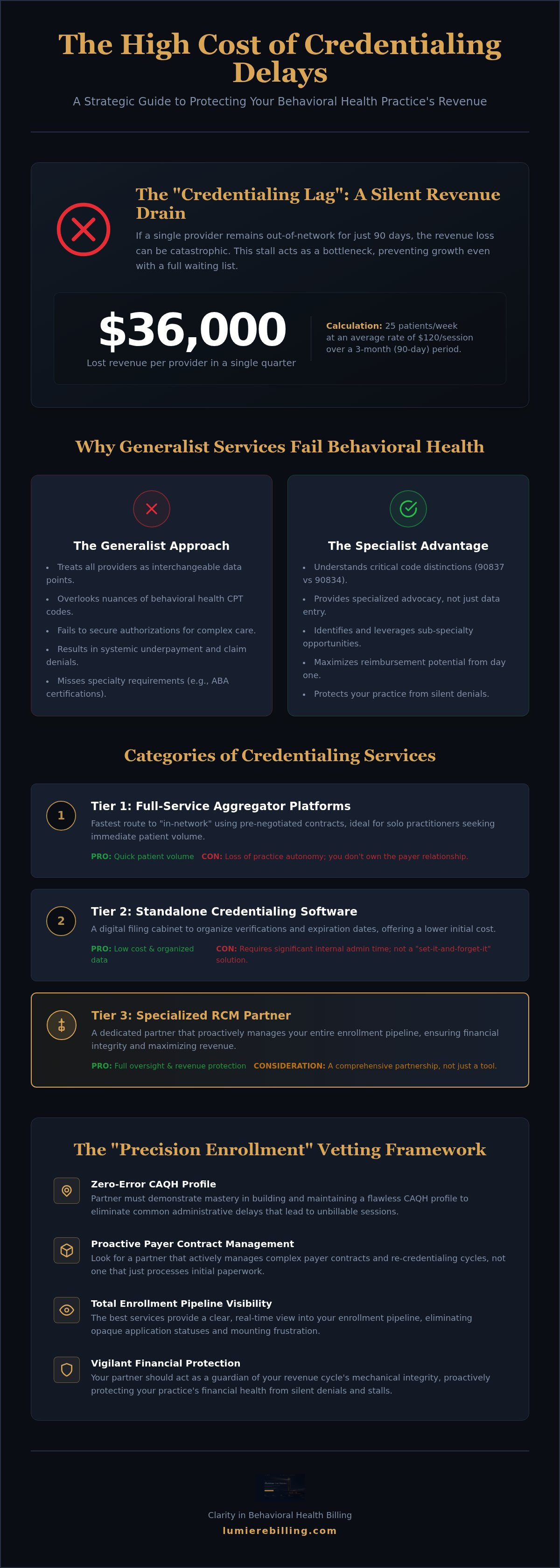
Generalist firms treat all providers as interchangeable data points. They don't understand the nuance of behavioral health CPT codes, such as the critical distinction between a 90837 and a 90834 session. A generalist might fail to secure the correct authorizations for higher-complexity codes, leading to underpayment from day one. For those in Applied Behavior Analysis (ABA), the stakes are even higher. ABA requires specific board certifications and unique payer requirements that a standard medical credentialing service simply won't catch. The best credentialing services for mental health providers identify these sub-specialty opportunities early, ensuring your enrollment reflects the full scope of your expertise and maximizes your reimbursement potential.
The Hidden Cost of Credentialing Delays
The "Credentialing Lag" is a silent drain on your practice's cash flow. If a single provider is forced to remain out-of-network for just 90 days, the revenue loss can be catastrophic. Imagine a therapist seeing 25 patients a week; at a modest $120 per session, that's $36,000 in unbillable or out-of-pocket revenue lost in a single quarter. Beyond the immediate financial impact, these delays erode patient retention. Clients who find a therapist they trust are often forced to seek care elsewhere if their insurance isn't accepted promptly. An enrollment stall is a primary driver of revenue leakage in 2026, acting as a bottleneck that prevents your practice from scaling even when your waiting list is full.
Top Categories of Credentialing Services for Behavioral Health
Choosing the best credentialing services for mental health providers requires understanding that enrollment is not a monolithic category. It's a spectrum of partnership levels. High-growth group practices often find that mental health provider credentialing is a living process rather than a one-time administrative hurdle. It requires constant CAQH upkeep and re-credentialing cycles to maintain the mechanical integrity of your revenue cycle. Evaluating these services based on practice autonomy, depth of service, and cost is the first step in protecting your bottom line.
Tier 1: Full-Service Aggregator Platforms
These platforms offer the fastest route to being "in-network" by using pre-negotiated contracts. They're ideal for solo practitioners who need immediate patient volume. However, the trade-off is a significant loss of practice autonomy. You don't own the payer relationship. Your brand becomes secondary to the platform's ecosystem. If you ever leave the platform, you often have to start the credentialing process from scratch with each individual payer. This loss of control can be a major disadvantage for practices looking to build long-term value.
Tier 2: Standalone Credentialing Software
Software solutions act as a digital filing cabinet. They keep your primary source verifications and expiration dates organized in a single repository. While the initial cost is lower, these tools aren't "set it and forget it" systems. They still require your internal administrative team to spend hours on hold with payers to track application statuses. For a practice without dedicated admin staff, this often leads to "enrollment stalls" where applications sit untouched for months. High-growth practices typically outgrow these tools because they lack the proactive advocacy needed to resolve payer disputes.
Tier 3: Specialized Revenue Cycle Partners (The Lumiere Model)
This is the gold standard for scaling group practices and ABA clinics. Specialized partners provide end-to-end management, acting as a dedicated extension of your practice team rather than a mere vendor. They don't just submit data; they advocate for your specific sub-specialties to secure higher reimbursement rates. This model integrates credentialing directly into your billing workflow. It ensures that no claim is ever submitted for a provider who isn't fully billable. While the initial investment is higher than DIY software, the return is realized through faster "in-network" dates and zero-error CAQH profiles. If you suspect your enrollment pipeline is leaking revenue, a specialized billing audit can bring hidden issues into focus.
Evaluating the Best Credentialing Services: A 5-Point Framework
Identifying the best credentialing services for mental health providers requires a shift in perspective. You aren't just hiring a data entry clerk; you're securing a revenue advocate. We utilize the "Precision Enrollment" framework to vet potential partners, moving beyond simple form submission toward a model of active oversight. The best services don't just submit data; they interrogate payer requirements to ensure your practice isn't sidelined by administrative technicalities. This framework prioritizes CAQH enrollment services as a core, non-negotiable feature rather than a secondary add-on. Without this foundational accuracy, your entire enrollment pipeline remains vulnerable to systemic leaks.
1. Niche Specialization in Behavioral Health
Does your provider understand the specific modifiers and CPT codes that drive mental health reimbursement? Generalist services often miss the nuance of behavioral health billing, such as the complexities of ABA unit tracking and reconciliation. They might successfully enroll a provider but fail to secure the correct authorizations for specialized care levels. Niche advocacy is the differentiator between data entry and strategic enrollment. A specialized partner ensures that your sub-specialties are recognized by payers from the start, preventing the need for costly retroactive corrections.
2. Proactive CAQH and Roster Maintenance
Credentialing is not a static event. It's a continuous cycle that requires vigilant maintenance to avoid "expiration stalls." You must evaluate how a service manages the mental health provider re-credentialing process. A breakdown here can lead to immediate provider deactivation and unbillable sessions. For group practices, robust provider roster management is essential. Your partner should provide automated reminders and proactive updates, ensuring that every clinician's profile remains current and compliant without requiring constant internal intervention.
3. Pipeline Visibility and Status Transparency
Visibility is the antidote to the "black hole" of insurance enrollment. You need to know exactly where each application stands at any given moment. A dedicated portal or a direct line to an account manager is essential for tracking progress. There's a critical distinction between "automated status" and "verified status." Automated updates from payer portals are frequently outdated or inaccurate. A high-tier service provides verified status through human-confirmed follow-ups with insurance reps. This level of transparency allows you to forecast your revenue and hire new clinicians with confidence, knowing exactly when they'll be ready to see patients.
The Credentialing Checklist: Preparing Your Practice for Success
Success in insurance enrollment starts months before a provider's first clinical session. To maintain the mechanical integrity of your revenue cycle, you must treat "Credentialing Readiness" as a rigorous internal audit. Rushing the process or submitting incomplete data is the fastest way to trigger behavioral health billing errors that can haunt your practice for months. The best credentialing services for mental health providers don't just ask for your name and NPI; they demand a comprehensive documentation package that ensures every application is "clean" upon first submission. For new hires, this process should ideally begin 90 to 120 days before their anticipated start date to account for payer processing times.
A critical component of this preparation is the distinction between NPI Type 1 and NPI Type 2. Individual clinicians require a Type 1 NPI, while your group practice or clinic requires a Type 2 NPI for organizational billing. If these aren't correctly linked during the enrollment phase, your claims will be rejected immediately, regardless of the provider's clinical qualifications. Ensuring these identifiers are accurately reflected across all state and federal databases is a non-negotiable step in securing your practice revenue.
Phase 1: Internal Documentation Audit
Before engaging with payers, you must ensure your internal records are flawless. Discrepancies in your practice address or Tax ID across different documents will cause immediate application stalls. Your audit should include:
- Current state licenses and DEA certifications with matching addresses.
- Updated malpractice insurance face sheets showing adequate coverage limits.
- Fully unlocked and accessible CAQH profiles with updated work histories.
- Proof of board certifications or specialized ABA credentials.
Phase 2: Payer Selection Strategy
Don't apply to every payer blindly. A strategic enrollment approach requires analyzing your specific geography to identify the top-paying carriers for behavioral health services. Some panels may be "closed" to new providers in certain regions, requiring a specialized advocate to petition for an exception based on your practice's unique sub-specialties. We recommend a tiered approach: prioritize your primary high-volume payers first to stabilize cash flow, then move to secondary carriers to expand your patient reach. This methodical sequence prevents your administrative team from being overwhelmed by a flood of simultaneous follow-ups. If you're unsure where your current enrollment stands, a Free Billing Audit can help identify which payers are currently driving—or draining—your revenue.
Why Lumiere Billing is the Premier Partner for Behavioral Health Enrollment
Lumiere Billing doesn't just manage forms. We protect your practice's financial health by acting as a specialized extension of your clinical team. While generalist firms offer broad administrative support, we focus exclusively on the mechanical integrity of the behavioral health revenue cycle. This obsessive focus is why we're consistently recognized among the best credentialing services for mental health providers. We understand that your enrollment status isn't just a clerical checkbox; it's the lifeblood of your operation. Our approach integrates Credentialing & Enrollment with our comprehensive behavioral health billing services. This ensures that the moment a provider is credentialed, the billing system is ready to capture revenue without delay. We specialize in the high-stakes requirements of ABA and mental health sub-specialties, where a single missing modifier or an outdated roster can lead to months of denied claims.
Beyond Data Entry: Specialized Advocacy
Most vendors stop at submission. Lumiere starts at advocacy. We handle complex payer negotiations and constant roster updates to ensure your practice remains compliant and profitable. We understand the nuances of behavioral health modifiers and the specific documentation requirements that vary by state and payer. For clinics looking to scale nationally, our Practice Advisory service provides the strategic roadmap needed to navigate diverse regulatory landscapes. We bring hidden issues into focus before they become systemic leaks. Our team acts as a disciplined, behind-the-scenes operator, ensuring that your clinicians can focus on care while we handle the technical complexities of your enrollment pipeline.
Visibility and Insight: The Lumiere Dashboard
The traditional administrative experience is often opaque and frustrating. Lumiere replaces that "black hole" with transparent analytics and real-time visibility. Our dashboard provides a clear view into your enrollment pipeline, allowing you to see exactly where each application sits in the process. This level of insight is a core reason why practitioners seek out the best credentialing services for mental health providers. By issuing proactive re-credentialing alerts, we eliminate the risk of unbillable sessions caused by simple administrative oversight. Our partnership begins with a diagnostic deep dive into your current systems. Ready to eliminate enrollment delays and protect your revenue? Schedule your Free Billing Audit today to identify the gaps in your revenue cycle and start your journey toward total financial visibility.
Secure Your Practice Revenue Through Strategic Enrollment
The operational landscape of 2026 demands more than clerical data entry. It requires a partner that treats enrollment as a strategic gateway to growth rather than an administrative hurdle. By prioritizing niche advocacy and pipeline visibility, you protect your practice from the "silent denials" and enrollment stalls that drain cash flow. Identifying the best credentialing services for mental health providers involves finding an advocate who understands the specific nuances of behavioral health modifiers and ABA unit tracking. Lumiere Billing offers national coverage with specialized advocacy and proactive payer roster management. We bring hidden systemic leaks into focus so you can return to what matters most: patient care. Get Your Free Behavioral Health Billing Audit to secure your practice's financial health today. Your growth shouldn't be held hostage by a payer's signature. With the right systems in place, you can scale with confidence and clarity.
Frequently Asked Questions
What are the best credentialing services for mental health providers in 2026?
The best services are those that specialize exclusively in behavioral health and ABA rather than general medicine. These providers act as advocates, managing the entire enrollment pipeline with high visibility. They provide more than simple data entry; they offer strategic oversight to prevent unbillable sessions. Lumiere Billing is a premier choice because we integrate credentialing directly into the revenue cycle, ensuring clinicians are fully billable the moment their status goes active.
How much do credentialing services for mental health typically cost?
Costs vary significantly based on the service model, ranging from software subscriptions to comprehensive managed services. Software-only tools are generally the most affordable but require your internal staff to perform all follow-ups. Full-service partners often utilize a per-application fee or a monthly maintenance structure. The true cost should be measured against the potential revenue loss from a provider being out-of-network for several months, which often far exceeds the service fees.
How long does the mental health credentialing process take?
Most behavioral health providers should expect the process to take between 90 and 120 days from the initial submission. This timeline depends heavily on the specific payer and the accuracy of the initial application. Delays often occur due to enrollment stalls caused by minor data discrepancies or slow payer responses. Specialized partners mitigate these delays by performing weekly follow-ups and ensuring that CAQH profiles are zero-error before the process begins.
Can I outsource mental health billing and credentialing to the same company?
Yes, and this integration is often the most efficient way to protect your practice revenue. When a single partner manages both billing and enrollment, they can ensure that claims are never submitted for a provider who isn't fully credentialed. This prevents immediate rejections and silent denials. This unified approach provides total visibility into your financial health, allowing you to hire new clinicians without worrying about unbillable sessions during the transition.
What is the difference between credentialing and payer enrollment?
Credentialing is the verification of a provider's qualifications, while enrollment is the process of getting that provider on a specific insurance panel. Credentialing confirms that you are who you say you are; enrollment confirms that you can bill the insurance company for services. Both steps are essential for receiving reimbursement. The best credentialing services for mental health providers manage both phases seamlessly to ensure there are no gaps in your ability to collect payment.
Is CAQH maintenance included in most credentialing services?
High-tier credentialing services include CAQH maintenance as a core feature of their offering. CAQH is the central database that payers use to verify your information, and it requires quarterly re-attestation to remain active. If your profile expires, your enrollment status can be deactivated immediately. Specialized partners provide proactive alerts and handle the technical updates, ensuring your profile remains current and compliant without requiring constant manual intervention from your clinical or administrative staff.
Why should a group practice use a specialized behavioral health credentialing service?
Group practices face unique challenges, such as managing provider rosters and linking Type 1 NPIs to a Type 2 organizational NPI. Generalist firms often overlook the specific CPT modifiers and unit-tracking requirements necessary for ABA and mental health practices. A specialized service acts as a vigilant protector of your group's mechanical integrity. They advocate for higher reimbursement rates and ensure that your practice's sub-specialties are correctly recognized by every insurance carrier in your network.
What happens if my credentialing application is denied?
A denial usually occurs due to missing documentation, data discrepancies, or a closed payer panel. If this happens, your service partner should initiate an immediate appeal or petition for an exception based on your niche expertise. This is where specialized advocacy becomes critical. A generalist firm might accept the denial at face value, but a dedicated partner will leverage their industry relationships to resolve the issue and secure your spot on the insurance panel.
Frequently Asked Questions
The best services are those that specialize exclusively in behavioral health and ABA rather than general medicine. These providers act as advocates, managing the entire enrollment pipeline with high visibility. They provide more than simple data entry; they offer strategic oversight to prevent unbillable sessions. Lumiere Billing is a premier choice because we integrate credentialing directly into the revenue cycle, ensuring clinicians are fully billable the moment their status goes active.
Costs vary significantly based on the service model, ranging from software subscriptions to comprehensive managed services. Software-only tools are generally the most affordable but require your internal staff to perform all follow-ups. Full-service partners often utilize a per-application fee or a monthly maintenance structure. The true cost should be measured against the potential revenue loss from a provider being out-of-network for several months, which often far exceeds the service fees.
Most behavioral health providers should expect the process to take between 90 and 120 days from the initial submission. This timeline depends heavily on the specific payer and the accuracy of the initial application. Delays often occur due to enrollment stalls caused by minor data discrepancies or slow payer responses. Specialized partners mitigate these delays by performing weekly follow-ups and ensuring that CAQH profiles are zero-error before the process begins.
Yes, and this integration is often the most efficient way to protect your practice revenue. When a single partner manages both billing and enrollment, they can ensure that claims are never submitted for a provider who isn't fully credentialed. This prevents immediate rejections and silent denials. This unified approach provides total visibility into your financial health, allowing you to hire new clinicians without worrying about unbillable sessions during the transition.
Credentialing is the verification of a provider's qualifications, while enrollment is the process of getting that provider on a specific insurance panel. Credentialing confirms that you are who you say you are; enrollment confirms that you can bill the insurance company for services. Both steps are essential for receiving reimbursement. The best credentialing services for mental health providers manage both phases seamlessly to ensure there are no gaps in your ability to collect payment.
High-tier credentialing services include CAQH maintenance as a core feature of their offering. CAQH is the central database that payers use to verify your information, and it requires quarterly re-attestation to remain active. If your profile expires, your enrollment status can be deactivated immediately. Specialized partners provide proactive alerts and handle the technical updates, ensuring your profile remains current and compliant without requiring constant manual intervention from your clinical or administrative staff.
Group practices face unique challenges, such as managing provider rosters and linking Type 1 NPIs to a Type 2 organizational NPI. Generalist firms often overlook the specific CPT modifiers and unit-tracking requirements necessary for ABA and mental health practices. A specialized service acts as a vigilant protector of your group's mechanical integrity. They advocate for higher reimbursement rates and ensure that your practice's sub-specialties are correctly recognized by every insurance carrier in your network.
A denial usually occurs due to missing documentation, data discrepancies, or a closed payer panel. If this happens, your service partner should initiate an immediate appeal or petition for an exception based on your niche expertise. This is where specialized advocacy becomes critical. A generalist firm might accept the denial at face value, but a dedicated partner will leverage their industry relationships to resolve the issue and secure your spot on the insurance panel.