Behavioral Health Billing Errors to Avoid: Plugging the Leaks in Your Revenue Cycle

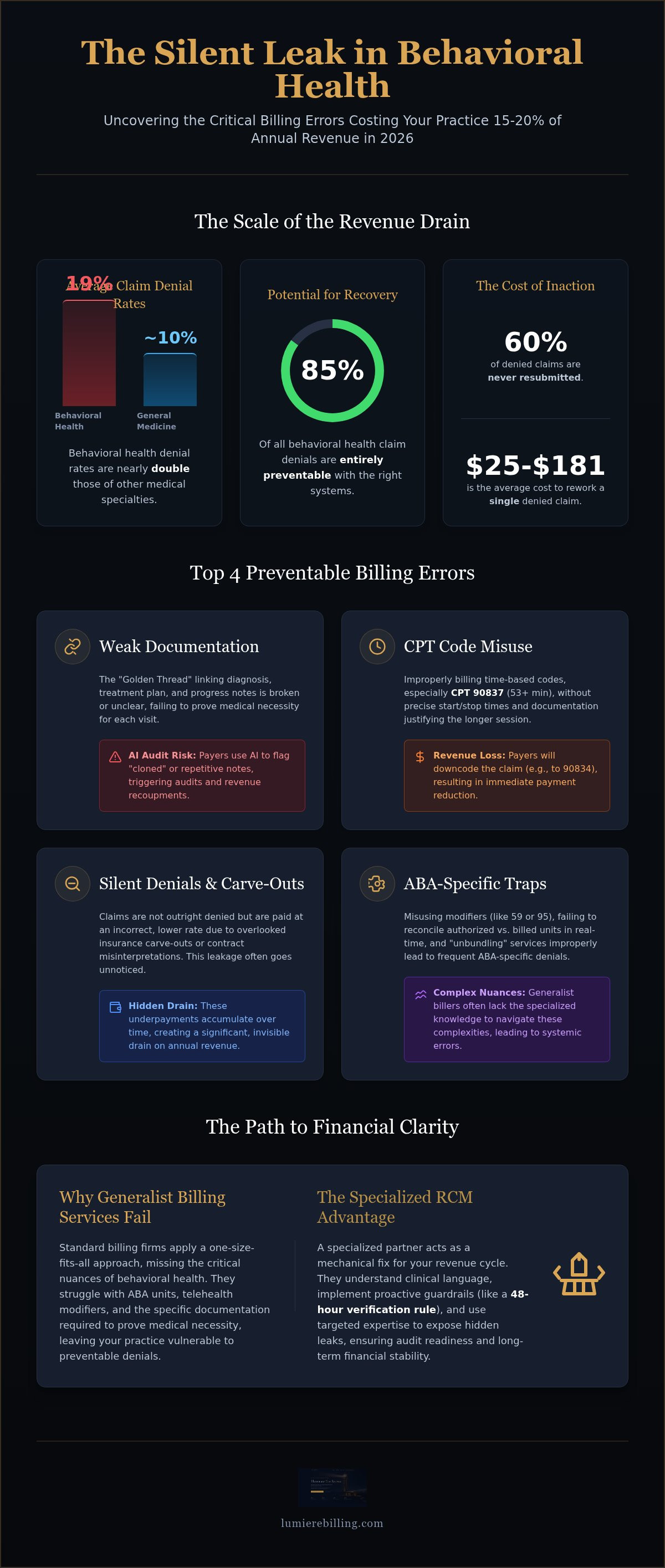
In 2026, the average behavioral health practice loses 19% of its revenue to claim denials, a rate nearly double that of general medical specialties. Most of these losses are invisible. They stay buried under the weight of high AR days and the exhaustion of clinician burnout. You likely suspect your revenue cycle is leaking, yet the specific failure points remain obscured by opaque administrative processes and shifting payer rules. It's a frustrating reality where 85% of these denials are entirely preventable.
We understand that managing a practice shouldn't feel like a constant battle against a broken system. This guide will help you identify the critical behavioral health billing errors to avoid to reclaim the 15-20% of annual revenue currently slipping through the cracks. We'll examine the mechanical integrity of your documentation, the complexities of 2026 telehealth POS codes, and the hidden danger of insurance carve-outs. By bringing these silent denials into focus, you can achieve faster reimbursement cycles, improved audit readiness, and the financial clarity your practice deserves.
Key Takeaways
- Understand the 2026 financial landscape where specialized practices lose nearly 20% of revenue to preventable claim denials.
- Strengthen the "Golden Thread" of documentation to navigate behavioral health billing errors to avoid, focusing on precise CPT code application.
- Expose the mechanics of silent denials and insurance carve-outs that often result in claims being paid at incorrect, lower rates.
- Establish proactive guardrails, such as a 48-hour verification rule, to shift your operations from reactive billing to optimized revenue cycle management.
- Learn how specialized RCM brings hidden systemic leaks into focus, ensuring mechanical integrity and long-term audit readiness.
The Financial Impact of Behavioral Health Billing Errors in 2026
Behavioral health revenue cycle management in 2026 is a landscape of high-precision scrutiny. Payers now utilize AI-driven claims analysis to flag any session note that lacks measurable data or fails to justify medical necessity on a per-visit basis. This environment has pushed the average in-network denial rate for behavioral health to 19%, which is nearly double the rate of general medical claims. Identifying specific behavioral health billing errors to avoid is no longer optional; it is a requirement for survival.
The cost of these errors extends beyond the balance sheet. Administrative friction creates a toxic environment for clinicians, forcing them to choose between rigorous documentation requirements and actual patient care. This tension is a primary driver of clinician burnout. When a practice operates with opaque billing processes, revenue leakage becomes a systemic failure rather than a series of human mistakes. It is a broken valve in the machinery of your practice that requires a mechanical fix, not just a faster data entry clerk.
The 20% Revenue Drain: Where Money Disappears
Data from 2024 benchmarks show that 82% to 85% of behavioral health denials are entirely preventable. Despite this, as many as 60% of denied claims are never resubmitted. This creates a compounding deficit. When you factor in that the cost to rework a single denied claim ranges from $25 to $181, the financial hemorrhage is clear. Ignoring these behavioral health billing errors to avoid leads to a systemic leak that typically costs practices 15% to 20% of their annual revenue. Over a fiscal year, these uncollected small amounts aggregate into a significant loss of capital that could have funded practice expansion or higher clinician compensation.
Why Generalist Billing Firms Fail Behavioral Health
Standard billing services often lack the specialized vision required to manage behavioral health RCM. They operate as generalists, applying the same logic to a psychotherapy session that they would to a routine physical. They frequently struggle with the nuances of ABA-specific unit tracking or the correct application of modifiers like -95 for synchronous telehealth. Generalist software often fails to bridge the gap between clinical hours and authorized units, leading to "silent denials" where claims are paid but at the wrong rate. A true partner must speak the language of clinicians and understand the mechanical integrity of specialized practice management systems. Without this specialized mastery, your practice remains vulnerable to the oversights that generalist firms simply aren't trained to see.
Coding and Documentation: Strengthening the Golden Thread
Precision in clinical documentation is the bedrock of a healthy revenue cycle. The "Golden Thread" represents the mechanical integrity of a claim. It's the logical, unbroken link between the initial diagnosis, the established treatment plan, and the individual progress notes. If one link fails, the entire claim is vulnerable to scrutiny. Documentation must prove that the specific intervention provided was necessary, planned, and actually performed. Without this clarity, your practice is essentially operating in the dark.
In 2026, payers are using sophisticated AI to flag "cloned" documentation. If your notes for different sessions or different patients appear nearly identical, you're signaling a lack of individualized care. This is one of the most significant behavioral health billing errors to avoid. Repetitive phrasing triggers manual audits that can result in massive revenue recoupments. Every note must stand on its own as a unique clinical record that justifies the time spent and the code billed.
Mastering CPT 90837 and Time-Based Billing
The most audited area in 2026 remains CPT code 90837. This code is reserved for psychotherapy sessions of 53 minutes or more. Vague documentation like "60-minute session" is a liability. You must record the exact start and stop times to the minute. If a clinician bills 90837 but the note only supports 45 minutes of work, the payer will downcode the claim to 90834. This results in immediate revenue loss. Beyond time, the clinical language must justify why the longer session was medically necessary. High-intensity interventions or crisis management must be clearly described to satisfy payer scrutiny.
ABA-Specific Modifier and Unit Errors
Applied Behavior Analysis (ABA) practices face specialized unit tracking traps that often lead to "unbundling" denials. Misusing modifiers like 59 or 95 is a common oversight that generalist billers often miss. You must reconcile authorized units against actual billed hours in real time. Over-billing even a fractional unit can trigger a systemic "stop-pay" on a patient's account, creating a backlog of uncollectible revenue. In 2026, commercial payers have narrowed coverage for specific unit combinations, making it another critical behavioral health billing errors to avoid. Aligning your CentralReach or TherapyNotes workflows with specific payer requirements is essential for maintaining mechanical integrity. A free billing audit can help identify these hidden unit tracking leaks before they lead to a hard denial.
Navigating the Complexity of Carve-Outs and Silent Denials
A processed claim is not always a paid claim. In the specialized world of behavioral health, the most dangerous revenue leaks are often the ones that appear successful on the surface. These "silent denials" occur when a payer processes a claim but reimburses it at an incorrect rate or applies unexpected offsets. Unlike a hard denial that triggers an immediate alert, a silent denial quietly erodes your profit margins. Identifying these discrepancies requires a level of oversight that goes beyond basic billing. It requires an obsessive focus on the mechanical integrity of every transaction.
If your aging reports show a high volume of claims in a "processed" status yet your bank balance remains stagnant, you are likely experiencing systemic revenue leakage. Relying on the status code in your EHR is a mistake. True visibility comes from comparing every remittance against your specific contracted fee schedules. This is a primary pillar of the behavioral health billing errors to avoid to ensure your practice remains financially viable in 2026.
Identifying Payer Carve-Outs Before Submission
Checking for active medical insurance is a common trap. Behavioral health benefits are frequently "carved out" to a Managed Behavioral Health Organization (MBHO), such as Carelon or Optum, even when the primary medical plan is with a different carrier. Billing the primary medical entity results in a hard denial that often cannot be resubmitted due to timely filing limits. Your front-end workflow must specifically verify the behavioral benefit manager and the unique authorization path they require. This step is a foundational component of a refined Revenue Cycle Management strategy. Without this specialized verification, you are essentially flying blind.
The Anatomy of a Silent Denial
Silent denials often hide within the fine print of an Explanation of Benefits (EOB). You might see a payment, but without cross-referencing that figure against your specific contracted fee schedule, you won't notice the underpayment. Common signs of leakage include:
- Claims paid at a "usual and customary" rate instead of your contracted rate.
- Systemic downcoding of CPT 90837 to 90834 without a formal denial notice.
- Hidden administrative offsets or "recoupments" from previous sessions that reduce the net payment.
Using advanced analytics to spot these trends is the only way to bring these issues into focus. Regular underpayment recovery audits are essential. A proactive partner treats every dollar as a commitment to be protected, ensuring that "processed" actually means "paid in full." This level of vigilance transforms your back-office from a cost center into a protector of your practice's financial health.
Proactive Guardrails: A Checklist for Denial Prevention
Stop treating billing as a post-service afterthought. True Revenue Cycle Management (RCM) is a proactive discipline that starts long before the clinician enters the room. By establishing mechanical guardrails, you shift from a reactive state of chasing denials to a proactive state of protecting revenue. A "Clean Claim" culture is the result of this transition. It requires every member of the practice team to understand their role in maintaining the integrity of the financial cycle. This discipline ensures that your practice isn't just submitting claims, but securing reimbursements.
Implementing a strict 48-hour rule for insurance verification is a non-negotiable first step. This protocol ensures that every patient's coverage is active and authorized before services are rendered. In 2026, automated front-end eligibility checks are essential for identifying the behavioral health billing errors to avoid that stem from outdated patient information or changed policy terms. Technology should act as a vigilant filter, catching discrepancies before they reach the clinical documentation stage.
The Pre-Service Verification Workflow
A refined workflow prevents leaks at the source. This three-step process ensures mechanical integrity from the first point of contact:
- Step 1: Primary vs. Secondary Payer Identification. Confirming the order of benefits prevents the "wrong payer" denials that often occur with dual-coverage patients.
- Step 2: Confirming Level-of-Care Coverage. Verify specific benefits for PHP, IOP, or ABA services to avoid coverage gaps for specialized treatment programs.
- Step 3: Securing Prior Authorizations. Ensure authorizations match the intended CPT codes and include the correct unit counts for the entire treatment duration.
Daily Reconciliation and Claim Scrubbing
Submitting a claim without scrubbing it against current Correct Coding Initiative (CCI) edits is a gamble your practice shouldn't take. Daily reconciliation allows your team to catch "incomplete patient information" errors at the source. This process creates a vital feedback loop between billers and clinicians. When a biller identifies a recurring documentation error, they must communicate it immediately. This prevents a single oversight from appearing on dozens of future claims. Precision at the front end is the only way to achieve a clean claim rate of 95% or higher.
If your current process feels like a constant scramble against mounting denials, it is time for a professional intervention. You can schedule a free billing audit to identify the specific failure points in your current workflow and install the guardrails necessary for financial stability.
From Chaos to Clarity: Leveraging Specialized RCM
Managing a behavioral health practice in 2026 requires more than clinical excellence; it demands a defensive posture against systemic revenue loss. For many practitioners, the back office is a source of constant noise. Claims are submitted, but the reimbursement is inconsistent and the reasons for denials are often obscured. This is the chaos of the generalist approach. Transitioning to a specialized Revenue Cycle Management (RCM) partner moves your practice from a state of reactive struggle to one of controlled, outsourced mastery. A specialized partner acts as a vigilant protector of your financial health, allowing you to return your focus to patient outcomes.
The complexity of modern billing means that generalist firms often overlook the subtle failure points that lead to recoupments. By partnering with a master of this specific craft, you gain access to a level of focus that borders on the obsessive. We don't just process claims; we repair the systems that cause them to fail. This proactive stance is the most effective way to address the behavioral health billing errors to avoid that currently cost your practice a significant portion of its annual revenue.
The Power of Practice Analytics and Dashboards
Basic aging reports are a rearview mirror. They show you where you've been, but they offer no guidance for the road ahead. To achieve true financial clarity, you must move toward KPI-driven oversight. Specialized RCM brings hidden leaks into focus through advanced analytics and real-time dashboards. You need to see denial trends categorized by payer, reason code, and even individual clinician. This data allows you to identify if a specific commercial payer is disproportionately downcoding your 90837 sessions or if a specific modifier is triggering "unbundling" alerts. High-level visibility transforms your billing data into a strategic asset, driving better decisions for practice expansion and compliance readiness.
Lumiere Billing: Your Partner in Mechanical Integrity
At Lumiere Billing, we reject the generalist identity. We specialize exclusively in ABA and mental health RCM because we know that these fields require a unique set of technical skills. Our percentage-based fees ensure that our success is perfectly aligned with yours; we only thrive when your practice is at its peak financial health. Our approach is methodical and highly observant, focusing on three core pillars: precise verification, proactive authorization management, and aggressive denial prevention. We don't just follow up on denials; we analyze the mechanical failure that caused them and implement a refined counter-measure to prevent a recurrence.
The first step toward plugging the leaks in your revenue cycle is identifying exactly where they are. We invite you to schedule a Free Billing Audit. Our team will perform a deep-dive analysis of your current aging reports and documentation workflows to identify your specific error profile. This audit brings the "silent denials" and systemic oversights into the light, providing you with a clear roadmap from financial chaos to operational clarity.
Reclaiming Your Practice's Financial Integrity
Securing your practice's future in 2026 requires more than clinical excellence; it demands mechanical integrity in your back-office operations. We've examined how the "Golden Thread" of documentation and the identification of silent denials are critical to stopping the 20% revenue drain. By addressing these specific behavioral health billing errors to avoid, you reclaim the resources necessary to support your clinicians and expand your patient care. This isn't just about administrative efficiency. It's about ensuring your practice remains a viable, thriving pillar of the community.
Lumiere Billing serves as a dedicated advocate for your financial health. We provide specialized behavioral health expertise and comprehensive analytics to bring every systemic leak into focus. Our percentage-based performance fees mean we're fully invested in your success, offering a proactive partnership built on transparency and compliance oversight. It's time to stop guessing where your revenue is going. Get Your Free Billing Audit to Identify Hidden Revenue Leaks and start building a more resilient, audit-ready practice today. You've dedicated your life to helping others; let us protect the financial foundation that makes your work possible.
Frequently Asked Questions
What are the most common billing errors in behavioral health?
The most frequent errors include using incorrect telehealth Place of Service (POS) codes, such as confusing POS 02 with POS 10, and failing to append mandatory modifiers like -95 for synchronous sessions. These oversights are prime examples of behavioral health billing errors to avoid. Additionally, billing for the wrong unit counts in ABA or failing to document individual interventions in group notes frequently leads to preventable denials and administrative friction.
How much revenue do behavioral health practices typically lose to billing errors?
Industry benchmarks indicate that practices typically lose between 15% and 20% of their annual revenue to systemic billing mistakes. Beyond the lost reimbursement, the administrative cost to rework a single denied claim can range from $25 to $181. Since nearly 85% of these denials are preventable, failing to address these leaks represents a significant and unnecessary financial drain on your practice's overall health and stability.
What is a "Silent Denial" in mental health billing?
A silent denial occurs when a claim is processed as "paid" but the reimbursement amount is lower than the contracted fee schedule. These underpayments often hide behind hidden offsets or systemic downcoding that isn't explicitly flagged as a rejection. Detecting these requires comparing every remittance against your specific contracts. Without this level of oversight, your practice may be losing substantial revenue while assuming your billing cycle is functioning successfully.
Can I bill CPT 90837 and 90834 on the same day?
Generally, you cannot bill CPT 90837 and 90834 for the same patient on the same day if they are provided by the same practitioner. Payers view these as mutually exclusive psychotherapy services. Attempting to unbundle these sessions or billing two time-based codes for one encounter triggers immediate audit red flags. If multiple sessions are clinically necessary, they must be documented with distinct medical necessity and often require specific modifiers for approval.
How do I avoid ABA billing modifier errors?
Avoiding ABA modifier errors requires strict reconciliation between your clinical hours and authorized units. You must ensure modifiers like 59 or 95 are applied only when specific payer guidelines are met for telehealth or distinct procedural services. Automating these checks within platforms like CentralReach or TherapyNotes helps maintain mechanical integrity. Regular internal reviews of your unit tracking are essential to prevent the "over-billing" traps that lead to future recoupments.
Is it better to outsource behavioral health billing or keep it in-house?
Outsourcing to a specialized RCM partner is often superior to in-house management due to the high cost of training and the risk of clinician burnout. Specialized firms bring a level of focus that generalist in-house teams often lack, especially regarding complex carve-outs and shifting 2026 regulations. While in-house teams provide direct control, the mastery and advanced analytics provided by an external partner typically yield a higher clean claim rate and faster reimbursement cycles.
How often should a behavioral health practice perform a billing audit?
You should conduct internal billing audits quarterly and a comprehensive external audit at least once per year. Regular reviews are necessary to identify behavioral health billing errors to avoid before they become systemic habits. These audits bring hidden leaks into focus, ensuring your documentation remains compliant with the latest payer requirements. This proactive cadence protects your practice's financial health and ensures you are always prepared for a potential payer audit.
What is the "Golden Thread" in clinical documentation?
The "Golden Thread" is the logical, unbroken connection between the patient's diagnosis, the treatment plan, and the subsequent progress notes. Every session note must clearly reference the interventions planned to address the specific diagnosis. If this thread is broken, the medical necessity of the service is called into question. Maintaining this mechanical integrity is the most effective defense against post-payment audits and claim recoupments in the 2026 regulatory environment.
Frequently Asked Questions
The most frequent errors include using incorrect telehealth Place of Service (POS) codes, such as confusing POS 02 with POS 10, and failing to append mandatory modifiers like -95 for synchronous sessions. These oversights are prime examples of behavioral health billing errors to avoid. Additionally, billing for the wrong unit counts in ABA or failing to document individual interventions in group notes frequently leads to preventable denials and administrative friction.
Industry benchmarks indicate that practices typically lose between 15% and 20% of their annual revenue to systemic billing mistakes. Beyond the lost reimbursement, the administrative cost to rework a single denied claim can range from $25 to $181. Since nearly 85% of these denials are preventable, failing to address these leaks represents a significant and unnecessary financial drain on your practice's overall health and stability.
A silent denial occurs when a claim is processed as "paid" but the reimbursement amount is lower than the contracted fee schedule. These underpayments often hide behind hidden offsets or systemic downcoding that isn't explicitly flagged as a rejection. Detecting these requires comparing every remittance against your specific contracts. Without this level of oversight, your practice may be losing substantial revenue while assuming your billing cycle is functioning successfully.
Generally, you cannot bill CPT 90837 and 90834 for the same patient on the same day if they are provided by the same practitioner. Payers view these as mutually exclusive psychotherapy services. Attempting to unbundle these sessions or billing two time-based codes for one encounter triggers immediate audit red flags. If multiple sessions are clinically necessary, they must be documented with distinct medical necessity and often require specific modifiers for approval.
Avoiding ABA modifier errors requires strict reconciliation between your clinical hours and authorized units. You must ensure modifiers like 59 or 95 are applied only when specific payer guidelines are met for telehealth or distinct procedural services. Automating these checks within platforms like CentralReach or TherapyNotes helps maintain mechanical integrity. Regular internal reviews of your unit tracking are essential to prevent the "over-billing" traps that lead to future recoupments.
Outsourcing to a specialized RCM partner is often superior to in-house management due to the high cost of training and the risk of clinician burnout. Specialized firms bring a level of focus that generalist in-house teams often lack, especially regarding complex carve-outs and shifting 2026 regulations. While in-house teams provide direct control, the mastery and advanced analytics provided by an external partner typically yield a higher clean claim rate and faster reimbursement cycles.
You should conduct internal billing audits quarterly and a comprehensive external audit at least once per year. Regular reviews are necessary to identify behavioral health billing errors to avoid before they become systemic habits. These audits bring hidden leaks into focus, ensuring your documentation remains compliant with the latest payer requirements. This proactive cadence protects your practice's financial health and ensures you are always prepared for a potential payer audit.
The "Golden Thread" is the logical, unbroken connection between the patient's diagnosis, the treatment plan, and the subsequent progress notes. Every session note must clearly reference the interventions planned to address the specific diagnosis. If this thread is broken, the medical necessity of the service is called into question. Maintaining this mechanical integrity is the most effective defense against post-payment audits and claim recoupments in the 2026 regulatory environment.