Mastering Behavioral Health Provider Rosters: 2026 Guide

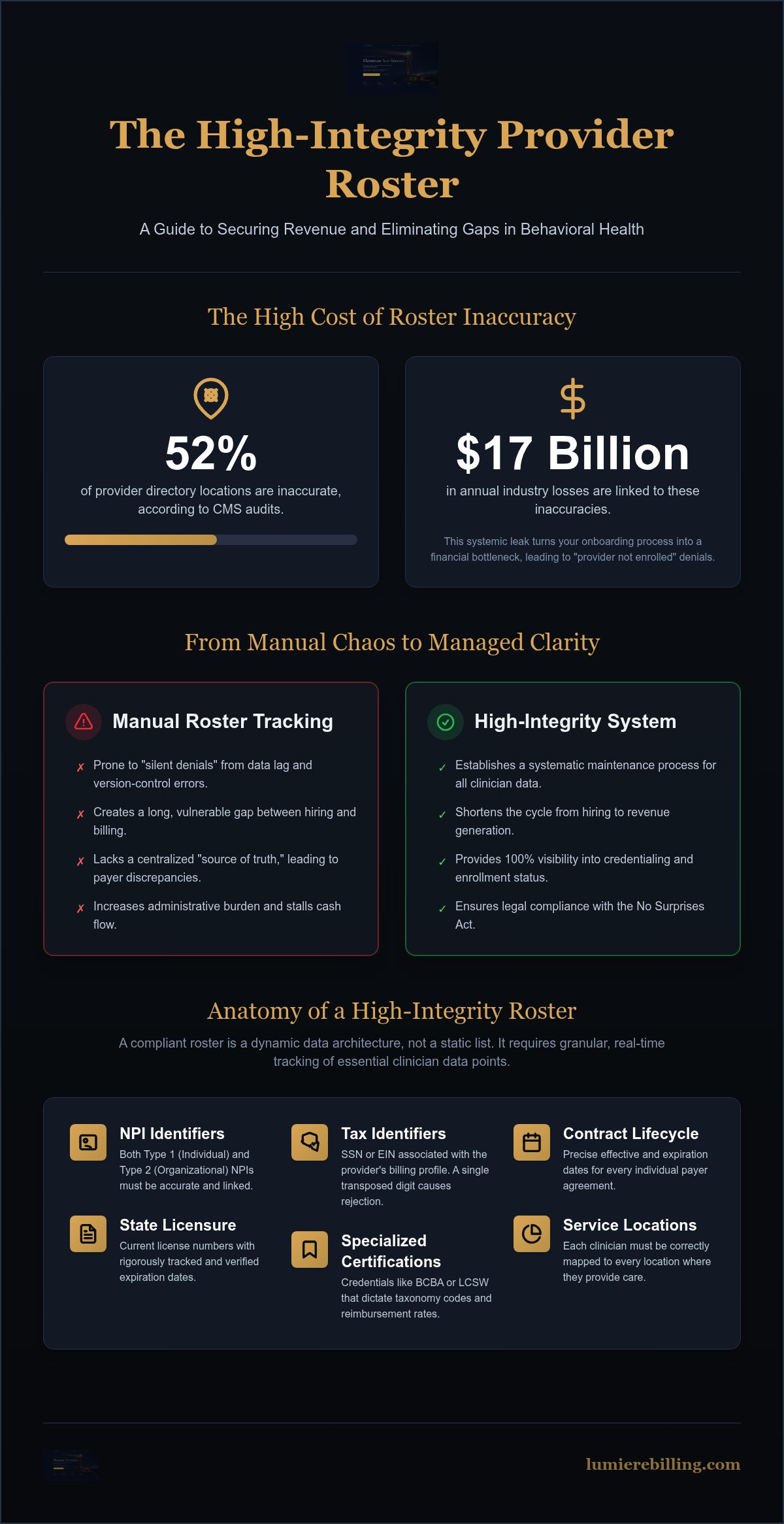
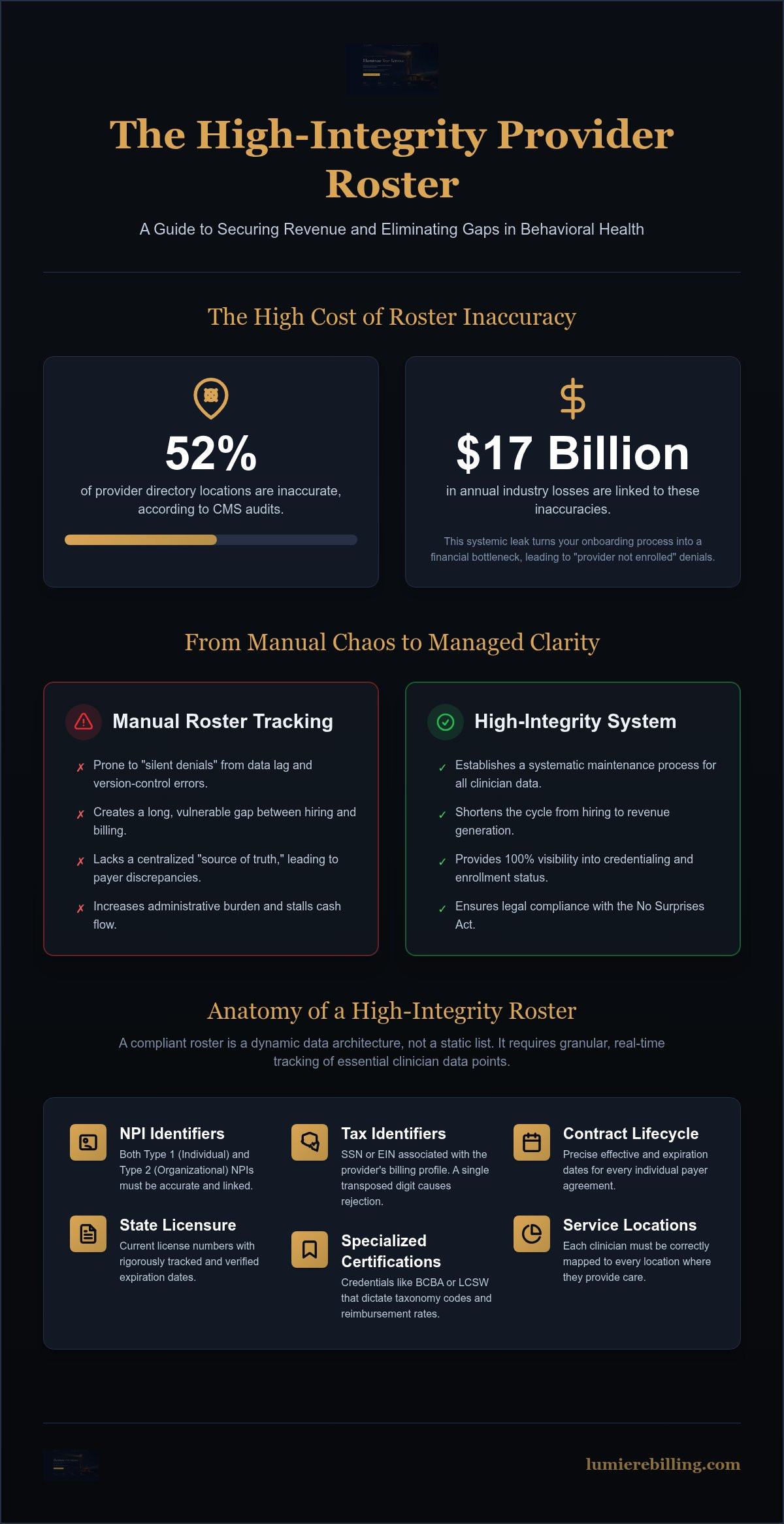
CMS audits reveal that 52% of provider directory locations are inaccurate, contributing to a staggering $17 billion in annual industry losses. For a behavioral health practice, these aren't just numbers on a report. They represent the silent erosion of your hard-earned revenue. You've likely felt the frustration of a "provider not enrolled" denial or the mounting anxiety of a manual spreadsheet riddled with version-control errors. It's a systemic leak that turns your onboarding process into a financial bottleneck. Effective provider roster management behavioral health organizations rely on requires more than just data entry. It demands a high-integrity system that functions as the mechanical heartbeat of your practice.
We recognize that the lag time between hiring a clinician and billing for their first session is a critical vulnerability. This 2026 guide promises to help you build a streamlined workflow that secures your revenue and eliminates credentialing gaps once and for all. You'll learn how to navigate the strict 90-day verification requirements of the REAL Health Providers Act while gaining 100% visibility into your roster. We will examine the latest regulatory shifts, outline a path to reduced administrative burden, and provide a blueprint for total oversight of your clinical team.
Key Takeaways
- Establish a systematic maintenance process for clinician data across all contracted payers to prevent avoidable claim rejections.
- Master the specific taxonomy codes and data points required for high-integrity provider roster management behavioral health practices need for compliant billing.
- Identify and eliminate "silent denials" caused by the lag time inherent in manual, spreadsheet-based tracking systems.
- Build a scalable onboarding workflow using a centralized system of record that shortens the time between hiring and revenue generation.
- Integrate roster management directly into your revenue cycle strategy to ensure 100% visibility into your credentialing and enrollment status.
What is Provider Roster Management in Behavioral Health?
Provider roster management is the systematic maintenance of clinician data across all your contracted payers. It's the engine room of your practice's administrative infrastructure. While primary care offices might update their records annually, behavioral health demands a higher frequency of oversight. Clinician turnover in mental health is historically higher; providers move between groups or transition to private practice more often. This volatility makes managed care systems particularly sensitive to your data quality. Establishing a rigorous process for provider roster management behavioral health practices can trust is the first step toward financial stability.
There's a critical distinction between your internal roster, the "source of truth" you keep in-house, and the external rosters maintained by payers. Discrepancies between the two are where revenue dies. We view roster integrity as the absolute prerequisite for successful behavioral health revenue cycle management. Without it, you aren't just managing data; you're managing chaos. When internal records drift away from payer directories, the entire billing cycle begins to fail.
The Link Between Roster Accuracy and Reimbursement
A single digit error in an NPI or a transposed number in a tax ID will trigger an immediate claim rejection. These aren't just administrative nuisances. They are financial roadblocks. When a payer's system cannot match the clinician on the claim to their internal directory, the result is a "provider not found" denial. This adds weeks to your accounts receivable (AR) days. Your cash flow stalls while you manually reconcile data that should have been synchronized months ago. Roster sync is the mechanical bridge that validates your credentialing status for every claim submitted.
Directory Accuracy and the No Surprises Act
Beyond the financial impact, roster management is now a legal mandate. The No Surprises Act and recent federal scrutiny target "ghost networks," which are directories filled with providers who aren't actually available or in-network. For behavioral health, this is a crisis of access. If a patient can't find care because your roster data is stale, the liability rests on the practice. You have a professional and legal responsibility to maintain payer directory integrity. It's about protecting your patients as much as protecting your revenue. Accuracy is no longer optional; it's a core compliance requirement.
The Anatomy of a High-Integrity Behavioral Health Roster
A high-integrity roster is not a static list; it's a dynamic data architecture that reflects the real-time status of your clinical team. For behavioral health groups, this data must be granular. Generic healthcare rosters often fail because they ignore the nuances of specialty taxonomy codes. A Board Certified Behavior Analyst (BCBA) requires different identifiers than a Licensed Clinical Social Worker (LCSW). If these codes are misaligned, your claims will hit a wall. Effective provider roster management behavioral health organizations implement depends on treating the CAQH profile as the primary source of truth. Any discrepancy between CAQH and your roster creates a ripple effect of denials.
Managing a group practice adds another layer of complexity: service locations. Each clinician must be correctly mapped to every location where they provide care. If a provider is listed at Site A but bills from Site B, the payer system flags the claim as a mismatch. This lack of precision leads to inaccurate provider information in public directories, which can trigger regulatory audits. Accuracy is the only defense against these systemic failures.
Essential Clinician Data Points
Your internal system must track more than just names. To maintain mechanical integrity, your roster should include:
- NPI Identifiers: Both Type 1 (individual) and Type 2 (organizational) NPIs.
- Tax Identifiers: SSN or EIN associated with the provider's billing profile.
- State Licensure: Current license numbers with verified expiration dates.
- Specialized Certifications: Specific credentials like BCBA or CADC that dictate reimbursement rates.
- Contract Lifecycle: Precise effective and expiration dates for every individual payer agreement.
Tracking these dates is non-negotiable. A missed re-credentialing window can pause your billing for months and force you to write off thousands in uncollectable revenue.
Payer-Specific Requirements
Payers like UnitedHealthcare, Aetna, and BCBS do not share a universal format. Each has a unique roster template that requires specific data fields. If you submit a BCBS roster on a Cigna template, it will be ignored. This administrative friction is amplified for practices with "delegated credentialing" status, where you carry the burden of maintaining the data to the payer's exact specifications. Your roster must be a perfect mirror of your mental health provider credentialing data. If you find this level of detail overwhelming, our credentialing and enrollment services can provide the professional oversight needed to keep your data synchronized.
Manual vs. Managed: The Hidden Costs of Roster Failures
The belief that spreadsheets are a "free" tool for provider roster management behavioral health is a dangerous administrative fallacy. In reality, manual tracking creates a technical debt that accumulates interest in the form of rejected claims and administrative friction. When you rely on a static document to manage a dynamic clinical team, you aren't saving money; you're obscuring systemic leaks. Manual processes lack the mechanical integrity required to survive the scrutiny of modern payer audits.
The Spreadsheet Trap
Version control is the primary failure point in manual systems. Within a group practice, the billing team, the credentialing coordinator, and the clinical director often work from disparate files. This creates data silos where critical updates, like a change in service location or a new taxonomy code, never reach the payer. Manual systems don't offer automated triggers to flag expiring state licenses or DEA certifications. Consequently, your team only discovers a lapse after a batch of claims has already been denied. This triggers a costly "re-work" cycle where staff must troubleshoot errors that should've been prevented at the roster level. Organizations often find it helpful to review standardized CareOregon provider data management forms to understand the depth of data required for even basic compliance.
Revenue Leakage and Opportunity Cost
The financial impact of roster lag is immediate and measurable. A 30-day delay in updating a new clinician's status can stall tens of thousands of dollars in cash flow, forcing the practice to carry the cost of a salary without the corresponding reimbursement. This lag often results in silent denials in behavioral health, where claims are trapped in a "pending" or "rejected" state because the payer's directory hasn't been refreshed. Your administrative team then enters the "denial-and-appeal" treadmill, spending hours on the phone to fix data mismatches. High-integrity roster management acts as a proactive denial prevention strategy that preserves your AR health. Beyond the balance sheet, these failures contribute to clinician burnout. When a provider's compensation is delayed due to preventable administrative errors, it erodes trust and destabilizes your practice's culture. Professional oversight ensures that your data moves as fast as your clinical operations.
How to Build a Scalable Roster Management Workflow
Scalability isn't about the size of your clinical team; it's about the rigidity of your administrative process. A haphazard approach to provider roster management behavioral health practices often default to is a recipe for revenue stagnation. You need a centralized "System of Record" that serves as the single, audited source of truth for your entire organization. This system must be deeply integrated into your hiring and termination checklists to ensure that no provider remains on a roster after they've left, and no new hire is left in billing limbo. Establishing this mechanical integrity prevents the data drift that leads to systemic claim rejections.
Step 1-3: Intake, Validation, and Centralization
Precision begins at the moment of hire. You must standardize the intake form for every new clinician to capture the granular data points discussed earlier, from specific taxonomy codes to Type 1 NPIs. Once collected, this data cannot be taken at face value. It must be immediately validated against the NPPES and CAQH databases to ensure absolute alignment. If the clinician's CAQH profile is stale, your onboarding process stops until it's corrected. Centralizing this validated data in a flexible format allows your team to export tailored files for various payer templates without manual re-entry. This step brings hidden discrepancies into focus before they ever reach a payer's desk.
Step 4-5: Submission and Verification
Submission is only half the battle. You must establish a bi-monthly submission cadence for all active payers to maintain directory accuracy and comply with the 90-day verification cycles required by the REAL Health Providers Act. After submission, the workflow shifts to verification. Your team must actively check the payers' "Provider Find" tools to ensure the updates were processed correctly. If a provider isn't visible or their location is wrong, the roster has failed. Document the exact "Effective Date" provided by the payer for each update. This date is the mechanical trigger that signals when it's safe to begin billing for that clinician's services. Without this documented verification, you are essentially guessing with your cash flow. To ensure your practice's financial health is fully protected, consider a free billing audit to identify where your current roster workflow might be leaking revenue.
A monthly roster audit completes the cycle. This audit reconciles your internal system of record against your active billing reports to ensure every provider currently seeing patients is fully enrolled and correctly rostered. It's a proactive measure that repairs broken links in your revenue cycle before they result in a denial. By treating roster management as a continuous loop rather than a one-time task, you secure the financial foundation of your practice.
Optimizing Your Practice with Professional Roster Oversight
Provider roster management behavioral health practices often relegate to the back office is actually the most critical precursor to a healthy bottom line. It shouldn't be an isolated administrative task. It's the mechanical foundation of your entire Revenue Cycle Management (RCM) strategy. When your roster data is out of sync, your revenue stops. By centralizing this process, you transition your practice from a reactive mode, where you're constantly fixing "provider not enrolled" denials, into a strategic growth mode. Precision in data management is the only way to ensure that your clinical expansion translates directly into financial stability.
The Lumiere Approach to Roster Integrity
Lumiere Billing acts as the vigilant protector of your clinician data. We don't just manage lists; we maintain the mechanical integrity of your practice's link to every payer. Our specialized focus on behavioral health niches, such as Applied Behavior Analysis (ABA) and Intensive Outpatient Programs (IOP), allows us to navigate the specific taxonomy and paneling requirements that generalist billers often overlook. We ensure every clinician is properly paneled and their data is verified before the first session occurs. This proactive stance eliminates the "silent denials" and roster lag that drain cash flow from group practices. We act as an extension of your team, providing the high-level oversight needed to keep your operations moving forward without friction.
Next Steps for Your Group Practice
Visibility is the first step toward true optimization. If you don't have 100% clarity on your current credentialing status across all payers, your revenue is at risk. Choosing to outsource mental health billing to a dedicated partner allows your leadership to stop managing spreadsheets and start managing clinical outcomes. We bring hidden systemic leaks into focus and repair the broken processes that lead to administrative burnout. It's time to move beyond the "re-work" cycle and establish a high-integrity system that supports your practice's long-term vision. We invite you to take the first step toward a more disciplined and profitable back office. Schedule your free billing audit with Lumiere Billing today to identify exactly where your provider roster management behavioral health workflow can be optimized for maximum reimbursement.
Eliminating Revenue Leaks Through Data Integrity
The stability of your practice depends on more than just clinical excellence; it requires a rigid commitment to data accuracy. High-integrity provider roster management behavioral health practices implement is the only way to prevent the silent denials that stall your cash flow. By moving away from manual spreadsheets and adopting a centralized system of record, you protect your revenue from the friction of credentialing gaps and directory errors. Precision is the ultimate safeguard against the administrative volatility of 2026.
Lumiere Billing acts as a vigilant protector of your practice's financial health. Our specialized behavioral health expertise and comprehensive credentialing and enrollment services ensure your clinicians are always paneled correctly before they see their first patient. We offer percentage-based fees to align our incentives with your growth, providing the transparency and mastery your back office deserves. Secure your revenue with a professional billing audit today to bring hidden systemic leaks into focus and repair broken workflows. You don't have to navigate these complexities alone. Your practice is ready for the clarity and stability that professional oversight provides.
Frequently Asked Questions
What is the difference between credentialing and roster management?
Credentialing is the initial process of verifying a clinician's qualifications and getting them paneled with an insurance company. Roster management is the ongoing maintenance of that provider's data across all active payers. While credentialing establishes the professional relationship, roster management ensures the relationship remains functional by updating locations, taxonomy codes, and active status. It's the difference between opening a door and keeping the hallway clear for traffic.
How often should a behavioral health group update its provider roster?
You should update your roster every 90 days at a minimum to comply with federal regulations like the REAL Health Providers Act of 2026. However, high-growth practices should submit updates immediately upon any change in clinician status, such as a new hire or a resignation. Maintaining a bi-monthly submission cadence ensures that your internal "System of Record" stays synchronized with payer directories, reducing the risk of "provider not found" denials.
What happens if a clinician is on our internal roster but not the payer’s roster?
If a clinician is missing from the payer's directory, any claims submitted under their NPI will likely be rejected or denied as "provider not enrolled." This discrepancy creates a "ghost network" issue where patients cannot find the care they are promised. It also causes significant revenue lag. You'll have to manually reconcile the data and appeal the denials once the payer's system finally reflects the correct provider information.
Can roster management errors cause CPT code denials?
Yes, roster errors often manifest as CPT code denials, specifically when a provider's taxonomy code is incorrect. For instance, if a provider is rostered as a general counselor but bills a CPT code specific to Applied Behavior Analysis (ABA), the payer may deny the claim for lack of appropriate credentials. Effective provider roster management behavioral health groups utilize ensures that every clinician's specialty codes align perfectly with the services they are billing.
How does CAQH enrollment factor into roster management?
CAQH acts as the primary "source of truth" for the entire industry. Most payers pull data directly from CAQH to populate their internal rosters. If a provider's CAQH profile is stale or unverified, any roster update you submit will be blocked or ignored. You must re-attest to CAQH every 120 days to maintain mechanical integrity. Roster management is essentially the bridge that connects your verified CAQH data to the payer's billing system.
Is there a standardized format for behavioral health rosters?
No, there is no universal industry standard, which is why roster management is so labor-intensive. Every payer, from UnitedHealthcare to BCBS, requires their own specific Excel or CSV template. Some payers even require different formats for delegated credentialing versus standard group rosters. You must maintain a flexible internal database that allows you to export your clinician data into these various templates without manual re-entry or formatting errors.
Does Lumiere Billing handle roster management as part of its RCM services?
Yes, Lumiere Billing integrates provider roster management behavioral health practices need directly into our comprehensive Revenue Cycle Management and Credentialing services. We act as a vigilant protector of your clinician data, ensuring that every new hire is properly paneled and rostered before their first session. By managing the link between enrollment and billing, we eliminate the administrative friction that causes revenue leakage and allow your team to focus on clinical care.
How long does it typically take for a payer to update a roster submission?
Payer processing times vary significantly, but most major insurers take between 30 and 45 days to reflect a roster update in their systems. Under the REAL Health Providers Act of 2026, some payers are now required to process removals within five business days, but additions still face a lag. You should always verify the update using the payer's "Provider Find" tool before you begin submitting claims for a newly rostered clinician.
Frequently Asked Questions
Credentialing is the initial process of verifying a clinician's qualifications and getting them paneled with an insurance company. Roster management is the ongoing maintenance of that provider's data across all active payers. While credentialing establishes the professional relationship, roster management ensures the relationship remains functional by updating locations, taxonomy codes, and active status. It's the difference between opening a door and keeping the hallway clear for traffic.
You should update your roster every 90 days at a minimum to comply with federal regulations like the REAL Health Providers Act of 2026. However, high-growth practices should submit updates immediately upon any change in clinician status, such as a new hire or a resignation. Maintaining a bi-monthly submission cadence ensures that your internal "System of Record" stays synchronized with payer directories, reducing the risk of "provider not found" denials.
If a clinician is missing from the payer's directory, any claims submitted under their NPI will likely be rejected or denied as "provider not enrolled." This discrepancy creates a "ghost network" issue where patients cannot find the care they are promised. It also causes significant revenue lag. You'll have to manually reconcile the data and appeal the denials once the payer's system finally reflects the correct provider information.
Yes, roster errors often manifest as CPT code denials, specifically when a provider's taxonomy code is incorrect. For instance, if a provider is rostered as a general counselor but bills a CPT code specific to Applied Behavior Analysis (ABA), the payer may deny the claim for lack of appropriate credentials. Effective provider roster management behavioral health groups utilize ensures that every clinician's specialty codes align perfectly with the services they are billing.
CAQH acts as the primary "source of truth" for the entire industry. Most payers pull data directly from CAQH to populate their internal rosters. If a provider's CAQH profile is stale or unverified, any roster update you submit will be blocked or ignored. You must re-attest to CAQH every 120 days to maintain mechanical integrity. Roster management is essentially the bridge that connects your verified CAQH data to the payer's billing system.
No, there is no universal industry standard, which is why roster management is so labor-intensive. Every payer, from UnitedHealthcare to BCBS, requires their own specific Excel or CSV template. Some payers even require different formats for delegated credentialing versus standard group rosters. You must maintain a flexible internal database that allows you to export your clinician data into these various templates without manual re-entry or formatting errors.
Yes, Lumiere Billing integrates provider roster management behavioral health practices need directly into our comprehensive Revenue Cycle Management and Credentialing services. We act as a vigilant protector of your clinician data, ensuring that every new hire is properly paneled and rostered before their first session. By managing the link between enrollment and billing, we eliminate the administrative friction that causes revenue leakage and allow your team to focus on clinical care.
Payer processing times vary significantly, but most major insurers take between 30 and 45 days to reflect a roster update in their systems. Under the REAL Health Providers Act of 2026, some payers are now required to process removals within five business days, but additions still face a lag. You should always verify the update using the payer's "Provider Find" tool before you begin submitting claims for a newly rostered clinician.