Mastering ABA Revenue Cycle Management: The 2026 Practice Guide

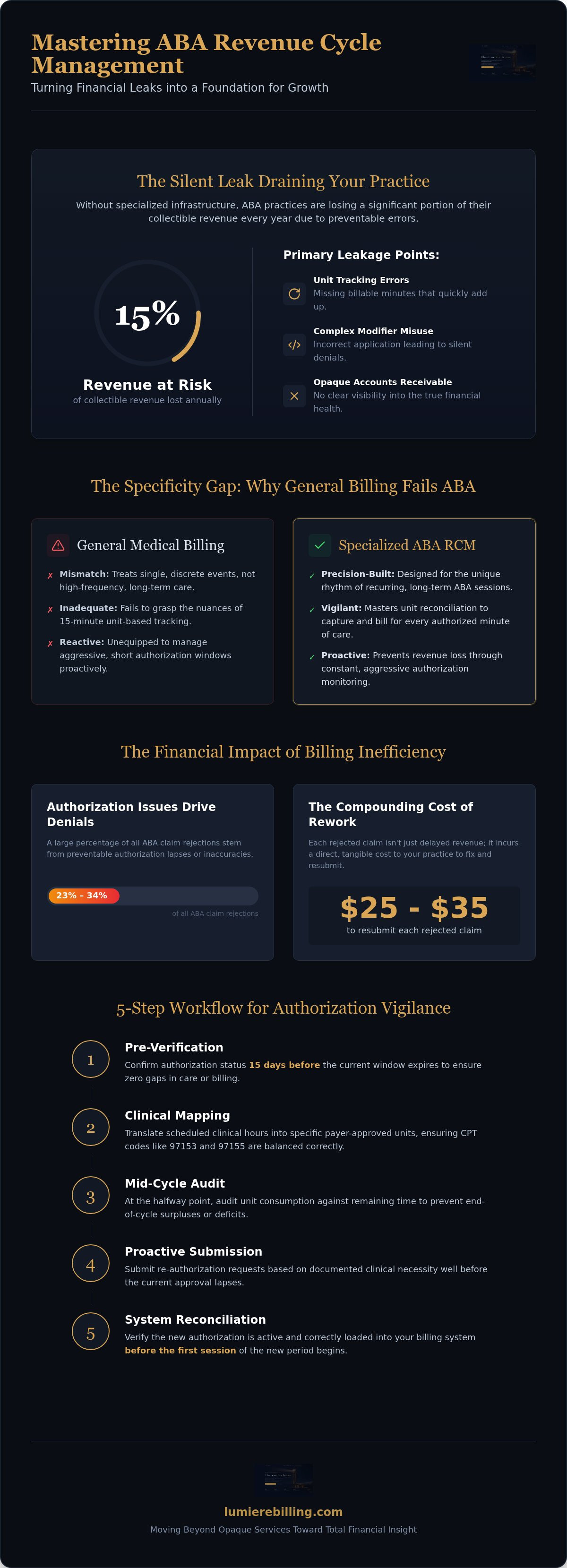
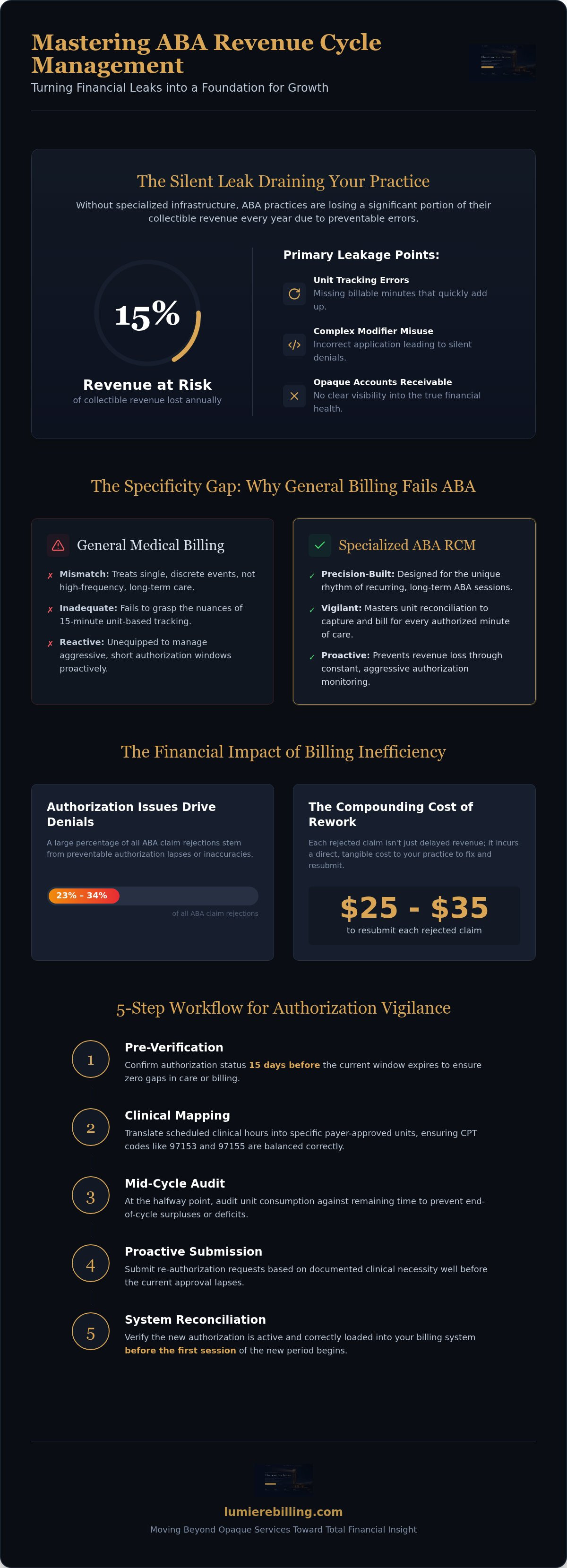
If your practice lacks a specialized infrastructure, you're likely losing up to 15% of your collectible revenue every single year. It's a silent leak. It drains the lifeblood from your clinical mission while you focus on patient care. You've likely felt the sting of unit tracking errors or the confusion of complex modifier requirements that turn hard-earned hours into unbillable losses. When ABA revenue cycle management lacks precision, it's impossible to have true visibility into the actual health of your accounts receivable.
We understand that 2026 brings tighter authorization windows and aggressive payer scrutiny. This guide will show you how to transform your billing from a back-office burden into a high-performance engine for clinical growth and financial stability. You'll learn how to master full unit utilization, reduce denial rates, and accelerate cash flow. We'll break down the precise methodologies required to repair broken systems and bring hidden systemic leaks into clear focus. It's time to move beyond opaque administrative services and toward total financial insight.
Key Takeaways
- Learn why general medical billing fails Applied Behavior Analysis and how to implement a unit-based tracking system that captures every billable minute.
- Identify specific "unit leakage" points in your workflow to stop session loss and ensure full utilization of authorized hours.
- Master the precise application of ABA modifiers to eliminate silent denials and prevent automatic rejections from increasingly vigilant payers.
- Establish 2026 industry benchmarks for ABA revenue cycle management, focusing on net collection rates to measure true financial health.
- Discover how a specialized, percentage-based RCM partnership aligns incentives to support practice scaling without compromising clinical quality.
Defining ABA Revenue Cycle Management: Beyond General Medical Billing
ABA revenue cycle management is a specialized discipline of authorization and unit reconciliation. It's the end-to-end management of every financial transaction within your practice. It starts at the first intake call and only ends when a claim reaches its final, accurate resolution. Most general medical billing firms treat ABA like standard primary care. They're wrong. Standard CPT codes often represent a single, discrete event. ABA relies on unit-based tracking where every 15 minutes counts. If you miss one unit, you lose revenue. If you bill one unit too many, you face a denial or a costly audit.
We view this process through the lens of a vigilant protector. This means moving away from passive processing. We don't just wait for denials to arrive; we build systems to prevent them. It's about proactive oversight that ensures your clinical growth isn't stunted by back-office inefficiency. When ABA revenue cycle management is handled with mechanical integrity, it transforms from a burden into a high-performance engine for your practice.
The Behavioral Health Specificity Gap
General medical billing firms often fail ABA practices because they don't understand the nuances of long-term, high-frequency care. In acute care, a patient visits, gets treated, and the cycle ends. In ABA, sessions recur daily or weekly for months. This volume creates a massive data trail. As of 2026, many commercial payers have shortened authorization windows to just three months. This requires constant, aggressive monitoring that generalists aren't equipped to handle. Behavioral health revenue cycle management requires a different rhythm. You need to track authorizations that expire, modifiers that change based on credentials, and overlapping session rules that standard software might ignore.
The RCM Life Cycle in an ABA Context
A clean claim begins long before a therapist enters a room. Intake and insurance verification form the bedrock. If the patient's benefits aren't verified with 100% accuracy, the entire cycle collapses. Clinical documentation must then align perfectly with CPT codes. A BCBA's notes aren't just clinical records; they're the evidence required to justify the units billed. Since over 85% of commercial ABA claims now require prior authorization, any disconnect between clinical notes and authorized units leads to immediate financial leakage.
Closing the loop is where many practices stumble. Payment posting is not the final step. True RCM involves analyzing why a penny was left on the table. It's about auditing the response from the payer to ensure every authorized unit was paid at the contracted rate. We look for the subtle failure points that others miss.
Mastering Authorization Tracking and Unit Reconciliation
Unit leakage is a systemic failure. It occurs when sessions are provided but cannot be billed because the authorization expired or units were exhausted. In 2026, many commercial payers have slashed authorization windows from six months to just three. This leaves a razor-thin margin for error. If your ABA revenue cycle management doesn't include real-time tracking, you're effectively flying blind. Sessions become "dead units", authorized hours that expire before they can be utilized. This isn't just a clinical oversight; it's a direct hit to your bottom line. Authorization-related issues now account for 23% to 34% of all ABA claim rejections. Each rejected claim costs between $25 and $35 to resubmit. These costs add up quickly, draining the resources needed for clinical expansion.
A 5-Step Workflow for Authorization Vigilance
Maintaining mechanical integrity in your billing requires a disciplined, step-by-step approach. We recommend this sequence:
- Step 1: Pre-verification. Confirm authorization status 15 days before the current window expires to avoid gaps in care.
- Step 2: Clinical Mapping. Translate scheduled clinical hours into specific payer-approved units, ensuring 97153 and 97155 codes are balanced correctly.
- Step 3: Mid-Cycle Audit. At the halfway point of the authorization, audit unit consumption against remaining time to prevent end-of-cycle surpluses.
- Step 4: Proactive Submission. Submit re-authorization requests based on clinical necessity well before the current approval lapses.
- Step 5: System Reconciliation. Verify that the new authorization is active and correctly loaded into your billing system before the first session of the new period.
Reconciling the Rendered vs. Billed Gap
The gap between what is rendered in the clinic and what is billed through the clearinghouse is where most revenue vanishes. Identifying these discrepancies requires a meticulous ABA unit tracking reconciliation process. Disconnects often happen when an EHR shows a session as complete, but the billing software fails to generate a claim due to a unit mismatch. These silent gaps lead to massive end-of-quarter losses that are often unrecoverable once the filing limit passes.
To stop this leakage, you must align scheduled hours with rendered hours and billed units daily. This level of focus borders on the obsessive, but it's necessary to protect your financial health. If you aren't sure where your leaks are, a Free Billing Audit can bring these hidden issues into focus before they become permanent losses.
The High Cost of ABA Modifiers and Silent Denials
Modifiers are the fine print of ABA revenue cycle management. They represent the difference between full reimbursement and a wasted hour. The modifier trap is a constant threat to practice stability. Incorrectly applying 95, GT, or HO modifiers triggers automatic rejections that stall your cash flow and increase administrative overhead. But there's a more insidious threat: the silent denial. This occurs when a claim is accepted by the payer but underpaid due to coding nuances. You might see a high clean claim rate and assume your back office is healthy. It's a false sense of security. If you aren't auditing the actual payment against your contracted rate, you're likely suffering from behavioral health billing errors to avoid.
Navigating ABA-Specific CPT Codes and Modifiers
Codes like 97153, 97155, and 97151 are the workhorses of your practice. However, their success depends entirely on the modifiers attached to them. Payer-specific contracts often have conflicting requirements for telehealth or provider education levels. One insurance company may demand the 95 modifier for remote supervision, while another insists on GT. A modifier error is often a systemic logic failure, not just a typo. It reflects a gap in your billing system's ability to adapt to diverse payer rules. Without mechanical integrity in your coding logic, these errors repeat across every claim for a specific client or payer, leading to massive annual losses.
Identifying Revenue Leakage in Existing Claims
Finding lost revenue requires looking backward. A retrospective audit can reveal patterns of underpayment that have persisted for months. These aren't just mistakes; they're systemic leaks. Recovering these funds often involves a rigorous process of ABA claim denial appeals. You must present clinical evidence and contract-specific language to force a correction. We often find that practices accept lower rates simply because they lack the visibility to see they're being underpaid. Our Free Billing Audit is designed to bring these hidden issues into focus. We don't just look for denied claims. We search for the accepted claims that were paid at the wrong rate. This meticulous attention to detail is what separates a specialized advocate from a generalist billing firm.
ABA RCM Benchmarks: Measuring Success in 2026
Measuring success in 2026 requires more than a glance at your bank balance. It demands a deep dive into the mechanics of your ABA revenue cycle management. For a healthy practice, Days in Accounts Receivable (AR) should consistently remain under 30 days. When this number exceeds 45 days, it's a signal that your billing engine is misfiring, likely due to credentialing gaps or unresolved denials. You must also distinguish between Gross and Net Collection Rates. Gross rates are vanity metrics. Net Collection Rate is the only number that defines your financial health, measuring what you actually collected against what you were contractually owed. Top-performing practices maintain a net collection rate of 98% or higher.
Denial management is equally critical. You need to categorize rejections as either "soft" or "hard" denials. A soft denial involves missing information or simple typos that are easily corrected. A hard denial challenges the medical necessity or coverage of the service itself. If your median first-submission denial rate sits between 18% and 28%, you're spending too much time on reactive fixes. Aim for a Clean Claim Rate (CCR) of 94% or higher to ensure your cash flow remains steady and predictable.
The KPI Dashboard: What Every ABA Director Needs to See
Visibility is the antidote to financial stress. Your dashboard should prioritize unit utilization percentage by provider. If a technician isn't utilizing authorized units, you're losing revenue and the patient is losing vital care. You must also monitor "Lag Time"—the days between session completion and claim submission. The industry's top quartile submits claims in less than 14 days. Use these analytics to predict your cash flow for the next 30 to 60 days, allowing you to make clinical hiring decisions with confidence rather than guesswork.
Benchmarking Your Practice Performance
Comparing your practice to industry standards reveals where your system is leaking revenue. Use the following benchmarks to evaluate your current performance:
- Days in AR: Industry Median (45-60 days) vs. Optimized (< 30 days)
- First-Pass Pay Rate: Industry Median (75-82%) vs. Optimized (94%+)
- Claim Write-Off Rate: Industry Median (8-15%) vs. Optimized (< 5%)
If your AR is consistently stagnant, it's often a sign that your internal team is overwhelmed by the high-frequency nature of ABA billing. This is typically when a behavioral health billing specialist becomes necessary to repair the system. Faster credentialing also plays a role here; the speed at which your providers are enrolled directly correlates to how quickly you can turn rendered sessions into collected revenue. Don't let your practice fall behind these 2026 standards. Request a Free Billing Audit to see exactly how your current metrics compare to industry leaders.
Scaling Your ABA Practice with Specialized RCM Support
Scaling an ABA practice introduces a specific type of friction. What worked for a single clinic often collapses when you add a second or third location. In-house billing teams frequently become overwhelmed by the sheer volume of recurring sessions and the meticulous unit tracking required for each new site. This is where ABA revenue cycle management shifts from a clerical task to a strategic barrier. When your internal staff is stretched thin, oversight fades. Denials go unaddressed. Authorizations lapse. By adopting a percentage-based RCM model, you align your success with your partner's performance. It's a simple, powerful incentive: our success is tied directly to your collections. This is a proactive partnership designed to protect your clinical mission.
Integrating outsource mental health billing into your clinical workflow ensures that growth is supported by a stable, scalable financial foundation. It allows you to move away from the generalist approach and embrace a partner who values precision over volume. This specialized support is what enables a practice to maintain a net collection rate of 98% even while doubling its patient roster.
Transitioning from In-House to Specialized Outsourcing
Transitioning to specialized outsourcing removes the administrative weight from your clinical leaders. Your BCBAs should focus on treatment plans and supervision, not chasing GT modifiers or arguing with payers over 97155 units. As you grow, maintaining audit readiness becomes a full-time job. A specialized partner ensures that every session note meets the tightened 2026 payer requirements before the claim is even generated. We also address the "Credentialing Bottleneck." When you hire new RBTs or BCBAs, their enrollment must be swift to prevent unbillable ramp-up periods that drain your cash reserves. Our team manages the enrollment process with the same level of focus we bring to ABA revenue cycle management, ensuring your new providers are revenue-ready on day one.
Lumiere Billing: Your Vigilant RCM Partner
Lumiere Billing operates as a specialized extension of your clinical team. We aren't just a vendor; we're a master of one specific craft. We bring hidden systemic leaks into focus and repair them with mechanical integrity. Our deep domain expertise in behavioral health allows us to anticipate payer shifts and audit trends before they impact your bottom line. The first step toward optimization is clarity. A Free Billing Audit identifies where your current system is failing and provides a roadmap for recovery. It's time to stop settling for mediocrity in your back office. Secure your practice’s financial future with Lumiere Billing and transform your billing operation into a high-performance engine for growth.
Transforming Your Practice into a High-Performance Engine
Mastering the complexities of 2026 requires moving beyond generalist administrative services. True ABA revenue cycle management demands a level of precision that general medical billing simply cannot provide. By focusing on meticulous unit reconciliation and navigating the intricate logic of ABA-specific modifiers, you protect your practice from the silent leaks that drain your resources. You've seen the benchmarks for success. Now it's time to align your back-office operations with your clinical excellence.
Lumiere Billing stands as your vigilant protector. Our exclusive focus on behavioral health RCM ensures we understand the nuances of your work; our percentage-based fee model aligns our success directly with yours. With our comprehensive analytics dashboard, you gain the visibility needed to scale with confidence. Don't let unbillable hours or constant denials stunt your growth. We're ready to bring your hidden financial issues into focus and repair the systems that hold you back. Request Your Free Billing Audit Today and see the difference a specialized partnership makes. Your clinical mission deserves a financial foundation built on mastery and mechanical integrity.
Frequently Asked Questions
What is the average denial rate for ABA therapy claims?
The median first-submission denial rate for ABA practices typically ranges between 18% and 28%. Top-performing agencies in the highest quartile maintain a much leaner rate of 4% to 8%. High denial rates often stem from authorization mismatches or credentialing lapses. Reducing these numbers requires a shift from passive processing to proactive oversight. Consistent monitoring and real-time reconciliation are the only ways to bring these figures down to industry-leading standards.
How does ABA revenue cycle management differ from general medical billing?
ABA revenue cycle management differs from general medical billing because it relies on unit-based tracking rather than discrete, one-time procedures. While a general practitioner might bill for a single office visit, an ABA therapist bills multiple 15-minute units per session. This high-frequency volume creates a massive data trail. It requires specialized knowledge of behavioral health CPT codes and the specific modifier logic mandated by diverse commercial and Medicaid payers.
Why are authorizations so difficult to track in ABA?
Authorizations are difficult to track because over 85% of commercial claims now require prior approval, and many payers have shortened windows to just three months. This razor-thin margin for error means a single missed deadline results in unbillable sessions. Tracking is complicated by the need to balance specific codes like 97153 and 97155 within the same window. Without mechanical integrity in your tracking system, units often expire unused or are over-utilized.
What are common ABA modifier billing errors?
Common errors involve the incorrect application of 95, GT, or HO modifiers, which often trigger automatic rejections. These codes indicate telehealth sessions or the specific educational level of the provider. Problems arise when modifier logic isn't tailored to individual payer contracts. A modifier error isn't just a typo; it's a systemic failure. If your billing system doesn't automatically map these codes based on specific insurance requirements, you'll face recurring rejections that stall cash flow.
How much do ABA billing services typically cost?
The typical fee for outsourced ABA revenue cycle management ranges between 5% and 8% of collected revenue. Most specialized firms use a percentage-based model to ensure their incentives align with the practice's financial health. This structure encourages the billing partner to pursue every dollar, including difficult appeals and underpaid claims. It's an investment in stability that often pays for itself by capturing the 8% to 15% of revenue typically lost to internal inefficiencies.
What is unit reconciliation in the context of ABA therapy?
Unit reconciliation is the process of aligning scheduled clinical hours with rendered sessions and billed units. It ensures that every minute of therapy provided is actually captured and submitted for payment within the authorized window. Discrepancies often occur between the clinical EHR and the billing clearinghouse, leading to "unit leakage." Meticulous reconciliation brings these hidden gaps into focus, preventing the "dead units" that expire before they can be converted into revenue.
How can I reduce my practice’s Days in AR?
You can reduce Days in AR by aiming for a Clean Claim Rate (CCR) of 94% or higher and submitting claims within 14 days of the session. Stagnant AR often points to a "Credentialing Bottleneck" or unresolved denials. If your AR exceeds 45 days, it's time to audit your follow-up processes. Proactive denial management and faster provider enrollment are essential levers. These steps ensure that rendered sessions are converted into liquid cash as quickly as possible.
What should be included in an ABA billing audit?
A comprehensive audit should include an analysis of denial patterns, a review of authorization utilization, and a verification of contracted rates against actual payments. It's designed to uncover "silent denials" where claims are accepted but underpaid. The audit should also evaluate modifier logic and provider credentialing status. This deep dive brings systemic leaks into focus, providing a clear roadmap to repair broken processes and stabilize the long-term financial health of your clinical practice.
Frequently Asked Questions
The median first-submission denial rate for ABA practices typically ranges between 18% and 28%. Top-performing agencies in the highest quartile maintain a much leaner rate of 4% to 8%. High denial rates often stem from authorization mismatches or credentialing lapses. Reducing these numbers requires a shift from passive processing to proactive oversight. Consistent monitoring and real-time reconciliation are the only ways to bring these figures down to industry-leading standards.
ABA revenue cycle management differs from general medical billing because it relies on unit-based tracking rather than discrete, one-time procedures. While a general practitioner might bill for a single office visit, an ABA therapist bills multiple 15-minute units per session. This high-frequency volume creates a massive data trail. It requires specialized knowledge of behavioral health CPT codes and the specific modifier logic mandated by diverse commercial and Medicaid payers.
Authorizations are difficult to track because over 85% of commercial claims now require prior approval, and many payers have shortened windows to just three months. This razor-thin margin for error means a single missed deadline results in unbillable sessions. Tracking is complicated by the need to balance specific codes like 97153 and 97155 within the same window. Without mechanical integrity in your tracking system, units often expire unused or are over-utilized.
Common errors involve the incorrect application of 95, GT, or HO modifiers, which often trigger automatic rejections. These codes indicate telehealth sessions or the specific educational level of the provider. Problems arise when modifier logic isn't tailored to individual payer contracts. A modifier error isn't just a typo; it's a systemic failure. If your billing system doesn't automatically map these codes based on specific insurance requirements, you'll face recurring rejections that stall cash flow.
The typical fee for outsourced ABA revenue cycle management ranges between 5% and 8% of collected revenue. Most specialized firms use a percentage-based model to ensure their incentives align with the practice's financial health. This structure encourages the billing partner to pursue every dollar, including difficult appeals and underpaid claims. It's an investment in stability that often pays for itself by capturing the 8% to 15% of revenue typically lost to internal inefficiencies.
Unit reconciliation is the process of aligning scheduled clinical hours with rendered sessions and billed units. It ensures that every minute of therapy provided is actually captured and submitted for payment within the authorized window. Discrepancies often occur between the clinical EHR and the billing clearinghouse, leading to "unit leakage." Meticulous reconciliation brings these hidden gaps into focus, preventing the "dead units" that expire before they can be converted into revenue.
You can reduce Days in AR by aiming for a Clean Claim Rate (CCR) of 94% or higher and submitting claims within 14 days of the session. Stagnant AR often points to a "Credentialing Bottleneck" or unresolved denials. If your AR exceeds 45 days, it's time to audit your follow-up processes. Proactive denial management and faster provider enrollment are essential levers. These steps ensure that rendered sessions are converted into liquid cash as quickly as possible.
A comprehensive audit should include an analysis of denial patterns, a review of authorization utilization, and a verification of contracted rates against actual payments. It's designed to uncover "silent denials" where claims are accepted but underpaid. The audit should also evaluate modifier logic and provider credentialing status. This deep dive brings systemic leaks into focus, providing a clear roadmap to repair broken processes and stabilize the long-term financial health of your clinical practice.