Outsource Mental Health Billing: A Strategic Guide

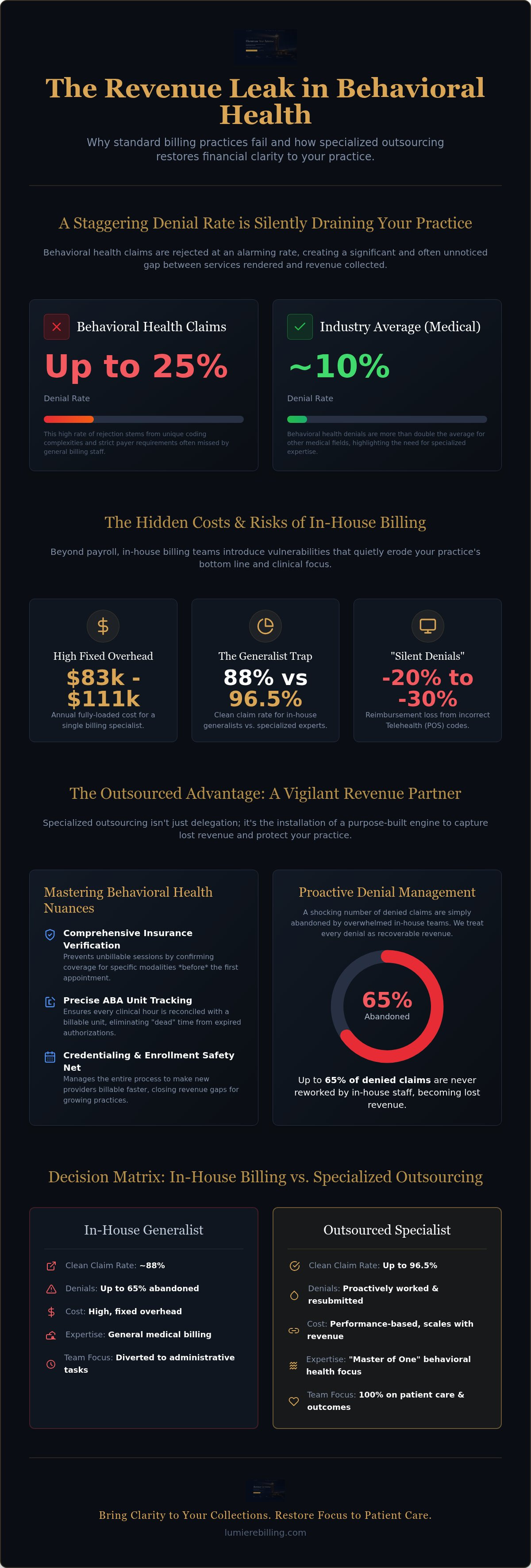
Did you know that behavioral health claims currently face denial rates as high as 25 percent; a figure that is more than double the industry average for standard medical claims? It's a staggering leak in your practice's financial health that often goes unnoticed until the administrative burnout becomes terminal. You likely feel the weight of every modifier error and the frustration of unworked denials that stall your growth. When you choose to outsource mental health billing, you aren't just offloading paperwork. You're installing a specialized revenue engine designed to detect the subtle systemic failures that in-house generalists often miss.
We understand that your clinical team should spend their hours in session, not chasing insurance payers or deciphering complex Place of Service codes. This guide reveals how specialized outsourcing recovers lost revenue by targeting clean claim rates as high as 96.5 percent. We'll explore how to reduce your days in Accounts Receivable and transition to a partnership that acts as a seamless extension of your team. By the end of this article, you'll see exactly how to bring clarity to your collections and restore your focus entirely to patient care.
Key Takeaways
- Identify the hidden financial drain of in-house billing, including the high cost of recruitment and the revenue lost to unworked denials.
- Learn why specialized ABA unit tracking and precise insurance verification are essential for preventing unbillable sessions.
- Evaluate the decision to outsource mental health billing by comparing in-house overhead against the transparency of a specialized revenue engine.
- Discover how to vet a potential partner by demanding real-time analytics instead of static reports that hide systemic leaks.
- Understand how a "master of one" strategy eliminates common behavioral health errors and allows your team to focus entirely on clinical outcomes.
The High Cost of In-House Mental Health Billing in 2026
Maintaining an in-house billing department is often viewed as a way to retain control. In reality, it frequently creates a veil of opacity that hides systemic financial leaks. For a three-provider practice in 2026, the fully loaded cost of a single billing specialist ranges from $83,000 to $111,000 annually when factoring in benefits, taxes, and software. This overhead is only the baseline. When that specialist leaves, the recruitment cycle and training lag leave your revenue cycle vulnerable. Most in-house teams struggle to keep pace with the 2026 Medicare Physician Fee Schedule updates, leading to a reliance on outdated workflows that invite audits.
The most dangerous threat to your practice is the "Silent Denial." These are claims that aren't outright rejected but are paid at a significantly lower rate than expected. This often happens when in-house staff use incorrect Telehealth Place of Service (POS) codes. Using POS 02 instead of POS 10 for a patient at home can trigger a 20 to 30 percent reduction in reimbursement. Without the specialized oversight found when you outsource mental health billing, these underpayments go unnoticed. They become a permanent, quiet drain on your resources.
The Generalist Trap: Why Medical Billing is Not Behavioral Health Billing
Generalist billers often treat mental health claims like standard medical procedures. This is a costly mistake. Behavioral health requires a master-of-one focus on time-based CPT codes. For example, billing a 60-minute session under CPT code 90837 requires exactly 53 minutes of documented time. Payers are increasing audits on these specific codes in 2026. A generalist may not flag documentation gaps before submission, leading to clawbacks. While an in-house team might achieve an 88 percent clean claim rate, specialized experts typically push that figure to 96.5 percent. That gap represents thousands of dollars in reclaimed revenue.
Administrative Burnout and Clinical Focus
When clinicians are forced to double as billing clerks, the patient-provider relationship suffers. Administrative friction creates a distracted environment where clinical mastery is sidelined by modifier errors and authorization tracking. This burnout is a primary driver of staff turnover. Revenue leakage is the systemic loss of earned income through uncaptured charges, under-coded sessions, and unworked denials that quietly erode a practice's bottom line. By choosing to outsource mental health billing, you remove this mechanical friction. You allow your clinical team to return to their true purpose while a vigilant partner repairs the broken systems in your back office.
Behavioral Health Nuances: What an Outsourced Expert Handles
Behavioral health is a discipline of exceptions. While standard medical billing follows a linear path, mental health requires a vigilant eye for time-based nuances and authorization limits. When you choose to outsource mental health billing, you gain a partner that understands the high-stakes environment of behavioral care. This starts with comprehensive insurance verification. It's the only way to ensure that a patient's plan covers the specific modality of care before the first session occurs. Proactive verification prevents the frustration of denied claims that stem from simple eligibility oversights.
Mastering the ABA Billing Cycle
Applied Behavior Analysis (ABA) presents some of the most complex challenges in the revenue cycle. Unit tracking is often where in-house teams fail. If units aren't reconciled in real-time, clinical hours become unbillable "dead" time that can never be recovered. A specialized partner manages complex modifiers and authorization expiration dates with obsessive detail. This prevents the common scenario where a provider delivers life-changing care only to find the authorization expired 48 hours prior. Our approach ensures that every hour of clinical work is matched by a billable unit.
The Credentialing Safety Net
Credentialing delays are the primary cause of revenue gaps for growing practices. A new provider sitting on the sidelines is a missed opportunity for both the practice and the community. We manage the entire enrollment process, from CAQH maintenance to payer roster updates. There is a critical difference between being "enrolled" and being "billable." We navigate the administrative labyrinth to ensure your team is ready to see patients the moment they join. You can start this process by requesting a Free Billing Audit to see where your current enrollment gaps exist.
Proactive Denial Management
Research indicates that 50 to 65 percent of denied mental health claims are never reworked or resubmitted by in-house teams. This is a massive failure of the system. An outsourced expert doesn't just resubmit claims; they diagnose the root cause. Whether it's a documentation inconsistency or a change in 42 CFR Part 2 consent requirements, we fix the source of the leak. This proactive stance is why outsourced specialists achieve a 96.5 percent clean claim rate. We treat every denial as a systemic flaw to be repaired, not a routine task to be repeated. We identify why the engine is leaking oil rather than just refilling the tank.
In-House vs. Outsourced: The Decision Matrix
Many practitioners equate physical proximity with financial oversight. They believe that having a biller in the office ensures accuracy and control. This is a fallacy. True oversight comes from visibility into the revenue engine, not a desk in the hallway. When you choose to outsource mental health billing, you replace manual, opaque processes with a system built on real-time dashboards and mechanical integrity. An in-house biller's performance is often buried in monthly manual reports that arrive too late to act upon. A specialized partner brings hidden issues into focus as they occur, providing a level of transparency that an internal team simply cannot match.
Evaluating the Bottom Line
A percentage-of-collections model creates a proactive partnership where our success is tied directly to yours. This alignment is absent in a salary-based model where the biller is paid regardless of how many denials they leave unworked. Consider the financial impact of a 5 percent increase in clean claim rates. For a practice collecting $1,000,000 annually, that shift alone represents $50,000 in recovered revenue that would have otherwise vanished into the 50 to 65 percent of denials that in-house teams typically ignore. Our Free Billing Audit provides the diagnostic clarity needed to uncover these hidden ROI opportunities within your existing ledger. This isn't just about reducing costs; it's about optimizing the yield of every clinical hour your team spends in session.
Scalability and Growth
Growth shouldn't be penalized by administrative friction. Expanding to a second location or adding three new clinicians often forces an in-house team to its breaking point, requiring another expensive hire before the new revenue even arrives. Outsourcing eliminates this bottleneck. We act as an elastic extension of your team, absorbing increased volume without adding to your fixed overhead. Beyond processing claims, we provide strategic practice advisory services. We use your billing data to identify which payers are most profitable and where your expansion will yield the highest returns. This transforms your back office from a cost center into a growth engine. You can scale your clinical impact without the fear that your administrative infrastructure will buckle under the weight of your success.
How to Choose a Behavioral Health Billing Partner
Selecting a partner is not a simple transaction. It is a deep integration into your clinical workflow. Many firms claim to handle mental health, but they are often generalist factories that prioritize volume over precision. When you decide to outsource mental health billing, you must verify that the firm is a master of your specific niche. A general medical billing company lacks the specialized knowledge to navigate the nuances of behavioral health documentation or the complexities of unit reconciliation. If they bill for podiatrists and pediatricians alongside behavioral health practitioners, your revenue is at risk of being treated as an afterthought. You need a dedicated advocate, not a generalist.
Demand to see their denial management workflow before signing any contract. Many providers discover too late that their billing service simply writes off complex denials because they lack the expertise to appeal them. A vigilant partner treats every denial as a systemic failure to be corrected, not a routine task to be ignored. They should provide a clear timeline for follow-up and a commitment to rework every claim until it is resolved. This proactive stance is what separates a specialized partner from a passive administrative service.
The Transparency Test
Static PDF reports are a relic of opaque administration. A high-quality partner provides a real-time KPI dashboard that brings your financial health into sharp focus. This visibility allows you to monitor your net collection rate, days in AR, and denial trends at a glance. If a firm resists this level of transparency, they are likely hiding inefficiencies or a lack of proactive oversight. You deserve a window into your financial health, not a monthly summary that masks systemic leaks. Ask specifically how often they update their data and whether you have 24/7 access to these insights.
EHR Optimization and Workflow
Your billing partner must be a master of the tools you use daily. Whether your practice relies on TherapyNotes or other specialized behavioral health platforms, the biller should optimize these systems to close the loop between clinical notes and claim submission. This technical mastery ensures that documentation triggers the correct billing logic automatically, reducing human error and accelerating the revenue cycle. They should act as a mechanical extension of your team, ensuring that your EHR is a bridge to reimbursement rather than a bottleneck. Before committing, you should schedule a Free Billing Audit to test their ability to identify missed revenue within your current setup.
The final step is the most critical: the diagnostic test. Never sign a long-term agreement without first seeing the firm's ability to uncover existing leaks in your ledger. A specialized partner will offer a comprehensive audit of your current accounts receivable to demonstrate their value. This process reveals their depth of knowledge and their ability to find revenue that your current system has missed. It is a low-risk way to verify if they truly possess the master-of-one focus required to protect your practice's financial health.
Lumiere Billing: Your Vigilant Revenue Partner
Lumiere Billing rejects the generalist identity. We are a master of one craft. In an industry where administrative mediocrity is the status quo, we position ourselves as the vigilant protector of your practice's financial health. When you choose to outsource mental health billing to our team, you aren't just offloading tasks. You are installing a specialized revenue engine designed for the unique complexities of behavioral health and ABA. We act as a disciplined, behind-the-scenes operator, deeply integrated into your clinical world. Our philosophy centers on precision over volume and partnership over mere transaction. We don't just process claims; we repair broken systems and bring hidden issues into sharp focus.
The Lumiere Difference: Precision and Visibility
Our approach transforms the "black box" of traditional billing into a transparent system of insight. While generalists focus on the volume of submissions, we focus on the integrity of the entire revenue cycle. This starts with meticulous insurance verification and extends to proactive denial prevention. We identify systemic leaks before they impact your cash flow. This level of specialized expertise does more than just recover lost revenue. It enhances your practice's valuation. A clean, predictable revenue cycle with reduced days in Accounts Receivable makes your practice a more stable and attractive entity. We provide the analytics and compliance oversight necessary to ensure your practice isn't just surviving, but optimizing every clinical hour.
Get Started with a Free Billing Audit
The first step toward financial clarity is a diagnostic one. Our Free Billing Audit is designed to uncover the revenue leakage that your current system has missed. We don't guess; we observe. We examine your existing AR to identify unworked denials, coding inconsistencies, and credentialing gaps that are stalling your growth. This audit provides immediate value by showing you exactly where your system is losing oil. It's a low-risk opportunity to experience our methodical approach and see the potential for a 96.5 percent clean claim rate. Don't let administrative friction dictate your clinical capacity. Claim your Free Billing Audit with Lumiere Billing today and secure the financial future of your practice.
Precision is our standard. Visibility is our promise. By aligning our success with your collections, we ensure a proactive partnership that respects your time and your mission. Let us handle the mechanical integrity of your back office so your clinical team can return to what matters most: patient care.
Secure Your Practice’s Financial Integrity
The decision to outsource mental health billing is more than an administrative shift; it's a commitment to the long-term health of your clinical mission. We've explored how specialized oversight repairs the systemic leaks that generalist billers and overworked in-house teams inevitably miss. By prioritizing data visibility over physical proximity, you transition from an opaque back-office operation to a transparent, data-driven revenue engine. True control isn't found in a desk down the hall; it's found in a clean claim rate that consistently hits 96.5 percent.
Lumiere Billing brings a master-of-one focus to your revenue cycle management, credentialing, and practice advisory. Our performance-aligned fee structure ensures we're vigilant protectors of your collections, while our analytics bring hidden issues into focus before they become terminal. You don't have to settle for the high cost of administrative burnout or the frustration of unworked denials. Your clinical team deserves a partner that acts as a seamless extension of their dedication.
Stop letting modifier errors and authorization gaps erode your impact. Get Your Free Behavioral Health Billing Audit and discover exactly where your revenue is leaking. You built your practice to provide life-changing care. Let us handle the mechanical integrity of your finances so you can return to your true purpose with absolute confidence.
Frequently Asked Questions
Is it more expensive to outsource mental health billing?
Outsourcing is typically more cost-effective than the total loaded cost of an in-house department. When you factor in recruitment, taxes, benefits, and the revenue lost to unworked denials, a percentage-based model often costs less than a single full-time salary. This transition moves your billing from a fixed overhead expense to a variable cost that only grows when your revenue does. You stop paying for administrative downtime and start paying for financial results.
Will I lose control over my practice's finances if I outsource?
You actually gain control by replacing office-based proximity with digital transparency. Having a biller in the next room doesn't guarantee you know your actual versus expected collections. A specialized partner provides real-time access to performance data, allowing you to see the movement of every claim. You retain full ownership of your accounts while gaining a level of visibility that manual, internal reporting rarely provides.
What is the typical clean claim rate for specialized behavioral health billing?
Specialized firms target a clean claim rate of 96.5 percent, which is the industry gold standard. Most in-house teams operate closer to 88 percent, meaning more claims are sent back for manual correction. This difference represents a significant acceleration of your cash flow. By ensuring claims are correct the first time, you reduce the time your money sits in insurance company accounts and move it into your own.
How does outsourcing help with insurance credentialing?
When you outsource mental health billing, your partner manages the administrative labyrinth of enrollment and CAQH maintenance. This is critical for onboarding new clinicians without the typical three-month revenue gap. We ensure that providers are fully billable before they see their first patient. This proactive management prevents the "dead weeks" where a therapist is seeing patients but the practice cannot yet submit claims for their work.
Can a billing company help reduce my claim denials?
Yes, by diagnosing the root cause of systemic errors rather than just resubmitting the same mistakes. We analyze denial patterns to identify documentation gaps or modifier errors that trigger automated insurance rejections. This diagnostic approach fixes the leak at the source. By repairing the workflow between the clinician and the biller, we significantly reduce the volume of claims that require manual intervention.
What should I look for in a mental health billing contract?
Look for clear language regarding data ownership, performance transparency, and specialized focus. The contract should specify that you own your patient and billing data, and it should outline exactly how often you will receive performance updates. Avoid contracts that don't emphasize behavioral health expertise. A specialized contract ensures your partner is accountable for the unique nuances of mental health billing, such as time-based CPT codes and ABA unit tracking.
How does a percentage-based fee structure benefit my practice?
A percentage-based model creates an absolute alignment of incentives. We are only paid when you are paid, which ensures we are obsessive about working every denial and appealing every underpayment. This is a proactive partnership that rewards precision and persistence. It eliminates the conflict of interest found in hourly or salary-based models where the biller is compensated regardless of the actual revenue they recover for the practice.
Do I need to change my EHR to outsource my billing?
You do not need to switch software to benefit from specialized billing oversight. We work within your existing TherapyNotes or other behavioral health platforms to optimize the revenue cycle from within. Our goal is to act as a mechanical extension of your team, not to force a disruptive technical migration. We audit your current workflow to ensure your EHR is configured to capture every billable unit accurately and compliantly.
Frequently Asked Questions
Outsourcing is typically more cost-effective than the total loaded cost of an in-house department. When you factor in recruitment, taxes, benefits, and the revenue lost to unworked denials, a percentage-based model often costs less than a single full-time salary. This transition moves your billing from a fixed overhead expense to a variable cost that only grows when your revenue does. You stop paying for administrative downtime and start paying for financial results.
You actually gain control by replacing office-based proximity with digital transparency. Having a biller in the next room doesn't guarantee you know your actual versus expected collections. A specialized partner provides real-time access to performance data, allowing you to see the movement of every claim. You retain full ownership of your accounts while gaining a level of visibility that manual, internal reporting rarely provides.
Specialized firms target a clean claim rate of 96.5 percent, which is the industry gold standard. Most in-house teams operate closer to 88 percent, meaning more claims are sent back for manual correction. This difference represents a significant acceleration of your cash flow. By ensuring claims are correct the first time, you reduce the time your money sits in insurance company accounts and move it into your own.
When you outsource mental health billing, your partner manages the administrative labyrinth of enrollment and CAQH maintenance. This is critical for onboarding new clinicians without the typical three-month revenue gap. We ensure that providers are fully billable before they see their first patient. This proactive management prevents the "dead weeks" where a therapist is seeing patients but the practice cannot yet submit claims for their work.
Yes, by diagnosing the root cause of systemic errors rather than just resubmitting the same mistakes. We analyze denial patterns to identify documentation gaps or modifier errors that trigger automated insurance rejections. This diagnostic approach fixes the leak at the source. By repairing the workflow between the clinician and the biller, we significantly reduce the volume of claims that require manual intervention.
Look for clear language regarding data ownership, performance transparency, and specialized focus. The contract should specify that you own your patient and billing data, and it should outline exactly how often you will receive performance updates. Avoid contracts that don't emphasize behavioral health expertise. A specialized contract ensures your partner is accountable for the unique nuances of mental health billing, such as time-based CPT codes and ABA unit tracking.
A percentage-based model creates an absolute alignment of incentives. We are only paid when you are paid, which ensures we are obsessive about working every denial and appealing every underpayment. This is a proactive partnership that rewards precision and persistence. It eliminates the conflict of interest found in hourly or salary-based models where the biller is compensated regardless of the actual revenue they recover for the practice.
You do not need to switch software to benefit from specialized billing oversight. We work within your existing TherapyNotes or other behavioral health platforms to optimize the revenue cycle from within. Our goal is to act as a mechanical extension of your team, not to force a disruptive technical migration. We audit your current workflow to ensure your EHR is configured to capture every billable unit accurately and compliantly.