Behavioral Health Revenue Cycle Management: 2026 Guide

Did you know that authorization-related errors now trigger 40% of all denied claims in the behavioral health sector? It's a staggering financial leak that quietly drains the lifeblood of otherwise thriving practices. You likely feel the weight of this imbalance every month. It's exhausting to watch your A/R aging reports climb while your clinicians focus on patient breakthroughs. You shouldn't have to choose between clinical excellence and financial viability. We understand that the administrative burden of credentialing delays and complex ABA unit tracking feels like a constant hurdle to your professional growth.
This 2026 guide will show you how to master behavioral health revenue cycle management to eliminate these leaks and stabilize your cash flow. We promise to provide the clarity you need to achieve a clean claim rate of 95% or higher. We'll explore the latest 2026 Medicare reimbursement shifts for LPCs and MFTs, the necessity of precise ABA modifier usage, and the specific strategies needed to reduce your A/R days to under 35. We're moving away from the opaque nature of traditional billing to bring your practice's financial health into sharp, actionable focus.
Key Takeaways
- Understand why behavioral health revenue cycle management serves as the financial nervous system of your practice, managing every critical touchpoint from initial intake to final payment.
- Learn to eliminate front-end errors by centralizing the Verification of Benefits process and mastering the meticulous precision required for ABA unit tracking.
- Identify and repair systemic revenue leakage caused by silent denials, outdated fee schedules, and credentialing gaps that compromise your practice's cash flow.
- Implement a refined clean claim scrubbing protocol to achieve a 95% first-pass resolution rate and stabilize your practice’s financial rhythm.
- Discover how specialized RCM partnerships and incentive-aligned fee models provide the visibility needed to scale your practice without clinical distraction.
Defining Behavioral Health Revenue Cycle Management (RCM)
Effective behavioral health revenue cycle management functions as the financial nervous system of your practice. It is a specialized ecosystem where clinical care and administrative precision must sync perfectly. This cycle is not a single, isolated administrative task. It is a continuous loop. It begins the moment a prospective patient requests an intake and only concludes when the final balance reaches zero. While general medical billing often deals with one-off acute incidents, behavioral health RCM manages the complexities of long-term therapeutic relationships. Every session, every modifier, and every minute documented serves as a critical pulse point in this system.
The role of clinical documentation is paramount. In this niche, the note is the claim. If start and stop times are missing or if a CPT code like 90837 is used without supporting documentation, the financial lifecycle breaks. We view RCM as a vigilant protector of your practice's health, ensuring that every clinical breakthrough is matched by fiscal stability.
The Core Components of the Behavioral Health Cycle
The lifecycle of a behavioral health claim demands precision at every stage to prevent revenue leakage. A failure at any point creates a ripple effect that delays your cash flow. The core pillars include:
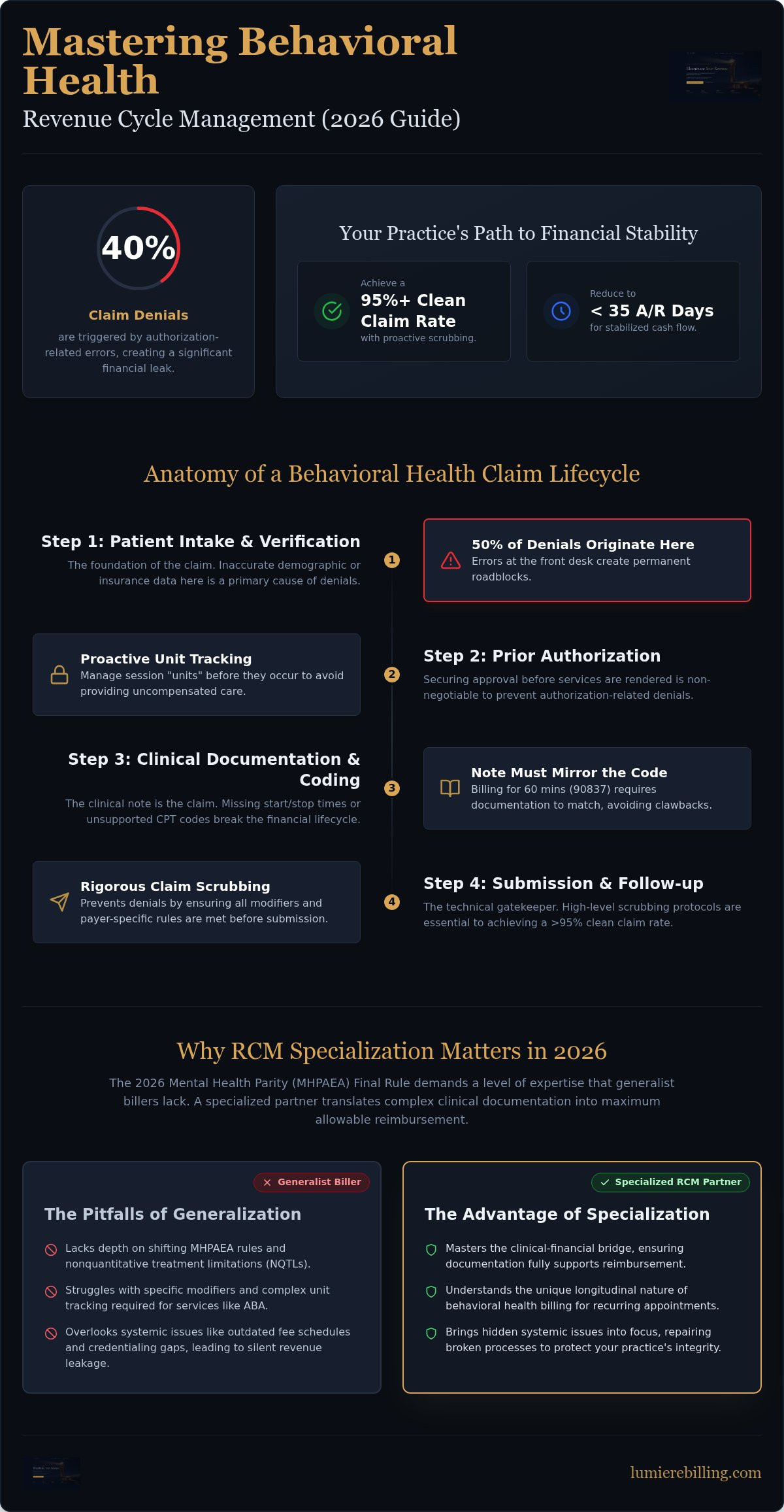
- Insurance verification and prior authorization: This is the foundation. With authorization-related denials accounting for 40% of all rejected claims in 2026, front-end accuracy is non-negotiable.
- Provider credentialing and enrollment: Revenue stops when enrollment lags. Maintaining active, accurate credentialing ensures new clinicians can bill immediately without months of "pending" status.
- Claims submission and proactive prevention: We don't just chase denials; we stop them. Achieving a 95% clean claim rate requires a rigorous scrubbing protocol before the claim ever reaches the payer.
- Patient responsibility: High-deductible plans make transparent collections and clear communication essential for maintaining a steady rhythm of income.
Why Specialization Matters in 2026
The 2026 landscape is defined by the Mental Health Parity and Addiction Equity Act (MHPAEA) Final Rule. Payers are now under stricter scrutiny regarding nonquantitative treatment limitations (NQTLs). A generalist billing service lacks the depth to understand these shifting rules or the specific modifiers required for complex ABA unit tracking. Behavioral health involves recurring appointments that create a unique longitudinal financial record. You need a partner that masters the clinical-financial bridge. This ensures that your clinical documentation translates directly into maximum allowable reimbursement. We bring hidden systemic issues into focus, repairing the broken processes that generalists often overlook. Precision isn't just a goal; it's the only way to protect your practice's integrity in a specialized market.
The Anatomy of a Behavioral Health Claim Lifecycle
A claim is more than a digital form; it's a chronological narrative of clinical care. In behavioral health revenue cycle management, the lifecycle begins long before the provider enters the room. Failure to treat each step with surgical precision leads to the revenue leakage that plagues many practices. We see it constantly: a brilliant clinical team undermined by a fractured administrative process. Each stage of the claim's journey must be meticulously monitored to ensure the practice remains financially viable.
Step 1: The Intake. Industry data indicates that 50% of claim denials originate at the front desk. This is where demographic errors, misspelled names, or expired insurance cards create permanent roadblocks. Step 2: Authorization Tracking. You must manage "units" before the session occurs. Without a proactive count, you're essentially providing free care. Step 3: Documentation and Coding. The clinical note must mirror the CPT code. If you bill for a 60 minute session but your note only supports 45, you're vulnerable to clawbacks. Step 4: Submission and Scrubbing. This is the technical gatekeeper. High-level scrubbing ensures that modifiers are present and payer-specific rules are met before the claim ever leaves your system.
Mastering CPT Codes and Modifiers
Navigating the choice between 90837 and 90834 is a common friction point. While 90837 (reimbursed at approximately $131 for Medicare in 2026) offers higher revenue, over-utilization without robust clinical justification triggers "red flag" audits. You must also account for credential-tier systems; Medicare pays LMFTs and LPCs at 75% of the psychologist rate. In ABA and telehealth, modifiers are the language of reimbursement. With Medicare permanently covering telehealth in 2026, using the correct platform modifiers is essential for clean claim submission. Understanding CCI edits ensures you don't attempt to bill incompatible services, such as certain group and individual therapy combinations on the same day.
The Prior Authorization Trap
Revenue Synergy reported in March 2026 that authorization-related issues cause 40% of all denied behavioral health claims. Most practices operate reactively, only realizing an authorization has expired after receiving a denial. A disciplined approach requires tracking unit utilization in real time. You should automate your re-authorization timeline to trigger at least 14 days before an existing authorization expires or when only two units remain. This proactive oversight prevents unbillable sessions and keeps your clinical schedule stable. If you're unsure where your current process is failing, a free billing audit can bring these hidden systemic leaks into focus and restore your practice's financial rhythm.
Beyond the Denial: Identifying Systemic Revenue Leakage
While a denied claim is a visible failure, systemic revenue leakage is a quiet, persistent erosion of your practice's equity. It's often more dangerous because it doesn't trigger an immediate alert. In behavioral health revenue cycle management, the focus often stops at the "accepted" status in the clearinghouse. This oversight allows "silent denials" to flourish. A silent denial occurs when a claim is processed and paid, but at a rate significantly lower than your legal, contracted fee schedule. You may see a payment and assume the cycle is complete, while in reality, you've left 15% or 20% of your earned revenue on the table.
Aging Accounts Receivable (A/R) is the primary killer of group practices. According to 2026 KPI benchmarks, A/R days exceeding 50 represent a critical warning sign for financial health. When cash remains trapped in the aging bucket, you lose the ability to reinvest in clinicians or expand services. Manual labor spent chasing these old claims is a high-cost substitute for automated accuracy. Every hour your staff spends on the phone with a payer is an hour they aren't improving the patient experience or streamlining intake. Automation in behavioral health revenue cycle management isn't just about speed; it's about eliminating the human error that leads to these administrative dead ends.
The Danger of Credentialing Delays
Credentialing is often treated as a "one and done" task. This is a mistake. Roster neglect or missed CAQH re-attestations can lead to a clinician becoming "un-paneled" overnight. If a high-volume provider cannot bill for just 30 days, the clinic loses thousands in unrealized revenue that can never be recovered. Moving beyond a "pending" status requires aggressive payer follow-up and a meticulous eye for detail. We view credentialing as a live, breathing part of the revenue cycle that requires constant vigilance to prevent total payment stoppages.
Uncovering Underpayments
Identifying underpayments requires comparing every remittance against your specific payer contracts. Many practices assume that if a claim is paid, it was paid correctly. This is rarely the case. We often find patterns where claims simply "vanish" between the EHR and the payer portal, or where payers apply incorrect credential-tier rates. Regular billing audits are the only way to bring these hidden issues into focus. By analyzing these discrepancies, you transition from passive observation to active protection of your practice's financial integrity. This level of oversight ensures that your actual reimbursements align with the 2026 Medicare rates, such as the $125 rate for LCSWs and LMFTs on code 90837. Without this vigilance, you are essentially leaving your practice's future to chance.
Strategies for Optimizing Practice Workflow and Cash Flow
Optimizing your practice's financial rhythm requires a shift from reactive chasing to proactive oversight. You must treat your administrative workflow with the same clinical rigor you apply to patient care. The first step in a high-performing behavioral health revenue cycle management strategy is centralizing the Verification of Benefits (VOB). Removing this burden from clinicians prevents burnout and ensures that coverage details are verified with 100% accuracy before the first session. This precision at the intake stage eliminates the demographic errors that often trigger a significant portion of industry denials.
A rigorous "clean claim" scrubbing protocol serves as your final technical gatekeeper. By implementing automated checks for payer-specific rules and CPT code compatibility before submission, you can achieve a first-pass resolution rate of 90% or higher. This level of vigilance prevents the manual rework that drains staff resources and delays your income. We recommend a disciplined 30-60-90 day A/R monitoring strategy. Daily monitoring allows you to identify and resolve aging claims before they reach the critical 40-day warning threshold. Data-driven analytics then transform these results into a predictive tool, helping you forecast cash flow and determine exactly when you have the financial stability to hire new clinicians.
ABA-Specific Optimization: Unit Tracking and Reconciliation
Applied Behavior Analysis (ABA) presents unique challenges that general medical billing systems often fail to address. You must master the reconciliation of authorized units against rendered sessions in real time. Managing the complexities of H2015 (wraparound services) and 97153 (adaptive behavior treatment) requires an obsessive focus on unit utilization. If a technician exceeds the authorized limit by even a single unit, the entire session often becomes unbillable. We focus on reducing modifier-related denials by ensuring that every intensive behavior therapy claim includes the specific credential-based modifiers required by your payers. This level of detail-oriented reconciliation is the only way to protect your ABA practice from significant revenue leakage.
EHR Optimization for Financial Clarity
Your Electronic Health Record (EHR) should be more than a digital filing cabinet. It must be a tool for financial visibility. Whether you use TherapyNotes or other specialized behavioral health platforms, configuring the system for billing efficiency is essential. We ensure total data integrity between your clinical notes and the billing module, preventing the "disconnects" that lead to audit risks. By customizing your dashboards for real-time KPI visibility, you bring hidden systemic issues into focus immediately. You gain a clear view of your net collection rate and charge lag, allowing you to make informed decisions based on facts rather than intuition. If your current workflow feels chaotic, request a free billing audit to see how a specialized partnership can restore precision to your practice.
Scaling Your Practice with Specialized RCM Partnership
Scaling a behavioral health practice from a solo operation to a multi-location group requires more than just clinical talent. It demands a transition from the reactive chaos of in-house administrative tasks to the outsourced precision of a specialized partner. Managing behavioral health revenue cycle management internally often results in high staff turnover and fragmented oversight. By contrast, a specialized partnership provides the mechanical integrity needed to support rapid growth. We act as a vigilant protector of your financial health, identifying the subtle failure points that generalist services overlook.
One of the most significant advantages of this model is the use of percentage-based fees. This structure creates a proactive partnership where incentives are perfectly aligned. We only succeed when you do. This transparency eliminates the opaque costs of hourly staff or flat-rate services that lack the motivation to chase difficult denials. For organizations moving toward multi-location operations, our Practice Advisory role offers the visibility and insight necessary to predict cash flow and manage complex credentialing across various payer regions. We bring hidden issues into focus, ensuring your expansion is built on a foundation of fiscal stability.
The Value of a Comprehensive Billing Audit
Every successful optimization begins with a clear view of the current landscape. A comprehensive billing audit brings hidden systemic issues into sharp focus. It reveals exactly where your revenue leakage is occurring, whether through "silent denials" or simple credentialing gaps. This process identifies "low-hanging fruit." These are the immediate billing errors that, once repaired, provide an instant boost to your cash flow. By establishing a baseline for your clean claim rates and A/R targets, we move your practice away from guesswork toward data-driven stability. We look for the 95% clean claim rate and sub-40 day A/R benchmarks that define industry leaders in 2026.
Focusing on the Mission: Clinician Freedom
The ultimate goal of professional RCM is to restore the focus on clinical care. Removing the administrative "noise" of insurance follow-ups and authorization tracking directly reduces clinician burnout. When your team is no longer burdened by the stress of back-office operations, patient outcomes naturally improve. Precision in billing isn't just a financial goal; it's a clinical necessity that allows your practice to fulfill its mission without the distraction of financial instability. To see exactly how much revenue your practice is leaving behind, Request your Free Billing Audit from Lumiere Billing today.
Securing Your Practice's Financial Future
Mastering behavioral health revenue cycle management requires more than basic administrative skills. It demands a vigilant, specialized approach that bridges the gap between clinical excellence and fiscal integrity. We've explored how front-end precision at intake prevents the errors that trigger 50% of industry denials and why proactive ABA unit tracking is essential for modern practice stability. Transitioning from in-house chaos to a disciplined, performance-based partnership provides the visibility you need to scale with confidence.
Our team brings hidden systemic leaks into focus by targeting a 95% clean claim rate and reducing A/R days to under 40. We specialize exclusively in the nuances of mental health and ABA billing; our performance-based pricing ensures we only win when you win. This alignment keeps us obsessive about your practice's growth and long-term stability. You deserve to focus on your patients while we protect your practice's financial health.
Take the first step toward total financial clarity today. Claim Your Free Behavioral Health Billing Audit to uncover exactly where your revenue is leaking. Your mission is clinical care; our mission is ensuring you are fully reimbursed for every minute of it.
Frequently Asked Questions
What is the difference between behavioral health RCM and general medical billing?
Behavioral health RCM is distinct because it manages credential-tier pay scales and recurring authorization cycles that general medical billing isn't built to handle. While general medical billing often deals with acute, one-off incidents, mental health requires tracking longitudinal care and time-based CPT codes. It also involves navigating complex "carve-out" administrators like Optum or Carelon, which require specialized knowledge to ensure accurate claims routing and reimbursement.
How can a specialized billing service reduce our claim denial rates?
A specialized service reduces denials by implementing front-end scrubbing protocols tailored to behavioral-specific rules and authorization requirements. By centralizing the Verification of Benefits, we catch the demographic errors that trigger 50% of industry denials before they reach the payer. Mastery of behavioral health revenue cycle management ensures that modifiers for telehealth or ABA are applied correctly, preventing the manual rework that typically slows your practice’s cash flow.
What are the most common CPT code errors in mental health billing?
The most frequent errors involve mismatched session times for codes like 90837 and 90834 or missing modifiers for telehealth and group therapy. Providers often fail to document exact start and stop times, which are mandatory for time-based reimbursement. Incorrectly billing 90837 for sessions under 53 minutes or neglecting the permanent 2026 telehealth modifiers triggers immediate audits and payment delays that compromise your practice's financial health.
How does ABA unit tracking and reconciliation work in RCM?
ABA unit tracking involves reconciling authorized units against rendered sessions in real-time to prevent unbillable service delivery. We monitor the utilization of codes like 97153 to ensure technicians don't exceed the session limits set by the payer. This proactive oversight prevents the revenue leakage that occurs when services are provided without a valid, remaining authorization balance, ensuring every hour of intensive behavior therapy is fully compensated.
Why is provider credentialing so critical for revenue cycle health?
Provider credentialing is the gatekeeper of your revenue because clinicians cannot bill for services rendered without active, verified enrollment. Delays in paneled status or neglected CAQH re-attestations can stop cash flow for an entire clinic overnight. Maintaining a clean, updated roster ensures that new providers begin generating revenue immediately rather than waiting months for "pending" status to resolve, protecting your group practice's growth trajectory.
What is a 'silent denial' in behavioral health?
A silent denial occurs when a claim is accepted and paid but at a rate significantly lower than your legal, contracted fee schedule. These underpayments often go unnoticed because the claim appears "successful" in your EHR or billing module. Without comparing every remittance against your specific payer contracts, you may be losing a significant portion of your earned revenue to these quiet administrative processing errors.
How much do behavioral health revenue cycle management services typically cost?
Most specialized behavioral health RCM services use a percentage-based fee model to align their incentives with your practice's actual collections. This performance-based structure means the billing partner only receives payment when you successfully receive your reimbursement. It's a transparent model that eliminates the fixed overhead of in-house staff while ensuring the billing team remains obsessive about capturing every dollar your practice is owed.
Can a billing audit help identify revenue leakage in my group practice?
A comprehensive billing audit identifies hidden systemic leaks and establishes a baseline for clean claim rates and A/R targets. It uncovers "low-hanging fruit" where simple process changes can provide an immediate boost to your cash flow. By analyzing your current aging A/R and denial patterns, an audit brings the invisible barriers to your practice's growth into sharp, actionable focus for 2026.
Frequently Asked Questions
Behavioral health RCM is distinct because it manages credential-tier pay scales and recurring authorization cycles that general medical billing isn't built to handle. While general medical billing often deals with acute, one-off incidents, mental health requires tracking longitudinal care and time-based CPT codes. It also involves navigating complex "carve-out" administrators like Optum or Carelon, which require specialized knowledge to ensure accurate claims routing and reimbursement.
A specialized service reduces denials by implementing front-end scrubbing protocols tailored to behavioral-specific rules and authorization requirements. By centralizing the Verification of Benefits, we catch the demographic errors that trigger 50% of industry denials before they reach the payer. Mastery of behavioral health revenue cycle management ensures that modifiers for telehealth or ABA are applied correctly, preventing the manual rework that typically slows your practice’s cash flow.
The most frequent errors involve mismatched session times for codes like 90837 and 90834 or missing modifiers for telehealth and group therapy. Providers often fail to document exact start and stop times, which are mandatory for time-based reimbursement. Incorrectly billing 90837 for sessions under 53 minutes or neglecting the permanent 2026 telehealth modifiers triggers immediate audits and payment delays that compromise your practice's financial health.
ABA unit tracking involves reconciling authorized units against rendered sessions in real-time to prevent unbillable service delivery. We monitor the utilization of codes like 97153 to ensure technicians don't exceed the session limits set by the payer. This proactive oversight prevents the revenue leakage that occurs when services are provided without a valid, remaining authorization balance, ensuring every hour of intensive behavior therapy is fully compensated.
Provider credentialing is the gatekeeper of your revenue because clinicians cannot bill for services rendered without active, verified enrollment. Delays in paneled status or neglected CAQH re-attestations can stop cash flow for an entire clinic overnight. Maintaining a clean, updated roster ensures that new providers begin generating revenue immediately rather than waiting months for "pending" status to resolve, protecting your group practice's growth trajectory.
A silent denial occurs when a claim is accepted and paid but at a rate significantly lower than your legal, contracted fee schedule. These underpayments often go unnoticed because the claim appears "successful" in your EHR or billing module. Without comparing every remittance against your specific payer contracts, you may be losing a significant portion of your earned revenue to these quiet administrative processing errors.
Most specialized behavioral health RCM services use a percentage-based fee model to align their incentives with your practice's actual collections. This performance-based structure means the billing partner only receives payment when you successfully receive your reimbursement. It's a transparent model that eliminates the fixed overhead of in-house staff while ensuring the billing team remains obsessive about capturing every dollar your practice is owed.
A comprehensive billing audit identifies hidden systemic leaks and establishes a baseline for clean claim rates and A/R targets. It uncovers "low-hanging fruit" where simple process changes can provide an immediate boost to your cash flow. By analyzing your current aging A/R and denial patterns, an audit brings the invisible barriers to your practice's growth into sharp, actionable focus for 2026.