Revenue Cycle Optimization for Therapists: 2026 Guide

Is your practice leaking revenue through cracks you can't even see? While your EHR might mark a claim as "accepted," the reality of silent denials and complex ABA authorization tracking means that much of your hard work remains uncompensated. Revenue cycle optimization for therapists isn't just a software setting; it's a disciplined clinical-to-claim integrity process that demands absolute precision. You didn't enter the behavioral health field to spend your evenings untangling payer rosters or fighting with credentialing departments. The administrative burnout is real, and the complexity of modern billing can make even the most successful practice feel like it's running in place.
We're here to help you regain control. This guide provides the blueprint to eliminate leakage and accelerate your cash flow through specialized behavioral health workflows. We'll break down how to achieve near-zero denial rates using proactive modifier management and how to build a scalable infrastructure that finally reduces your days in accounts receivable. It's time to bring your financial health into focus and repair the systems that are holding your practice back. By the end of this article, you'll have the strategies needed to turn your billing department into a vigilant protector of your practice's growth.
Key Takeaways
- Understand why behavioral health demands a specialized clinical-to-claim integrity process that general medical billing models simply can't match.
- Uncover "silent denials" and the hidden leakage points that prevent your practice from collecting on every session you provide.
- Master revenue cycle optimization for therapists by synchronizing your clinical documentation with proactive modifier management.
- Reposition credentialing from a standard administrative burden to a strategic growth catalyst that protects your long-term cash flow.
- Compare the efficiency of in-house billing against specialized oversight to determine which model best supports a scalable practice infrastructure.
The Behavioral Health RCM Ecosystem: Why Optimization is Different
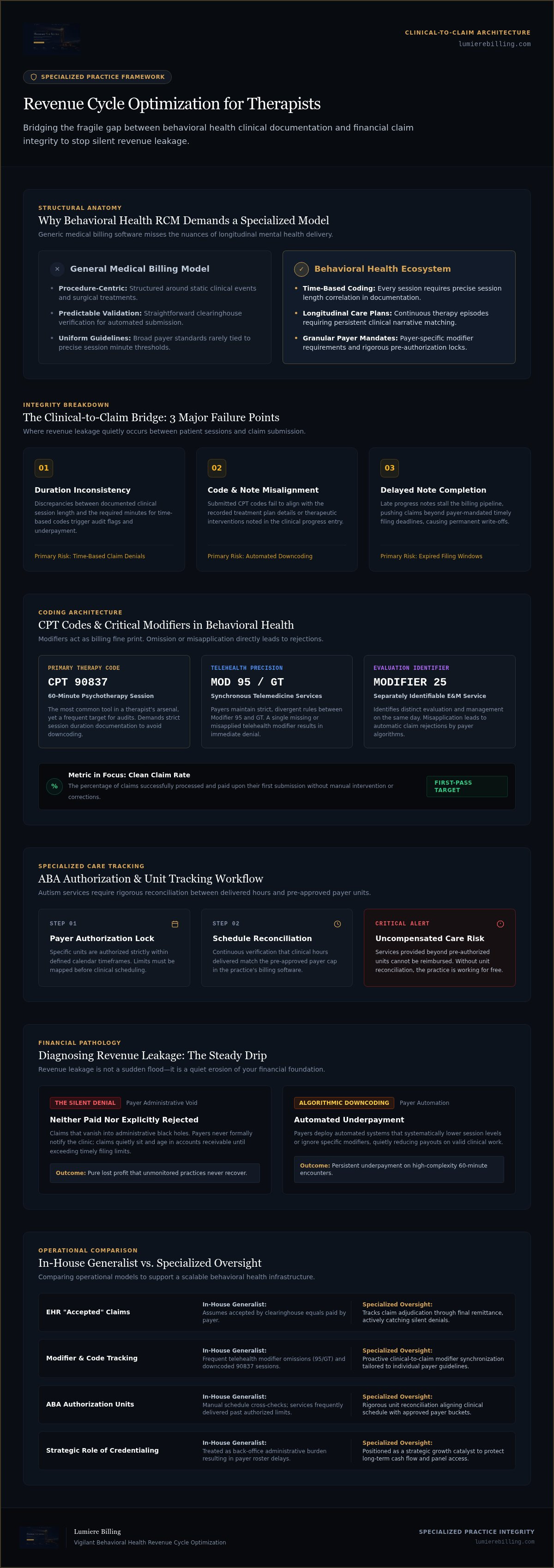
Revenue cycle management (RCM) is the lifeblood of any clinical practice, yet for behavioral health, it's far from a standard administrative task. At its core, healthcare revenue cycle management involves the strategic tracking of patient care episodes from initial appointment scheduling to the final payment of a balance. For therapists, this process is uniquely fragile. General medical billing often follows a rigid, procedure-based model. Behavioral health is different. It relies on time-based codes, longitudinal care plans, and complex payer-specific rules that generic software frequently misses.
True revenue cycle optimization for therapists requires bridging the gap between clinical documentation and financial submission. This "Clinical-to-Claim" bridge is where most revenue leakage occurs. It's not just about pushing buttons in an EHR; it's about ensuring that every minute of patient contact is captured and justified. Common failure points in this bridge include:
- Inconsistent session duration documentation for time-based billing.
- Misalignment between clinical notes and the submitted CPT codes.
- Delayed note completion that pushes claims outside of timely filing windows.
Implementing a rigorous system for revenue cycle optimization for therapists transforms billing from a back-office burden into a strategic asset that protects your practice's financial health.
The Role of CPT Codes and Modifiers
The 90837 cpt code is the most common tool in a therapist's arsenal, but its time-based nature makes it a frequent target for audits and denials. If your documentation doesn't precisely mirror the session duration or if you miss a required modifier, the claim is often rejected or underpaid. Modifiers act as the fine print of the billing world. A missing "95" for telehealth or an incorrect "GT" can lead to immediate revenue loss. In this context, a clean claim rate is the percentage of claims that are successfully processed and paid upon their first submission without requiring manual intervention or corrections.
Authorization and Unit Tracking Challenges
Autism services and ABA therapy introduce an even higher level of complexity. Practitioners must manage a heavy burden of authorization tracking where units are allocated for specific timeframes. If you provide services beyond the authorized units or fail to reconcile your schedule with your billing software, you're essentially working for free. Unit reconciliation is the foundation of RCM for these specialized services. It ensures that clinical hours delivered actually match the payer's pre-approved limits. To master these nuances, practitioners should focus on Mastering ABA Revenue Cycle Management to ensure no unit goes unbilled. Generalist billing services often overlook these granular details, leading to the silent denials that quietly erode your practice's profitability.
Diagnosing Revenue Leakage: Identifying Your Practice’s Profit Leaks
Revenue leakage is the quiet erosion of your practice's financial foundation. It represents the measurable gap between the services you provide and the actual collections that reach your bank account. For many behavioral health practitioners, this leakage isn't a sudden flood. It's a steady drip caused by systemic oversights. A primary culprit is the "silent denial." These are claims that payers neither pay nor explicitly reject. They often vanish into administrative black holes, left to age in accounts receivable until they exceed timely filing limits. Without a proactive strategy for revenue cycle optimization for therapists, these claims represent pure lost profit that most practices never recover.
Underpayment is another subtle form of leakage that generalist billing services often overlook. Payers frequently use automated systems to "downcode" sessions or ignore specific modifiers. For example, the misapplication of Modifier 25, which identifies significant, separately identifiable evaluation and management services, can lead to automatic denials in certain behavioral health contexts. If your billing team isn't monitoring these line items with clinical precision, you're likely leaving money on the table. Adhering to the CMS Medicare enrollment and billing guidelines is essential to ensure your practice meets federal standards and avoids these common pitfalls. Identifying these leaks is the first step toward reclaiming your practice's financial integrity.
The High Cost of Billing Errors
Inaccurate coding does more than delay payments; it invites audit risks. There are several behavioral health billing errors to avoid, such as unbundling services or misapplying time-based codes. When payers detect patterns of inaccuracy, they may flag your practice for manual review, slowing your cash flow to a crawl. Consider the cumulative impact: a seemingly small 5% denial rate can strip tens of thousands of dollars from a growing practice over a 12 month period. This is why visibility into your data is paramount. If you're unsure where your leaks are occurring, a Free Billing Audit can bring these hidden issues into focus.
Insurance Verification and Eligibility
Optimization starts before the patient ever sits on the couch. In 2026, real-time eligibility checks are non-negotiable. Many billing failures occur because of front-end errors, such as failing to identify behavioral health "carve-outs" where a different entity manages mental health benefits. A "Front-End First" mentality ensures that coverage is verified, authorizations are secured, and co-pays are identified before the session occurs. This proactive stance is the cornerstone of effective revenue cycle optimization for therapists, moving your practice away from reactive firefighting toward sustainable growth.
Strategic Workflow Optimization for Clinical and Financial Integrity
Workflow optimization is the mechanical backbone of a healthy practice. It requires a relentless audit of every touchpoint, from the initial client inquiry to the final reconciliation of funds. When clinical documentation is disconnected from billing requirements, revenue leakage becomes inevitable. Achieving true revenue cycle optimization for therapists means treating your clinical notes as financial documents. Every session note must serve as an airtight justification for the code billed. If your intake team captures incorrect insurance details or your clinicians delay signing notes, your cash flow stagnates.
The "Time-to-Submit" metric is a critical indicator of your practice's operational health. A lag of even 48 hours between the date of service and claim submission can delay your entire payment cycle. By streamlining the bridge from the therapist's office to the billing desk, you eliminate the friction that leads to aging AR. This process involves detecting and remediating revenue cycle leakage at the source rather than waiting for a payer rejection to signal a problem. Speed and accuracy aren't mutually exclusive; they're the dual engines of a well-oiled RCM system.
EHR Optimization and Integration
Your EHR is more than a digital filing cabinet. Platforms like CentralReach and TherapyNotes offer robust tools that many practices underutilize. EHR complacency often leads to manual workarounds that introduce human error and technical debt. You must configure your system to act as a gatekeeper, flagging missing modifiers or expired authorizations before a claim can even be generated. Automated unit tracking prevents over-billing by providing real-time visibility into remaining authorized hours for every client. This level of technical precision ensures that your billing infrastructure remains scalable as your provider roster grows.
The Power of Practice Analytics
Visibility is the antidote to administrative burnout. Moving from reactive billing to proactive revenue management requires a deep dive into your practice analytics. You should monitor Key Performance Indicators (KPIs) such as your net collection rate, days in accounts receivable (AR), and first-pass clean claim rate. Payer-specific dashboards allow you to identify trends where certain insurers consistently deny specific codes or modifiers. Instead of guessing why your revenue is fluctuating, you can use these insights to repair broken systems. This data-driven approach transforms your back-office from a cost center into a high-performance engine for practice growth.
Payer Management and Credentialing as Growth Catalysts
Credentialing is the silent gatekeeper of your practice's financial health. Many generalist billing services treat it as a secondary administrative task, separate from the billing cycle. This is a mistake. Without precise enrollment, your entire effort toward revenue cycle optimization for therapists collapses before the first claim is even generated. A delay in credentialing doesn't just stall a new provider's schedule; it creates a massive cash flow bottleneck that ripples through your accounts receivable for months. Strategic mental health provider credentialing allows you to leverage your clinical expertise during contract negotiations. It ensures you aren't just in-network, but profitably so, with rates that reflect the specialized care you provide.
Payer management is a dynamic process, not a one-time setup. It requires a vigilant approach to contract language and reimbursement schedules. When you view credentialing as a growth catalyst, you move from a passive recipient of payer terms to a proactive partner in the healthcare ecosystem. This shift is essential for any practice looking to scale without sacrificing clinical integrity or financial stability.
Credentialing and Enrollment Best Practices
Maintaining provider data is a relentless requirement that demands absolute accuracy. Utilizing CAQH enrollment services correctly is non-negotiable for keeping your information visible and accurate for payers. If your data lapses or re-attestation is missed, you face "unbillable gaps" where services are rendered but cannot be legally reimbursed. These gaps are often caused by provider transitions or simple administrative oversight during the hiring process. Expanding into new payer networks requires a methodical strategy that aligns with your practice's long-term growth goals. It's about precision and timing, ensuring every provider is fully authorized before the first session occurs.
Managing Payer Rosters for Group Practices
For group practices and multi-location clinics, the complexity of roster maintenance multiplies exponentially. Effective provider roster management behavioral health is essential to prevent "provider not found" rejections. These errors are entirely preventable but account for a significant portion of back-end failures in larger organizations. You must systematize your re-credentialing calendar to anticipate expirations at least 90 to 120 days in advance. A single missed deadline can halt payments for an entire provider's caseload, leading to administrative burnout and frustrated clinicians. If you need a partner to protect your practice from these systemic failures, our Credentialing & Enrollment services provide the specialized oversight you need to grow with confidence.
Implementing Professional Revenue Cycle Oversight
Transitioning from a reactive billing posture to a model of visibility and insight is the final stage of maturation for a successful clinical practice. When you evaluate revenue cycle optimization for therapists, you're faced with a critical choice: maintain an internal billing team or outsource mental health billing to a specialized partner. In-house management often suffers from administrative burnout and a lack of specialized oversight. This leaves "silent denials" to age out of existence because your team is too busy with daily tasks to chase complex appeals. A professional RCM partner brings mechanical integrity back to your back-office, ensuring that every session provided is a session paid.
The most effective partnerships utilize a percentage-based RCM fee model. This structure ensures total alignment between your practice and your billing team. If you don't get paid, the billing partner doesn't get paid. This creates a powerful incentive for the partner to act as a vigilant protector of your financial health, rather than a distant vendor just pushing claims through a system. By moving away from the opaque nature of traditional administrative services, you gain the clarity needed to make informed business decisions about your practice's future. True revenue cycle optimization for therapists isn't just about collecting money; it's about establishing a foundation of data that supports sustainable growth.
The Value of a Professional Billing Audit
A comprehensive behavioral health billing audit is the diagnostic tool that brings hidden issues into focus. It's the first step in repairing a broken system. You should expect an audit to identify historical underpayments that are still within the payer's appeal window, providing a strategy for immediate recovery. Lumiere Billing identifies systemic leaks in 48 hours or less, giving you a clear roadmap of where your revenue is escaping. This isn't a surface-level review. It's a deep dive into your clinical-to-claim bridge to ensure that your documentation, modifiers, and authorizations are working in perfect synchronization.
Choosing a Specialized RCM Partner
General medical billing firms often fail behavioral health providers because they don't understand the niche complexities of the field. They treat a therapy session like a standard physician visit, ignoring the obsessive unit tracking and specific modifier management required for ABA and mental health services. You need a partner that acts as a dedicated extension of your team, one that understands your EHR platform and your specific payer roster. Don't let mediocre billing practices cap your practice's potential. Schedule your Free Billing Audit today and take the first step toward reclaiming your practice's financial integrity.
Securing Your Practice’s Financial Future
The path to a resilient practice begins with acknowledging that billing is not merely a back-office chore. It's a precise clinical-to-claim bridge that requires specialized oversight to function correctly. By implementing revenue cycle optimization for therapists, you move from a state of administrative uncertainty to one of total visibility. You've learned how to diagnose silent denials, optimize your EHR workflows, and transform credentialing into a strategic growth catalyst. These aren't just incremental changes; they're the mechanics of a high-performance practice.
Lumiere Billing stands as your vigilant protector, offering nationwide credentialing expertise and advanced analytics designed specifically for ABA and mental health RCM. We bring hidden systemic leaks into focus and repair the cracks in your cash flow. It's time to stop letting underpayments cap your potential and start building the scalable infrastructure your providers deserve. Take the first step toward total financial clarity. Request Your Free Behavioral Health Billing Audit to uncover the hidden revenue opportunities waiting within your data. You've built a practice dedicated to healing; let us build the system that ensures you're paid for every moment of it.
Frequently Asked Questions
What is the difference between medical billing and behavioral health RCM?
Behavioral health RCM focuses on time-based session codes and complex unit reconciliation rather than the procedure-heavy model of general medical billing. You deal with longitudinal care plans and unique payer-specific authorization rules that standard medical billing often overlooks. For example, ABA services require meticulous tracking of authorized units across specific timeframes. Generalists often miss these nuances, leading to systemic revenue leakage that specialized oversight identifies and repairs.
How much revenue do therapists typically lose to billing errors?
While exact figures vary by practice size, some industry professionals report that behavioral health providers can lose a significant portion of their potential collections to unmanaged denials and coding errors. These losses often stem from silent denials or misapplied modifiers that go unnoticed by standard software. Without revenue cycle optimization for therapists, these minor discrepancies accumulate into substantial financial gaps. A professional audit often reveals that these hidden leaks quietly erode profitability month after month.
Can revenue cycle optimization work with my existing EHR?
Yes, professional optimization is designed to integrate seamlessly with your current EHR platform. We have deep expertise in industry-standard systems like CentralReach and TherapyNotes, ensuring that your data flow remains uninterrupted. Instead of replacing your software, we configure it to act as a more effective gatekeeper. This includes setting up triggers for missing modifiers and automating unit tracking to prevent the manual workarounds that often lead to human error and technical debt.
How long does it take to see results from RCM optimization?
You can see initial diagnostic results in as little as 48 hours through a comprehensive billing audit. This identifies immediate leakage points and historical underpayments ripe for recovery. Long-term results, such as a reduction in days in accounts receivable (AR) and a stabilized clean claim rate, typically manifest within the first 60 to 90 days. This timeline allows for the full cycle of claim submission, adjudication, and the implementation of refined clinical documentation habits.
Is it better to keep billing in-house or outsource to a specialist?
In-house billing often leads to administrative burnout and a lack of specialized oversight for complex appeals. Outsourcing to a behavioral health specialist provides a level of focus that borders on the obsessive, ensuring every session is justified and paid. A percentage-based fee model creates total alignment between your practice and the RCM partner. You gain the benefit of a dedicated extension of your team without the overhead of managing internal personnel or training generalists.
What are the most common CPT code errors for therapists?
The most frequent errors involve the 90837 CPT code, specifically regarding documentation that fails to justify the session's duration. Misapplied or missing telehealth modifiers, such as 95 or GT, also trigger immediate denials from many payers. Additionally, unbundling services that should be billed under a single code leads to audit risks and payment delays. Precision in these areas is essential for revenue cycle optimization for therapists to ensure that your clinical efforts translate directly into financial health.
How does credentialing affect my revenue cycle optimization?
Credentialing acts as the gatekeeper of your entire revenue cycle. Any delay in enrollment or a lapse in CAQH maintenance results in unbillable gaps where services rendered cannot be reimbursed. It isn't a one-time task but a dynamic process of roster maintenance and contract negotiation. When your providers aren't properly paneled, your RCM efforts fail at the source. Specialized oversight ensures that your providers remain fully authorized, preventing the systemic rejections that stall practice growth.
What is a "silent denial" in mental health billing?
A silent denial occurs when a claim is neither paid nor explicitly rejected by the payer. These claims often vanish into administrative black holes, left to age in your accounts receivable until they exceed timely filing limits. Because they don't trigger a standard rejection notification, they frequently go unnoticed by in-house teams. Identifying these hidden leaks is a primary focus of professional RCM, as they represent pure profit that is otherwise lost to payer inaction.
Frequently Asked Questions
Medical billing typically follows a linear procedural path, while behavioral health RCM manages complex, time-based sessions and recurring authorizations. Behavioral health requires meticulous unit tracking and reconciliation that general medical billing systems often overlook. True revenue cycle optimization for therapists involves bridging the gap between clinical notes and payer-specific requirements. This ensures that every hour of care provided is accurately captured and reimbursed without the delays typical of generalized billing services.
While exact figures vary by practice size, some industry professionals report that behavioral health providers lose between 5% and 15% of their potential revenue to billing errors and "silent denials." These losses stem from incorrect modifiers, expired authorizations, and poor follow-up on unpaid claims. Over a year, this leakage significantly impacts your bottom line. Identifying these profit leaks through a professional audit is the first step toward reclaiming your practice's earned income.
Yes, revenue cycle optimization for therapists is designed to integrate with and enhance your existing EHR platform. Specialized RCM partners have deep expertise in configuring systems like CentralReach, TherapyNotes, or SimplePractice to flag missing data before submission. Optimization isn't about replacing your software; it's about repairing the workflows and documentation habits that occur within that software to ensure a higher clean claim rate and faster cash flow.
You can often see a shift in visibility within the first 48 hours of a professional billing audit. Significant improvements in your clean claim rate and a reduction in days in Accounts Receivable typically materialize within 30 to 90 days of implementing optimized workflows. This timeline allows for the clearing of historical backlogs and the establishment of proactive denial management strategies that prevent future revenue interruptions and stabilize your income.
In-house billing offers direct control but often lacks the specialized depth and proactive oversight of a dedicated RCM firm. Outsourcing to a behavioral health specialist aligns your success with theirs through a percentage-based fee model. This partnership provides access to advanced analytics and national credentialing expertise that a single staff member cannot replicate. It transforms your billing from a fixed administrative cost into a performance-driven engine that supports scalable practice growth.
The most frequent errors involve the 90837 code for 60-minute sessions, particularly when documentation doesn't support the time spent. Other common pitfalls include the misapplication of modifiers like HJ or HO and failures in unit tracking for ABA services. These inaccuracies lead to immediate claim rejections or "downcoding" by payers. Precision in coding is essential to maintaining the mechanical integrity of your revenue cycle and avoiding costly audit risks.
Credentialing is the gatekeeper of your entire revenue cycle. If a provider's enrollment is outdated or a roster is maintained incorrectly, every claim submitted for their sessions will be rejected as "provider not found." This creates unbillable gaps that halt cash flow and damage your practice's reputation. Systematizing your re-credentialing calendar ensures that your clinical team remains revenue-positive and that your practice maintains leverage during payer contract negotiations.
A "silent denial" refers to a claim that is neither paid nor explicitly rejected by the insurance carrier. These claims often sit in a "pending" or "received" status indefinitely due to technical glitches or minor documentation omissions. Without a vigilant RCM partner to track and appeal these claims, they eventually expire and become uncollectible. Identifying and resolving these "limbo" claims is a core component of maximizing your actual collections and stopping revenue leakage.