Mental Health Revenue Reporting: Financial Visibility

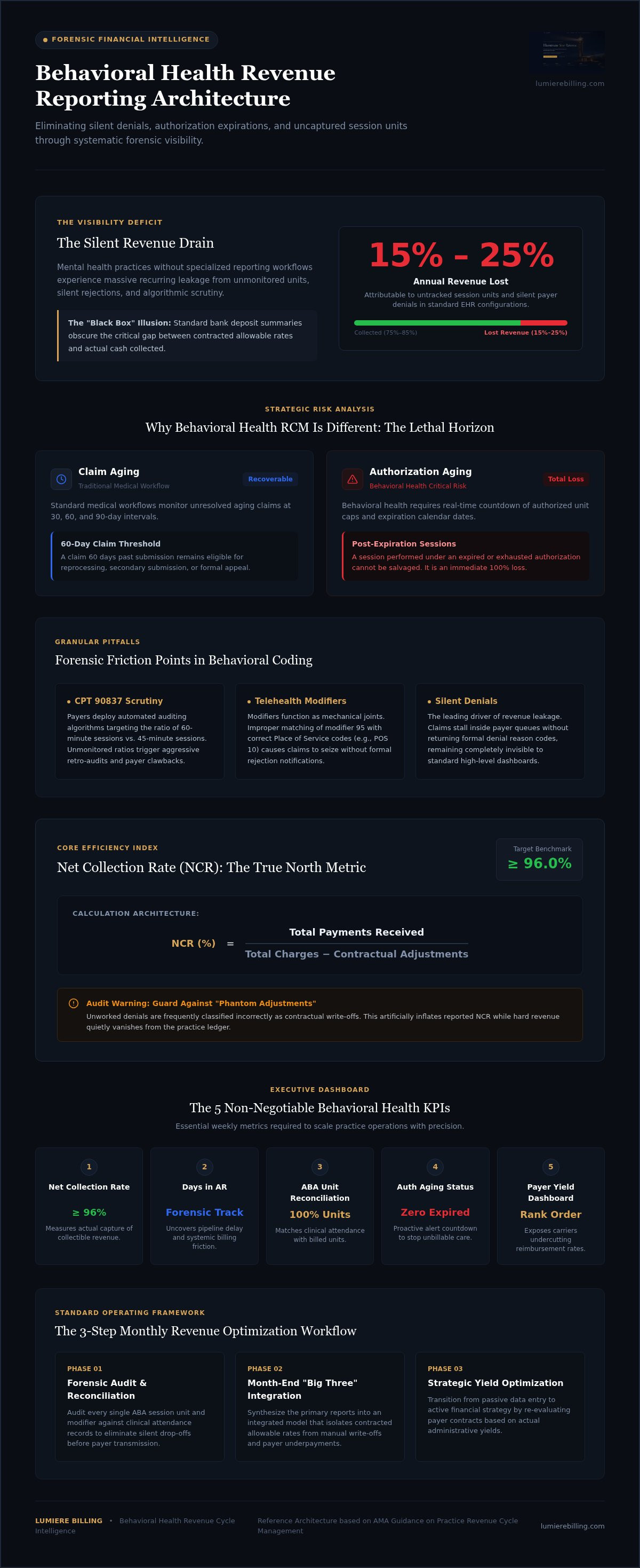
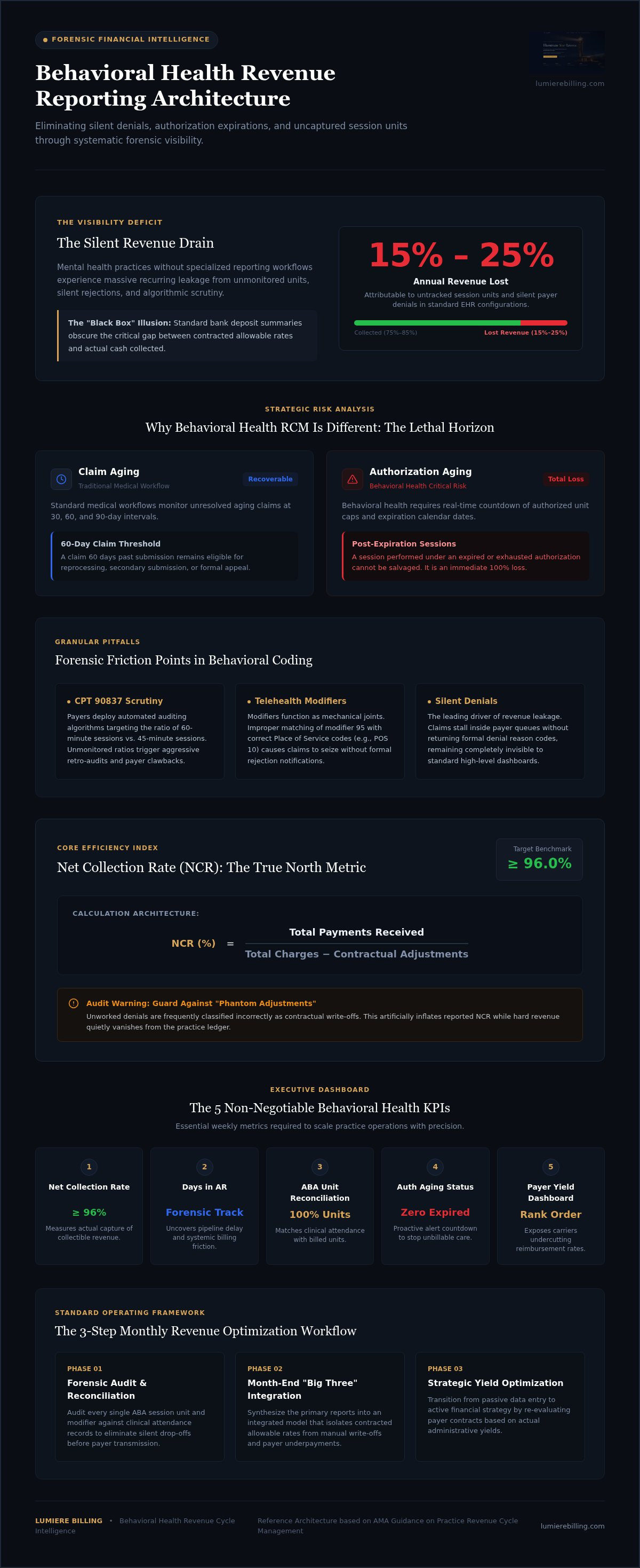
Recent industry data reveals that mental health practices without specialized workflows lose between 15% and 25% of their annual revenue to silent denials and untracked session units. This isn't a failure of clinical care; it's a failure of visibility. Most generic EHR dashboards provide a surface-level glance at billing that obscures the granular details needed for true financial health. Mastering revenue reporting for mental health practices requires moving beyond basic spreadsheets to a forensic approach that brings every ABA unit and modifier into sharp focus.
You likely feel the weight of opaque reports and the frustration of silent denials that never seem to resolve. We understand that tracking unit utilization and complex payer carve-outs is a specialized burden that general medical billing tools simply aren't built to handle. This guide will show you how to eliminate revenue leakage by implementing a repeatable monthly reporting workflow. You'll learn to calculate your net collection rate with certainty and identify exactly where payers are undercutting your reimbursement rates. We're breaking down the five non-negotiable KPIs every behavioral health leader needs to scale their practice with precision.
Key Takeaways
- Learn why bank deposits are a misleading metric and how to distinguish between contracted rates and actual collections to reveal your true financial standing.
- Master the five non-negotiable KPIs, including Net Collection Rate and Days in AR, to benchmark your practice against high-performing behavioral health groups.
- Implement a forensic audit process to uncover "silent denials" and ensure every ABA unit is reconciled and billed with mechanical precision.
- Establish a repeatable monthly revenue reporting for mental health practices that integrates rigorous month-end close procedures with the "Big Three" financial reports.
- Shift your focus from passive data collection to strategic revenue optimization by leveraging specialized analytics that standard EHR dashboards often obscure.
Why Standard Medical Billing Reports Fail Mental Health Practices
For many group practice owners, the bank balance is a comfort that masks systemic decay. Relying on simple deposit totals creates a "Black Box" problem where practitioners see the cash arriving but remain blind to the revenue left on the table. Standard medical billing software treats every claim as a static data point, yet behavioral health is inherently dynamic. If your reports only show "total billed" versus "total received," you are missing the critical delta between your contracted rates and your actual collections. This visibility gap often hides a revenue loss of 15% to 25%, a margin that represents the difference between a struggling clinic and a scalable enterprise.
Generic software often lacks the sophistication to navigate the nuances of CPT code 90837. Payers increasingly deploy automated algorithms to audit the ratio of 60-minute sessions against 45-minute sessions, yet most reporting tools don't flag these imbalances before they trigger a clawback. Effective revenue reporting for mental health practices must go deeper than surface-level summaries. It requires a forensic lens to identify where CCI edits or session duration scrutiny are quietly eroding your bottom line. Without specialized oversight, these subtle failure points become permanent financial leaks.
The Complexity of Behavioral Health Modifiers
Modifiers are the mechanical joints of a mental health claim; if they are misaligned, the entire system seizes. Standard reports often fail to categorize claims that are stalled due to modifier errors, leading to a phenomenon known as silent denials. Silent denials are the primary cause of unrecovered revenue, occurring when payers simply ignore a claim without issuing a formal rejection or reason code. Forensic reporting is the only way to catch 90837-specific underpayments and ensure that telehealth modifiers like 95 or POS 10 are reconciled correctly. Without this level of detail, your staff may spend weeks chasing payments that the payer has already written off in their internal systems.
Authorization Aging vs. Claim Aging
Traditional healthcare revenue cycle management focuses heavily on claim aging, but in the behavioral health sector, authorization aging is far more lethal. A claim that is 60 days old can often be recovered; a session conducted under an expired authorization is often a total loss. These "unbillable sessions" occur when the reporting workflow fails to countdown units or track expiration dates with precision. Specialized behavioral health revenue cycle management solves this visibility gap by integrating clinical attendance data with authorization thresholds. This proactive approach ensures that revenue reporting for mental health practices acts as an early warning system rather than a post-mortem analysis of lost income.
The 5 Non-Negotiable KPIs for Mental Health Revenue Reporting
If you cannot measure the precision of your billing cycle, you cannot scale your practice. Effective revenue reporting for mental health practices hinges on moving beyond intuition toward hard data. We focus on five metrics that differentiate a surviving practice from a thriving one. These KPIs provide the transparency needed to identify systemic bottlenecks and payer underperformance. Following AMA guidance on revenue cycle management, your team should monitor these figures weekly to prevent small leaks from becoming catastrophic losses.
Mastering the Net Collection Rate (NCR)
NCR is the ultimate indicator of your billing team's effectiveness. Calculated as (Total Payments) divided by (Total Charges minus Contractual Adjustments), this metric tells you exactly how much of your collectible revenue you are actually capturing. Behavioral practices should aim for an NCR of 96% or higher. Be vigilant against "phantom adjustments." These occur when unworked denials are written off as contractual adjustments, artificially inflating your NCR while your actual revenue vanishes. True visibility requires auditing these adjustments to ensure every dollar is accounted for.
The Payer Performance Dashboard
Not every insurance contract is worth the administrative burden. A specialized dashboard ranks carriers by "Time to Pay" and "Reimbursement Accuracy." If a payer consistently falls below your DAR (Days in Accounts Receivable) target of 30 days, it's time to reconsider that relationship. This data is also your strongest lever during mental health provider credentialing negotiations. When you can prove a payer has a 12% higher denial rate than their competitors, you have the evidence needed to demand better terms or higher rates. High-level revenue reporting for mental health practices turns these spreadsheets into strategic weapons.
To maintain a high-performing revenue cycle, your reporting must also include these critical benchmarks:
- Clean Claim Rate (CCR): Target 95% or higher. Anything lower indicates a systemic failure in front-end verification or coding accuracy that forces expensive claim rework.
- Days in Accounts Receivable (DAR): While 40 days is the industry average, top-performing psychiatric and therapy groups maintain a DAR under 30 days to ensure consistent cash flow.
- Denial Rate by Reason Code: Categorize denials by CARC and RARC codes. If 10% of your denials stem from "missing modifiers," you have a training issue; if they stem from "no authorization found," you have a front-end workflow collapse.
Requesting a specialized billing audit is the first step in establishing these baselines and identifying where your current reporting fails to protect your profit margins.
Forensic Analysis: Identifying Revenue Leakage in Mental Health Billing
Profitability in a behavioral health group isn't just about what you bill; it's about what you successfully recover. Many practice owners fall into the trap of assuming that a lack of rejection letters equals a healthy revenue cycle. This passivity is where profit dies. Silent denials represent claims that were submitted and received by the payer but never adjudicated. They sit in a digital purgatory, neither paid nor rejected, effectively vanishing from standard aging reports. Robust revenue reporting for mental health practices must include a systematic sweep for these non-responsive claims to prevent them from timing out under timely filing limits.
Identifying these hidden gaps is a core component of identifying revenue cycle leakage before it compromises your clinical operations. When you move beyond the surface level, you'll often find that "unexplained" revenue drops are actually tied to specific behavioral health billing errors to avoid, such as incorrect place of service codes or mismatched provider NPIs. Underpayment recovery requires a forensic mindset that treats every missing dollar as a puzzle to be solved rather than a cost of doing business.
ABA Unit Tracking and Reconciliation
ABA therapy presents a unique reporting challenge because it's built on 15-minute units rather than flat session fees. If your reporting doesn't reconcile authorized units against rendered units in real-time, you're likely providing free care. Overages occur when a technician provides more units than the insurance has approved, resulting in an automatic, unappealable denial. Precision in ABA revenue cycle management requires weekly reconciliation reports that compare clinical logs against claim submissions. This ensures that every hour of specialized care is accounted for and that your clinicians aren't inadvertently exceeding authorization caps.
Spotting Modifier-Related Underpayments
Payers frequently use National Correct Coding Initiative (CCI) edits to "bundle" services, effectively paying you for one service while ignoring the second. To fight this, your revenue reporting for mental health practices must track the usage and success rates of modifiers 25 and 59. These modifiers signal to the payer that a service is distinct and deserves separate reimbursement. Modifier errors and incorrect coding combinations can cost a practice up to 15% of its gross annual revenue if left unaddressed. By reporting on these codes at the payer level, you can identify which carriers are systematically downcoding your claims and adjust your billing strategy with forensic precision.
How to Build a Monthly Revenue Reporting Workflow
A disciplined monthly workflow transforms raw data into a strategic asset. Without a structured sequence, revenue reporting for mental health practices becomes a reactive exercise in damage control rather than a proactive shield for your profit margins. The process begins with a hard month-end close. You must draw a line in the sand where no further changes are made to the previous month's data. This ensures that your analytics remain consistent and verifiable.
Once the period is closed, follow this four-step sequence to achieve forensic visibility:
- Step 1: Data Validation. Confirm that your EHR encounters align perfectly with clearinghouse submissions. Discrepancies here lead to "ghost revenue" that will never materialize in your bank account.
- Step 2: Generate the "Big Three." Pull your AR Aging, Denial Summary, and Deposit Detail reports. These documents act as the diagnostic images of your practice health, revealing where cash is flowing and where it is stalled.
- Step 3: Authorization Cross-Referencing. Compare your authorization tracking logs against scheduled sessions. This step identifies sessions that were rendered without a valid authorization before they result in a permanent loss.
- Step 4: Leadership Review. Translate these figures into clinical staffing decisions. If a specific payer's turnaround time has slowed, you may need to adjust your cash reserves before onboarding new clinicians.
Establishing a Data Validation Routine
Daily payment posting is the mechanical core of an accurate reporting system. When payments are left unposted, they often sit as "unallocated payments" that distort your financial picture. This sediment makes your accounts receivable look artificially high and your collection rates look dangerously low. You must ensure that every dollar received is matched to a specific claim and patient account before running your month-end analytics. This rigor prevents the "Black Box" problem where bank deposits and EHR data fail to reconcile.
Translating Reports into Actionable Strategy
Data should dictate your next move. If your monthly denial trends show a spike in "medical necessity" rejections, you must update your clinical documentation training immediately. If your internal team consistently struggles to maintain a clean claim rate of 95%, it is often more cost-effective to outsource mental health billing to a specialized partner. High-level revenue reporting for mental health practices allows you to forecast cash flow with precision, providing the confidence needed for multi-location expansion. Schedule your Free Billing Audit today to identify your practice's hidden leakage points and establish a reporting baseline.
Scaling Visibility with Lumiere Billing’s Analytics & Advisory
Standard EHR dashboards often suffer from a "generalist" design, attempting to serve every medical specialty while mastering none. They provide a rear-view mirror look at your finances that lacks the depth required for strategic scaling. Revenue reporting for mental health practices demands more than just a summary of paid claims; it requires a predictive engine that identifies systemic friction before it stalls your cash flow. Lumiere Billing functions as an extension of your leadership team, moving your focus from passive data collection to proactive revenue optimization.
Our approach is built on the philosophy that visibility is the first step toward repair. While traditional billing services stop at claim submission, our Practice Advisory services analyze the "why" behind every financial outcome. We don't just report on your current state; we provide the roadmap for your next phase of growth by analyzing payer trends and identifying underutilized revenue streams. This transition from data observer to strategic operator is what allows behavioral health groups to expand with forensic precision.
The Power of Specialized Analytics
Lumiere provides custom dashboards designed exclusively for the behavioral health sector. These tools offer real-time insights into how provider roster management behavioral health impacts your bottom line. For example, we track the specific revenue lag caused by credentialing delays for new clinicians, allowing you to adjust hiring timelines with precision. By illuminating the mechanical failures that generalist billers miss, such as unit-based authorization leaks or modifier-driven bundling, we bring your entire financial ecosystem into sharp focus. We act as a vigilant protector of your practice's financial health, ensuring no session goes uncompensated due to lack of visibility.
Your Path to Financial Clarity
We operate on a percentage-based RCM model, which ensures our incentives are perfectly aligned with your success. We only thrive when your collections are optimized and your reporting is flawless. This partnership model fosters a level of focus that borders on the obsessive, as we meticulously hunt for every unrecovered dollar. Achieving financial clarity starts with understanding your current baseline and identifying where your existing systems are failing you. It's a disciplined, behind-the-scenes effort that allows you to focus entirely on patient care.
Don't let unexplained leakage or opaque software reports dictate your practice's future. Schedule your free behavioral health billing audit with Lumiere today. This forensic review is the first step in establishing a rigorous reporting workflow that protects your margins and empowers your clinical mission.
Achieve Absolute Financial Clarity
The transition from a struggling clinic to a scalable enterprise begins with visibility. We've established that standard medical billing reports often obscure the very failures that cause revenue leakage. By mastering forensic KPIs and implementing a rigorous monthly workflow, you move beyond passive observation. True revenue reporting for mental health practices requires a level of detail that generic software simply cannot provide. It demands a specialized partner that understands the mechanical nuances of ABA unit reconciliation and silent denial recovery.
Lumiere Billing stands as a vigilant protector of your financial health. Our percentage-based RCM model ensures our incentives are perfectly aligned with your growth; we only succeed when you do. Through comprehensive practice analytics and specialized behavioral health expertise, we bring hidden issues into focus and repair broken systems. Don't let unrecovered revenue limit your clinical mission. Claim your Free Behavioral Health Billing Audit to uncover hidden revenue leakage and establish a new baseline for excellence. Your practice deserves the precision of a master craft.
Frequently Asked Questions
What are the most important financial reports for a mental health practice?
The "Big Three" reports are AR Aging, Denial Summary, and Deposit Detail, but behavioral health requires a fourth: Authorization Tracking. AR Aging identifies overdue payments, while the Denial Summary categorizes rejections by reason code. Deposit Detail ensures bank totals match clearinghouse data. Tracking authorization expiration is particularly vital for revenue reporting for mental health practices to prevent unbillable sessions from occurring due to exhausted units or expired dates.
How often should I review my practice's revenue reports?
You should maintain a tiered review schedule to ensure long-term financial health. Daily reviews of payment posting prevent unallocated cash from distorting your data. Weekly reviews of KPIs like the Clean Claim Rate and unit utilization allow for rapid course correction. Finally, a comprehensive monthly forensic audit is necessary to validate month-end close procedures and identify systemic leakage points that only surface over a longer period of time.
What is a 'silent denial' in behavioral health billing?
A silent denial occurs when a payer receives a claim but fails to issue a formal adjudication, leaving it in a perpetual state of "pending." Unlike standard denials with reason codes, these claims simply vanish from immediate view. They are the primary cause of unrecovered revenue because they often bypass standard automated alerts. Catching these requires a manual sweep of aged claims that haven't received a corresponding remittance advice.
How do I track ABA unit utilization effectively in my reports?
Effective ABA unit tracking requires reconciling clinical logs against authorization caps on a weekly basis. Because ABA is billed in 15-minute increments rather than flat sessions, the risk of exceeding authorized units is high. Your reports must count down remaining units and flag clinicians when they reach a specific threshold. This prevents unappealable denials that occur when services are rendered beyond the payer's approved limit for that period.
Why does my EHR revenue report not match my bank deposits?
Discrepancies usually stem from unallocated payments or "phantom adjustments" that haven't been properly posted in the EHR. While your bank shows the cash, the EHR may still list the claim as open if the ERA wasn't processed correctly. Additionally, generic EHRs often fail to distinguish between contracted rates and actual collections. This "Black Box" problem makes revenue reporting for mental health practices difficult without a dedicated, manual reconciliation workflow.
What is the industry standard for Days in AR for mental health?
The industry benchmark for Days in Accounts Receivable (DAR) in behavioral health is generally under 40 days. However, top-performing psychiatric groups and therapy practices strive for a DAR of 30 days or less. If your DAR exceeds 50 days, it typically signals a systemic failure in front-end verification, credentialing lags, or a backlog of unworked denials that require immediate forensic intervention to resolve and accelerate cash flow.
Can revenue reporting help me negotiate better insurance contracts?
Yes, data-driven reporting is your most powerful lever during contract negotiations. By presenting a Payer Performance Dashboard, you can demonstrate exactly which carriers have the highest denial rates or the longest "Time to Pay" metrics. When you prove that a payer's reimbursement accuracy is significantly lower than their competitors, you have the objective evidence needed to demand higher rates or improved terms during the credentialing and enrollment process.
How do I identify revenue leakage in a group practice setting?
Identifying leakage requires a forensic audit of your entire billing cycle. Start by cross-referencing your clinical calendar against your claim submission logs to find "unbilled sessions" that were documented but never billed. Next, analyze your modifier 25 and 59 usage to see if payers are "bundling" services and reducing your checks. These subtle failure points often represent a 15% loss of gross revenue if they aren't systematically monitored and corrected.
Frequently Asked Questions
The "Big Three" reports are AR Aging, Denial Summary, and Deposit Detail, but behavioral health requires a fourth: Authorization Tracking. AR Aging identifies overdue payments, while the Denial Summary categorizes rejections by reason code. Deposit Detail ensures bank totals match clearinghouse data. Tracking authorization expiration is particularly vital for revenue reporting for mental health practices to prevent unbillable sessions from occurring due to exhausted units or expired dates.
You should maintain a tiered review schedule to ensure long-term financial health. Daily reviews of payment posting prevent unallocated cash from distorting your data. Weekly reviews of KPIs like the Clean Claim Rate and unit utilization allow for rapid course correction. Finally, a comprehensive monthly forensic audit is necessary to validate month-end close procedures and identify systemic leakage points that only surface over a longer period of time.
A silent denial occurs when a payer receives a claim but fails to issue a formal adjudication, leaving it in a perpetual state of "pending." Unlike standard denials with reason codes, these claims simply vanish from immediate view. They are the primary cause of unrecovered revenue because they often bypass standard automated alerts. Catching these requires a manual sweep of aged claims that haven't received a corresponding remittance advice.
Effective ABA unit tracking requires reconciling clinical logs against authorization caps on a weekly basis. Because ABA is billed in 15-minute increments rather than flat sessions, the risk of exceeding authorized units is high. Your reports must count down remaining units and flag clinicians when they reach a specific threshold. This prevents unappealable denials that occur when services are rendered beyond the payer's approved limit for that period.
Discrepancies usually stem from unallocated payments or "phantom adjustments" that haven't been properly posted in the EHR. While your bank shows the cash, the EHR may still list the claim as open if the ERA wasn't processed correctly. Additionally, generic EHRs often fail to distinguish between contracted rates and actual collections. This "Black Box" problem makes revenue reporting for mental health practices difficult without a dedicated, manual reconciliation workflow.
The industry benchmark for Days in Accounts Receivable (DAR) in behavioral health is generally under 40 days. However, top-performing psychiatric groups and therapy practices strive for a DAR of 30 days or less. If your DAR exceeds 50 days, it typically signals a systemic failure in front-end verification, credentialing lags, or a backlog of unworked denials that require immediate forensic intervention to resolve and accelerate cash flow.
Yes, data-driven reporting is your most powerful lever during contract negotiations. By presenting a Payer Performance Dashboard, you can demonstrate exactly which carriers have the highest denial rates or the longest "Time to Pay" metrics. When you prove that a payer's reimbursement accuracy is significantly lower than their competitors, you have the objective evidence needed to demand higher rates or improved terms during the credentialing and enrollment process.
Identifying leakage requires a forensic audit of your entire billing cycle. Start by cross-referencing your clinical calendar against your claim submission logs to find "unbilled sessions" that were documented but never billed. Next, analyze your modifier 25 and 59 usage to see if payers are "bundling" services and reducing your checks. These subtle failure points often represent a 15% loss of gross revenue if they aren't systematically monitored and corrected.