Maximizing Operational Efficiency for Mental Health Clinics: A 2026 Strategic Framework

Operational efficiency in mental health isn't a software problem; it's a revenue cycle integrity problem. You've likely invested in the latest EHR and expanded your team, yet the disconnect between your clinical volume and your actual cash flow remains. It's exhausting to watch talented clinicians drown in documentation while 'silent' revenue leaks through denied claims and credentialing delays. You've probably realized that true operational efficiency for mental health clinics should mean more time for healing, not more hours spent wrestling with insurance payers. We agree that your back-office should function as a silent engine of growth rather than a source of constant friction.
This 2026 strategic framework reveals exactly how to eliminate the administrative bottlenecks that paralyze your team and plug the leaks draining your bottom line. We'll show you how to significantly reduce days in Accounts Receivable and streamline insurance verification so your practitioners can focus on therapy. We'll examine the specific shifts required to master credentialing and billing oversight, ensuring every hour of care is captured and compensated. By the end of this guide, you'll possess a clear roadmap to reclaim your clinical focus and stabilize your practice's future.
Key Takeaways
- Learn how to redefine operational efficiency for mental health clinics by focusing on your collection-to-effort ratio rather than just patient volume.
- Identify the systemic failures and 'silent' denials that cause revenue to leak from your practice without being noticed.
- Transition from anecdotal evidence to data-driven strategy using specialized behavioral health KPI dashboards to track Days in AR and Net Collection Ratios.
- Discover a step-by-step process for auditing your clinical workflows and fine-tuning your EHR settings to eliminate redundant administrative steps.
- Understand why a percentage-based revenue cycle management model ensures your billing partner is as invested in your financial health as you are.
What is Operational Efficiency for Mental Health Clinics?
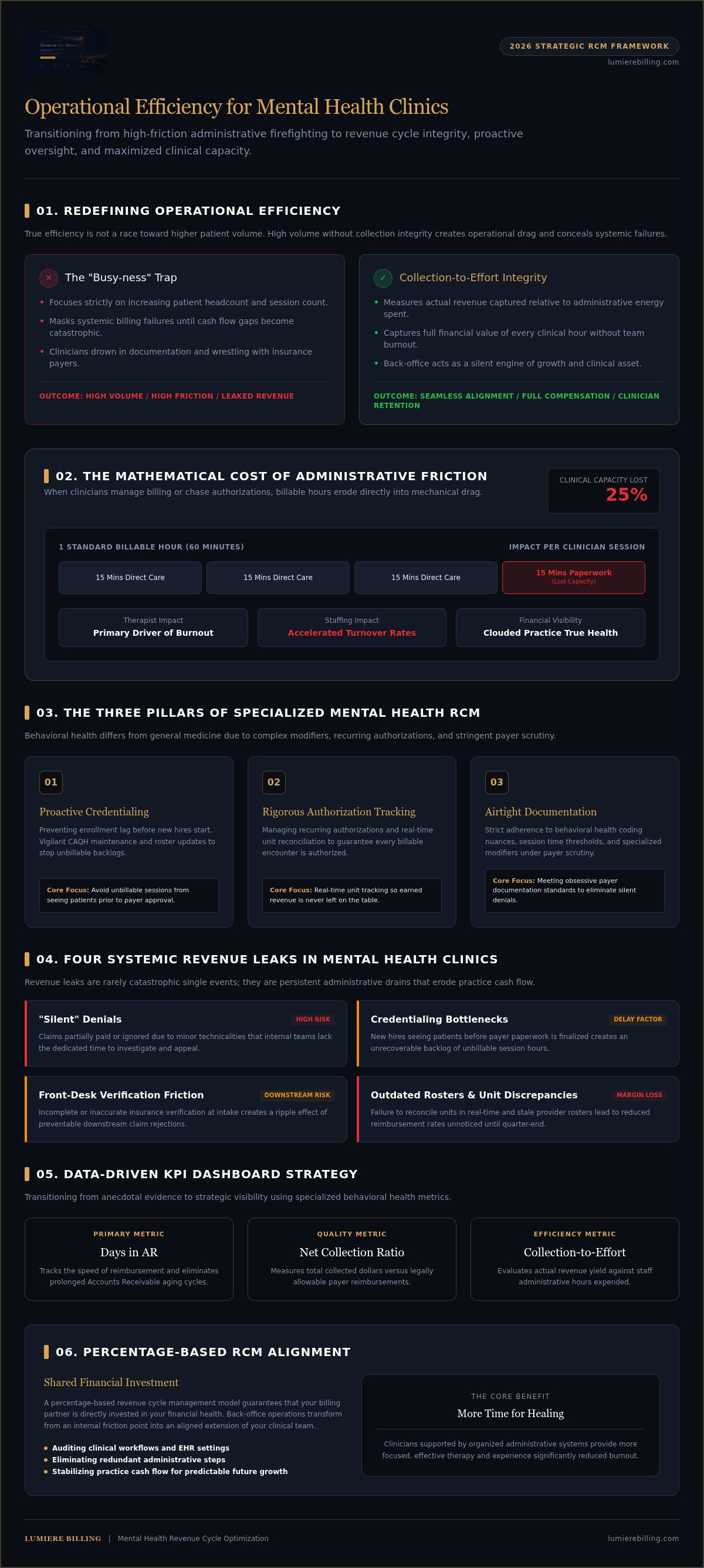
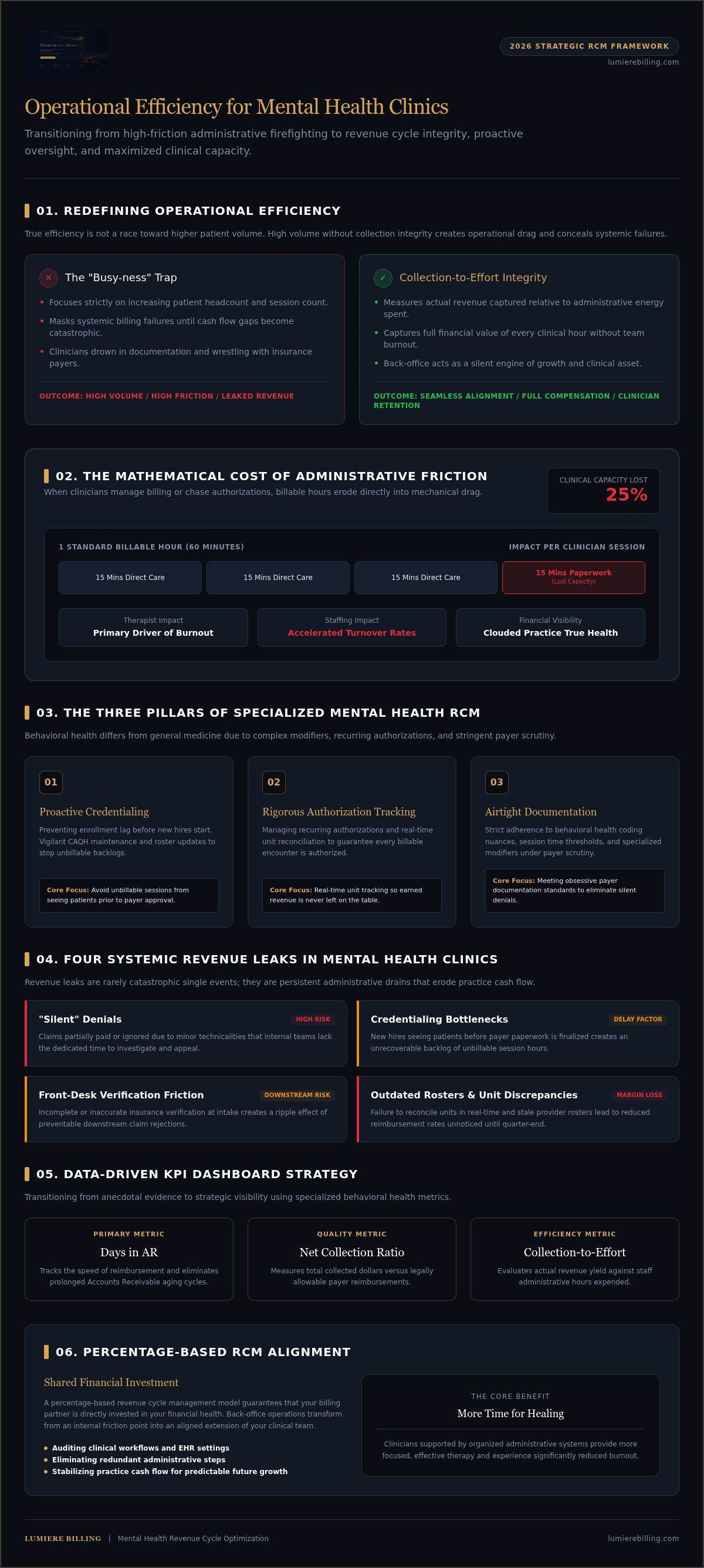
True operational efficiency for mental health clinics is often misunderstood as a frantic race toward higher patient volume. It isn't. High volume without high collections is simply "busy-ness," a state that masks systemic failures until they become catastrophic. Real efficiency is the seamless alignment of clinical excellence with administrative integrity. It's measured by your collection-to-effort ratio. This metric reveals how much actual revenue you capture relative to the administrative energy expended. When your systems have mechanical integrity, you capture the full value of every clinical hour without draining your team’s morale.
Behavioral health requires a specialized efficiency framework that general medicine simply doesn't account for. Our field relies on complex modifiers, recurring authorizations, and documentation standards that payers scrutinize with obsessive detail. To achieve stability, you must master the three pillars of revenue cycle management: proactive credentialing, rigorous authorization tracking, and airtight documentation. Without these pillars, you aren't running an efficient practice; you're managing a series of expensive emergencies. Achieving operational efficiency for mental health clinics means moving away from reactive firefighting toward a model of disciplined oversight.
The Cost of Administrative Friction
Administrative friction acts as a mechanical drag on your practice's growth. When highly trained clinicians manage their own billing or hunt for missing authorizations, the hidden cost is staggering. If a therapist spends just fifteen minutes of their billable hour on paperwork, you've effectively lost 25% of your clinical capacity. This burden is a primary driver of burnout and high turnover rates. Friction at the front desk, such as incomplete insurance verification, creates a ripple effect of downstream claim denials. These errors are expensive to repair and even more expensive to ignore, as they cloud your visibility into the practice's true financial health.
Efficiency as a Catalyst for Patient Care
A streamlined back-office is a clinical asset, not just a financial one. When you eliminate the guesswork from your revenue cycle, you create the psychological space necessary for better patient outcomes. Clinicians who aren't stressed by billing discrepancies or credentialing delays provide more focused, effective therapy. They stay with your practice longer because they feel supported by a masterfully organized system. Positioning your back-office strength as a core competency also provides a significant competitive advantage when hiring. It transforms your revenue cycle from a source of anxiety into a transparent, predictable engine that protects your clinical mission.
Identifying Systemic Leaks in the Revenue Cycle
Revenue leakage is rarely a single, catastrophic event. It's a slow, persistent drain caused by "silent denials" and administrative oversights. These occur when claims are partially paid or simply ignored due to minor technicalities that your team lacks the time to investigate. Establishing true operational efficiency for mental health clinics requires a shift from passive processing to active revenue protection. This is particularly critical when managing behavioral health billing services, where specialized nuances like unit tracking and reconciliation can make or break monthly profitability. If you don't reconcile units in real-time, you're likely leaving earned revenue on the table. Outdated provider rosters further complicate this, leading to lower reimbursement rates that practitioners often fail to notice until the end of the fiscal quarter.
The Credentialing Bottleneck
Enrollment delays are more than an administrative annoyance; they're a financial liability. When a new hire begins seeing patients before their paperwork is finalized, you create a backlog of unbillable sessions that may never be recovered. This friction in mental health provider credentialing stalls clinic-wide cash flow and creates unnecessary tension between clinical and administrative staff. While providers focus on delivering high-quality mental health services and treatment, the back-office must ensure they're actually authorized to bill for them. Proactive CAQH maintenance and vigilant payer roster management are essential. A single expired license or a missed re-credentialing window can halt payments for an entire department without warning.
Authorization and Modifier Errors
Precision is your only defense against the rising tide of claim denials. There are several common behavioral health billing errors to avoid, but modifier misuse remains among the most frequent and costly. ABA billing, in particular, requires exactness with modifiers to reflect the specific level of care and provider type involved. A "clean claim" culture must start at the very first point of patient contact. This means verifying every authorization before the first session even begins. It requires a disciplined approach to documentation that matches payer requirements exactly. If you suspect your current system is failing you, a Free Billing Audit can bring these hidden issues into sharp focus before they compound into major financial losses.
Leveraging Practice Analytics for Strategic Visibility
Many directors manage their clinics by intuition, but scaling requires precision. Intuition doesn't reveal why your cash flow is lagging behind your clinical growth. To move from guessing to knowing, you must deploy specialized behavioral health KPI dashboards. General business intelligence tools often fail here because they don't track industry-specific nuances like unit utilization rates or modifier-specific denial trends. This level of visibility is the foundation of operational efficiency for mental health clinics. It allows you to see the mechanical integrity of your revenue cycle in real-time, bringing hidden issues into sharp focus before they impact your ability to pay your team.
Tracking Days in AR (Accounts Receivable) provides a pulse check on your financial health. If your AR is aging beyond 45 days, you have a systemic blockage that requires immediate attention. Similarly, your Net Collection Ratio tells you exactly how much of your contracted rate you're actually capturing after write-offs. Data shouldn't just be a record of the past; it should be a predictor of the future. By identifying underperforming payers or recurring denial patterns, you can adjust your strategy to prioritize partnerships that respect your clinical value and pay on time.
Key Metrics Every Mental Health Director Must Track
Revenue leakage is the quantified sum of earned clinical income that remains uncollected due to preventable administrative failures, technical denials, or unoptimized payer contracts. You must distinguish between clinician productivity and billing efficiency. A clinician might be 100% productive in terms of billable hours, but if your billing efficiency is only 85%, you're losing 15% of your potential revenue to back-office friction. Payer-specific reimbursement timelines also demand close monitoring. Knowing that Payer A takes 14 days to pay while Payer B takes 60 days allows you to manage your cash reserves with much greater accuracy and less stress.
Turning Insights into Actionable Workflow Changes
Data is only valuable if it leads to movement. You can use a behavioral health billing audit to reset your strategy and identify where your current workflows are failing. This audit often reveals the tipping point where it makes more sense to outsource mental health billing rather than struggling with an overburdened in-house team. Communicating these financial insights to clinical teams requires a delicate balance. Instead of focusing on "billing," frame the data around "clinical integrity." Explain how accurate documentation ensures the practice remains stable so clinicians can continue focusing on patient outcomes. When the clinical team understands that data-driven operational efficiency for mental health clinics protects their mission, resistance turns into partnership.
Optimizing Clinic Workflows for Maximum Cash Flow
Workflows are the mechanical pathways through which revenue travels. If these paths are cluttered, cash flow stalls. Achieving operational efficiency for mental health clinics requires a disciplined sequence of actions from intake to submission. You must start with a comprehensive workflow audit to identify where steps are redundant or where manual data entry is failing. Don't assume your software is optimized out of the box. Whether you use specialized platforms or standard tools, the system must be fine-tuned for behavioral health specifics. This prevents clinical energy from being wasted on administrative friction and ensures your back-office remains a silent, effective engine of growth.
- Standardize documentation templates to meet 90837 CPT code requirements. This ensures every session note captures the necessary clinical complexity and time-based data without requiring clinicians to reinvent the process for every patient.
- Implement a rigorous insurance verification process at the point of intake. This prevents the "unbillable session" trap where care is delivered before coverage is confirmed.
- Establish a 24-hour claim submission rule. Submitting claims immediately after session completion reduces the likelihood of documentation backlogs and significantly accelerates your reimbursement cycle.
EHR Optimization: Beyond Basic Data Entry
Configuring alerts for authorization expirations and unit limits is vital for maintaining steady revenue. You should also automate the reconciliation of ABA unit tracking to ensure every hour of care is captured without manual errors. Ensuring modifier logic is built into the billing engine allows you to catch technical denials before they happen. This proactive stance protects your practice from the "silent" leaks that often go unnoticed in high-volume clinics. It's about moving away from reactive corrections toward a system that prevents errors by design.
Documentation Standards and Compliance
Clinical documentation is your primary defense against claim denials. Training staff on CCI edits and CPT code nuances ensures that every note supports the level of care billed. You must create a tight feedback loop between your billing team and clinicians. When a denial occurs, the cause must be communicated back to the clinical source immediately to prevent repetition. This creates a culture of precision where everyone understands the link between clinical notes and financial stability. If you're unsure where your current workflows are failing, a Free Billing Audit from Lumiere Billing can identify your most profitable improvements and help you reclaim lost time.
The Lumiere Approach: Expert RCM as an Extension of Your Team
Lumiere Billing doesn't just process claims. We act as a vigilant protector of your clinic's financial health, providing deep visibility and insight into every stage of your revenue cycle. Many traditional administrative services operate in a black box, offering little more than basic data entry. We reject this opaque approach. Our partnership is built on transparency and mechanical integrity. By serving as an extension of your team, we ensure that operational efficiency for mental health clinics isn't just a conceptual goal; it's a daily reality. Our percentage-based fee model aligns our incentives perfectly with yours. We only win when you do. This creates a disciplined, results-oriented relationship where our success is directly tied to the health of your bottom line.
Maintaining revenue cycle integrity requires more than software. It requires dedicated account managers who possess an obsessive focus on detail. These experts monitor your accounts daily, identifying subtle failure points before they escalate into systemic leaks. For clinics looking to scale nationally, our practice advisory services provide the strategic framework necessary to manage multi-location complexities without sacrificing precision. We bring hidden issues into focus, allowing you to move away from reactive management toward a state of total oversight.
Why Specialization Matters in Behavioral Health
General medical billers often miss the critical nuances that define our field. Behavioral health modifiers and unit-based billing require a level of domain expertise that generalists simply don't have. At Lumiere, we bring hidden issues into focus through a relentless pursuit of denial prevention and underpayment recovery. We've seen how specialized oversight can transform a practice. For example, by repairing broken credentialing workflows and optimizing modifier logic, we've successfully reduced AR days for scaling clinics. This allows practitioners to reinvest in clinical staff rather than administrative debt. This specialized focus is what allows us to repair systems that others merely manage.
Starting Your Efficiency Journey with a Free Billing Audit
The path to optimization begins with clarity. A Lumiere Billing professional audit provides an exhaustive look at your current financial state, identifying immediate "quick wins" to improve your cash flow. We look for the "silent" leaks mentioned earlier, such as uncollected co-pays or miscoded units, that drain your resources. You can expect a methodical breakdown of your processes and a clear roadmap for improvement. There is no guesswork involved; only data-driven strategies designed to maximize your operational efficiency for mental health clinics. Don't let administrative friction hold your practice back. Schedule your Free Billing Audit today to reclaim your focus and protect your clinical mission.
Securing Your Clinical Mission Through Operational Mastery
Achieving sustainable growth requires more than just clinical excellence; it demands a revenue cycle with mechanical integrity. By identifying silent denials and optimizing your EHR workflows, you transform your back-office from a source of stress into a transparent engine of stability. True operational efficiency for mental health clinics is found when your administrative processes move in perfect alignment with your care delivery. This framework provides the roadmap to stop guessing and start knowing your practice's financial health.
Lumiere Billing brings specialized expertise in ABA and behavioral health to every partnership. We possess deep mastery of platforms like CentralReach and TherapyNotes, ensuring your unit tracking and modifiers are precise. Because we operate on a percentage-based fee model, our performance-based results are directly tied to your success. Claim Your Free Billing Audit and Optimize Your Practice today to bring hidden issues into focus. Your practice deserves a vigilant protector that is as dedicated to your mission as you are.
Frequently Asked Questions
How do I measure the operational efficiency of my mental health clinic?
You measure the operational efficiency for mental health clinics by analyzing your collection-to-effort ratio rather than just patient volume. This involves tracking your Net Collection Ratio and Days in AR to see how much earned revenue is actually hitting your bank account. A high-performing clinic should aim for a Net Collection Ratio above 95%. Monitoring these KPIs allows you to identify where administrative friction is slowing down your cash flow and clinical operations.
What are the most common causes of revenue leakage in behavioral health practices?
Revenue leakage is primarily caused by technical errors such as incorrect behavioral health modifiers, unit tracking discrepancies, and "silent denials" that go uninvestigated. Other common causes include failing to verify insurance at intake and outdated provider rosters that lead to lower reimbursement rates. These small, systemic failures compound over time, often draining 10% to 15% of a practice's potential revenue without the leadership team realizing there is a problem.
Can outsourcing my billing actually improve our internal clinic workflows?
Outsourcing to a specialized partner improves internal workflows by removing the administrative burden from your clinical and front-desk staff. When your team no longer has to wrestle with complex claim denials or recurring authorization tracking, they can focus entirely on patient care and intake accuracy. This shift creates a cleaner documentation culture and establishes a feedback loop where billing insights help refine your internal clinical processes for better performance.
How long does it take to see results after optimizing our revenue cycle?
You will often see immediate "quick wins" within the first 30 days after a comprehensive workflow audit and EHR optimization. Significant improvements in your Days in AR and Net Collection Ratio typically materialize within 60 to 90 days as cleaner claims are submitted and older outstanding balances are recovered. The goal is to establish a consistent, predictable revenue cycle that provides long-term financial stability and the ability to scale.
What is the difference between general medical billing and specialized behavioral health RCM?
General medical billing often lacks the granular focus required for behavioral health modifiers, ABA unit tracking, and recurring authorization requirements. Specialized RCM providers understand the specific documentation standards and payer nuances that prevent "silent denials" in mental health. This expertise ensures that your practice captures the full value of every clinical hour, whereas a generalist might overlook the technical details that lead to underpayments or delayed reimbursements.
Does Lumiere Billing work with our existing EHR, like TherapyNotes or CentralReach?
Yes, Lumiere Billing is highly specialized in optimizing and managing the end-to-end billing process within leading EHR platforms like TherapyNotes and CentralReach. We don't require you to switch software; instead, we act as an extension of your team to fine-tune your existing settings. Our expertise ensures that your EHR’s billing engine is configured correctly for behavioral health specifics, including complex modifier logic and unit utilization tracking.
How does credentialing impact the overall efficiency of a large group practice?
Credentialing is a critical pillar of operational efficiency for mental health clinics because enrollment delays directly create unbillable sessions. For large group practices, a single provider with an expired CAQH profile or a missed re-credentialing window can halt revenue for an entire department. Proactive management ensures that every new hire can begin billing immediately, preventing the financial drag and administrative friction that occurs when clinicians are out-of-network.
What is a 'silent denial' and why is it dangerous for my clinic's cash flow?
A silent denial occurs when a payer pays only a portion of a claim or ignores it entirely due to a minor technicality without a formal rejection notice. These are dangerous because they often bypass standard automated alerts, leading to a slow drain on your cash flow. Without vigilant oversight and manual investigation, these underpayments remain unrecovered, significantly reducing your practice’s overall profitability while increasing your administrative debt.
Frequently Asked Questions
You measure the operational efficiency for mental health clinics by analyzing your collection-to-effort ratio rather than just patient volume. This involves tracking your Net Collection Ratio and Days in AR to see how much earned revenue is actually hitting your bank account. A high-performing clinic should aim for a Net Collection Ratio above 95%. Monitoring these KPIs allows you to identify where administrative friction is slowing down your cash flow and clinical operations.
Revenue leakage is primarily caused by technical errors such as incorrect behavioral health modifiers, unit tracking discrepancies, and "silent denials" that go uninvestigated. Other common causes include failing to verify insurance at intake and outdated provider rosters that lead to lower reimbursement rates. These small, systemic failures compound over time, often draining 10% to 15% of a practice's potential revenue without the leadership team realizing there is a problem.
Outsourcing to a specialized partner improves internal workflows by removing the administrative burden from your clinical and front-desk staff. When your team no longer has to wrestle with complex claim denials or recurring authorization tracking, they can focus entirely on patient care and intake accuracy. This shift creates a cleaner documentation culture and establishes a feedback loop where billing insights help refine your internal clinical processes for better performance.
You will often see immediate "quick wins" within the first 30 days after a comprehensive workflow audit and EHR optimization. Significant improvements in your Days in AR and Net Collection Ratio typically materialize within 60 to 90 days as cleaner claims are submitted and older outstanding balances are recovered. The goal is to establish a consistent, predictable revenue cycle that provides long-term financial stability and the ability to scale.
General medical billing often lacks the granular focus required for behavioral health modifiers, ABA unit tracking, and recurring authorization requirements. Specialized RCM providers understand the specific documentation standards and payer nuances that prevent "silent denials" in mental health. This expertise ensures that your practice captures the full value of every clinical hour, whereas a generalist might overlook the technical details that lead to underpayments or delayed reimbursements.
Yes, Lumiere Billing is highly specialized in optimizing and managing the end-to-end billing process within leading EHR platforms like TherapyNotes and CentralReach. We don't require you to switch software; instead, we act as an extension of your team to fine-tune your existing settings. Our expertise ensures that your EHR’s billing engine is configured correctly for behavioral health specifics, including complex modifier logic and unit utilization tracking.
Credentialing is a critical pillar of operational efficiency for mental health clinics because enrollment delays directly create unbillable sessions. For large group practices, a single provider with an expired CAQH profile or a missed re-credentialing window can halt revenue for an entire department. Proactive management ensures that every new hire can begin billing immediately, preventing the financial drag and administrative friction that occurs when clinicians are out-of-network.
A silent denial occurs when a payer pays only a portion of a claim or ignores it entirely due to a minor technicality without a formal rejection notice. These are dangerous because they often bypass standard automated alerts, leading to a slow drain on your cash flow. Without vigilant oversight and manual investigation, these underpayments remain unrecovered, significantly reducing your practice’s overall profitability while increasing your administrative debt.