Behavioral Health Billing Services: A Specialist Guide to Revenue Optimization in 2026

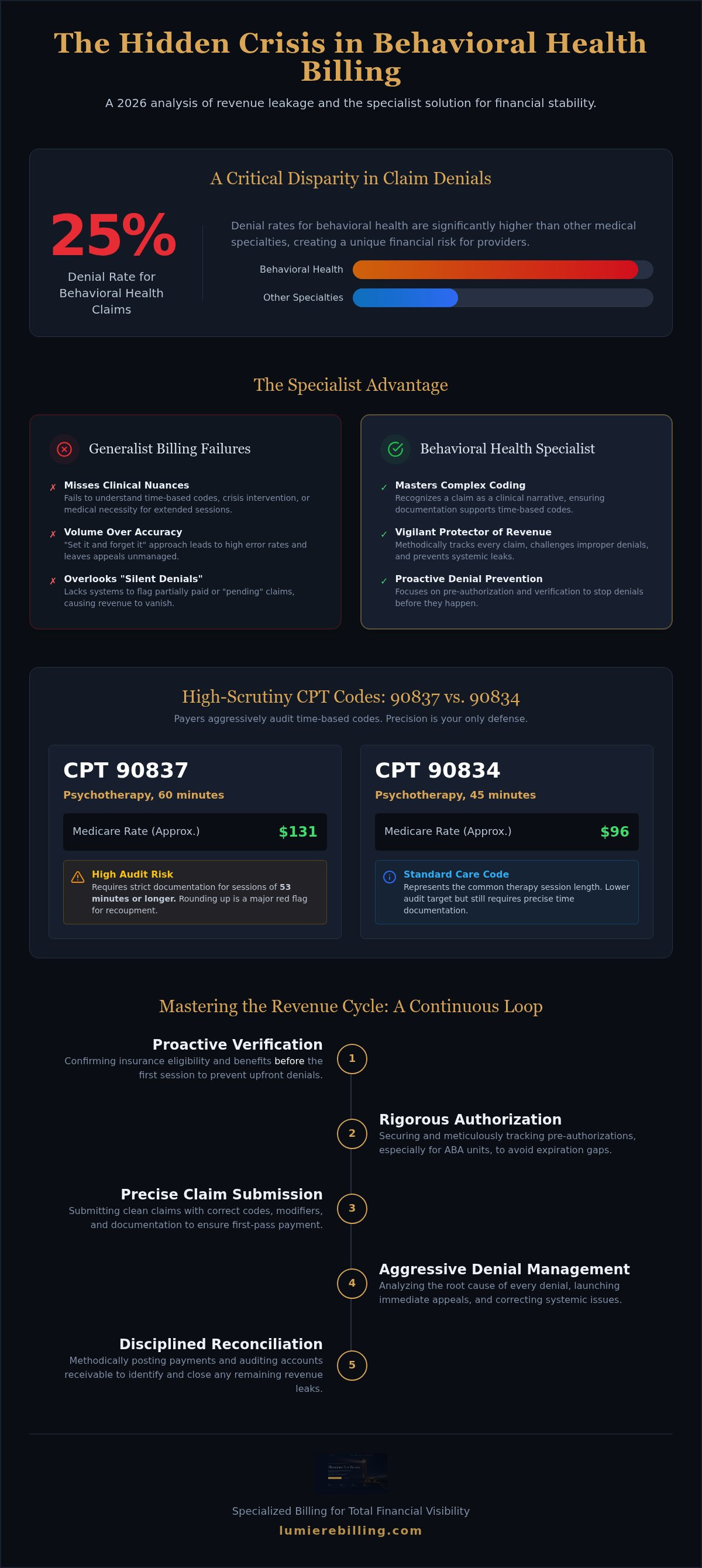
Did you know that behavioral health claims face denial rates as high as 25 percent, a figure significantly higher than almost any other medical specialty in 2026? You likely feel the weight of this statistic every time a 90837 claim is rejected for time documentation or an ABA authorization expires without notice. It is an exhausting cycle that forces providers to choose between clinical excellence and financial stability. We understand that your practice isn't just a business; it's a vital service that shouldn't be undermined by administrative friction or opaque billing cycles.
Specialized behavioral health billing services act as a vigilant protector of your revenue, bringing hidden systemic leaks into sharp focus and repairing the broken workflows that generalist services simply cannot see. By partnering with experts who master the nuances of mental health reimbursement, you can eliminate the stress of unbilled sessions and authorization gaps. This guide explores the 2026 landscape of revenue optimization, from navigating the latest Medicare psychotherapy rates to implementing precision tracking for ABA units. We will show you how to move away from traditional administrative burdens toward a future of total financial visibility and insight.
Key Takeaways
- Learn why generalist billing models fail to address the specific audit risks inherent in time-based mental health CPT codes.
- Master a proactive revenue cycle workflow that prioritizes insurance verification to prevent authorization-related denials before they occur.
- Identify hidden revenue leakage by auditing your accounts receivable for aging claims and systemic documentation gaps.
- Discover how specialized behavioral health billing services eliminate administrative friction, allowing practitioners to refocus on clinical excellence.
- Gain a clear framework for transitioning from opaque back-office operations to a system of total financial visibility and optimized reimbursement.
The Specialized Complexity of Behavioral Health Billing
Revenue cycle management in behavioral health is not a subset of general medicine; it is a distinct discipline requiring a different set of eyes. While a generalist might see a claim as a simple data entry task, specialized behavioral health billing services recognize it as a complex clinical narrative. The primary differentiator lies in the "time-based" nature of mental health codes. Unlike a standard physical exam, the value of a psychotherapy session is dictated by the clock. This creates a unique audit risk. If your documentation doesn't precisely support the minute-by-minute requirements of the code billed, payers will claw back payments years after the service was rendered. This isn't just a clerical error. It's a systemic vulnerability that can threaten the very foundation of your practice.
Modifier errors and "silent denials" further complicate the landscape. Silent denials occur when claims are neither fully paid nor explicitly rejected, often languishing in a state of partial reimbursement or "pending" status that generalist software fails to flag. These leaks erode your margins without ever appearing on a standard error report. Without a vigilant protector to monitor these nuances, thousands of dollars in earned revenue simply vanish into the opaque systems of major payers.
Why Generalist Billing Services Fail Behavioral Health Providers
The "set it and forget it" approach used by high-volume generalist services is dangerous in a behavioral health context. Generalists often miss the subtle nuance required for crisis intervention or complex psychotherapy coding. They lack the specialized follow-up mechanisms needed to challenge behavioral health specific denials, such as those involving medical necessity for extended sessions. When a generalist encounters a rejection for a code like 90837, they often lack the clinical understanding to audit the documentation and provide the specific evidence required for a successful appeal. They prioritize volume over accuracy, leaving you to bear the financial burden of their oversight.
The Critical Role of CPT Codes 90837 and 90834
In 2026, CPT code 90837 remains a high-scrutiny target for payers. Because it represents a higher reimbursement rate-approximately $131 under Medicare compared to $96 for 90834-insurance companies frequently flag it for "upcoding" audits. Documentation alignment is mandatory. A 53-minute session must be documented as such; rounding up is a red flag that triggers recoupment demands. To avoid these traps, your billing partner must be methodical. We ensure that every session billed under 90837 meets the strict time thresholds and clinical depth required by current regulations. Precision in this area is the only way to safeguard your revenue against the aggressive audit tactics of modern insurers.
Mastering the Revenue Cycle: From Authorization to Reconciliation
A masterfully executed revenue cycle isn't a series of isolated administrative tasks. It's a continuous, methodical loop of oversight that begins long before a claim is generated. For providers utilizing behavioral health billing services, this cycle must be rigid and transparent. It starts with proactive insurance verification, moves through rigorous authorization management, and ends with precise payment reconciliation. Any break in this chain results in revenue leakage that many practices simply accept as the cost of doing business. We reject that mediocrity. By treating the revenue cycle as a professional methodology rather than a back-office chore, we bring hidden failure points into focus.
Closing the loop requires more than just submission. It demands aggressive denial management and disciplined payment posting. When a claim is rejected, the clock starts ticking. A specialized partner doesn't just resubmit; they analyze the root cause to prevent a recurrence. This level of meticulous attention ensures that your practice margins remain healthy and your cash flow stays predictable. If you are unsure where your cycle is breaking, a free billing audit can illuminate the specific leaks in your current process.
ABA Unit Tracking and Reconciliation Challenges
ABA billing presents a unique mechanical challenge: the unit vs. hour mismatch. Most ABA codes are billed in 15-minute increments, but authorizations are often granted in total hours or units over a six-month span. Without precise tracking, it's easy to over-utilize units early in a cycle, leading to unbillable sessions later. We solve this by reconciling rendered services against authorized units in real-time. This prevents the nightmare of authorization expirations and ensures every hour of therapy is fully reimbursable.
The Importance of Real-Time Insurance Verification
Checking eligibility at the start of the month is no longer sufficient in 2026. Coverage can shift mid-treatment due to employment changes or plan updates. Meticulous data entry at the front end reduces rejections by identifying COB (Coordination of Benefits) issues before they trigger a denial. Authorization issues account for 40 percent of all denied claims in behavioral health, according to recent industry data. Real-time verification acts as a refined counter-measure, ensuring that every session is backed by active, valid coverage.
The Specialist Advantage: Generalist vs. Behavioral Health Billing
Generalist services operate on a volume-first model. They process thousands of claims across dozens of medical specialties, from podiatry to pediatrics. This diluted focus is a liability. In contrast, specialized behavioral health billing services prioritize an accuracy-first model that protects your bottom line. We don't just push data; we audit clinical documentation to ensure it mirrors the billing codes exactly. This meticulous alignment is the only way to survive the high-scrutiny environment of 2026. Specialized behavioral health billing services go beyond data entry to offer practice advisory that generalists can't match. We look at the mechanical integrity of your systems, identifying if your clinicians are consistently under-coding or if they're missing essential modifiers that trigger recoupment.
This partnership model is reinforced by percentage-based fees. Unlike flat-rate models that reward mere submission, percentage-based fees align our success with yours. We're incentivized to collect every dollar, not just process every claim. This creates a relationship where we act as a vigilant protector of your financial health, rather than a detached administrative vendor. We identify hidden failure points in your workflow and present refined counter-measures before they result in lost revenue.
Credentialing and Enrollment: The Hidden Revenue Driver
Credentialing is the silent engine of your revenue cycle. Delays here cause irreparable loss. If a new provider isn't enrolled correctly, you're forced to either delay care or provide it for free. We maintain proactive payer rosters and manage CAQH enrollment for multi-provider groups. This ensures that as you scale, your revenue stream remains uninterrupted. We treat enrollment as a continuous process, not a one-time task. This vigilance prevents the sudden "out-of-network" surprises that alienate patients and drain your practice margins.
Denial Prevention vs. Denial Management
Many firms brag about their denial management. We believe that's a failure of the system. A well-designed "clean claim" engine focuses on denial prevention. This requires a deep understanding of Correct Coding Initiative (CCI) edits specific to mental health and ABA services. By catching errors before submission, we reduce the administrative friction that slows down your cash flow. It's about precision over volume. We don't just fix mistakes; we eliminate the root causes of systemic leaks. This proactive stance is what separates a true partner from a mere processor.
Identifying Revenue Leakage: A Framework for Practice Health
Revenue leakage is rarely a sudden collapse. It is more often a silent, systemic erosion of your practice's financial health, occurring one unbilled session or ignored denial at a time. For many providers, the first sign of trouble isn't a lack of patients; it's a persistent cash flow crunch despite a full schedule. Identifying these leaks requires a shift from passive observation to active, methodical oversight. Specialized behavioral health billing services bring these hidden issues into focus, providing the clarity needed to repair broken financial systems and restore mechanical integrity to your revenue stream.
The most common failure point is the aging accounts receivable (AR) report. If your 90-plus day bucket is growing, you are losing money. Payers rely on timely filing limits to avoid paying legitimate claims, and an unmonitored AR is essentially an interest-free loan to the insurance company. To perform a basic internal audit, start by cross-referencing your clinician’s session logs against your billing software’s "billed" status. Any mismatch represents a direct hit to your margin. Relying on generic software often leaves these gaps open, whereas dedicated behavioral health billing services provide the granular oversight needed to close them permanently.
Tracking Key Performance Indicators (KPIs)
Precision requires measurement. In behavioral health, your "Clean Claim Rate"-the percentage of claims accepted on the first submission-should ideally sit above 95 percent. If yours is lower, your front-end verification process is likely failing. Another critical metric is "Days in AR." For mental health and ABA practices, you should aim for a benchmark of 35 to 45 days. If your claims are languishing for 60 days or more, your billing cycle lacks the necessary momentum. Tracking denial rates by payer is equally vital, especially since authorization issues account for 40 percent of all denied claims. This level of detail allows you to spot systemic issues before they become catastrophic.
The Value of a Professional Billing Audit
Internal reports often provide a filtered view of reality. They may show what was billed, but they rarely reveal what was recoverable versus what is truly uncollectible. A professional audit provides a high-level conceptual hook into your practice's actual health, identifying why claims were denied and whether those denials are reversible through disciplined appeal strategies. At Lumiere, we serve as a vigilant protector of your revenue through our specialized methodology. You can start this journey toward transparency by visiting the Lumiere Billing Homepage to learn about our approach to practice advisory. If you want to stop the slow drip of lost revenue, you should schedule a free billing audit to uncover your specific failure points today.
Scaling with Precision: The Lumiere Billing Partnership
Scaling a practice requires more than clinical growth. It demands an infrastructure that remains stable under pressure. Specialized behavioral health billing services provide this stability by acting as a disciplined extension of your clinical team. Instead of managing a revolving door of administrative staff, you gain a partner that possesses an obsessive focus on your revenue cycle. This transition moves you away from the opaque nature of traditional billing toward a system of total financial visibility. It’s about more than just collecting payments; it’s about establishing the mechanical integrity needed to support multiple locations and diverse service lines.
Our partnership model is designed to alleviate the stress of back-office operations through a display of mastery and meticulous attention to detail. We act as a vigilant protector of your financial health, ensuring that every session rendered is a session paid. As you expand to multiple locations, our practice advisory services provide the logical sequence of steps needed to maintain compliance and profitability. We don't just process claims; we repair the broken systems that generalist services often overlook. This specialized focus is the difference between a practice that survives and one that thrives.
Visibility Through Advanced Analytics
True growth is impossible without deep-dive profitability data. We move your practice beyond the surface-level metric of "total collections" to uncover the actual health of your operations. For group practices and ABA clinics, custom dashboards provide the insight needed to make data-driven decisions. You can see which payers are underperforming, which service codes are triggering audits, and where your margins are strongest. This level of clarity is essential for practice expansion. By bringing hidden issues into focus, we ensure that your growth is built on a foundation of precision rather than guesswork.
The future of behavioral health billing services lies in the integration of AI-assisted accuracy and human mastery. While AI can automate real-time eligibility and identify documentation gaps, it cannot replace the nuanced judgment required for complex appeals. We combine these tools to create a refined counter-measure against payer scrutiny. This synergy ensures that your claims are scrubbed with mechanical precision while being overseen by experts who understand the clinical reality of your work.
Getting Started: Illuminating Your Path Forward
Transitioning to a specialized RCM partnership is a methodical process designed to minimize disruption. The onboarding phase begins with a thorough assessment of your current systems to identify legacy failure points. To prepare, your practice should organize its current authorization logs and payer contracts. This preparation allows us to hit the ground running, repairing broken workflows from day one. If you are ready to eliminate administrative friction and secure your practice’s future, you should Schedule your Free Billing Audit today to begin your journey toward financial clarity.
Securing Your Practice’s Financial Future
Revenue optimization in 2026 isn't about working harder; it's about working with greater precision. We've explored how the mechanical integrity of your revenue cycle depends on mastering time-based CPT codes and maintaining rigorous authorization tracking. Generalist models often fail to identify the subtle failure points that lead to recoupment and silent denials. By contrast, specialized behavioral health billing services bring these hidden issues into focus, ensuring your clinical efforts translate directly into financial stability.
Lumiere Billing serves as a vigilant protector of your practice through nationwide credentialing expertise and a dedicated focus on ABA and mental health. Our percentage-based fee structure ensures our incentives are perfectly aligned with your success; we only get paid when you do. Take the first step toward total financial visibility and insight. Request Your Free Billing Audit from Lumiere Billing today to identify exactly where your revenue is leaking. You deserve a partner that is as committed to your practice's health as you are to your patients.
Frequently Asked Questions
What are the most common billing errors in behavioral health?
Leading errors include expired authorizations and time-based documentation gaps. Payers audit session lengths strictly; if a 53-minute session isn't documented to the minute, recoupment is likely. Coordination of benefits issues also account for 14 percent of denials. These mechanical failures erode your margins. Specialized behavioral health billing services identify these patterns early to prevent systemic revenue leakage before it becomes a permanent loss.
How long does it take to see results from outsourcing behavioral health billing?
Practices typically observe increased visibility within the first 30 days of partnership. While a free billing audit provides immediate insight into current leaks, full stabilization of the revenue cycle requires approximately 60 to 90 days. This period allows us to clean up the aging AR and implement proactive verification workflows. Speed is essential, but precision ensures the results are sustainable for the long term.
Is a percentage-based fee better than a flat fee for billing services?
Percentage-based fees are superior because they create a partnership model rather than a mere transaction. Flat-rate models reward volume and submission, regardless of whether a claim is actually paid. Our model ensures we act as a vigilant protector of your financial health. We're incentivized to pursue every dollar, including difficult appeals that generalist firms often abandon to maintain their own profit margins.
Do you provide credentialing services for new mental health providers?
We provide comprehensive credentialing and enrollment services for providers across the country. Managing CAQH profiles and payer rosters is a critical revenue driver that prevents irreparable loss during practice expansion. We ensure your clinicians are correctly enrolled before they see their first patient. This proactive approach eliminates the "out-of-network" surprises that frustrate patients and drain your practice's potential income.
Can you help with ABA-specific unit tracking and authorizations?
ABA-specific unit tracking is a core component of our methodology. We reconcile rendered services against authorized units in real-time to solve the unit vs. hour mismatch. This prevents the common failure point where authorizations are exhausted before the cycle ends. By maintaining this level of oversight, we ensure every hour of clinical work remains fully reimbursable and compliant with payer requirements.
What is the difference between a general medical biller and a behavioral health specialist?
Generalists focus on volume, while behavioral health specialists focus on accuracy and clinical nuance. General medical billers often don't understand the specific audit risks associated with code 90837 or the complexity of mental health parity laws. A specialist acts as a practice advisor, bringing hidden issues into focus. We understand the clinical narrative behind the codes, which is essential for surviving high-scrutiny payer audits.
How do you handle denied claims and appeals?
We prioritize denial prevention but maintain a disciplined strategy for aggressive appeals. When a claim is rejected, we don't just resubmit the same error. We analyze the root cause, whether it's a documentation gap or a payer processing error, and provide the clinical evidence needed to overturn the decision. This methodical approach ensures that your "uncollectible" revenue is brought back into your practice's cash flow.
What EHR systems do specialized billing services typically work with?
Specialized behavioral health billing services are typically EHR-agnostic, meaning we work within the software you already use. We don't sell proprietary EHR software; instead, we integrate our expert workflows into your existing clinical platform. This ensures a seamless transition and allows your team to focus on patient care while we maintain the mechanical integrity of your back-office operations and financial analytics.
Frequently Asked Questions
Leading errors include expired authorizations and time-based documentation gaps. Payers audit session lengths strictly; if a 53-minute session isn't documented to the minute, recoupment is likely. Coordination of benefits issues also account for 14 percent of denials. These mechanical failures erode your margins. Specialized behavioral health billing services identify these patterns early to prevent systemic revenue leakage before it becomes a permanent loss.
Practices typically observe increased visibility within the first 30 days of partnership. While a free billing audit provides immediate insight into current leaks, full stabilization of the revenue cycle requires approximately 60 to 90 days. This period allows us to clean up the aging AR and implement proactive verification workflows. Speed is essential, but precision ensures the results are sustainable for the long term.
Percentage-based fees are superior because they create a partnership model rather than a mere transaction. Flat-rate models reward volume and submission, regardless of whether a claim is actually paid. Our model ensures we act as a vigilant protector of your financial health. We're incentivized to pursue every dollar, including difficult appeals that generalist firms often abandon to maintain their own profit margins.
We provide comprehensive credentialing and enrollment services for providers across the country. Managing CAQH profiles and payer rosters is a critical revenue driver that prevents irreparable loss during practice expansion. We ensure your clinicians are correctly enrolled before they see their first patient. This proactive approach eliminates the "out-of-network" surprises that frustrate patients and drain your practice's potential income.
ABA-specific unit tracking is a core component of our methodology. We reconcile rendered services against authorized units in real-time to solve the unit vs. hour mismatch. This prevents the common failure point where authorizations are exhausted before the cycle ends. By maintaining this level of oversight, we ensure every hour of clinical work remains fully reimbursable and compliant with payer requirements.
Generalists focus on volume, while behavioral health specialists focus on accuracy and clinical nuance. General medical billers often don't understand the specific audit risks associated with code 90837 or the complexity of mental health parity laws. A specialist acts as a practice advisor, bringing hidden issues into focus. We understand the clinical narrative behind the codes, which is essential for surviving high-scrutiny payer audits.
We prioritize denial prevention but maintain a disciplined strategy for aggressive appeals. When a claim is rejected, we don't just resubmit the same error. We analyze the root cause, whether it's a documentation gap or a payer processing error, and provide the clinical evidence needed to overturn the decision. This methodical approach ensures that your "uncollectible" revenue is brought back into your practice's cash flow.
Specialized behavioral health billing services are typically EHR-agnostic, meaning we work within the software you already use. We don't sell proprietary EHR software; instead, we integrate our expert workflows into your existing clinical platform. This ensures a seamless transition and allows your team to focus on patient care while we maintain the mechanical integrity of your back-office operations and financial analytics.