Prior Auth for Behavioral Health: Revenue Integrity Guide

Most behavioral health practices treat insurance approvals as a bureaucratic hurdle to be cleared, yet this reactive mindset is exactly what creates systemic leaks in your revenue cycle. When you view prior authorization behavioral health protocols as a mere administrative task, you're essentially leaving the door open for silent denials and uncompensated care. It’s a specialized craft that requires more than just filling out forms; it requires clinical revenue integrity.
You already know the frustration of completing a session only to find the authorization expired three days prior. You've felt the drain of losing hours to payer hold music and the uncertainty of ever-changing medical necessity requirements. It’s an exhausting cycle that pulls your focus away from the patients who need it most. We're here to help you regain that focus by transforming your back-office operations into a disciplined, high-performance engine.
This guide provides the roadmap to master these complexities and secure your practice’s cash flow. We will explore how to build a streamlined, predictable authorization workflow that eliminates expired approvals and brings transparency to your financial health. By the end, you'll have the tools to replace administrative red tape with methodical oversight and mechanical precision.
Key Takeaways
- Understand the critical components of an authorization, including the precise coordination of CPT codes, unit counts, and date ranges.
- Bridge the gap between clinical notes and payer requirements by mastering the specific data points that establish medical necessity.
- Establish a proactive prior authorization behavioral health workflow that prioritizes verification at intake and early submission of clinical packets.
- Eliminate the risk of silent denials by moving away from reactive administrative habits toward a disciplined system of mechanical integrity.
- Secure your practice’s financial health by leveraging specialized RCM expertise that transforms opaque billing processes into transparent revenue insights.
What is Prior Authorization in Behavioral Health?
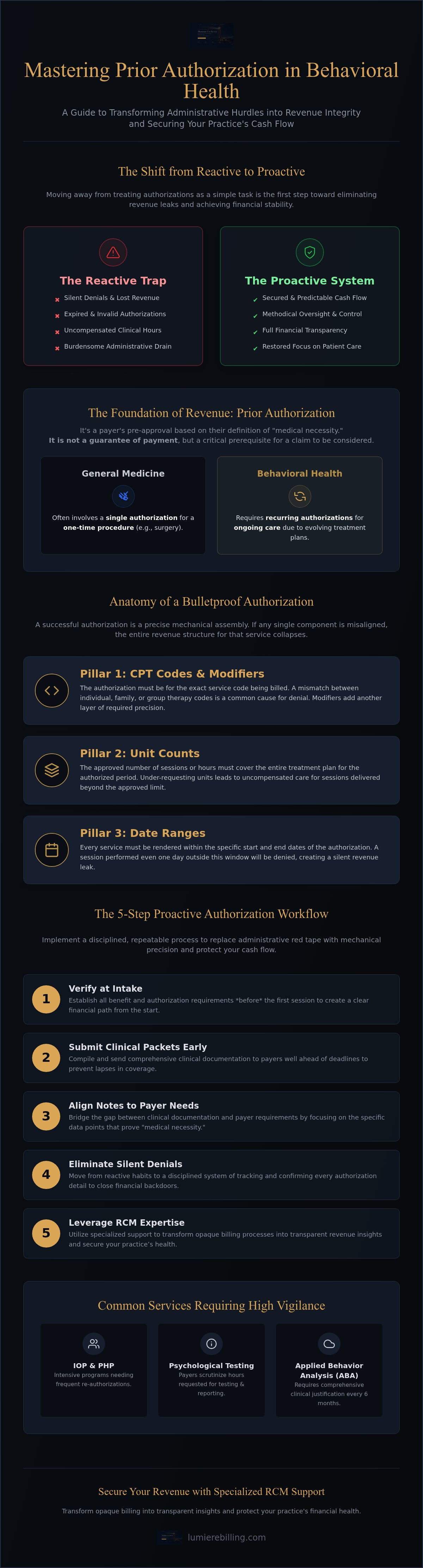
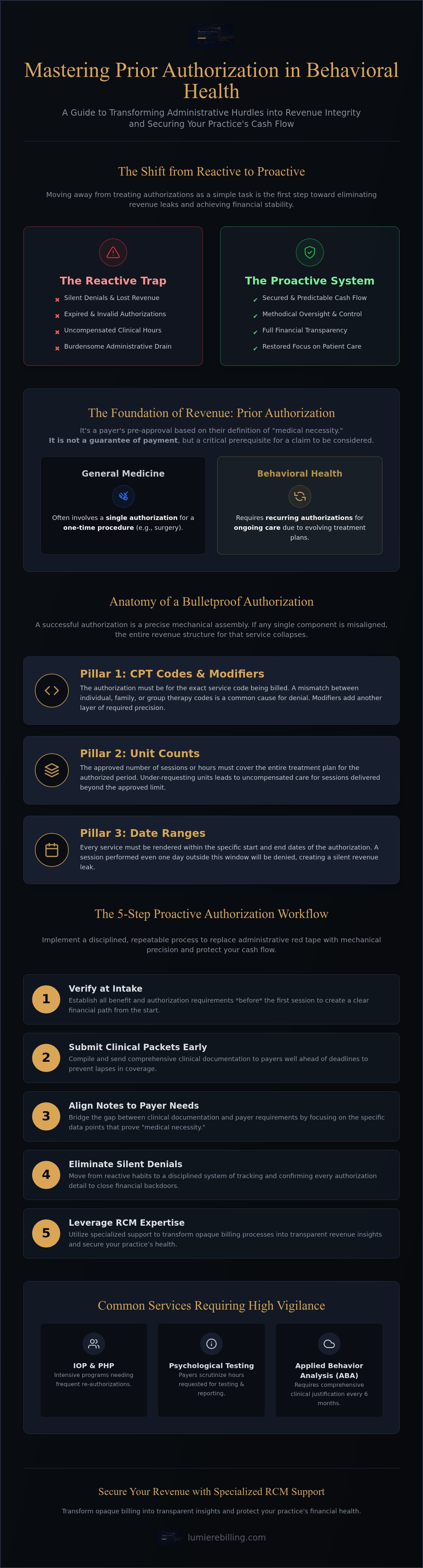
At its core, What is Prior Authorization? In the clinical context, it's the process where a payer grants "pre-approval" for a specific service based on their determination of medical necessity. It isn't a guarantee of payment. It's a prerequisite for the claim to even be considered. For practitioners, prior authorization behavioral health requirements represent the first line of defense against revenue loss. Without this verified green light, the most effective clinical intervention remains a financial liability.
Behavioral health differs significantly from general medicine in its authorization frequency. While a surgeon might secure a single authorization for a one-time procedure, a therapist or ABA provider often manages recurring authorizations for ongoing care. The clinical landscape is fluid. Treatment plans evolve. Consequently, payers demand frequent check-ins to justify continued utilization. This constant cycle makes authorization the absolute foundation of effective behavioral health revenue cycle management. If the foundation is cracked, the entire financial structure of the practice is at risk.
The Gatekeeper Role of the Payer
Payers act as gatekeepers, using the authorization process to control costs and manage utilization. They've shifted the goalposts. It's no longer just about your clinical judgment. It's about meeting "payer-defined necessity." This distinction is critical. You might see a patient's progress. The payer sees a data point that either fits their internal criteria or doesn't. Failing to align with these specific standards leads to immediate, unappealable claim denials. These aren't just administrative errors; they're systemic failures that drain your practice's resources.
Common Behavioral Health Services Requiring Approval
Not every session requires a prior nod from the insurance company, but high-acuity and long-term services almost always do. Identifying these early is vital for maintaining cash flow. Common services include:
- Intensive Outpatient Programs (IOP) and Partial Hospitalization (PHP): These require frequent re-authorizations due to the high level of care provided.
- Psychological and Neuropsychological Testing: Payers scrutinize the number of hours requested for testing and report writing.
- Applied Behavior Analysis (ABA): Long-term interventions often require comprehensive clinical packets every six months to justify continued hours.
Managing these demands requires a level of focus that borders on the obsessive. It's about bringing hidden requirements into focus before they become denials. We act as a vigilant protector of your financial health, ensuring no session goes uncompensated due to a preventable oversight.
The Anatomy of a Behavioral Health Authorization
A successful prior authorization behavioral health request is a precise mechanical assembly. It's not enough to simply obtain a confirmation number. You must ensure every component of the approval matches your intended clinical delivery. The core of this assembly includes specific CPT codes, unit counts, and date ranges. If any of these three pillars is misaligned, the entire revenue structure collapses. Recent regulatory shifts, such as the CMS Interoperability and Prior Authorization Final Rule, emphasize the need for transparency and efficiency in these exchanges, yet the burden of precision remains on the provider.
Precision starts at the request phase. Small oversights here lead to massive leaks later. To protect your practice, you must identify and eliminate behavioral health billing errors to avoid before they reach the payer's desk. This includes verifying that the requested units account for the entire duration of the treatment plan, not just the initial sessions. An authorization is a contract. If you deviate from the terms, the payer is no longer obligated to pay.
CPT Codes and Modifier Alignment
Requesting the wrong code invalidates the entire authorization. In behavioral health, this often happens when providers confuse individual therapy codes with family or group codes. Modifiers add another layer of complexity. They specify the level of the practitioner or the delivery method, such as telehealth. If your authorization specifies code 90837 with a 95 modifier, but you bill without it, the claim will trigger a denial. The payer sees a mismatch, and the system automatically rejects the payment. We bring these hidden details into focus to ensure your claims move through the system without friction.
ABA Unit Tracking and Reconciliation
Applied Behavior Analysis presents a unique challenge due to its 15-minute unit increments. Tracking units is not the same as tracking sessions. A single session of ABA might consume sixteen units of code 97153. If your team loses sight of the remaining balance, you risk over-billing the authorized amount. This triggers a clawback or a "silent denial" where the claim is processed but the payment is withheld. Maintaining unit integrity is a cornerstone of ABA revenue cycle management. It requires a disciplined, behind-the-scenes operator to reconcile utilized units against the authorized total in real time. If your current tracking feels opaque, a free billing audit can reveal where your system is leaking revenue.
Clinical Documentation vs. Payer Requirements
Clinical excellence doesn't always translate to administrative success. You might write thorough, empathetic notes that perfectly capture a patient's journey, yet still face a wall of denials. Payers don't look for empathy. They look for data. For prior authorization behavioral health protocols, "good clinical notes" are often insufficient because they lack the specific markers of medical necessity. This disconnect creates a systemic leak where clinical work is performed but never compensated. Visibility into the alignment between your documentation and prior authorization behavioral health expectations is the only way to ensure revenue integrity. Payers look for specific data points like symptom severity, frequency of episodes, and the precise impact on daily living to justify their approval.
Defining Medical Necessity for Mental Health
Payers require objective proof that a service is required. This often comes down to standardized assessment scores like the PHQ-9 or GAD-7. You must document "functional impairment" clearly. How does the condition prevent the patient from working, attending school, or maintaining relationships? Justifying ongoing treatment requires showing progress or, paradoxically, a lack of progress that necessitates a higher level of care. Without these specific benchmarks, your request is likely to result in a silent denial where the claim is simply ignored or rejected without clear feedback.
The Danger of Vague Documentation
Efficiency shouldn't come at the cost of precision. "Copy-paste" notes are immediate red flags for insurance auditors. If every session note looks identical, the payer assumes the treatment is stagnant and medical necessity has vanished. This doesn't just affect individual claims. Poor documentation habits can negatively impact mental health provider credentialing and trigger broader practice audits. To maintain a "billing-ready" status, summaries must be meticulous. Consider these essential elements for every request:
- Linking every session to a specific treatment plan goal.
- Quantifying symptoms rather than using vague adjectives like "better" or "improved."
- Documenting the specific intervention used and the patient's response with clinical precision.
- Outlining the rationale for the specific frequency and duration of the requested service.
We act as a vigilant protector of your practice by bringing these hidden documentation gaps into focus. We help you transition from opaque administrative struggles to a system of mechanical integrity. This ensures your clinical expertise is matched by your financial results, allowing you to focus on care rather than red tape.
The Proactive Authorization Workflow: 5 Steps to Success
Reactive billing is a choice. Usually, it's a poor one. To secure your practice's financial future, your prior authorization behavioral health strategy must be proactive. It's about building a system that anticipates hurdles rather than tripping over them. We've refined this into a five step cycle designed for mechanical integrity. First, perform a Verification of Benefits (VOB) at the point of intake. Second, submit comprehensive clinical packets 14 days before any current authorization expires. Third, maintain rigorous tracking of unit utilization throughout the period. Fourth, conduct continuous reconciliation of billed units against authorized balances. Finally, initiate proactive re-authorization requests before the current period ends. This prevents the systemic leaks that lead to uncompensated care.
Intake and Verification Best Practices
Precision begins before the first session. You must verify benefits for every new patient, every time. Don't assume coverage is static. Payers frequently update their requirements without notice, and "hidden" authorization needs often lurk within secondary insurance policies. If the primary payer doesn't require an auth but the secondary does, you risk a partial denial that drains your margin. Utilizing accurate data from CAQH enrollment services ensures your provider eligibility is up to date, preventing credentialing issues from stalling the authorization process. We bring these hidden requirements into focus at the start of the patient relationship, ensuring a clear path to payment.
Unit Tracking and Expiration Alerts
Manual spreadsheets are the primary cause of authorization-related revenue loss. They are static, prone to human error, and lack real-time visibility. A disciplined workflow requires EHR optimization to track authorized units as they are consumed. Set up automated alerts for expiration dates to trigger the 14 day submission window. If you're tracking ABA units in 15 minute increments, the margin for error is razor thin. One miscount can invalidate weeks of work. By moving away from opaque manual tracking toward a methodical, tech-enabled system, you eliminate the "silent denials" that occur when authorizations expire without notice.
If your current workflow feels like a constant race against expiration dates, it’s time to repair the system. You can schedule a free billing audit to identify exactly where your authorization process is leaking revenue and how to fix it.
Secure Your Revenue with Specialized RCM Support
Generalist billing services often fail when confronted with the intricate, recurring demands of prior authorization behavioral health protocols. They apply a broad, one-size-fits-all approach that ignores the specific unit tracking requirements of ABA or the complex medical necessity documentation needed for high-acuity mental health care. This lack of specialization leads to systemic leaks, where sessions are performed but never paid. We reject this mediocrity. We position ourselves as a disciplined, behind-the-scenes operator, functioning as an integrated extension of your practice team rather than a distant vendor. Our approach is built on the principle of mechanical integrity, where every part of the revenue cycle is synchronized to prevent friction and loss.
The Specialist Advantage in Behavioral Health
Our mastery lies in a deep domain expertise tailored exclusively to ABA, mental health, and substance use billing. We don't just process claims; we protect your revenue cycle through proactive denial prevention and meticulous authorization management. By overseeing every request with obsessive focus, we bring "light" to the opaque corners of your administrative operations. We see the hidden requirements and subtle payer shifts that generalists overlook. This specialized focus ensures that your clinical work is supported by a robust financial foundation, allowing you to operate with absolute confidence in your cash flow.
Your Path to Financial Clarity
Choosing the right partner for outsourcing mental health billing is a strategic decision that impacts your practice's long-term viability. It's the move from administrative anxiety to clinical focus. When your back-office operations are governed by methodical oversight, you gain the freedom to prioritize patient outcomes over paperwork. We leverage comprehensive analytics to identify existing revenue leaks and implement refined counter-measures to plug them permanently. This transition from uncertainty to insight is essential for any practitioner who values precision over volume.
The first step toward this visibility is understanding exactly where your current system is failing. An opaque billing process hides the very issues that drain your practice's resources. We offer a comprehensive assessment to bring these failure points into focus and repair the broken links in your system. You can Request your free billing audit today to begin the process of securing your revenue and reclaiming your time. We are ready to act as your vigilant protector, ensuring every session you provide is a session you are paid for.
Restoring Revenue Integrity through Clinical Precision
Mastering prior authorization behavioral health protocols is the difference between a practice that merely survives and one that thrives with predictable cash flow. You've seen how precision in CPT alignment and unit tracking prevents systemic leaks. You understand that clinical notes must speak the payer's language of medical necessity to secure approvals. These aren't just administrative tasks; they're the mechanics of revenue integrity.
Transitioning from administrative anxiety to clinical focus requires a disciplined, behind-the-scenes operator. We act as an extension of your practice team, bringing hidden issues into focus through specialized behavioral health RCM mastery. Our dedicated ABA unit tracking experts ensure your authorizations never expire without notice, repairing broken systems before they impact your bottom line.
It's time to bring clarity to your back-office operations. Secure your practice revenue with a free billing audit from Lumiere Billing and turn your billing cycle into a source of insight rather than stress. You've dedicated your career to patient care; let us protect the financial health that makes that care possible.
Frequently Asked Questions
How long does a prior authorization typically take for behavioral health?
Standard prior authorization behavioral health requests typically take five to fourteen business days for a final determination. Urgent or crisis-level requests might be processed within 72 hours, depending on the payer’s protocols. We recommend submitting clinical packets at least 14 days before the anticipated start of care to prevent treatment gaps. This proactive window allows our team to address documentation requests before they disrupt your practice’s cash flow and create systemic revenue leaks.
Can I provide services while waiting for a prior authorization to be approved?
Providing services while an authorization is pending is a significant financial risk. Most payers won't backdate an approval unless there's a documented emergency or a verifiable delay on their end. If you proceed without an active authorization number, the resulting claims will likely face immediate, unappealable denials. It's safer to wait for the official approval to ensure every session you provide is fully compensated and your practice's revenue cycle remains robust and predictable.
What happens if I exceed the number of authorized units for a patient?
Exceeding authorized units triggers silent denials or future clawbacks during an audit. Payers track utilization with mechanical precision; any claim submitted after the unit balance reaches zero will be rejected. This is why continuous reconciliation is vital for behavioral health practices. Our specialized RCM approach brings these hidden unit balances into focus, ensuring your team knows exactly when to request additional hours before the current authorization is exhausted and your revenue begins to leak.
Do all insurance plans require prior authorization for mental health services?
Not every insurance plan requires prior authorization behavioral health checks, but requirements vary between payers and plan types. Some plans only require approval for high-acuity services like IOP, while others demand it for standard therapy. You must perform a comprehensive Verification of Benefits (VOB) at the point of intake for every patient. This step identifies hidden requirements before you invest clinical time in sessions that the insurance company won't cover.
How do I appeal a denied prior authorization for medical necessity?
Appealing a denial for medical necessity requires a two-pronged approach. First, request a peer-to-peer review, where your clinician speaks directly with the payer’s medical director. Second, submit a formal written appeal supported by objective clinical data and standardized assessment scores. This process repairs the disconnect between your clinical judgment and the payer’s defined criteria. We act as an advocate, bringing necessary documentation into focus to overturn unfair denials and restore your revenue integrity.
What is the difference between a prior authorization and a referral?
A referral is a recommendation from a primary care physician, whereas a prior authorization is the payer’s formal approval of clinical necessity. Referrals are common in HMO plans to direct patients to specialists. Prior authorizations are more complex. They require detailed clinical evidence to justify the specific CPT codes and unit counts you plan to bill. Understanding this distinction is essential for maintaining mechanical integrity in your practice’s enrollment and billing workflows to prevent uncompensated care.
How can I track authorizations across multiple different insurance payers?
Tracking authorizations across multiple payers requires a disciplined system beyond manual spreadsheets. You should optimize your EHR to trigger automated expiration alerts and track unit consumption in real time. For practices managing high volumes, partnering with specialized experts ensures no authorization expires unnoticed. We provide the methodical oversight needed to synchronize these disparate payer requirements, transforming an opaque administrative burden into a visible, streamlined process that protects your practice’s long-term financial health.
Does a prior authorization guarantee that the insurance company will pay the claim?
An authorization is not a guarantee of payment. It's simply a determination that the service is medically necessary. The claim can still be denied due to patient eligibility changes, filing deadline errors, or incorrect modifier usage. Think of the authorization as the foundation, but the mechanical integrity of the entire billing cycle must be maintained for the payment to arrive. We provide the vigilant oversight needed to prevent these secondary failure points and secure your cash flow.
Frequently Asked Questions
Standard prior authorization behavioral health requests typically take five to fourteen business days for a final determination. Urgent or crisis-level requests might be processed within 72 hours, depending on the payer’s protocols. We recommend submitting clinical packets at least 14 days before the anticipated start of care to prevent treatment gaps. This proactive window allows our team to address documentation requests before they disrupt your practice’s cash flow and create systemic revenue leaks.
Providing services while an authorization is pending is a significant financial risk. Most payers won't backdate an approval unless there's a documented emergency or a verifiable delay on their end. If you proceed without an active authorization number, the resulting claims will likely face immediate, unappealable denials. It's safer to wait for the official approval to ensure every session you provide is fully compensated and your practice's revenue cycle remains robust and predictable.
Exceeding authorized units triggers silent denials or future clawbacks during an audit. Payers track utilization with mechanical precision; any claim submitted after the unit balance reaches zero will be rejected. This is why continuous reconciliation is vital for behavioral health practices. Our specialized RCM approach brings these hidden unit balances into focus, ensuring your team knows exactly when to request additional hours before the current authorization is exhausted and your revenue begins to leak.
Not every insurance plan requires prior authorization behavioral health checks, but requirements vary between payers and plan types. Some plans only require approval for high-acuity services like IOP, while others demand it for standard therapy. You must perform a comprehensive Verification of Benefits (VOB) at the point of intake for every patient. This step identifies hidden requirements before you invest clinical time in sessions that the insurance company won't cover.
Appealing a denial for medical necessity requires a two-pronged approach. First, request a peer-to-peer review, where your clinician speaks directly with the payer’s medical director. Second, submit a formal written appeal supported by objective clinical data and standardized assessment scores. This process repairs the disconnect between your clinical judgment and the payer’s defined criteria. We act as an advocate, bringing necessary documentation into focus to overturn unfair denials and restore your revenue integrity.
A referral is a recommendation from a primary care physician, whereas a prior authorization is the payer’s formal approval of clinical necessity. Referrals are common in HMO plans to direct patients to specialists. Prior authorizations are more complex. They require detailed clinical evidence to justify the specific CPT codes and unit counts you plan to bill. Understanding this distinction is essential for maintaining mechanical integrity in your practice’s enrollment and billing workflows to prevent uncompensated care.
Tracking authorizations across multiple payers requires a disciplined system beyond manual spreadsheets. You should optimize your EHR to trigger automated expiration alerts and track unit consumption in real time. For practices managing high volumes, partnering with specialized experts ensures no authorization expires unnoticed. We provide the methodical oversight needed to synchronize these disparate payer requirements, transforming an opaque administrative burden into a visible, streamlined process that protects your practice’s long-term financial health.
An authorization is not a guarantee of payment. It's simply a determination that the service is medically necessary. The claim can still be denied due to patient eligibility changes, filing deadline errors, or incorrect modifier usage. Think of the authorization as the foundation, but the mechanical integrity of the entire billing cycle must be maintained for the payment to arrive. We provide the vigilant oversight needed to prevent these secondary failure points and secure your cash flow.