Mental Health Practice Analytics: The 2026 Guide to Data-Driven Growth

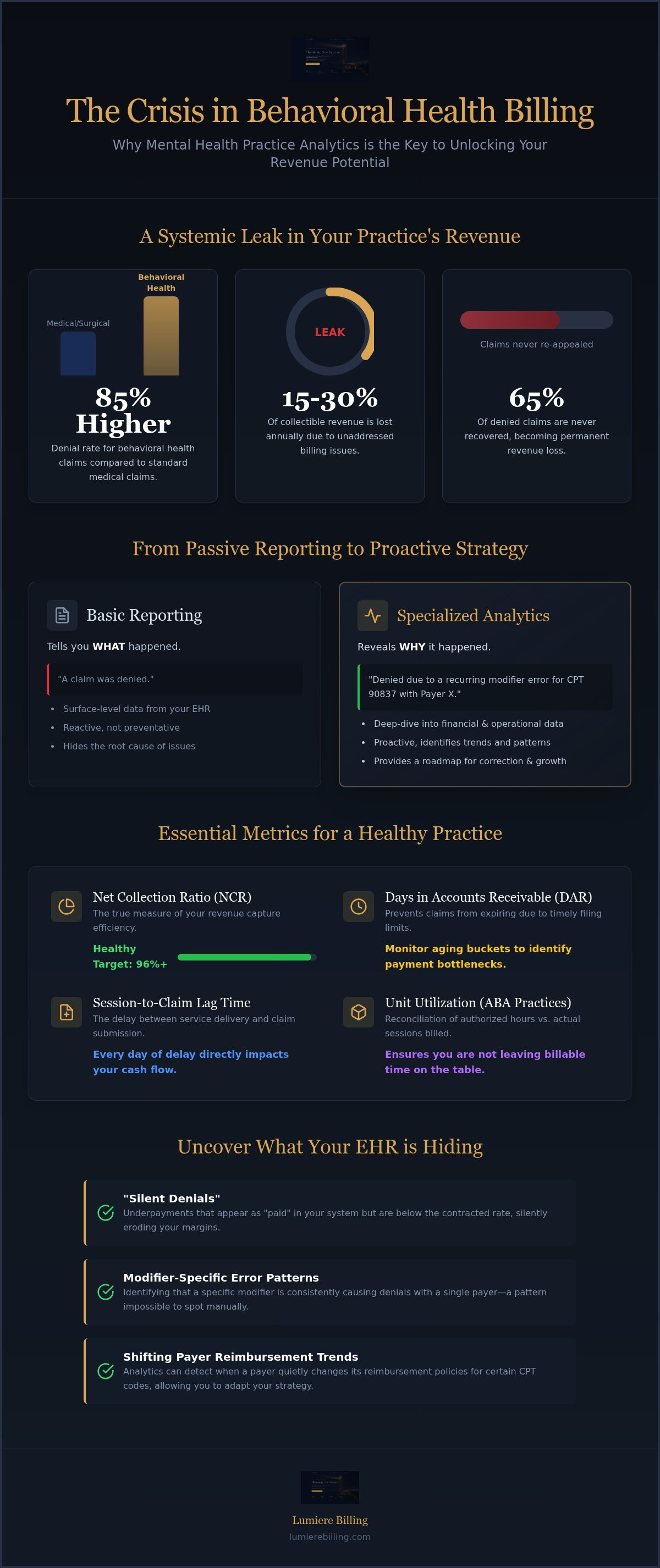
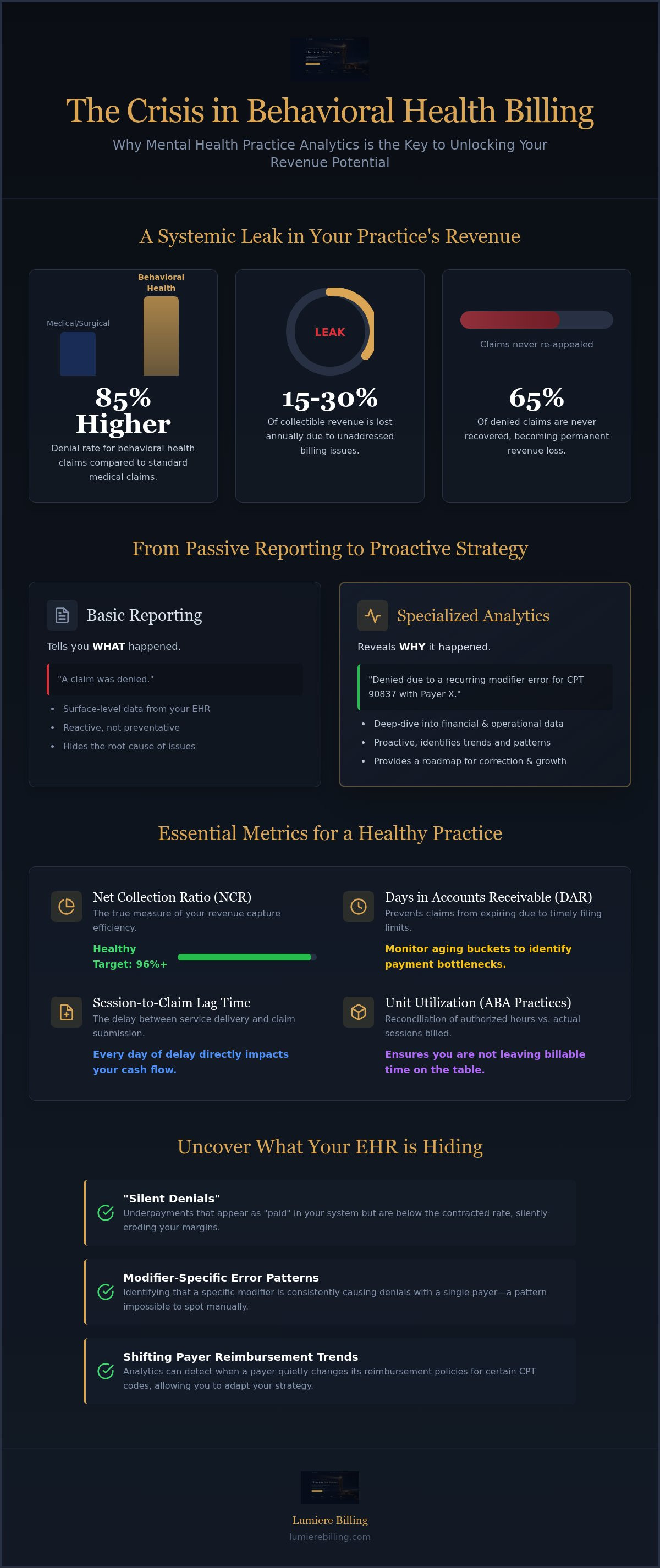
Behavioral health claims are denied approximately 85% more often than standard medical or surgical claims. This statistic isn't just a hurdle; it's a systemic leak that drains between 15% and 30% of a practice's collectible revenue every year. When your billing data remains an opaque black box, growth becomes a matter of guesswork rather than strategy. Mastering mental health practice analytics is no longer a luxury reserved for large hospital groups. It's the baseline requirement for any provider who refuses to let sixty-five percent of their denied claims go unrecovered and unaddressed.
You likely feel the exhaustion of facing high denial rates without clear explanations or struggling to track if your clinicians are meeting productivity benchmarks. It's difficult to scale when payer-specific reimbursement trends shift without warning. This guide will show you how to illuminate those hidden failure points and transform fragmented billing data into a roadmap for expansion. We'll explore how to reduce denials through pattern recognition, optimize your revenue cycle, and build a data-backed strategy to scale your behavioral health practice into 2026 and beyond.
Key Takeaways
- Learn the critical distinction between passive reporting and proactive analytics to understand the "why" behind your financial outcomes rather than just observing them.
- Master mental health practice analytics to uncover "silent denials" and modifier-specific errors that frequently bypass standard EHR systems.
- Gain total visibility into operational efficiency by tracking clinician productivity and unit utilization rates to ensure a stable foundation for growth.
- Identify the essential KPIs, such as Net Collection Ratio and Days in AR, that serve as the definitive pulse check for your revenue cycle health.
- Discover how specialized practice advisory services transform raw billing data into a strategic roadmap for multi-location expansion.
Beyond the EHR: Defining Mental Health Practice Analytics in 2026
The definition of success for a behavioral health clinic has fundamentally shifted. It's no longer enough to simply record patient encounters or store clinical notes. True mental health practice analytics involves the systematic analysis of clinical outcomes, operational workflows, and financial data to drive sustainable growth. Many practitioners confuse basic reporting with analytics. Reporting tells you that a claim was denied; analytics tells you that the denial stems from a specific modifier error recurring across three different payers. Practice analytics is the financial nervous system of a modern clinic.
In a high-volume environment where margins are increasingly thin, visibility is your only defense against insolvency. You need to see beyond the surface of your ledger to understand the mechanical integrity of your business. Analytics transforms opaque billing data into a roadmap. It shows you exactly where revenue is leaking and where your clinicians are most effective, allowing you to move from passive observation to proactive management.
The Evolution of Data in Behavioral Health
The industry bottleneck has moved. A decade ago, the primary challenge was digitizing paper files. Today, we're drowning in data but starving for insight. The 2026 landscape is defined by extreme payer complexity and tightened regulations, such as the February 2026 compliance deadline for 42 CFR Part 2. Manual tracking of these variables is now impossible. Without sophisticated algorithmic detection, silent denials, those underpayments that appear as paid in your software, will continue to erode your margins. This shift requires a deep understanding of Mental Health Informatics to bridge the gap between clinical documentation and financial recovery.
EHR Reporting vs. Specialized RCM Analytics
Standard EHR reports are built for clinical compliance, not financial optimization. They often fail to track complex variables like ABA unit reconciliation or the specific patterns behind 90837 vs. 90834 CPT code denials. Specialized analytics must integrate deeply with your behavioral health revenue cycle management to be effective. Surface-level metrics often hide systemic leaks. If you only look at total collections, you'll miss a rising trend in partial payments that signals a credentialing or modifier issue. Relying on basic EHR reports is like looking at a snapshot when you need a live diagnostic feed of your practice's health.
The Four Dimensions of Behavioral Health Data Visibility
Achieving true visibility in a behavioral health clinic requires looking beyond the clinical chart. You must synchronize four distinct data dimensions to build a sustainable organization. Many owners focus solely on clinical outcomes, yet without financial and operational clarity, the mission itself becomes vulnerable. Effective mental health practice analytics integrates these silos to reveal the mechanical integrity of your business. It transforms a collection of individual sessions into a cohesive, measurable system.
Financial KPIs: Protecting Your Bottom Line
Gross charges are essentially vanity metrics. They represent what you wish to be paid, not what you actually capture. To understand your true standing, you must track the Net Collection Ratio (NCR). If your practice bills $500,000 but only recovers $350,000 after contractual adjustments and denials, your NCR is 70%. This indicates a massive gap in revenue capture. A healthy target for behavioral health in 2026 is 96% or higher. Monitoring Days in AR (DAR) and aging buckets prevents claims from falling into the timely filing trap. By analyzing these trends, you can identify specific behavioral health billing errors to avoid, such as recurring credentialing lapses that stall payments for months.
Operational Analytics: Optimizing Your Clinicians
Operational data reveals the efficiency of your human capital. One critical metric is the session-to-claim lag time. If a clinician takes five days to finalize documentation, your cash flow is delayed by that same margin. For ABA practices, unit utilization is paramount. You must reconcile authorized hours against actual sessions in real time. If a technician consistently under-utilizes units, you are losing authorized revenue that cannot be recovered later. Data also acts as an early warning system for staff burnout. A sudden drop in documentation speed or a spike in no-show rates often signals a clinician who is overextended. Integrating these insights into your mental health practice analytics allows you to intervene before turnover occurs. If your current reporting feels incomplete, a Free Billing Audit can often reveal the specific operational leaks hiding in your data.
Clinical Outcomes and Payer Performance
As the industry moves toward value-based care, tracking patient progress through standardized measures is no longer optional. These clinical outcomes provide the leverage needed for payer negotiations. Finally, comparative payer performance analysis allows you to see which carriers are your true partners. By comparing reimbursement rates and denial patterns across different carriers, you can decide which contracts to prioritize and which to renegotiate. This level of transparency ensures that your practice isn't just busy, but profitable and clinically effective. You stop guessing which payers are costing you money and start making decisions based on hard evidence.
Identifying Revenue Leakage Through Specialized Analytics
Revenue leakage in behavioral health isn't always a loud event. It often manifests as a "silent denial," where a claim is processed and paid, but at a rate significantly lower than your contracted fee schedule. Without comparative mental health practice analytics, these underpayments vanish into the background of your daily operations. You might assume a payment is correct simply because it isn't "denied," but failing to catch these discrepancies can cost your practice between 15% and 30% of its annual collectible revenue. Analytics brings these hidden issues into focus, allowing you to reclaim what you've already earned.
Modifier analysis is a critical component of this oversight. We frequently see systemic patterns in how carriers handle 90837 versus 90834 CPT codes. Some payers automatically downcode 60-minute sessions to 45-minute sessions without notifying the provider. By analyzing these trends across thousands of claims, you can identify which payers are targeting your highest-value services for "soft denials." This data gives you the mechanical integrity needed to challenge payer behavior with evidence rather than anecdotes.
Credentialing status is another primary driver of revenue loss that often goes untracked. When mental health provider credentialing gaps occur, the resulting denials are often misclassified as "administrative errors." Analytics allows you to trace every dollar lost back to its origin. If a specific provider's claims are consistently failing, you can quickly determine if the issue is a documentation error or an expired enrollment. In 2026, staying ahead of payer recoupment trends and "takebacks" requires this level of granular visibility.
The High Cost of Modifier and CPT Errors
Sophisticated data tools help you spot "impossible day" billing errors before an external auditor does. If your clinicians bill for more hours than exist in a standard workday, your practice becomes a target for recoupment. In complex ABA billing, analytics flags missing 25 or 59 modifiers that frequently cause line-item denials. Quantifying the ROI of a behavioral health billing specialist becomes simple when you can see the direct correlation between expert modifier application and a rising clean-claim rate. Precision replaces volume as your primary growth driver.
Payer Behavior Profiling
Not all payers are created equal. You should rank your carriers by "Ease of Doing Business" based on their specific denial rates and average time to pay. Identifying which carriers are lagging behind 2026 reimbursement benchmarks allows you to focus your energy on the most profitable contracts. This data is your most powerful tool when you enter the mental health provider re-credentialing process. When you can prove your clinical outcomes and show a payer's specific administrative failures, you negotiate from a position of strength and mastery.
Building Your KPI Dashboard: Essential Metrics for Scaling Clinics
A dashboard is not just a collection of charts. It is the command center that allows you to steer your practice away from financial volatility. High-performance mental health practice analytics must bridge the gap between clinical activity and fiscal reality. Without this centralized view, you are flying blind, reacting to crises rather than preventing them. A well-constructed dashboard provides the mechanical integrity needed to support a growing caseload without sacrificing care quality.
The ultimate health check for any clinic is the comparison of Total Collections against Expected Reimbursement. This metric is distinct from the Net Collection Ratio. It measures your performance against the specific terms of your payer contracts. If your expected reimbursement is $100 per session but you're only collecting $85, you have a contractual integrity issue that requires immediate investigation. This gap often points to silent underpayments or undisclosed fee schedule changes that simple EHR reports fail to capture.
Your dashboard must also categorize denials into "fixable" and "final" buckets. Technical errors, such as missing zip codes or incorrect NPIs, are fixable and represent a failure in administrative workflow. Clinical denials based on medical necessity are often final and suggest a breakdown in your intake or documentation process. Pairing this with authorization expiration alerts ensures that your team stops providing unbillable services before the session even starts. Precision in these early stages prevents the wasted effort of chasing uncollectible debt.
The Executive View: What Owners Need to See Weekly
Ownership requires a high-level perspective that focuses on velocity and risk. Every Monday, you should review your cash on hand against forecasted revenue based on current billing volume. Identifying your top five denial reasons and their specific dollar impact allows you to allocate resources to the most expensive problems first. Establishing a consistent weekly dashboard review reduces month-end stress by transforming massive reconciliation tasks into manageable, proactive adjustments.
Operational Scaling Metrics
To scale successfully, you must understand your unit economics. Calculating the cost per session versus the reimbursement per session reveals your true break-even point. This calculation includes clinician salary, facility overhead, and administrative costs. In a growth phase, you must also track new patient acquisition cost (CAC) against the lifetime value (LTV) of a patient. For those managing multiple sites, the data requirements for ABA revenue cycle management become exponentially more complex. Centralizing these metrics ensures that expanding to a new location doesn't dilute the profitability of your existing ones.
If your current dashboard leaves you with more questions than answers, it's time for professional clarity. Start with a Free Billing Audit to identify the KPIs that will drive your 2026 growth.
Lumiere Analytics: Illuminating the Path to Profitability
Data is only as valuable as the decisions it informs. At Lumiere Billing, we don't just hand you a spreadsheet of numbers and expect you to find the patterns. We transform fragmented raw data into a strategic roadmap for practice expansion. Our approach to mental health practice analytics is built on the belief that visibility is the first step toward optimization. We act as a vigilant protector of your financial health; we identify the subtle failure points that generalist services overlook. By mastering mental health practice analytics, you stop guessing and start growing with precision.
The true power of our system lies in our Practice Advisory. We move your clinic away from reactive billing, where you're constantly chasing old debt, and toward proactive revenue optimization. Our team interprets complex data sets to reveal which payers are underperforming and which clinical workflows are causing delays. Because our RCM fees are percentage-based, our incentives are perfectly aligned with your growth. We're obsessed with data accuracy because your success is the only metric that defines our own. We don't just report on your revenue; we actively engineer its improvement.
Real-World Impact: From Data to Recovered Revenue
Consider the impact of identifying a single systemic error. In one instance, a professional behavioral health billing audit revealed a modifier pattern that was causing silent denials across a specific payer group. By correcting this one workflow, the practice recovered 12% of its annual revenue that would have otherwise been lost to time. We handle the heavy lifting of data analysis. This allows you to focus entirely on patient care while we maintain the mechanical integrity of your revenue cycle. Our goal is to bring hidden issues into sharp focus before they impact your bottom line.
Next Steps: Your Data-Driven Future
Transitioning to a data-driven model doesn't have to be disruptive. We integrate our analytics into your existing workflow to provide immediate clarity without adding administrative burden. The first step is identifying where your current system is leaking revenue. Secure your free behavioral health billing audit and start scaling today. We'll bring the hidden issues into focus and help you build a foundation for sustainable, multi-location expansion in 2026. Don't let your hard-earned revenue remain hidden in the shadows of opaque billing data.
Mastering the Future of Behavioral Health Growth
The landscape of 2026 demands more than just clinical excellence; it requires a level of fiscal visibility that standard EHR reports cannot provide. By implementing robust mental health practice analytics, you transform your billing department from a cost center into a strategic engine for expansion. You've learned how to identify the silent denials eroding your margins and how to build a KPI dashboard that supports multi-location scaling. Precision is your greatest asset in a high-volume, low-margin environment.
Success in this specialized niche depends on comprehensive analytics and a partner who is as invested in your data accuracy as you are. Our percentage-based fee model ensures our incentives are perfectly aligned with your recovery and growth. Stop wondering where your revenue is leaking and start building a foundation of mechanical integrity. Get Your Free Behavioral Health Billing Audit and bring your practice's financial health into sharp focus today. Your roadmap to sustainable scaling is already hidden in your data; it's time to illuminate it.
Frequently Asked Questions
What is the most important KPI for a mental health practice?
The Net Collection Ratio is the single most vital metric for assessing your financial health. It measures the percentage of collectible revenue you actually recover after contractual adjustments. While gross charges represent a wish list, the NCR reveals the mechanical integrity of your revenue cycle. A healthy behavioral health practice should target an NCR of 96% or higher. Falling below this threshold signals systemic leaks in your billing process or unaddressed payer underpayments.
How often should I review my practice analytics dashboards?
You should perform high-level reviews of your mental health practice analytics weekly to catch immediate operational shifts. This frequency allows you to identify sudden spikes in denials or documentation lags before they impact cash flow. Monthly reviews are better suited for deep-dive analysis of payer reimbursement trends and clinician productivity. Consistent oversight reduces the administrative burden of month-end reconciliations and ensures your practice remains on its projected growth path.
Can analytics help reduce my claim denial rate?
Analytics reduce denial rates by exposing the root causes of claim rejections. Instead of treating every denial as an isolated event, sophisticated data tools reveal patterns such as recurring modifier errors or payer-specific credentialing gaps. Once you identify that a specific carrier is downcoding 90837 sessions, you can adjust your documentation or billing workflows proactively. This transition from reactive corrections to proactive prevention is the only way to achieve a high clean-claim rate.
What is the difference between an EHR report and practice analytics?
EHR reports are typically static summaries of what happened, such as a list of scheduled appointments or total charges. In contrast, mental health practice analytics provide the "why" behind those numbers and suggest specific corrective actions. Analytics integrate clinical, financial, and operational data to reveal the mechanical integrity of your entire system. While an EHR report shows a denial, analytics reveal that the denial stems from a provider's expired enrollment status.
How do analytics help with ABA unit tracking and reconciliation?
Specialized analytics provide real-time visibility into authorized unit utilization for ABA providers. This prevents the common failure of providing services that exceed payer limits or failing to use units before they expire. By reconciling authorized hours against actual sessions daily, you ensure 100% revenue capture. This level of oversight is impossible with manual tracking and is essential for maintaining the profitability of high-intensity behavioral health programs.
Is it worth investing in analytics for a small solo practice?
Investing in data visibility is critical even for solo practitioners. Small practices often operate on tighter margins where a few "silent denials" can significantly impact personal income. Establishing a foundation of data-driven oversight early prevents the chaotic administrative breakdown that often occurs during the transition to a group practice. It ensures you build your business on a stable, profitable model from day one rather than fixing broken systems later.
How can I identify revenue leakage in my billing process?
Identifying revenue leakage requires comparing your actual collections against your contracted fee schedules. You must look for "silent denials," which are underpayments that payers process without a formal rejection notice. Specialized analytics flag these discrepancies by highlighting sessions where the reimbursement doesn't match the expected rate. A professional Free Billing Audit is often the most efficient way to bring these hidden leaks into focus and quantify their dollar impact.
What data do I need to scale my mental health practice to multiple locations?
Scaling requires a deep understanding of your unit economics across different sites. You need data on the cost per session versus reimbursement per session for each location to find your true break-even point. Additionally, tracking new patient acquisition costs and clinician utilization rates ensures that expansion doesn't dilute your overall profitability. Mastery of these metrics allows you to replicate your success in new markets with predictable financial outcomes and maintained care standards.
Frequently Asked Questions
The Net Collection Ratio is the single most vital metric for assessing your financial health. It measures the percentage of collectible revenue you actually recover after contractual adjustments. While gross charges represent a wish list, the NCR reveals the mechanical integrity of your revenue cycle. A healthy behavioral health practice should target an NCR of 96% or higher. Falling below this threshold signals systemic leaks in your billing process or unaddressed payer underpayments.
You should perform high-level reviews of your mental health practice analytics weekly to catch immediate operational shifts. This frequency allows you to identify sudden spikes in denials or documentation lags before they impact cash flow. Monthly reviews are better suited for deep-dive analysis of payer reimbursement trends and clinician productivity. Consistent oversight reduces the administrative burden of month-end reconciliations and ensures your practice remains on its projected growth path.
Analytics reduce denial rates by exposing the root causes of claim rejections. Instead of treating every denial as an isolated event, sophisticated data tools reveal patterns such as recurring modifier errors or payer-specific credentialing gaps. Once you identify that a specific carrier is downcoding 90837 sessions, you can adjust your documentation or billing workflows proactively. This transition from reactive corrections to proactive prevention is the only way to achieve a high clean-claim rate.
EHR reports are typically static summaries of what happened, such as a list of scheduled appointments or total charges. In contrast, mental health practice analytics provide the "why" behind those numbers and suggest specific corrective actions. Analytics integrate clinical, financial, and operational data to reveal the mechanical integrity of your entire system. While an EHR report shows a denial, analytics reveal that the denial stems from a provider's expired enrollment status.
Specialized analytics provide real-time visibility into authorized unit utilization for ABA providers. This prevents the common failure of providing services that exceed payer limits or failing to use units before they expire. By reconciling authorized hours against actual sessions daily, you ensure 100% revenue capture. This level of oversight is impossible with manual tracking and is essential for maintaining the profitability of high-intensity behavioral health programs.
Investing in data visibility is critical even for solo practitioners. Small practices often operate on tighter margins where a few "silent denials" can significantly impact personal income. Establishing a foundation of data-driven oversight early prevents the chaotic administrative breakdown that often occurs during the transition to a group practice. It ensures you build your business on a stable, profitable model from day one rather than fixing broken systems later.
Identifying revenue leakage requires comparing your actual collections against your contracted fee schedules. You must look for "silent denials," which are underpayments that payers process without a formal rejection notice. Specialized analytics flag these discrepancies by highlighting sessions where the reimbursement doesn't match the expected rate. A professional Free Billing Audit is often the most efficient way to bring these hidden leaks into focus and quantify their dollar impact.
Scaling requires a deep understanding of your unit economics across different sites. You need data on the cost per session versus reimbursement per session for each location to find your true break-even point. Additionally, tracking new patient acquisition costs and clinician utilization rates ensures that expansion doesn't dilute your overall profitability. Mastery of these metrics allows you to replicate your success in new markets with predictable financial outcomes and maintained care standards.