Mastering Behavioral Health Practice Financial Performance: A 2026 Strategic Guide

In 2026, the average unmanaged behavioral health practice allows revenue to sit in accounts receivable for up to 75 days. This is a systemic failure. While your clinicians focus on patient outcomes, your back-office mechanics are likely grinding against opaque billing processes and rising denial rates. You see the volume of patients grow, yet the cash flow feels restricted. Mastering behavioral health practice financial performance requires more than just submitting claims. It demands a level of surgical precision that turns hidden data into actionable insight.
You know that chasing unworked denials and tracking complex ABA units shouldn't be your primary job. We agree that clinical excellence shouldn't be penalized by administrative friction. This guide promises to reveal the specific financial levers and specialized KPIs that drive sustainable growth for modern practices. You'll discover how to identify revenue leakage, achieve a clean claim rate above 95 percent, and implement a scalable framework designed for multi-location expansion. We are moving from the shadows of best guesses into the clarity of a high-performing revenue cycle.
Key Takeaways
- Identify the specific 2026 benchmarks for Days in Accounts Receivable and Clean Claim Rates that separate high-performing practices from those losing revenue.
- Uncover the hidden impact of "Silent Denials," which often allow significant revenue to leak from behavioral health practices that appear healthy on the surface.
- Master a strategic framework to optimize behavioral health practice financial performance by aligning clinical documentation with rigorous payer necessity standards.
- Differentiate your revenue cycle management from general medical billing by mastering the nuances of session-based units and proactive authorization tracking.
- Establish a scalable workflow from patient intake to final payment that supports sustainable growth and financial visibility for multi-location practices.
Understanding the Unique Levers of Behavioral Health Financial Performance
Realized revenue isn't just about what you bill. It's about what you keep. In this industry, we define behavioral health practice financial performance as the mechanical efficiency of converting clinical hours into actual collections. Unlike a general practitioner who might bill for a single annual exam or a one-off procedure, a behavioral health practice manages a high volume of recurring sessions. This creates a complex web of authorizations and unit caps that requires constant vigilance. The standard healthcare revenue cycle management model often breaks down here because it isn't built for the recurring nature of therapy or the granular unit-based tracking required for ABA.
Traditional financial metrics often fail to capture the true health of a psychiatric or therapy practice. If you only look at gross charges or bank balances, you're looking through a distorted lens. You must bridge the clinical-administrative gap. When a clinician's documentation doesn't align with the billed units, the practice suffers a "silent leak" that won't show up on a standard balance sheet until an audit occurs. True behavioral health practice financial performance is found in the synergy between clinical precision and administrative follow-through.
The Role of Specialized CPT Codes
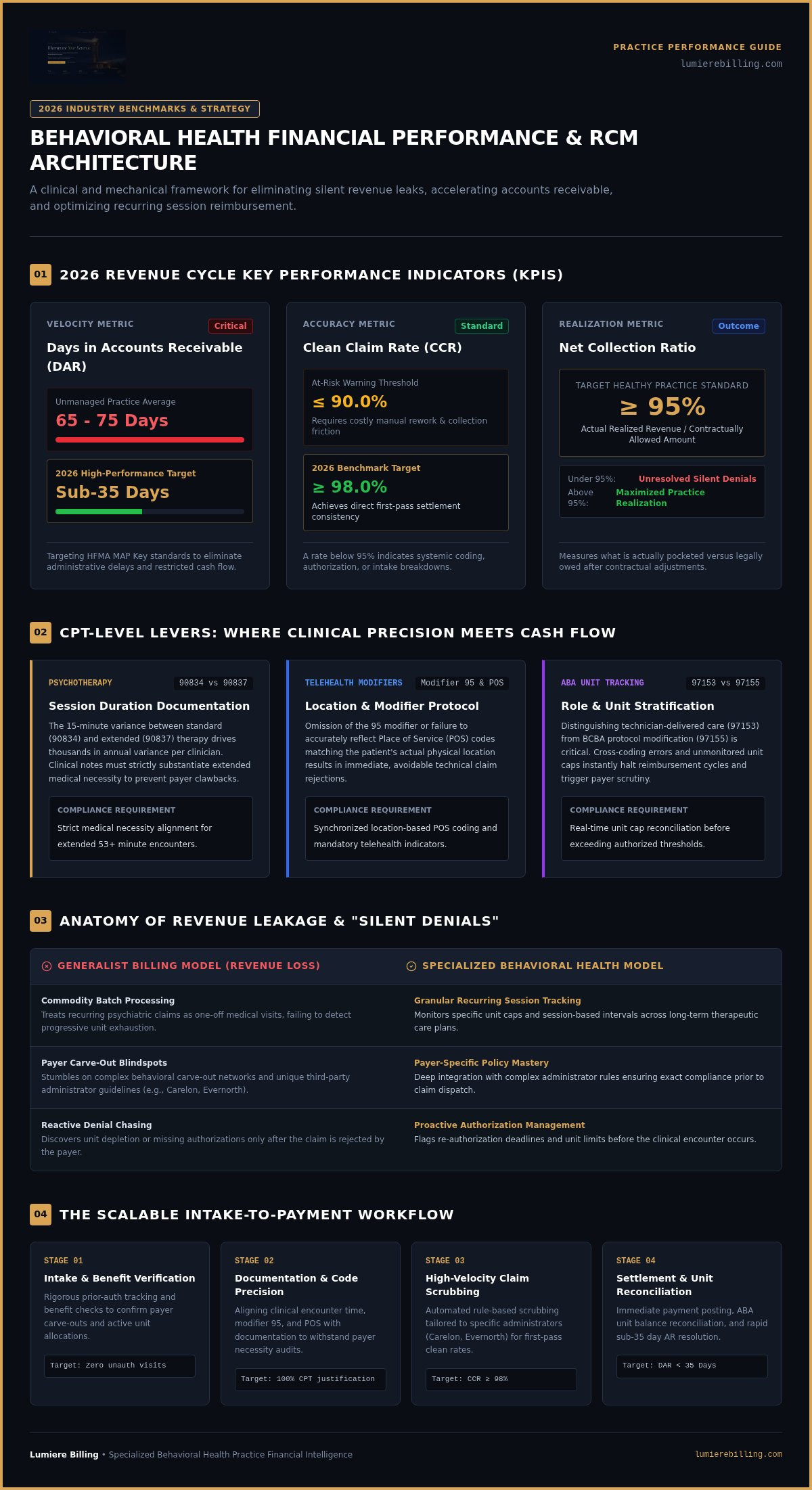
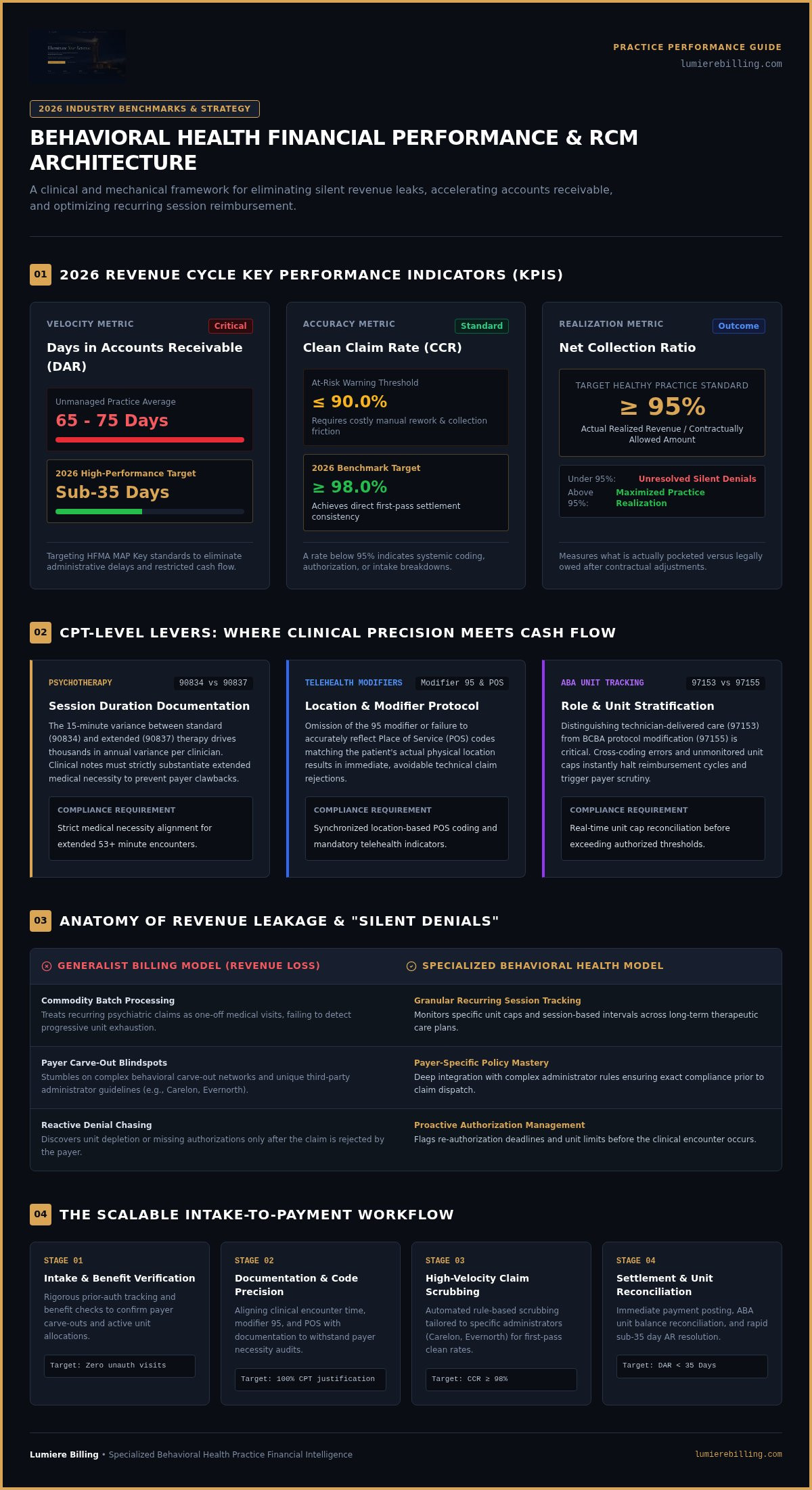
Precision starts at the code level. The difference between a 90834 and a 90837 code isn't just fifteen minutes of clinical time; it's a calculated reimbursement variance that impacts your annual bottom line by thousands. Documentation must justify the longer session, or you risk a clawback. Telehealth brings its own friction. Missing the 95 modifier or failing to update POS codes based on the patient's location results in immediate, avoidable denials. In ABA therapy, the stakes are higher. Misidentifying 97153 (technician-led) as 97155 (BCBA-led) isn't just a clerical error. It's a compliance failure that halts your cash flow and triggers payer scrutiny.
Why Generalist Billing Firms Underperform
Generalist firms treat every claim like a commodity. They don't understand the nuances of payer carve-outs or the specific rules of administrators like Carelon or Evernorth. This lack of focus leads to systemic leaks. A generalist often stumbles during ABA unit tracking reconciliation, failing to notice when a patient exceeds their authorized sessions until the denial arrives. Specialized behavioral health billing services act as a vigilant protector. They anticipate these friction points before the encounter occurs. They don't just process claims; they optimize the entire lifecycle of the patient encounter.
Key Performance Indicators (KPIs) for Behavioral Health Growth
Data without context is just noise. To truly optimize behavioral health practice financial performance, you must move beyond the basic bank balance and look at the mechanical health of your revenue cycle. High-performing practices in 2026 don't wait for month-end reports to identify failures. They use real-time benchmarks to steer their operations. By adopting the HFMA MAP Keys for revenue cycle benchmarking, specialized practices can align their internal metrics with the highest industry standards.
Your primary objective is to reduce Days in Accounts Receivable (DAR). While unmanaged psychiatric practices often linger at 65 to 75 days, your target for 2026 is sub-35 days. Speed is a byproduct of accuracy. This brings us to the Clean Claim Rate (CCR). In behavioral health, where margins are often tight, a CCR of 90 percent is a warning sign. You must aim for 98 percent or higher. Every rejected claim requires manual intervention, which increases your cost to collect and delays cash flow. If you are unsure where your current metrics stand, a Free Billing Audit can provide the baseline visibility needed to begin optimization.
Finally, track your Net Collection Ratio. This measures what you actually pocket versus what you are legally owed after contractual adjustments. A healthy practice should maintain a ratio of 95 percent or higher. If your ratio is lower, you likely have systemic issues with specific insurance carriers. Analyzing denial rates by payer allows you to identify which carriers are creating friction through "authorization fatigue" or inconsistent medical necessity criteria.
Clinician Productivity and Utilization Metrics
Financial health is inextricably linked to clinical documentation. We measure this through the "Billable vs. Actual" ratio. If a therapist is scheduled for 30 hours but only produces 22 billable hours, your practice is absorbing a massive overhead leak. Late documentation is the silent killer of the revenue cycle. When notes are delayed beyond 72 hours, the charge lag pushes your DAR into the danger zone. Clinician Utilization Rate is the primary driver of group practice scalability.
The Behavioral Health KPI Dashboard
Effective leadership requires a dashboard that provides a proactive financial forecast rather than a retrospective autopsy. Your weekly executive summary should include encounter-to-submission lag, authorization expiration dates, and 90-plus day aging buckets. This level of transparency is the cornerstone of modern behavioral health revenue cycle management. When you can see a denial spike the moment it happens, you can pivot your strategy before it impacts your payroll or growth plans. Moving from reactive to proactive management transforms your back office from a cost center into a strategic asset.
Identifying and Plugging Revenue Leaks
High collections can mask systemic rot. The most dangerous phrase in a clinical founder's vocabulary is "we are collecting, so we must be doing well." This mindset ignores the erosion occurring beneath the surface. True behavioral health practice financial performance isn't measured by the money that hits your bank, but by the money that never leaves the payer's pocket. Silent Denials are the primary culprit. These aren't standard rejections that appear on a daily report. Instead, they are claims that payers subtly downcode, leave unworked, or ignore due to minor technicalities that your team may never notice. When combined with common behavioral health billing errors to avoid, the cumulative loss often exceeds 10 percent of a practice's annual revenue.
Credentialing gaps represent another significant, yet preventable, leak. When a new provider starts seeing patients before their enrollment is finalized, those sessions are frequently uncollectible. You cannot bill retroactively for many commercial payers. Maintaining proactive mental health provider credentialing is a financial necessity, not just a compliance task. As the industry moves toward the CMS Innovation in Behavioral Health (IBH) Model, the ability to align provider status with reimbursement frameworks becomes even more critical for sustainable growth.
The Authorization-to-Claim Reconciliation Gap
ABA practices are particularly vulnerable to unit-based leakage. We frequently see practices lose 10 to 15 percent of their potential revenue because they provide more units than a payer has authorized. This happens when there is no real-time bridge between the clinical schedule and the billing department. You must implement a workflow for real-time authorization tracking that alerts your team before a clinician enters the room. Without this mechanical oversight, you are essentially providing free labor to insurance carriers who have no intention of paying for unauthorized units.
Underpayment Recovery Strategies
Payers don't always pay what they promised in your contract. Identifying when a carrier reimburses below the agreed-upon rate requires automated contract variance monitoring. Most practices lack the tools to see these discrepancies, allowing payers to keep thousands in underpayments every year. We recommend performing a quarterly behavioral health billing audit to compare actual payments against your fee schedules. This proactive stance ensures you are capturing every dollar you've earned through clinical care. Don't leave your behavioral health practice financial performance to chance or payer goodwill.
Strategic Framework for Financial Optimization
Precision isn't a suggestion; it's the foundation of a scalable practice. To move from a reactive posture to a growth-oriented one, your practice needs a mechanical framework that eliminates guesswork. We view behavioral health practice financial performance as a series of interlocking gears. If one gear slips, the entire system loses momentum. Optimization begins with a comprehensive workflow audit that traces every dollar from the initial patient intake to the final payment posting. This audit often reveals that revenue isn't lost at the billing stage, but at the front desk where insurance verification fails or in the clinician's office where documentation lags.
Once your workflow is mapped, you must align clinical documentation with rigorous payer medical necessity requirements. This is followed by optimizing your existing EHR settings to their full capacity. Most specialized behavioral health platforms have untapped automation features that can flag authorization unit overages before they become denials. A tiered denial management process ensures that every rejection is appealed based on its clinical merit, rather than just being written off as uncollectible. Finally, transitioning to a performance-based billing model ensures that your incentives are perfectly aligned with realized revenue.
Workflow Audits for Multi-Location Practices
Scalability introduces significant complexity. For multi-location practices, standardizing intake and insurance verification across all sites is the only way to maintain a clean claim rate above 95 percent. Centralizing the billing function prevents the "silo effect" where different locations follow different rules, leading to inconsistent cash flow. When internal teams become overwhelmed by this complexity, it's time to outsource mental health billing to a partner that can provide centralized oversight and specialized expertise across your entire footprint.
The Financial Impact of Compliance
Compliance is a financial safeguard. Proactive internal documentation audits prevent "clawbacks," which can devastate a practice's reserves years after the service was provided. For example, if your team frequently bills for high-complexity sessions, your clinical time-stamps must explicitly support the required duration. Payers are increasingly targeting specific high-value codes for audits. Beyond immediate cash flow, audit readiness significantly increases your practice valuation. Investors and buyers look for clean, defensible revenue cycles that demonstrate long-term stability. If your documentation is bulletproof, your behavioral health practice financial performance becomes a tangible asset rather than a liability.
Ready to identify the hidden gaps in your revenue cycle? Schedule your Free Billing Audit today to secure your practice's financial future.
Partnering for Visibility: The Lumiere Billing Approach
Administrative overhead is often viewed as a necessary burden. We reject this premise. At Lumiere Billing, we transform back-office operations into a high-octane growth engine. Most generalist firms simply process what you give them, regardless of accuracy. We operate as a vigilant protector of your behavioral health practice financial performance. Our approach centers on absolute visibility. We bring light to the dark corners of your revenue cycle where unworked remittances and unverified authorizations typically hide. By integrating billing, credentialing, and practice advisory, we create a holistic financial strategy that doesn't just react to the past; it prepares you for the future.
Our percentage-based fee model ensures our incentives are perfectly aligned with yours. We don't get paid until you do. This creates a partnership based on results rather than mere transactions. It forces a level of focus on every single claim, from high-value psychiatric evaluations to high-frequency ABA units. We don't just "do billing." We repair broken systems and optimize the mechanical integrity of your entire financial operation.
From Data to Decisions
Hiring clinicians shouldn't be a guess. Our specialized analytics help you decide exactly when your clinician utilization rates justify a new hire. We evaluate payer profitability with surgical precision. If a carrier's administrative friction outweighs their reimbursement rate, we provide the data you need to renegotiate or refine your provider mix. In a recent case study summary, we identified a 20 percent revenue growth opportunity simply by correcting systemic modifier errors that a generalist firm had overlooked for years. We move your practice from best guesses to data-driven mastery.
Take the First Step Toward Financial Clarity
Clarity starts with an objective look at your current state. Our Free Billing Audit is designed for established practices that suspect they're leaving money on the table. During a Lumiere financial performance consultation, we don't just hand you a report. We walk you through the mechanical failures in your workflow and outline the refined counter-measures required for optimization. You'll gain a clear view of your revenue leakage and a roadmap for scalable growth. Don't let opaque processes dictate your future. Request your Free Billing Audit today and bring your behavioral health practice financial performance into focus.
Secure Your Practice’s Financial Future
Mastering behavioral health practice financial performance is a continuous process of refinement and vigilance. It requires more than just submitting claims. It demands a mechanical alignment between your clinical documentation and administrative oversight. You've seen how reducing days in accounts receivable and tightening authorization tracking can transform your bottom line. Precision is not a luxury; it's a requirement for any practice aiming to scale in 2026. By moving from reactive collections to proactive optimization, you ensure that every clinical hour is fully realized as revenue.
At Lumiere Billing, we act as a dedicated advocate for your practice's health. Our specialized behavioral health RCM experts utilize a percentage-based fee model, ensuring our incentives are perfectly aligned with your success. With our comprehensive analytics dashboards, you gain the visibility needed to make confident, data-driven decisions. The path to financial clarity begins with an objective assessment of your current systems.
Get a Free Billing Audit to Uncover Your Practice’s Hidden Revenue and start your journey toward sustainable growth today. Your clinical excellence deserves a financial operation that matches its precision.
Frequently Asked Questions
What are the most important KPIs for a behavioral health practice?
The most critical metrics for behavioral health practice financial performance include the Net Collection Rate and First-Pass Resolution Rate (FPRR). You should target an NCR of 95 percent or higher to ensure you aren't leaving contracted dollars on the table. A high FPRR, ideally above 90 percent, indicates that your internal documentation and coding are aligned with payer rules. This prevents the administrative burden of rework and ensures steady, predictable cash flow for your practice.
How much revenue do behavioral health practices typically lose to claim denials?
Behavioral health practices currently face an average claim denial rate between 11.0 and 11.8 percent. When you account for unworked remittances and untracked session units, the total revenue loss often climbs to 15 percent of annual billings. This friction is typically caused by authorization fatigue and complex carve-out rules from administrators like Carelon or Optum. Reducing this loss requires a vigilant approach to denial prevention rather than just reactive appeals.
Can a specialized billing company improve my practices financial performance more than an EHR?
An EHR is a necessary infrastructure, but it lacks the proactive oversight of a specialized RCM partner. Software can't follow up on unworked claims, manage complex credentialing cycles, or analyze payer-specific contract variances. A specialized billing firm acts as an extension of your team, providing the human expertise needed to repair broken systems. While the EHR stores data, a specialized partner uses that data to optimize your overall behavioral health practice financial performance.
What is a "silent denial" in mental health billing?
A silent denial occurs when a payer underpays a claim or downcodes a service without issuing a formal rejection notice. These often stem from subtle discrepancies in session length or missing interactive complexity modifiers. Because these claims aren't flagged as "denied" in your EHR, they often go unnoticed. Identifying these leaks requires automated contract variance monitoring to ensure every payment matches your negotiated fee schedule and clinical documentation accurately reflects the service provided.
How does clinician documentation affect the practices bottom line?
Clinician documentation is the primary engine of your revenue cycle. When notes are delayed beyond 72 hours, it creates a charge lag that pushes your accounts receivable into the danger zone. Documentation must also explicitly support the medical necessity of specific CPT codes like 90837. If the clinical record doesn't justify the session length, your practice faces a high risk of clawbacks during a retrospective payer audit, regardless of whether the claim was initially paid.
Is a percentage-based billing fee better than a flat fee for behavioral health?
A percentage-based model is superior because it aligns the billing partner's success directly with your realized revenue. Unlike flat-fee models that reward the volume of claims processed, a percentage fee motivates the biller to chase every dollar, including difficult appeals and underpayments. This model transforms the billing service from a vendor into a proactive partner. It ensures that your RCM team is as invested in your practice's growth and collection success as you are.
How often should a behavioral health practice conduct a billing audit?
We recommend conducting an internal billing audit quarterly to identify systemic leaks and contract variances. These reviews are especially critical at the start of the calendar year to manage deductible resets and new payer rules. An annual external audit provides a deeper look at compliance and audit readiness. Regular audits ensure that your billing processes remain mechanically sound as you scale, protecting you from long-term revenue erosion and unexpected payer clawbacks.
What is the ideal Days in AR (DAR) for an ABA practice?
The ideal benchmark for Days in AR (DAR) in a high-performing ABA practice is sub-35 days. While the 2026 industry average for unmanaged practices has risen to 75 days, top performers maintain velocity by reconciling session units in real-time. A DAR over 50 days is a significant warning sign of authorization friction or documentation delays. Maintaining a low DAR is essential for sustaining the cash flow required to support multi-location expansion and operational stability.
Frequently Asked Questions
The most critical metrics for behavioral health practice financial performance include the Net Collection Rate and First-Pass Resolution Rate (FPRR). You should target an NCR of 95 percent or higher to ensure you aren't leaving contracted dollars on the table. A high FPRR, ideally above 90 percent, indicates that your internal documentation and coding are aligned with payer rules. This prevents the administrative burden of rework and ensures steady, predictable cash flow for your practice.
Behavioral health practices currently face an average claim denial rate between 11.0 and 11.8 percent. When you account for unworked remittances and untracked session units, the total revenue loss often climbs to 15 percent of annual billings. This friction is typically caused by authorization fatigue and complex carve-out rules from administrators like Carelon or Optum. Reducing this loss requires a vigilant approach to denial prevention rather than just reactive appeals.
An EHR is a necessary infrastructure, but it lacks the proactive oversight of a specialized RCM partner. Software can't follow up on unworked claims, manage complex credentialing cycles, or analyze payer-specific contract variances. A specialized billing firm acts as an extension of your team, providing the human expertise needed to repair broken systems. While the EHR stores data, a specialized partner uses that data to optimize your overall behavioral health practice financial performance.
A silent denial occurs when a payer underpays a claim or downcodes a service without issuing a formal rejection notice. These often stem from subtle discrepancies in session length or missing interactive complexity modifiers. Because these claims aren't flagged as "denied" in your EHR, they often go unnoticed. Identifying these leaks requires automated contract variance monitoring to ensure every payment matches your negotiated fee schedule and clinical documentation accurately reflects the service provided.
Clinician documentation is the primary engine of your revenue cycle. When notes are delayed beyond 72 hours, it creates a charge lag that pushes your accounts receivable into the danger zone. Documentation must also explicitly support the medical necessity of specific CPT codes like 90837. If the clinical record doesn't justify the session length, your practice faces a high risk of clawbacks during a retrospective payer audit, regardless of whether the claim was initially paid.
A percentage-based model is superior because it aligns the billing partner's success directly with your realized revenue. Unlike flat-fee models that reward the volume of claims processed, a percentage fee motivates the biller to chase every dollar, including difficult appeals and underpayments. This model transforms the billing service from a vendor into a proactive partner. It ensures that your RCM team is as invested in your practice's growth and collection success as you are.
We recommend conducting an internal billing audit quarterly to identify systemic leaks and contract variances. These reviews are especially critical at the start of the calendar year to manage deductible resets and new payer rules. An annual external audit provides a deeper look at compliance and audit readiness. Regular audits ensure that your billing processes remain mechanically sound as you scale, protecting you from long-term revenue erosion and unexpected payer clawbacks.
The ideal benchmark for Days in AR (DAR) in a high-performing ABA practice is sub-35 days. While the 2026 industry average for unmanaged practices has risen to 75 days, top performers maintain velocity by reconciling session units in real-time. A DAR over 50 days is a significant warning sign of authorization friction or documentation delays. Maintaining a low DAR is essential for sustaining the cash flow required to support multi-location expansion and operational stability.