Mastering ABA Revenue Cycle Management: 2026 Guide

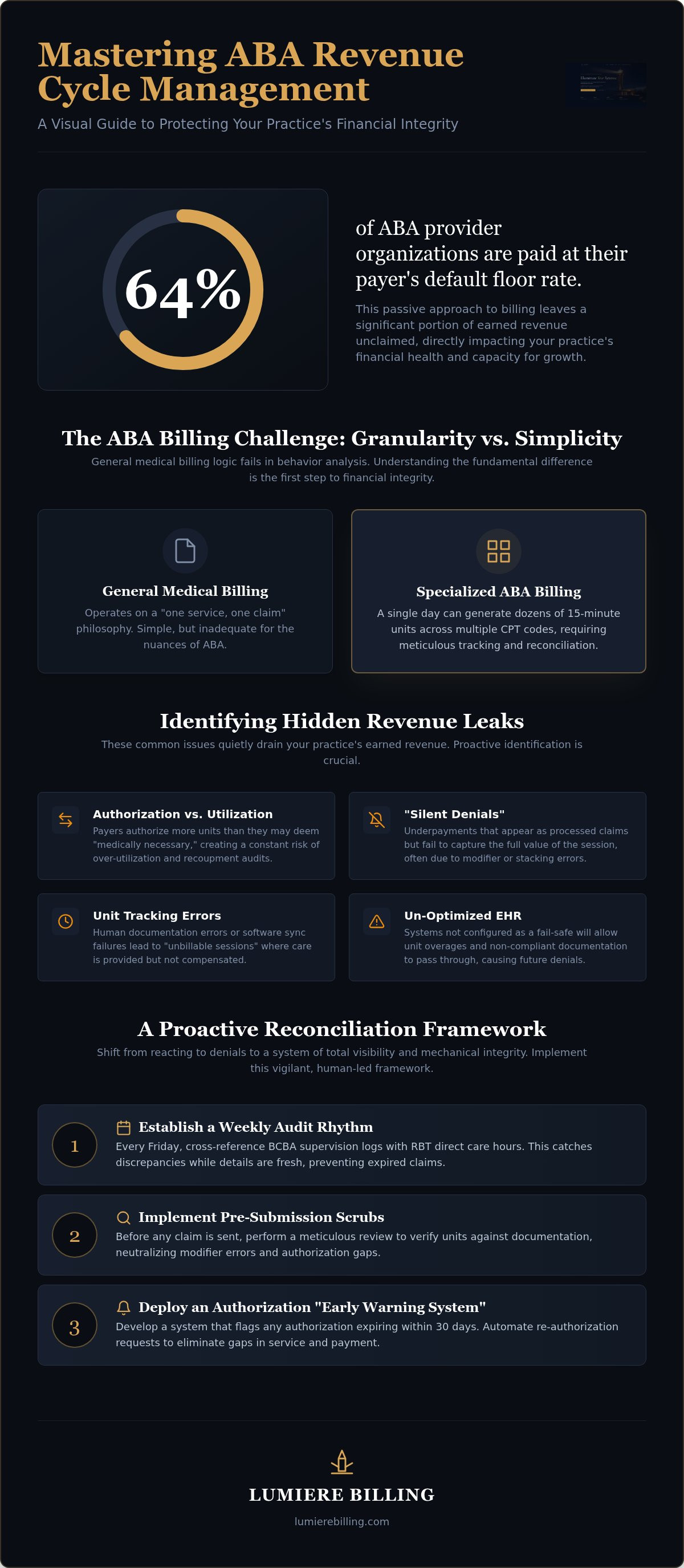
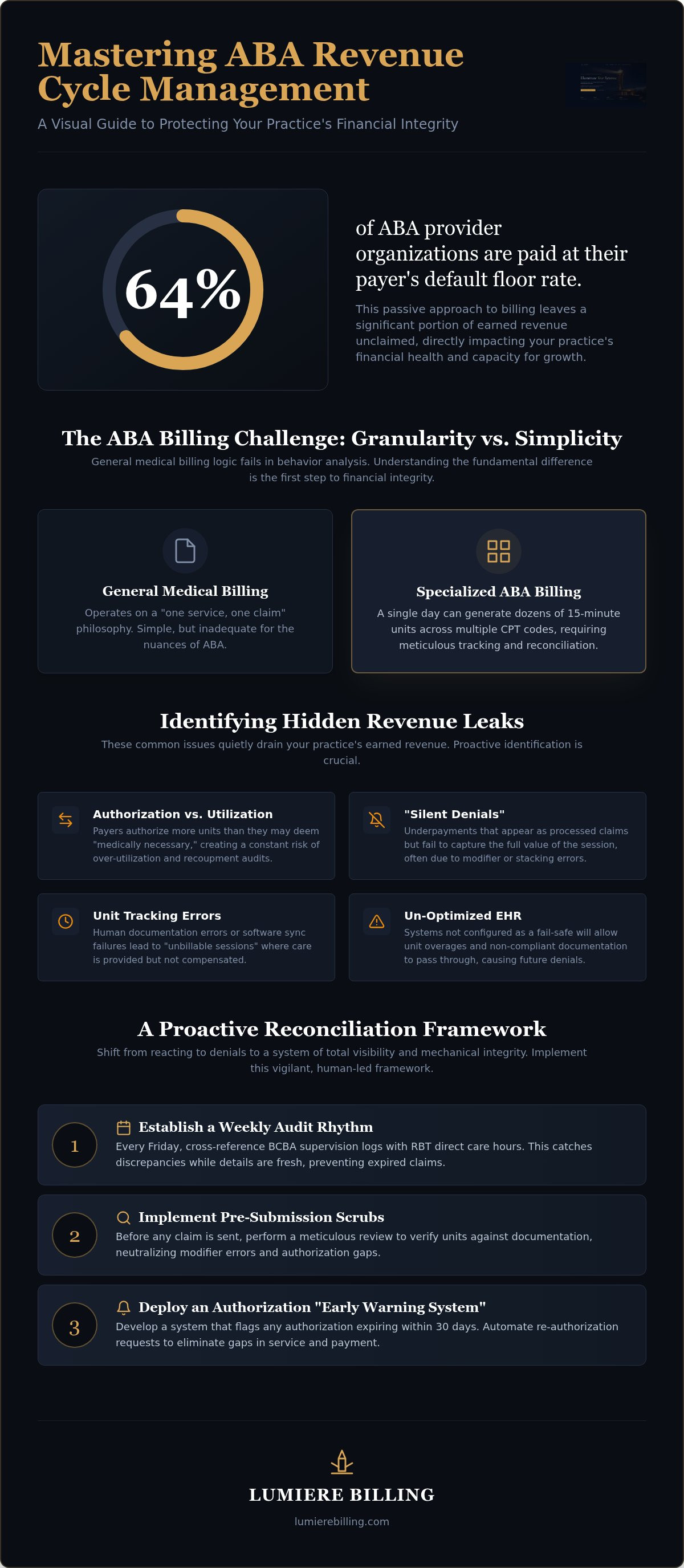
Approximately 64% of ABA provider organizations are currently being paid at their payer's default floor rate, leaving significant revenue unclaimed due to passive billing structures. It's a frustrating reality for clinical directors who entered this field to change lives, not to spend their nights reconciling units or fighting modifier denials. You likely feel the weight of every unreconciled unit, knowing it represents a session delivered but never compensated. Mastering ABA revenue cycle management is no longer just an administrative task; it's a vigilant protection of your practice's financial health.
You deserve a system that reflects the precision of your clinical work. This guide will show you how to eliminate unit tracking errors and master the nuances of 2026 CPT code requirements to ensure zero authorization gaps. We'll outline a proactive reconciliation framework that bridges the divide between clinical documentation and financial recovery. By the end of this article, you'll have the roadmap to achieve predictable revenue and a significant reduction in your days in AR. We're moving beyond mere claim submission toward a system of total visibility and mechanical integrity.
Key Takeaways
- Discover why general medical billing logic fails in behavior analysis and how to protect the integrity of your 15-minute unit sessions.
- Establish a proactive framework for ABA revenue cycle management by implementing weekly reconciliation rhythms and pre-submission scrubs to eliminate authorization gaps.
- Identify and neutralize "silent denials" and modifier errors before they quietly drain your practice's earned revenue.
- Configure your EHR to act as a fail-safe by flagging unit overages and standardizing documentation to meet rigorous 2026 payer requirements.
- Shift from reactive billing to strategic growth by aligning with a specialized partner whose success is tied directly to your actual collections.
Why ABA Revenue Cycle Management Requires a Specialized Approach
General medical billing logic operates on a "one service, one claim" philosophy. This mindset fails in behavioral health. A single day of service in Applied Behavior Analysis (ABA) can generate dozens of 15-minute units across multiple CPT codes. If your system isn't built for this granularity, you aren't just losing time; you're losing money. Effective ABA revenue cycle management requires a shift from passive processing to active clinical-financial reconciliation. It's the difference between merely submitting claims and actually securing the practice's financial integrity.
The Complexity of ABA CPT Codes
The current billing landscape relies on CPT codes 97151 through 97158. These codes aren't interchangeable, and their rules are rigid. For instance, 97151 covers assessment and remains unique because it allows for non-face-to-face time, such as scoring and treatment planning. Direct treatment (97153) and supervision (97155) have distinct unit values and modifier requirements. When these codes are "stacked" or billed simultaneously without precise documentation, payers trigger "silent denials." These are underpayments that appear processed but fail to capture the full value of the session. In multi-disciplinary practices, the 90837 CPT code is frequently utilized for individual psychotherapy sessions lasting 60 minutes, requiring careful separation from ABA-specific unit tracking to avoid duplicate billing flags.
Authorization vs. Utilization: The Constant Tug-of-War
An authorization is merely a permission slip, not a guarantee of payment. Payers often authorize more units than they intend to pay if the documentation doesn't show "medical necessity" for every 15-minute increment. This creates a systemic vulnerability. Over-utilization is a primary trigger for recoupment audits, where payers claw back funds months after the session. You must integrate clinical hours with billing limits in real-time. This prevents the "unbillable session" trap where a technician provides care that exceeds the authorized unit ceiling. Without this synchronization, your practice is essentially providing free labor.
Managing these variables requires moving beyond the role of a "billing clerk." It demands strategic revenue oversight. You need visibility into why units are leaking and where authorizations are expiring. It's about repairing broken systems to ensure every hour of care translates into realized revenue. This specialized focus brings hidden issues into the light, allowing you to optimize performance rather than just reacting to the latest denial letter.
How to Optimize Your ABA Unit Tracking and Reconciliation
Software is a tool, not a strategy. Relying solely on automated EHR syncing for ABA revenue cycle management is a frequent failure point because software cannot always account for human documentation errors or shifting payer logic. You need a proactive, human-led reconciliation framework to ensure every unit is verified before it hits the clearinghouse. This vigilant approach brings hidden leaks into focus, allowing you to repair systems that would otherwise drain your practice's resources.
Step 1: The Weekly Audit of Billed vs. Rendered Units
Weekly audits are the heartbeat of a healthy practice. Cross-reference BCBA supervision logs with RBT direct care hours every Friday to identify discrepancies before they become expired claims. This rhythm catches unit-overages and documentation gaps while the details are still fresh in the clinicians' minds. Following CMS Administrative Simplification Standards ensures your data remains structured and compliant across all electronic transactions. Effective ABA unit tracking reconciliation prevents the "unbillable session" trap, keeping your cash flow steady and your data integrity intact.
Step 2: Managing Multi-Payer Authorization Cycles
Medicaid and private payers operate on vastly different clocks. One might authorize six months of care, while another requires a review every 90 days. Develop an "Early Warning System" that flags any authorization expiring within 30 days. Automating the re-authorization request process eliminates service gaps that force providers to choose between pausing therapy or working for free. If you're concerned that your current tracking is falling behind, a Free Billing Audit can highlight specific areas where your revenue is currently at risk.
Beyond the calendar, you must monitor "Concurrent Billing" with obsessive focus. Supervision (97155) and direct care (97153) must be documented with precision to ensure they don't overlap in a way that payers deem "double dipping." In 2026, payers are applying increased scrutiny to these overlapping timestamps. A centralized dashboard provides real-time visibility into remaining authorized units, acting as a mechanical safeguard against over-utilization. Before any batch is sent, implement a specialized "Pre-Submission Scrub" specifically for authorization-to-unit matching. This final check ensures that every claim submitted is backed by a valid, unexhausted authorization, securing every dollar your practice earns.
Combatting Modifier Errors and the 'Silent Denial' Trap
Modifiers are the mechanical fine-tuning of your claim submission. In ABA revenue cycle management, they act as essential qualifiers that prevent payers from bundling distinct services into a single, lower-paying code. Without them, your practice falls victim to "silent denials." These aren't traditional rejections that trigger a flag in your software. Instead, they're insidious underpayments where a payer processes a claim but reduces the rate because the system didn't recognize the services as separate. It looks like a successful transaction on your ledger, but your bottom line is quietly bleeding out.
Mastering ABA Modifiers for Concurrent Care
Modifier 59 remains the primary tool for indicating distinct procedural services performed on the same day. However, the 2026 landscape requires even greater specificity. Many private payers now favor X-modifiers, specifically XP, to denote services delivered by different practitioners, such as a BCBA supervising an RBT. For telehealth sessions, which CMS has permanently added to the Medicare list as of January 2026, Modifier 95 is mandatory to signal synchronous audio-visual delivery. A single missing or incorrect modifier can reduce your total reimbursement by 20% or more on a single claim. Precision isn't just about compliance; it's about protecting the actual value of your clinical work.
Identifying and Recovering Revenue Leakage
You must shift from a "denial management" mindset to one of "denial prevention." This requires integrating Correct Coding Initiative (CCI) edits into your billing workflow to catch code-pairing errors before they leave your office. Aligning your internal oversight with the OIG General Compliance Program Guidance ensures your practice remains disciplined and prepared for external audits. This proactive stance is the most effective method for reducing claim denials in mental health and securing predictable revenue.
Visibility is your best defense against systemic underpayment. You should audit every Explanation of Benefits (EOB) against your contracted rates to catch partial payments that don't align with your agreements. When a legitimate claim is underpaid or caught in a "silent denial" loop, you must be prepared to file ABA claim denial appeals. These appeals should be reinforced with clinical evidence and documentation that clearly demonstrates the medical necessity of the billed units. By treating every modifier as a critical data point, you move away from the opaque nature of general billing toward a style that emphasizes total financial insight.
Workflow Efficiency: EHR Optimization for ABA Practices
Your EHR should function as a vigilant guardian of your practice's financial health. Too often, it remains a passive digital filing cabinet. You must transform it into an active engine of efficiency. Optimizing your ABA revenue cycle management starts with the tools you use every day. Configure your system to flag unit-overages before a clinician can finalize a session note. This creates a mechanical fail-safe against the over-utilization risks discussed earlier. A robust 'Billing Bridge' ensures that clinical data flows seamlessly into claim generation without manual re-entry. Integrating provider roster management ensures that only fully credentialed staff are linked to billable codes. This prevents the common frustration of claims being rejected due to simple enrollment gaps. It's about building a system that repairs its own vulnerabilities.
Standardizing Documentation for Audit-Proof Claims
Documentation is the bedrock of an audit-proof practice. Every session note must include precise start and stop times along with measurable goals that reflect the treatment plan. There's an undeniable link between the quality of clinical documentation and the speed of your revenue cycle. High-quality, specific notes move through the clearinghouse faster because they leave no room for payer interpretation. Conversely, 'copy-paste' notes are a massive red flag. They are the fastest way to trigger a full-scale audit and recoupment request. Standardizing your templates to meet payer-specific requirements ensures your team hits every mark without redundant effort. This precision protects your clinical staff from the burnout of back-and-forth documentation corrections.
Leveraging Dashboards for Financial Visibility
Visibility brings your financial performance into focus. Dashboards provide real-time insight into the Key Performance Indicators (KPIs) that matter most. You must track your Net Collection Rate and AR Aging with obsessive detail to maintain a healthy cash flow. This data reveals which payers have the longest 'Clean Claim' cycles and where your revenue is stalling. Leveraging mental health practice analytics allows you to identify hidden bottlenecks in your ABA revenue cycle management. It's about moving from administrative guesswork to strategic precision. If your current system feels opaque, a Free Billing Audit can illuminate the specific leaks in your workflow and provide a clear path to optimization.
The Strategic Advantage of Specialized ABA RCM Oversight
A generalist billing approach treats your revenue like a series of isolated transactions. This is a mistake. True ABA revenue cycle management requires a partner that views your financial health as a reflection of their own success. Percentage-based fee models create this necessary alignment. When your billing partner only earns when you collect, their focus shifts from mere data entry to aggressive optimization. This model ensures accountability and drives a relentless pursuit of every authorized unit. It transforms the relationship from a vendor transaction into a proactive partnership. The strategic advantage of specialized ABA revenue cycle management lies in this transition from reactive billing to proactive advisory.
Moving beyond the role of a "billing clerk" allows for high-level consulting that addresses systemic leaks. A specialized advisor looks at the mechanical integrity of your entire workflow. They identify why certain payers have longer clean-claim cycles and how to repair those delays. This oversight reduces administrative friction, allowing BCBAs and clinical directors to focus on patient outcomes rather than back-office stress. A professional behavioral health billing audit serves as the essential benchmark for this transition, revealing exactly where your current performance stands against industry standards.
Lumiere Billing: Your Partner in ABA Growth
Lumiere Billing operates as a specialized extension of your clinical team. We reject the "generalist" identity to master the specific nuances of behavior analysis. You receive a dedicated account manager who understands the difference between 97153 and 97155. This isn't a distant service; it's a deeply integrated collaboration. Our proactive denial prevention strategies bring hidden issues into focus before they impact your cash flow. We act as a vigilant protector of your practice, ensuring that your financial recovery is as precise as your clinical interventions.
Taking the Next Step: The Free Billing Audit
The path to predictable revenue begins with visibility. A comprehensive revenue cycle review identifies immediate "wins" in your current workflow, such as unbilled modifiers or lingering AR. We examine your authorization-to-unit matching and documentation standards to highlight specific areas for repair. This process provides a clear roadmap for optimization without the guesswork. You gain a partner who values precision over volume and partnership over transaction. Secure your practice's financial future with a Free Billing Audit from Lumiere Billing.
Securing the Financial Future of Your ABA Practice
Protecting your practice's revenue requires more than just administrative effort; it demands a mechanical integrity that matches your clinical precision. We've detailed how mastering 15-minute unit tracking and neutralizing modifier errors can stop the silent leak of earned revenue. By transforming your EHR from a passive tool into a vigilant guardian, you ensure that every session is documented for maximum recovery. Specialized ABA revenue cycle management isn't just a back-office function. It's a strategic engine for growth.
Lumiere Billing stands as a dedicated advocate for your practice. We're specialized exclusively in Behavioral Health, and our percentage-based fee model ensures that our success is completely aligned with yours. Through a comprehensive denial prevention strategy, we bring hidden systemic issues into focus and repair them before they impact your cash flow. It's time to move away from the stress of administrative friction and return your full focus to patient care. Schedule Your Free ABA Billing Audit Today to illuminate the path toward a more predictable and profitable future. You've earned every dollar your practice generates; it's time to secure it.
Frequently Asked Questions
What is the difference between general medical billing and ABA RCM?
General medical billing typically operates on a flat-fee or single-encounter model, which fails to capture the complexity of behavior analysis. Specialized ABA revenue cycle management focuses on the granular 15-minute unit structure and the rigid documentation requirements of codes 97151 through 97158. This niche approach accounts for concurrent care, supervision overlaps, and the constant reconciliation of authorized versus rendered units that generalist billers often overlook.
How do I track ABA units to prevent over-utilization denials?
Preventing over-utilization requires a weekly reconciliation rhythm between clinical logs and billed units. You should cross-reference BCBA supervision hours with RBT direct care sessions to ensure no one exceeds the authorized ceiling. Configuring your EHR to flag potential overages before a note is finalized acts as a mechanical fail-safe. This proactive oversight stops unbillable sessions from reaching the clearinghouse and triggering immediate recoupment audits.
What are the most common ABA billing modifiers for 2026?
In 2026, the most critical modifiers include 59 for distinct procedural services and 95 for synchronous telehealth delivery. Many private payers have also transitioned to X-modifiers, such as XP, to specifically denote services provided by different practitioners during the same encounter. Accurate modifier usage is the only way to prevent "silent denials" and ensure you receive the full contracted rate for every unit of care provided.
How often should I audit my ABA practice's revenue cycle?
You should establish a weekly internal audit to reconcile rendered units with billing submissions. On a broader scale, a comprehensive review of your ABA revenue cycle management should occur at least quarterly. These deeper dives help identify payer-specific bottlenecks, shifting denial trends, and credentialing gaps. A professional audit benchmarks your practice's performance against national standards to ensure your net collection rate remains optimized.
Can specialized RCM help with ABA insurance credentialing?
Yes, specialized RCM providers like Lumiere Billing offer dedicated Credentialing & Enrollment services. We manage the entire lifecycle of payer contracting, CAQH maintenance, and enrollment applications to ensure your clinicians are properly paneled. This integration is vital because even perfect billing can't recover revenue if the rendering provider isn't correctly enrolled. We handle the administrative burden so your staff can focus entirely on clinical outcomes.
What is a 'silent denial' in behavioral health billing?
A silent denial is an underpayment that appears as a "paid" claim in your software but is actually reimbursed at a lower rate than your contract specifies. These often occur when payers bundle codes or ignore modifiers because the billing logic was flawed. Because the claim isn't technically rejected, many practices fail to notice the lost revenue. Identifying these requires a vigilant comparison of EOBs against contracted rates.
Why is a percentage-based fee better for ABA billing services?
A percentage-based fee model creates a proactive partnership by aligning your billing partner's success with your actual collections. Unlike flat-fee services that get paid regardless of your revenue, this model ensures your RCM team is incentivized to fight every denial and recover every missing unit. It shifts the focus from simple data entry to aggressive revenue optimization, making your billing partner a vigilant protector of your practice's financial health.
How does Lumiere Billing handle ABA authorization tracking?
We utilize a proactive monitoring system that flags authorizations expiring within 30 days. This "Early Warning System" allows our team to initiate the re-authorization process before a service gap occurs. We also integrate authorization limits directly with your clinical logs to prevent over-utilization. This methodical oversight ensures that every hour of care your team provides is backed by a valid, unexhausted authorization from the payer.
Frequently Asked Questions
General medical billing typically operates on a flat-fee or single-encounter model, which fails to capture the complexity of behavior analysis. Specialized ABA revenue cycle management focuses on the granular 15-minute unit structure and the rigid documentation requirements of codes 97151 through 97158. This niche approach accounts for concurrent care, supervision overlaps, and the constant reconciliation of authorized versus rendered units that generalist billers often overlook.
Preventing over-utilization requires a weekly reconciliation rhythm between clinical logs and billed units. You should cross-reference BCBA supervision hours with RBT direct care sessions to ensure no one exceeds the authorized ceiling. Configuring your EHR to flag potential overages before a note is finalized acts as a mechanical fail-safe. This proactive oversight stops unbillable sessions from reaching the clearinghouse and triggering immediate recoupment audits.
In 2026, the most critical modifiers include 59 for distinct procedural services and 95 for synchronous telehealth delivery. Many private payers have also transitioned to X-modifiers, such as XP, to specifically denote services provided by different practitioners during the same encounter. Accurate modifier usage is the only way to prevent "silent denials" and ensure you receive the full contracted rate for every unit of care provided.
You should establish a weekly internal audit to reconcile rendered units with billing submissions. On a broader scale, a comprehensive review of your ABA revenue cycle management should occur at least quarterly. These deeper dives help identify payer-specific bottlenecks, shifting denial trends, and credentialing gaps. A professional audit benchmarks your practice's performance against national standards to ensure your net collection rate remains optimized.
Yes, specialized RCM providers like Lumiere Billing offer dedicated Credentialing & Enrollment services. We manage the entire lifecycle of payer contracting, CAQH maintenance, and enrollment applications to ensure your clinicians are properly paneled. This integration is vital because even perfect billing can't recover revenue if the rendering provider isn't correctly enrolled. We handle the administrative burden so your staff can focus entirely on clinical outcomes.
A silent denial is an underpayment that appears as a "paid" claim in your software but is actually reimbursed at a lower rate than your contract specifies. These often occur when payers bundle codes or ignore modifiers because the billing logic was flawed. Because the claim isn't technically rejected, many practices fail to notice the lost revenue. Identifying these requires a vigilant comparison of EOBs against contracted rates.
A percentage-based fee model creates a proactive partnership by aligning your billing partner's success with your actual collections. Unlike flat-fee services that get paid regardless of your revenue, this model ensures your RCM team is incentivized to fight every denial and recover every missing unit. It shifts the focus from simple data entry to aggressive revenue optimization, making your billing partner a vigilant protector of your practice's financial health.
We utilize a proactive monitoring system that flags authorizations expiring within 30 days. This "Early Warning System" allows our team to initiate the re-authorization process before a service gap occurs. We also integrate authorization limits directly with your clinical logs to prevent over-utilization. This methodical oversight ensures that every hour of care your team provides is backed by a valid, unexhausted authorization from the payer.