Scaling Multi-Location Behavioral Health Billing: A 2026 Operational Roadmap

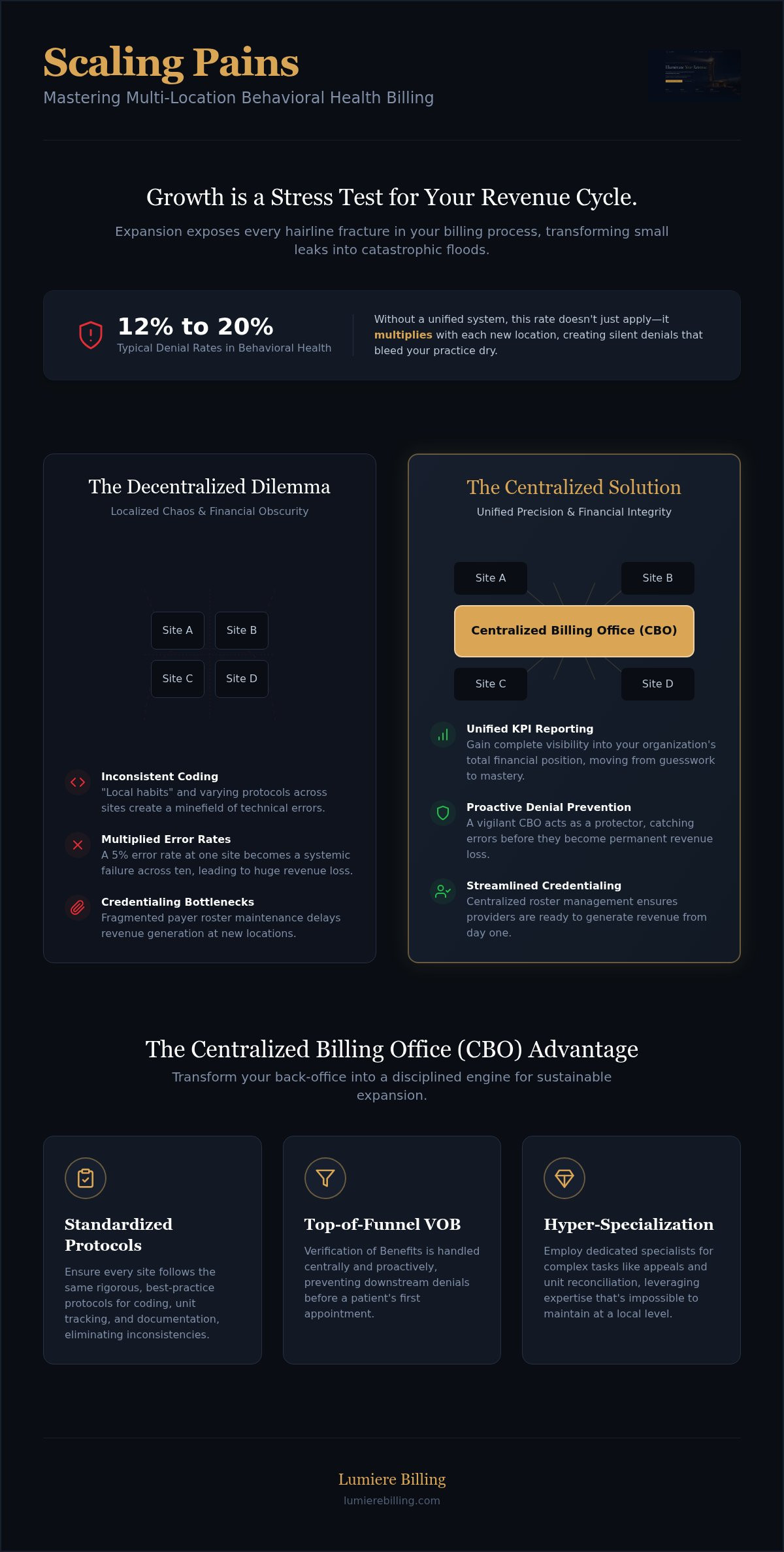
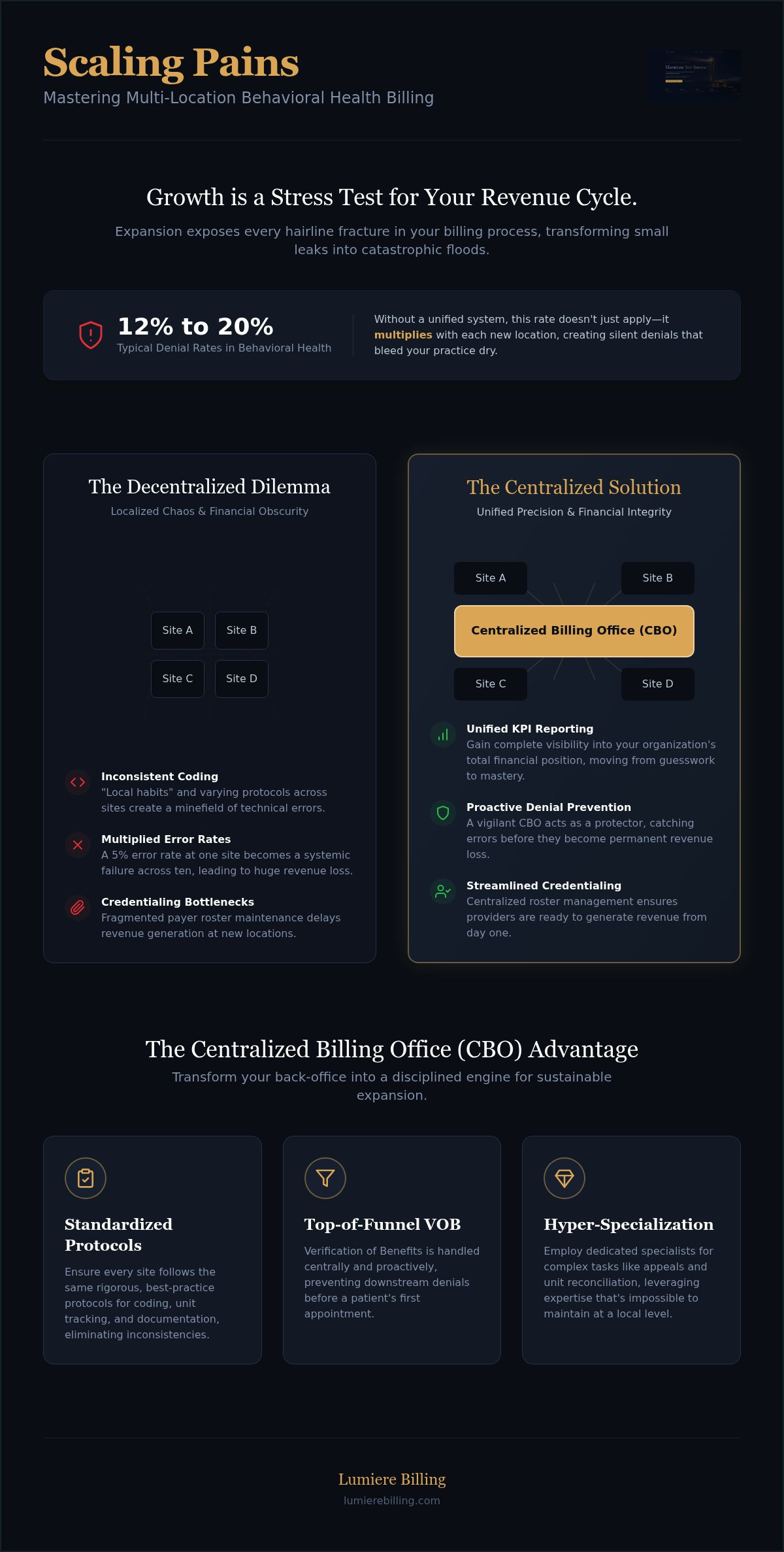
Growth is not a trophy. It is a stress test that exposes every hairline fracture in your revenue cycle. When you expand, the friction of fragmented data and inconsistent coding across sites doesn't just slow you down; it creates silent denials that bleed your practice dry. Managing multi-location behavioral health billing requires more than just hiring more staff. It demands a shift from localized chaos to centralized precision. With behavioral health denial rates hovering between 12% and 20% in 2026, you can't afford the mechanical failure of a disjointed system.
You need a vigilant protector of your financial health. This roadmap shows you how to master the complexities of scaling by building a high-integrity revenue cycle strategy. We'll break down the transition to unified KPI reporting, the resolution of credentialing bottlenecks, and the implementation of proactive denial prevention that turns your billing into a source of visibility and insight. By moving away from the opaque nature of traditional administrative services, you can transform your back-office operations into a disciplined engine that supports sustainable expansion.
Key Takeaways
- Identify how decentralized billing models create silos that lead to inconsistent coding and multiplied error rates across your organization.
- Learn to implement a centralized revenue cycle engine that provides the visibility and mechanical integrity required for multi-location behavioral health billing.
- Discover how to optimize your EHR tech stack to ensure seamless interoperability and unified reporting across every new site you open.
- Follow a structured five-phase roadmap to audit your foundations and streamline credentialing to prevent common expansion bottlenecks.
- Understand why specialized RCM expertise is critical for high-integrity niches like ABA and mental health compared to generalist billing firms.
The Complexity of Multi-Location Behavioral Health Billing
Scaling a practice feels like progress until the first wave of cross-site denials arrives. Growth is a stress test for your back-office infrastructure. In a single-site environment, tribal knowledge and manual oversight might keep the lights on. However, multi-location behavioral health billing operates under a different set of physics. What worked for one clinic will likely fail at five, and it will certainly collapse at ten. Expansion doesn't just add volume; it adds layers of systemic friction that can obscure your financial health.
The danger lies in the multiplier effect. A 5% error rate at a single location is a manageable leak that a diligent biller can patch in an afternoon. Across ten locations, that same 5% becomes a catastrophic flood. Without a centralized engine, these errors compound. You lose the ability to see the "why" behind your aging A/R because the data is trapped in silos. Visibility is the first casualty of rapid growth. When data lives in disconnected EHR instances or separate billing accounts, tracking your total financial position becomes an exercise in guesswork rather than a display of mastery.
Fragmented Revenue Cycles and Data Silos
Habits are difficult to break, especially when they're formed at the site level. In many expanding groups, clinicians and administrative staff develop "local habits" for coding and documentation. One site might use specific modifiers for telehealth while another ignores them entirely. This lack of standardization is the root cause of fragmented behavioral health revenue cycle management. It leads to "Silent Denials," claims that aren't rejected for lack of medical necessity but are instead caught in a purgatory of technical inconsistencies. These leaks are often invisible until they've already drained significant capital from your operations.
The Burden of Payer Roster Maintenance
Managing regional contracts under one corporate umbrella is a logistical gauntlet. Each new NPI and every additional provider adds a layer of complexity to your Revenue Cycle Management. If a provider isn't correctly rostered at Site C, even if they've been credentialed at Site A for years, the payer will deny the claim. Credentialing bottlenecks are the primary reason new sites fail to meet their first-quarter revenue targets. A centralized roster strategy is not a luxury; it's a mechanical necessity. It ensures that your providers are ready to generate revenue the moment the doors open, protecting the group from the staggering cost of administrative delays.
Centralization vs. Decentralization: A Strategic Framework
Choosing between a centralized or decentralized model is a pivot point for your practice's scalability. Decentralized billing allows each site to manage its own claims, which often leads to "local habits" that vary wildly from one location to the next. Centralization, by contrast, pulls these administrative levers into a single, high-performance engine. For multi-location behavioral health billing, the centralized model is the only way to maintain a lean cost-to-collect ratio as you grow. It strips away the administrative noise that distracts clinical directors from patient care. By consolidating your financial operations, you transform a series of disconnected outposts into a unified organization with a singular focus on mechanical integrity.
The Case for the Centralized Billing Office (CBO)
A CBO acts as a vigilant protector of the group's financial health. By standardizing behavioral health billing services, you ensure that every site follows the same rigorous protocols for unit tracking and modifier application. Verification of Benefits (VOB) happens at the top of the funnel, preventing downstream denials before the patient even enters the treatment room. This model allows for hyper-specialization. Instead of hiring generalists at every site, you can employ dedicated appeal specialists who obsess over payer-specific nuances and specialized unit reconciliation. This level of focus is what separates high-performing practices from those that simply survive. It ensures that your revenue cycle is proactive rather than reactive, catching errors before they become permanent losses.
Hybrid Models: When to Keep It Local
Total centralization isn't always the answer for every group. Successful practices often leave patient-facing financial counseling at the site level. Patients usually prefer discussing their deductible or co-pay with someone they've already met in the clinic. This maintains the human connection that is vital in behavioral health. However, the back-end mechanical work belongs in a centralized environment. Claims submission, payment posting, and denial management require a level of focus that is rarely possible in a busy clinical setting. You'll know you've reached the tipping point for a fully outsourced partner when the cost of managing your internal CBO exceeds the value it provides. If you're struggling to maintain visibility across multiple sites, it's time to request a specialized billing audit to identify systemic leaks and optimize your collection strategy.
Standardizing the Tech Stack for Multi-Site Integrity
A fractured tech stack is a liability. When you scale, your software must function as a cohesive nervous system rather than a collection of isolated tools. Interoperability is the glue that holds your expansion together. Without it, multi-location behavioral health billing becomes a manual nightmare of data entry and reconciliation. You need a single source of truth. This requires optimizing platforms like CentralReach or TherapyNotes to handle complex multi-site reporting structures. If your EHR isn't configured to distinguish between locations while aggregating data, you're flying blind. You lose the ability to compare site performance or identify systemic leaks before they drain your capital.
Centralizing your clearinghouse is equally vital. It serves as the single "Front Door" for all claims, providing a vantage point to spot trends before they become systemic failures. When every location uses a different clearinghouse account, you lose the ability to see aggregate denial patterns. Dashboards shouldn't just show total revenue. They should illuminate the mechanical health of each site. High-visibility KPIs allow you to act as a vigilant protector of your practice's financial future. By bringing hidden issues into focus through unified reporting, you can repair broken processes before they impact your group's bottom line.
Eliminating Systemic Revenue Leakage
Inconsistent tech configurations are the primary driver of behavioral health billing errors to avoid. In high-integrity niches like ABA, automated unit tracking is non-negotiable. If Site A reconciles units manually while Site B uses an automated trigger, your data integrity vanishes. This discrepancy creates "Silent Denials" that multiply across your network. Analytics and dashboards bring these hidden issues into focus. They allow you to pinpoint exactly which location is underperforming and, more importantly, why. Optimization isn't about volume; it's about precision and mechanical integrity across the entire revenue cycle.
Security and HIPAA Compliance at Scale
Scaling introduces new vectors for data breaches and compliance failures. Managing user permissions across dozens of sites requires a disciplined, methodical approach to system access. You must ensure that audit trails remain consistent regardless of where the service occurs. Centralized document storage for clinical backup isn't just a compliance requirement; it's a defense mechanism against aggressive payer audits. By maintaining a rigorous standard for data integrity and security, you protect the reputation and financial stability of the entire group. A broken system at one site shouldn't compromise the integrity of ten others. It's about building a system that is both methodical and highly observant.
How to Scale Your Billing Operations: A 5-Step Roadmap
Scaling is a test of mechanical integrity. You can't build a skyscraper on a cracked foundation. If you want to expand without losing your financial footing, you need a disciplined blueprint. This roadmap moves your practice from a collection of loosely joined clinics to a centralized, high-integrity revenue engine. It's about shifting from local chaos to corporate precision.
Step 1: The Workflow Audit
Every location eventually develops "rogue" processes. One site might be lax on unit reconciliation while another uses outdated modifiers or inconsistent documentation habits. A comprehensive RCM audit serves as a diagnostic tool for scalability; it identifies where your current system will break under the weight of five or ten new locations. You must define a single "Gold Standard" for documentation and coding that applies universally. This ensures that your multi-location behavioral health billing remains consistent, protecting the group from the technical inconsistencies that trigger payer audits and silent denials.
Step 2: Master the Provider Roster
Credentialing is the most common growth killer. Without disciplined provider roster management behavioral health, new sites sit empty while you wait for payer approvals. We recommend a strict 90-day lead time for all new site enrollments to account for payer processing lags and administrative friction. This phase requires a centralized roster that tracks every NPI and payer contract under one corporate umbrella. It's about movement and optimization, ensuring that every provider is ready to generate revenue the moment the doors open. If you miss a single site-specific enrollment, the entire location's cash flow can stall for months.
Phase 3: Unify Intake and VOB. Standardizing the start of the revenue cycle is critical for long-term health. Verification of Benefits must happen centrally to ensure that coverage is confirmed before treatment begins. This prevents front-end errors that lead to uncollectible debt and administrative rework. By moving this function to a centralized team, you ensure a higher level of accuracy than is possible with site-level generalists.
Phase 4: Implement Tiered Reporting. You need different lenses for different levels of the organization. Site directors need site-specific KPIs to manage daily operations and clinical staff. Corporate leadership needs an aggregated view of the group's total A/R, collection rates, and denial trends. This visibility allows you to spot an underperforming location before it impacts the group's overall stability.
Phase 5: Optimize Denial Management. Move from reactive to proactive. Instead of just working denials as they arrive, use your data to identify root causes across the entire network. If a specific payer is rejecting claims for a specific modifier across all sites, you can fix the issue at the source. This methodical approach turns your billing department into a vigilant protector of your financial health.
If your current growth is creating more administrative noise than profit, request a free billing audit to identify your systemic leaks and stabilize your foundation for 2026.
Scaling with a Specialized RCM Partner
A generalist billing firm is a liability when your practice spans multiple sites. These broad-market agencies often treat behavioral health as just another medical specialty, ignoring the nuanced unit tracking and modifier requirements that define your revenue cycle. For multi-location behavioral health billing, this lack of focus leads to systemic leaks. You don't need a vendor; you need a master of the craft. Lumiere Billing operates as a vigilant protector of your financial health, bringing hidden issues into focus through specialized mastery over ABA, mental health, and SUD facilities. We reject the generalist identity in favor of a disciplined, behind-the-scenes partnership that acts as a mechanical extension of your own team.
Aligning incentives is the only way to ensure long-term integrity. Our percentage-based model means we only succeed when you do. This structure creates a proactive environment where our team is constantly looking for ways to optimize your collections and reduce your aging A/R. While you offload the administrative burden, you never lose visibility. Through our advanced analytics and dashboards, you maintain a clear view of every location's performance. It's a style that emphasizes transparency over the opaque nature of traditional administrative services. You gain the freedom to focus on clinical excellence while we repair the broken systems that often plague rapid expansion.
The Extension of Your Team
When you choose to outsource mental health billing to a specialized partner, you gain an advocate who understands the specific logic of behavioral health modifiers. We move beyond the role of a simple billing service. We act as a strategic advisor, helping you navigate the complexities of regional payer contracts and shifting 2026 regulations. This level of focus borders on the obsessive because we know that a single coding error at one site can trigger a chain reaction of denials across your entire group. Our goal is to provide a sense of stability and order to your back-office operations, allowing you to scale with confidence.
The Roadmap to Your First (or Next) Audit
Every successful scaling plan begins with a clear-eyed assessment of the status quo. A professional billing audit is the diagnostic tool you need to identify where your current systems are failing. These findings provide the objective data necessary to secure buy-in from site managers who may be resistant to change. By highlighting specific revenue leaks and technical inconsistencies, an audit brings the necessity of centralization into sharp focus. Don't let your growth be undermined by mediocre administrative oversight. Schedule your free billing audit today to secure your practice's financial future and build a roadmap based on precision and results.
Mastering the Mechanics of Expansion
Scaling your practice is a test of mechanical integrity. We've explored how a centralized engine, a standardized tech stack, and a disciplined roadmap turn administrative friction into operational visibility. Success in multi-location behavioral health billing requires moving beyond the local habit problem to embrace a unified, high-integrity revenue cycle. By shifting from reactive denial management to proactive oversight, you protect your group's financial health and your clinical mission.
Lumiere Billing acts as an extension of your team, providing specialized ABA and mental health expertise that generalist firms simply cannot replicate. Our percentage-based fees ensure our success is tied directly to yours, while our national credentialing and roster management services eliminate the bottlenecks that stall new site revenue. It's time to bring hidden systemic leaks into focus. Secure your multi-location growth with a Free Billing Audit from Lumiere and build a foundation that's as robust as your clinical care. You've built a practice that changes lives; let's build a system that sustains it.
Frequently Asked Questions
How do I centralize billing for locations using different EHRs?
Centralizing billing across disparate EHRs requires a robust clearinghouse integration and an aggregated analytics layer. By routing all claims through a single "front door," you can normalize data from platforms like CentralReach and TherapyNotes. This approach brings hidden issues into focus without forcing every site to migrate software immediately. It's about creating mechanical integrity through visibility rather than uniform software adoption across the entire group.
Does multi-location billing require a separate NPI for each site?
Most multi-site groups require a unique Type 2 NPI for each physical location to ensure accurate payer enrollment and reimbursement rates. Payers often tie contracts to specific addresses and NPIs; failing to distinguish between sites can lead to immediate claim rejections. Proper roster management ensures that each provider is correctly linked to the specific NPI where they provide care, protecting your cash flow from administrative friction.
What is the biggest risk when scaling a behavioral health practice?
The most significant risk in multi-location behavioral health billing is the multiplier effect of technical inconsistencies, often called "Silent Denials." A small coding error that is manageable at one site becomes a catastrophic financial leak when replicated across ten locations. Without a vigilant protector of your revenue cycle, these systemic flaws go unnoticed for months. They drain your capital and compromise your ability to reinvest in clinical expansion.
How does centralized VOB improve cash flow for multi-site groups?
Centralized Verification of Benefits (VOB) improves cash flow by stopping uncollectible debt at the intake level. When a specialized team handles authorizations centrally, they apply a consistent standard of scrutiny that site-level generalists often lack. This ensures that every session is billable before the patient even enters the treatment room. It reduces the administrative rework that typically plagues expanding practices and accelerates your overall collection cycle.
What KPIs should I track to monitor performance across multiple locations?
You should track Days in A/R, Net Collection Rate, and Denial Rate by location to maintain full visibility. Aggregated data is useful for corporate oversight, but site-specific metrics allow you to pinpoint mechanical failures at the source. Monitoring these KPIs helps you identify which site is underperforming and why. It turns your back-office into a disciplined operator that values precision over volume and partnership over transaction.
Can I use one billing team for both ABA and general mental health services?
You can use a single team if they possess specialized mastery over both ABA unit tracking and mental health CPT codes. ABA billing requires obsessive attention to unit reconciliation that general mental health services don't. A specialized RCM partner acts as an extension of your team, providing the niche expertise required for both disciplines. This prevents the "generalist" trap where complex behavioral health modifiers are overlooked.
How often should I audit my multi-location billing processes?
High-growth practices should conduct a professional billing audit at least quarterly to identify "local habits" that deviate from your corporate standard. As you add locations, new staff may inadvertently introduce "rogue" processes that trigger payer scrutiny. Regular audits serve as a diagnostic tool, ensuring your foundation remains strong as you build higher. This methodical approach identifies systemic leaks before they impact your group's total financial stability.
What is the advantage of percentage-based billing for large groups?
Percentage-based billing aligns the incentives of your RCM partner with your practice's actual collections. Unlike fixed-fee models, this structure ensures that your billing team is a dedicated advocate for every dollar. They're motivated to obsess over denial prevention and aging A/R because they only succeed when you do. For large groups, this model provides a scalable cost structure that grows in tandem with your revenue successfully.
Frequently Asked Questions
Centralizing billing across disparate EHRs requires a robust clearinghouse integration and an aggregated analytics layer. By routing all claims through a single "front door," you can normalize data from platforms like CentralReach and TherapyNotes. This approach brings hidden issues into focus without forcing every site to migrate software immediately. It's about creating mechanical integrity through visibility rather than uniform software adoption across the entire group.
Most multi-site groups require a unique Type 2 NPI for each physical location to ensure accurate payer enrollment and reimbursement rates. Payers often tie contracts to specific addresses and NPIs; failing to distinguish between sites can lead to immediate claim rejections. Proper roster management ensures that each provider is correctly linked to the specific NPI where they provide care, protecting your cash flow from administrative friction.
The most significant risk in multi-location behavioral health billing is the multiplier effect of technical inconsistencies, often called "Silent Denials." A small coding error that is manageable at one site becomes a catastrophic financial leak when replicated across ten locations. Without a vigilant protector of your revenue cycle, these systemic flaws go unnoticed for months. They drain your capital and compromise your ability to reinvest in clinical expansion.
Centralized Verification of Benefits (VOB) improves cash flow by stopping uncollectible debt at the intake level. When a specialized team handles authorizations centrally, they apply a consistent standard of scrutiny that site-level generalists often lack. This ensures that every session is billable before the patient even enters the treatment room. It reduces the administrative rework that typically plagues expanding practices and accelerates your overall collection cycle.
You should track Days in A/R, Net Collection Rate, and Denial Rate by location to maintain full visibility. Aggregated data is useful for corporate oversight, but site-specific metrics allow you to pinpoint mechanical failures at the source. Monitoring these KPIs helps you identify which site is underperforming and why. It turns your back-office into a disciplined operator that values precision over volume and partnership over transaction.
You can use a single team if they possess specialized mastery over both ABA unit tracking and mental health CPT codes. ABA billing requires obsessive attention to unit reconciliation that general mental health services don't. A specialized RCM partner acts as an extension of your team, providing the niche expertise required for both disciplines. This prevents the "generalist" trap where complex behavioral health modifiers are overlooked.
High-growth practices should conduct a professional billing audit at least quarterly to identify "local habits" that deviate from your corporate standard. As you add locations, new staff may inadvertently introduce "rogue" processes that trigger payer scrutiny. Regular audits serve as a diagnostic tool, ensuring your foundation remains strong as you build higher. This methodical approach identifies systemic leaks before they impact your group's total financial stability.
Percentage-based billing aligns the incentives of your RCM partner with your practice's actual collections. Unlike fixed-fee models, this structure ensures that your billing team is a dedicated advocate for every dollar. They're motivated to obsess over denial prevention and aging A/R because they only succeed when you do. For large groups, this model provides a scalable cost structure that grows in tandem with your revenue successfully.