Psychiatry Revenue Cycle Management: A Specialist’s Framework for 2026

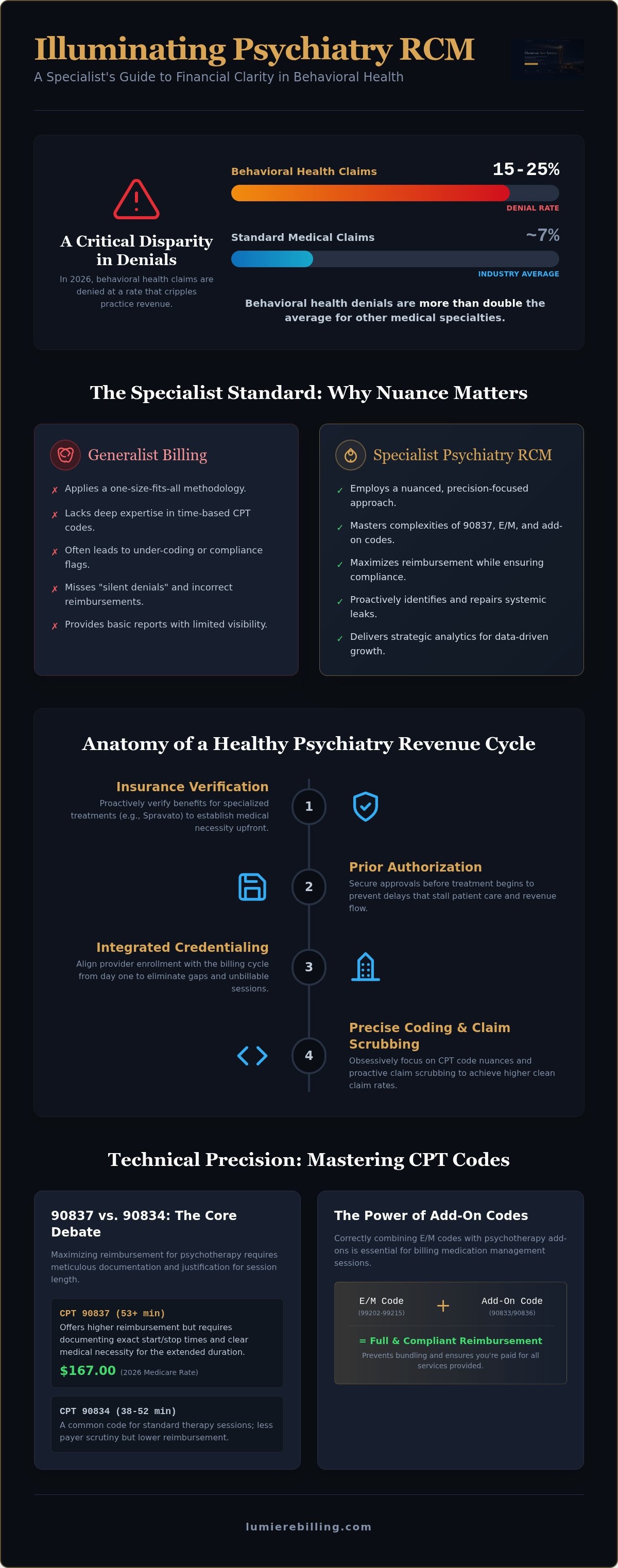
In 2026, the average claim denial rate for behavioral health sits between 15% and 25%, which is more than double the average for standard medical claims. This isn't just a statistic. It's a systemic leak that drains the vitality of your practice every single day. You've likely grown tired of fighting modifier errors or watching credentialing delays prevent your new providers from billing for months. It's common to feel like you're operating in the dark, lacking the visibility needed to see where your money is actually getting stuck. Effective psychiatry revenue cycle management requires a level of focus that generalist billing companies simply cannot provide.
We've developed this framework to help you navigate the complexities of 2026 reimbursement rates and documentation requirements with absolute confidence. By the end of this guide, you'll have a clear roadmap to reduce your days in A/R and achieve higher clean claim rates. We'll explore the technical nuances of the latest CPT codes and provide the actionable data you need to scale your practice while maintaining total compliance. It's time to bring your financial health into focus and move away from the opaque systems of the past.
Key Takeaways
- Define the specialist standard by contrasting general medical billing with the high-complexity, high-stakes environment of behavioral health.
- Master the technical nuances of time-based CPT codes and E/M coding to ensure every session is reimbursed at its maximum value.
- Identify and repair systemic leaks through proactive claim scrubbing and specialized psychiatry revenue cycle management strategies tailored for 2026.
- Evaluate the true financial impact of in-house operations versus the precision and visibility offered by a dedicated behavioral health partner.
- Shift from basic billing reports to strategic analytics that provide actionable data for scaling your practice with confidence.
What is Psychiatry Revenue Cycle Management? Defining the Specialist Standard
Psychiatry revenue cycle management is not a simple administrative task. It is the vital intersection where clinical documentation, technical coding, and payer relations meet. While Revenue cycle management (RCM) in a general medical setting often focuses on high-volume procedural billing, psychiatry requires a more nuanced approach. Precision is everything. In 2026, the complexity of behavioral health billing demands a shift from reactive problem-solving to proactive oversight. We view RCM as a system of visibility that brings every systemic leak into sharp focus before it impacts your bottom line. This transparency allows you to see the entire cycle from the initial intake to the final collection, moving away from the opaque nature of traditional administrative services.
The Anatomy of a Psychiatry Revenue Cycle
A healthy cycle begins long before the patient enters the room. Insurance verification serves as the foundation. We don't just confirm coverage; we verify specific benefits for specialized treatments like Spravato to ensure medical necessity is established early. This proactive stance extends to prior authorization management, where delays can stall patient care and revenue flow. Perhaps most critically, we integrate credentialing into the RCM framework. Many practices treat credentialing as a separate silo, but a provider who isn't properly enrolled on a payer's roster creates unbillable sessions. We eliminate these gaps by aligning provider enrollment with the billing cycle from day one. It's about protecting your financial health through methodical, behind-the-scenes coordination.
Why Generalist Billing Fails Psychiatric Practices
Generalist billing firms often struggle because they attempt to apply a one-size-fits-all methodology to a highly specialized field. They lack the deep domain expertise required to navigate time-based CPT codes effectively. For instance, the ongoing scrutiny surrounding 90837 vs. 90834 requires a specialist's touch to ensure compliance while maximizing reimbursement. The logic behind psychotherapy add-on codes is frequently misunderstood, leading to under-coding or immediate denials. Generalists also overlook "silent denials," where claims are accepted but reimbursed at incorrect rates or stuck in a perpetual state of "pending" due to minor modifier errors. In a landscape where behavioral health denials are more than double those of medical claims, these oversights are catastrophic. A specialist approach repairs these broken systems through meticulous attention to detail and a disciplined focus on psychiatric nuances.
Technical Precision: Navigating Psychiatry CPT Codes and Modifiers
Technical precision is the primary defense against the systemic leaks that plague behavioral health practices. In 2026, psychiatry revenue cycle management requires an obsessive focus on the nuances of time-based coding. Misapplying a single code doesn't just delay payment; it signals a lack of compliance that payers now use AI to flag instantly. Understanding the Psychiatric Billing and Coding Guidelines is the first step toward reclaiming your practice's financial health. Precision isn't a luxury. It's a survival requirement in a landscape of increasing payer scrutiny.
The debate between 90837 and 90834 remains a central friction point for many clinicians. While 90837 offers higher reimbursement, reaching $167.00 in 2026 Medicare non-facility rates, it demands meticulous documentation of medical necessity for the extended duration. When medication management is involved, the mechanics of E/M coding (99202-99215) must be integrated seamlessly with psychotherapy add-on codes like 90833 or 90836. E/M codes are now selected based on either the level of Medical Decision Making (MDM) or the total time spent on the date of the encounter. This layered approach ensures you're compensated for the full scope of your clinical expertise. Failure to use these add-ons correctly often results in the bundling of services, which effectively means you're providing complex care for free.
Mastering the 90837 CPT Code for Maximum Reimbursement
To successfully bill 90837, you must document exact start and stop times. Payers in 2026 are increasingly aggressive in auditing sessions that consistently hit the 60-minute mark without specific clinical justification. For a deeper dive into these requirements, see our guide on Mastering the 90837 CPT Code. High-intensity codes are natural audit triggers; your documentation must be the shield that protects your revenue. We recommend a proactive review of your session notes to ensure they reflect the complexity required for this code level. It's about building a bulletproof record that stands up to payer challenges.
The Modifier Framework: Protecting Your Claims
Modifiers are the technical signals that tell payers why a service is unique or how it was delivered. In 2026, the telehealth landscape has shifted significantly. While modifier 95 remains standard for synchronous video, new permanent policies require the use of FQ for audio-only services and FR for real-time supervision. Using Modifier 59 is equally vital when performing distinct procedural services on the same day to prevent them from being bundled and unpaid. Many practices fall into the "Modifier Error" trap, which can cost up to 15% of annual revenue. If your denial rates are climbing due to these technicalities, a specialized revenue cycle audit can help identify these hidden failures before they compound. We help you bring these hidden issues into focus, repairing broken billing systems with methodical precision.
In-House vs. Specialized Psychiatry RCM: A Strategic Comparison
The decision to maintain an in-house billing team or partner with a specialist is often framed as a simple budget line item. This perspective is dangerously narrow. In-house operations frequently mask systemic leaks under the guise of control, yet they often lack the technical precision required for modern psychiatry revenue cycle management. While generalist firms might offer lower entry costs, they lack the niche expertise to navigate the high-complexity environment of behavioral health. They handle podiatry, pediatrics, and psychiatry with the same generic toolkit. This lack of focus is where revenue disappears. In 2026, financial survival requires the Specialist Advantage, moving away from fragmented billing toward a unified, methodical framework.
The Hidden Costs of In-House Operations
In-house billing is fragile. Staff turnover in the billing department is a silent profit killer. When a lead biller leaves, they take years of institutional knowledge and specific payer nuances with them, creating a Knowledge Gap that can stall your cash flow for months. Beyond salaries and benefits, practices often face significant technology debt. They pay for expensive EHR systems but only utilize a fraction of their billing capabilities. This under-optimization leads to manual workarounds that invite human error. Burnout is also a constant threat. When clinical staff are forced to troubleshoot technical modifier errors, their focus on patient care suffers. It's a broken system that prioritizes activity over actual results.
Choosing a Specialized RCM Partner
A true partner should feel like a disciplined extension of your clinical team, not a distant vendor. When you decide to outsource mental health billing, look for a provider that offers total transparency and advanced analytics. You need to see exactly where every dollar is at every stage of the cycle. A specialist doesn't just "do the billing"; they provide proactive practice advisory to help you scale. This includes ensuring your credentialing rosters are current and your documentation meets the latest 2026 compliance standards. We recommend evaluating behavioral health billing services based on their ability to provide actionable data rather than just static reports. Our percentage-based fee model ensures our goals are perfectly aligned with yours. If you don't get paid, we don't get paid. This alignment transforms the relationship from a mere transaction into a vigilant partnership dedicated to your practice's financial health.
Plugging the Leaks: Denial Prevention and Management Strategies
Denials are a systemic tax on your labor. In 2026, the primary catalysts for rejected psychiatric claims include modifier mismatches, expired authorizations, and credentialing lapses where a provider isn't yet active on a specific payer roster. We counter these failures with a proactive "Claim Scrubbing" protocol. This isn't a simple spell-check. It's a technical audit that mirrors payer logic to catch errors before they leave your office. By identifying Common Behavioral Health Billing Errors early, we ensure your clean claim rate remains high and your cash flow remains steady. Effective psychiatry revenue cycle management requires this level of vigilant, pre-submission oversight.
Silent denials are perhaps the most insidious threat to your practice's financial health. These occur when a claim is technically accepted but is either stuck in a "pending" status indefinitely or processed at an incorrect rate due to a subtle modifier error. Generalist firms often overlook these because the claim isn't flagged as "denied" in the system. We treat every underpayment or stalled claim as a failure that requires immediate intervention. If your practice is struggling with persistent rejections or stalled revenue, our Free Billing Audit can pinpoint the exact failure points in your current workflow.
The 2026 Denial Prevention Checklist
Prevention is more efficient than recovery. A disciplined front-end process eliminates the majority of downstream errors. Your team should follow a methodical workflow for every patient encounter:
- Real-time eligibility checks: Verify coverage at every appointment, not just the initial intake, to catch plan changes or COB issues.
- Automated authorization tracking: Use systems that alert you 30 days before an authorization expires or when units are running low.
- Modifier validation: Ensure telehealth modifiers (95, FQ, FR) align with the place of service code (POS 10 or 02) used for the session.
- Credentialing verification: Confirm provider enrollment status before scheduling sessions with new payers to avoid unbillable encounters.
Underpayment Recovery: Finding Your Missing Revenue
Recovery is about more than just resubmitting claims. It requires a deep dive into your practice analytics to identify when a payer is consistently paying less than your contracted rate. This often happens with psychotherapy add-on codes or complex E/M sessions where the payer's system defaults to a lower reimbursement level. We use specialized data to spot these systemic underpayments across your entire payer mix. Once a leak is identified, we execute a methodical appeal process that includes providing the necessary clinical documentation to justify the higher intensity codes. We don't just accept what the payer offers. We fight for every dollar your practice has earned through technical mastery and persistent follow-up.
Data-Driven Growth: Using RCM Analytics to Scale Your Practice
Static billing reports are a relic of the past. They tell you what happened yesterday but offer no insight into tomorrow's growth. To scale a modern practice, you must shift your perspective from basic bookkeeping to strategic analytics. This visibility is the core of effective psychiatry revenue cycle management. It transforms your back-office from a cost center into a growth engine. By treating your financial data as a clinical diagnostic tool, you can identify systemic leaks and repair them before they compromise your ability to expand. We move away from the opaque nature of traditional services toward a style that emphasizes insight and proactive partnership.
The KPI Dashboard: Your Practice’s Vital Signs
Net Collection Rate (NCR) serves as the ultimate measure of your practice's financial health. While many generalist firms focus on gross charges, NCR reveals what you actually keep after payer adjustments and denials. A healthy psychiatric practice in 2026 should target an NCR of 95% or higher. We also monitor Days in A/R to ensure your cash flow remains fluid, preventing the stagnation that often occurs when claims get stuck in "pending" status for 60 or 90 days. When your denial rate climbs, our analytics drill down to the provider level. This allows us to see if specific documentation habits are triggering audits or rejections, enabling targeted Practice Advisory sessions that resolve the issue at the source. It's a methodical way to optimize clinician performance without increasing their administrative burden.
Scaling with Confidence
Robust RCM is the foundation for transitioning from a solo clinic to a multi-provider group. You cannot manage five locations with the same manual processes used for one. As you add providers, the complexity of maintaining mental health provider re-credentialing increases exponentially. We integrate this oversight into our specialized framework to ensure no clinician's revenue is interrupted by an expired roster status. This disciplined approach provides the stability needed to hire and expand with total confidence. Our Practice Advisory services act as a vigilant protector of your growth, ensuring that your financial systems are as resilient as your clinical care. If you're ready to bring your practice's hidden revenue potential into focus, Request a Free Billing Audit today. We'll help you repair broken systems and build a future of data-driven success.
Securing Your Practice's Financial Future
Mastering psychiatry revenue cycle management isn't just about submitting claims; it's about building a resilient, transparent system that protects your labor. We've explored how technical precision in 2026 coding and a disciplined approach to denial prevention can transform your practice's bottom line. By moving away from opaque generalist services and embracing specialized behavioral health expertise, you gain the visibility needed to scale with absolute confidence. Our comprehensive analytics dashboard and dedicated credentialing support ensure your team stays focused on clinical excellence while we handle the back office complexities with obsessive focus. It's time to repair the systemic leaks that drain your resources and bring your true financial performance into focus.
Your practice deserves a partner that acts as a vigilant protector of its health. Don't let modifier errors or credentialing gaps dictate your growth. Get Your Free Psychiatry Billing Audit today to uncover hidden revenue and optimize your workflow for 2026. You've built a practice dedicated to healing; let us build the framework that ensures it thrives for years to come.
Frequently Asked Questions
What is the difference between psychiatry billing and revenue cycle management?
Psychiatry billing is the transactional act of submitting claims to payers. Revenue cycle management is a comprehensive, methodical framework that oversees the entire financial lifecycle. It integrates front-end eligibility, technical coding precision, and back-end strategic analytics to ensure long-term stability. While billing is reactive, psychiatry revenue cycle management is proactive, identifying systemic leaks and repairing broken processes before they impact your practice's cash flow.
Why are psychiatry claim denial rates higher than other specialties?
In 2026, psychiatry denial rates average between 15% and 25%, more than double the rate for surgical or medical claims. This disparity exists because behavioral health requires complex time-based coding and rigorous documentation of medical necessity. Payers now use advanced AI to scrutinize psychotherapy add-on logic. Minor modifier errors or session duration discrepancies that generalists overlook often lead to immediate rejections in this high-complexity environment.
How does credentialing affect my psychiatry revenue cycle?
Credentialing is the gatekeeper of your revenue flow. If a provider isn't properly enrolled on a payer's roster, every session they conduct becomes unbillable, leading to total revenue loss for those encounters. We integrate credentialing into our psychiatry revenue cycle management framework to synchronize provider enrollment with billing. This proactive oversight prevents the "unbillable session" trap that often stalls the growth of expanding multi-provider practices.
What are the most common CPT code errors in psychiatry?
The most frequent errors involve the misapplication of psychotherapy add-on codes like 90833 when combined with E/M services. Clinicians also struggle with documenting exact start and stop times for 90837, which remains a primary audit trigger in 2026. Additionally, failing to use the correct telehealth modifiers, such as FQ for audio-only services or FR for real-time supervision, leads to immediate silent denials and significant underpayments.
Should I outsource my psychiatry billing or keep it in-house?
In-house billing often suffers from high staff turnover and technology debt, creating a fragile system that lacks technical precision. Outsourcing to a specialized partner provides visibility and expertise that's difficult to maintain internally. A specialist brings deep domain knowledge in behavioral health, ensuring your practice isn't just "billing" but is actively optimizing its financial health through proactive practice advisory and advanced analytics that generalist firms simply can't offer.
What is a "clean claim" rate, and why does it matter for my practice?
A clean claim rate is the percentage of claims paid on the first submission without rejections or denials. In 2026, this metric is vital because reworking a single denied claim can cost a practice between $25 and $62 in administrative labor. High clean claim rates indicate a disciplined system where technical errors are scrubbed before submission, ensuring steady cash flow and reducing the days your revenue sits in A/R.
How can I prevent denials for Spravato or TMS treatments?
Preventing denials for specialized treatments requires rigorous prior authorization management and precise place-of-service coding. You must verify specific benefits in real-time to ensure coverage before the first session begins. Documentation must independently justify medical necessity according to the latest 2026 payer guidelines. We use automated tracking to monitor authorization units and expiration dates, preventing the common "expired auth" denials that frequently plague these high-cost service lines.
What is the average cost for specialized psychiatry RCM services?
The industry standard for outsourced behavioral health RCM typically ranges between 6% and 12% of a practice's total collections. We utilize a percentage-based fee model because it aligns our incentives directly with your practice's financial performance. This model ensures we're as invested in your clean claim rate and recovery efforts as you are. Unlike flat-fee services, our success is tied to the movement and optimization of your revenue.
Frequently Asked Questions
Psychiatry billing is the transactional act of submitting claims to payers. Revenue cycle management is a comprehensive, methodical framework that oversees the entire financial lifecycle. It integrates front-end eligibility, technical coding precision, and back-end strategic analytics to ensure long-term stability. While billing is reactive, psychiatry revenue cycle management is proactive, identifying systemic leaks and repairing broken processes before they impact your practice's cash flow.
In 2026, psychiatry denial rates average between 15% and 25%, more than double the rate for surgical or medical claims. This disparity exists because behavioral health requires complex time-based coding and rigorous documentation of medical necessity. Payers now use advanced AI to scrutinize psychotherapy add-on logic. Minor modifier errors or session duration discrepancies that generalists overlook often lead to immediate rejections in this high-complexity environment.
Credentialing is the gatekeeper of your revenue flow. If a provider isn't properly enrolled on a payer's roster, every session they conduct becomes unbillable, leading to total revenue loss for those encounters. We integrate credentialing into our psychiatry revenue cycle management framework to synchronize provider enrollment with billing. This proactive oversight prevents the "unbillable session" trap that often stalls the growth of expanding multi-provider practices.
The most frequent errors involve the misapplication of psychotherapy add-on codes like 90833 when combined with E/M services. Clinicians also struggle with documenting exact start and stop times for 90837, which remains a primary audit trigger in 2026. Additionally, failing to use the correct telehealth modifiers, such as FQ for audio-only services or FR for real-time supervision, leads to immediate silent denials and significant underpayments.
In-house billing often suffers from high staff turnover and technology debt, creating a fragile system that lacks technical precision. Outsourcing to a specialized partner provides visibility and expertise that's difficult to maintain internally. A specialist brings deep domain knowledge in behavioral health, ensuring your practice isn't just "billing" but is actively optimizing its financial health through proactive practice advisory and advanced analytics that generalist firms simply can't offer.
A clean claim rate is the percentage of claims paid on the first submission without rejections or denials. In 2026, this metric is vital because reworking a single denied claim can cost a practice between $25 and $62 in administrative labor. High clean claim rates indicate a disciplined system where technical errors are scrubbed before submission, ensuring steady cash flow and reducing the days your revenue sits in A/R.
Preventing denials for specialized treatments requires rigorous prior authorization management and precise place-of-service coding. You must verify specific benefits in real-time to ensure coverage before the first session begins. Documentation must independently justify medical necessity according to the latest 2026 payer guidelines. We use automated tracking to monitor authorization units and expiration dates, preventing the common "expired auth" denials that frequently plague these high-cost service lines.
The industry standard for outsourced behavioral health RCM typically ranges between 6% and 12% of a practice's total collections. We utilize a percentage-based fee model because it aligns our incentives directly with your practice's financial performance. This model ensures we're as invested in your clean claim rate and recovery efforts as you are. Unlike flat-fee services, our success is tied to the movement and optimization of your revenue.