Mental Health Billing: 2026 Private Practice Guide

Your practice is likely losing significant revenue to silent denials that won't even show up on your radar for months. In the specialized world of behavioral health, a single incorrect modifier or a missed ABA unit tracking detail doesn't just delay a payment; it often erases it entirely. You started your practice to change lives, not to spend your evenings deciphering insurance codes or chasing credentialing paperwork that keeps new clinicians on the sidelines. Effective mental health billing for private practice requires more than just a software subscription or a generalist clerk. It demands a level of technical precision that mirrors your clinical integrity.
We understand that the opacity of traditional administrative services creates a frustrating sense of lost control. This guide outlines how to choose a specialized partner that transforms your back office into a transparent engine for growth. You'll discover how to plug revenue leaks, master the specific nuances of behavioral health coding, and finally achieve predictable cash flow with accelerated accounts receivable. We will explore the path to zero-effort credentialing and the power of real-time financial dashboards that provide total visibility into your practice’s financial health.
Key Takeaways
- Shift from general medical billing to specialized behavioral health RCM to stop the subtle revenue leaks that generalist firms often miss.
- Master the technical complexities of mental health billing for private practice, including precise ABA unit tracking and the strategic use of modifiers.
- Compare the true cost of in-house administrative staffing against the efficiency and expertise of a dedicated full-service partner.
- Choose percentage-based fee models to ensure your billing solution is financially incentivized to fight for every dollar your practice earns.
- Use real-time analytics and practice advisory insights to transform your financial data into a roadmap for scaling your operations.
The Landscape of Therapy Practice Billing Solutions in 2026
The boundary between administrative support and clinical integrity has dissolved. For years, practitioners viewed billing as a clerical afterthought, a simple task delegated to anyone with a spreadsheet. In 2026, this mindset is a liability. Modern mental health billing for private practice has transitioned into a sophisticated discipline known as Behavioral Health Revenue Cycle Management (RCM). This shift represents a move away from the "clerical" mindset of merely filing claims toward a "strategic" approach that protects every dollar a practice earns.
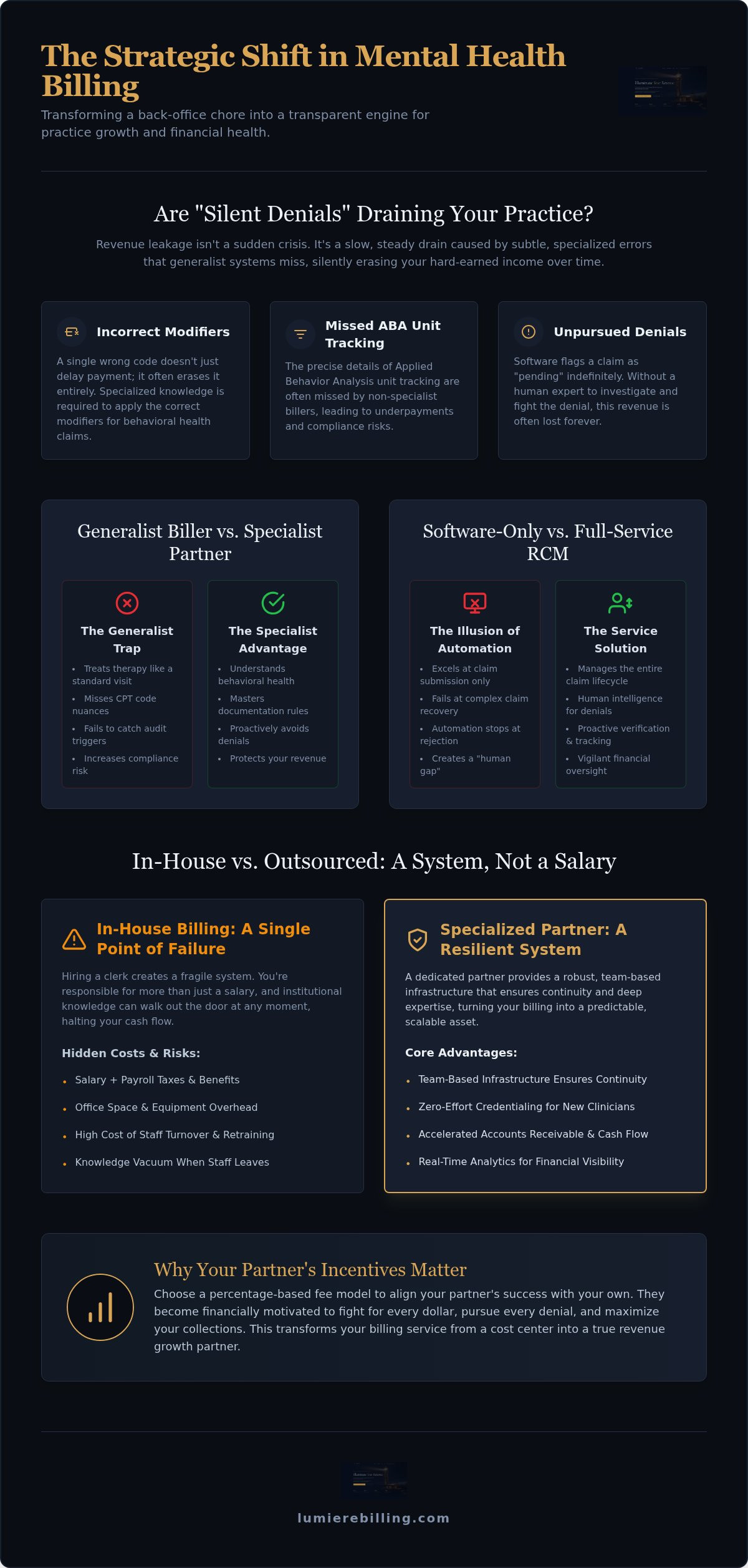
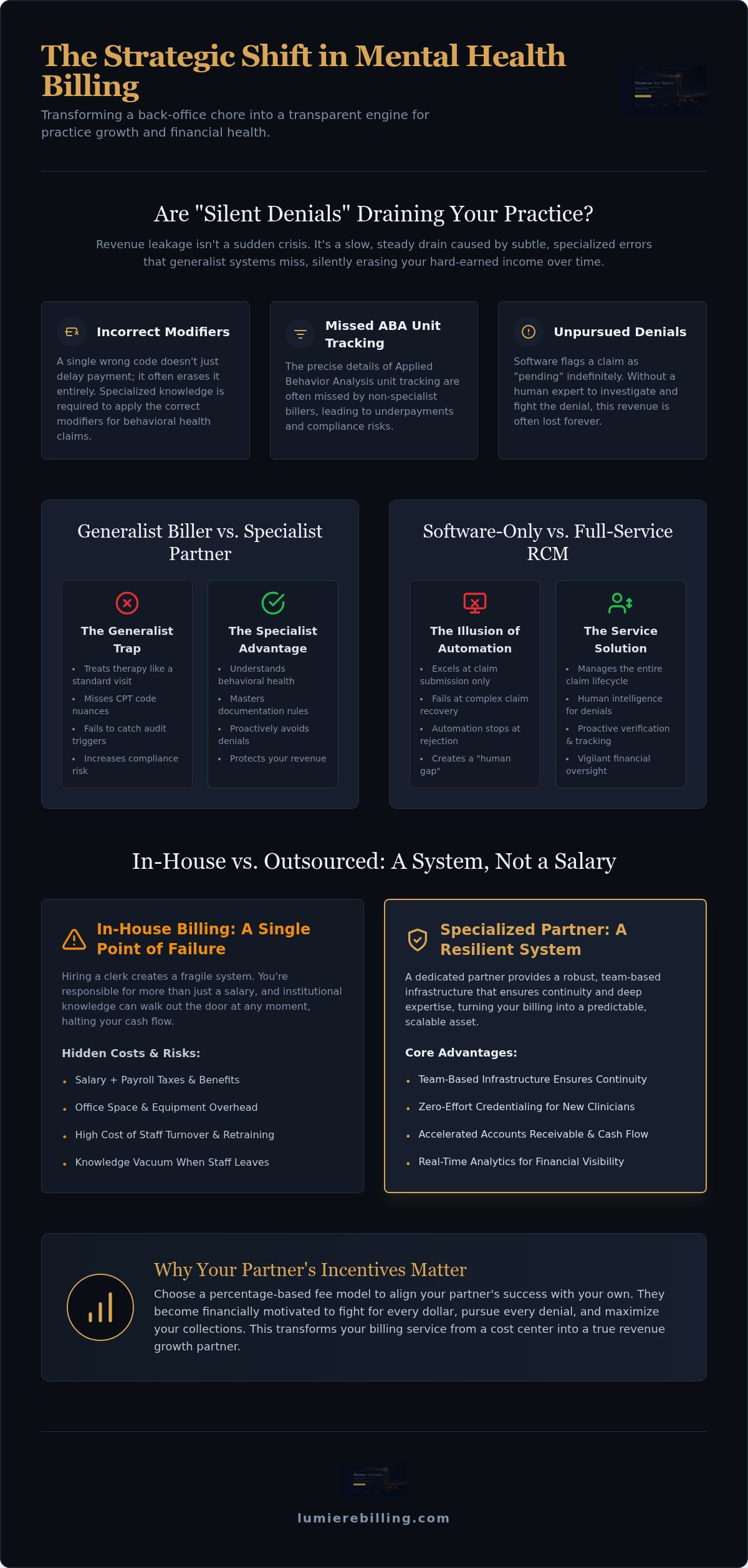
Generalist solutions often ignore the concept of revenue leakage. This isn't a sudden, catastrophic loss of funds. Instead, it's a slow, steady drain caused by uncaptured units, incorrect modifiers, and unpursued denials that software identifies as "pending" indefinitely. To scale effectively, you must stop treating billing as a chore and start treating it as the financial heartbeat of your clinical work.
The Generalist Trap: Why Broad Billing Services Miss the Mark
General medical billers treat therapy like a standard physician’s visit, but the nuances of behavioral health are far more complex. A generalist might not recognize the specific documentation requirements that distinguish CPT 90837 from 90834. They often fail to catch the subtle triggers for audits or the specific payer rules regarding session frequency. This lack of specialization leads to frequent behavioral health billing errors to avoid, such as coding mismatches that result in immediate denials. When your biller doesn't speak the language of mental health, your practice pays the price in lost revenue and increased compliance risk.
Software vs. Service: The Illusion of Automation
Many providers fall for the promise of "one-click" EHR billing. While modern software is excellent for claim submission, it's notoriously poor at claim recovery. Automation stops the moment a claim is rejected. Software cannot pick up the phone to argue a complex denial or track down a missing authorization. It creates a "human gap" where thousands of dollars sit in accounts receivable because no one is actively managing the lifecycle of the claim. Full-service RCM fills this void. It provides the vigilant oversight necessary to navigate the labyrinth of insurance company tactics, ensuring that mental health billing for private practice remains a source of growth rather than a source of stress. Software is a tool; specialized partnership is the strategy.
Evaluating Software vs. Full-Service RCM for Mental Health
Choosing between a software-only approach and a full-service partner is the most consequential financial decision a practice owner makes. It isn't just about the monthly bill. It's about the long-term health of your revenue cycle. While technology is essential for modern mental health billing for private practice, it cannot replace the human intelligence required for complex denial recovery. Software is a tool; specialized Revenue Cycle Management (RCM) is a strategy. Determining which path to take requires a cold look at your practice's growth trajectory and its current administrative burden.
The Hidden Costs of In-House Billing
Hiring an in-house billing clerk often feels like the safe choice for maintaining control. The reality is often a fragile system prone to single-point failure. You aren't just paying a salary. You're funding payroll taxes, health benefits, and the overhead of physical office space. The real danger lies in turnover. When a solo biller leaves, the institutional knowledge of your specific payer quirks leaves with them. This creates a vacuum that can halt your cash flow for weeks or months. A specialized firm provides a team-based infrastructure that ensures continuity, regardless of individual staff changes. It replaces a vulnerable point of failure with a resilient, professional system.
Full-Service RCM: Beyond Claim Submission
Many practitioners confuse software with a solution. Automation is excellent for clean claims, but it fails the moment a payer issues a complex denial. When you choose to outsource mental health billing, you gain a partner that manages the entire lifecycle. This includes proactive insurance verification and rigorous authorization tracking before the session even occurs. A specialized RCM partner acts as a vigilant extension of your clinical team. They don't just file claims; they fight for them. This level of oversight is what differentiates a practice that survives from one that thrives.
How do you know if you've outgrown your current setup? Look at your data visibility. If you lack real-time insights into your aging accounts receivable or your denial rates, your current system is failing you. Scaling a practice requires data-driven decisions, not guesswork. If you're unsure where your revenue stands, a free billing audit can illuminate the hidden leaks in your current process and provide a roadmap for optimization.
Essential Features of Specialized Behavioral Health Billing
Precision is the only defense against the increasing complexity of insurance payer requirements. In 2026, specialized mental health billing for private practice requires a proactive stance on insurance verification that goes beyond a simple eligibility check. You can't afford to wait for a denial to discover a patient's policy has changed or a specific authorization has expired. The most dangerous threat to your practice's financial health is the "silent denial." These are claims that aren't outright rejected but instead languish in a "pending" or "additional information requested" status. Automated systems often misinterpret these as active claims, leaving thousands of dollars in accounts receivable to expire quietly.
ABA and Behavioral Health Technicalities
Applied Behavior Analysis (ABA) providers face a unique set of technical hurdles that generalist billers simply aren't equipped to handle. Unit tracking reconciliation is a meticulous process. Every 15 minute increment must be precisely matched against clinical notes and authorization limits. A single mismatch triggers a cascade of denials that can take months to resolve. Modifier errors are equally damaging. Misapplying modifiers like HO or HN doesn't just delay payment; it often results in permanent reimbursement cuts that your staff might not even notice. This is why behavioral health revenue cycle management is a specialized craft. It requires a partner that understands the mechanical integrity of your coding and treats every unit as a critical asset.
Credentialing: The Foundation of the Revenue Cycle
Billing success begins long before a claim is filed. If your clinicians aren't properly enrolled or their rosters aren't maintained, your entire revenue cycle is built on sand. Many practice owners view enrollment as a administrative chore. We view it as a primary revenue-generating function. Mastering the mental health provider re-credentialing process is the only way to ensure your team remains billable without interruption. A single missed re-attestation deadline can freeze payments for an entire clinician's caseload for ninety days or more. Proactive roster management ensures that new clinicians can begin billing on day one, preventing the "credentialing lag" that often drains a growing practice's cash reserves. Visibility into your credentialing status is as important as visibility into your bank balance.
Calculating ROI: Percentage-Based vs. Flat-Fee Models
Evaluating the return on investment for your back-office operations requires looking past the monthly invoice. Many practitioners prioritize low flat fees, but this often masks a deeper financial failure. In 2026, the most effective approach to mental health billing for private practice is one that aligns the biller's success directly with your own. You shouldn't pay for the act of filing a claim; you should pay for the result of collecting revenue.
The Incentive Alignment of Percentage Fees
Flat-fee models create a dangerous disconnect. When a biller receives the same amount regardless of whether a claim is paid or denied, they're incentivized to focus on volume over accuracy. They file the claim, check the box, and move on. If that claim hits a silent denial or requires a complex appeal, the flat-fee biller has already been paid for their labor. They don't have skin in the game to pursue the grueling work of revenue recovery.
In contrast, percentage-based fees transform your biller into a vigilant protector of your practice. They only get paid when you get paid. This model drives lower denial rates because the biller is incentivized to ensure every modifier is correct and every authorization is verified before the claim leaves the door. It turns a transactional service into a proactive partnership focused on your bottom line.
Identifying and Plugging Revenue Leaks
Revenue leakage is the silent killer of private practices. In a behavioral health context, this often manifests as uncollected patient balances, ignored underpayments, or claims that are simply never followed up on. You might see a high gross billing number, but your net collection is what actually pays the salaries and keeps the lights on. Analyzing your net collection rate reveals the true efficacy of your mental health billing for private practice.
Revenue cycle management in 2026 is the synthesis of master-level technical accuracy and AI-driven oversight to identify systemic payment anomalies before they become aging accounts receivable. A professional audit often uncovers thousands of dollars in uncaptured revenue that software alone would never identify. If you suspect your current system is leaving money on the table, you can schedule a free billing audit to identify exactly where your revenue is leaking and how to plug those holes permanently.
Partnering with Lumiere: The Strategic Advantage
Many billing companies function as distant, reactive vendors. We operate as a proactive partner. Our "Vigilant Protector" model ensures that mental health billing for private practice isn't just managed; it's optimized. We don't just wait for claim outcomes. We anticipate obstacles and repair systemic leaks before they impact your cash flow. This disciplined approach moves your back office from a state of constant repair to a state of high-performance optimization. We bring hidden issues into focus, ensuring your practice remains financially resilient in an increasingly complex payer environment.
Visibility and Insight via Custom Dashboards
Clarity is the antidote to administrative anxiety. Our custom analytics dashboards provide real-time visibility into your practice’s financial health. You shouldn't have to wait for a monthly report to understand your aging accounts receivable or denial trends. Seeing your KPIs in real-time prevents the "surprises" in your bank account that often plague growing practices. This transparency provides the clinical freedom to focus on patients, knowing that your revenue cycle is under constant, expert oversight. Data isn't just numbers on a screen. It's the key to your clinical freedom and the foundation of your practice's mechanical integrity.
Scaling with Practice Advisory and Consulting
Scaling from a solo provider to a multi-location group requires more than just filing more claims. It requires a structural evolution. We provide Practice Advisory services that go beyond basic RCM. We help you optimize your EHR workflows and navigate the complexities of adding new clinicians and locations. We invite you to experience our behavioral health billing services as a strategic partnership rather than a mere transaction. Our consulting ensures that your financial infrastructure scales alongside your clinical vision. We act as the disciplined, behind-the-scenes operator that powers your expansion.
The transition to a more robust financial system starts with a single, clear-eyed assessment. We offer a free billing audit to identify existing revenue leakage and provide a clear roadmap for improvement. This audit brings hidden issues into focus, allowing you to reclaim lost revenue and stabilize your cash flow. Request a discovery call today to see how specialized mental health billing for private practice can secure your future. Stop managing the chaos and start leading your growth.
Securing Your Practice’s Financial Integrity
Your practice deserves a financial system that operates with the same mechanical integrity as your clinical work. We've examined how specialized behavioral health expertise and proactive denial prevention outmatch generic software solutions. By shifting to an incentive-aligned model, you move from a clerical mindset to a strategic partnership that values results over volume. Effective mental health billing for private practice is built on comprehensive practice analytics and the courage to address revenue leaks before they drain your resources. It's the difference between merely surviving and scaling with confidence.
Stop wondering where your revenue is disappearing or why your accounts receivable continues to age. It's time to bring your financial health into focus and reclaim the clinical freedom you've earned. Our master-level technical accuracy ensures that no unit goes uncaptured and no modifier is misapplied. You don't have to navigate the opaque tactics of insurance payers alone.
Get Your Free Billing Audit and Identify Revenue Leakage
You've built something vital for your community. Now, let's ensure it has the resilient, transparent foundation it needs to thrive. We're ready to stand as your vigilant protector in the back office while you stay focused on the front lines of care.
Frequently Asked Questions
Is it better to hire an in-house biller or use a therapy practice billing solution?
Choosing a specialized therapy practice billing solution is generally superior to hiring an in-house clerk because it eliminates the risk of a single point of failure. When an in-house biller leaves or takes leave, your cash flow often stops. A specialized firm provides a team of experts who maintain continuity. This ensures your mental health billing for private practice remains consistent and accurate, regardless of individual staffing changes or turnover.
How much do mental health billing services typically charge in 2026?
Most specialized behavioral health billing services utilize a percentage-based fee structure rather than a flat monthly rate. This model ensures that your costs scale proportionally with your actual revenue. It's a strategic alignment where the service provider only succeeds when your practice collects its earnings. While specific percentages vary based on practice volume and complexity, this approach typically prevents the hidden costs associated with hiring, training, and providing benefits to internal staff.
What is the difference between an EHR and a full-service RCM company?
An EHR is a software tool designed for clinical documentation and claim submission, whereas a full-service RCM company manages the entire financial lifecycle. Software often lacks the human intelligence required to pick up the phone and fight a complex denial or navigate payer-specific technicalities. A Revenue Cycle Management partner provides the vigilant oversight needed to close the "human gap" that software leaves behind, ensuring that no claim remains unpaid in a pending status.
Can a billing service help with my insurance credentialing and enrollment?
Yes, a comprehensive RCM partner handles insurance credentialing and enrollment because they are the foundation of a healthy revenue cycle. Billing cannot succeed if your clinicians aren't properly rostered or their attestations have lapsed. By managing the enrollment process proactively, a specialized service ensures new clinicians can begin billing immediately. This prevents the significant revenue gaps that occur when a practice treats credentialing as an isolated clerical task rather than a billing prerequisite.
How do percentage-based billing fees work for private practices?
Percentage-based fees work by linking the biller's compensation directly to the actual dollars collected by your practice. Under this model, the service provider has a powerful incentive to pursue every dollar, including difficult appeals and aging accounts receivable. Unlike flat-fee models that pay for the act of filing, percentage fees pay for the result of payment. This creates a proactive partnership where the biller is financially motivated to maintain a low denial rate.
What happens if my claims are denied when using an outsourced service?
When a claim is denied, a specialized RCM service initiates a methodical recovery process rather than letting the claim sit. This involves identifying the technical failure point, correcting the coding or modifier errors, and submitting a formal appeal with the necessary clinical documentation. Most software-only solutions simply flag the denial, leaving the work to you. A dedicated partner acts as a vigilant protector, fighting for reimbursement until the claim reaches a final resolution.
How long does it take to see an improvement in cash flow after switching?
Most practices begin to see measurable improvements in cash flow within the first full billing cycle after the transition. This acceleration occurs as the new partner plugs existing revenue leaks and cleans up the backlog of aging accounts receivable. While the initial cleanup phase can vary depending on the state of your current books, the shift toward proactive mental health billing for private practice typically results in more predictable bank balances within sixty to ninety days.
Do billing companies handle prior authorizations for behavioral health?
Yes, managing prior authorizations is a critical feature of specialized mental health billing for private practice. In behavioral health and ABA, failing to secure or renew an authorization is one of the most common causes of permanent revenue loss. A dedicated partner tracks these dates and unit limits meticulously, ensuring that every session is authorized before the clinician sees the patient. This proactive oversight prevents the "silent denials" that often cripple unmanaged practices.
Frequently Asked Questions
Choosing a specialized therapy practice billing solution is generally superior to hiring an in-house clerk because it eliminates the risk of a single point of failure. When an in-house biller leaves or takes leave, your cash flow often stops. A specialized firm provides a team of experts who maintain continuity. This ensures your mental health billing for private practice remains consistent and accurate, regardless of individual staffing changes or turnover.
Most specialized behavioral health billing services utilize a percentage-based fee structure rather than a flat monthly rate. This model ensures that your costs scale proportionally with your actual revenue. It's a strategic alignment where the service provider only succeeds when your practice collects its earnings. While specific percentages vary based on practice volume and complexity, this approach typically prevents the hidden costs associated with hiring, training, and providing benefits to internal staff.
An EHR is a software tool designed for clinical documentation and claim submission, whereas a full-service RCM company manages the entire financial lifecycle. Software often lacks the human intelligence required to pick up the phone and fight a complex denial or navigate payer-specific technicalities. A Revenue Cycle Management partner provides the vigilant oversight needed to close the "human gap" that software leaves behind, ensuring that no claim remains unpaid in a pending status.
Yes, a comprehensive RCM partner handles insurance credentialing and enrollment because they are the foundation of a healthy revenue cycle. Billing cannot succeed if your clinicians aren't properly rostered or their attestations have lapsed. By managing the enrollment process proactively, a specialized service ensures new clinicians can begin billing immediately. This prevents the significant revenue gaps that occur when a practice treats credentialing as an isolated clerical task rather than a billing prerequisite.
Percentage-based fees work by linking the biller's compensation directly to the actual dollars collected by your practice. Under this model, the service provider has a powerful incentive to pursue every dollar, including difficult appeals and aging accounts receivable. Unlike flat-fee models that pay for the act of filing, percentage fees pay for the result of payment. This creates a proactive partnership where the biller is financially motivated to maintain a low denial rate.
When a claim is denied, a specialized RCM service initiates a methodical recovery process rather than letting the claim sit. This involves identifying the technical failure point, correcting the coding or modifier errors, and submitting a formal appeal with the necessary clinical documentation. Most software-only solutions simply flag the denial, leaving the work to you. A dedicated partner acts as a vigilant protector, fighting for reimbursement until the claim reaches a final resolution.
Most practices begin to see measurable improvements in cash flow within the first full billing cycle after the transition. This acceleration occurs as the new partner plugs existing revenue leaks and cleans up the backlog of aging accounts receivable. While the initial cleanup phase can vary depending on the state of your current books, the shift toward proactive mental health billing for private practice typically results in more predictable bank balances within sixty to ninety days.
Yes, managing prior authorizations is a critical feature of specialized mental health billing for private practice. In behavioral health and ABA, failing to secure or renew an authorization is one of the most common causes of permanent revenue loss. A dedicated partner tracks these dates and unit limits meticulously, ensuring that every session is authorized before the clinician sees the patient. This proactive oversight prevents the "silent denials" that often cripple unmanaged practices.