Mental Health Billing: 2026 Group Practice Guide

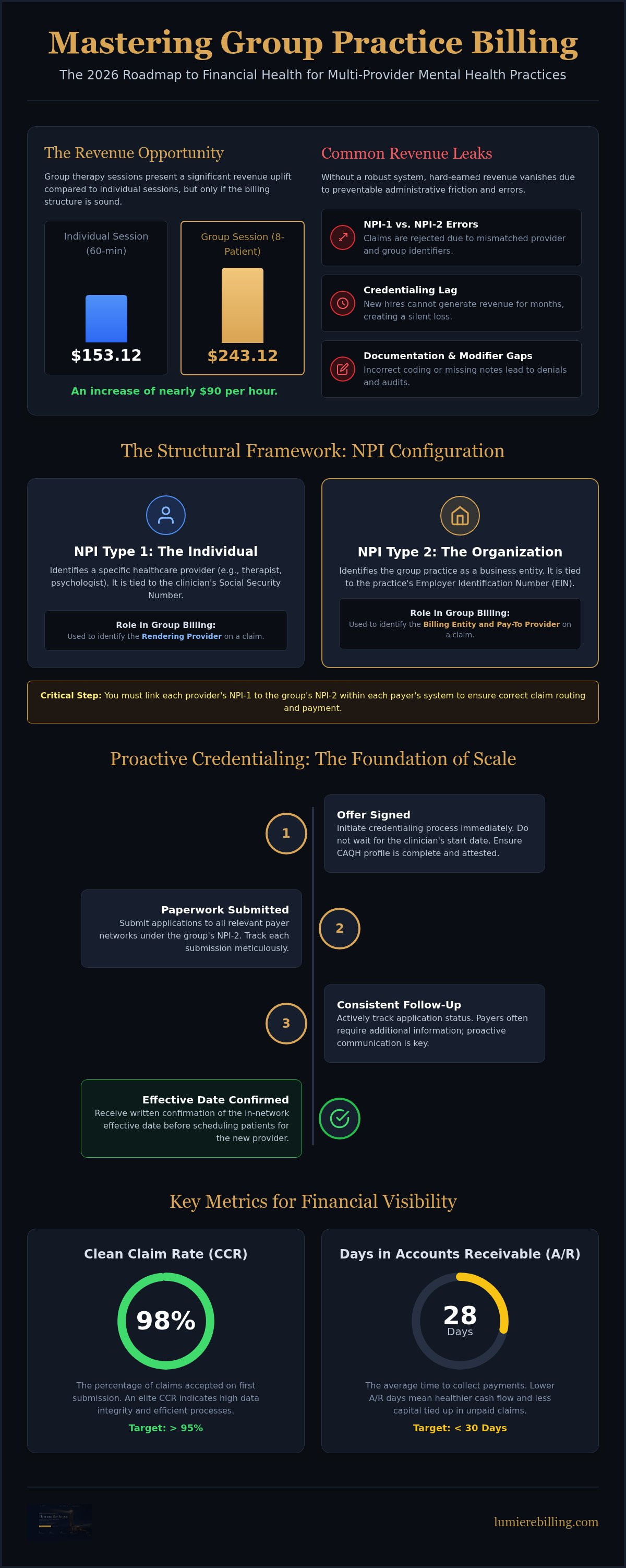
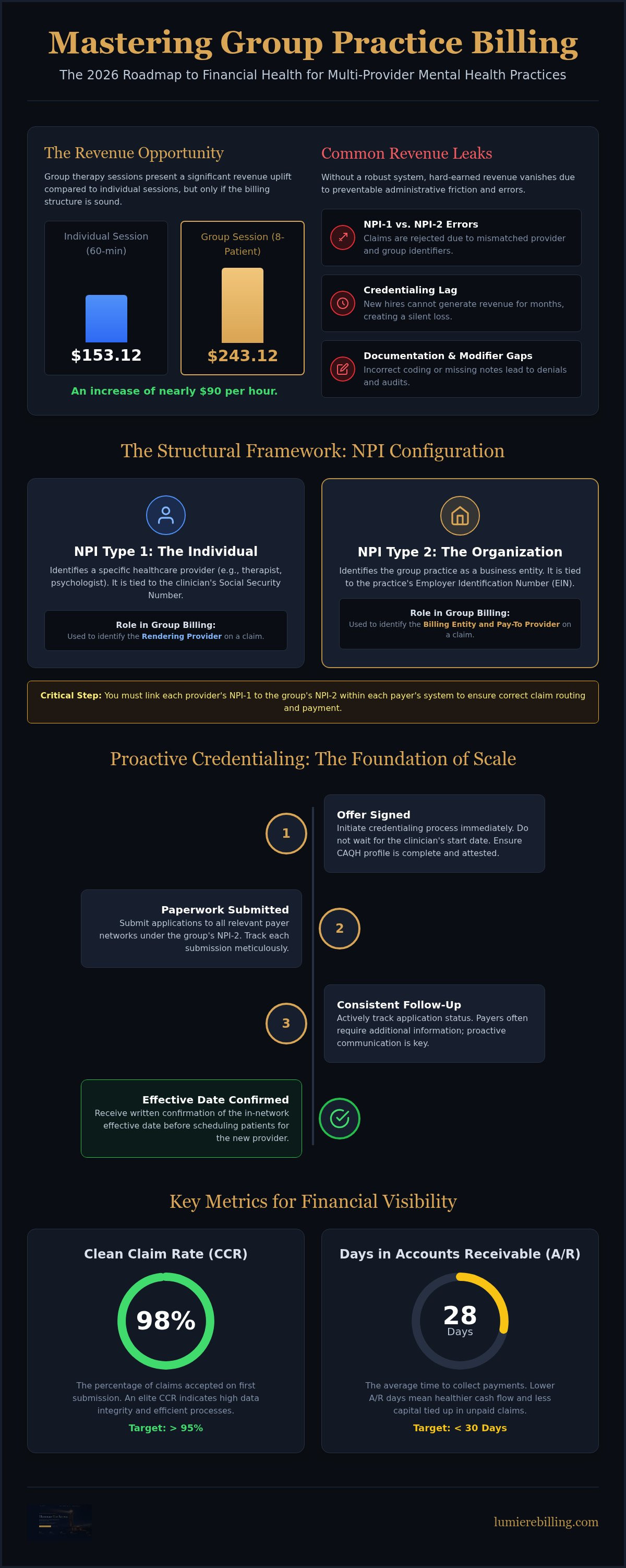
An eight-patient group therapy session in 2026 generates $243.12 per hour, outperforming a standard 60-minute individual session by nearly $90. While the revenue potential is clear, the administrative friction of managing multiple providers often leads to systemic leaks. You likely recognize that mental health billing for group practice isn't just solo billing on a larger scale. It is a different machine entirely. One un-credentialed hire or a single NPI-1 versus NPI-2 error can stall your cash flow for months.
We understand the frustration of watching hard-earned revenue vanish into the black hole of documentation gaps or modifier errors. This guide serves as your 2026 roadmap to master the complexities of multi-provider billing, from managing credentialing rosters to perfecting group therapy CPT codes. We will examine the latest CMS reimbursement rates, scalable workflows, and the rigorous compliance standards required to reduce your days in Accounts Receivable. You'll gain the visibility needed to protect your practice's financial health and scale with confidence.
Key Takeaways
- Distinguish between NPI Type 1 and Type 2 requirements to ensure your organizational structure supports seamless multi-provider reimbursement.
- Eliminate revenue leakage by implementing a proactive roster management system that tracks credentialing timelines for every new hire.
- Master the nuances of CPT 90853 to maximize hourly revenue and debunk common myths regarding group psychotherapy billing.
- Optimize your mental health billing for group practice by monitoring essential KPIs like Clean Claim Rates and Days in Accounts Receivable.
- Identify how specialized revenue cycle management and practice advisory services provide the visibility needed to scale your operations securely.
Understanding the Structural Framework of Group Practice Billing
Group practice billing is the centralized management of multiple provider revenue streams into a single, cohesive financial engine. It differs fundamentally from solo practice billing because it requires an organizational architecture that bridges individual clinical work with a collective business identity. Transitioning to this model requires a shift from provider-centric processes to entity-centric systems. Understanding the basics of medical billing is helpful, but group practices must go deeper into the "Entity Gap." This gap occurs when a practice attempts to bill under a single Tax ID without correctly configuring payer contracts to recognize the group entity. Without this alignment, claims are often rejected because the payer's system sees a mismatch between the rendering provider and the billing entity.
Centralized Revenue Cycle Management (RCM) is the backbone of this structure. It allows for high-level oversight of all provider performance and claim health. Instead of managing five separate billing cycles, you manage one optimized system. This visibility is vital. It reveals which providers have documentation lags and which payers are delaying reimbursements. Protecting your practice's financial health starts with this structural clarity. It ensures that mental health billing for group practice remains a tool for growth rather than a source of administrative chaos.
NPI and Tax ID Configurations for Groups
An individual NPI (Type 1) identifies the clinician, but a group practice requires an Organizational NPI (Type 2) to function as a business entity. You must use NPI-2 for all organizational billing to ensure payments are directed to the practice rather than the individual. This becomes complex for multi-state practices. Each state may have different enrollment requirements even if you use a single Tax ID. A common error involves failing to link individual NPIs to the group NPI within the payer’s portal. This oversight creates a "provider not found" denial, even if the clinician is fully credentialed. Precision in these configurations is the first line of defense.
The Role of Centralized Intake and Verification
Scaling requires a "provider-agnostic" intake process. This means your front-office staff verifies insurance based on the practice’s collective payer contracts rather than the specific provider’s status. Standardizing this workflow is essential. It ensures that every patient entering the system is matched with a clinician who is currently in-network. A single point of truth for payer rules prevents the "Credentialing Lag" from turning into a total loss of revenue. Centralized intake acts as a filter. It catches potential modifier errors or coverage limits before the session even occurs. By the time a claim is generated, the data integrity is already verified. This proactive approach is what distinguishes a scalable group from a collection of solo providers.
Credentialing and Roster Management: The Foundation of Scale
Credentialing is the structural integrity of your practice. It's a continuous cycle of verification that ensures every clinician under your umbrella is authorized to generate revenue. The "Credentialing Lag"—the window between hiring a clinician and their first in-network payout—is a silent revenue killer. For mental health billing for group practice, this isn't just a solo hurdle multiplied; it's a systemic risk. If your roster isn't maintained with surgical precision, you're effectively operating in the dark. You can learn more about mastering behavioral health provider rosters to mitigate these gaps and keep your cash flow predictable.
As your group grows, understanding the difference between delegated and non-delegated credentialing becomes vital. Larger entities often pursue delegated status, allowing the group to vet providers internally and significantly shortening the timeline to "in-network" status. However, most groups remain non-delegated, relying on the payer's timeline. Regardless of your model, strict adherence to CMS guidelines for practitioner billing remains the gold standard for avoiding audit reversals. Every provider in the group must also maintain an immaculate CAQH profile. This isn't optional. It's the central repository that payers use to verify your practice’s legitimacy.
The 2026 Credentialing Workflow for New Hires
Success begins the moment an offer letter is signed. You shouldn't wait for a start date to initiate the paperwork. The first step is ensuring the clinician’s CAQH profile is current and their NPI-1 is correctly associated with your group’s NPI-2. Clinicians transitioning from other practices often face delays if their previous associations aren't terminated. Your workflow must include proactive tracking of license renewals and malpractice expirations. A single expired document in a group of fifty can trigger a full-practice payment hold, stalling the revenue cycle for everyone.
Maintaining Payer Rosters and Directory Accuracy
Roster accuracy directly impacts claim payment speed. "Ghost rosters"—directories listing providers who are no longer at your practice—damage your reputation and lead to misrouted claims. Payers are increasingly aggressive about directory accuracy in 2026, often penalizing practices that fail to provide quarterly updates. You can leverage CAQH enrollment services to automate group updates and maintain visibility. If you suspect your current system is leaking revenue due to roster errors, a free billing audit can identify where your documentation and billing cycles are out of sync.
Billing for Group Therapy: CPT 90853 and Beyond
CPT 90853 represents the engine of group practice profitability in 2026. With a national average Medicare reimbursement rate of $30.39 per patient, an eight-person session generates $243.12 per hour. This significantly outperforms the $154 to $160 average for a single-patient 90837 session. However, maximizing this revenue requires a precise understanding of mental health billing for group practice. A common misconception is that 90853 is a timed code. Unlike individual psychotherapy, 90853 is a per-session code. You bill it once per patient, per day, regardless of whether the session lasts 45 or 90 minutes. If clinical complexity arises, such as communication barriers, you may append the interactive complexity add-on, CPT 90785, which adds approximately $14.50 to the Medicare reimbursement.
When individual and group sessions occur on the same day for the same patient, modifier usage is critical to prevent denials. Use modifier -59 to indicate that the group session is a distinct procedural service from the individual session. Failure to use this modifier often results in the group claim being "bundled" into the individual session, leading to a total loss of the group revenue. Referencing the AMA behavioral health CPT codes provides the foundational nomenclature needed to train your clinical staff on these distinctions.
Comparing 90853, 90849, and 90847
Choosing the correct code depends on the participants and the clinical intent. Medicare typically enforces a 10-patient limit for 90853, while commercial payers may vary. License requirements also dictate billing; for instance, LMHCs and LMFTs can now bill Medicare for these services at 75% of the Physician Fee Schedule rate.
- CPT 90853: Group Psychotherapy. Focuses on the interaction of group members. Max 10 patients for Medicare.
- CPT 90849: Multiple Family Group Psychotherapy. Involves groups of families. Often used in intensive outpatient settings.
- CPT 90847: Family Psychotherapy with patient present. Focuses on the family system rather than a group of unrelated peers.
Documentation Standards for Group Sessions
Audits often target group therapy because of "cloned notes." You must generate a unique, individual progress note for every participant in the group. While the "group theme" may be identical, the patient’s specific response, progress, and clinical goals must be individualized. Documentation that appears copied and pasted across multiple charts is a primary cause for recoupment. To safeguard your revenue, review these behavioral health billing errors to avoid. Precision in mental health billing for group practice means ensuring that every note reflects a distinct clinical encounter, protecting your practice from the $580 million in improper payments estimated by the OIG.
Optimizing Group Practice Workflows and Analytics
Scaling a group practice requires moving beyond manual tracking. Spreadsheets are insufficient for a multi-provider environment where hundreds of claims move through the system weekly. You need a centralized system that provides total visibility into your behavioral health revenue cycle management. Without this oversight, revenue leakage becomes inevitable. It often hides in small, recurring errors across multiple clinicians. Mastery of mental health billing for group practice depends on monitoring three core KPIs that act as the pulse of your financial health. A healthy practice should maintain these benchmarks:
- Days in Accounts Receivable (DAR): This measures how long it takes to get paid. Aim for a DAR between 30 and 40 days.
- Clean Claim Rate (CCR): This is the percentage of claims that pass through the payer system without edits. Target a rate of 95% or higher.
- Denial Rate: This tracks rejected claims. Keep this under 5% to ensure predictable cash flow.
Anything lower than these targets suggests your front-end verification process or documentation workflow is failing. Visibility is your best defense against systemic leaks.
The KPI Dashboard for Group Directors
A robust dashboard allows you to track DAR by individual provider. This reveals who is under-billing or struggling with documentation lags. If one clinician consistently has a higher denial rate, it signals a need for targeted training rather than a systemic payer issue. Monitoring denial patterns across the entire group helps identify if a specific payer has changed their requirements or updated their 2026 reimbursement rules. This data is your most powerful tool. It justifies hiring additional administrative staff or clinical leads by proving exactly where the ROI will manifest. You can identify which providers are outliers in their coding habits, which helps prevent the kind of red flags that trigger insurance audits.
Standardizing Documentation for Faster Reimbursement
Documentation is the foundation of every claim. Implementing practice-wide templates ensures every clinician meets CPT compliance standards without guesswork. We recommend a strict 24-Hour Rule for note completion. Claims cannot be filed until notes are finished. Delays in documentation directly extend your billing cycle and increase the risk of denials. Regular internal reviews act as a dress rehearsal for external audits. They ensure your group practice remains audit-proof and financially resilient. These reviews should focus on matching the exact start and stop times in the note to the claim itself. If your current workflow feels opaque, our analytics and compliance services can help you implement a scalable, high-visibility billing system.
Scaling Your Practice with Specialized RCM Support
General medical billing firms often fail because they treat behavioral health as an afterthought. They lack the specialized focus required to manage the complexities of mental health billing for group practice, such as ABA unit tracking or the specific documentation requirements for psychiatric evaluations. A generalist firm might miss the subtle shifts in 2026 CMS reimbursement rates or the evolving nuances of the Mental Health Parity and Addiction Equity Act updates. At Lumiere Billing, we position ourselves as the vigilant protector of your financial health. We operate as a proactive partner, ensuring that your revenue cycle is not just managed, but optimized for scale.
Our percentage-based fee model ensures our incentives are perfectly aligned with your growth. This model fosters a disciplined, behind-the-scenes operation where we only succeed when you do. We bridge the "Credentialing-Billing" feedback loop by maintaining a constant flow of information between enrollment status and claim submission. This prevents the common scenario where a new clinician begins seeing patients before their payer status is finalized, leading to avoidable revenue loss. Precision in these transitions is what separates a thriving group from one struggling with consistent cash flow.
The Lumiere Advantage for Mental Health Groups
We bring hidden issues into focus. Our expertise extends across ABA, Psychiatry, and multi-location psychotherapy groups. Beyond merely processing claims, our Practice Advisory service helps you optimize your EHR workflows and standardizes your documentation to meet 2026 compliance standards. We focus on proactive denial prevention rather than reactive re-submissions. By identifying systemic leaks early, we repair broken systems before they impact your cash flow. This level of focus borders on the obsessive, ensuring that every dollar earned by your providers is successfully captured and reconciled.
Taking the Next Step: The Free Billing Audit
Transitioning from an in-house team to outsourced mental health billing is a strategic move toward visibility and insight. A professional audit reveals the exact points of revenue leakage in your current system, from un-credentialed provider sessions to modifier errors. It provides a baseline for your practice’s financial integrity. If you're ready to move away from opaque administrative services and toward a model of mastery and meticulous detail, schedule your free billing audit with Lumiere today. We provide the clarity you need to scale your group practice with confidence.
Securing Your Practice's Financial Future in 2026
Scaling a group practice requires more than clinical excellence. It demands a structural framework that bridges individual performance with organizational integrity. We've explored how NPI-2 configurations, proactive roster management, and the nuances of CPT 90853 create the foundation for sustainable growth. Mastering mental health billing for group practice is not a one-time setup; it's a continuous process of vigilance and optimization. Without specialized oversight, revenue leakage becomes a systemic risk that threatens your ability to provide care.
Lumiere Billing stands as your vigilant protector. Our behavioral health specialists provide a proactive partnership through percentage-based RCM and full-cycle credentialing and advisory services. We move beyond simple claim processing to bring hidden issues into focus. It's time to stop reacting to denials and start optimizing your revenue cycle. Request Your Free Billing Audit and Optimize Your Group Practice Revenue to ensure every session is captured with precision. Your practice deserves the clarity and stability that comes from expert mastery. Let's build a more resilient financial future together.
Frequently Asked Questions
How do I bill for group therapy with multiple clinicians in one practice?
Centralized billing requires using the individual clinician’s Type 1 NPI as the rendering provider while the practice’s Type 2 NPI serves as the billing provider. It’s vital to ensure every clinician is correctly linked to the practice’s Tax ID within each payer’s portal. This configuration allows for the aggregation of multiple revenue streams under a single organizational umbrella, ensuring payments are directed to the group entity rather than individual providers.
What is the 2026 reimbursement rate for CPT code 90853?
The national average Medicare reimbursement rate for CPT 90853 is $30.39 per patient in 2026, representing an 8.0% increase from the previous year. Commercial payers typically offer higher rates, with national averages ranging from $34.35 for BCBS to $43.66 for Aetna. When managing mental health billing for group practice, these per-patient rates allow for significantly higher hourly revenue compared to individual psychotherapy sessions when multiple participants are present.
Can I bill for a group session and an individual session for the same patient on the same day?
Yes, you can bill both services if they are clinically distinct and necessary. You must append modifier -59 to the group psychotherapy claim to indicate that it is a separate procedural service from the individual session. Without this modifier, payers will likely bundle the services, leading to a denial of the group claim. Documentation must clearly support the independent nature and clinical goals of each encounter to withstand an audit.
Do all clinicians in my group need their own NPI, or do we use the group NPI?
Every clinician must maintain their own Type 1 NPI for identification as the rendering provider. The group practice must also possess a Type 2 NPI for organizational billing. Claims are submitted with both numbers; the Type 1 identifies who performed the service, while the Type 2 ensures the payment is issued to the practice. Failure to correctly associate these numbers is a primary cause of credentialing-related claim rejections.
What are the documentation requirements for group psychotherapy in 2026?
You must generate a unique, individual progress note for every participant in the group. While the session’s general theme may be shared, each note must document the specific patient’s participation, clinical response, and progress toward their individual treatment goals. Cloned notes that appear identical across multiple patient charts are a major red flag for auditors and often lead to significant payment recoupments during insurance reviews.
How long should a group therapy session be for CPT 90853 billing?
CPT 90853 is not a timed code, meaning it doesn't have a specific duration requirement like individual psychotherapy codes. Most clinical group sessions naturally last between 45 and 90 minutes, but the reimbursement remains the same regardless of the exact length. It’s essential to document the start and stop times of the therapeutic portion of the session to meet CMS compliance standards, even though the code itself isn't time-based.
What happens if a provider in our group is not yet credentialed with a specific payer?
Sessions conducted by a provider before their credentialing is finalized are generally unbillable to that insurance payer. Attempting to bill these sessions under a different, credentialed clinician’s name is considered fraudulent and can lead to severe legal consequences. To protect your practice’s integrity, you must track the "Credentialing Lag" closely and only schedule in-network patients once the clinician’s status is officially confirmed in the payer's system.
Can group practices bill for support groups that are not clinical in nature?
Insurance reimbursement for 90853 requires the session to be clinical psychotherapy led by a licensed professional with a specific therapeutic intent. Non-clinical support groups, peer-led meetings, or educational workshops don't meet the criteria for medical necessity. Attempting to bill these services as psychotherapy is a common error in mental health billing for group practice that can trigger audits. These sessions should typically be handled as out-of-pocket or community-funded services.
Frequently Asked Questions
Centralized billing requires using the individual clinician’s Type 1 NPI as the rendering provider while the practice’s Type 2 NPI serves as the billing provider. It’s vital to ensure every clinician is correctly linked to the practice’s Tax ID within each payer’s portal. This configuration allows for the aggregation of multiple revenue streams under a single organizational umbrella, ensuring payments are directed to the group entity rather than individual providers.
The national average Medicare reimbursement rate for CPT 90853 is $30.39 per patient in 2026, representing an 8.0% increase from the previous year. Commercial payers typically offer higher rates, with national averages ranging from $34.35 for BCBS to $43.66 for Aetna. When managing mental health billing for group practice, these per-patient rates allow for significantly higher hourly revenue compared to individual psychotherapy sessions when multiple participants are present.
Yes, you can bill both services if they are clinically distinct and necessary. You must append modifier -59 to the group psychotherapy claim to indicate that it is a separate procedural service from the individual session. Without this modifier, payers will likely bundle the services, leading to a denial of the group claim. Documentation must clearly support the independent nature and clinical goals of each encounter to withstand an audit.
Every clinician must maintain their own Type 1 NPI for identification as the rendering provider. The group practice must also possess a Type 2 NPI for organizational billing. Claims are submitted with both numbers; the Type 1 identifies who performed the service, while the Type 2 ensures the payment is issued to the practice. Failure to correctly associate these numbers is a primary cause of credentialing-related claim rejections.
You must generate a unique, individual progress note for every participant in the group. While the session’s general theme may be shared, each note must document the specific patient’s participation, clinical response, and progress toward their individual treatment goals. Cloned notes that appear identical across multiple patient charts are a major red flag for auditors and often lead to significant payment recoupments during insurance reviews.
CPT 90853 is not a timed code, meaning it doesn't have a specific duration requirement like individual psychotherapy codes. Most clinical group sessions naturally last between 45 and 90 minutes, but the reimbursement remains the same regardless of the exact length. It’s essential to document the start and stop times of the therapeutic portion of the session to meet CMS compliance standards, even though the code itself isn't time-based.
Sessions conducted by a provider before their credentialing is finalized are generally unbillable to that insurance payer. Attempting to bill these sessions under a different, credentialed clinician’s name is considered fraudulent and can lead to severe legal consequences. To protect your practice’s integrity, you must track the "Credentialing Lag" closely and only schedule in-network patients once the clinician’s status is officially confirmed in the payer's system.
Insurance reimbursement for 90853 requires the session to be clinical psychotherapy led by a licensed professional with a specific therapeutic intent. Non-clinical support groups, peer-led meetings, or educational workshops don't meet the criteria for medical necessity. Attempting to bill these services as psychotherapy is a common error in mental health billing for group practice that can trigger audits. These sessions should typically be handled as out-of-pocket or community-funded services.