EHR Optimization for Behavioral Health: 2026 Guide

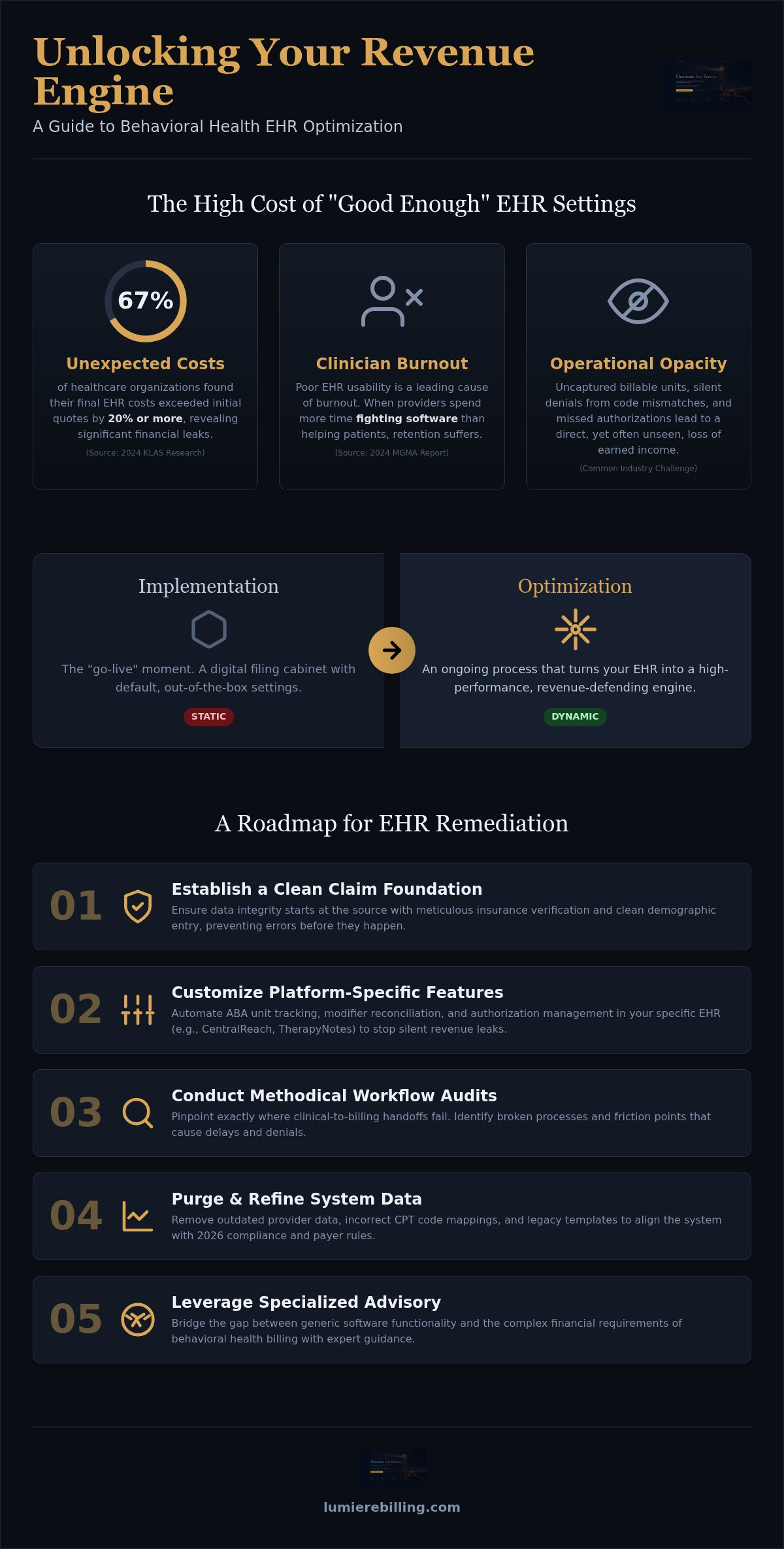
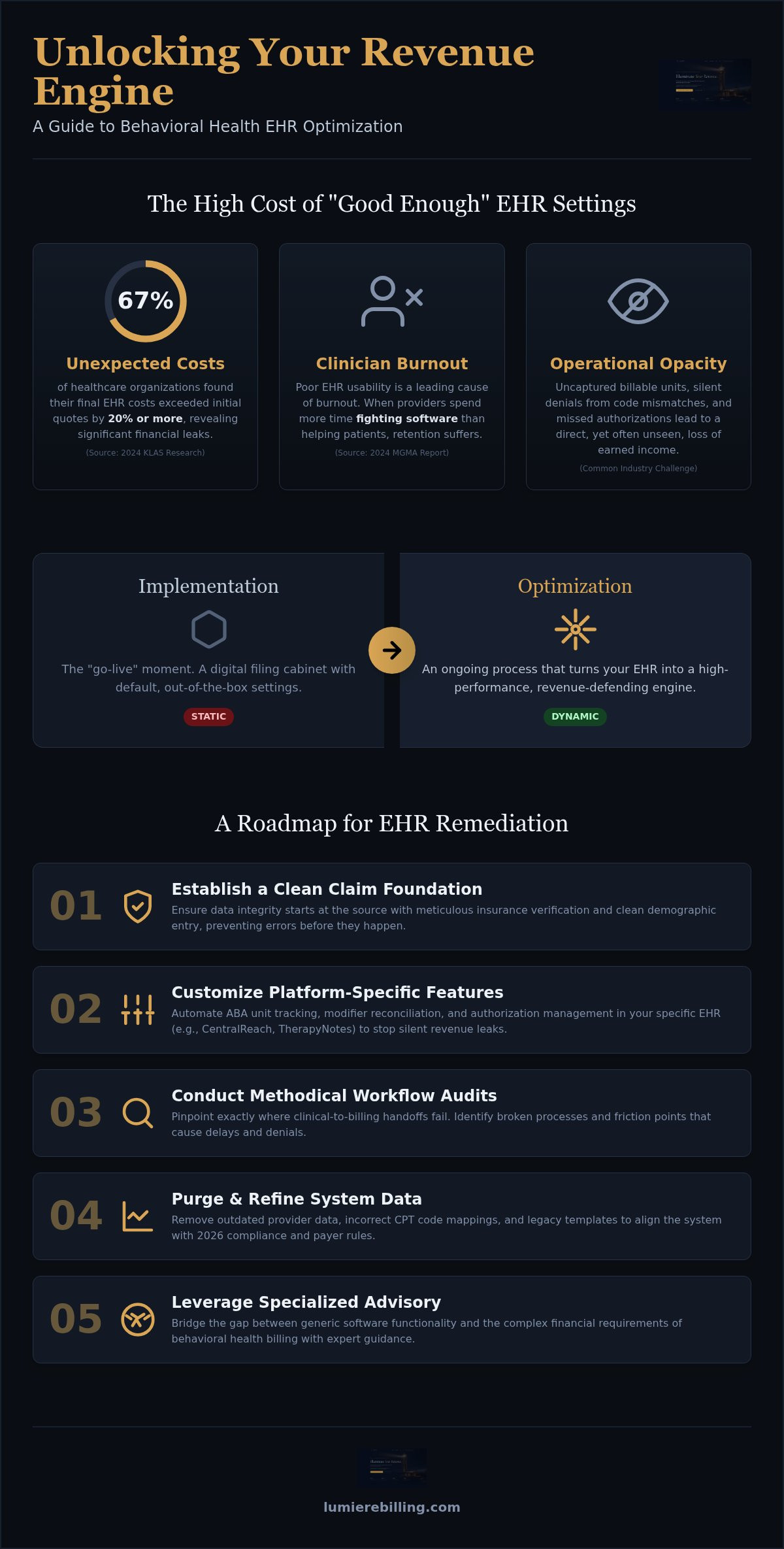
According to a 2024 KLAS Research survey, 67% of healthcare organizations discovered their final EHR costs exceeded initial quotes by 20% or more. For many providers, this financial leak is compounded by clinician burnout and high claim denial rates. You likely feel the friction of double-entry workflows and the opacity of unit usage data every single day. It is a common frustration. Your system should be a vigilant protector of your financial health. It shouldn't be a clunky digital filing cabinet that slows down your team and obscures your revenue.
Effective EHR optimization behavioral health is the bridge between clinical documentation and financial solvency. We promise to show you how to transform your current platform into a high-performance revenue engine through targeted, methodical strategies. This 2026 guide provides a roadmap to streamline your clinical-to-billing workflow and reduce days in Accounts Receivable. We will examine how to align your system with new requirements like the CMS-0057-F rule while restoring productivity and ensuring every unit of care is captured with meticulous precision. Our goal is to move your practice away from administrative opacity toward a future of total visibility and operational mastery.
Key Takeaways
- Move beyond standard out-of-the-box setups by treating optimization as an iterative process that aligns your software with actual clinical workflows.
- Establish a Clean Claim Foundation through high-performance EHR optimization behavioral health, ensuring data integrity starts at the point of insurance verification.
- Customize platform-specific features in CentralReach or TherapyNotes to automate ABA unit tracking and modifier reconciliation, stopping silent revenue leaks.
- Implement a methodical 5-step remediation roadmap to identify broken clinical-to-billing handoffs and purge outdated provider data.
- Leverage specialized practice advisory to bridge the gap between software functionality and the complex financial requirements of behavioral health billing.
Beyond the Basics: What is Behavioral Health EHR Optimization?
EHR optimization behavioral health isn't a static software update; it's an ongoing refinement of technical workflows to mirror clinical truth. Most practices treat their EHR like a digital filing cabinet. They accept out-of-the-box settings as a final destination. High-performance customization requires a deeper alignment. It demands that your clinical protocols and software architecture speak the same language. This is the difference between simply storing data and actively defending your practice's financial health.
Behavioral health providers face unique mechanical challenges that general medicine systems often ignore. You deal with recurring authorizations and complex unit tracking that shifts based on payer contracts. As we enter 2026, the focus is pivoting toward value-based care. Optimization now serves as the foundation for quality reporting. It proves clinical outcomes to ensure you receive full reimbursement. Without this precision, your practice remains exposed to the increasingly opaque requirements of modern payers.
The Cost of "Good Enough" EHR Settings
Default settings act as a sieve for your revenue. They create silent denials where claims fail because CPT codes or modifiers weren't mapped correctly to clinical activity. The damage isn't just financial. A 2024 MGMA report identifies poor EHR usability as a leading cause of clinician burnout. When workflows feel clunky, your best providers spend more time fighting software than helping patients. This friction destroys clinician retention. Additionally, uncaptured billable units represent a direct loss of earned income. If your system can't track usage in real-time, you're essentially providing care for free.
Optimization vs. Implementation: Knowing the Difference
Implementation is the act of turning the system on. It's the go-live moment where data migrates and logins are issued. Optimization is the act of making that system work for your specific bottom line. It usually begins after the initial 90-day stabilization phase. While implementation provides the frame, optimization builds the high-performance engine. This requires a constant feedback loop between your billers and clinicians. We view this as a cycle of mechanical integrity:
- Workflow Audits: Pinpointing where the clinical-to-billing handoff fails.
- Refinement: Adjusting templates to meet 2026 compliance without adding clicks.
- Verification: Using data to confirm every billable minute reaches a claim.
Software vendors understand code, but they don't understand the nuances of behavioral health reimbursement. Optimization bridges that gap. It transforms your existing platform into a vigilant protector of your practice's financial future.
The Financial Engineering of EHR Workflows: Aligning Data with RCM
A Clean Claim Foundation is built on the premise that every billable event must be validated at the source. It is not enough to fix errors in the back office; you must prevent them at the front desk. This requires a shift in perspective. View your EHR as a financial gatekeeper rather than a passive data repository. By integrating behavioral health revenue cycle management best practices into your initial software configuration, you create a system where data integrity is the default state. Accurate insurance verification and clean demographic entry are the bedrock of this architecture. Without them, the most advanced billing software in the world will still produce denials.
Automated authorization tracking is the next layer of this financial defense. Many practices lose thousands of dollars each month simply because they provide services after an authorization has expired. You shouldn't rely on spreadsheets or memory to track these units. High-performance EHR optimization behavioral health ensures that your scheduling module is hard-wired to your authorization data. If a client's units are depleted, the system should flag the appointment before the clinician ever steps into the room. This level of mechanical oversight transforms your workflow from a reactive scramble into a proactive revenue engine.
Mapping Clinical Documentation to CPT Logic
Note templates should do more than just record clinical observations. They must be engineered to trigger specific billing outcomes. When a clinician completes a session, the system should automatically suggest the correct 90837 CPT code or its equivalent based on the time documented. This reduces the cognitive load on your staff and eliminates manual coding errors. We recommend configuring hard-stops for missing signatures or incomplete session notes. If the documentation isn't finished, the claim shouldn't move to the billing queue. This discipline ensures your documentation can survive payer audits and prevents the "silent denials" that often plague unoptimized systems.
Automating the Authorization Lifecycle
Manual unit tracking is a systemic leak that many practices fail to plug. To solve this, you need proactive "low balance" alerts that trigger within the EHR. These notifications should reach your administrative team well before the units hit zero, allowing for a seamless re-authorization process. By integrating prior authorization data directly into the scheduling module, you reduce the manual labor of reconciliation. Automated rules can then match sessions to authorized units in real-time, providing total visibility into your utilization rates. If you're unsure if your current setup is capturing every dollar, a specialized billing audit can reveal where your data is falling through the cracks.
Platform-Specific Optimization: CentralReach, TherapyNotes, and Beyond
Generic software setups are a liability. A generalist approach fails because it ignores the mechanical nuances of specialized care. High-level EHR optimization behavioral health requires a deep dive into the specific architecture of your chosen platform. CentralReach and TherapyNotes serve different masters. One is built for the granularity of ABA; the other is designed for the streamlined flow of mental health groups. Enterprise-level systems like AdvancedMD or Kareo often present configuration traps. These occur when global settings override the specific billing requirements of behavioral health. Multi-location data silos further complicate this, creating opaque pockets of information that hide revenue leakage.
ABA Optimization: Unit Tracking and Modifier Logic
ABA providers grapple with high-volume, low-unit transactions. You must solve the ABA unit tracking reconciliation challenge by hard-wiring your software settings. This includes configuring automatic modifier application based on provider credentials. Your system should know when to apply HO or HM modifiers without a biller's touch. We recommend building custom dashboards to monitor BCBA utilization rates in real-time. This level of visibility allows you to repair broken systems before they impact your cash flow. It moves you from reactive billing to proactive financial management. It ensures that every unit of care is visible and accounted for.
Mental Health Group Practice Workflows
For mental health group practices, efficiency is the priority. TherapyNotes offers significant automation, but only if the settings are refined. Start by optimizing the patient portal to shift the administrative load away from your front desk. Digital intake forms should feed directly into the clinical record, eliminating double-entry. Configure the system to generate automated Superbills for out-of-network clients. This maintains your service standard without increasing manual labor. Role-based access is another critical area. You need to ensure HIPAA compliance without sacrificing the speed of your clinical workflow. This balanced approach creates a stable environment where clinicians can thrive and revenue is protected. It is about creating a system that is both secure and frictionless.
A Roadmap for EHR Remediation: 5 Steps to Plugging Revenue Leaks
Remediation is a surgical strike on inefficiency. It is the process of repairing your system while it remains in flight. High-performance EHR optimization behavioral health requires a methodical approach that moves beyond superficial fixes. We view remediation as a five-step discipline designed to restore mechanical integrity to your practice's financial engine.
- Step 1: The Workflow Audit. You've got to pinpoint exactly where the clinical-to-billing handoff breaks down. This is the diagnostic phase where hidden fractures are brought into focus.
- Step 2: Data Cleanup. Systems become sluggish with age. Scrubbing provider rosters and outdated payer contracts is essential for maintaining a Clean Claim Foundation.
- Step 3: Template Refinement. Documentation should be lean and purposeful. We focus on reducing clicks while ensuring every note meets 2026 compliance standards.
- Step 4: Staff Training. Software is only as effective as the person clicking the mouse. Training bridges the gap between system capability and actual user habits.
- Step 5: Reporting Setup. You can't manage what you can't see. We build the KPIs that provide total visibility into your financial health.
The Behavioral Health Billing Workflow Audit
A rigorous audit analyzes the lifecycle of a single claim from the moment of intake to the final payment. It identifies the friction points where data is lost or corrupted. During this cleanup phase, you must identify behavioral health billing errors to avoid, such as mismatched modifiers or outdated insurance IDs. Use a specialized behavioral health billing audit to benchmark your current performance against industry standards. This creates a baseline for all future optimization efforts. It ensures your practice isn't just busy, but profitable.
Customizing Dashboards for Clinical Visibility
Standard aging reports are often too slow to prevent revenue loss. Effective EHR optimization behavioral health transforms these reports into proactive utilization trackers that flag issues in real-time. We recommend building "Denial Heat Maps" within your EHR. These visual tools identify provider-specific documentation patterns that lead to denials. If one clinician consistently misses signatures, the heat map brings that issue into focus immediately. Executive summaries then allow practice owners to monitor the entire system's health at a glance. If you're ready to stop the leakage, our Free Billing Audit is the first step toward total revenue protection.
Strategic Advisory: How Lumiere Billing Bridges the Gap
Software vendors are masters of digital architecture, but they are rarely warriors in the revenue cycle. They build the digital roads; they don't navigate the complex terrain of payer logic. This is where the gap exists. Most practices struggle because their software is configured for general use rather than the specific, high-stakes requirements of behavioral health. Strategic EHR optimization behavioral health requires more than just technical knowledge. It demands an advocate who understands the nuances of ABA unit tracking, mental health modifiers, and the mechanical integrity of a clean claim.
Lumiere Billing acts as the bridge between your existing platform and your financial solvency. We position ourselves as a proactive partner, functioning as an extension of your team to ensure your systems are vigilant protectors of your revenue. Instead of accepting the opaque nature of standard administrative services, we bring your hidden issues into focus. We move your practice away from the chaos of manual entry and toward a style of management that emphasizes visibility, insight, and mastery of the billing lifecycle.
The Lumiere Approach to EHR Optimization
We don't replace your EHR; we make it work for your bottom line. Our methodology focuses on mechanical integrity, repairing broken workflows that cause systemic leaks. By refining clinical-to-billing handoffs, we've helped practices achieve significant results, such as reducing AR days by 20% through targeted workflow refinement. We integrate our advanced analytics with your existing platform data to provide a level of clarity that software alone cannot offer. This partnership turns your EHR from a digital filing cabinet into a high-performance revenue engine that tracks every unit with precision.
Next Steps: Securing Your Practice’s Financial Future
In 2026, a professional billing audit is no longer optional. It is a necessary measure for identifying revenue leakage in an increasingly complex regulatory environment. Transitioning to an outsourced mental health billing model allows your team to focus on clinical care while we maintain the technical precision of your revenue cycle. Working with a specialized behavioral health billing specialist ensures your documentation standards remain high and your claims are paid on the first submission.
Don't let your practice's financial health remain in the dark. It's time to move from administrative struggle to data-driven mastery. Take the first step toward a refined, profitable system by requesting your Free Billing Audit and EHR Workflow Assessment today. We bring the light of clarity to your back-office operations, ensuring your practice is built on a foundation of financial strength.
Mastering Your Practice’s Financial Architecture
Your EHR is the heart of your daily operations. It shouldn't be a source of frustration or a catalyst for revenue leakage. True EHR optimization behavioral health transforms your software into a vigilant protector of your financial health. By refining workflows and aligning clinical documentation with precise CPT logic, you move from administrative chaos to data-driven clarity. We specialize exclusively in Behavioral Health and ABA. Our team brings deep mastery to platforms like CentralReach, TherapyNotes, and AdvancedMD to ensure your system works for you, not against you.
Mechanical integrity is the foundation of a healthy practice. Organizations that prioritize optimization often achieve a 98% clean claim rate, ensuring that every unit of care is captured and reimbursed without delay. You don't have to navigate these technical complexities alone. It's time to stop the silent denials and restore your team's focus to what matters most: patient care. We are ready to act as the dedicated advocate that repairs your broken systems and secures your future. Request Your Free Behavioral Health Billing Audit today and start your journey toward total operational visibility.
Frequently Asked Questions
What is the first sign that our behavioral health EHR needs optimization?
High clinician burnout and mounting claim denials are the primary indicators. If your team spends more time navigating menus than treating patients, the system is failing. You might notice "silent denials" where claims are never submitted due to technical friction. A professional audit often reveals that these issues stem from poor clinical-to-billing handoffs. Fixing these fractures requires a shift from a passive setup to a high-performance configuration.
Can EHR optimization really reduce our claim denial rate?
Yes, targeted optimization addresses the root causes of technical and clinical denials. By hard-wiring modifier logic and automating authorization tracking, you eliminate manual errors before the claim is even generated. We focus on creating a Clean Claim Foundation where data integrity is the default state. This methodical approach helps practices achieve a high clean claim rate by ensuring all documentation meets 2026 payer requirements before submission.
How long does a typical EHR remediation project take for a group practice?
Most remediation projects follow a phased approach over three to six months. The initial workflow audit and data cleanup typically occur in the first 30 days. This is followed by template refinement and staff training to ensure long-term adoption. While the software changes happen quickly, the shift in user habits and reporting accuracy requires continuous monitoring. We provide specialized practice advisory to guide you through each logical sequence of this transformation.
Do we need to switch EHRs if our billing is constantly failing?
Not necessarily. Most billing failures are caused by poor configuration rather than the software itself. Switching vendors is a massive investment that often results in the same problems if the underlying workflows aren't fixed. Before considering a costly data migration, a specialized billing audit can determine if your current system can be repaired. Optimization often provides the same financial results as a new implementation at a fraction of the cost.
What is the role of clinicians in the EHR optimization process?
Clinicians are the primary drivers of data integrity. Their feedback is essential for refining note templates and reducing the number of clicks required for documentation. When clinicians are involved, the system becomes a tool that supports care rather than an administrative burden. We work to align their clinical reality with your financial goals. This partnership ensures that documentation is both compliant and efficient, protecting your revenue without contributing to staff burnout.
How does EHR optimization impact HIPAA compliance and data security?
Optimization strengthens security by refining role-based access and ensuring data is handled through secure, automated channels. By reducing manual data manipulation and workarounds, you minimize the risk of human error and unauthorized disclosures. Our approach ensures your system supports 2026 standards, such as FHIR-based prior authorization API compliance. This level of mechanical integrity protects your patient data while maintaining the transparency needed for high-level clinical oversight and financial reporting.
Can Lumiere Billing work with our existing software like CentralReach or TherapyNotes?
We specialize in optimizing existing platforms like CentralReach, TherapyNotes, and AdvancedMD. We don't sell proprietary software; instead, we act as an extension of your team to bridge the gap between your EHR and your bank account. Our expertise in ABA unit tracking and mental health modifiers allows us to repair broken system bridges. We bring hidden issues into focus, ensuring your current software delivers the visibility and revenue you expect.
What KPIs should we track after optimizing our EHR workflows?
You should monitor Days in Accounts Receivable (AR), Clean Claim Rate, and Authorization Utilization. After completing EHR optimization behavioral health, these metrics provide a clear view of your system's mechanical health. You should also track clinician documentation time to measure the impact on staff productivity. These KPIs move your practice away from opaque administrative guesswork toward a style of management characterized by clarity, precision, and proactive financial protection.
Frequently Asked Questions
High clinician burnout and mounting claim denials are the primary indicators. If your team spends more time navigating menus than treating patients, the system is failing. You might notice "silent denials" where claims are never submitted due to technical friction. A professional audit often reveals that these issues stem from poor clinical-to-billing handoffs. Fixing these fractures requires a shift from a passive setup to a high-performance configuration.
Yes, targeted optimization addresses the root causes of technical and clinical denials. By hard-wiring modifier logic and automating authorization tracking, you eliminate manual errors before the claim is even generated. We focus on creating a Clean Claim Foundation where data integrity is the default state. This methodical approach helps practices achieve a high clean claim rate by ensuring all documentation meets 2026 payer requirements before submission.
Most remediation projects follow a phased approach over three to six months. The initial workflow audit and data cleanup typically occur in the first 30 days. This is followed by template refinement and staff training to ensure long-term adoption. While the software changes happen quickly, the shift in user habits and reporting accuracy requires continuous monitoring. We provide specialized practice advisory to guide you through each logical sequence of this transformation.
Not necessarily. Most billing failures are caused by poor configuration rather than the software itself. Switching vendors is a massive investment that often results in the same problems if the underlying workflows aren't fixed. Before considering a costly data migration, a specialized billing audit can determine if your current system can be repaired. Optimization often provides the same financial results as a new implementation at a fraction of the cost.
Clinicians are the primary drivers of data integrity. Their feedback is essential for refining note templates and reducing the number of clicks required for documentation. When clinicians are involved, the system becomes a tool that supports care rather than an administrative burden. We work to align their clinical reality with your financial goals. This partnership ensures that documentation is both compliant and efficient, protecting your revenue without contributing to staff burnout.
Optimization strengthens security by refining role-based access and ensuring data is handled through secure, automated channels. By reducing manual data manipulation and workarounds, you minimize the risk of human error and unauthorized disclosures. Our approach ensures your system supports 2026 standards, such as FHIR-based prior authorization API compliance. This level of mechanical integrity protects your patient data while maintaining the transparency needed for high-level clinical oversight and financial reporting.
We specialize in optimizing existing platforms like CentralReach, TherapyNotes, and AdvancedMD. We don't sell proprietary software; instead, we act as an extension of your team to bridge the gap between your EHR and your bank account. Our expertise in ABA unit tracking and mental health modifiers allows us to repair broken system bridges. We bring hidden issues into focus, ensuring your current software delivers the visibility and revenue you expect.
You should monitor Days in Accounts Receivable (AR), Clean Claim Rate, and Authorization Utilization. After completing EHR optimization behavioral health, these metrics provide a clear view of your system's mechanical health. You should also track clinician documentation time to measure the impact on staff productivity. These KPIs move your practice away from opaque administrative guesswork toward a style of management characterized by clarity, precision, and proactive financial protection.