Credentialing Support for Behavioral Health: 2026 Guide

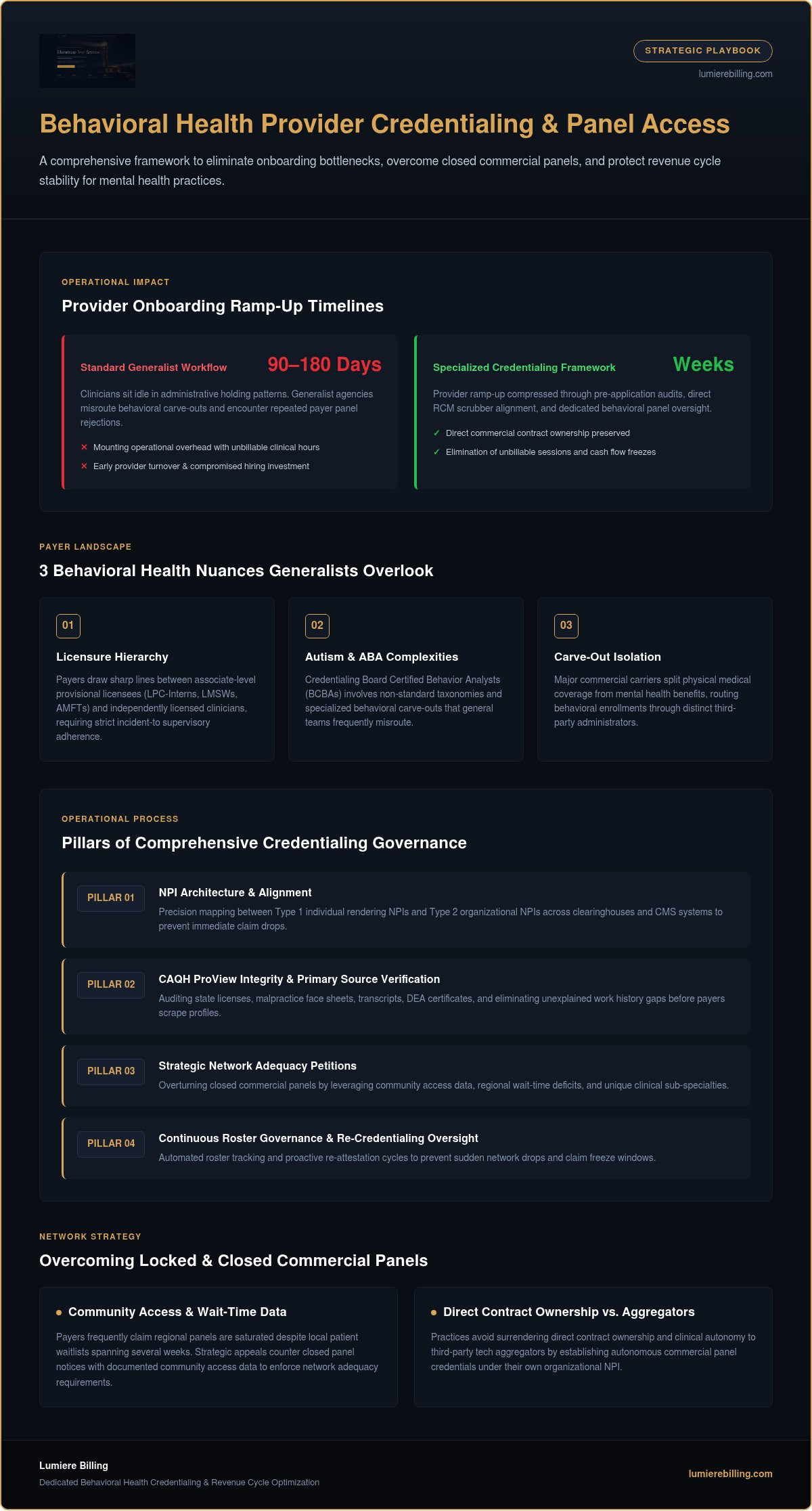
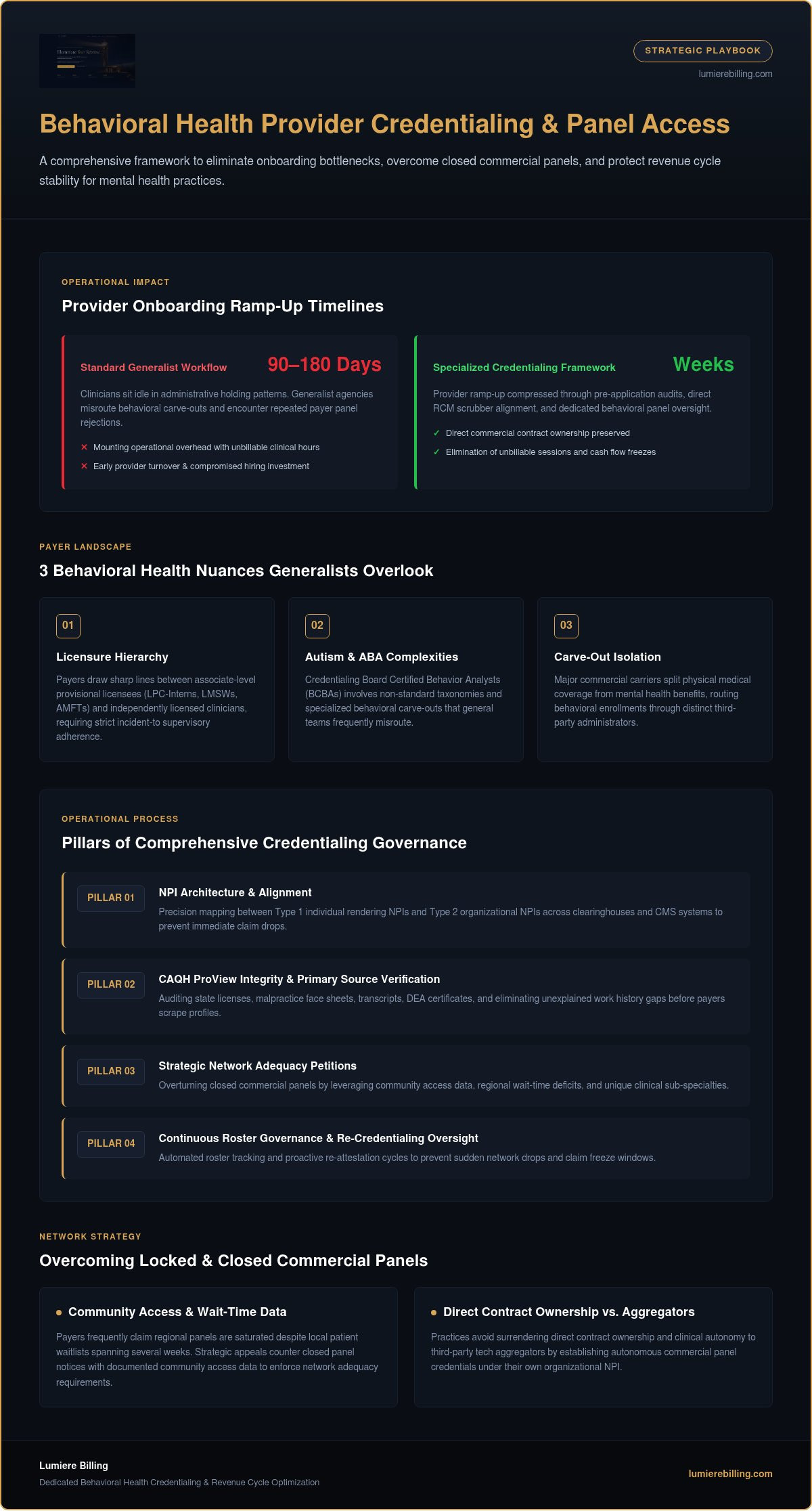
Hiring a talented clinician should expand your clinic's reach, not freeze its cash flow. Yet for many mental health leaders, bringing on new staff triggers a grueling holding pattern where providers sit idle for 90 to 180 days awaiting payer approval. Generalist billing agencies treat mental health like routine physical medicine, stumbling over supervisory billing models and behavioral carve-outs while claims silently fail. Securing specialized credentialing support for behavioral health practices is the operational foundation that keeps your revenue cycle intact.
You already know how devastating unbillable clinical hours and closed panel notices are to your bottom line, and you shouldn't have to surrender direct contract ownership to tech aggregators just to survive enrollment delays. In this guide, you will discover how to master payer enrollment, eliminate onboarding bottlenecks, and safeguard clinic cash flow. We walk through the exact framework needed to cut provider ramp-up from months to weeks, overcome closed panels, and protect every dollar your clinicians earn.
Key Takeaways
- Specialized credentialing support for behavioral health practices safeguards clinic cash flow and secures direct contract ownership without surrendering autonomy to tech aggregators.
- Meticulous CAQH ProView governance and pre-application audits eliminate administrative bottlenecks and stop silent claim rejections before files reach payer desks.
- Strategic network adequacy petitions leverage community access data to successfully overturn locked or ostensibly closed commercial panels.
- Integrating credentialing tracking directly with revenue cycle scrubbers accelerates clinician ramp-up from months to weeks, eliminating unbillable clinical hours.
- Continuous roster oversight and automated monitoring defend active panels against sudden network drops during mandatory re-credentialing cycles.
Why Behavioral Health Credentialing Demands a Specialized Framework
Behavioral health credentialing is not simple administrative filing. It is the rigorous, dual-phase mechanism of primary source qualification and payer contracting that establishes a clinician's legal right to bill an insurer. While general medical specialties follow standardized workflows, mental health and therapy clinics face severe panel saturation barriers. Payers frequently issue outright panel denials, claiming regional networks are full, even while patients wait weeks for care. Dedicated medical credentialing and provider enrollment requires understanding these nuanced commercial barriers. Every single day a clinician remains unpaneled creates unrecoverable revenue loss for the practice. Generalist billing clearinghouses treat behavioral health like routine outpatient medicine. They overlook specialized taxonomy codes, misclassify provider types, and trigger immediate claim rejections that choke cash flow before a single patient is treated.
The High Cost of Onboarding Lag for Mental Health Clinicians
Onboarding lag carries a severe financial penalty. When newly hired clinicians cannot bill commercial insurance, clinical revenue stalls while operational overhead continues to mount. Practices face an impossible dilemma: absorb the financial loss of unbillable sessions, or turn away clients who need care. This operational friction quickly breeds clinician dissatisfaction. Providers want to treat patients, not sit idle in administrative purgatory. When credentialing drags out over several months, early staff turnover rates spike, destroying your hiring investment.
Behavioral Health Nuances Versus General Medical Enrollment
General enrollment frameworks fail because they do not account for behavioral health hierarchy. Mastering mental health provider credentialing trends means knowing exactly how commercial networks treat distinct licensing tiers:
- Licensure Hierarchy: Commercial payers draw sharp, arbitrary lines between associate-level provisional licensees (such as LPC-Interns, LMSWs, and AMFTs) and independently licensed clinicians. Billing under supervision requires strict adherence to payer-specific incident-to guidelines.
- Autism and ABA Complexities: Credentialing Board Certified Behavior Analysts (BCBAs) involves non-standard taxonomies and specialized behavioral health carve-outs that generalist enrollment teams frequently misroute.
- Carve-Out Isolation: Major commercial carriers split medical coverage from mental health benefits, routing behavioral enrollments to distinct third-party administrators.
Without targeted credentialing support for behavioral health practices, these systemic nuances lead to stalled applications and lost revenue.
The Core Pillars of Comprehensive Credentialing Support
End-to-end credentialing is not a passive administrative task. It represents the structural framework connecting your clinical team directly to clinic cash flow. Reliable credentialing support for behavioral health practices operates across the entire provider lifecycle, beginning with initial verification and extending into active reimbursement oversight. A core vulnerability in this process lies in National Provider Identifier (NPI) architecture. Type 1 individual rendering NPIs must align perfectly with your clinic's Type 2 organizational NPI across all clearinghouses and payer systems. An error in this hierarchy leads to immediate clearinghouse rejections. Ensuring this alignment while meeting CMS Medicare provider enrollment guidelines establishes compliance, streamlines billing, and strengthens your leverage during commercial contract negotiations.
CAQH Profile Integrity and Primary Source Verification
The Council for Affordable Quality Healthcare (CAQH) ProView portal serves as the primary gateway for commercial paneling. Payers scrape this portal directly during credentialing audits. Missing documentation or unexplained gaps in work history trigger automatic delays. Diligent verification requires systematic document governance:
- Source Verification: Validate active state licenses, malpractice policy face sheets, academic transcripts, and DEA certificates with mandatory training verifications.
- Audit Prevention: Eliminate work history gaps exceeding 30 days before payer committees examine the submission file.
- Cycle Management: Enforce strict re-attestations at least once every 120 days. A single lapsed cycle marks the provider profile as inactive, halting active applications instantly.
Following protocols for mastering CAQH enrollment guarantees your clinical data remains pristine before payers pull verification files.
Payer Contracting and Group Roster Governance
Contracting secures your independent market presence. Your organizational Type 2 NPI anchors the master agreement, while individual rendering providers link to that structure through systematic roster additions. Mismanaged rosters create silent denials, stranding claims in out-of-network status even after an application is supposedly finished.
Practices must submit regular roster updates to both commercial plans and Medicaid Managed Care Organizations (MCOs). Adopting structured provider roster management prevents administrative drift and preserves panel integrity. For clinics ready to protect their revenue cycle and remove operational blind spots, partnering with experts for dedicated credentialing and enrollment support provides absolute transparency into every pending application.
Evaluating Credentialing Models: In-House, Tech Platforms, or Dedicated Partners
Practice owners typically weigh three distinct operational models: building an internal administrative engine, joining a venture-backed tech aggregator, or retaining an external specialized partner. Each route shapes clinical autonomy and financial resilience differently. Choosing poorly creates structural vulnerabilities that stall practice growth. Effective credentialing support for behavioral health practices must protect enterprise equity while driving rapid payer approvals.
The Tech Aggregator Trap: Speed Versus Practice Independence
Tech aggregators promise rapid paneling within weeks. The trade-off is steep: you surrender direct contract ownership. Providers bill under the aggregator's Tax ID and organizational NPI rather than your clinic's legal entity. You become an operational tenant within their closed ecosystem. If reimbursement terms shift or you decide to exit, your clinicians cannot transfer those payer panels. They forfeit active patient pipelines immediately, resetting the credentialing clock back to zero. Reviewing the best credentialing services for mental health providers underscores why direct, practice-held contracts remain the foundation of enterprise value.
In-House Administrative Strain Versus Strategic Partnership
Handling payer enrollment internally appears cost-effective on paper, but reality quickly intervenes. Office managers juggle front-desk triage, patient intake, and billing discrepancies while parsing shifting payer portals. A single missing attestation detail or incorrect supervisor taxonomy derails files for months. Worse, in-house administration relies heavily on single points of failure. When your solo credentialing specialist resigns, institutional knowledge walks out the door, leaving unsubmitted applications buried in desktop folders.
A dedicated partner provides operational continuity. By monitoring payer relations, tracking portal changes, and managing escalation pathways, an external specialist eliminates back-office blind spots. Clinics secure reliable credentialing support for behavioral health practices without burdening administrative teams or surrendering long-term equity.
Strategic Playbook: Accelerating Provider Enrollment and Overcoming Closed Panels
Accelerating payer enrollment requires methodical execution rather than hopeful waiting. Paperwork submitted with subtle errors languishes at the bottom of review queues for months. Establishing disciplined pre-application auditing ensures that every enrollment packet satisfies specific payer criteria before transmission. Once submissions enter the payer pipeline, your team must enforce a strict weekly follow-up cadence with provider relations representatives. Log reference numbers, document agent interactions, and secure written confirmation of effective dates before clinical scheduling begins. Treating credentialing as an active campaign protects clinic cash flow from catastrophic uncollectible balances.
Pre-Application Audits and Taxonomy Verification
Payer clearinghouses reject behavioral health files over minuscule technical discrepancies. Systematic pre-submission screening prevents these automated traps:
- NPI Registry Synchronization: Ensure the National Plan and Provider Enumeration System matches state licensing boards character for character. Conflicting business names or outdated practice locations cause instant verification halts.
- Taxonomy Precision: Select explicit 10-digit Healthcare Provider Taxonomy Codes corresponding directly to clinical licensure. Mislabeling a licensed counselor or marriage therapist stalls applications in general medical processing queues.
- Chronological History: Audit curriculum vitae records to account for every gap exceeding 30 days. Payer committees routinely shelve files that omit explanations for brief sabbatical or study intervals.
Overcoming Closed Panels Through Clinical Network Appeals
A closed panel notice is rarely a final verdict. Commercial insurers routinely cite saturated networks while harboring ghost directories filled with providers who no longer accept patients. When an insurer issues a panel rejection, deploy a data-backed network adequacy appeal:
- Clinical Specialization: Highlight high-demand specialties such as Dialectical Behavior Therapy, pediatric autism services, or bilingual psychotherapy capabilities.
- Access Standards: Cite network adequacy benchmarks, including federal 10-business-day appointment access requirements for outpatient mental health.
- Parity Protections: Challenge nonquantitative treatment limitations under the Mental Health Parity and Addiction Equity Act, requiring payers to demonstrate equitable administrative standards.
Executing these targeted appeals requires specialized credentialing support for behavioral health practices that understands payer leverage points. If you are ready to eliminate enrollment bottlenecks and secure independent panel access, schedule a free billing audit with Lumiere Billing to uncover hidden vulnerabilities across your commercial contracts.
Securing Long-Term Panel Access with Proactive Roster Governance
Panel approval is never the finish line. It marks the start of active compliance. Insurers enforce mandatory 36-month re-credentialing cycles, terminating contracts without hesitation when deadlines slip past unmonitored desks. At the same time, directory inaccuracies violate federal compliance mandates, exposing practices to sudden audits and network removal. True credentialing support for behavioral health practices treats credentialing and revenue cycle management as an integrated engine. Disconnected operations create billing leaks. By binding provider enrollment tracking directly to daily billing workflows, clinics stop claim denials before a patient ever walks through the door.
Systematic Re-Credentialing Cycles and Attestation Tracking
Losing in-network status overnight instantly paralyzes clinic cash flow. Preventing network dropouts requires establishing rolling 120-day warning windows ahead of all upcoming 36-month re-credentialing milestones. Sustaining active network standing requires rigorous administrative hygiene:
- License and Policy Renewals: Manage update workflows for state clinical licenses, DEA registrations, and malpractice coverage face sheets well before expiration dates arrive.
- Directory Verification Audits: Cross-check public payer directories monthly to verify accurate clinic locations, telehealth indicators, and accepting-patient statuses.
- Attestation Synchronization: Align state renewals with CAQH schedules so payers always pull current credentialing profiles during routine audits.
Aligning Credentialing Operations with Revenue Cycle Management
Clinical scheduling should never outpace verified payer effective dates. Front-desk scheduling teams often book appointments the moment an application is submitted, mistakenly assuming retroactive coverage will protect the claim. In reality, commercial payers routinely reject backdated claims for behavioral health services, leaving clinics to absorb the loss.
Bridging the communication gap between clinical onboarding pipelines and front-desk coordination protects your margin. Billing systems must be configured to hold claims automatically until payer portals show an active, verified effective date. This coordination eliminates uncollectible clinical hours and prevents costly credentialing-related write-offs. Take control of your practice revenue by scheduling a Free Billing Audit today to discover where administrative disconnects are draining your collections.
Take Control of Your Provider Enrollment Pipeline
Clinical excellence means very little if payer friction keeps your providers on the sidelines. Sustaining clinical growth in a demanding reimbursement landscape requires moving beyond reactive administrative habits. Securing specialized credentialing support for behavioral health practices ensures your clinic retains direct contract ownership, breaks through closed panels, and synchronizes roster governance directly with revenue cycle management. You don't have to sacrifice practice autonomy or absorb months of unbillable clinical hours just to expand your team.
Lumiere Billing is exclusively dedicated to behavioral health and ABA revenue cycle management. We deliver proven credentialing strategies to overcome closed payer panels while ensuring your practice maintains total contract ownership and equity. Your providers deserve rapid onboarding, and your clinic deserves predictable cash flow. Protect your practice revenue with a Free Billing Audit from Lumiere Billing and build an enrollment pipeline designed for lasting financial resilience.
Frequently Asked Questions
How long does credentialing typically take for behavioral health providers?
Standard behavioral health paneling typically takes between 90 and 180 days. Government programs like Medicare Part B via PECOS often process applications in 30 to 60 days, while commercial insurers average 60 to 90 days. State Medicaid programs and managed behavioral carve-outs routinely require up to 180 days. Incomplete application packets, taxonomy mismatches, or unverified work history gaps push these review timelines out even further.
Can therapists see insurance patients while credentialing is pending?
Generally, no. Most commercial payers do not offer retroactive reimbursement for behavioral health services rendered prior to the verified effective date. Scheduling patients before approval forces clinics to write off charges or balance-bill out-of-network clients. Exceptions occasionally exist for associate-level clinicians billing incident-to an approved supervisor, but this depends strictly on individual commercial payer policies and state clinical supervision mandates.
What happens if an insurer states their mental health panel is closed?
A closed panel letter is an administrative hurdle, not an absolute rejection. Practices can contest closed status by submitting a formal network adequacy exception appeal. These petitions highlight specialized clinical modalities, bilingual services, or appointment availability that meets the federal 10-business-day standard. Specialized credentialing support for behavioral health practices routinely helps clinics leverage public directory errors to prove local network deficiencies and overturn panel locks.
Why do behavioral health practices lose credentialing status unexpectedly?
Unexpected drops usually stem from administrative oversights rather than clinical sanctions. Missing the mandatory 120-day CAQH ProView re-attestation window flips provider profiles to inactive, blocking payer verification access. Lapsed malpractice insurance certificates, unmonitored state license renewals, or failing to respond to 36-month re-credentialing notices also trigger immediate termination. Payers rarely send repeated warnings before dropping non-compliant clinicians from active network rosters.
How does dedicated credentialing support differ from joining a tech aggregator platform?
Tech aggregators panel clinicians under their own corporate Tax ID and master contract. You gain speed, but the platform owns your patient pipeline and commercial contracts. If you ever leave, you lose panel access entirely. Dedicated credentialing support for behavioral health practices secures direct contracts held under your clinic's legal entity. Your practice retains permanent contract ownership, fee schedule negotiating leverage, and long-term enterprise equity.
What is the difference between getting credentialed and getting contracted?
Credentialing is primary source verification. The insurer evaluates clinical competence, licensing, education, and malpractice history to confirm the provider meets professional standards. Contracting is the legal business agreement that follows. Once credentialed, the payer issues a participating provider contract defining reimbursement fee schedules, billing rules, and effective start dates. A provider can be approved by a credentialing committee but still cannot bill until the formal contract executes.
How often must behavioral health clinicians complete re-credentialing?
Most commercial health plans, Medicaid agencies, and Medicare contractors mandate formal re-credentialing every 36 months. However, ongoing governance happens much faster. Providers must re-attest their CAQH ProView profiles every 120 days. In addition, payers continuously audit active licensing, DEA registrations, and monthly exclusion databases. Missing a single 36-month formal re-enrollment notice results in administrative contract termination and frozen reimbursement claims.
Frequently Asked Questions
Standard behavioral health paneling typically takes between 90 and 180 days. Government programs like Medicare Part B via PECOS often process applications in 30 to 60 days, while commercial insurers average 60 to 90 days. State Medicaid programs and managed behavioral carve-outs routinely require up to 180 days. Incomplete application packets, taxonomy mismatches, or unverified work history gaps push these review timelines out even further.
Generally, no. Most commercial payers do not offer retroactive reimbursement for behavioral health services rendered prior to the verified effective date. Scheduling patients before approval forces clinics to write off charges or balance-bill out-of-network clients. Exceptions occasionally exist for associate-level clinicians billing incident-to an approved supervisor, but this depends strictly on individual commercial payer policies and state clinical supervision mandates.
A closed panel letter is an administrative hurdle, not an absolute rejection. Practices can contest closed status by submitting a formal network adequacy exception appeal. These petitions highlight specialized clinical modalities, bilingual services, or appointment availability that meets the federal 10-business-day standard. Specialized credentialing support for behavioral health practices routinely helps clinics leverage public directory errors to prove local network deficiencies and overturn panel locks.
Unexpected drops usually stem from administrative oversights rather than clinical sanctions. Missing the mandatory 120-day CAQH ProView re-attestation window flips provider profiles to inactive, blocking payer verification access. Lapsed malpractice insurance certificates, unmonitored state license renewals, or failing to respond to 36-month re-credentialing notices also trigger immediate termination. Payers rarely send repeated warnings before dropping non-compliant clinicians from active network rosters.
Tech aggregators panel clinicians under their own corporate Tax ID and master contract. You gain speed, but the platform owns your patient pipeline and commercial contracts. If you ever leave, you lose panel access entirely. Dedicated credentialing support for behavioral health practices secures direct contracts held under your clinic's legal entity. Your practice retains permanent contract ownership, fee schedule negotiating leverage, and long-term enterprise equity.
Credentialing is primary source verification. The insurer evaluates clinical competence, licensing, education, and malpractice history to confirm the provider meets professional standards. Contracting is the legal business agreement that follows. Once credentialed, the payer issues a participating provider contract defining reimbursement fee schedules, billing rules, and effective start dates. A provider can be approved by a credentialing committee but still cannot bill until the formal contract executes.
Most commercial health plans, Medicaid agencies, and Medicare contractors mandate formal re-credentialing every 36 months. However, ongoing governance happens much faster. Providers must re-attest their CAQH ProView profiles every 120 days. In addition, payers continuously audit active licensing, DEA registrations, and monthly exclusion databases. Missing a single 36-month formal re-enrollment notice results in administrative contract termination and frozen reimbursement claims.