Mental Health Billing Process Improvement: A Practical 2026 Guide

A billing breakdown rarely starts with the claim denial. It often begins earlier, when an authorization, documentation question, or follow-up task changes hands without a clear owner. That’s why mental health billing process improvement should focus on the workflow between tasks, not just another isolated checklist.
If your billing data shows delays but not where they begin, or process changes risk adding work for clinicians, it can be hard to know where to start. Trace a claim from scheduling through payment, then look for stalled handoffs, repeated corrections, and steps that depend on someone remembering to follow up.
This practical 2026 guide explains how to identify bottlenecks and their underlying causes, assign ownership across billing stages, and add repeatable controls without disrupting patient-care workflows. You’ll also learn which operational measures can show whether a change is reducing delays and rework, and how to keep useful improvements in place. The goal is a billing process with clearer visibility, more reliable handoffs, and less guesswork.
Key Takeaways
- Approach mental health billing process improvement as a connected workflow, not a series of isolated claim fixes.
- Map a claim’s path and record who owns each step, what information they need, and where the next handoff occurs.
- Choose process changes that address the diagnosed bottleneck without shifting unnecessary billing work to clinicians.
- Set a clear baseline, then track measures such as unresolved claims, rework, aging, or follow-up completion.
- Document changes that work, assign owners, and consider specialist support when internal capacity or visibility is limited.
What Mental Health Billing Process Improvement Really Means
Mental health billing process improvement is a repeatable effort to reduce friction across connected billing steps by clarifying ownership, information, timing, and follow-up. It improves how work moves from one stage to the next. It isn’t a one-time claim correction, a software replacement by default, or a judgment about staff performance.
That distinction matters. Correcting a claim may resolve one account, but it won’t prevent the same information gap from affecting the next one. A new system may change where work happens without clarifying who acts on an authorization response or an unpaid claim. Improvement examines the handoffs themselves, helping billing tasks move reliably while clinicians stay focused on patient care.
Which Parts of the Mental Health Billing Process Connect?
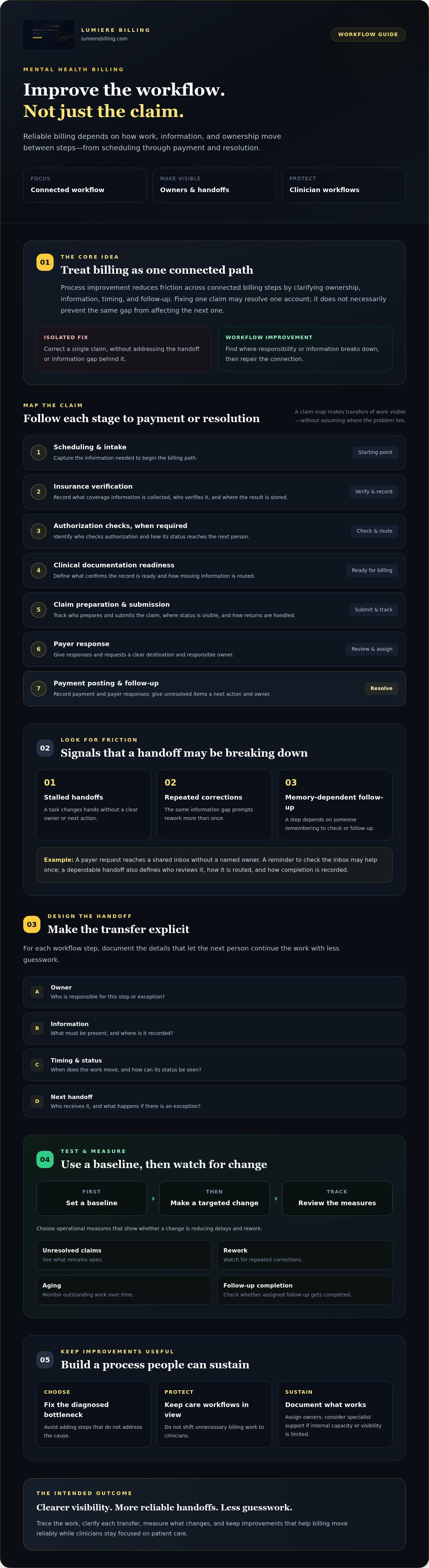
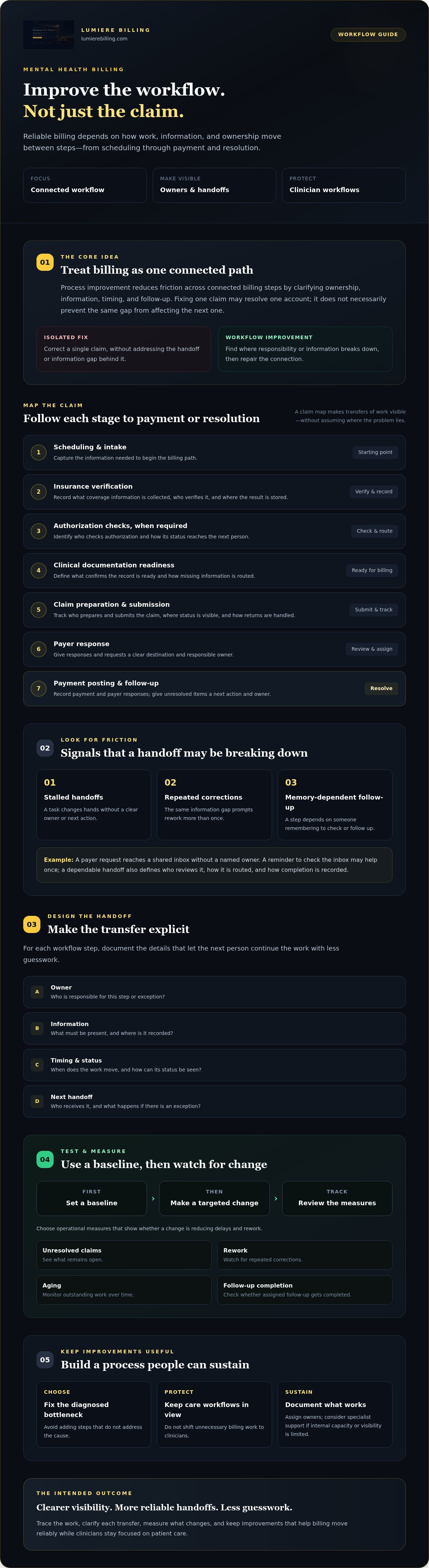
Map the claim’s path as a connected sequence: scheduling, insurance verification, authorization when required, clinical documentation, claim preparation and submission, payer response, payment posting, and follow-up or resolution. This broader view aligns with revenue cycle management, which covers the financial process from patient registration through final payment.
At each handoff, ask what information must be present and who receives it. For example, if coverage details collected during intake aren’t available to the person preparing the claim, that gap may prompt rework later. If a payer response has no assigned owner, follow-up may stall. Payer requirements and practice workflows vary, so verify the applicable details rather than assuming one process fits every service or plan.
Why Improving One Task May Not Fix the Workflow
Isolated fixes focus on a single action. Workflow improvement also checks whether the next person receives the right information, when they receive it, who owns exceptions, and how feedback reaches the earlier step that caused an issue. Without those connections, a team may keep correcting errors without addressing their source. A broader behavioral health revenue cycle management guide can provide context for how these stages fit together.
Hypothetical example: A staff member submits a claim, but a payer request for additional information arrives in a shared inbox without a named owner. The claim remains unresolved. Reminding the original submitter to “check the inbox” may help once, but it doesn’t establish a dependable process. A clearer handoff would specify who reviews the response, how it is routed, and how completion is recorded.
That’s the practical starting point for mental health billing process improvement: follow work across the full pathway, find where responsibility or information breaks down, and repair the connection rather than blaming the person who last touched the claim.
How to Map a Mental Health Billing Workflow and Find Bottlenecks
A useful workflow map follows a claim from intake to payment or final resolution, making each transfer of work visible. For mental health billing process improvement, the aim isn’t to assume where the problem lies. Document what happens first, then distinguish confirmed delays from guesses about their cause.
Trace a Claim from Intake Through Payment
Choose a representative claim and record each step in order. For every step, capture its owner, required information, system or record used, timing, and next handoff. Include where staff record the claim’s status, exceptions, next action, and responsible team member.
- 1. Intake and insurance verification: Note what coverage information is collected, who verifies it, and where the result is recorded.
- 2. Authorization checks: Record whether an authorization check applies, who completes it, and how its status reaches the next person.
- 3. Documentation readiness: Identify what confirms the record is ready for billing and how missing information is routed for follow-up.
- 4. Claim submission: Track who prepares and submits the claim, where submission status is visible, and how returned claims are handled.
- 5. Payment posting and resolution: Show who records payer responses and payment, and how unresolved items receive a next action and owner.
A simple swimlane map can separate responsibilities by team or role, with process steps moving across the page. Use the systems your practice already relies on; the map should reveal handoffs, not prescribe a particular EHR. A PubMed Central paper describes a custom application integrated into an EHR to streamline clinician workflow, illustrating how workflow design and tools can work together.
Use Exceptions to Locate Rework and Waiting
Review a representative sample of delayed, returned, denied, or unresolved claims. Group them by the step where the issue surfaced and the documented cause. Then check apparent patterns against available records and conversations with the staff who handle those steps.
Separate observed facts from assumptions. “These claims were returned because required information was missing” is a finding if the records support it. “The intake team is causing delays” is an interpretation that needs more evidence. A single delayed claim may be an exception, not proof of a systemic issue. For common error categories to investigate, consult behavioral health billing errors to avoid; verify any payer-specific details against current requirements.
Bottlenecks often appear at handoffs, not only within individual tasks. A step may be completed correctly, yet the next owner may not receive the information or status needed to act. Mapping the transfer makes that gap visible.
Which Process Changes Improve Billing Without Burdening Clinicians?
Effective mental health billing process improvement doesn’t mean asking clinicians to manage more billing tasks. It means placing the right administrative controls around clinical work so information is complete, questions reach the right person, and follow-up has a clear owner. Changes should address a diagnosed workflow issue; none can guarantee fewer denials or faster payment, since results depend on implementation and payer factors.
Standardize Repeatable Work While Preserving Clinical Judgment
Start with repeatable administrative steps. A checklist can prompt staff to confirm required intake details or check authorization status. A consistent work queue can make unresolved items visible, while escalation rules can identify who handles exceptions and when. These controls reduce ambiguity without transferring billing administration to clinicians.
Keep clinical documentation decisions with qualified clinical staff. Administrative teams can flag missing information or route questions, but the process should make clear where clinical judgment begins. Before broad rollout, test templates and prompts against actual practice workflows and applicable payer requirements. The American Medical Association’s guidance on improving revenue cycle management also emphasizes a connected approach to managing the revenue cycle.
Automation may help route routine information or surface exceptions, but it requires oversight. Someone must confirm that outputs are accurate and define what happens when the process can’t resolve an issue. Training is useful when the workflow is sound but responsibilities or procedures aren’t understood. Training alone won’t fix an unclear handoff.
Decide What to Keep In-House and What to Delegate
The right model depends on capacity, visibility, behavioral health expertise, and accountability for follow-up. Keeping work in-house can suit practices with clear procedures and enough staff time to monitor them. Targeted outside advisory may help review a specific process while internal staff retain execution. Outsourced revenue cycle support may be worth assessing when ongoing work or follow-up exceeds internal capacity, provided responsibilities and reporting expectations are clear.
Compare the options by fit, effort, and oversight needs:
- Standardization: Fits recurring tasks; takes time to design and maintain clear procedures.
- Automation: Fits predictable routing or status work; requires monitoring, exception handling, and suitable systems.
- Training: Fits knowledge or role gaps; needs reinforcement when processes change.
- Specialist support: Fits limited internal capacity or a need for behavioral health revenue cycle expertise; requires agreed ownership and visibility.
Before deciding whether to outsource mental health billing, compare what your team can reliably own with what needs additional support. Lumiere Billing’s behavioral health focus and practice advisory may be relevant when a practice needs a collaborative partner to help assess process changes. Learn more about its behavioral health billing support.
How to Test Billing Improvements and Measure Progress
Before changing a billing step, capture how it works now. A baseline gives the practice a reference point and helps distinguish a real change from ordinary variation. Choose measures that match the bottleneck you identified, such as unresolved claims, repeated corrections, claim aging, or completion of follow-up tasks.
A before-and-after comparison is meaningful only when the measure uses the same definitions, data source, and comparable time periods in both views. Otherwise, an apparent improvement may reflect a change in what was counted rather than a change in the workflow.
Choose Measures That Reveal the Process, Not Just the Outcome
Pair an outcome measure with a process measure. For example, review collections alongside whether assigned follow-up tasks are completed on time. Collections can show the financial result, while work-queue follow-up can help reveal whether the underlying process is moving as intended. Treat both as diagnostic signals, not targets to chase at the expense of accurate documentation or appropriate care.
Define each measure before collecting data. Specify its numerator and denominator where relevant, the data source, who is responsible for reviewing it, and the review interval. For instance, a practice tracking follow-up completion should agree on which tasks count, what “completed” means, and which records provide the evidence. Use your own baseline; a benchmark without comparable definitions may mislead more than it helps.
Well-organized mental health practice analytics can make these patterns easier to see, particularly when measures are tied to a specific workflow question rather than collected without a clear purpose.
Run Small Tests and Keep What the Evidence Supports
Test one change at a time when practical. Before the pilot begins, set the team involved, the workflow stage, the review period, and a rollback plan. If you revise a follow-up queue, for example, define who will use it, what task it is meant to clarify, and how you’ll respond if it creates confusion or extra work.
Review the results with both billing and clinical staff. Ask whether the change reduced avoidable steps, created new administrative demands, or affected documentation and care workflows. Keep the change if the evidence supports it and the process remains workable; revise or stop it if it introduces problems. This test-and-review cycle makes mental health billing process improvement measurable without assuming every intervention will produce the same outcome.
If your practice needs help establishing a clear billing baseline, explore Lumiere Billing’s analytics and compliance support.
How to Sustain Mental Health Billing Improvements With the Right Support
A successful test is useful only if the improved process remains clear after the pilot ends. Make mental health billing process improvement part of routine operations: document what changed, name an owner, define exception routes, and schedule reviews. That keeps a workable fix from fading when staff responsibilities or practice conditions shift.
Create a Practical Improvement Rhythm
At each review, examine selected measures, recurring exceptions, and unresolved questions about ownership. Keep the procedure concise enough for staff to use, but specific enough to guide action. Include the effective date, roles involved, staff guidance, and escalation path. If a payer requirement, staffing arrangement, or practice workflow changes, check whether the procedure still fits and update it as needed.
Consistency matters. A recurring review gives the team a place to identify when a once-reliable handoff starts failing or when an exception keeps returning without a clear resolution. Record the decision and who will carry it forward. That creates an operational record, not just a meeting discussion.
Evaluate Specialist Billing Support With Clear Questions
Outside support may be worth considering when staffing limits leave important work unattended, follow-up varies by person, or the practice lacks useful visibility into its billing activity. Before choosing a partner, ask how responsibilities are handled across the revenue cycle and how the partner will work with your team. For example:
- How are insurance verification and authorization workflows addressed?
- Who owns claims follow-up, denial activity, and payment posting?
- What reporting or analytics are available, and how are findings shared?
- How will the practice access relevant information and communicate questions?
- How are process responsibilities coordinated with clinical staff?
Look for clear accountability and a collaborative approach, not a promise of guaranteed results. Lumiere Billing specializes in behavioral health revenue cycle management and offers Revenue Cycle Management, Analytics & Compliance, Practice Advisory, and a Free Billing Audit. A billing partner should complement the practice team, with responsibilities and communication expectations made clear from the start.
If you’re considering outside help, you can request a free billing audit as a possible starting point for discussing workflow friction and what information may help establish a baseline. Ask what the audit covers and what your practice would need to provide, so you understand its scope before proceeding.
Make Your Next Billing Improvement Visible
Lasting mental health billing process improvement starts with a clear view of the work: map where claims move, identify where ownership or information breaks down, then test a focused change. Measure the result against a consistent baseline, and document the steps that prove useful so the improvement becomes part of everyday operations.
Billing shouldn’t rely on clinicians absorbing extra administrative work. Clear handoffs, defined follow-up, and practical review measures can help the practice strengthen its process while keeping care at the center.
Lumiere Billing specializes exclusively in behavioral health providers. Its Revenue Cycle Management service spans verification through payment posting, and its offerings also include Analytics & Compliance and Practice Advisory. If you’d like an outside perspective on workflow friction and a starting point for review, request a free billing audit.
Start with one handoff, one measurable change, and clear ownership. Steady improvements can build a more visible, dependable billing workflow over time.
Frequently Asked Questions
What does mental health billing process improvement involve?
Mental health billing process improvement involves making repeatable changes that reduce friction across connected billing steps. A practice examines how work moves from intake and insurance verification through authorization, claim submission, payment posting, and follow-up. It then clarifies ownership, required information, and exception handling. The goal isn’t simply to correct one claim or replace software, but to make the workflow more reliable and easier to monitor.
How can a behavioral health practice identify billing workflow bottlenecks?
Trace representative claims from intake to payment or resolution, noting each step’s owner, required information, system, timing, and next handoff. Then review delayed, returned, denied, or unresolved claims and group documented issues by process stage and cause. Check the records and ask staff who handle the work to validate apparent patterns. One delayed claim alone doesn’t prove the workflow has a systemic problem.
Which metrics should a mental health practice track to improve billing?
Choose measures that relate to the issue being investigated. A practice might track unresolved claims, rework, claim aging, or completion of assigned follow-up. Pair an outcome measure, such as collections, with a process measure that can help explain how work is moving. Define what counts, the data source, who reviews it, and how often. Establish a practice-specific baseline instead of assuming a universal benchmark applies.
Can billing process changes reduce claim denials?
Changes may help prevent avoidable denials when they address a documented cause, such as incomplete information, an unclear authorization handoff, or inconsistent follow-up. Standardized checks and defined exception routes can make responsibilities clearer. However, no process change can guarantee fewer denials: outcomes depend on implementation, the claim details, and payer requirements. Track denial patterns consistently and verify relevant payer guidance before changing billing procedures.
How can a practice improve billing without adding work for clinicians?
Place practical controls around administrative work instead of shifting routine billing tasks to clinicians. For example, use staff checklists for repeatable intake steps, clear work queues for unresolved items, and escalation rules for exceptions. Keep clinical documentation decisions with qualified clinical staff, while making it clear how administrative staff should route questions. Test prompts and templates in the actual workflow to catch extra steps before wider use.
When should a behavioral health practice consider outside billing support?
Consider outside support when staffing limits leave billing tasks unattended, follow-up is inconsistent, or internal reporting doesn’t show where delays begin. First identify which responsibilities need help and what the practice expects to retain. Ask potential partners about behavioral health expertise, workflow ownership, communication, reporting, and how findings will be shared. A partner should complement the practice team, with clear accountability rather than assumptions about who handles each task.
What should a mental health billing audit review?
A billing audit can examine how claims move through the practice, where work is delayed or returned, and whether responsibilities and follow-up are clear. Depending on its scope, a review may look at claim samples, recurring exceptions, available workflow records, and measures that could establish a baseline. Ask the audit provider what it includes, what information is needed, and how findings will be communicated before beginning.
Frequently Asked Questions
Map the claim’s path as a connected sequence: scheduling, insurance verification, authorization when required, clinical documentation, claim preparation and submission, payer response, payment posting, and follow-up or resolution. This broader view aligns with revenue cycle management, which covers the financial process from patient registration through final payment. At each handoff, ask what information must be present and who receives it. For example, if coverage details collected during intake aren’t available to the person preparing the claim, that gap may prompt rework later. If a payer response has no assigned owner, follow-up may stall. Payer requirements and practice workflows vary, so verify the applicable details rather than assuming one process fits every service or plan.
Mental health billing process improvement involves making repeatable changes that reduce friction across connected billing steps. A practice examines how work moves from intake and insurance verification through authorization, claim submission, payment posting, and follow-up. It then clarifies ownership, required information, and exception handling. The goal isn’t simply to correct one claim or replace software, but to make the workflow more reliable and easier to monitor.
Trace representative claims from intake to payment or resolution, noting each step’s owner, required information, system, timing, and next handoff. Then review delayed, returned, denied, or unresolved claims and group documented issues by process stage and cause. Check the records and ask staff who handle the work to validate apparent patterns. One delayed claim alone doesn’t prove the workflow has a systemic problem.
Choose measures that relate to the issue being investigated. A practice might track unresolved claims, rework, claim aging, or completion of assigned follow-up. Pair an outcome measure, such as collections, with a process measure that can help explain how work is moving. Define what counts, the data source, who reviews it, and how often. Establish a practice-specific baseline instead of assuming a universal benchmark applies.
Changes may help prevent avoidable denials when they address a documented cause, such as incomplete information, an unclear authorization handoff, or inconsistent follow-up. Standardized checks and defined exception routes can make responsibilities clearer. However, no process change can guarantee fewer denials: outcomes depend on implementation, the claim details, and payer requirements. Track denial patterns consistently and verify relevant payer guidance before changing billing procedures.
Place practical controls around administrative work instead of shifting routine billing tasks to clinicians. For example, use staff checklists for repeatable intake steps, clear work queues for unresolved items, and escalation rules for exceptions. Keep clinical documentation decisions with qualified clinical staff, while making it clear how administrative staff should route questions. Test prompts and templates in the actual workflow to catch extra steps before wider use.
Consider outside support when staffing limits leave billing tasks unattended, follow-up is inconsistent, or internal reporting doesn’t show where delays begin. First identify which responsibilities need help and what the practice expects to retain. Ask potential partners about behavioral health expertise, workflow ownership, communication, reporting, and how findings will be shared. A partner should complement the practice team, with clear accountability rather than assumptions about who handles each task.
A billing audit can examine how claims move through the practice, where work is delayed or returned, and whether responsibilities and follow-up are clear. Depending on its scope, a review may look at claim samples, recurring exceptions, available workflow records, and measures that could establish a baseline. Ask the audit provider what it includes, what information is needed, and how findings will be communicated before beginning.