Insurance Benefit Verification for Therapists: A Reliable 2026 Workflow

What if the eligibility check your practice completed before a session still left a claim exposed? Insurance benefit verification for therapists involves more than confirming that a policy is active. Benefits vary by payer and plan, and a coverage response does not promise that a specific service will be reimbursed.
Rechecking benefits by hand takes staff time, and inconsistent notes can make payer responses difficult to find when a claim is questioned. A standard process helps your team capture the details that matter, set realistic expectations with clients, and avoid presenting a benefit response as a promise of payment.
This guide explains what to check before a session, including coverage, cost sharing, visit limits, behavioral health payer routing, and authorization requirements. You’ll learn what to document, how to flag unanswered questions, and how to make verification a repeatable part of your workflow. The goal is to connect benefit checks with authorization follow-up and claim preparation while keeping payer confirmation at the center.
Key Takeaways
- Separate active eligibility from covered benefits, authorization, medical necessity, and final claim payment.
- Use a consistent checklist to confirm the member, plan, coverage dates, and clinician before reviewing benefits.
- Insurance benefit verification for therapists is easier to manage when payer responses, open questions, and follow-up steps are documented in one secure location.
- Choose phone checks, payer portals, or billing support based on the consistency and staff oversight your practice needs.
- Connect verification findings with authorization, claim preparation, and payment follow-up so potential gaps surface before submission.
What Insurance Benefit Verification for Therapists Actually Confirms
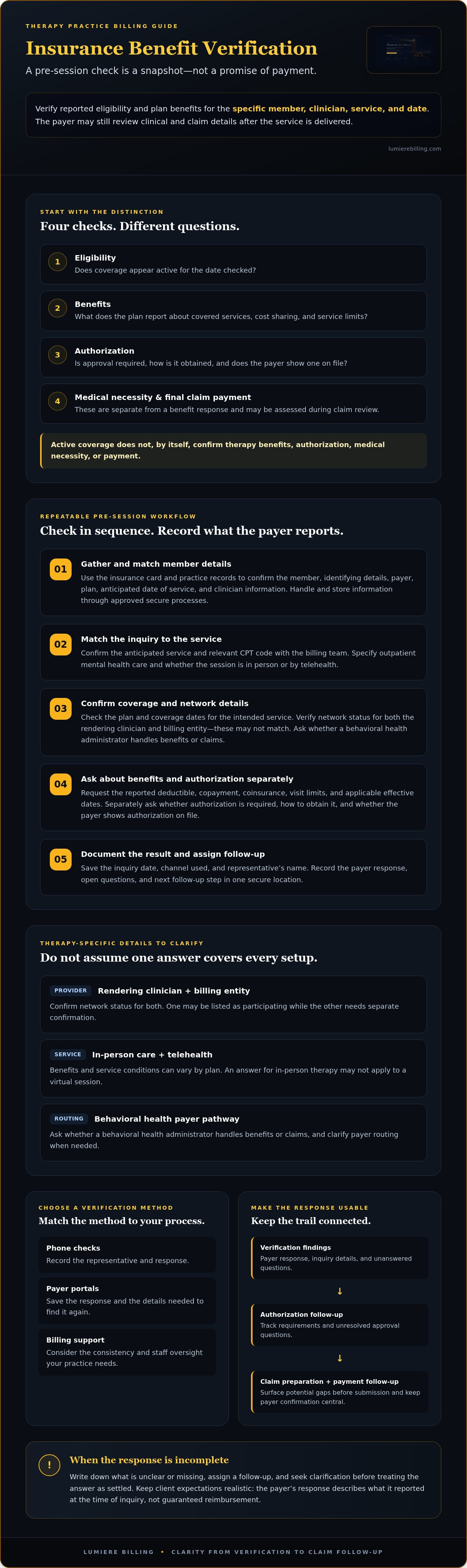
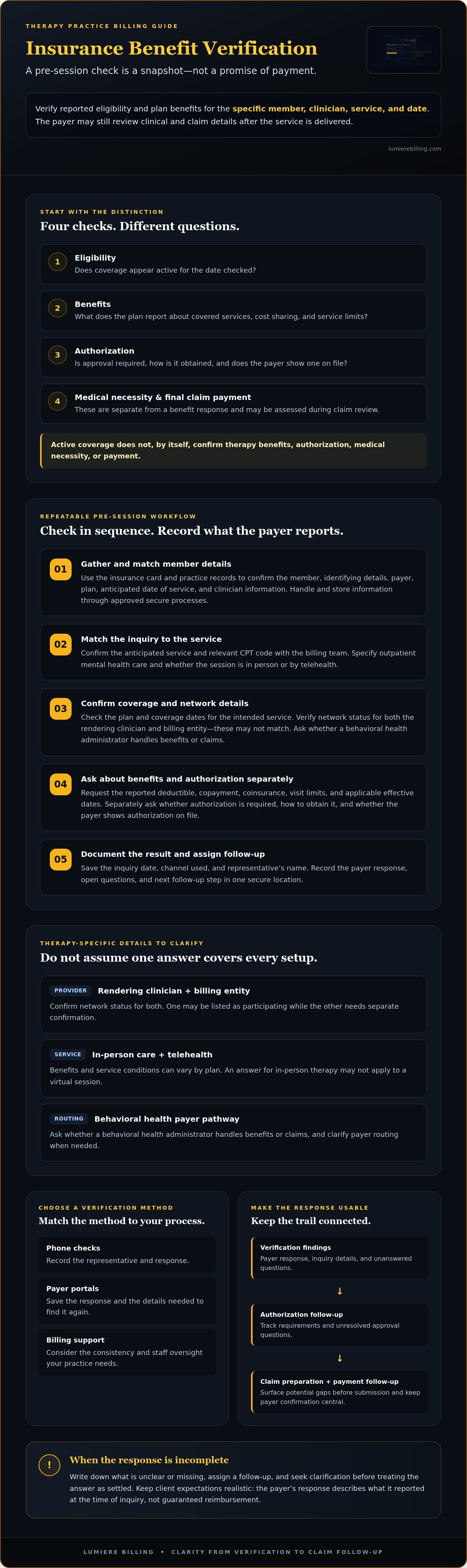
Insurance benefit verification for therapists reviews plan information for a specific member, provider, service, and date. It clarifies what the payer’s records show at the time of the inquiry, but it does not determine whether a future claim will be paid. Treat the response as a snapshot, not a reimbursement promise.
Definition: Benefit verification checks reported eligibility and plan benefits for a particular member, clinician, and service. It helps a practice understand the payer’s response, but it does not guarantee coverage, authorize care, establish medical necessity, or determine final payment.
Verification is an early control in the medical billing process. It helps answer specific coverage questions, but it does not replace the payer’s review of a submitted claim.
Eligibility, benefits, and authorization are different checks
Eligibility asks whether coverage appears active for the date checked. Benefits describe plan information such as cost sharing, service limits, and whether a type of care appears covered. A payer may report active coverage without clarifying how the member’s plan treats outpatient therapy.
Authorization is a separate requirement to confirm. A plan may require approval for a service, but an eligibility or benefit response alone does not confirm that approval is in place. Medical necessity and final claim adjudication are separate as well. The payer may assess clinical and claim details after the service is delivered and the claim is submitted.
Why therapy benefits need service-specific checks
For outpatient mental health care, check whether the service appears covered under the member’s plan, then confirm network status for both the rendering clinician and the billing entity. These details may not match. For example, a clinician might be listed as participating while the group billing entity or service location requires separate confirmation.
Check telehealth separately. Benefits and service conditions can vary by plan, so do not assume that an answer for in-person therapy applies to a virtual session. Confirm what the payer reports for the intended service and provider arrangement. If the response is unclear or incomplete, record what is missing and seek clarification before treating the answer as settled.
Keep the scope clear: verification shows what the payer reported, not what it will ultimately reimburse. Capture those details consistently so they can guide authorization follow-up and claim preparation.
How to Verify Insurance Benefits for Therapy: A Repeatable Checklist
A reliable check starts before anyone contacts the payer. First confirm the member, plan, clinician, and service. Otherwise, even a detailed response may apply to the wrong coverage or billing scenario. Follow the same sequence each time and leave a record another staff member can use.
Insurance benefit verification for therapists is a date-specific check of payer-reported coverage and benefits, not a guarantee that a future claim will be covered or paid.
Follow these steps for each verification
- Gather member information securely. Use the insurance card and practice records to confirm the member’s name, identifying details, payer, and plan. Note the anticipated date of service and clinician information, including the rendering provider and billing entity. Handle and store this information through the practice’s approved secure processes.
- Match the service to the inquiry. Confirm the anticipated service and relevant CPT code with the billing team. Specify whether the session is outpatient mental health care and whether it will be delivered in person or by telehealth. A general eligibility inquiry may not answer service-specific questions.
- Confirm coverage and network details. Check the plan and coverage dates for the intended service. Verify network status for both the rendering clinician and billing entity. Ask whether the payer identifies a behavioral health administrator that handles benefits or claims.
- Ask about benefits and authorization. Request the reported deductible, copayment, coinsurance, visit limits, and any applicable effective dates. Separately ask whether authorization is required, how to obtain it, and whether the payer shows an authorization on file. Record the response as reported, not as a promise of payment.
- Document the result and assign follow-up. Save the inquiry date, channel used, and the representative’s name or reference number when available. Record the responses, mark missing, unclear, or conflicting information as unresolved, and assign someone to follow up. Note what needs confirmation before the claim is submitted.
Make the record useful to the next person
A useful verification note tells staff what was checked, what the payer said, and what remains open. For example, if the portal shows active coverage but no visit limit, record the limit as unknown rather than assuming there isn’t one. If a phone representative gives different information, preserve both responses and seek clarification before setting a firm expectation with the client.
Practices looking for a more connected process can explore behavioral health revenue cycle management support that links verification findings with authorization follow-up and claim preparation. Coordination can support the workflow, but payer confirmation remains the reference point.
Manual Checks, Payer Portals, or Billing Support: Which Method Fits?
No verification channel guarantees that a claim will be paid. Phone representatives and payer portals report information available to them at the time of the inquiry. The level of detail may differ, and access or response availability can vary. Choose a method your practice can use consistently, document clearly, and follow up when an answer is missing.
Compare the options using the same practical criteria:
- Phone inquiry: A staff member can ask follow-up questions and clarify the representative’s response. Because the answer depends on the information available to that representative, record the call date, reference details, and unanswered questions.
- Payer portal: Portal results can be convenient to retrieve and save, but may not show every service-specific detail. Keep a copy or record of the result and flag missing information for follow-up. Do not treat silence as confirmation.
- Specialized billing support: A behavioral health billing team can help connect verification findings with authorization and claims workflows. Agree on responsibilities, documentation standards, and how unresolved payer responses will be escalated.
Consider what happens when the initial answer is incomplete, not just which method you use first. If a portal shows active eligibility but does not clarify whether authorization is required, assign someone to contact the payer and track the question through to resolution.
When a practice-managed process may work well
A small practice may manage checks internally if an assigned staff member has time to complete them, record results consistently, and follow open questions through. Consider payer mix, appointment volume, and staff capacity, not just the number of clinicians. Repeated unanswered inquiries, inconsistent notes, or missed follow-ups are signs to review ownership and strengthen the process.
When specialized billing support may be useful
As verification volume or workflow complexity grows, specialized support may help keep payer findings connected to authorization follow-up and claim preparation. Lumiere Billing provides revenue cycle management exclusively for behavioral health providers, with verification, authorization, and claims workflows that can be coordinated rather than handled as separate tasks. Support can organize follow-through, but it does not replace payer confirmation.
Practices assessing whether a more coordinated process fits can explore Lumiere Billing support. Whatever method you choose for insurance benefit verification for therapists, define who owns the next action whenever a response is unclear. That turns a tool preference into a working control.
Build a Pre-Session Verification Workflow That Catches Gaps
A check only helps if it happens at the right time and someone acts on the result. Set practice-defined triggers for insurance benefit verification for therapists, then make ownership, documentation, and escalation visible to the team. The goal is not to recheck every plan on an arbitrary schedule. It is to catch changes and open questions before they affect scheduling or billing decisions.
Decide when to verify and when to check again
Start with a verification before the initial appointment. Repeat it when a client reports a new plan, a coverage change, or another update that could affect the service. Your practice can also set review intervals based on payer updates, appointment patterns, or internal policy. One interval will not fit every payer and practice.
If a response leaves a coverage or authorization question unresolved, assign someone to follow up rather than leaving the note unattended. Recheck through the appropriate payer channel before relying on that detail for a scheduling or billing decision. Record the next step and close the loop when an answer arrives.
Document exceptions and communicate without overpromising
Keep verification records in a secure location that staff use consistently and that is accessible to those who need the information. Each record should make three things clear: what the payer reported, what remains unknown or conflicts with another response, and who owns follow-up. Restrict access through your practice’s established privacy and security processes.
Build a simple exception path for common gaps:
- Coverage appears inactive: Confirm the member and plan details, then ask the payer or client for updated information before relying on the result.
- Benefits are unclear or conflicting: Preserve the responses and seek clarification through the payer’s designated channel.
- Authorization is uncertain: Route the question to the staff member responsible for authorization follow-up, and document the payer’s response separately from eligibility or benefits.
Tell clients what the payer reported in plain language, while explaining the limits of that response. For example: “The plan reported active coverage and a copayment for this service; the payer still needs to confirm whether authorization is required.” Avoid describing a benefit response as guaranteed reimbursement. For related process risks, see the behavioral health billing errors guide.
If your team needs help connecting verification with authorization and claims workflows, explore behavioral health revenue cycle management support. Clear ownership keeps unresolved details visible between intake, scheduling, and billing.
How Behavioral Health RCM Can Keep Verification Connected to Billing
Verification is most useful when its findings travel with the account. If intake confirms a plan detail but billing never sees it, staff may prepare a claim without knowing that an authorization question is still open. A connected behavioral health revenue cycle management (RCM) workflow gives each finding a next step, from payer follow-up to claim review and payment posting.
Connect verification details to downstream billing work
Use the verification record as a handoff, not a dead end. If the payer reports an authorization requirement, route the information to the person tracking authorization and document its status. Before claim preparation, billing staff can review the payer response alongside the service and provider details. After submission, those notes can help the team investigate a payment discrepancy by showing what was confirmed and when.
That history supports follow-up, but it does not determine the outcome. Final payment depends on applicable plan terms, claim details, and the payer’s adjudication. Verification informs the work; it cannot replace claim review or payer decisions. For a broader view of how these steps fit together, read the behavioral health revenue cycle management guide.
Assess whether your current process needs support
Look for patterns that show where handoffs are breaking down: repeated eligibility surprises, incomplete verification notes, staff rework, or payer questions left open without an assigned owner. These patterns do not automatically mean you need outside support. They do show where to examine responsibilities, records, and follow-up procedures.
Lumiere Billing focuses exclusively on behavioral health providers and provides revenue cycle management spanning insurance verification, prior authorization, claims submission, denial prevention, analytics, and payment posting. That scope can help connect administrative steps across the cycle, while payer confirmation and claim adjudication remain essential. The aim is coordinated visibility, not a promise of fewer denials or higher collections.
If you want an outside review of possible gaps in your billing workflow, explore the free billing audit. A clear picture of the current process can help your practice decide which handoffs to tighten and whether additional RCM support fits.
Make Verification a Reliable Part of Your Workflow
Strong insurance benefit verification for therapists is a repeatable process, not a one-time eligibility lookup. Confirm the details that apply to the member, clinician, and service; document what the payer reports; and assign someone to resolve unanswered questions. Keep the limits clear: a benefit response informs client conversations and billing steps, but does not guarantee claim payment.
Connect verification findings to authorization follow-up, claim preparation, and payment review so details do not get lost between intake and billing. If your team is seeing recurring gaps or spending staff time chasing incomplete records, review the workflow to identify where ownership and handoffs need attention.
Lumiere Billing specializes exclusively in behavioral health providers, with revenue cycle management that includes verification, authorization, claims, and payment posting. A free billing audit is available to help practices review their billing process. Request a free billing audit to take a practical step toward a clearer, more consistent workflow.
Frequently Asked Questions
Is insurance benefit verification a guarantee that therapy will be covered?
No. Verification records information a payer reports for a particular member, plan, provider, service, and date. Coverage and payment may still depend on plan terms, authorization, medical necessity, coding, documentation, eligibility on the service date, and the payer’s claim adjudication. Explain reported benefits carefully, document the inquiry, and avoid promising reimbursement to a client. A response is useful information, not a payment decision.
What should therapists verify before an appointment?
Confirm the member and plan, whether coverage appears active for the relevant date, and the network status of both the clinician and practice. Ask about outpatient mental health benefits, cost sharing, visit limits, authorization or referral requirements, telehealth conditions, and relevant service restrictions. Record what the payer confirms and what remains unclear. Assign someone to follow up on unanswered questions instead of assuming those details are covered.
How often should a therapist verify insurance benefits?
Set a practice policy that includes checking benefits before the first appointment and revisiting them when coverage, payer information, or service circumstances change. Your practice may also choose periodic checks based on its payer mix and workflow. There is no single interval that applies to every plan or practice. Record when each check occurred, and follow up on details that were incomplete or may have changed.
Can therapists verify benefits through a payer portal?
Often, yes. A payer portal may provide eligibility or benefit information, but details and display formats vary. The result may not clarify a specific therapy service, clinician network status, authorization requirement, or plan limitation. Save the response according to practice policy and note what is missing. Contact the payer when an unresolved detail could affect scheduling, client communication, or claim preparation.
What happens if the payer cannot confirm a therapy benefit?
Record the inquiry date, contact channel, reference details when available, and the specific question that remains unresolved. Follow the payer’s process for clarification and assign a staff member to close the loop. Let the client know confirmation is pending, without presenting uncertainty as coverage. An unanswered question is neither approval nor proof that benefits are unavailable. Keep it marked as unresolved until you receive clarification.
Does insurance benefit verification replace prior authorization?
No. Benefit verification checks reported eligibility and plan benefits. Prior authorization is a separate payer process when a plan requires approval for a service. A benefit response does not establish that authorization has been granted. Confirm requirements for the specific plan and service, track approval details separately, and follow the payer’s instructions. Keep the authorization status visible to staff preparing for the appointment and subsequent billing work.
What information should a therapist document after verification?
Keep a clear record of the inquiry date, member and plan checked, service context, clinician or practice identifiers, and payer response. Include reported benefits, cost-sharing details, limits, authorization findings, and unanswered questions when available. Note the source or reference number and the next action, such as contacting the payer for clarification. Follow your practice’s secure recordkeeping policies, and label assumptions as unconfirmed rather than documenting them as payer-reported facts.
Frequently Asked Questions
No. Verification records information a payer reports for a particular member, plan, provider, service, and date. Coverage and payment may still depend on plan terms, authorization, medical necessity, coding, documentation, eligibility on the service date, and the payer’s claim adjudication. Explain reported benefits carefully, document the inquiry, and avoid promising reimbursement to a client. A response is useful information, not a payment decision.
Confirm the member and plan, whether coverage appears active for the relevant date, and the network status of both the clinician and practice. Ask about outpatient mental health benefits, cost sharing, visit limits, authorization or referral requirements, telehealth conditions, and relevant service restrictions. Record what the payer confirms and what remains unclear. Assign someone to follow up on unanswered questions instead of assuming those details are covered.
Set a practice policy that includes checking benefits before the first appointment and revisiting them when coverage, payer information, or service circumstances change. Your practice may also choose periodic checks based on its payer mix and workflow. There is no single interval that applies to every plan or practice. Record when each check occurred, and follow up on details that were incomplete or may have changed.
Often, yes. A payer portal may provide eligibility or benefit information, but details and display formats vary. The result may not clarify a specific therapy service, clinician network status, authorization requirement, or plan limitation. Save the response according to practice policy and note what is missing. Contact the payer when an unresolved detail could affect scheduling, client communication, or claim preparation.
Record the inquiry date, contact channel, reference details when available, and the specific question that remains unresolved. Follow the payer’s process for clarification and assign a staff member to close the loop. Let the client know confirmation is pending, without presenting uncertainty as coverage. An unanswered question is neither approval nor proof that benefits are unavailable. Keep it marked as unresolved until you receive clarification.
No. Benefit verification checks reported eligibility and plan benefits. Prior authorization is a separate payer process when a plan requires approval for a service. A benefit response does not establish that authorization has been granted. Confirm requirements for the specific plan and service, track approval details separately, and follow the payer’s instructions. Keep the authorization status visible to staff preparing for the appointment and subsequent billing work.
Keep a clear record of the inquiry date, member and plan checked, service context, clinician or practice identifiers, and payer response. Include reported benefits, cost-sharing details, limits, authorization findings, and unanswered questions when available. Note the source or reference number and the next action, such as contacting the payer for clarification. Follow your practice’s secure recordkeeping policies, and label assumptions as unconfirmed rather than documenting them as payer-reported facts.