Psychiatric Credentialing Services: Practice Guide 2026

A clinician can be ready to see patients and still be unable to bill a payer. Submitting an application is only one step in a longer process. Missing documents, inconsistent provider details, or unclear follow-up can leave a practice unsure what happens next. The right psychiatric credentialing services make the work easier to track, from payer-specific enrollment steps to ongoing profile and contract maintenance.
Credentialing takes coordination, and administrative work can compete with patient care and practice operations. This guide explains what credentialing and enrollment support may cover, how to assess whether a service fits your practice, and what to confirm before a clinician begins billing a payer. It also outlines ways to keep applications, CAQH information, and payer status current, so enrollment becomes a visible part of the revenue workflow rather than a one-time submission.
Key Takeaways
- Understand how psychiatric credentialing services support payer enrollment, and distinguish application preparation from credential verification and contracting.
- Use an enrollment workflow to track submissions, follow-ups, and confirmations, while checking each payer’s requirements.
- Compare service providers by scope, communication, status reporting, maintenance, and escalation ownership, not by promises about payer-controlled outcomes.
- Set a clear process for reporting provider or practice changes, updating payer records, and retaining confirmation.
- Assess fit by reviewing provider count, payer mix, administrative capacity, and visibility needs before contacting a credentialing service.
What psychiatric credentialing services manage for a practice
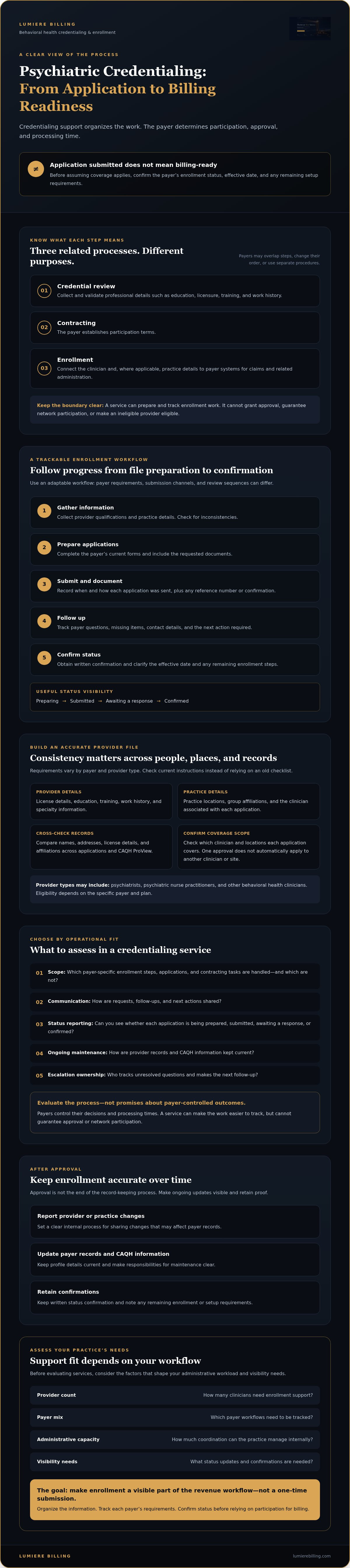
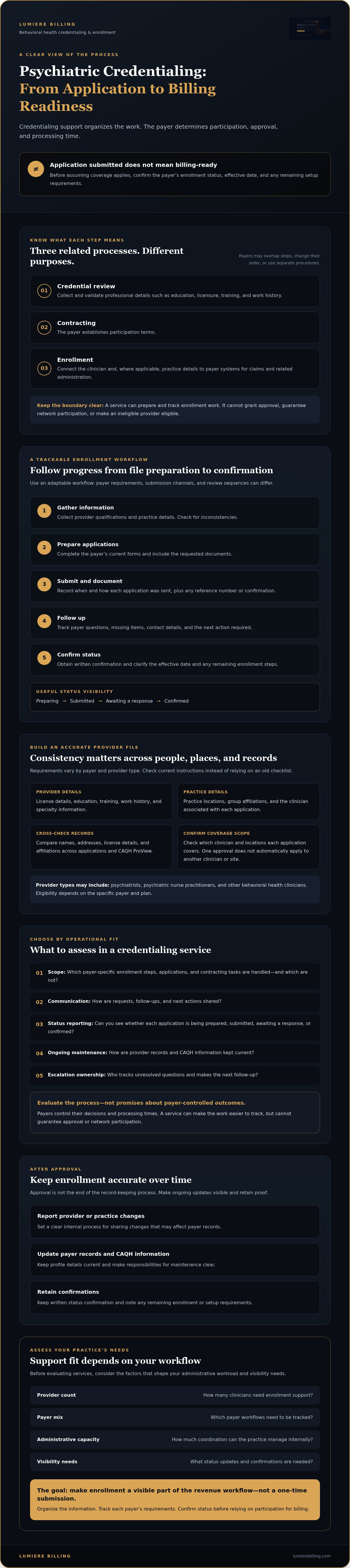
Psychiatric credentialing services provide administrative support for preparing and managing a clinician’s enrollment with health plans. Depending on the service and payer, this work may include organizing professional information, coordinating applications, tracking requests, and maintaining provider records.
Definition: Psychiatric credentialing support helps prepare and track the information and steps involved in payer enrollment. It does not grant approval, guarantee network participation, or independently establish billing readiness.
Submitting an application is a milestone, not proof that a clinician is in network or can bill under a particular plan. Before scheduling services on the assumption that coverage applies, confirm the payer’s enrollment status, effective date, and any remaining setup requirements. A clinician’s professional qualifications, sometimes called Medical Credentials, are foundational, but payer participation involves additional steps.
Credentialing, contracting, and enrollment are related but distinct
Credential review involves collecting and validating professional details, such as education, licensure, training, and work history. Contracting is the payer’s process for establishing participation terms. Enrollment links the clinician and, where applicable, practice details to the payer’s systems for claims and related administration. These steps may overlap, happen in a different order, or follow separate procedures depending on the payer. Ask a service to specify which steps it handles and which decisions remain with the health plan.
Which psychiatric providers and practice details may be involved?
Applications may involve psychiatrists, psychiatric nurse practitioners, and other behavioral health clinicians. Eligibility still depends on the specific payer and plan. A credentialing service can organize the required information, but it can’t make an ineligible provider eligible.
Check that the application reflects the right clinician, practice location, and group affiliation. Inconsistencies in licensure, specialty, or practice details can prompt questions or leave payer records mismatched. Ask how changes will be recorded and which locations each application covers. Participation rules can vary by clinician type, plan, and location, so don’t assume that one provider’s approval applies to another clinician or site.
Lumiere Billing focuses exclusively on behavioral health providers and offers credentialing and enrollment support, including payer contracting and CAQH maintenance. When assessing any service, confirm its scope, the payer workflows it supports, and how it reports status. A useful update should show whether an application is being prepared, submitted, awaiting a response, or confirmed.
How psychiatric credentialing moves from application to payer enrollment
Credentialing follows a sequence, but there is no universal script. Payers may request different information, use different submission channels, or handle review and enrollment in a different order. Psychiatric credentialing services can organize the work and track progress, but the payer controls its decisions and processing times.
Use this adaptable workflow to see what is complete and what still needs attention:
- Gather information: Collect provider qualifications and practice details, then check for inconsistencies.
- Prepare applications: Complete the payer’s current forms and include the requested documents.
- Submit and document: Record when and how each application was sent, along with any reference number or confirmation.
- Follow up: Track payer questions, missing items, contact details, and the next action required.
- Confirm status: Obtain written confirmation and clarify the effective date and any remaining enrollment steps.
Prepare a complete and consistent provider file
Build a working file with the clinician’s license details, education, training, work history, specialty information, and requested practice data, including locations and group affiliations. Document requirements vary by payer and provider type, so check current instructions instead of reusing an old checklist. Professional qualifications are central to review; the American Board of Physician Specialties outlines psychiatry certification eligibility for its specialty process. That reference does not replace a payer’s application requirements.
Compare names, addresses, license details, and practice affiliations across payer forms, CAQH ProView, NPI information, and internal rosters. These records may support applications, but they do not replace checking each payer’s current requirements. For platform-specific detail, see this CAQH enrollment guide.
Track submissions, requests, and effective status
Use a shared tracker for each provider and payer. Record the submission date, contact or reference details, outstanding requests, last follow-up, next action, and person responsible. Update the tracker when the payer responds. This gives the team a clear handoff if someone else needs to manage the application.
Keep written payer confirmations and effective-date details with the enrollment record. “Submitted” does not mean confirmed participation, and an approval notice may not resolve every billing setup question. Verify status before treating enrollment as active. For a broader view of the process, consult this mental health provider credentialing guide.
Practices seeking help coordinating behavioral health credentialing and enrollment can review Lumiere Billing’s credentialing and enrollment support. Ask how application status, payer follow-up, and confirmation will be reported.
How to evaluate psychiatric credentialing services before choosing
Compare psychiatric credentialing services by how clearly they define the work, communicate progress, and keep your practice informed. Outsourcing should clarify ownership, not make application status harder to see. Look for a service that explains its process and boundaries before work begins.
A payer approval decision belongs to the payer, so no credentialing service can guarantee approval or network participation. You can assess whether a provider follows trackable process steps, such as documenting submissions, sharing updates, and identifying outstanding requests. Separate promises about outcomes from commitments about administrative work.
Scope
Which tasks are included: document gathering, application preparation, submission, follow-up, contracting support, or maintenance? Ask what your staff must handle.
Communication
Who provides updates, through what channel, and how are payer requests or missing information shared with your team?
Status reporting
Can you see each application’s current status, recent activity, open items, and next step?
Maintenance
Does the service explain whether ongoing provider-record updates or CAQH maintenance are included, and what triggers follow-up?
Escalation ownership
Who contacts the payer when an application stalls or a request is unclear, and when does the issue return to your practice?
Questions to ask about ownership and visibility
Walk through a typical application before choosing a provider. Ask who gathers documents, prepares and submits the application, follows up, and tells your team when the payer needs more information. Find out how you can review payer correspondence, application status, and next steps. Also clarify how provider details are coordinated with your billing workflow and practice roster, so updates do not stop at the application stage.
Warning signs in service promises and reporting
Be cautious of guaranteed approvals or a single processing timeline presented as universal. Payer decisions and procedures vary. Reporting should distinguish an application that is submitted from one that is pending, returned for information, or confirmed. If every application is labeled “in progress,” ask what that status means and what action is underway.
Request written terms that define scope, fees, responsibilities, and tasks your practice must complete. Confirm who owns payer escalation and how unresolved questions are raised with your team. Clear boundaries reduce the risk of missed handoffs. A useful partner should make the process easier to inspect, not ask you to rely on vague assurances.
How to keep psychiatric payer enrollment accurate after approval
Approval is a milestone, not the end of enrollment administration. Provider details can change after a payer record is established. An outdated address, group affiliation, contact detail, or provider status can create confusion across payer and practice records. Assign ownership for updates so changes are identified, communicated, and confirmed rather than left to informal handoffs.
Ongoing maintenance is different from recredentialing. Maintenance means keeping payer and practice records aligned when details change. Recredentialing is a payer-defined review that may require updated information or documents. Many payers require recredentialing every two to three years, but the applicable cycle and instructions depend on the payer. Use each payer’s notice as the guide to its requirements.
Build a repeatable provider-change and roster workflow
Assign someone to collect provider changes from the people who manage staffing, locations, and practice records. That person can determine which payer records may need attention, coordinate updates, and retain confirmation. For group practices, a central roster helps show where a provider is listed and what still needs review. See this provider roster management guide for additional tracking context.
Include these fields in a shared roster or tracking system:
- Provider name, status, and group affiliation
- Payer and plan, along with the effective date recorded by the payer
- Practice locations and relevant contact details
- Change date, update owner, confirmation received, and unresolved requests
Set a documented schedule to compare internal provider records with payer confirmations. Review the roster when a clinician joins or leaves, changes locations, or moves between group affiliations. Regular checks can surface mismatches, while retained payer correspondence shows what was submitted and what the payer confirmed.
Prepare for recredentialing without assuming a universal cycle
Start with the payer’s recredentialing notice. Check its deadline, required forms, supporting documents, and submission instructions, then assign an owner and record the next action. Don’t assume one payer’s renewal process or timing applies to another. If a notice is unclear or does not arrive as expected, confirm requirements directly with the payer and document the response. For renewal-focused considerations, consult the mental health re-credentialing process guide.
Psychiatric credentialing services may support payer contracting and CAQH maintenance, but confirm which ongoing tasks are included and what remains with your team. If your practice needs behavioral-health-focused credentialing and enrollment support, explore Lumiere Billing’s credentialing and enrollment services and ask how provider updates and payer confirmations are tracked.
When psychiatric credentialing support fits, and how to get started
Outside support can help when enrollment work is difficult to track, but outsourcing is not automatically right for every practice. Consider your provider count, payer mix, administrative capacity, and need for clear status reporting. A solo clinician with a manageable workload may keep the process in-house. A growing group managing more provider records and payer relationships may need more structured support.
Signs a practice may benefit from outside credentialing support
Look for workflow strain, not just application volume. If no one clearly owns payer follow-ups, provider changes, or open enrollment questions, tasks can fall between roles. Growth adds records to maintain, but first assess whether existing staff, processes, and reporting tools can handle the work reliably.
Ask whether your team can identify each application’s status, outstanding requests, and next action without searching through emails and spreadsheets. If that information is hard to find, psychiatric credentialing services may help organize the administrative workflow. The goal is clearer ownership and tracking, not a promise of payer approval.
What to prepare for an initial service discussion
A concise overview helps a prospective service understand your needs and explain its scope. Prepare:
- Provider types and the number of clinicians needing support
- Current payer relationships, practice locations, and group affiliations
- Applications in progress, returned requests, and known enrollment gaps
- Where CAQH maintenance, payer follow-up, and billing coordination sit today
Bring specific questions, too. Ask what the service handles, what your staff must provide, how progress is reported, and who communicates with you when a payer requests more information. Clarify how the service coordinates with your practice’s roster and billing workflows. Before engaging, make sure responsibilities, reporting practices, and next steps are clear.
Lumiere Billing specializes exclusively in behavioral health providers and offers credentialing and enrollment support, including payer contracting and CAQH maintenance. Confirm the scope and supported payer processes directly to determine whether the service matches your practice’s needs.
Ready to review your options? Explore Lumiere Billing’s services to learn more about its behavioral-health-focused support. Payer decisions remain with the payer.
Make payer enrollment easier to see and manage
Strong psychiatric credentialing services bring order to more than the initial application. They clarify who owns each step, make payer status visible, and help practices keep provider records current after enrollment. That visibility matters: a submitted application is not confirmation of participation, and payer decisions remain outside a service provider’s control.
As you assess your process, focus on clear responsibilities, consistent follow-up, written status updates, and a reliable way to record provider changes and payer confirmations. Choose support based on your provider count, payer mix, administrative capacity, and the level of oversight your team needs.
Lumiere Billing specializes exclusively in behavioral health providers. Its credentialing and enrollment support includes payer contracting and CAQH maintenance, helping practices coordinate enrollment administration without promising payer outcomes. Explore Lumiere Billing’s behavioral health credentialing and enrollment support to see whether it aligns with your practice’s needs.
Frequently Asked Questions
What do psychiatric credentialing services include?
Psychiatric credentialing services generally provide administrative support for preparing and managing payer enrollment. Depending on the agreed scope, this may include organizing provider information, preparing or submitting applications, tracking payer requests, coordinating contracting steps, and maintaining records such as CAQH profiles. Ask which tasks the service handles and which remain with your practice. The payer reviews applications and determines whether a provider meets its participation requirements.
How long does psychiatric credentialing take?
There is no single timeline for every psychiatric credentialing application. Processing varies by payer, provider type, application requirements, and whether the submission is complete. Follow-up requests or record discrepancies can add steps. Ask the payer or credentialing service for a current estimate, then track the application’s status and outstanding items. Treat estimates as planning guidance, not a promise of approval or a confirmed date when billing can begin.
Is credentialing the same as insurance enrollment?
No. Credentialing usually refers to reviewing and validating a provider’s professional qualifications and information. Contracting concerns the payer’s agreement process, while enrollment links the provider and practice details to the payer’s systems. These steps may be connected or handled in a different order, depending on the payer. A credential review or submitted application alone does not confirm network participation, an effective date, or readiness to bill.
What documents are needed for psychiatric provider credentialing?
Requirements vary by payer and clinician type, so use the payer’s current checklist. Commonly requested information may include license details, education and training, work history, specialty information, malpractice coverage, and practice locations or group affiliations. Keep names, addresses, and provider details consistent across forms, CAQH records, NPI information, and practice rosters. Confirm which documents are required before submitting, and clarify how the payer wants them delivered.
Can a psychiatrist bill insurance while credentialing is pending?
Don’t assume a psychiatrist can bill a payer while an application is pending. Billing eligibility may depend on the payer’s rules, the provider’s enrollment status, and the effective date the payer confirms. Contact the payer to verify whether claims for services during the pending period can be submitted or considered. Keep the response in writing, and do not treat an application receipt or verbal progress update as confirmation of participation.
Does CAQH credential a psychiatric provider?
No. CAQH ProView is a database where providers maintain professional information that participating health plans may use during their credentialing processes. Completing or updating a CAQH profile does not itself credential a clinician, approve a contract, or enroll them with a payer. Providers should keep their profile accurate, complete required attestations, and check each payer’s instructions, since plans may have additional application or documentation requirements.
How often should psychiatric providers update credentialing information?
Update provider records when relevant details change, such as a practice address, contact information, group affiliation, or provider status. Also follow CAQH attestation prompts and each payer’s instructions. Recredentialing is separate from routine maintenance; payers set their own review cycles, forms, and deadlines. Assign someone to monitor notices, review roster changes, submit required updates, and retain payer confirmations so the practice can verify what changed and when.
Frequently Asked Questions
Applications may involve psychiatrists, psychiatric nurse practitioners, and other behavioral health clinicians. Eligibility still depends on the specific payer and plan. A credentialing service can organize the required information, but it can’t make an ineligible provider eligible. Check that the application reflects the right clinician, practice location, and group affiliation. Inconsistencies in licensure, specialty, or practice details can prompt questions or leave payer records mismatched. Ask how changes will be recorded and which locations each application covers. Participation rules can vary by clinician type, plan, and location, so don’t assume that one provider’s approval applies to another clinician or site. Lumiere Billing focuses exclusively on behavioral health providers and offers credentialing and enrollment support, including payer contracting and CAQH maintenance. When assessing any service, confirm its scope, the payer workflows it supports, and how it reports status. A useful update should show whether an application is being prepared, submitted, awaiting a response, or confirmed. Credentialing follows a sequence, but there is no universal script. Payers may request different information, use different submission channels, or handle review and enrollment in a different order. Psychiatric credentialing services can organize the work and track progress, but the payer controls its decisions and processing times. Use this adaptable workflow to see what is complete and what still needs attention:
Psychiatric credentialing services generally provide administrative support for preparing and managing payer enrollment. Depending on the agreed scope, this may include organizing provider information, preparing or submitting applications, tracking payer requests, coordinating contracting steps, and maintaining records such as CAQH profiles. Ask which tasks the service handles and which remain with your practice. The payer reviews applications and determines whether a provider meets its participation requirements.
There is no single timeline for every psychiatric credentialing application. Processing varies by payer, provider type, application requirements, and whether the submission is complete. Follow-up requests or record discrepancies can add steps. Ask the payer or credentialing service for a current estimate, then track the application’s status and outstanding items. Treat estimates as planning guidance, not a promise of approval or a confirmed date when billing can begin.
No. Credentialing usually refers to reviewing and validating a provider’s professional qualifications and information. Contracting concerns the payer’s agreement process, while enrollment links the provider and practice details to the payer’s systems. These steps may be connected or handled in a different order, depending on the payer. A credential review or submitted application alone does not confirm network participation, an effective date, or readiness to bill.
Requirements vary by payer and clinician type, so use the payer’s current checklist. Commonly requested information may include license details, education and training, work history, specialty information, malpractice coverage, and practice locations or group affiliations. Keep names, addresses, and provider details consistent across forms, CAQH records, NPI information, and practice rosters. Confirm which documents are required before submitting, and clarify how the payer wants them delivered.
Don’t assume a psychiatrist can bill a payer while an application is pending. Billing eligibility may depend on the payer’s rules, the provider’s enrollment status, and the effective date the payer confirms. Contact the payer to verify whether claims for services during the pending period can be submitted or considered. Keep the response in writing, and do not treat an application receipt or verbal progress update as confirmation of participation.
No. CAQH ProView is a database where providers maintain professional information that participating health plans may use during their credentialing processes. Completing or updating a CAQH profile does not itself credential a clinician, approve a contract, or enroll them with a payer. Providers should keep their profile accurate, complete required attestations, and check each payer’s instructions, since plans may have additional application or documentation requirements.
Update provider records when relevant details change, such as a practice address, contact information, group affiliation, or provider status. Also follow CAQH attestation prompts and each payer’s instructions. Recredentialing is separate from routine maintenance; payers set their own review cycles, forms, and deadlines. Assign someone to monitor notices, review roster changes, submit required updates, and retain payer confirmations so the practice can verify what changed and when.