Behavioral Health Insurance Verification: A Comprehensive 2026 Practice Guide

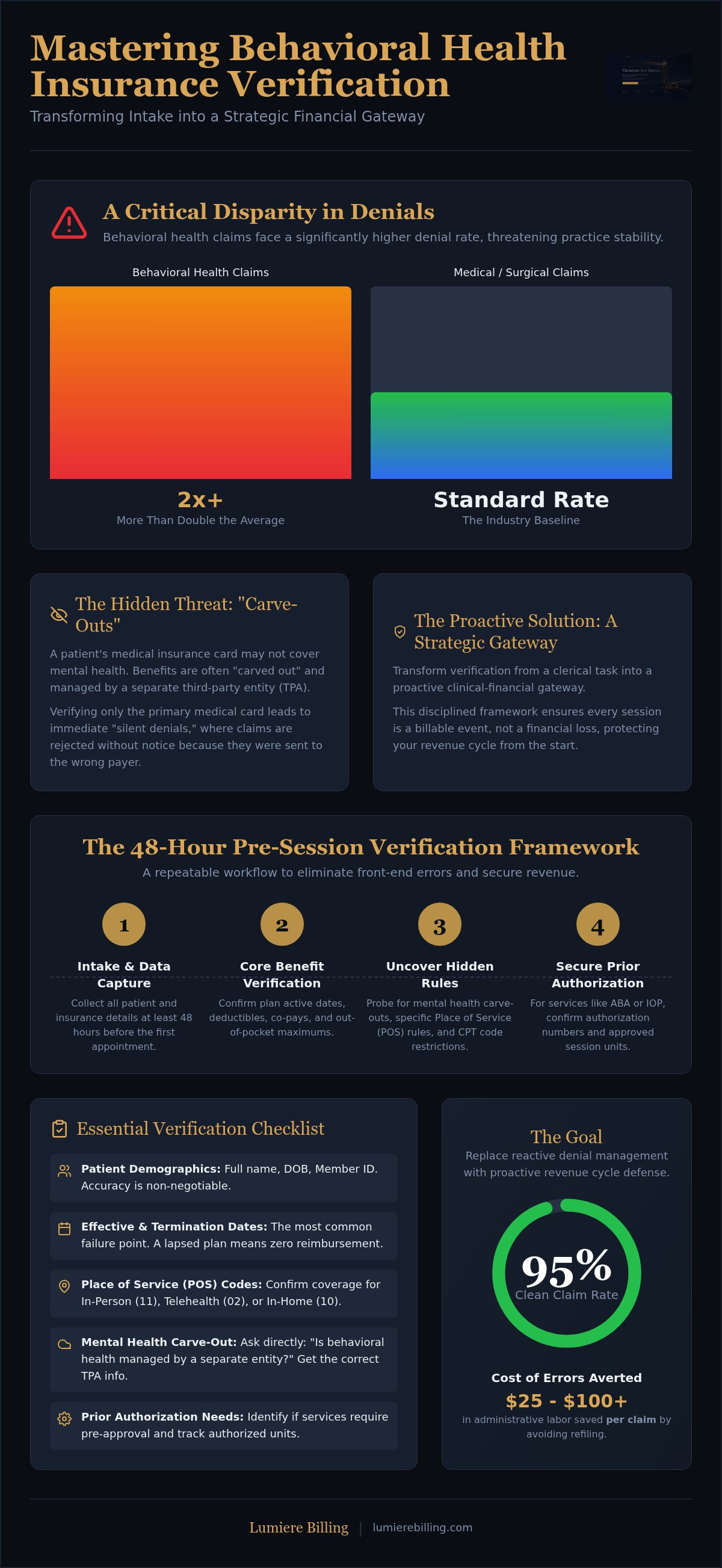
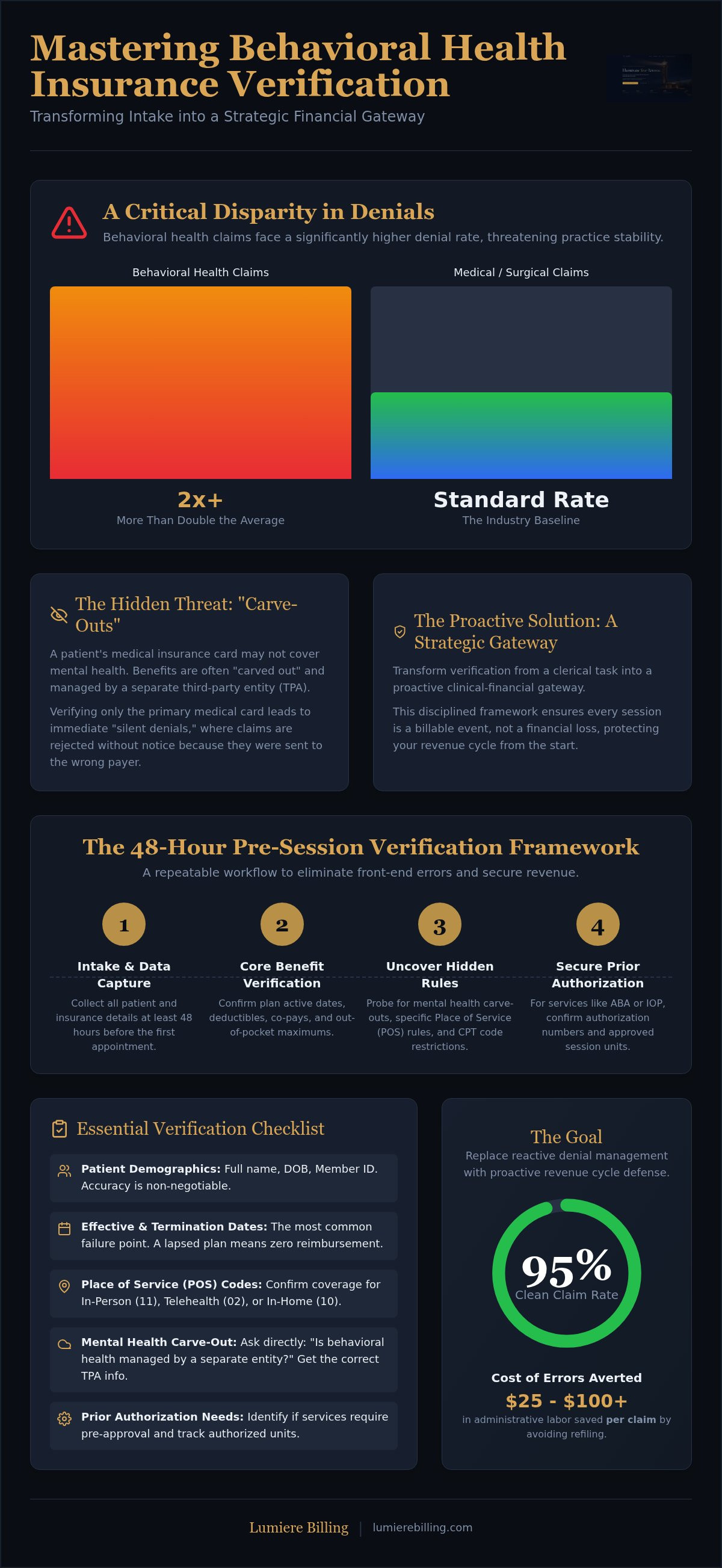
Behavioral health claim denials are currently more than double the average of standard medical and surgical claims. This isn't just a clerical oversight. It's a systemic failure that threatens the financial integrity of your practice. You likely feel the weight of silent denials and the persistent confusion surrounding carved-out mental health benefits. Wasted clinician time on unbillable sessions is a luxury no modern practice can afford. We understand that complete visibility into patient out-of-pocket costs is mandatory before the first appointment begins.
You're about to master the essential steps of behavioral health insurance verification to eliminate these leaks and secure your revenue cycle. By implementing a disciplined verification framework, you can achieve a 95% clean claim rate while significantly reducing the administrative burden on your clinical staff. This guide provides a methodical breakdown of the 2026 landscape, from the enforcement of 42 CFR Part 2 to the latest CMS prior authorization timelines. We'll show you how to transform a broken administrative process into a precise, high-performance gateway for patient care.
Key Takeaways
- Transform behavioral health insurance verification from a clerical checkbox into a strategic clinical-financial gateway that protects your practice from "silent denials."
- Implement a standardized 48-hour intake protocol to validate effective dates and specific carve-out benefits before a single unbillable session occurs.
- Master the critical distinction between eligibility and prior authorization to manage the complex unit-based requirements of ABA and intensive outpatient programs.
- Secure a 95% clean claim rate by replacing reactive denial management with a specialized, proactive revenue cycle workflow.
The Critical Role of Behavioral Health Insurance Verification in 2026
Behavioral health insurance verification is far more than a clerical task. It's the proactive validation of patient eligibility, benefit limits, and authorization requirements before a clinician ever steps into the room. In 2026, this process serves as the strategic gateway that determines whether a session is a billable event or a total financial loss. While general medical practices often deal with straightforward coverage, mental health and Applied Behavior Analysis (ABA) providers face a landscape riddled with specialized rules and hidden requirements.
Mastering behavioral health insurance verification allows your practice to operate with total visibility. A foundational understanding health insurance concepts like deductibles and co-pays is only the starting point. For behavioral health, you must also confirm if the specific service type is covered under the patient's plan. This level of diligence builds immediate trust with your patients. By providing clear out-of-pocket estimates before the first appointment, you eliminate the financial anxiety that often leads to early treatment dropout.
Why Behavioral Health Verification is Unique
The prevalence of "carve-outs" remains the primary hurdle for modern practices. In these scenarios, a patient's physical health may be covered by one major carrier, while their mental health benefits are managed by a completely different third-party entity. If your intake team only verifies the primary card, you'll face immediate "silent denials." Furthermore, parity laws in 2026 continue to evolve. While limits on session counts are technically restricted, payers often use "medical necessity" reviews to circumvent these protections. High-frequency CPT codes, such as 90837 for 60-minute therapy sessions, frequently trigger specific verification rules that don't exist in standard primary care.
The Cost of Getting it Wrong
Front-end errors are the most expensive mistakes a practice can make. Industry data suggests the cost of refiling a single rejected claim ranges from $25 to over $100 in administrative labor. These behavioral health billing errors to avoid almost always originate at the intake desk. When eligibility isn't confirmed at least 48 hours before an appointment, you risk providing uncompensated care. Once a clinician has dedicated their time to a session, that revenue becomes uncollectable if retroactive eligibility issues arise. A specialized verification process repairs these broken systems by bringing hidden coverage gaps into focus before they become costly denials.
A Comprehensive Checklist for Behavioral Health Benefits
A rigorous data collection protocol is the bedrock of a stable revenue cycle. Accuracy is non-negotiable. Your intake team must capture every detail 48 hours before the initial session to ensure the behavioral health insurance verification process is complete. This starts with the basics: patient name, date of birth, and member ID. However, the most frequent failure points are the "effective date" and "termination date." A plan that was active last month may have lapsed yesterday. Verifying these dates prevents the immediate loss of revenue from sessions that simply cannot be billed.
In 2026, place of service (POS) requirements have become increasingly specific. Payers now distinguish strictly between in-person visits (POS 11) and various telehealth modalities. You must confirm if the plan requires POS 02 for traditional telehealth or POS 10 for services provided in the patient's home. Failure to align your billing with these verified POS requirements leads to automatic denials that are difficult to overturn. If your current workflow feels fragmented, a Free Billing Audit can help identify where these administrative leaks are occurring.
Identifying Mental Health Carve-Outs
A carve-out occurs when a primary medical insurer delegates the management of behavioral health benefits to a third-party administrator (TPA). This is a common source of billing confusion. The card in the patient's wallet might say BlueCross, but the behavioral health claims must go to a different entity like Magellan or Optum. When speaking with payer representatives, your team should ask: "Is behavioral health managed by a separate entity?" and "Does this TPA have different CPT code restrictions than the medical plan?" Understanding these nuances is vital for compliance with the Department of Labor on MHPAEA, which ensures mental health benefits are handled fairly compared to medical ones.
Verifying Out-of-Pocket Responsibilities
Visibility into patient costs is a tool for clinical retention. You must differentiate between copays, co-insurance, and deductibles during the verification call. Specifically, check the "deductible met" status. If a patient has a $5,000 deductible that hasn't been touched, your practice won't see a reimbursement check from the insurer for months. Communicating these costs to the patient before the first session reduces financial friction and builds a foundation of transparency. It's better to have a difficult conversation about costs on day one than a collection dispute on day sixty.
Navigating Prior Authorizations and ABA Unit Tracking
Eligibility and prior authorization are two distinct but inextricably linked processes. While behavioral health insurance verification confirms that a patient has an active policy, prior authorization determines if the specific treatment plan meets the payer's criteria for medical necessity. Confusing these two steps is a primary driver of high-dollar denials. In 2026, the regulatory landscape has shifted to provide more transparency. Under CMS rule CMS-0057-F, impacted payers are now required to make decisions on standard prior authorization requests within seven days, while urgent requests require a 72-hour turnaround. This mandates a tighter, more disciplined intake window for your practice.
The complexity intensifies within the framework of ABA revenue cycle management. Unlike traditional outpatient therapy, Applied Behavior Analysis and intensive outpatient programs (IOP) rely on unit-based authorizations. A single session isn't the billing metric; instead, you're tracking 15-minute increments. This requires a level of oversight that borders on the obsessive. We also see the continued rise of "gold carding" programs in 2026. Some payers now exempt providers with high approval rates from routine authorization requirements, rewarding practices that demonstrate consistent clinical integrity and precise documentation.
The Authorization Life Cycle
The life cycle begins with the submission of clinical documentation and the proposed treatment plan. Once the payer completes their review, they issue a unique authorization number. You must verify the exact start and end dates of this period immediately. An authorization that begins on a Tuesday will not cover a session held on the preceding Monday. Common triggers for these requirements include intensive services, psychological testing, and prolonged therapy sessions. Missing these triggers during the intake phase ensures a denial that no amount of back-end "rework" can fix.
Reconciling Units in ABA and Intensive Services
Unit-based billing is a high-risk operational area. If you're authorized for 40 units of a specific code and you bill 41, the entire claim is often rejected or flagged for a future recoupment. Real-time unit tracking is the only way to prevent over-billing. This is especially critical for multi-disciplinary teams where different providers might draw from the same pool of authorized units. Effective practices implement a centralized monitoring system to ensure the remaining balance is always visible to the clinical staff. This approach repairs the systemic leaks that occur when clinical delivery outpaces administrative oversight.
Building a Repeatable Verification Workflow: Step-by-Step
A systematic workflow is the only defense against administrative chaos. You must standardize your intake process to capture all insurance data at least 48 hours before the first session. This window allows for a "double-check" of high-value CPT codes or intensive outpatient programs (IOP) where the financial stakes are highest. Integrating this data into your behavioral health revenue cycle management dashboard ensures that every stakeholder has visibility into a patient's coverage status. Proactive behavioral health insurance verification stops leaks before they start.
Step 1: The Pre-Intake Data Capture
Precision is the core of pre-intake. You need specific fields for a successful Electronic Data Interchange (EDI) inquiry: the member ID, the correct payer ID for behavioral health, and the subscriber's relationship to the patient. Don't ignore patients who claim they are "self-pay." They may have out-of-network benefits that provide a path to reimbursement. Encourage the use of a patient portal to upload clear images of insurance cards. This prevents the "silent denials" caused by simple typing errors or obscured member numbers.
Step 2: The Portal vs. Phone Verification
Efficiency depends on choosing the right channel. Clearinghouse portals are faster for routine checks, but complex benefit questions require a direct call. Train your staff to flag "Inactive" or "Member not found" responses immediately. When calling, use a structured script to ask about specific carve-outs or session limits. If a representative is vague, escalate the inquiry to a supervisor. If your staff is overwhelmed by these calls, you can Request a Free Billing Audit to see how a professional team handles these complex inquiries.
Step 3: Documentation and Audit Trails
Documentation is your final line of defense. You must save a PDF or screenshot of every verification inquiry. If a claim is later denied for eligibility, this proof is your leverage during the appeal process. Meticulous behavioral health insurance verification turns a reactive denial management posture into a proactive, audit-ready strategy. This record-keeping is a core component of effective behavioral health billing services. Always record the "Reference Number" provided by the payer. It's the only way to hold an insurer accountable for the information they provided during the call.
Eliminating Verification Errors with Specialized RCM Partnership
Reactive denial management is a slow bleed for your practice. It forces your staff to chase revenue that should have been secured before the first clinical hour. By shifting to a proactive "verification-first" posture, you repair the mechanical integrity of your entire revenue cycle. General medical billers often miss the subtle nuances of behavioral health insurance verification. They may understand standard co-pays, but they frequently overlook the complex carve-out TPAs or specific ABA unit requirements that define our field. They treat your specialized practice like a general practitioner's office. This oversight leads to systemic leaks and "silent denials" that generalists simply aren't trained to catch. Lumiere Billing operates as a specialized extension of your team, bringing hidden eligibility issues into sharp focus before they become uncollectable debt.
The Value of Specialized Expertise
Specialized RCM firms are vigilant protectors of your financial health. In 2026, staying ahead of payer policy shifts is a full-time commitment. For example, the updated 42 CFR Part 2 regulations and the new CMS-0057-F timelines for prior authorizations require constant monitoring and rapid adjustment. When you consider outsourcing mental health billing, you're investing in a partner that possesses an obsessive focus on these details. This specialized mastery provides the peace of mind that comes from knowing every session is pre-cleared for payment. As your practice grows, this model scales with you, ensuring that administrative burdens never throttle your clinical capacity.
Next Steps: Securing Your Revenue
The transition from a broken system to a high-performance gateway begins with a clear-eyed assessment. We invite you to request a professional billing audit to uncover the hidden verification errors currently impacting your bottom line. This audit isn't just a review; it's a diagnostic tool that identifies exactly where your revenue cycle is leaking. Moving to a specialized billing partner is a methodical, purposeful process. We integrate into your world, providing the visibility and insight you've been missing. Our goal is simple: let the specialists handle the administrative complexity so you can return your full attention to patient care. Secure your revenue cycle today by moving away from the opaque practices of the past toward a future of clarity and precision.
Mastering Your Practice Revenue Gateway
Precision in behavioral health insurance verification is the defining factor between a thriving practice and one plagued by systemic revenue leaks. You've seen how a disciplined intake protocol and rigorous unit tracking can transform your operations from a reactive struggle into a high-performance system. By moving away from the generic approach of generalist billers, you protect your clinical time and ensure every session remains billable. Specialized oversight brings hidden coverage gaps into focus before they manifest as costly administrative burdens.
Lumiere Billing acts as a vigilant extension of your practice. Our exclusive focus on Behavioral Health and ABA RCM allows us to deploy proactive denial prevention strategies that generalists simply cannot replicate. We maintain a transparent, percentage-based fee structure that aligns our success with your financial health. It's time to stop chasing payments and return your focus to patient care. Get a Free Billing Audit to identify and plug your revenue leaks today. You possess the clinical expertise; let us provide the administrative mastery to help your practice lead the way in 2026.
Frequently Asked Questions
How far in advance should we verify insurance for a new patient?
You should complete the verification process at least 48 hours before the initial appointment. This window provides the necessary time to resolve eligibility discrepancies, identify hidden carve-outs, or secure missing authorizations. Performing this check during the intake phase prevents clinicians from dedicating time to unbillable sessions. It also ensures the patient understands their out-of-pocket responsibilities before treatment begins, which reduces early dropout rates and financial friction.
What is a "carve-out" in behavioral health insurance?
A carve-out is a benefit management structure where a primary medical insurer delegates mental health or substance use coverage to a third-party administrator. During behavioral health insurance verification, you may discover that while a patient carries a major medical card, their psychiatric benefits are managed by a completely different entity. Failure to identify this managing TPA leads to immediate claim rejections because the medical payer and behavioral health payer often use different payer IDs.
Do I need to re-verify insurance for every session?
Re-verifying every session is unnecessary, but you must re-verify at the start of every calendar month. Insurance plans frequently lapse or change at the beginning of a month due to employment shifts or plan resets. Implementing a monthly "sweep" of your active patient roster prevents the accumulation of "silent denials." For intensive services like ABA, more frequent monitoring is required to ensure that unit-based authorizations remain valid throughout the treatment plan.
What should I do if a payer portal says "active" but the claim is denied for eligibility?
Call the payer immediately and request a reference number for the verification inquiry. Portals often lag behind real-time policy changes or fail to account for specific sub-plan exclusions. If you saved a screenshot or PDF of the "active" status from the portal, use that documentation as evidence during your appeal. This highlights why saving an audit trail for every behavioral health insurance verification is a mandatory step in a high-performance revenue cycle.
Is prior authorization the same as insurance verification?
No, they are distinct but sequential administrative steps. Verification confirms that a patient has an active policy with behavioral health coverage. Prior authorization is a deeper clinical review where the payer determines if the specific treatment plan meets their criteria for medical necessity. You cannot obtain a valid authorization without first confirming the underlying eligibility. Both must be tracked with obsessive detail to ensure your sessions remain billable and protected from recoupment.
How do parity laws affect behavioral health insurance verification in 2026?
Parity laws mandate that insurers cannot apply more restrictive financial requirements or treatment limitations on mental health benefits than they do on medical services. In 2026, this means your verification team should scrutinize plans that attempt to apply higher co-pays or arbitrary session limits for mental health. If a verification call reveals disparate limits, your practice may have grounds to challenge the payer's policy based on federal Mental Health Parity and Addiction Equity Act protections.
Can I bill the patient if I failed to verify their insurance correctly?
Your ability to bill the patient depends on your specific payer contract and the patient's signed financial agreement. Most in-network contracts prohibit balance billing if the provider failed to follow administrative protocols like verification or authorization. If the patient provided fraudulent information, you might have recourse. However, it's always more efficient to verify coverage upfront than to attempt collections after a denial occurs. This proactive approach protects your practice's clinical-financial integrity.
What are the most common CPT codes that require special verification in mental health?
High-frequency codes that trigger specific verification rules include:
- 90837: 60-minute psychotherapy sessions often require medical necessity reviews.
- 90791: Psychiatric diagnostic evaluations may have frequency limits.
- 96130: Psychological testing typically requires prior authorization.
- 97153: ABA adaptive behavior treatment requires strict unit-based tracking.
Frequently Asked Questions
You should complete the verification process at least 48 hours before the initial appointment. This window provides the necessary time to resolve eligibility discrepancies, identify hidden carve-outs, or secure missing authorizations. Performing this check during the intake phase prevents clinicians from dedicating time to unbillable sessions. It also ensures the patient understands their out-of-pocket responsibilities before treatment begins, which reduces early dropout rates and financial friction.
A carve-out is a benefit management structure where a primary medical insurer delegates mental health or substance use coverage to a third-party administrator. During behavioral health insurance verification, you may discover that while a patient carries a major medical card, their psychiatric benefits are managed by a completely different entity. Failure to identify this managing TPA leads to immediate claim rejections because the medical payer and behavioral health payer often use different payer IDs.
Re-verifying every session is unnecessary, but you must re-verify at the start of every calendar month. Insurance plans frequently lapse or change at the beginning of a month due to employment shifts or plan resets. Implementing a monthly "sweep" of your active patient roster prevents the accumulation of "silent denials." For intensive services like ABA, more frequent monitoring is required to ensure that unit-based authorizations remain valid throughout the treatment plan.
Call the payer immediately and request a reference number for the verification inquiry. Portals often lag behind real-time policy changes or fail to account for specific sub-plan exclusions. If you saved a screenshot or PDF of the "active" status from the portal, use that documentation as evidence during your appeal. This highlights why saving an audit trail for every behavioral health insurance verification is a mandatory step in a high-performance revenue cycle.
No, they are distinct but sequential administrative steps. Verification confirms that a patient has an active policy with behavioral health coverage. Prior authorization is a deeper clinical review where the payer determines if the specific treatment plan meets their criteria for medical necessity. You cannot obtain a valid authorization without first confirming the underlying eligibility. Both must be tracked with obsessive detail to ensure your sessions remain billable and protected from recoupment.
Parity laws mandate that insurers cannot apply more restrictive financial requirements or treatment limitations on mental health benefits than they do on medical services. In 2026, this means your verification team should scrutinize plans that attempt to apply higher co-pays or arbitrary session limits for mental health. If a verification call reveals disparate limits, your practice may have grounds to challenge the payer's policy based on federal Mental Health Parity and Addiction Equity Act protections.
Your ability to bill the patient depends on your specific payer contract and the patient's signed financial agreement. Most in-network contracts prohibit balance billing if the provider failed to follow administrative protocols like verification or authorization. If the patient provided fraudulent information, you might have recourse. However, it's always more efficient to verify coverage upfront than to attempt collections after a denial occurs. This proactive approach protects your practice's clinical-financial integrity.
High-frequency codes that trigger specific verification rules include: 90837: 60-minute psychotherapy sessions often require medical necessity reviews. 90791: Psychiatric diagnostic evaluations may have frequency limits. 96130: Psychological testing typically requires prior authorization. 97153: ABA adaptive behavior treatment requires strict unit-based tracking. Verifying the specific "place of service" requirements for these codes is also mandatory to ensure compliance with 2026 modality rules.