Behavioral Health Denial Management: The 2026 Strategic Recovery Checklist

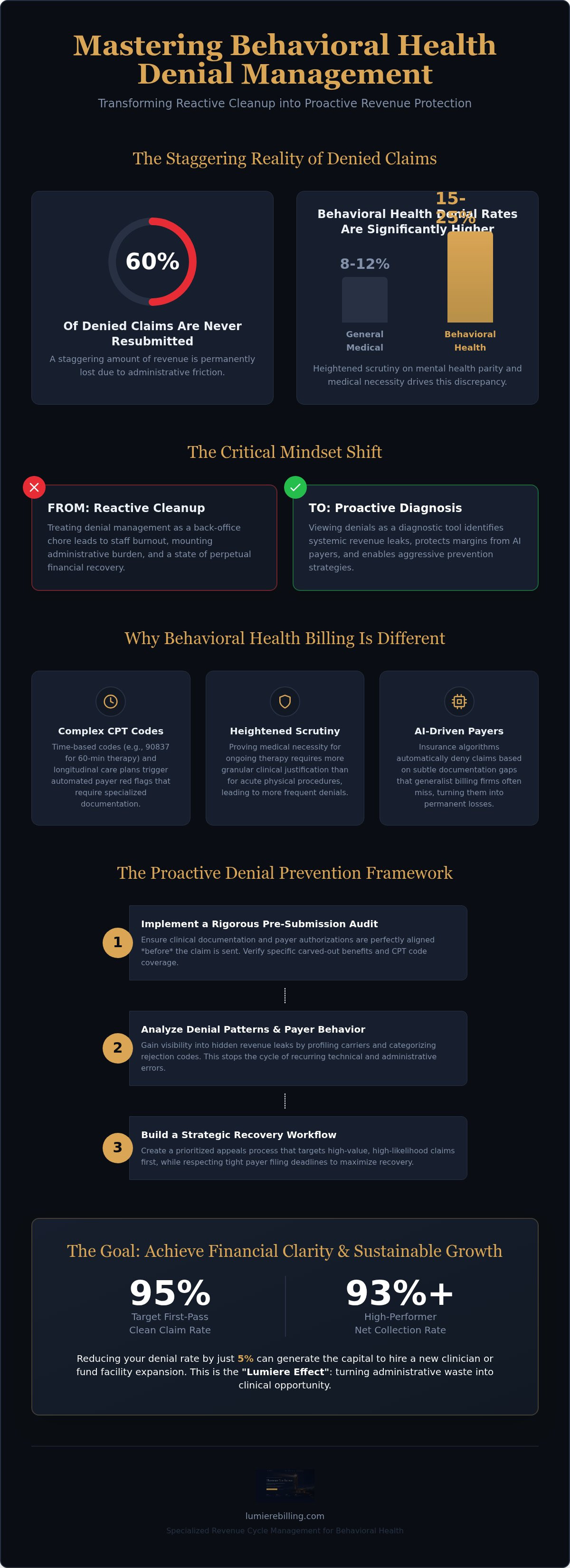
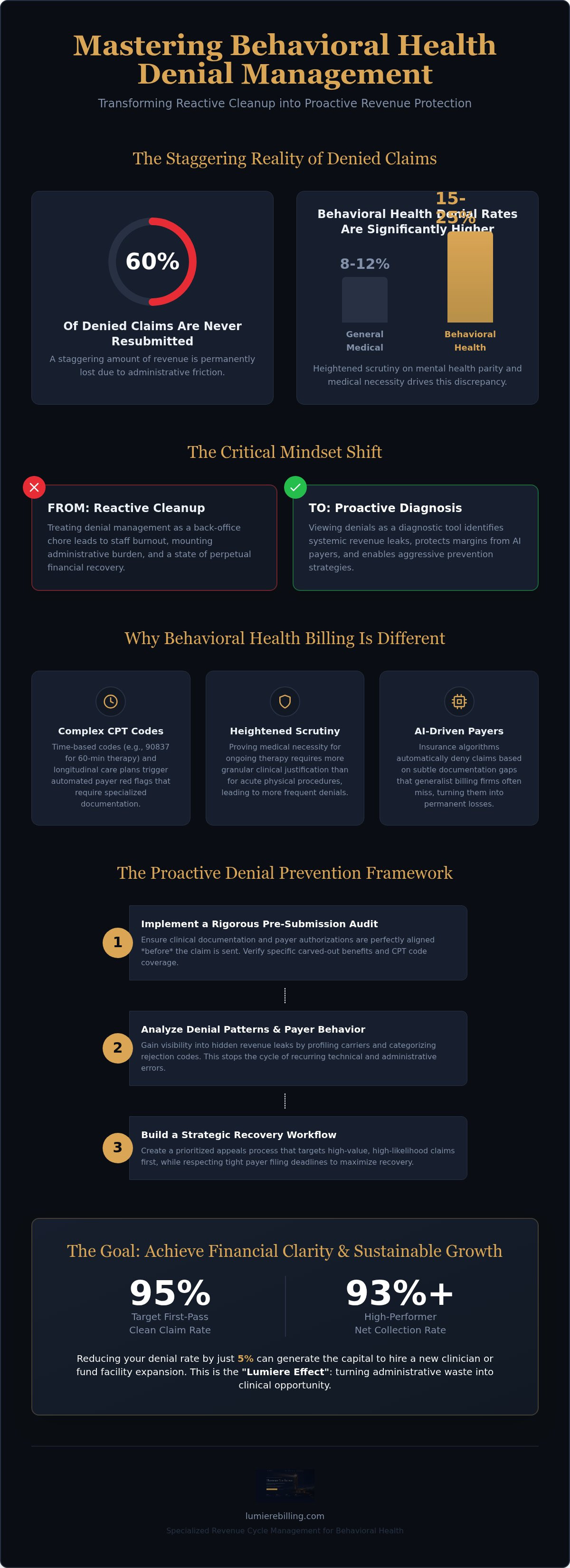
Did you know that sixty percent of denied behavioral health claims are never resubmitted? That is a staggering amount of revenue left on the table simply because the administrative burden feels too heavy to carry. When your team is already stretched thin, a surge in medical necessity rejections can feel like a death by a thousand paper cuts. Effective behavioral health denial management is no longer just a back-office task; it is a critical diagnostic tool for your practice's survival. In 2026, where AI-driven insurance algorithms are tightening the screws on reimbursement, staying passive is a strategy for insolvency.
We understand the exhaustion of fighting for every dollar while your staff burns out on manual appeals and opaque rejection codes. You deserve a system that brings these hidden leaks into focus and repairs the broken mechanics of your revenue cycle. This guide provides a specialized framework to transform your billing from reactive to proactive. You'll learn how to categorize root causes, implement a strategic recovery checklist, and recover the "silent denials" that currently vanish from your ledger. It's time to move toward a 95% first-pass clean claim rate and reclaim the financial health of your practice.
Key Takeaways
- Shift your mindset from reactive administrative work to a proactive diagnostic process that identifies systemic revenue leaks.
- Implement a rigorous pre-submission audit to ensure clinical documentation and payer authorizations are perfectly aligned before the claim leaves your office.
- Gain visibility into payer behavior by profiling carriers and categorizing rejections to stop the cycle of recurring technical errors.
- Build a prioritized recovery workflow for behavioral health denial management that targets high-value claims and respects tight filing deadlines.
- Learn why specialized behavioral health RCM expertise is necessary to navigate the nuances of mental health billing that generalist firms often overlook.
The Financial Impact of Behavioral Health Denial Management in 2026
Denial management is often mischaracterized as a cleanup crew for administrative errors. This perspective is a costly mistake. In the current climate, effective behavioral health denial management functions as a clinical and financial diagnostic tool. It identifies systemic failures before they drain your cash reserves. Treating denials as a reactive chore ensures your practice stays in a state of perpetual recovery. Transforming this process into a proactive strategy allows you to protect your margins from increasingly aggressive payer algorithms. Modern Revenue Cycle Management (RCM) demands a shift from simply "fixing" claims to aggressively preventing them.
Industry data reveals a harsh reality for behavioral health practitioners. While general medical specialties see denial rates between 8% and 12%, behavioral health practices face rates as high as 15% to 25%. This discrepancy is not a coincidence; it is the result of heightened scrutiny on mental health parity and medical necessity. The "10% Rule" suggests that losing a tenth of your revenue is a baseline for many, but in 2026, it is a sign of a failing system. With 60% of denied claims never being resubmitted, the cumulative loss is staggering. You can calculate your practice leakage with a simple formula: multiply your monthly denied dollar amount by 0.60. That figure represents the revenue that likely vanishes forever each month.
The Unique Challenges of Behavioral Health Reimbursement
Generalist billing firms often treat behavioral health claims like standard medical procedures. This is a fundamental error. Behavioral health involves complex, time-based CPT codes and longitudinal care that trigger automated payer red flags. Proving medical necessity for a 60-minute therapy session or long-term ABA services requires more granular documentation than an acute physical procedure. Payers frequently use AI-driven systems to deny claims based on subtle documentation gaps that general RCM firms simply aren't trained to see. Without specialized insight, these "technical" denials become a permanent tax on your practice.
The ROI of a Specialized Denial Prevention Strategy
Focusing on your first-pass clean claim rate is only half the battle. High-performing practices prioritize their net collection rate, aiming for 93% or higher. Reducing your denial rate by just 5% does more than just stabilize your books. It generates the liquid capital necessary to hire an additional clinician or fund a facility expansion. Precision in billing is the most direct path to growth. At Lumiere, we define the "Lumiere effect" as the total financial clarity achieved when systemic billing leaks are replaced by a disciplined, transparent recovery framework. By reclaiming underpaid or silently denied claims, you turn administrative waste into clinical opportunity.
The Pre-Submission Checklist: Preventing Denials at the Source
The most effective way to manage a denial is to ensure it never happens. High-performing practices don't wait for a rejection to fix a process. They hard-code precision into the front end of their workflow. Every claim that leaves your office should be an airtight reflection of the patient's current benefits, the provider's active credentials, and the payer's specific authorization rules. Stop treating the front desk as a data entry point; it is your first line of defense in behavioral health denial management.
Front-End Verification and Authorization Management
A common failure point is relying on a general "active coverage" status. For behavioral health, this is insufficient. You must verify specific carved-out benefits and ensure the plan covers the exact CPT codes you intend to bill, such as 90837. Many payers are increasing scrutiny on 60-minute therapy sessions, often requiring explicit clinical justification. Following behavioral health insurance verification best practices means identifying these requirements before the first session. Tracking authorization expiration dates is equally vital. An "unauthorized service" denial is almost always a systemic failure of oversight, not a clinical one. Implementing Strategic Denial Management for Mental Health requires a proactive audit of these units every week.
ABA-Specific Unit Tracking and Reconciliation
Applied Behavior Analysis (ABA) presents unique complexities that generalist billing firms often ignore. The use of modifiers and the conversion of hours to units create multiple opportunities for "silent" rejections. If you bill POS 02 instead of POS 10 for home-based telehealth in 2026, the revenue loss can be catastrophic. Reconciling rendered units against authorized units weekly prevents end-of-month surprises that lead to unbillable time. Our ABA revenue cycle management framework emphasizes this meticulous reconciliation. Precision in unit tracking ensures that clinical work translates into practice revenue. If you aren't sure where your current leaks are, specialized Revenue Cycle Management can bring those hidden issues into focus.
Credentialing integrity remains a silent killer of revenue. Ensuring every provider is correctly paneled before they see their first patient is non-negotiable. A single session with an unpaneled provider can trigger a chain reaction of rejections that take months to untangle. Coding accuracy is the final layer of protection. In 2026, using modifier 95 for synchronous telemedicine or modifier 25 for same-day E/M and therapy services is mandatory for clean claims. Mastery of these details is essential for effective behavioral health denial management and separates a thriving practice from one that is constantly chasing its own tail.
Analyzing Denial Patterns: Bringing Visibility to Hidden Leakage
Data is only useful if it leads to action. In behavioral health denial management, visibility is the primary tool for recovery. Most practices view a denial as an isolated incident. This is a mistake. Denials are symptoms of systemic friction. By categorizing every rejection into eligibility, medical necessity, or administrative buckets, you transform a pile of paperwork into a roadmap for repair. Eligibility issues often point to front-desk gaps; medical necessity denials suggest clinical documentation needs refinement. Administrative errors frequently reveal a lack of attention to coding modifiers or place-of-service details.
Payer profiling adds another layer of defense. Some insurance carriers are notorious for "technical" denials, using automated triggers to delay payment on high-value codes like 90837 or 90791. Identifying these patterns allows your team to front-load documentation for specific carriers, effectively neutralizing their tactics before the claim is even sent. Knowledge of which carriers have the highest rejection rates allows you to allocate your staff's energy where it is most needed. You stop guessing and start operating with precision.
The most dangerous leaks are the ones you don't see. "Silent denials" occur when a claim is accepted but underpaid according to your contracted rates. These aren't technical rejections; they are quiet erosions of your margin. Performing a regular audit of your actual payments against your negotiated fee schedule is the only way to catch these discrepancies. If a carrier consistently pays even a small percentage less than the agreed rate, that is a denial in all but name. Real-time dashboards bring these mechanical failures into focus, allowing you to visualize revenue cycle clogs as they happen.
Identifying and Fixing Systemic Billing Errors
Spotting behavioral health billing errors to avoid is the first step in plugging these leaks. Training your clinical staff is essential. They must understand that documentation isn't just about patient care; it is the evidence required to satisfy a payer audit. Moving away from manual spreadsheets to automated tracking systems ensures no claim falls through the cracks. Automation provides the mechanical integrity your revenue cycle needs to stay operational under heavy volume.
The Role of Practice Analytics in Financial Health
Key Performance Indicators (KPIs) provide the pulse of your practice. You should monitor "Days in AR" with obsessive focus. If this number climbs, it signals a breakdown in your denial management workflow. High-performing behavioral health organizations aim for under 40 days in AR to maintain healthy cash flow. Leveraging professional practice advisory for regular workflow audits ensures your systems remain optimized. Data should drive every decision your practice makes regarding its financial future.
The Strategic Appeals Framework: A Step-by-Step Recovery Guide
Winning an appeal is a matter of clinical precision and tactical timing. In behavioral health denial management, you cannot afford to treat every rejection with the same level of urgency. Prioritize your workflow by dollar value and, more importantly, by the payer's clock. For instance, UnitedHealthcare (UHC) requires peer-to-peer requests within 30 days of a denial for behavioral health claims. Missing that window turns a recoverable claim into a permanent loss. Given that the average administrative cost to rework an appealed claim sits at $62.40, your process must be efficient to remain profitable.
Effective behavioral health denial management requires a structured argument, not a generic plea. Your appeal letter should clearly state the reason for the dispute, cite specific clinical documentation, and reference the payer’s own medical necessity guidelines. If a carrier repeatedly denies the same service, escalation is your only option. This might involve requesting a supervisor review or initiating a formal grievance. You must be persistent. Payers often count on the fact that 60% of denied claims are never resubmitted. Defy that expectation with a disciplined, methodical follow-up system.
Mastering the Medical Necessity Narrative
Generic templates are the primary reason behavioral health appeals fail. Payers, particularly Aetna, are increasing scrutiny on 60-minute therapy sessions and frequently deny them without explicit clinical justification. To succeed, you must translate clinical progress notes into "payer language" that proves the patient's condition requires that specific level of care. Ensure your documentation matches the 90837 CPT code requirements precisely. When medical necessity is challenged, the treating clinician must be involved to provide the clinical nuance that a biller cannot.
Managing Timely Filing and Payer Follow-Up
Speed is your greatest ally. We recommend a 48-hour internal deadline for responding to any new denial. This keeps your AR lean and prevents a backlog that can choke your cash flow. While payer portals offer speed, phone calls are often necessary for complex escalations where a human decision-maker is required. You must track every interaction with obsessive detail. There comes a point where the cost of the appeal outweighs the potential recovery. If multiple levels of appeal are exhausted, transition the claim to a write-off or patient responsibility status to keep your data clean. If your current recovery rate is stagnant, a Free Billing Audit can identify exactly where your strategy is breaking down.
Partnering for Success: Why Specialized RCM Outshines General Billing
Many practices fall into the "Generalist Trap" by hiring firms that treat behavioral health like standard medical procedures. General medical billing firms often lack the domain expertise required to handle the nuances of mental health parity or ABA unit reconciliation. They apply a broad-brush approach to a niche that requires a scalpel. Specialized behavioral health denial management is not just about submitting claims; it is about understanding the clinical intent behind the services provided. A generalist firm might accept a denial as a finality, whereas a specialist sees it as a starting point for a refined counter-measure.
At Lumiere Billing, we utilize a percentage-based fee model to ensure our interests are perfectly aligned with your practice's growth. We are not incentivized by the volume of claims processed, but by the volume of revenue successfully collected. This model drives us to be aggressive in our pursuit of every dollar, particularly when it comes to underpaid or silently denied claims. When our fee is tied to your success, we become a dedicated advocate for your practice's financial health, rather than just another administrative vendor.
The Advantage of Behavioral Health Specialization
Choosing to outsource mental health billing to a specialist provides a level of oversight that internal teams or generalist firms cannot match. We act as a vigilant protector of your revenue cycle. This includes proactive Credentialing & Enrollment to ensure your providers are paneled before they see their first patient. A specialist partner understands that behavioral health denial management requires a level of focus that borders on the obsessive, identifying potential failure points in the revenue cycle before they ever have a chance to occur.
Next Steps: Securing Your Practice’s Financial Future
Moving from survival mode to strategic expansion requires a transition from reactive billing to proactive Revenue Cycle Management. You can begin this transformation today by implementing the 2026 strategic recovery checklist. The first step is often the most revealing. We offer a Free Billing Audit designed to bring hidden issues into focus and uncover the "silent denials" currently eroding your margins. This audit serves as a comprehensive diagnostic of your financial integrity, providing the clarity needed to fund additional clinicians or facility growth.
It is time to stop accepting administrative waste as an inevitable cost of doing business. Secure your practice’s future with a partner that values precision over volume and partnership over mere transaction. By replacing systemic leaks with disciplined oversight, you ensure that your clinical work is always matched by clinical-grade financial results.
Mastering the Future of Your Practice Financial Health
Managing a practice is primarily about clinical outcomes, but those outcomes require consistent financial fuel. We've explored how a shift from reactive habits to a proactive diagnostic system can plug the systemic leaks in your revenue cycle. By implementing a rigorous pre-submission checklist and analyzing denial patterns with technical precision, you move from mere survival to strategic expansion. Effective behavioral health denial management is the difference between leaving a significant portion of your revenue on the table and achieving the total clarity your practice deserves.
Lumiere Billing stands as a vigilant protector of your financial integrity. We're exclusively specialized in behavioral health and ABA, possessing the deep domain expertise required to win complex medical necessity appeals that generalist firms often abandon. Our percentage-based fee model ensures that our interests are perfectly aligned with your growth. It's time to bring hidden issues into focus and repair the mechanical failures in your back office. Take the first step toward total visibility and Request Your Free Behavioral Health Billing Audit today. You've dedicated your career to healing others; let us ensure your practice remains healthy enough to continue that vital mission.
Frequently Asked Questions
What are the most common reasons for behavioral health claim denials in 2026?
In 2026, common triggers for rejections include medical necessity challenges, eligibility lapses, and coding errors. Payers are increasingly scrutinizing high-value codes and telehealth place-of-service details. Automated AI systems also flag missing modifiers or mismatches between documented time and billed units. Precision in every line item is essential for successful behavioral health denial management, as even minor technical oversights can lead to immediate rejections that drain your practice resources and staff energy.
How long do I have to appeal a denied mental health claim?
Timely filing deadlines vary by carrier, but most major payers require appeals within 60 to 90 days. Some carriers have even tighter windows for specific clinical reviews, such as peer-to-peer requests. Waiting too long turns a potentially recoverable claim into a permanent loss, so it's essential to act quickly. Your team should prioritize these deadlines with a disciplined tracking system to ensure you never miss a critical window for recovery.
What is a "silent denial" in behavioral health billing?
A silent denial occurs when a claim is accepted but the payment amount is lower than your contracted fee schedule. These discrepancies don't trigger standard rejection codes, so they often go unnoticed without a manual audit. They quietly erode your profit margins over time. Catching these requires a meticulous comparison of your actual payments against negotiated rates to ensure every session is reimbursed at the full value you deserve.
Can I appeal a denial based on medical necessity without a doctor’s note?
You can appeal, but it's rarely successful when relying solely on administrative data. Successful medical necessity appeals require detailed clinical evidence that translates patient progress into the specific language payers require. While a formal doctor's note is helpful, the longitudinal documentation of care is often more persuasive. Involving the treating clinician ensures the clinical nuance of the treatment plan is clearly communicated, significantly increasing your chances of a successful reversal.
How does ABA unit tracking impact my denial rate?
ABA unit tracking is a critical driver of clean claim rates due to the complexity of unit-to-hour conversions. If rendered units exceed authorized limits, the claim will be rejected immediately. Regular reconciliation is the only way to prevent end-of-month surprises that result in unbillable time. Precise tracking also ensures that modifiers are applied correctly, preventing the technical rejections that often plague Applied Behavior Analysis providers who lack specialized revenue cycle oversight.
Is it better to handle denial management in-house or outsource it?
While in-house teams offer control, they often lack the specialized bandwidth to fight complex rejections. Outsourcing to a niche partner like Lumiere Billing provides access to experts who understand behavioral health nuances. Our percentage-based model means we only get paid when you do, so it's a true partnership. This allows your staff to focus on patient care while a disciplined, behind-the-scenes team handles the methodical follow-up required to maximize collections.
How can I track my clean claim rate effectively?
Effective tracking requires moving away from manual spreadsheets to automated dashboards that visualize your revenue cycle in real-time. You should monitor your first-pass clean claim rate and your net collection rate with obsessive focus. If your accounts receivable timelines begin to climb, it's a signal of a breakdown in your current behavioral health denial management workflow. Data should drive every decision, providing the visibility needed to identify and repair systemic leaks.
What should be included in a behavioral health appeal letter?
A winning appeal letter must include the patient's demographics, the specific claim number, and a clear statement of the dispute. You should cite the payer's own medical necessity criteria and provide matching clinical documentation. Reference specific CPT codes and explain why the level of care was appropriate for the diagnosis. Avoid generic templates. Each letter should be a customized, professional argument that addresses the specific reason for the rejection with absolute precision.
Frequently Asked Questions
In 2026, common triggers for rejections include medical necessity challenges, eligibility lapses, and coding errors. Payers are increasingly scrutinizing high-value codes and telehealth place-of-service details. Automated AI systems also flag missing modifiers or mismatches between documented time and billed units. Precision in every line item is essential for successful behavioral health denial management, as even minor technical oversights can lead to immediate rejections that drain your practice resources and staff energy.
Timely filing deadlines vary by carrier, but most major payers require appeals within 60 to 90 days. Some carriers have even tighter windows for specific clinical reviews, such as peer-to-peer requests. Waiting too long turns a potentially recoverable claim into a permanent loss, so it's essential to act quickly. Your team should prioritize these deadlines with a disciplined tracking system to ensure you never miss a critical window for recovery.
A silent denial occurs when a claim is accepted but the payment amount is lower than your contracted fee schedule. These discrepancies don't trigger standard rejection codes, so they often go unnoticed without a manual audit. They quietly erode your profit margins over time. Catching these requires a meticulous comparison of your actual payments against negotiated rates to ensure every session is reimbursed at the full value you deserve.
You can appeal, but it's rarely successful when relying solely on administrative data. Successful medical necessity appeals require detailed clinical evidence that translates patient progress into the specific language payers require. While a formal doctor's note is helpful, the longitudinal documentation of care is often more persuasive. Involving the treating clinician ensures the clinical nuance of the treatment plan is clearly communicated, significantly increasing your chances of a successful reversal.
ABA unit tracking is a critical driver of clean claim rates due to the complexity of unit-to-hour conversions. If rendered units exceed authorized limits, the claim will be rejected immediately. Regular reconciliation is the only way to prevent end-of-month surprises that result in unbillable time. Precise tracking also ensures that modifiers are applied correctly, preventing the technical rejections that often plague Applied Behavior Analysis providers who lack specialized revenue cycle oversight.
While in-house teams offer control, they often lack the specialized bandwidth to fight complex rejections. Outsourcing to a niche partner like Lumiere Billing provides access to experts who understand behavioral health nuances. Our percentage-based model means we only get paid when you do, so it's a true partnership. This allows your staff to focus on patient care while a disciplined, behind-the-scenes team handles the methodical follow-up required to maximize collections.
Effective tracking requires moving away from manual spreadsheets to automated dashboards that visualize your revenue cycle in real-time. You should monitor your first-pass clean claim rate and your net collection rate with obsessive focus. If your accounts receivable timelines begin to climb, it's a signal of a breakdown in your current behavioral health denial management workflow. Data should drive every decision, providing the visibility needed to identify and repair systemic leaks.
A winning appeal letter must include the patient's demographics, the specific claim number, and a clear statement of the dispute. You should cite the payer's own medical necessity criteria and provide matching clinical documentation. Reference specific CPT codes and explain why the level of care was appropriate for the diagnosis. Avoid generic templates. Each letter should be a customized, professional argument that addresses the specific reason for the rejection with absolute precision.