Behavioral Health Billing Audit: A 2026 Case Study in Revenue Recovery

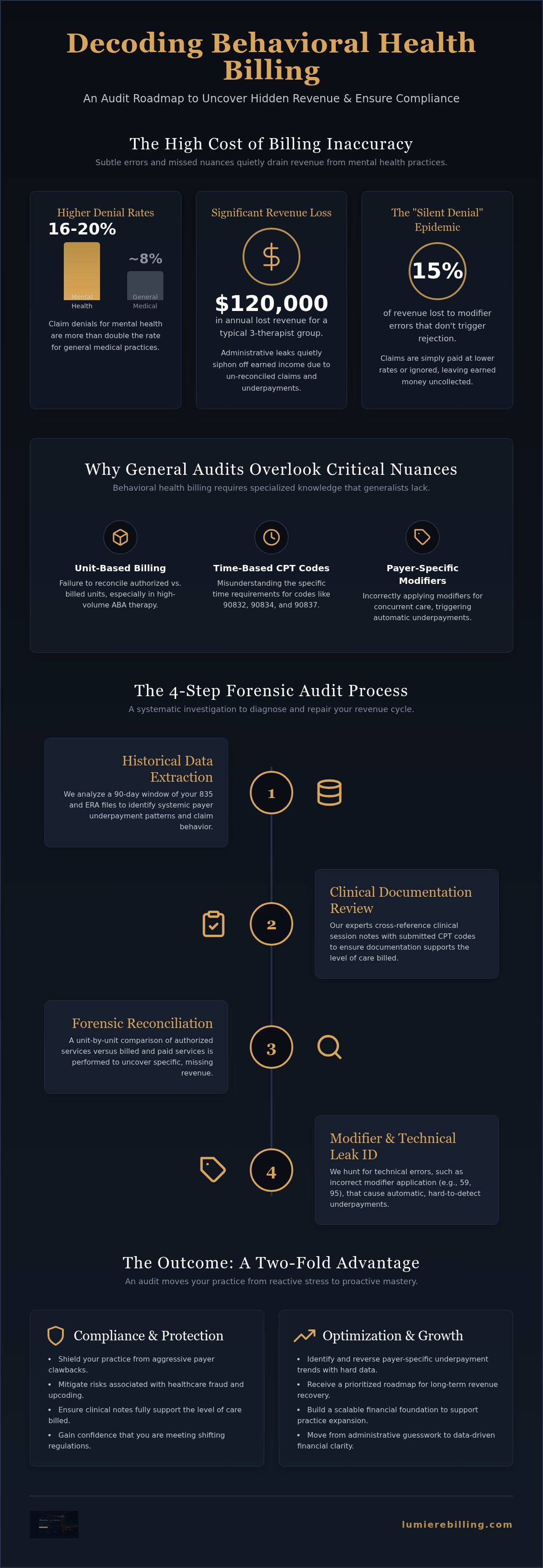
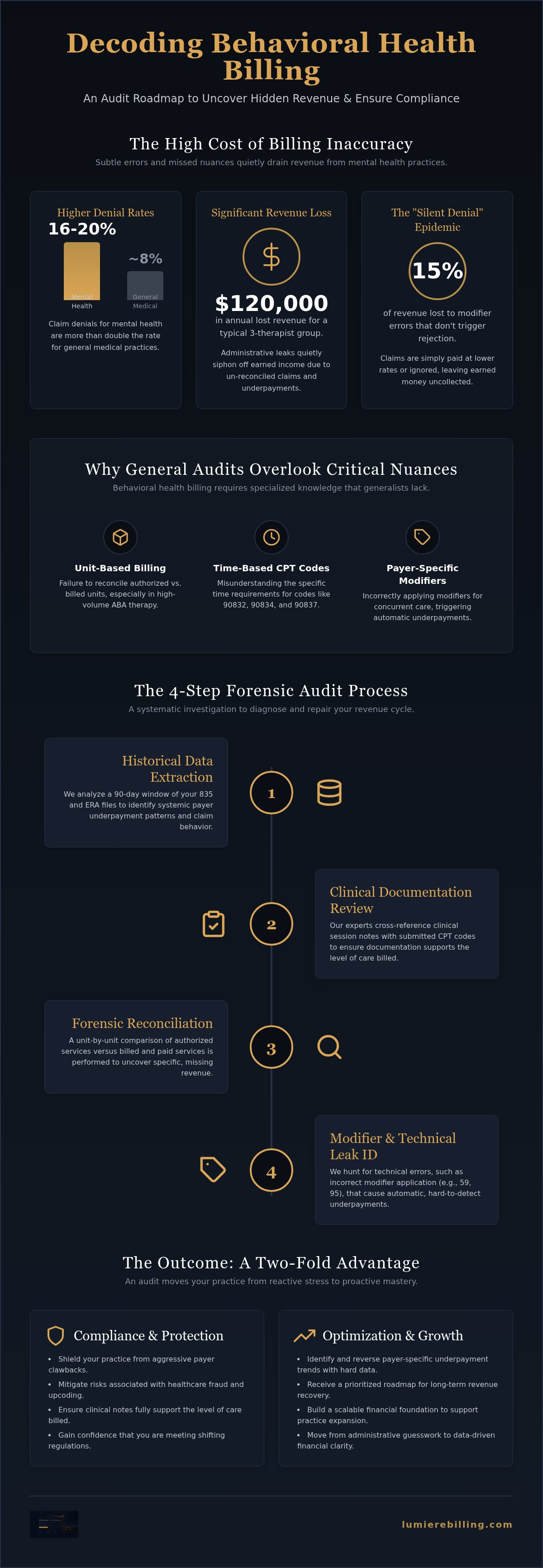
Mental health providers face claim denial rates averaging 16 to 20 percent, a figure more than double the rate seen in general medical practices. For a typical three therapist group, these administrative leaks can quietly siphon off up to 120,000 dollars in annual revenue. You likely suspect that your clinical volume isn't translating into the bank account balance it should. A specialized behavioral health billing audit acts as a high powered lens, bringing these hidden failures into focus and repairing the mechanical integrity of your revenue cycle.
It's exhausting to battle high denial rates without clear explanations or to lose sleep over the compliance risks buried in your documentation. You deserve total visibility into your practice's financial health and the confidence that your revenue is protected. This article provides a 2026 case study in revenue recovery, detailing how specialized oversight identifies underpayments and secures your practice against shifting regulations. We will preview a roadmap for sustainable growth that prioritizes denial prevention and ensures your billing reflects the mastery of your clinical work.
Key Takeaways
- Understand why general medical audits overlook behavioral health nuances. You'll learn to identify specialized unit-based billing errors that generalists routinely miss.
- Discover how a professional behavioral health billing audit extracts historical data to expose exactly where payers are underpaying for your clinical services.
- Master the mechanics of unit reconciliation. We examine how modifier errors and tracking failures lead to double-digit revenue leakage in high-volume ABA practices.
- Identify the essential data points needed for success. We outline the specific EHR records and 835 files required to ensure your financial diagnostic is precise.
- Move beyond simple recovery. Use audit insights to build a prioritized roadmap for long-term compliance and optimized practice growth.
The Strategic Necessity of a Behavioral Health Billing Audit
A behavioral health billing audit is a systematic, forensic review of clinical documentation and financial outcomes. It isn't a cursory glance at claims. It's a deep dive into the mechanical integrity of your revenue stream. General medical audits often overlook the specific complexities of behavioral health. They fail because they don't account for:
- Unit-based billing nuances in ABA therapy.
- The specific time-based requirements of 90832, 90834, and 90837 CPT codes.
- Payer-specific modifier rules for concurrent care.
While generalists focus on broad coding accuracy, they miss the nuances that define your specialty. Without specialized focus, your revenue remains vulnerable to systemic underpayments. Identifying these gaps is the only way to move from administrative guesswork to financial clarity.
The High Cost of Billing Mediocrity
Mediocrity in billing creates a widening gap between clinical hours worked and actual revenue collected. Many practices operate under the "good enough" philosophy, unaware that subtle errors are costing them thousands in underpayments. This isn't just about lost cash today. It's about practice scalability. If your foundation is leaky, you can't build a larger clinical team. The "Silent Denial" epidemic is a prime example. Practices frequently lose up to 15% of their revenue to modifier errors that never trigger a formal rejection letter. These claims are simply paid at lower rates or ignored, leaving money on the table that you've already earned. When your billing is stagnant, your growth is capped.
Compliance vs. Optimization: Two Sides of the Same Audit
An audit serves two masters: protection and growth. Proactive auditing shields your practice from aggressive payer clawbacks and risks associated with Health care fraud, such as upcoding or insufficient documentation. It ensures your clinical notes support the highest level of reimbursable care without crossing regulatory lines. Beyond compliance, auditing is a tool for optimization. It allows you to identify payer-specific underpayment trends using hard data. This diagnostic clarity is the essential first step in a healthy behavioral health revenue cycle management strategy. By analyzing 835 files and historical data, a professional behavioral health billing audit allows you to move from reactive stress to proactive mastery. You can't fix what you haven't measured.
Anatomy of a Specialized Audit: The Lumiere Methodology
Transparency is the antidote to administrative opacity. Many billing firms promise a review but treat their process like a black box, leaving you with a vague "score" and no actionable steps. Our methodology is different. We utilize a four-step diagnostic framework designed to reveal exactly where your revenue cycle is losing pressure. This isn't a surface-level scan. It's a forensic investigation into the specific behavioral health billing errors to avoid to protect your practice's financial health.
- Step 1: Historical Data Extraction. We pull your 835 and ERA files to analyze payer-specific claim behavior over a set period.
- Step 2: Clinical Documentation Review. Our experts verify that your session notes actually support the CPT codes you've submitted.
- Step 3: Forensic Reconciliation. We perform a unit-by-unit comparison of authorized services versus billed services to find missing revenue.
- Step 4: Modifier Identification. We hunt for technical leaks, such as the incorrect application of modifiers 59 or 95, which often trigger automatic underpayments.
By the end of this behavioral health billing audit, you don't just have a list of problems. You have a prioritized roadmap for recovery. You can start this diagnostic journey today by requesting a Free Billing Audit to see how your data stacks up against industry benchmarks.
Forensic Claim Analysis
We typically examine a 90-day window of claims to identify systemic patterns. This timeframe is critical. It's long enough to reveal consistent payer habits but short enough to allow for rapid course correction. We track the entire lifecycle of a claim from submission to final adjudication. This includes spotting "silent denials"—those claims that payers underpay or ignore without ever sending a formal rejection notice. If you aren't scrutinizing your 835 data, you're missing the most important part of the story. We bring these hidden failures into focus.
Documentation and CPT Alignment
Our audit ensures your session notes meet the rigid requirements for high-reimbursement codes like 90837 and 90834. We verify that time-based billing is documented with precision rather than estimation. For example, a 90837 requires at least 53 minutes of face-to-face time. If your notes lack the start and stop times or fail to justify the duration, you're at high risk for a payer clawback. We cross-reference treatment plans with billed services to ensure medical necessity is undeniable. This alignment is the only way to maintain the mechanical integrity of your practice while maximizing clinical value.
Case Study: Uncovering Hidden Revenue Leaks in ABA and Mental Health
Data doesn't lie, but it often hides. For many practices, the gap between clinical effort and financial reward remains a mystery until a professional behavioral health billing audit brings the evidence to light. In a recent 2026 engagement with a multi-location behavioral health group, we identified systemic failures that were previously invisible to their internal team. The outcome was a definitive 22% increase in net collections within just 60 days of implementing our audit recommendations.
The ABA Unit Tracking Challenge
A multi-location ABA practice was struggling with a chronic mismatch between authorized hours and billed units. They faced a recurring nightmare: clinicians provided services that the billing team couldn't submit because the authorized units were already exhausted or improperly tracked. This poor unit reconciliation led to a high volume of "unbillable" sessions and frustrated clinical staff. Our solution involved deploying a real-time unit reconciliation dashboard that synced clinical schedules with remaining authorizations. By fixing this mechanical failure, the practice eliminated unbillable sessions entirely and significantly improved provider utilization. They stopped guessing and started billing with absolute precision.
Mental Health Modifier Optimization
A separate mental health group discovered they were losing 12% of their expected revenue to a "silent denial" epidemic. Their claims weren't being rejected; they were being underpaid due to incorrect modifier usage for telehealth services. Payers were processing claims at lower rates because the required 95 or GT modifiers were missing or applied to the wrong CPT codes. To repair this, we provided targeted provider education and implemented automated scrubbing for specific CPT and modifier combinations. The result was a 98% clean claim rate for telehealth services, ensuring every minute of conversational therapy was reimbursed at its full value.
Once these leaks were plugged, the group realized that maintaining this level of vigilance required specialized focus. They made the strategic decision to outsource mental health billing to our team, transitioning from a state of constant financial stress to one of predictable practice growth. This case study proves that an audit isn't just a compliance check. It's a forensic recovery mission that transforms clinical volume into sustainable revenue.
Preparing Your Practice for a Comprehensive Audit
Preparation is the pivot point where a behavioral health billing audit shifts from a theoretical exercise to a recovery engine. Success begins with a clear inventory of your current standing. Before the forensic review starts, you must ensure your foundation is solid. This includes a rigorous review of your mental health provider credentialing status. If your clinicians aren't properly enrolled with your top payers, even the most perfect billing workflow will result in a denial. A methodical approach to data collection ensures that no revenue leak remains hidden. It's the difference between a superficial check and a forensic investigation. You need to be proactive, not reactive, during this phase.
Data Gathering Checklist
A behavioral health billing audit is only as good as the data feeding it. You must move beyond surface level summaries and provide raw documentation for analysis. Start by securing read-only access to your EHR, whether you utilize TherapyNotes or another specialized behavioral health platform. This allows auditors to verify that clinical notes match the billed time and CPT codes. You should also compile:
- A list of your top five payers and their current contracted reimbursement rates.
- All 835 and ERA files from the previous six months to track payment patterns.
- A summary of your most frequent denial reasons to identify systemic failures.
This data serves as the baseline for the entire investigation. Without it, the audit lacks the clinical and financial context necessary to identify subtle underpayments. You're looking for patterns, not just isolated errors.
Defining Audit Objectives
Clarity of purpose prevents scope creep and ensures actionable results. You must decide if your primary goal is immediate revenue recovery, long term compliance assurance, or workflow optimization. For multi-specialty practices, you might prioritize the audit based on your largest revenue streams. You might focus on high volume ABA unit reconciliation before moving to outpatient counseling. Establish a firm timeline for the review and a deadline for implementing the findings. This ensures the audit remains a live roadmap for practice growth rather than a static report. By setting these benchmarks early, you create accountability for your administrative team. If you're ready to identify your specific failure points, you can schedule your free billing audit today to begin the preparation process.
Securing Your Practice’s Future with Lumiere Billing’s Expert Oversight
A behavioral health billing audit is the starting line, not the finish. While identifying historical leaks is essential for immediate recovery, true financial health requires a permanent shift in how your revenue cycle operates. We don't just hand you a report and walk away. We act as a vigilant protector of your practice's financial integrity. By focusing exclusively on the behavioral health niche, we bring hidden systemic failures into focus and repair the mechanical integrity of your back office operations. This specialized expertise is the only way to navigate the complexities of 2026 regulations and payer behaviors.
Transparency isn't a buzzword. It's our operational standard. We provide custom dashboards that give you total visibility into your claims' lifecycles. You'll see exactly where your money is and why. This level of insight moves your practice away from the opaque administrative styles of the past toward a model of clarity and mastery. When you partner with a specialist, you gain a dedicated advocate who understands the nuances of 90837 CPT codes and the specific documentation requirements that protect your revenue from clawbacks.
From Audit to Action
We convert raw audit data into a prioritized strategy. This transition is where your practice moves from reactive stress to ABA revenue cycle management excellence. We implement denial prevention workflows based on the specific failure points discovered during your review. If the audit revealed modifier errors or unit reconciliation gaps, we build automated safeguards to ensure those mistakes never happen again. Our percentage-based model ensures our incentives are perfectly aligned with yours. We only win when you do. This partnership model fosters a disciplined, behind-the-scenes operation that values precision over volume.
Your Invitation to Visibility
Your journey toward financial clarity begins with a zero-risk diagnostic tool. During your initial consultation, we'll discuss your current pain points and outline the specific data points we need to analyze. Our Free Billing Audit is designed to provide a comprehensive roadmap without any upfront financial commitment. It's a no-risk opportunity to see exactly where your revenue is leaking and how to plug those holes permanently. We invite you to move beyond mediocrity and embrace a higher standard of billing integrity. Don't let clinical value go uncollected due to administrative oversight. You can Request Your Free Behavioral Health Billing Audit today and start building a more sustainable future for your practice.
Reclaiming Your Practice’s Financial Integrity
The gap between your clinical hours and your bank balance isn't a mystery; it's a mechanical failure. Generalist billing approaches often ignore the nuances of unit reconciliation and specialty modifiers that define your field. A specialized behavioral health billing audit brings these hidden leaks into focus, transforming administrative stress into a clear roadmap for recovery. By prioritizing forensic data over guesswork, you protect your practice from clawbacks and ensure your revenue matches your mastery.
You don't have to navigate these complexities alone. Lumiere Billing acts as a vigilant protector of your financial health, providing a forensic approach to revenue recovery with incentives perfectly aligned through our percentage-based fees. We are exclusively specialized in Behavioral Health and ABA, ensuring every claim reflects the true value of your care. It's time to replace opacity with transparency and secure your practice’s future.
Request Your Free Behavioral Health Billing Audit today and discover the path to sustainable growth. Your practice deserves a partner that is as dedicated to your success as you are to your patients.
Frequently Asked Questions
What is included in a behavioral health billing audit?
A specialized behavioral health billing audit includes a forensic review of 835/ERA files, clinical documentation, and payer contracts. We examine the mechanical integrity of your revenue cycle by cross-referencing session notes with billed CPT codes like 90837. Our team analyzes unit-based billing for ABA services to ensure authorized units match clinical volume. This systematic diagnostic brings hidden revenue leaks into focus while identifying systemic failures in your current administrative workflows.
How long does a professional billing audit take for a mental health practice?
The timeline for a professional review typically spans two to four weeks depending on the volume of historical data and the complexity of your payer mix. We prioritize a methodical extraction of 90 days of claim data to identify recurring patterns of underpayment. This steady, purposeful pace ensures we don't miss subtle "silent denials" that a rushed scan would overlook. You'll receive a comprehensive roadmap for recovery once the forensic investigation is complete.
Will a billing audit disrupt my daily clinical operations?
An audit is designed as a disciplined, behind-the-scenes operation that requires minimal involvement from your clinical staff. We typically request read-only access to your EHR and financial records to perform our analysis independently. This allows your therapists to remain focused on patient care while we act as a vigilant protector of your practice's financial health. We move away from the opaque nature of traditional services by providing clarity without creating administrative burdens.
How often should a behavioral health practice undergo a billing audit?
We recommend conducting a comprehensive review at least once per year or whenever you experience a significant shift in your payer mix. Regular oversight is essential because insurance policies and 2026 regulations evolve rapidly. A recurring behavioral health billing audit ensures your documentation standards remain aligned with current medical necessity requirements. This proactive approach prevents small coding errors from ballooning into systemic revenue leakage that could threaten your practice's long-term scalability.
Can a billing audit help with insurance credentialing issues?
Yes, our diagnostic process often reveals that persistent denials are rooted in outdated credentialing or enrollment gaps. We verify that every provider is properly paneled with your top payers and that CAQH profiles are current. Identifying these credentialing failures allows us to repair the broken links in your revenue cycle. This ensures that your clinicians can provide care with the confidence that their services are fully reimbursable under current payer contracts.
Is there a difference between a compliance audit and a revenue audit?
A compliance audit focuses on protecting your practice from payer clawbacks and regulatory risks, while a revenue audit identifies hidden leaks to optimize growth. Our methodology treats these as two sides of the same coin. We bring both risks and opportunities into focus by ensuring your documentation supports the highest level of reimbursable care. This dual focus provides total visibility into your practice's financial integrity while securing your roadmap for sustainable expansion.
What data do I need to provide for a Lumiere Billing audit?
To begin your diagnostic review, we require read-only access to your EHR and your most recent 835 or ERA files. We also need a current roster of your providers and a list of your top payer contracts with their specific reimbursement rates. This data allows our forensic team to analyze systemic patterns and extract the insights needed for a prioritized RCM strategy. We value your time by getting to the core of the issue quickly with precise data.
Frequently Asked Questions
A specialized behavioral health billing audit includes a forensic review of 835/ERA files, clinical documentation, and payer contracts. We examine the mechanical integrity of your revenue cycle by cross-referencing session notes with billed CPT codes like 90837. Our team analyzes unit-based billing for ABA services to ensure authorized units match clinical volume. This systematic diagnostic brings hidden revenue leaks into focus while identifying systemic failures in your current administrative workflows.
The timeline for a professional review typically spans two to four weeks depending on the volume of historical data and the complexity of your payer mix. We prioritize a methodical extraction of 90 days of claim data to identify recurring patterns of underpayment. This steady, purposeful pace ensures we don't miss subtle "silent denials" that a rushed scan would overlook. You'll receive a comprehensive roadmap for recovery once the forensic investigation is complete.
An audit is designed as a disciplined, behind-the-scenes operation that requires minimal involvement from your clinical staff. We typically request read-only access to your EHR and financial records to perform our analysis independently. This allows your therapists to remain focused on patient care while we act as a vigilant protector of your practice's financial health. We move away from the opaque nature of traditional services by providing clarity without creating administrative burdens.
We recommend conducting a comprehensive review at least once per year or whenever you experience a significant shift in your payer mix. Regular oversight is essential because insurance policies and 2026 regulations evolve rapidly. A recurring behavioral health billing audit ensures your documentation standards remain aligned with current medical necessity requirements. This proactive approach prevents small coding errors from ballooning into systemic revenue leakage that could threaten your practice's long-term scalability.
Yes, our diagnostic process often reveals that persistent denials are rooted in outdated credentialing or enrollment gaps. We verify that every provider is properly paneled with your top payers and that CAQH profiles are current. Identifying these credentialing failures allows us to repair the broken links in your revenue cycle. This ensures that your clinicians can provide care with the confidence that their services are fully reimbursable under current payer contracts.
A compliance audit focuses on protecting your practice from payer clawbacks and regulatory risks, while a revenue audit identifies hidden leaks to optimize growth. Our methodology treats these as two sides of the same coin. We bring both risks and opportunities into focus by ensuring your documentation supports the highest level of reimbursable care. This dual focus provides total visibility into your practice's financial integrity while securing your roadmap for sustainable expansion.
To begin your diagnostic review, we require read-only access to your EHR and your most recent 835 or ERA files. We also need a current roster of your providers and a list of your top payer contracts with their specific reimbursement rates. This data allows our forensic team to analyze systemic patterns and extract the insights needed for a prioritized RCM strategy. We value your time by getting to the core of the issue quickly with precise data.