2026 Behavioral Health In-Network Decision Guide

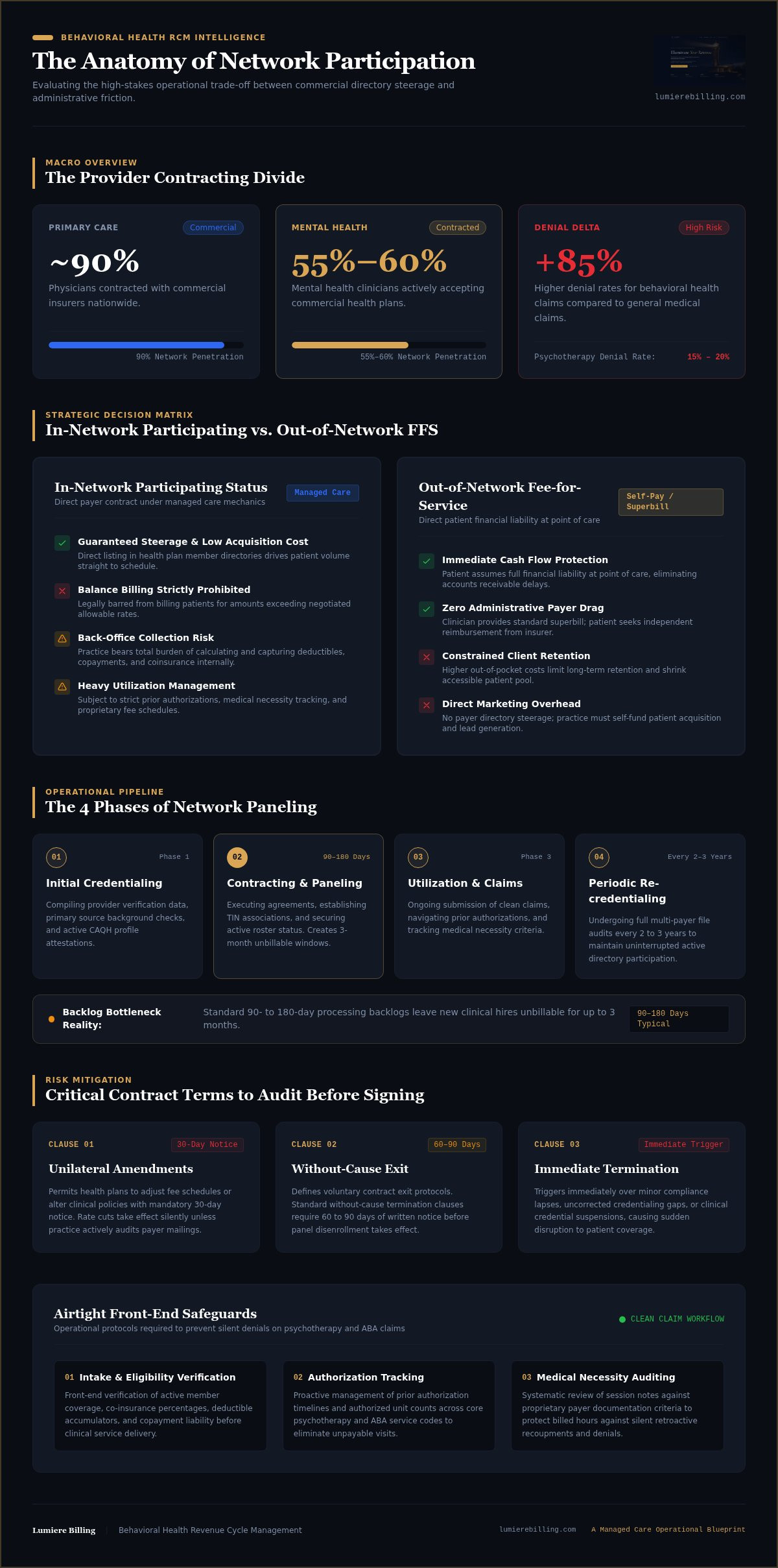
While roughly 90% of primary care physicians contract with commercial insurers, only 55% to 60% of mental health clinicians take insurance. That divide highlights an unspoken reality: behavioral health network participation is not an automatic growth lever, but a high-stakes trade-off between client volume and administrative drag.
You already feel that operational tension. Between three-month credentialing backlogs that leave new clinicians unbillable, opaque fee schedule conversion factors, and denial rates averaging 15% to 20% on psychotherapy codes, entering payer panels often threatens the very margins it promises to expand.
You don't have to gamble your practice's solvency on guesswork. This guide provides the strategic blueprint to master the financial mechanics of payer contracting, quantify the true net revenue differences between in-network and self-pay models, and establish airtight back-office workflows that eliminate revenue leakage. Ahead, we will unpack how to evaluate payer agreements, streamline your paneling pipeline, and safeguard your clinical cash flow from silent denials.
Key Takeaways
- Understand the binding operational mechanics of behavioral health network participation to evaluate whether guaranteed patient steerage outweighs discounted fee schedules.
- Quantify your practice's true cost-to-collect by weighing gross contracted allowances against administrative overhead, prior authorization requirements, and billing friction.
- Map the multi-stage credentialing and paneling lifecycle to prevent standard 90- to 180-day processing backlogs from stalling billable clinical hours.
- Audit unmasked fee schedules across core psychotherapy and ABA service codes to catch revenue-eroding contract clauses before signing.
- Deploy airtight front-end intake, eligibility verification, and authorization tracking workflows to safeguard incoming claims against silent denials.
What Is Behavioral Health Network Participation and How Does It Function?
At its core, behavioral health network participation is a binding legal contract between an individual clinician or clinical group and a third-party health plan. It operates under the broader mechanics of managed care, where insurers build preferred provider panels to control service utilization and standardize expenditures. In this framework, the provider agrees to deliver mental health, substance use, or applied behavior analysis (ABA) services to plan members at predetermined, capped reimbursement rates known as the allowable amount.
In return, payers deliver steerage. Your practice gains direct visibility in member directories, drastically lowering patient acquisition costs. Yet this exchange is strictly transactional; commercial insurers trade patient access for contractual fee discounts, shifting complex utilization management requirements squarely onto your operational team.
The operational lifecycle of network participation follows four distinct phases:
- Initial Credentialing: Compiling provider verification data, primary source background checks, and active CAQH profile attestations.
- Contracting and Paneling: Executing participating provider agreements, establishing tax identification associations, and receiving active roster confirmation.
- Utilization and Maintenance: Submitting clean claims, navigating prior authorizations, and tracking ongoing medical necessity criteria.
- Periodic Re-credentialing: Undergoing full multi-payer file audits every two to three years to maintain active directory participation.
In-Network Participating Status vs. Out-of-Network Fee-for-Service
Choosing in-network status completely alters your billing mechanics. In an out-of-network model, the patient assumes full financial liability at the point of care, collecting a superbill to seek independent reimbursement. This protects your cash flow but limits client retention.
In-network agreements legally prohibit balance billing. You cannot bill the client for the difference between your standard fee and the negotiated rate. Worse, collection risk shifts entirely to your back office. Deductibles, coinsurance, and copayments must be calculated and captured internally. Failure to collect patient responsibility means writing off earned income.
The Core Governance of Behavioral Health Payer Contracts
A payer contract is rarely a single document. It consists of the primary participation agreement, covered service attachments, and proprietary fee schedules. Hidden clauses within these documents can quietly damage margins.
Payers routinely insert unilateral amendment clauses. These provisions permit health plans to adjust fee schedules or alter clinical policies with a mandatory thirty-day notice. Unless practice leadership actively audits payer mailings, rate cuts take effect silently. Contracts also define strict exit terms: standard without-cause termination clauses require 60 to 90 days of written notice, while immediate termination clauses trigger over minor compliance lapses, uncorrected credentialing gaps, or credential suspensions.
Evaluating the Financial Reality: In-Network Volume vs. Administrative Overhead
Gross reimbursement numbers tell an incomplete story. A contract offering a set fee per clinical hour looks viable on paper, but that figure rarely matches what lands in your bank account. The core financial paradox of behavioral health network participation lies between patient steerage and operational drag. Paneling with major commercial payers immediately reduces patient acquisition costs, channeling search-driven directory volume straight to your schedule. A diverse payer mix also protects private practices against regional employer shifts that wipe out narrow patient panels.
Yet volume without operational discipline creates severe revenue leakage. With behavioral health claims facing denial rates around 85% higher than general medical claims, a surge in appointments simply magnifies administrative friction. Maintaining sustainable margins under fixed fee structures requires rigorous behavioral health revenue cycle management that tracks every dollar through adjudication.
Calculating Your True Net Reimbursement per Clinical Encounter
To expose your genuine operating yield, look past contracted fee schedules. You must calculate net collected revenue per encounter using a direct formula:
Net Collected Revenue = Gross Contracted Rate - (Billing Labor Costs + Clearinghouse Fees + Appeals Overhead + Patient Default Losses)
High-deductible health plans compound this issue. When an in-network client owes hundreds of dollars out of pocket before coverage activates, collection responsibility falls on your staff. Practices seeing high client default rates quickly watch an acceptable contracted rate slip into an operational loss. High volume cannot rescue an operation struggling with low first-pass claim acceptance rates.
Administrative Burden: Authorizations, Audits, and Documentation
Payer oversight eats into clinical productivity. Managing initial prior authorizations, attending peer-to-peer reviews, and filing concurrent treatment plans requires significant administrative labor. That extra overhead directly deflates provider margins.
Worse, payers routinely leverage targeted post-payment chart reviews. A clinical documentation discrepancy identified twelve months down the line can result in swift clawbacks from current disbursements. Practices that lack specialized oversight lose substantial cash flow defending claims that were properly delivered. If your team is struggling to quantify these friction points, ordering a free billing audit can pinpoint exactly where back-office overhead is eroding your contracted earnings.
The Credentialing and Contracting Process for Mental Health and ABA Providers
Securing behavioral health network participation demands methodical preparation. Many practices view credentialing as simple data entry, only to watch applications sit in administrative limbo for quarters on end. The end-to-end credentialing lifecycle requires a synchronized sequence: building an unassailable CAQH profile, submitting formal letters of intent, passing payer committee reviews, and counter-signing the participating provider agreement.
Payer marketing claims often suggest a brief onboarding turnaround. In reality, panel backlogs routinely span 90 to 180 days across major commercial payers. Medicaid and Medicare approvals can take between 45 and 90 days, while complex private insurance panels drag on for three to six months. A single 90-day delay for one full-time therapist can create over $45,000 in unrecoverable session revenue. Small errors trigger massive disruptions. Unexplained gaps in work history, missing malpractice coverage certificates, or expired board documents push applications to the bottom of the stack. Partnering with specialized CAQH enrollment services keeps this administrative machinery running smoothly without risking stalled clinical hours.
Navigating CAQH ProView and Primary Source Verification
CAQH ProView is the operational nexus of provider paneling. To prevent file rejections, clinical profiles require active state licenses, national provider identifier (NPI) confirmations, and complete malpractice face sheets showing adequate coverage limits.
Profiles demand re-attestation every 120 days. Missing that window causes automated deactivations, locking out payers during active credentialing cycles. Once submitted, payer committees launch primary source verification, cross-referencing graduate degrees, post-degree clinical internships, and state disciplinary boards before approving clinical privileges.
Group Panel Contracts vs. Individual Provider Credentialing
Solo practitioners hold direct, individual payer agreements linked to their personal Social Security Number or Type 1 NPI. Group practices, by contrast, contract through a Type 2 organizational NPI. This structure decouples your brand from any single provider, allowing multiple clinicians to deliver care under a single tax ID.
Scaling a multi-provider behavioral health or ABA group requires strict provider roster management behavioral health workflows. Integrating new staff onto an existing contract requires submitting formal roster updates before the clinician sees their first insured client. Without confirmed roster effective dates, sessions delivered by associate therapists, residents, or registered behavior technicians (RBTs) face immediate, non-appealable denials for uncredentialed rendering providers.
Critical Contract Terms and Fee Schedule Realities to Audit Before Signing
Signing a participation contract without scrutinizing the underlying fee exhibits exposes your bottom line to immediate margin compression. Health plans frequently provide master service agreements while masking the actual fee schedules behind vague percentage-of-Medicare formulas. Securing an unmasked, code-specific reimbursement schedule is a mandatory prerequisite for calculated behavioral health network participation. You cannot budget clinic payroll against an unverified rate sheet.
Dissect high-volume CPT codes line by line. Scrutinize base psychotherapy rates for 90834 (45-minute psychotherapy) and 90837 (60-minute psychotherapy), along with diagnostic evaluations under 90791. Applied behavior analysis practices must review adaptive behavior treatment by protocol (97153) alongside direct behavior identification assessments and direction (97155). Eliminating routine behavioral health billing errors to avoid prevents clearinghouses from rejecting these exact service codes upon initial submission.
Deconstructing Payer Fee Schedules and Conversion Factors
Watch for hidden reimbursement carve-outs. Despite federal parity statutes, mental health services are frequently discounted 16% to 59% compared to physical health codes across major commercial payers. Payers routinely compress margins through time-based daily limits, capping units or downcoding prolonged 60-minute sessions to standard 45-minute rates.
Licensure tiering also shifts gross recovery. Reimbursement differentials between doctoral-level psychologists, master's-level therapists, and board-certified behavior analysts can span 15% to 30% for identical service codes. Understanding these provider-level rate drops ensures your staffing model remains profitable.
Audit Protections, Recoupment Clauses, and Timely Filing Limits
Operational traps hide within the contract's standard administrative terms. Timely filing windows range from 90 to 365 days; an aggressive 90-day window turns minor clearinghouse snags into uncollectible revenue write-offs. Look closely at retroactive recoupment provisions. Many plans grant themselves open-ended rights to claw back past disbursements by withholding payment on current, valid claims.
Insist on limiting retrospective audits to 12 months, and establish clear dispute-resolution timelines before signing. Protect your clinical revenue before executing a binding agreement. You can schedule a practice advisory consultation with our team to evaluate your payer contracts and identify underperforming fee schedules before enrollment.
Operationalizing In-Network Status: Protecting Cash Flow and Preventing Revenue Leaks
Executing a managed care contract is merely the baseline. The true test of profitable behavioral health network participation lies in your day-to-day administrative execution. Without structured front-end safeguards, in-network volume rapidly turns into uncollected accounts receivable. A high-performing practice treats revenue cycle management as an active, preventative clinical shield rather than a retrospective billing chore.
Many practices rely entirely on standard clearinghouse submissions, assuming green acceptance flags mean guaranteed payment. That assumption is fatal to practice margins. Claims regularly slip into silent clearinghouse holds, fail secondary payer edits, or encounter non-notified plan changes. Converting contracted rates into realized liquidity demands proactive denial management and absolute oversight across the entire billing pipeline.
Airtight Eligibility Verification and Prior Authorization Workflows
Clean billing begins before the first intake session. Administrative staff must verify patient eligibility 48 hours prior to service, confirming active mental health benefits, unmet deductibles, copay structures, and specific third-party behavioral carve-out administrators. Never assume standard commercial cards route mental health claims to the primary carrier.
Authorization management must be equally methodical. Deploy a systematic tracking process that triggers administrative alerts the moment delivered services reach 80% of authorized units. This early notification gives clinicians ample runway to file concurrent review documents and establish continued medical necessity, ensuring unbilled sessions never cross the finish line without payer pre-approval.
Defending Reimbursement Through Specialized RCM Oversight
Downstream claim integrity requires rigorous scrubbing protocols tailored to mental health and ABA realities. Every submission must be systematically validated for correct diagnostic coding, accurate rendering taxonomy numbers, and requisite telehealth or supervision modifiers like 95 or HO. Small clerical omissions reliably spark automated rejections.
To eliminate aged balances, deploy a disciplined 14-day secondary claim and patient statement cycle. When secondary insurance or copays sit past two weeks, collection yields plummet precipitously. Partnering with a dedicated behavioral health ally like Lumiere Billing delivers the integrated credentialing, compliance monitoring, and revenue cycle management required to protect your earned clinical revenue from systemic managed care attrition.
Take Control of Your Payer Strategy and Protect Practice Margins
Sustainable growth requires treating payer relationships with the same clinical precision you apply to client care. Successful behavioral health network participation is never about accepting every commercial agreement that lands on your desk. It demands calculating your genuine net collection yield, auditing contract exhibits for restrictive clauses, and enforcing airtight front-end authorization workflows that stop unbillable hours before they start.
You don't have to carry the administrative burden alone. Lumiere Billing operates exclusively within the behavioral health and ABA sectors nationwide, acting as a dedicated back-office guardian for growing clinics. From systematic credentialing and roster maintenance that keeps providers billable to aggressive denial follow-up that eliminates clearinghouse write-offs, our team insulates your clinical operations against managed care friction. Request a free billing audit to protect your practice margins and uncover the hidden revenue leaks holding back your clinical potential today.
Frequently Asked Questions
What is behavioral health network participation?
Behavioral health network participation is a contractual relationship between a mental health or ABA practice and an insurance payer. The provider agrees to deliver clinical care to plan members at negotiated, capped allowable rates. In return, the payer includes the clinician in their member directory. This arrangement prohibits balance billing while shifting deductible and copay collection responsibilities directly to the practice's billing team.
How long does the mental health credentialing process typically take for commercial networks?
Commercial network credentialing routinely takes 90 to 180 days from application submission to contract execution. While government programs like Medicare average 45 to 90 days, private commercial payers often move slowly through committee reviews. Because unpaneled clinicians cannot bill for sessions, practices should initiate CAQH file compilation and formal applications at least four to five months before a new provider begins seeing clients.
Can a behavioral health group practice negotiate in-network fee schedules with commercial payers?
Yes, group practices can negotiate rates, especially when armed with concrete operational data. Successful renegotiations require demonstrating regional network necessity, specialized clinical capabilities, short appointment wait times, and high clean-claim submission rates. You shouldn't accept boilerplate amendments; request contract discussions three to six months prior to renewal windows, focusing on high-volume codes such as 90837, 90791, and ABA adaptive behavior services.
What is the primary difference between in-network participation and out-of-network billing for therapy?
The difference centers on payment liability and client financial exposure. Out-of-network practices collect full private fees directly from the patient at the time of service, leaving the client to submit superbills for independent reimbursement. In-network providers agree to fixed payer allowances and cannot balance bill. Instead, they must bill the health plan first and collect variable copayments or unmet deductibles directly from the client.
What happens if an in-network provider renders services without an active prior authorization?
Services rendered without an active authorization are denied by commercial payers, and these losses cannot be balance billed to the client. Most participating contracts classify missing authorizations as administrative failures. That classification forces the clinic to write off the entire session balance. Establishing automated tracking systems that alert administrators when authorized units hit 80% utilization prevents clinicians from treating clients without valid pre-approval.
How does joining an insurance network affect patient acquisition and clinic growth?
Network participation instantly eliminates client acquisition friction by placing your practice directly into commercial member search directories. While out-of-network practices spend heavily on private marketing and patient retention, in-network clinics receive steady inquiries from insured individuals seeking local care. This high-volume steerage provides predictable scheduling, allowing growing group practices to recruit clinicians and scale clinical capacity with confidence.
Why do commercial payers reject behavioral health credentialing applications?
Payers reject credentialing applications due to administrative discrepancies, stale data, or closed network panels. Common technical triggers include unexplained gaps in work history, malpractice insurance face sheets lacking required minimums, mismatched NPI taxonomy classifications, and expired CAQH attestations. Additionally, health plans often issue automated rejections claiming network adequacy unless the applicant documents specialized, high-demand clinical proficiencies needed within that geographic area.
What is the financial danger of retroactive recoupments and payer audits for in-network clinics?
Retroactive recoupments allow payers to claw back historic disbursements by withholding funds from current, active claims. If a post-payment chart audit finds missing treatment plans or insufficient medical necessity documentation, the plan demands full repayment, often covering visits dating back twelve to twenty-four months. This creates immediate cash flow volatility, turning previously earned clinical revenue into sudden practice liabilities overnight.
Frequently Asked Questions
Behavioral health network participation is a contractual relationship between a mental health or ABA practice and an insurance payer. The provider agrees to deliver clinical care to plan members at negotiated, capped allowable rates. In return, the payer includes the clinician in their member directory. This arrangement prohibits balance billing while shifting deductible and copay collection responsibilities directly to the practice's billing team.
Commercial network credentialing routinely takes 90 to 180 days from application submission to contract execution. While government programs like Medicare average 45 to 90 days, private commercial payers often move slowly through committee reviews. Because unpaneled clinicians cannot bill for sessions, practices should initiate CAQH file compilation and formal applications at least four to five months before a new provider begins seeing clients.
Yes, group practices can negotiate rates, especially when armed with concrete operational data. Successful renegotiations require demonstrating regional network necessity, specialized clinical capabilities, short appointment wait times, and high clean-claim submission rates. You shouldn't accept boilerplate amendments; request contract discussions three to six months prior to renewal windows, focusing on high-volume codes such as 90837, 90791, and ABA adaptive behavior services.
The difference centers on payment liability and client financial exposure. Out-of-network practices collect full private fees directly from the patient at the time of service, leaving the client to submit superbills for independent reimbursement. In-network providers agree to fixed payer allowances and cannot balance bill. Instead, they must bill the health plan first and collect variable copayments or unmet deductibles directly from the client.
Services rendered without an active authorization are denied by commercial payers, and these losses cannot be balance billed to the client. Most participating contracts classify missing authorizations as administrative failures. That classification forces the clinic to write off the entire session balance. Establishing automated tracking systems that alert administrators when authorized units hit 80% utilization prevents clinicians from treating clients without valid pre-approval.
Network participation instantly eliminates client acquisition friction by placing your practice directly into commercial member search directories. While out-of-network practices spend heavily on private marketing and patient retention, in-network clinics receive steady inquiries from insured individuals seeking local care. This high-volume steerage provides predictable scheduling, allowing growing group practices to recruit clinicians and scale clinical capacity with confidence.
Payers reject credentialing applications due to administrative discrepancies, stale data, or closed network panels. Common technical triggers include unexplained gaps in work history, malpractice insurance face sheets lacking required minimums, mismatched NPI taxonomy classifications, and expired CAQH attestations. Additionally, health plans often issue automated rejections claiming network adequacy unless the applicant documents specialized, high-demand clinical proficiencies needed within that geographic area.
Retroactive recoupments allow payers to claw back historic disbursements by withholding funds from current, active claims. If a post-payment chart audit finds missing treatment plans or insufficient medical necessity documentation, the plan demands full repayment, often covering visits dating back twelve to twenty-four months. This creates immediate cash flow volatility, turning previously earned clinical revenue into sudden practice liabilities overnight.