Understanding CCI Edits: A Behavioral Health Provider’s Guide to Preventing Denials

A single cci edit can quietly siphon thousands of dollars from your behavioral health practice without a single human ever reviewing your claim. It is a mechanical gatekeeper, cold and binary. You have likely felt the frustration of receiving an Explanation of Benefits with a cryptic denial code, leaving you to wonder why a legitimate clinical service was suddenly deemed unbillable. These opaque bundling errors create a climate of fear, often leading providers to under-code simply to avoid the threat of an audit. We understand that your focus should remain on patient outcomes, not deciphering the shifting logic of payer algorithms. By mastering the National Correct Coding Initiative framework, you can transform these administrative hurdles into a predictable system for revenue protection. This guide brings hidden coding errors into focus, providing the clarity you need to stop revenue leakage. We will break down the mechanics of PTP and MUE edits, clarify the precise application of Modifier 59, and provide a roadmap to eliminate the systemic failures that lead to claim denials.
Key Takeaways
- Identify how the NCCI system acts as an automated gatekeeper to bundle services and restrict reimbursement.
- Distinguish between Procedure-to-Procedure (PTP) edits and Medically Unlikely Edits (MUE) to anticipate payer logic.
- Master the nuances of common behavioral health pairings, including the specific cci edit triggers for psychotherapy and ABA services.
- Determine when and how to deploy Modifier 59 or X-series modifiers to accurately reflect distinct clinical encounters.
- Implement a proactive workflow that captures coding errors before they leave your office to stop revenue leakage.
What is a CCI Edit and Why Does It Matter for Behavioral Health?
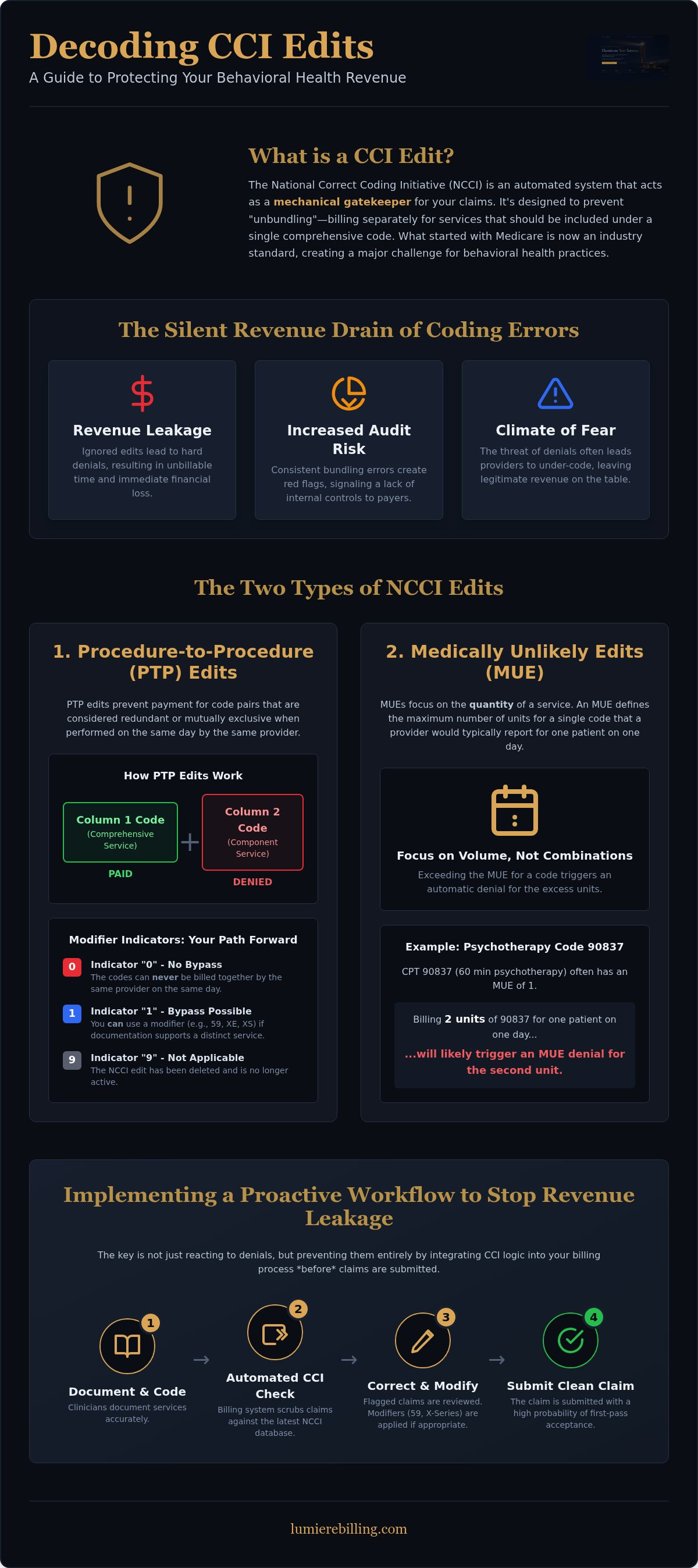
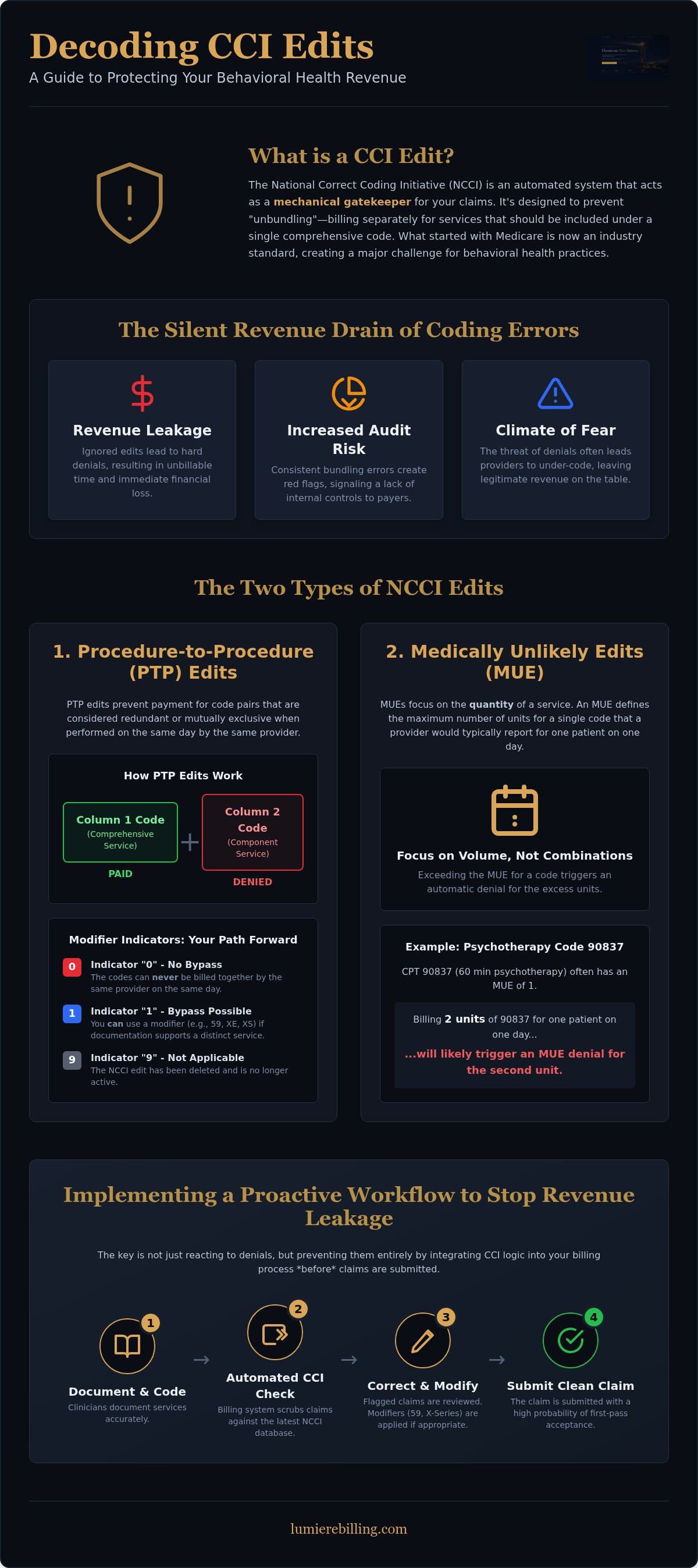
The National Correct Coding Initiative (NCCI) acts as a high-precision filter for every claim you submit. It is a system of automated logic, developed by CMS, designed to ensure that clinical services aren't artificially separated to increase reimbursement. When a cci edit triggers, the system has identified what it considers "unbundling." This occurs when a provider bills for multiple components of a service that should, by definition, be captured under a single comprehensive code. What began as a tool for Medicare has now migrated to nearly all commercial behavioral health payers. It is no longer a federal quirk; it is an industry standard.
The financial impact of these edits is often immediate and punishing. An ignored edit results in a hard denial, leaving you with unbillable time and lost revenue. Beyond the immediate loss, consistent bundling errors signal a lack of internal controls. This creates a trail of red flags that can lead to invasive audits. For the modern practitioner, these edits are the mechanical gatekeepers of your financial health. They require your attention to ensure your practice remains sustainable and compliant.
The Origin and Evolution of NCCI Edits
CMS launched the National Correct Coding Initiative in 1996. Since its inception, the database has expanded to include tens of thousands of code pairs. For years, behavioral health practitioners operated largely under the radar. The focus remained on surgical and high-cost medical procedures. That has changed. Payers have refined their algorithms to scrutinize the high-volume, time-based codes that define mental health and ABA therapy. The system is no longer static. It evolves quarterly, requiring a proactive stance to maintain billing integrity.
The Behavioral Health Context: Why We Are Targeted
Behavioral health is uniquely vulnerable due to the nature of the specialty. High-volume codes like 90837 for psychotherapy or 97153 for ABA treatment are frequent targets for bundling. The overlap between diagnostic evaluations and therapeutic sessions often triggers automated flags. Success in behavioral health revenue cycle management requires more than clinical excellence. It demands a technical understanding of how these edits interact with your daily documentation. Without this visibility, your practice remains blind to the mechanical errors that drain your financial stability. Precision is the only defense against these automated denials.
The Mechanics of NCCI: PTP Edits and Medically Unlikely Edits (MUE)
The NCCI system functions as an automated filtration system. It uses two distinct mechanical tools to evaluate your claims: Procedure-to-Procedure (PTP) edits and Medically Unlikely Edits (MUE). These filters act instantly. They don't wait for a human reviewer; they apply logic the moment your claim hits the payer's gateway. Understanding the logic behind every cci edit is the first step toward reclaiming your practice's financial integrity and preventing the "silent denials" that drain your revenue.
Understanding PTP Column 1 and Column 2 Code Pairs
PTP edits prevent payment for code combinations that payers deem mutually exclusive or redundant. The system organizes these into pairs. Column 1 represents the comprehensive service. Column 2 represents the component service. If you bill both on the same date for the same patient, the payer will typically pay the Column 1 code and deny the Column 2 code. The order of your claim lines matters. If your billing process doesn't recognize a cci edit before submission, you are essentially surrendering legitimate revenue. For example, billing certain psychotherapy codes alongside evaluation services often triggers a PTP denial because the payer assumes the evaluation is already "bundled" into the therapy time.
The "Modifier Indicator" determines your path forward. A "0" indicator means the codes can never be billed together. A "1" indicator means you can bypass the edit using a modifier, such as 59 or the X-series, provided your documentation supports a distinct service. A "9" indicates the edit is non-applicable. Precision requires knowing exactly which indicator applies to your specific code pair. Guesswork is not a strategy; it is a liability.
MUEs: When "Too Much" is a Red Flag
While PTP edits look at code combinations, Medically Unlikely Edits (MUE) look at volume. An MUE is the maximum number of units a provider would report for a single patient on a single date of service. For many behavioral health codes, the MUE is strictly limited. For instance, CPT 90837 (psychotherapy, 60 minutes) generally has an MUE of 1. If you bill two units, the automated system triggers a denial. These limits are updated quarterly. In April 2026, for example, CMS revised over 120 MUEs, demonstrating how quickly the landscape shifts. Some MUEs result in a line-item denial, while others cause the entire claim to be rejected. Identifying these limits before submission is critical to maintaining a healthy cash flow. If you are unsure where your leaks are occurring, a Free Billing Audit can bring these hidden technical failures into focus. Payers rely on these automated filters to trigger immediate denials, hoping you lack the technical oversight to challenge them. We provide the visibility you need to secure your practice's future.
Common Behavioral Health CCI Edits and the 90837 Dilemma
General medical coding guides often overlook the specific complexities of behavioral health. This oversight leaves practitioners vulnerable to automated denials that target high-volume services. The 90837 psychotherapy code, for instance, is a lightning rod for scrutiny. When you bill for an extended session alongside other diagnostic or crisis services, you are essentially challenging an automated system designed to assume redundancy. These errors are among the first issues flagged during a behavioral health billing audit. Identifying these patterns is the only way to secure your revenue cycle against mechanical failure. A single cci edit can disrupt your cash flow if you don't anticipate how code pairs interact.
Crisis intervention codes, such as 90839, present another layer of complexity. These codes are often bundled with standard therapy codes if billed on the same date. The system expects a crisis to be the primary focus of the encounter. If you attempt to bill a routine 90837 and a crisis 90839 for the same patient on the same day, the payer's gateway will likely trigger a denial for the bundled component. This mechanical gatekeeping requires clinical documentation that clearly separates the routine session from the emergency intervention. Without this distinction, your practice loses the reimbursement it earned through high-intensity care.
The 90837 vs. 90791 Conflict
The conflict between 90837 (psychotherapy, 60 minutes) and 90791 (psychiatric diagnostic evaluation) is a primary source of revenue leakage. Under standard NCCI logic, you cannot bill a diagnostic intake and a full therapy session on the same day for the same patient. The system views the intake as comprehensive. Exceptions exist, but they are narrow. If a patient experiences a separate, distinct clinical event later in the day, you must document the "distinct procedural service" with surgical precision. You need clear timestamps. You need separate session notes. Without these, your claim will fail the automated check. Mastery of these nuances prevents your legitimate clinical work from being swallowed by a bundling algorithm.
ABA Coding: Navigating the 97150s
Applied Behavior Analysis (ABA) providers face a different set of mechanical hurdles. The relationship between 97153 (adaptive behavior treatment by protocol) and 97155 (protocol modification) is a frequent site of friction. Bundling rules often restrict the ability to bill for concurrent supervision and direct therapy. This is a critical component of ABA revenue cycle management. If you report both without an appropriate modifier, the system will deny the secondary code. Additionally, unit-over-reporting is a constant threat. With MUE values being updated as recently as the July 2026 quarterly release, staying current on unit limits is non-negotiable. Precision in ABA billing is not just about therapy; it's about respecting the mechanical boundaries of the payer's system.
Strategies to Manage CCI Edits: Modifiers and Workflow Optimization
Managing a cci edit requires more than reactive corrections. It demands a systematic workflow that preempts the payer's automated filters before the claim ever leaves your office. Relying on the insurance company to explain why a claim was bundled is a recipe for revenue leakage. Instead, your internal process must become the primary shield for your practice's financial health. A disciplined approach to these edits moves your billing from a state of uncertainty to one of mechanical precision.
Your workflow should follow five essential steps to ensure compliance and maximize reimbursement:
- Step 1: Check the Indicator. Identify if the code pair has a Modifier Indicator of "1" (bypass allowed) or "0" (never allowed). If the indicator is 0, no modifier will secure payment.
- Step 2: Select the Specific Modifier. Determine if the services occurred during separate encounters or represented distinct procedural services.
- Step 3: Clinical Substantiation. Document the clinical necessity for the separate billing directly in the progress note. The note must clearly stand alone as evidence of a distinct service.
- Step 4: EHR Pre-Submission Audit. Verify that your software's CCI filters are active. This prevents "dirty" claims from being transmitted.
- Step 5: Monitor Remittance Advice. Watch for denial code CO-97, which specifically signals that a service was bundled into another procedure.
The Proper Use (and Misuse) of Modifier 59
Modifier 59 is defined as a "Distinct Procedural Service." In behavioral health, it is frequently used to indicate that a session was separate from another service provided on the same day. However, it has become the number one red flag for insurance audits. Payers now prefer the more specific "X" modifiers. XE (Separate Encounter) and XU (Unusual Non-Overlapping Service) provide the clarity that a generic 59 lacks. Using these specific modifiers demonstrates a higher level of coding mastery and reduces the likelihood of triggering a manual review. Overusing Modifier 59 without specific documentation is not a strategy; it is an invitation for an audit.
Leveraging EHR Automation for Compliance
The most effective defense against a cci edit is automation. Modern billing software should include "Claim Scrubbers" that reference the most recent quarterly NCCI updates. Through EHR optimization, you can flag bundling errors at the point of entry. This forces a resolution before the claim enters the revenue cycle. Training clinical staff on the "distinct" nature of bundled services ensures that the documentation supports the billing logic. If your current system feels opaque or disconnected, you can request a Free Billing Audit to identify where these mechanical failures are occurring. Visibility is the only way to stop the silent denials that compromise your practice's growth.
Beyond the Basics: How Lumiere Billing Solves the CCI Puzzle
Mastering the National Correct Coding Initiative is not about memorizing tables. It's about maintaining a vigilant, obsessive oversight of your practice's financial health. While generalist billing companies treat every specialty with the same broad strokes, Lumiere Billing operates with a level of focus that borders on the surgical. We bring hidden issues into focus. We repair broken systems. We ensure that a cci edit never becomes a permanent loss of revenue for your practice. Our approach isn't transactional. It's a proactive partnership designed to protect your clinical mission from administrative failure.
Our team provides the specialized oversight required for complex behavioral health environments. From the high-volume unit tracking of ABA to the intricate bundling rules of Intensive Outpatient Programs (IOP), we understand the specific nuances that trigger automated denials. We don't wait for the Remittance Advice to tell us a claim failed. We identify the cci edit before the claim leaves the door. This proactive denial management is supported by real-time dashboards that offer total visibility into your revenue cycle. You'll see exactly where revenue is leaking and, more importantly, how we're plugging those gaps through technical precision and strategic advisory.
The Lumiere Advantage in Behavioral Health RCM
We function as an extension of your team. This philosophy allows your clinicians to remain focused on patient care while we manage the complexities of CPT pairs and modifier indicators. Our systems integrate seamlessly with specialty EHRs like CentralReach and TherapyNotes, ensuring that data flows accurately from the point of care to the final claim. We don't just process transactions. We optimize them. Because our fees are percentage-based, our success is directly aligned with your clean claim rate. We're incentivized to be perfect. This alignment of interests creates a disciplined, behind-the-scenes operation that values precision over volume and partnership over mere transaction.
Next Steps: Securing Your Revenue
The transition from reactive billing to proactive revenue management begins with visibility. You can't fix what you can't see. A Free Billing Audit is the first step to uncovering the hidden CCI errors that are currently draining your practice's resources. We'll analyze your recent claims, identify systemic bundling issues, and provide a clear roadmap for optimization. Don't let mechanical gatekeepers dictate your financial future. Contact Lumiere Billing to fortify your practice's financial integrity and ensure that every service you provide is fully reimbursed. It's time to move away from the opaque nature of traditional services and toward a partnership built on clarity, mastery, and results.
Reclaiming Your Practice's Financial Integrity
Mastery of the National Correct Coding Initiative is the definitive line between a sustainable practice and one plagued by constant revenue leakage. Every cci edit serves as a mechanical test of your internal systems and documentation precision. By distinguishing between PTP and MUE logic and deploying specific modifiers with surgical accuracy, you protect your clinical work from being erased by automated payer algorithms. We understand the unique pressures of ABA and mental health billing. Our specialized oversight has helped providers reduce denial rates by up to 20% while maintaining total compliance. With deep expertise in platforms like CentralReach and TherapyNotes, we bring the hidden failures of your revenue cycle into clear focus. It's time to stop reacting to cryptic denial codes and start optimizing your financial health through expert partnership. Take the first step toward total visibility and mechanical integrity for your practice today.
Request Your Free Behavioral Health Billing Audit
Your dedication to patient care deserves a financial system that works just as hard to protect your mission.
Frequently Asked Questions
What is the difference between a CCI edit and a bundling denial?
A cci edit is the mechanical rule set within the National Correct Coding Initiative that identifies code pairs that shouldn't be billed together. A bundling denial is the actual financial outcome when that logic is applied to your claim. Essentially, the edit is the gatekeeper, while the denial is the result of failing to meet the gatekeeper's criteria. One is the regulatory framework; the other is the specific revenue loss your practice experiences.
Can I bill CPT 90837 and 90832 on the same day for the same patient?
No, these codes are mutually exclusive and represent different durations of the same service. Billing a 60 minute session (90837) and a 30 minute session (90832) for the same patient on the same day triggers a cci edit because the payer assumes the longer session captures the total time spent. You cannot split a single encounter into multiple time based codes to increase reimbursement. Documentation must reflect the single most accurate code for the total time.
When should I use Modifier 59 versus the newer X modifiers?
You should use the specific X modifiers (XE, XS, XP, XU) whenever a payer recognizes them, as they provide greater clinical detail than the generic Modifier 59. While Modifier 59 is a broad catch-all for "distinct procedural services," X modifiers define exactly why the service is separate, such as a different encounter or provider. Many commercial payers now require this level of specificity to bypass a cci edit and avoid manual reviews.
Do CCI edits apply to private pay or only to insurance claims?
CCI edits are a component of the insurance claims process and don't legally apply to private pay arrangements where no insurance company is involved. However, following these guidelines is still a best practice for clinical integrity and documentation standards. If a private pay client ever seeks out of network reimbursement through a superbill, the insurance company will apply these automated filters, potentially denying the client's claim and creating administrative friction for your practice.
How often does CMS update the NCCI edit tables?
CMS updates the NCCI edit tables quarterly to reflect changes in clinical practice and coding standards. These updates typically occur on January 1, April 1, July 1, and October 1. Staying current is essential because a code pair that was billable last month might trigger a cci edit today. For example, the Q3 2026 update, effective July 1, introduced thousands of new PTP pairs that behavioral health billing departments must now account for.
What happens if I ignore a CCI edit and the payer pays the claim anyway?
Receiving payment for a claim that should've triggered a cci edit doesn't mean you're in the clear. It often indicates a "silent overpayment" that payers can reclaim during a retrospective audit. If a post payment review discovers that you bypassed bundling rules without proper documentation, the payer will issue a recoupment request. This creates significant financial instability and may trigger more frequent, invasive audits of your clinical records and billing history.
How can I check if two CPT codes have a CCI edit between them?
You can check the official PTP and MUE tables hosted on the CMS website or use a coding verification tool within your EHR. These tables list Column 1 and Column 2 code pairs along with their modifier indicators. If you're unsure how to interpret these technical documents, Lumiere Billing provides a Free Billing Audit to identify existing bundling errors. This visibility ensures your practice doesn't leave revenue on the table due to mechanical oversights.
Will using a modifier to bypass a CCI edit increase my risk of an audit?
Yes, frequent use of modifiers to bypass a cci edit is a primary red flag for insurance audits. Payers monitor the ratio of sessions billed with modifiers versus those billed without them. If your practice consistently uses Modifier 59 to unbundle services, you're more likely to trigger a "pre-payment review" or a full clinical audit. The key is ensuring your documentation clearly substantiates why the services were distinct, separate, and medically necessary.
Frequently Asked Questions
A cci edit is the mechanical rule set within the National Correct Coding Initiative that identifies code pairs that shouldn't be billed together. A bundling denial is the actual financial outcome when that logic is applied to your claim. Essentially, the edit is the gatekeeper, while the denial is the result of failing to meet the gatekeeper's criteria. One is the regulatory framework; the other is the specific revenue loss your practice experiences.
No, these codes are mutually exclusive and represent different durations of the same service. Billing a 60 minute session (90837) and a 30 minute session (90832) for the same patient on the same day triggers a cci edit because the payer assumes the longer session captures the total time spent. You cannot split a single encounter into multiple time based codes to increase reimbursement. Documentation must reflect the single most accurate code for the total time.
You should use the specific X modifiers (XE, XS, XP, XU) whenever a payer recognizes them, as they provide greater clinical detail than the generic Modifier 59. While Modifier 59 is a broad catch-all for "distinct procedural services," X modifiers define exactly why the service is separate, such as a different encounter or provider. Many commercial payers now require this level of specificity to bypass a cci edit and avoid manual reviews.
CCI edits are a component of the insurance claims process and don't legally apply to private pay arrangements where no insurance company is involved. However, following these guidelines is still a best practice for clinical integrity and documentation standards. If a private pay client ever seeks out of network reimbursement through a superbill, the insurance company will apply these automated filters, potentially denying the client's claim and creating administrative friction for your practice.
CMS updates the NCCI edit tables quarterly to reflect changes in clinical practice and coding standards. These updates typically occur on January 1, April 1, July 1, and October 1. Staying current is essential because a code pair that was billable last month might trigger a cci edit today. For example, the Q3 2026 update, effective July 1, introduced thousands of new PTP pairs that behavioral health billing departments must now account for.
Receiving payment for a claim that should've triggered a cci edit doesn't mean you're in the clear. It often indicates a "silent overpayment" that payers can reclaim during a retrospective audit. If a post payment review discovers that you bypassed bundling rules without proper documentation, the payer will issue a recoupment request. This creates significant financial instability and may trigger more frequent, invasive audits of your clinical records and billing history.
You can check the official PTP and MUE tables hosted on the CMS website or use a coding verification tool within your EHR. These tables list Column 1 and Column 2 code pairs along with their modifier indicators. If you're unsure how to interpret these technical documents, Lumiere Billing provides a Free Billing Audit to identify existing bundling errors. This visibility ensures your practice doesn't leave revenue on the table due to mechanical oversights.
Yes, frequent use of modifiers to bypass a cci edit is a primary red flag for insurance audits. Payers monitor the ratio of sessions billed with modifiers versus those billed without them. If your practice consistently uses Modifier 59 to unbundle services, you're more likely to trigger a "pre-payment review" or a full clinical audit. The key is ensuring your documentation clearly substantiates why the services were distinct, separate, and medically necessary.