The Silent Denial Crisis in Behavioral Health: 2026 Revenue Leakage Trend Analysis

While your clinicians focus on patient outcomes, payers are weaponizing administrative friction to create a strategic exhaustion gap. It's not a clerical error when a claim simply stalls or disappears without a formal rejection. In 2026, the rise of silent denials behavioral health practices face has become a systemic crisis, quietly draining up to 15% of your revenue before an appeal is even considered. You likely feel the burnout of fighting insurance companies that use AI audits to down-code complex ABA sessions or flag 90837 codes without cause. It's frustrating to see your hard work met with calculated resistance while standard EHR reports fail to flag the shortfall.
We're here to help you fight back. This analysis will uncover the sophisticated payer tactics currently suffocating your cash flow and provide the specialized RCM strategies needed to reclaim your practice's financial integrity. We'll break down the 2026 landscape of unit reconciliation, modifier precision, and the specific methodology required to identify hidden underpayments that automated systems consistently miss. By understanding these mechanical failure points, you can reduce administrative friction and stabilize the cash flow necessary for practice scaling.
Key Takeaways
- Distinguish between standard CO-code rejections and the subtle, stalled underpayments that characterize silent denials behavioral health providers face in 2026.
- Map the "exhaustion gap" to your workflow to identify where AI-driven medical necessity reviews are intentionally stalling your reimbursement.
- Implement precise unit reconciliation and modifier checks to stop the compounding 15% revenue drain caused by specialized billing errors.
- Adopt a vigilant protector mindset by utilizing targeted billing audits to illuminate and repair hidden systemic leaks in your revenue cycle.
- Understand why general medical billing fails to protect behavioral health practices and how specialized RCM serves as a disciplined extension of your team.
Anatomy of a Silent Denial: Why Behavioral Health Reimbursement is Under Attack
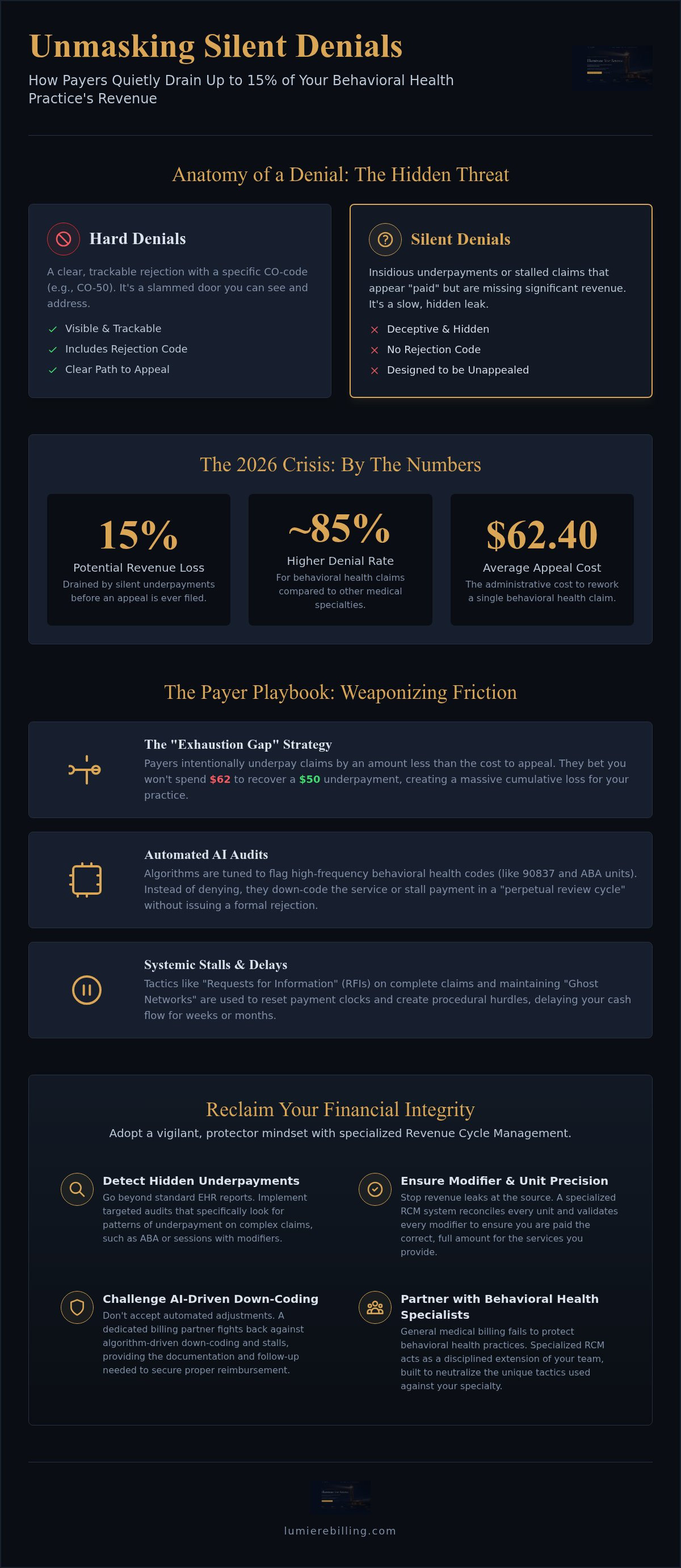
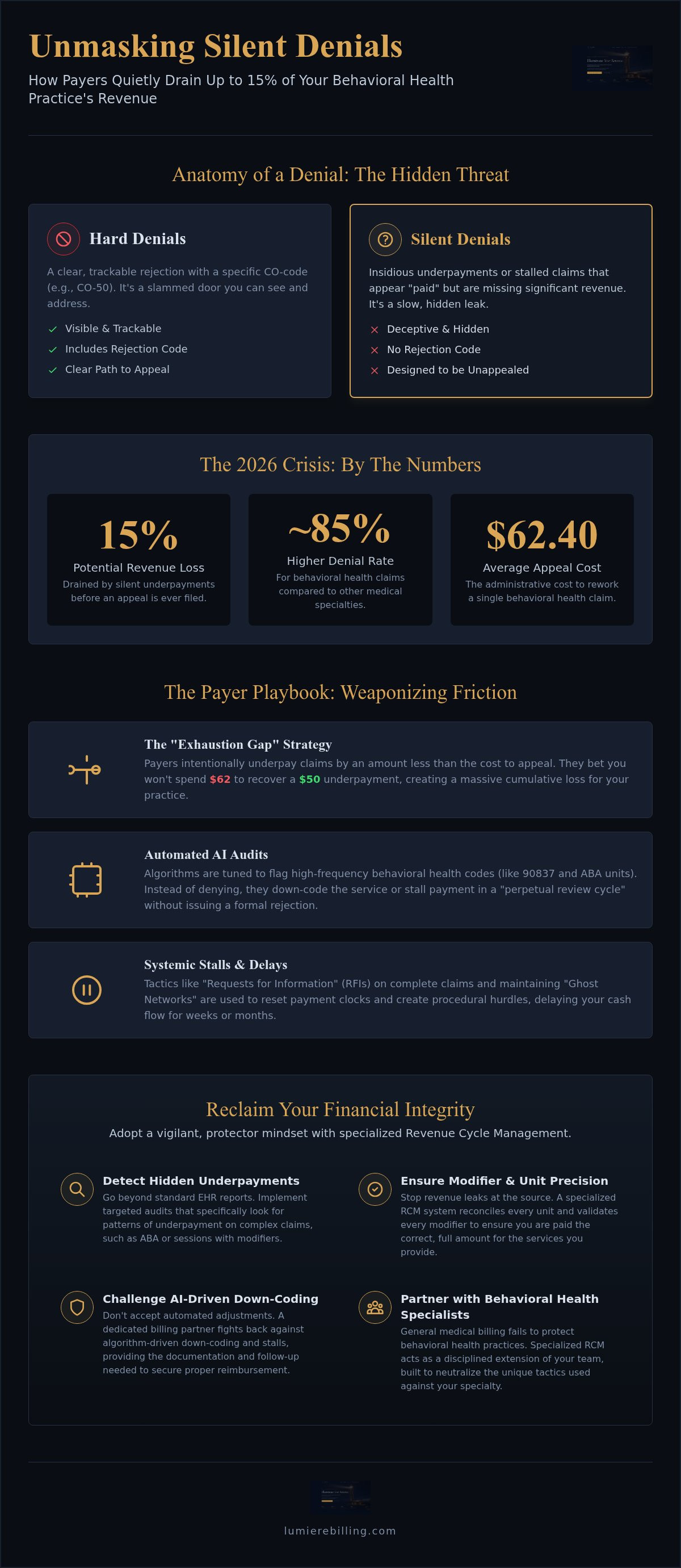
Silent denials aren't just errors. They represent a systematic erosion of your practice's financial health. While a hard denial arrives with a clear CO-code, such as CO-50 for medical necessity or CO-197 for a missing authorization, the silent denials behavioral health providers encounter are far more insidious. These occur when a claim is processed and ostensibly "paid," but the final amount reflects a strategic underpayment or a stalled status designed to induce administrative fatigue. This friction undermines your Revenue Cycle Management (RCM), shifting the burden of proof back onto your clinical staff for every missing dollar. Revenue Cycle Integrity isn't just a goal; it's the essential baseline required to sustain clinical operations in an increasingly hostile payer environment.
Hard Denials vs. Silent Underpayments
A hard denial is a door slammed shut. It's visible, trackable, and easily identifiable on a Remittance Advice. In contrast, silent underpayments act like a slow leak in a pressurized system. They often manifest as "ghost" payments where the payer ignores specific modifiers, such as those for telehealth or complex ABA unit increments, and pays only a base rate. This creates a deceptive sense of completion. You see a payment and move on, unaware that 15% of the earned revenue vanished because a modifier wasn't reconciled. Silent denials are the strategic erosion of revenue through unappealed underpayments.
The 2026 Behavioral Health Landscape
The landscape in 2026 is defined by the rise of AI-driven payer audits. These algorithms are specifically tuned to flag behavioral health claims, which now face denial rates 50-85% higher than other medical specialties. The reason is mechanical. Behavioral health relies on high-frequency sessions and intricate unit tracking that general billing systems simply aren't built to manage. ABA billing is particularly vulnerable to these silent denials behavioral health practices face. When an algorithm flags a 60-minute session for "documentation analysis," it doesn't always issue a formal rejection. It might simply down-code the claim or stall the payment in a perpetual review cycle. Without specialized oversight, these mechanical failures become permanent losses that drain your practice's ability to scale.
The Payer Playbook: How 'Exhaustion Gaps' and AI Algorithms Drive Revenue Leakage
Payers aren't simply making clerical errors. They are executing a calculated strategy designed to weaponize administrative friction against your practice. Central to this playbook is the "Exhaustion Gap." As of 2026, the average administrative cost to rework an appealed behavioral health claim has risen to $62.40. When a payer underpays a session by $40 or $50, they understand that the math works in their favor. Most practices won't spend $62 to reclaim $50. This strategic underpayment creates a massive cumulative loss that standard EHR reports often fail to capture. It's a primary driver of the silent denials behavioral health providers must navigate to remain solvent.
Beyond simple underpayments, payers utilize "Ghost Networks" and "Requests for Information" (RFI) to systematically stall cash flow. A Ghost Network creates a systemic denial by listing providers who are not actually accepting new patients or are no longer in-network, making it harder for legitimate claims to process through the correct channels. Meanwhile, an RFI serves as a tactical pause button. By requesting additional documentation for a claim that is already complete, the payer resets their internal clock and delays payment by weeks or months. If you suspect your practice is currently losing revenue to these invisible barriers, a comprehensive billing audit can illuminate exactly where your cash flow is being diverted.
Weaponizing Administrative Friction
In 2026, payers have moved beyond simple rejections to a model of "strategic silence." They complicate the reimbursement process by requiring multi-page treatment plans for routine services or subjecting providers to excessive hold times. These hurdles are not accidental. They are designed to create clinical burnout, forcing practitioners to choose between patient care and the bureaucratic labor required to get paid. When the administrative burden exceeds the practice's capacity, these silent denials become permanent revenue leakage.
AI-Driven Gatekeeping in 2026
The shift from human review to algorithmic gatekeeping has accelerated. Payers now deploy AI models to scan documentation for technical flaws. These systems use automated session-limit triggers to flag any provider whose coding patterns, like the frequent use of 90837, deviate from a narrow average. Instead of a clinical peer review, your claims are met with algorithmic rejections that prioritize "medical necessity" thresholds over patient needs. This turns billing into a mechanical gauntlet that only a specialized, vigilant RCM system can successfully navigate.
Quantifying the Damage: The 15% Revenue Drain and Its Clinical Consequences
Financial stability in behavioral health is under siege from a specific, measurable source. The silent denials behavioral health practices face often result in a 15% loss of gross revenue. This isn't a one-time hit. It's a persistent drain that compounds monthly, effectively capping your practice's ability to hire new clinicians or expand services. When you don't have a specialized Behavioral Health Revenue Cycle Management (RCM) strategy, these leaks remain invisible, hidden behind the "paid" status of your EHR reports. You are essentially working at a discount for payers who have perfected the art of the partial payment.
The Financial Impact of Modifier Errors
The 90837 CPT code is a frequent target for these silent underpayments. Payers often flag 60-minute sessions for documentation reviews or simply ignore the modifiers that justify the higher rate. Telehealth billing adds another layer of complexity. If a claim for a synchronous audio-video session lacks the -95 modifier, or if an audio-only session is missing modifier 93, the payer might down-code the claim to an office-visit rate without notifying you of the discrepancy. A single modifier error can reduce a claim’s value by 20-40% without triggering a hard denial. This creates a deceptive revenue cycle where you are working more for less, unaware that your clinical integrity is being devalued by a missing two-digit code.
The Clinical Toll of Back-Office Chaos
Revenue leakage isn't just a financial metric; it's a primary driver of clinician burnout. When back-office systems fail, the administrative burden inevitably shifts to the providers. Therapists find themselves spending hours on hold or rewriting treatment plans to satisfy arbitrary AI-driven criteria. This friction reduces the time spent with patients and erodes professional satisfaction. Over time, the instability of your cash flow makes it impossible to offer competitive therapist retention packages or invest in practice expansion. Choosing to outsource mental health billing to a specialized partner can insulate your clinicians from this bureaucratic noise, allowing them to focus on what matters most: the patients.
Strategic Oversight: Detecting Underpayments and Modifier Errors Before They Compound
Passive observation is the enemy of practice health. To combat the silent denials behavioral health providers face, you must adopt the mindset of a vigilant protector. This transition requires moving beyond standard EHR reporting, which often masks underpayments as "completed" transactions. True oversight involves a disciplined, mechanical review of every remittance to ensure that payer behavior aligns with your contracted fee schedules. If you aren't actively hunting for discrepancies, you're essentially permitting payers to dictate your practice's valuation. Precision is your only defense against the strategic erosion of your margins.
The Behavioral Health Billing Audit
A professional billing audit is not a general overview. It is a granular cross-reference of your Remittance Advices (RAs) against your specific fee schedules. When an insurer pays $140 for a 90837 session instead of the contracted $165, and no denial code appears, your system may flag it as paid. This is a silent leak. By identifying patterns in payer behavior, you can pinpoint which insurers are the primary offenders of these tactical underpayments. Specialized analytics bring visibility to these gaps, turning opaque data into actionable intelligence. This level of scrutiny is the first step toward plugging the leaks in your revenue cycle and reclaiming lost capital.
Mastering ABA and Mental Health Modifiers
ABA practices encounter a unique level of complexity that general medical billing cannot handle. Unit tracking is the primary failure point. If your clinicians provide eight units of 97153 but the payer only reimburses six, those missing units represent a silent denial that often goes unappealed. Reconciliation must occur at the unit level to be effective. Furthermore, multi-provider or multi-session days require precise modifier compliance to navigate automated payer filters. Without a disciplined approach to mastering ABA revenue cycle management, these technical nuances become permanent financial liabilities. You need a system that tracks every unit from the point of care to the final penny of reimbursement.
To stop the bleed, you need a specialized perspective that understands the "BS" of fighting AI-driven underpayments. Secure your practice's future by requesting a free billing audit today to expose the hidden leaks in your revenue stream.
Systemic Integrity: Implementing Specialized RCM to Neutralize Silent Denials
General medical billing is a broad-spectrum tool applied to a precision problem. It fails because it treats behavioral health like a standard office visit, ignoring the specific unit-tracking and modifier-logic requirements that drive reimbursement. To neutralize the silent denials behavioral health practices face, you need a system designed for the nuances of your craft. Specialized Revenue Cycle Management (RCM) acts as a disciplined extension of your clinical team, moving beyond simple data entry to provide comprehensive oversight. This shift from reactive denial management to proactive revenue protection ensures that your practice remains financially resilient against increasingly sophisticated payer tactics. We position ourselves as the innovator in this space, bringing hidden issues into focus before they can erode your margins.
Why Niche Expertise Matters
The distinction between a standard billing company and a revenue cycle partner is found in the level of integration. A generalist might get your claims out the door, but a specialized partner ensures they are paid correctly and completely. Lumiere Billing focuses on the entire lifecycle of a claim, starting long before a session occurs. We manage the complexities of CAQH profiles, credentialing, and enrollment to ensure your providers are correctly positioned within payer networks. By handling the rigorous authorization requirements at the source, we prevent denials before they can manifest. Our percentage-based fee structure aligns our incentives directly with your practice growth. We only succeed when your clinical integrity is fully reflected in your bank account. This model transforms the traditional administrative burden into a partnership focused on optimization and absolute visibility.
Next Steps: Reclaiming Your Revenue
The first step toward systemic integrity is identifying where your current system is failing. Most practices are unaware of their specific leakage points until they see the results of a professional audit. Establishing a workflow that prioritizes visibility and mechanical integrity allows you to stop the compounding 15% revenue drain. It involves a commitment to unit-level reconciliation and a refusal to accept the "strategic silence" of payers as a final answer. You deserve a partner that treats your financial health with the same level of focus that you bring to your patients. We bring the light of clarity to your back-office operations, repairing broken systems and securing your cash flow for long-term scaling.
Your practice's future depends on the strength of your back-office systems. Don't let your revenue vanish into the exhaustion gap created by insurance companies. Contact Lumiere Billing for a specialized revenue cycle audit and begin the process of reclaiming your clinical integrity today.
Securing Your Practice's Financial Future in a Hostile Payer Landscape
The landscape of 2026 demands more than just clerical accuracy; it requires a vigilant defense against the strategic erosion of your margins. We've explored how payers weaponize administrative friction and AI-driven filters to create an exhaustion gap that drains up to 15% of your gross revenue. These silent denials behavioral health providers encounter are not inevitable. They are mechanical failures that can be identified, reconciled, and corrected through specialized oversight.
By transitioning from reactive billing to proactive revenue protection, you insulate your clinicians from bureaucratic noise and stabilize your cash flow for sustainable growth. Lumiere Billing serves as an extension of your team, providing a specialized focus on ABA and mental health RCM that identifies the hidden leakage generalists consistently miss. You have the power to reclaim your practice's clinical integrity and financial health. Take the first step toward total visibility and mechanical precision today.
Request Your Free Behavioral Health Billing Audit
Frequently Asked Questions
What is a silent denial in behavioral health billing?
A silent denial occurs when a claim is processed and marked as paid but the actual reimbursement is lower than the contracted rate. Unlike hard denials with clear CO codes, these underpayments often pass through automated EHR systems completely unnoticed. They represent a strategic erosion of revenue. Payers exploit administrative friction to avoid paying the full value of clinical services rendered. This tactic effectively forces your practice to accept a discount for your essential clinical work.
How do I know if my practice is losing revenue to silent denials?
You can identify these leaks by cross-referencing your Remittance Advices against your specific payer fee schedules. If your net collection rate is dropping despite high claim acceptance, you're likely facing the silent denials behavioral health practices often overlook. Check your ABA unit counts. Discrepancies in these counts are clear indicators that your revenue cycle requires a more granular, mechanical level of oversight and reconciliation to protect your financial health.
Why are behavioral health claim denials higher than other medical specialties?
Behavioral health is uniquely targeted due to the high frequency of sessions and the complexity of time-based coding. Payers frequently use AI-driven audits to flag 90837 codes. It is a mechanical hurdle. Research from 2026 shows that these specialties face denial rates 50-85% higher than general medicine. The billing requirements for modifiers and concurrent sessions are far more intricate and prone to algorithmic rejection by automated systems that prioritize thresholds over patients.
What is the "exhaustion gap" in insurance appeals?
The exhaustion gap is the point where the administrative cost of appealing a claim exceeds the dollar value of the underpayment itself. In 2026, the average cost to rework a claim reached $62.40. Payers bet you won't fight back. They underpay by smaller amounts to discourage appeals. This tactical friction forces providers to abandon legitimate revenue, turning small underpayments into massive cumulative annual losses that standard reporting tools fail to catch.
Can a general medical billing company handle ABA or mental health claims?
General billing companies often lack the specialized knowledge required for behavioral health nuances like ABA unit tracking. They focus on high-volume, low-complexity claims. This means they miss the subtle underpayments that drive revenue leakage. A specialized RCM partner acts as an extension of your team. They possess the domain expertise to navigate complex authorization requirements and ensure every unit of care is fully reimbursed. This focus prevents the administrative burnout often caused by generalist oversights.
How does a billing audit help identify hidden revenue leakage?
A professional billing audit illuminates systemic failures by performing a deep-dive analysis of your historical claims data. It exposes patterns where specific payers consistently underpay certain codes or ignore justifiable modifiers. This process brings hidden issues into focus. It allows you to repair broken workflows and implement a more resilient revenue protection strategy that standard EHR reports simply cannot provide. It is the only way to see the leaks that are otherwise invisible to your staff.
What are the most common modifier errors in behavioral health?
Most errors involve telehealth modifiers like -95 or 93, as well as ABA-specific modifiers for concurrent care. If these two-digit codes are missing, payers often down-code the claim without triggering a formal rejection. It's a quiet loss. These mistakes are a primary source of silent denials behavioral health providers face, often resulting in a 15% loss of gross revenue if left uncorrected by a vigilant RCM partner. Precision is your only defense.
How can specialized RCM services improve my practice’s cash flow?
Specialized RCM services stabilize your cash flow by implementing proactive denial prevention and meticulous unit reconciliation. They handle the task of fighting AI-driven payer tactics. This reduces administrative friction. It allows your clinicians to focus entirely on patient care. This disciplined approach ensures that your practice captures every dollar earned, providing the financial stability and visibility necessary for scaling your operations effectively in a competitive and increasingly complex national market.
Frequently Asked Questions
A silent denial occurs when a claim is processed and marked as paid but the actual reimbursement is lower than the contracted rate. Unlike hard denials with clear CO codes, these underpayments often pass through automated EHR systems completely unnoticed. They represent a strategic erosion of revenue. Payers exploit administrative friction to avoid paying the full value of clinical services rendered. This tactic effectively forces your practice to accept a discount for your essential clinical work.
You can identify these leaks by cross-referencing your Remittance Advices against your specific payer fee schedules. If your net collection rate is dropping despite high claim acceptance, you're likely facing the silent denials behavioral health practices often overlook. Check your ABA unit counts. Discrepancies in these counts are clear indicators that your revenue cycle requires a more granular, mechanical level of oversight and reconciliation to protect your financial health.
Behavioral health is uniquely targeted due to the high frequency of sessions and the complexity of time-based coding. Payers frequently use AI-driven audits to flag 90837 codes. It is a mechanical hurdle. Research from 2026 shows that these specialties face denial rates 50-85% higher than general medicine. The billing requirements for modifiers and concurrent sessions are far more intricate and prone to algorithmic rejection by automated systems that prioritize thresholds over patients.
The exhaustion gap is the point where the administrative cost of appealing a claim exceeds the dollar value of the underpayment itself. In 2026, the average cost to rework a claim reached $62.40. Payers bet you won't fight back. They underpay by smaller amounts to discourage appeals. This tactical friction forces providers to abandon legitimate revenue, turning small underpayments into massive cumulative annual losses that standard reporting tools fail to catch.
General billing companies often lack the specialized knowledge required for behavioral health nuances like ABA unit tracking. They focus on high-volume, low-complexity claims. This means they miss the subtle underpayments that drive revenue leakage. A specialized RCM partner acts as an extension of your team. They possess the domain expertise to navigate complex authorization requirements and ensure every unit of care is fully reimbursed. This focus prevents the administrative burnout often caused by generalist oversights.
A professional billing audit illuminates systemic failures by performing a deep-dive analysis of your historical claims data. It exposes patterns where specific payers consistently underpay certain codes or ignore justifiable modifiers. This process brings hidden issues into focus. It allows you to repair broken workflows and implement a more resilient revenue protection strategy that standard EHR reports simply cannot provide. It is the only way to see the leaks that are otherwise invisible to your staff.
Most errors involve telehealth modifiers like -95 or 93, as well as ABA-specific modifiers for concurrent care. If these two-digit codes are missing, payers often down-code the claim without triggering a formal rejection. It's a quiet loss. These mistakes are a primary source of silent denials behavioral health providers face, often resulting in a 15% loss of gross revenue if left uncorrected by a vigilant RCM partner. Precision is your only defense.
Specialized RCM services stabilize your cash flow by implementing proactive denial prevention and meticulous unit reconciliation. They handle the task of fighting AI-driven payer tactics. This reduces administrative friction. It allows your clinicians to focus entirely on patient care. This disciplined approach ensures that your practice captures every dollar earned, providing the financial stability and visibility necessary for scaling your operations effectively in a competitive and increasingly complex national market.