Risk Management in Behavioral Health Billing: The 2026 Defensive Playbook

A paid claim does not guarantee retained revenue. Too often, it simply starts the clock on retrospective payer clawbacks. Real risk management behavioral health billing begins long before an electronic claim crosses a clearinghouse, yet many specialized practices remain trapped in reactive damage control. You know the daily friction intimately: tracking elusive prior authorizations, deciphering conflicting modifier mandates, and enduring the operational burnout that follows disputed time-based therapy codes. When commercial and Medicaid payers aggressively scrutinize claims, standard administrative habits aren't enough to preserve your margins.
Operating under the constant threat of post-payment recoupments drains clinical focus and destabilizes your foundation. It doesn't have to be this way. In this guide, you'll master proactive risk mitigation strategies designed to eliminate systemic billing vulnerabilities, neutralize audit triggers prior to submission, and protect practice solvency. Here is your operational playbook for fortifying clinical documentation, driving down days in accounts receivable, and engineering an audit-proof behavioral health revenue cycle.
Key Takeaways
- Proactive risk management behavioral health billing protects practice solvency by eliminating audit triggers before claims ever reach a payer clearinghouse.
- Systemic procedural missteps, particularly unmonitored authorization thresholds and mismatched time-based modifiers, cause the majority of unappealable denials and retrospective recoupments.
- Replacing reactive denial appeals with a structured pre-submission workflow insulates clinical documentation while driving down days in accounts receivable.
- Generalist billing clearinghouses frequently overlook nuanced mental health parity rules and documentation standards, making specialized operational oversight essential for long-term defense.
What Is Risk Management in Behavioral Health Billing?
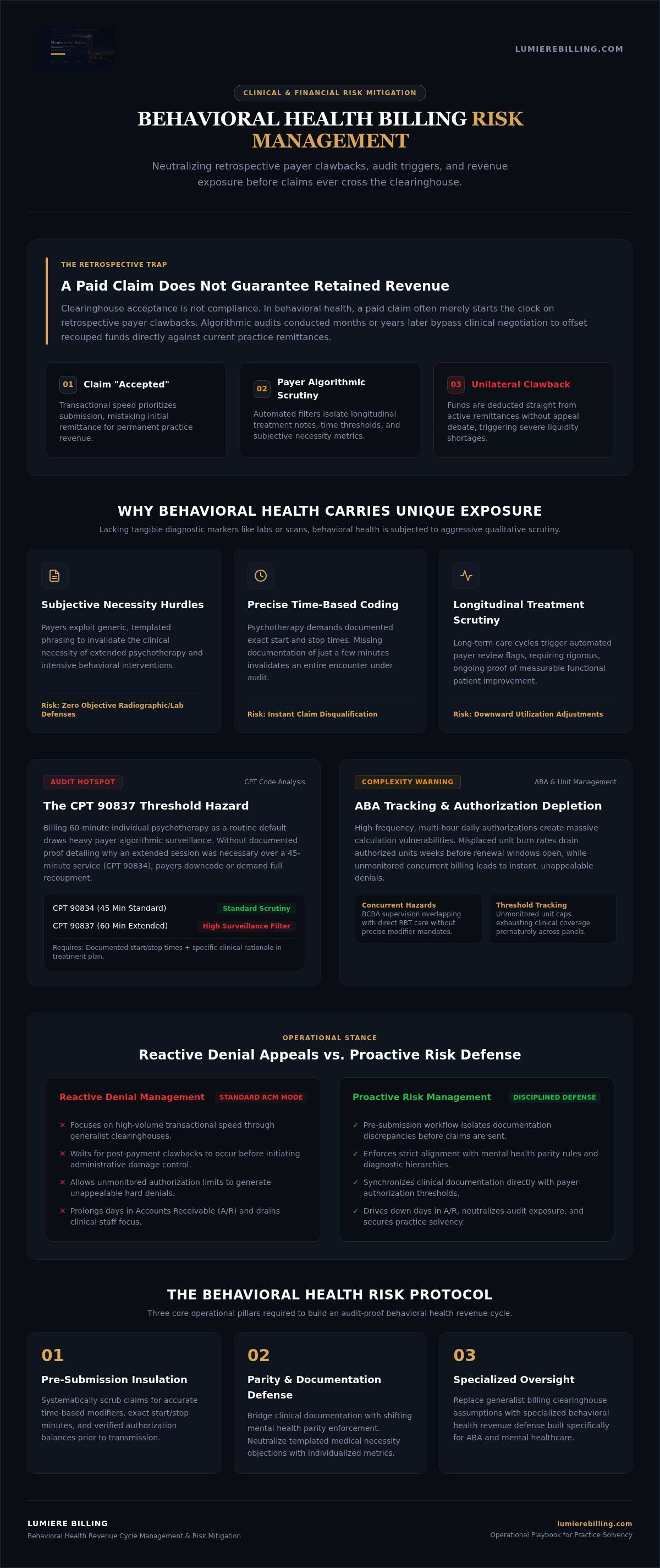
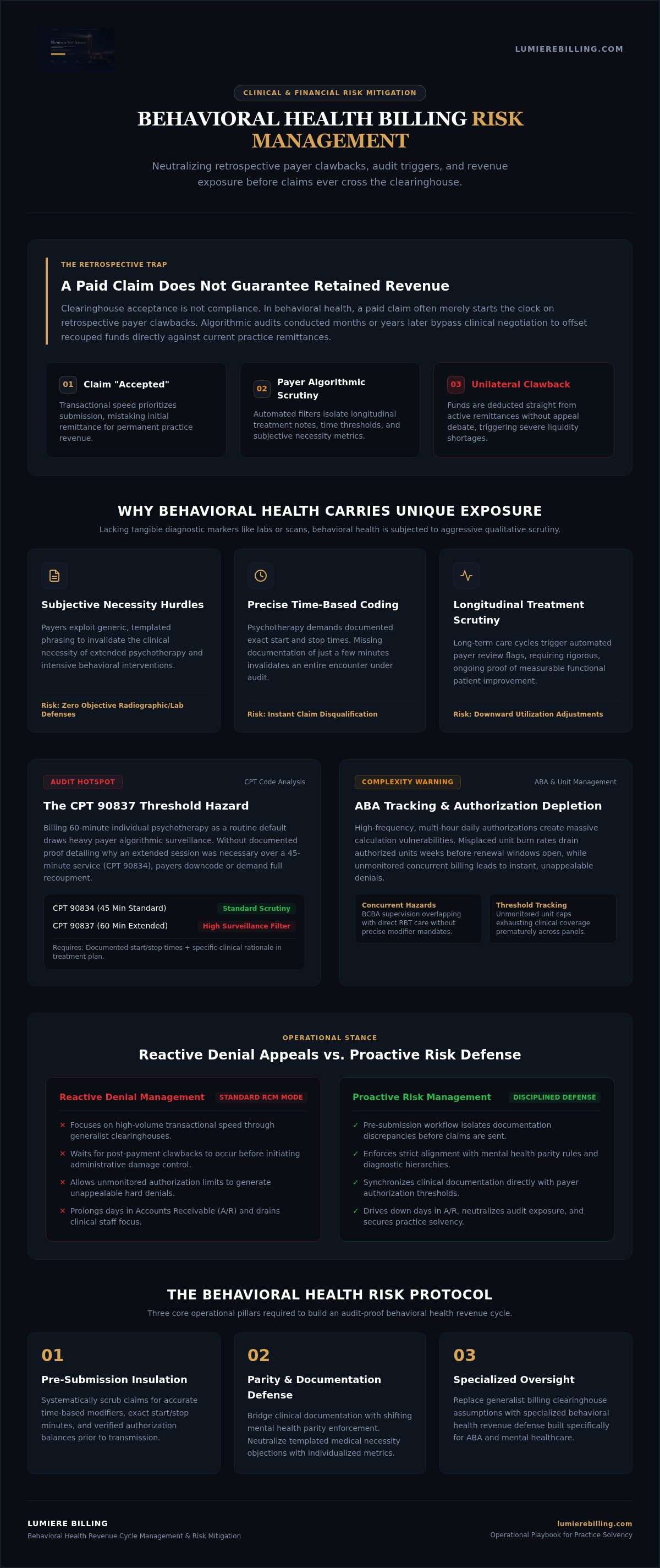
At its core, risk management behavioral health billing is the disciplined operational defense system that isolates and resolves documentation, coding, and authorization discrepancies before claims ever cross a clearinghouse, ensuring earned revenue remains safe from clawbacks. It rejects the passive assumption that clearinghouse acceptance equates to compliance. Instead, this defensive discipline bridges clinical care and financial integrity, serving as the protective spine of modern behavioral health revenue cycle management. While standard healthcare Revenue Cycle Management (RCM) often prioritizes transactional processing speed, proactive risk management protects solvency against aggressive payer scrutiny.
Mental healthcare does not operate like standard clinical medicine. Billing workflows must account for shifting parity enforcement, complex diagnostic hierarchies, and subjective treatment plans. When practices treat billing as mere clerical data entry, financial vulnerabilities spread quietly through the ledger. A robust risk posture repairs these operational leaks, aligning clinical documentation with exact payer expectations.
The Reality of Payer Audits and Post-Payment Recoupments
Commercial payers and Medicaid managed care programs routinely conduct retrospective audits months, or even years, after paying claims. If auditor algorithms detect flawed time entries or missing medical necessity criteria, payers don't debate the clinical intent. They initiate post-payment recoupments. Funds are offset against current remittances without prior negotiation. For high-utilization practices, these clawbacks quickly trigger severe liquidity shortages and operational paralysis.
Why Behavioral Health Carries Unique Reimbursement Exposure
Unlike surgical or diagnostic specialties, behavioral health lacks tangible objective markers like lab results or radiographic scans. Payer reviewers evaluate subjective progress notes to validate treatment efficacy. This qualitative reliance creates significant exposure:
- Subjective Necessity Hurdles: Payers exploit generic, templated phrasing to dispute the medical necessity of long-term psychotherapy and behavioral interventions.
- Precise Time-Based Coding: Psychotherapy codes require exact start and stop times. Missing documentation of a few minutes can invalidate an entire claim under audit review.
- Longitudinal Scrutiny: Extended treatment cycles draw automated payer flags, requiring defensible proof of measurable functional gains.
The Top Operational Vulnerabilities in Mental Health and ABA Billing
Revenue leaks in behavioral health rarely stem from simple typos or isolated administrative blunders. Instead, systemic procedural cracks quietly erode profitability. When clinical workflows run parallel to billing without tight synchronicity, unmonitored authorization thresholds generate instant, unappealable denials across commercial panels. Establishing proactive risk management behavioral health billing means identifying these operational blind spots before payers convert them into costly losses. Reviewing the most prevalent behavioral health billing errors to avoid helps expose structural vulnerabilities before submitting another claim batch.
Time-Based Coding Pitfalls and the 90837 Threshold
Routine utilization of CPT 90837 draws intense payer surveillance. Payers deploy algorithmic filters to isolate providers who bill 60-minute individual psychotherapy sessions as a default standard. Without documented, exact start and stop times, auditors downcode or claw back these reimbursements automatically. If a treatment plan fails to substantiate why an extended session was clinically necessary instead of a standard 45-minute service (CPT 90834), your practice absorbs the financial liability.
ABA Unit Tracking and Concurrent Billing Hazards
Applied Behavior Analysis (ABA) presents extreme operational complexity due to high-frequency, multi-hour daily authorizations. A single misplaced calculation can burn through authorized units weeks before a renewal period opens. Furthermore, concurrent billing between Board Certified Behavior Analysts (BCBAs) conducting supervision and Registered Behavior Technicians (RBTs) rendering direct therapy demands meticulous modifier application. Omitting these precise billing qualifiers triggers duplicate claim denials or immediate special investigation unit flags, leaving practices holding uncollectable balances.
Telehealth Modifiers and Provider Credentialing Gaps
Telehealth coding remains a volatile territory. Fluctuating place-of-service designations, such as POS 02 versus POS 10, combined with rapidly changing modifier expectations (like 95 or FQ), continually catch internal teams off guard. As detailed in the CMS guidelines on BHI services, strict procedural criteria govern non-face-to-face and integrated interventions. Compounding this friction is the credentialing lag. Billing an associate therapist's encounters under a fully licensed supervisor without explicit payer contract authorization constitutes billing fraud in the eyes of an auditor. Partnering with a dedicated specialist like Lumiere Billing keeps your provider rosters synchronized and eliminates these avoidable compliance exposures.
Reactive Denial Appeals vs. Proactive Risk Management: A Direct Comparison
Treating claim denials after they occur is an expensive operational trap. When practices depend entirely on reactive appeals, they bleed administrative bandwidth chasing revenue that should have been secured upfront. Reactive billing merely addresses symptoms, patching errors after cash flow has already stalled. Comprehensive risk management behavioral health billing, by contrast, re-engineers intake, verification, and documentation workflows to stop billing defects before submission. Practices caught in the reactive cycle lose significant net collections to silent denials, which internal teams eventually abandon as uncollectible write-offs due to fatigue. Evaluating your operational posture often reveals why leaders choose to outsource mental health billing to protect financial stability.
| Operational Dimension | Reactive Denial Appeals | Proactive Risk Management |
|---|---|---|
| Primary Focus | Post-adjudication dispute resolution | Pre-submission error elimination |
| Cash Flow Impact | Delayed, unpredictable remittances | Accelerated, steady daily cash flow |
| Staff Allocation | Burdened by repetitive manual appeals | Focused on patient care and operations |
| Audit Exposure | High; patterns alert payer algorithms | Low; documentation satisfies guidelines |
The Hidden Operational Costs of Chasing Denied Claims
Working a single disputed claim requires significant administrative time. Staff members sit on hold with payer representatives, track down missing medical necessity details, and reformat documentation for secondary reviews. Accounts receivable aging beyond 90 days face a sharp decline in ultimate collectability. Submitting repeated claim corrections signals operational disorganization to payer algorithms, frequently escalating automated audits into intrusive manual record requests.
Building an Upstream Defense to Safeguard Practice Solvency
Defensive revenue cycle management relocates operational control to the front door. Upstream verification identifies carved-out behavioral health managed care plans, exact co-insurance terms, and pre-authorization requirements prior to the first session. Scrubbing claims against active provider enrollment dates prevents out-of-network surprises. By shifting internal energy to upfront validation, practices dramatically lower rejection ratios, drive down days in accounts receivable, and protect clinical margins from retrospective clawbacks.
How to Build a Behavioral Health Billing Risk Management Protocol
An annual compliance review is dangerously obsolete in modern mental healthcare. Payers adjust utilization criteria continuously. To safeguard cash flow, practices must replace passive compliance policies with a disciplined four-phase operational workflow embedded directly into daily operations. Establishing this standard of proactive risk management behavioral health billing bridges the historical divide between clinical care and technical billing, illuminating documentation vulnerabilities long before an external health plan issues an audit demand.
Steps 1 & 2: Upfront Intake Verification and Clinical Alignment
Financial defense begins at the front desk before the patient ever enters the consultation room:
- Step 1: Execute Rigorous Intake Verification. Never assume previous coverage remains active. Front-office teams must re-verify active eligibility, deductible resets, behavioral health carve-outs, and pre-authorization limits before every monthly treatment cycle begins. Embed hard stop validations within your EHR workflow to block appointments from being scheduled when an authorization threshold is exhausted.
- Step 2: Train Clinicians on Documentation Integrity. Clinicians focus on patient care, not technical coding, yet their progress notes carry the legal burden of proof. Train staff to articulate medical necessity clearly, link progress directly to treatment goals, and document exact start and stop times rather than rounded session blocks.
Steps 3 & 4: Defensive Coding Audits and Routine Retrospective Reviews
Downstream verification acts as your final inspection line, catching mechanical and procedural errors before claim transmission:
- Step 3: Perform Pre-Submission Defensive Scrubbing. Screen every claim batch for accurate psychiatric modifiers, telehealth place-of-service designations, and cross-coverage rules. Standard clearinghouse edits check basic data syntax; defensive screening ensures medical and procedural logic align with payer guidelines.
- Step 4: Conduct Monthly Retrospective Self-Audits. Pull random samples of paid claims each month to evaluate documentation drift against actual reimbursements. Categorize denial root causes inside your practice management analytics to provide ongoing, targeted feedback to clinical and administrative teams.
Executing an airtight internal defense requires continuous vigilance. If you want an objective assessment of your operational vulnerabilities, request a Free Billing Audit with Lumiere Billing to isolate systemic leaks and protect practice solvency.
Eliminating Billing Exposure with a Specialized Behavioral Health Partner
Generalist billing companies treat mental health like routine family medicine. They push high claim volume through automated clearinghouses without understanding the clinical nuances underneath. Mental health parity laws, carved-out networks, and complex diagnostic structures demand dedicated domain expertise. Effective risk management behavioral health billing requires an integrated operational barrier, not an administrative clearinghouse that merely rubber-stamps submissions. Entrusting specialized therapy codes to non-specialized processors creates an ongoing vulnerability that payers eventually exploit.
The Limitations of Generalist Billing Services and Off-the-Shelf EHRs
Standard billing vendors and off-the-shelf practice management platforms promise automated efficiency, but they lack clinical context. They don't check whether progress notes substantiate the medical necessity of extended psychotherapy sessions or verify if concurrent ABA supervisory units meet strict payer guidelines. Software catches basic data syntax errors, yet it completely overlooks the documentation nuances that trigger retrospective clawbacks. Disconnected billing platforms cannot resolve complex provider enrollment timelines, allowing credentialing lapses to turn clean claims into immediate, unappealable write-offs.
Deploying Proactive Protection with Lumiere Billing
Lumiere Billing delivers specialized end-to-end Revenue Cycle Management engineered exclusively for behavioral health and ABA practices nationwide. Rather than functioning as a passive data processor, we operate as a vigilant operational partner. Our specialists conduct rigorous pre-claim audits, inspecting authorization thresholds, modifier precision, and documentation alignment before claims ever reach a payer clearinghouse. We bring hidden systemic leaks into clear focus and repair broken workflows at the source.
Through our comprehensive suite of services, including Credentialing & Enrollment, Practice Advisory, and Analytics & Compliance, we insulate your practice from aggressive commercial and Medicaid audits. Real financial protection doesn't come from chasing denials after they occur; it comes from preventing them through specialized clinical coding knowledge. By reinforcing your revenue cycle with disciplined risk management behavioral health billing protocols, we secure predictable cash flow and preserve your operating margins while your clinicians focus on delivering exceptional patient care.
Fortify Your Practice with Proactive Financial Defense
Retrospective payer audits and sudden clawbacks don't have to threaten your practice's survival. Shifting away from reactive denial appeals toward upfront benefit verification, documentation alignment, and disciplined pre-submission screening keeps your earned revenue where it belongs. Embedding structured risk management behavioral health billing into your daily operations ensures every claim reflects exact clinical necessity and easily withstands aggressive payer scrutiny.
Lumiere Billing specializes exclusively in behavioral health and ABA revenue cycles. We provide comprehensive end-to-end protection against payer clawbacks, backed by full-service credentialing, compliance analytics, and ongoing advisory support. You don't have to navigate complex payer tripwires alone or let administrative friction drain your team. Take charge of your financial health today: Request Your Free Behavioral Health Billing Audit to expose hidden vulnerabilities, eliminate revenue leaks, and build an enduring operational defense.
Frequently Asked Questions
What is risk management in behavioral health billing?
Risk management behavioral health billing is a proactive operational protocol designed to identify and resolve documentation gaps, authorization limits, and coding vulnerabilities before claims get submitted. Unlike basic transaction processing, it protects practice revenue against retrospective audits and post-payment clawbacks. It integrates front-desk insurance verification, clinical documentation integrity, and specialized coding defense into a continuous operational feedback loop that maintains practice cash flow and regulatory standing.
Why do commercial payers frequently audit CPT code 90837?
Commercial payers scrutinize CPT code 90837 because it represents the highest reimbursement tier for routine individual psychotherapy. Payer algorithms flag practices that bill this 60-minute code at disproportionately high ratios compared to standard 45-minute sessions (CPT 90834). Audits zero in on missing start and stop times, lack of documented medical necessity, or insufficient clinical justification explaining why an extended session was clinically warranted.
Can insurance companies claw back money already paid to mental health practices?
Yes, commercial and Medicaid payers routinely execute retrospective recoupments months or even years after issuing reimbursement. Following a post-payment audit, if an auditor determines that clinical documentation fails to substantiate medical necessity or proper time tracking, the payer issues a demand letter. They typically offset the clawback amount against future claim remittances automatically, creating immediate cash flow emergencies for unprepared practices.
How do billing errors impact behavioral health practice compliance?
Billing errors compromise compliance by establishing a documented pattern of non-adherence to payer contracts and federal guidelines. Frequent code discrepancies, misapplied telehealth modifiers, or unbundled concurrent units alert payer Special Investigation Units. Repeated administrative infractions transform routine clerical mistakes into formal fraud and abuse investigations, placing provider panel participation, clinical licenses, and total practice solvency at immediate operational risk.
What is the difference between a clearinghouse scrubber and a billing risk audit?
A clearinghouse scrubber merely checks technical syntax, verifying that standard fields contain valid alphanumeric characters and basic formatting. It cannot assess clinical validity. A specialized billing risk audit inspects the medical documentation behind the claim. It validates whether progress notes substantiate the billed CPT codes, verifies active pre-authorizations, checks supervisory modifier rules, and ensures full alignment with payer-specific medical policies before submission.
How often should a behavioral health practice conduct internal billing audits?
Behavioral health practices should conduct internal billing audits monthly using random sample reviews. Annual reviews occur too late to prevent systemic compounding errors. Monthly evaluations of paid claims allow clinical leadership to spot documentation drift, identify expiring pre-authorizations, and isolate modifier errors early. These regular audits provide the data needed to continually train clinicians and protect operations against external payer investigations.
Why are general medical billing services risky for behavioral health providers?
General medical billing services are risky because they apply family practice templates to complex mental health workflows. Generalists often miss behavioral health carve-outs, miscalculate multi-hour ABA unit allocations, and fail to track psychotherapy time thresholds. Without specialized risk management behavioral health billing expertise, generic billers overlook documentation flaws that satisfy basic clearinghouse checks but ultimately trigger devastating retrospective audits and clawbacks.
Frequently Asked Questions
Risk management behavioral health billing is a proactive operational protocol designed to identify and resolve documentation gaps, authorization limits, and coding vulnerabilities before claims get submitted. Unlike basic transaction processing, it protects practice revenue against retrospective audits and post-payment clawbacks. It integrates front-desk insurance verification, clinical documentation integrity, and specialized coding defense into a continuous operational feedback loop that maintains practice cash flow and regulatory standing.
Commercial payers scrutinize CPT code 90837 because it represents the highest reimbursement tier for routine individual psychotherapy. Payer algorithms flag practices that bill this 60-minute code at disproportionately high ratios compared to standard 45-minute sessions (CPT 90834). Audits zero in on missing start and stop times, lack of documented medical necessity, or insufficient clinical justification explaining why an extended session was clinically warranted.
Yes, commercial and Medicaid payers routinely execute retrospective recoupments months or even years after issuing reimbursement. Following a post-payment audit, if an auditor determines that clinical documentation fails to substantiate medical necessity or proper time tracking, the payer issues a demand letter. They typically offset the clawback amount against future claim remittances automatically, creating immediate cash flow emergencies for unprepared practices.
Billing errors compromise compliance by establishing a documented pattern of non-adherence to payer contracts and federal guidelines. Frequent code discrepancies, misapplied telehealth modifiers, or unbundled concurrent units alert payer Special Investigation Units. Repeated administrative infractions transform routine clerical mistakes into formal fraud and abuse investigations, placing provider panel participation, clinical licenses, and total practice solvency at immediate operational risk.
A clearinghouse scrubber merely checks technical syntax, verifying that standard fields contain valid alphanumeric characters and basic formatting. It cannot assess clinical validity. A specialized billing risk audit inspects the medical documentation behind the claim. It validates whether progress notes substantiate the billed CPT codes, verifies active pre-authorizations, checks supervisory modifier rules, and ensures full alignment with payer-specific medical policies before submission.
Behavioral health practices should conduct internal billing audits monthly using random sample reviews. Annual reviews occur too late to prevent systemic compounding errors. Monthly evaluations of paid claims allow clinical leadership to spot documentation drift, identify expiring pre-authorizations, and isolate modifier errors early. These regular audits provide the data needed to continually train clinicians and protect operations against external payer investigations.
General medical billing services are risky because they apply family practice templates to complex mental health workflows. Generalists often miss behavioral health carve-outs, miscalculate multi-hour ABA unit allocations, and fail to track psychotherapy time thresholds. Without specialized risk management behavioral health billing expertise, generic billers overlook documentation flaws that satisfy basic clearinghouse checks but ultimately trigger devastating retrospective audits and clawbacks.