Psychiatry Denial Management: 2026 Buyer’s Guide

How much of your hard-earned revenue is quietly vanishing into the void of "silent denials" that your team never even sees, let alone appeals? For most practitioners, the answer is a painful reality hidden behind a wall of administrative complexity. Effective denial management for psychiatry practices isn't just about resubmitting a rejected claim; it's about diagnosing a systemic failure in the clinical documentation process. You've likely felt the sting of medical necessity denials on complex E/M codes or the frustration of losing track of unit-based authorizations for intensive treatments.
We understand that your focus should be on patient outcomes, not fighting a losing battle with insurance payers. This 2026 Buyer’s Guide reveals how specialized oversight can plug these revenue leaks and optimize your collections through a proactive, rather than reactive, lens. You'll discover how to achieve full visibility into your billing performance and accelerate your accounts receivable turnover. We will explore the technical nuances of behavioral health billing, the power of practice analytics, and the exact criteria you need to evaluate a partner who acts as a vigilant protector of your financial health.
Key Takeaways
- Transition from reactive fixes to a proactive denial prevention strategy that addresses clinical documentation gaps at the source.
- Master the nuances of CPT code scrutiny, specifically payer downcoding of 90837 sessions.
- Learn why effective denial management for psychiatry practices requires specialized human expertise to navigate complex, unit-based authorizations.
- Identify the hidden financial impact of silent denials and discover how a billing audit uncovers lost revenue.
- Leverage analytics to gain transparency and accelerate turnover.
The Current State of Denial Management for Psychiatry Practices
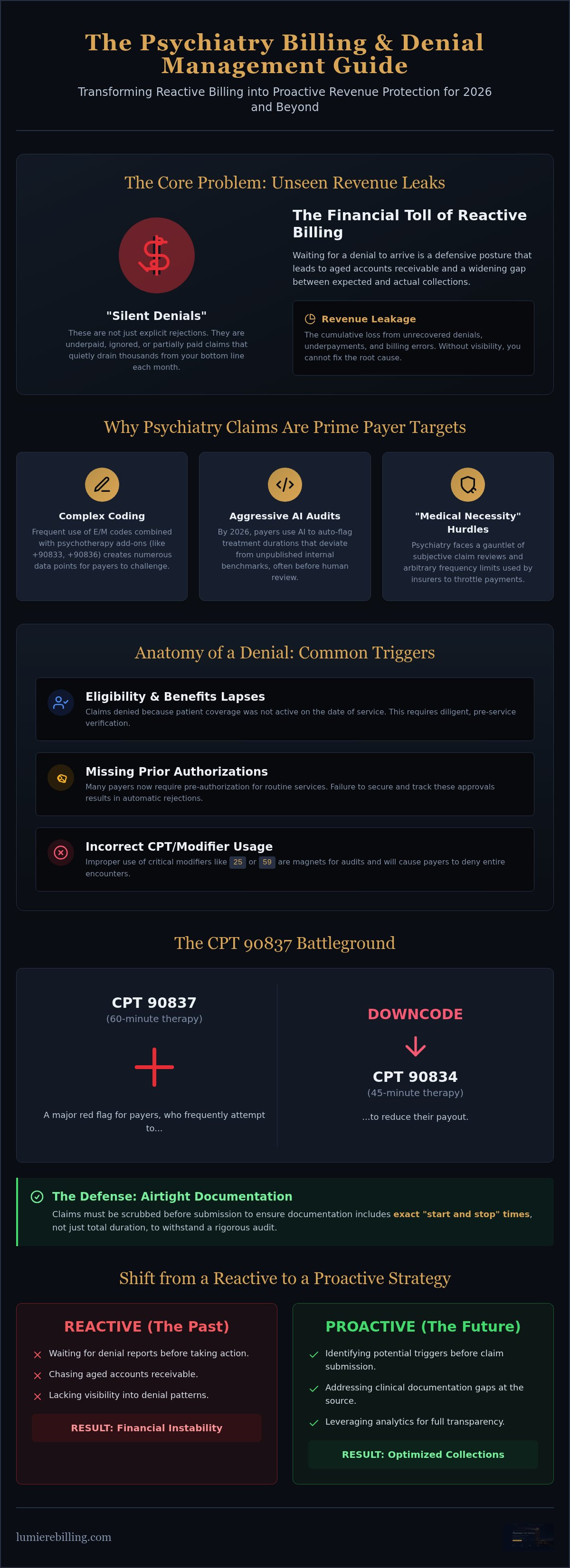
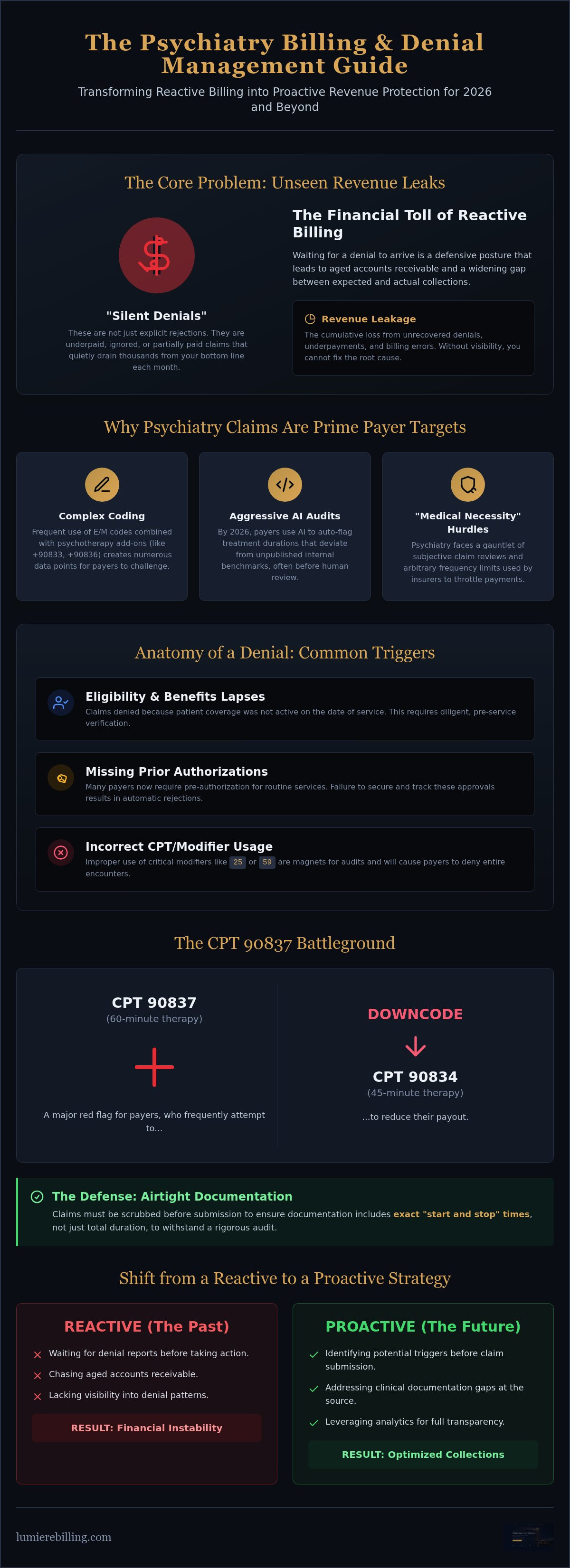
Denial management is the strategic process of identifying, appealing, and preventing rejected claims. It's the financial heartbeat of a modern practice. In the specialized field of psychiatry, this process is often the difference between a thriving clinic and one struggling to maintain operations. Unlike general medicine, psychiatry faces a gauntlet of subjective "medical necessity" hurdles and arbitrary frequency limits that insurers use to throttle payments. Poor oversight here doesn't just delay payment; it threatens the very sustainability of your practice. You're not just fighting for a single claim; you're defending the financial integrity of your entire organization.
We must also address the "silent denial" threat. These aren't always explicit rejections that show up on a clear report. Often, they are claims that are underpaid or simply ignored by the payer in the hope that your team won't notice. Without dedicated denial management for psychiatry practices, these subtle errors go unnoticed, slowly draining your financial resources. It's a quiet erosion of your bottom line that can amount to thousands of dollars in lost revenue every month. Visibility is the only cure for this systemic leak.
Why Psychiatry Claims are Unique Targets for Payers
Psychiatry is a prime target for payer scrutiny because of the inherent complexity of its billing codes. The frequent use of Evaluation and Management (E/M) codes combined with psychotherapy add-ons creates a high volume of data points for payers to challenge. It's a specialized coding language that generalist billers often misunderstand. By 2026, payers have pivoted toward aggressive, AI-driven automated audits. These systems flag treatment durations that deviate from narrow, often unpublished, internal benchmarks. If your documentation doesn't precisely mirror the payer's logic for long-term psychiatric care, the claim is flagged for denial before a human ever reviews the clinical context.
The Financial Toll of Reactive Billing
Relying on a reactive billing model is a recipe for financial instability. Waiting for a denial to arrive before taking action is a defensive posture that costs you time and money. Proactive denial prevention identifies potential triggers before a claim is even submitted. Many behavioral health billing errors to avoid, such as missing modifiers or incorrect authorization units, lead to cumulative revenue leakage. Revenue leakage is the gap between expected and actual collections due to unrecovered denials. When you lack visibility into these patterns, you can't fix the root cause. You're simply chasing your tail while your accounts receivable age out.
Common Triggers: Specialized CPT Codes and Payer Logic
Payers rely on a predictable set of triggers to stall your revenue. Most rejections stem from three main areas: eligibility lapses, missing prior authorizations, and specific coding errors. Understanding these failure points is the foundation of effective denial management for psychiatry practices. If your billing team treats a psychiatric claim like a standard medical claim, you're already at a disadvantage. Payer logic in 2026 is increasingly aggressive, using automated systems to flag high-value codes for immediate review or downcoding.
The successful submission of a claim requires a perfect alignment between clinical documentation and the level of service billed. Modifiers like 25 (significant, separately identifiable E/M service) or 59 (distinct procedural service) are critical tools. However, they are also magnets for audits. If you bill an E/M service alongside a psychotherapy add-on without the correct modifier, the payer will likely deny the entire encounter. Precision is not optional; it's a survival requirement. You can identify these vulnerabilities early by requesting a free billing audit to see where your current process is failing.
CPT 90837 vs. E/M Coding Scrutiny
The 60-minute therapy session (90837) remains a major red flag. Payers often attempt to downcode these to 90834 (45 minutes) to reduce their payout. To defend against this, your documentation must be airtight. You must record exact "start and stop" times, not just the total duration. Specialized RCM services prevent this downcoding by scrubbing claims for these specific time-stamps before they leave your desk. If the documentation doesn't support the 90837, the system flags it for correction, ensuring you only submit claims that can withstand a rigorous audit.
The Prior Authorization Bottleneck
By 2026, many payers have expanded authorization requirements to include routine psychiatric visits that were previously exempt. This creates a massive administrative bottleneck. We've seen that applying advanced ABA revenue cycle management strategies for unit-based tracking is highly effective for complex psychiatry cases. Just as ABA therapy requires meticulous tracking of authorized units, your psychiatry practice must proactively monitor authorization expiration dates and unit consumption. Failing to track these leads to "no-auth" denials that are nearly impossible to appeal successfully. Proactive tracking ensures you never provide a service that hasn't already been financially cleared.
Evaluating Solutions: Software Automation vs. Specialized RCM Services
Choosing the right infrastructure for your revenue cycle is a pivotal decision. Most practices oscillate between three options: maintaining an in-house team, utilizing general medical billing software, or partnering with specialized behavioral health RCM services. While software-only solutions promise automation and lower upfront costs, they often mask a significant "hidden cost." When a system flags a technical error but cannot interpret the clinical reason behind a denial, that burden falls back on the clinician. Every hour a psychiatrist spends deciphering payer codes is an hour lost to patient care. Effective denial management for psychiatry practices requires more than a digital tool; it demands a strategic partner who understands the clinical nuances of the work.
Specialized RCM services typically operate on a percentage-based fee structure. This model creates a proactive partnership where the billing provider only succeeds when the practice gets paid. It shifts the focus from simple claim submission to aggressive denial recovery. Is specialized RCM worth the investment? When you consider the recovery of "silent denials" and the reduction in aged accounts receivable, the service often pays for itself by reclaiming revenue that would otherwise be abandoned. It's an investment in mechanical integrity for your practice's financial engine.
The Limitations of Generic Medical Billing
Generalist billing services often struggle with the shifting landscape of psychiatry-specific regulations. They frequently overlook telehealth parity laws or state-specific frequency limits for psychotherapy. Without deep domain expertise, these generalists cannot effectively engage in specialist-to-specialist communication during the appeal process. They lack the clinical vocabulary to argue against a medical necessity denial. For those weighing their options, our strategic guide to outsourcing mental health billing provides a framework for identifying a partner who actually understands your specialty.
Human Expertise vs. AI Automation
AI automation is excellent at catching technical omissions, such as a missing NPI or an invalid zip code. However, AI cannot yet construct a persuasive argument for clinical necessity. A dedicated billing specialist acts as a vigilant protector, navigating the complex web of payer contracts to find the specific clause that justifies your treatment plan. In our view, a "Clean Claim" in psychiatry is not just one that passes a technical scrubber. It's a claim that is both technically flawless and clinically justified. Humans provide the insight; software provides the speed. You need both to achieve total visibility into your billing performance.
Strategic Framework for Minimizing Revenue Leakage
Stopping revenue leakage requires a methodical, five-step approach that moves your practice from a defensive posture to a proactive one. First, conduct a comprehensive billing audit to identify recurring denial patterns across your specific payer mix. You can't fix a leak you haven't located. Second, implement rigorous insurance verification protocols that happen 48 hours before the patient is seen. Eligibility is a moving target in 2026. Third, train your clinicians on documentation standards that explicitly support high-level CPT codes. Fourth, establish a strict 24 to 48 hour turnaround for all denial appeals. Speed is your greatest ally when fighting payer tactics. Finally, utilize real-time dashboards to monitor key performance indicators like Days in AR. This framework ensures that denial management for psychiatry practices is a controlled, repeatable process rather than a series of administrative emergencies.
The Power of Practice Analytics
Visibility into denial trends allows you to implement systemic fixes rather than wasting time on one-off appeals. If a specific payer consistently denies a certain code, the data will reveal the trend, allowing you to adjust your submission logic before the next claim leaves your desk. This insight also highlights the value of mental health provider credentialing, as many "not-enrolled" denials are simply administrative oversights that should have been caught during onboarding. A KPI dashboard is the "early warning system" for a psychiatry practice’s financial health.
Documentation as a Defense
Your clinical notes are your primary defense against aggressive payer audits. To improve accuracy without increasing administrative burden, focus on capturing specific behavioral observations and measurable progress goals that justify the level of service billed. "Audit-proof" documentation is the cornerstone of successful denial management for psychiatry practices. Specialized RCM partners act as an extension of your team, providing direct, actionable feedback to clinicians to bridge the gap between treatment and billing. This feedback loop ensures your documentation remains sharp and your claims remain defensible against even the most rigorous automated reviews. Ready to identify your practice's hidden leaks? Schedule your free billing audit today to secure your revenue cycle.
Optimizing Psychiatry Collections with Lumiere Billing
Lumiere Billing isn't a generalist operation trying to force psychiatric claims into a one-size-fits-all medical template. We act as a specialized extension of your psychiatry practice team, bringing a level of focus that is exclusively dedicated to behavioral health. This mastery allows us to navigate the complex payer logic that often leads to revenue loss in generalist settings. Our approach to denial management for psychiatry practices focuses on mechanical integrity; we don't just process claims, we optimize the entire revenue cycle from initial verification to final payment. By positioning ourselves as your dedicated partner, we remove the burden of complex back-office operations through meticulous attention to detail.
The Lumiere Advantage is built on proactive oversight rather than reactive fixes. We manage the high-friction areas of insurance verification and prior authorization to stop denials before they ever reach a payer's system. When a rejection does occur, our recovery team is assertive and precise. Because our business model relies on a percentage-based fee structure, we only succeed when you do. This aligns our incentives perfectly with your practice's growth, driving us to recover every dollar, including those "silent denials" that often go unnoticed. We provide the visibility you need to protect your financial health.
Why a Free Billing Audit is the First Step
Understanding the true state of your revenue cycle requires a deep diagnostic look. Our free billing audit uncovers the subtle failure points that lead to revenue leakage, such as missed modifiers, un-appealed denials, and credentialing gaps. This process is completely no-risk for psychiatry practices, providing a transparent roadmap for repairing your billing systems without any upfront cost. It brings hidden issues into focus, allowing you to see the immediate potential for increased collections. Schedule your free psychiatry billing audit today to begin securing your practice's financial future.
Beyond Billing: Practice Advisory and Scaling
We support your growth far beyond simple claim submission. As your practice scales to multi-location operations, our advisory services provide the strategic guidance needed to maintain efficiency. We offer specialized expertise in EHR optimization for platforms like TherapyNotes and other leading behavioral health systems, ensuring your clinical workflow supports your billing goals. Our commitment to transparency is reflected in the custom analytics we provide, giving you full visibility into your performance metrics. We value precision and partnership, helping you build a disciplined, scalable practice that prioritizes both patient care and financial stability.
Securing Your Practice’s Financial Future
The landscape of behavioral health billing is shifting toward aggressive automation and tighter scrutiny. Navigating this environment requires more than just a software tool; it demands a strategic partner who understands the clinical heartbeat of your work. By implementing a proactive framework and leveraging specialized human expertise, you can transform your revenue cycle from a source of stress into an engine of growth. Effective denial management for psychiatry practices is about more than just recovering lost funds. It's about gaining total visibility and control over your financial health.
Lumiere Billing acts as a vigilant protector of your collections. Our exclusively behavioral health focus ensures that your claims are handled with the precision they deserve. Because we use a percentage-based fee structure, we only get paid when you do, ensuring our incentives are perfectly aligned with your recovery goals. We provide the comprehensive practice analytics you need to bring hidden issues into focus. Take the first step toward plugging your revenue leaks today.
Request a Free Billing Audit for Your Psychiatry Practice
You have the clinical mastery to change lives. Let us provide the financial mastery to sustain and scale your vital mission.
Frequently Asked Questions
What are the most common denial reasons for psychiatry practices in 2026?
The most frequent triggers include expired prior authorizations and eligibility changes that occur mid-treatment. Payers often flag claims for medical necessity review if the documentation doesn't explicitly justify long-term care or frequent visits. By 2026, automated audits have also increased rejections for missing or incorrect modifiers, such as 25 or 59, which are essential for identifying separate services. Understanding these patterns is key to effective denial management for psychiatry practices.
How does Lumiere Billing handle medical necessity denials for E/M codes?
We tackle medical necessity denials through a clinical lens rather than a purely technical one. Our team uses deep domain expertise to review your documentation and identify the specific clinical markers that justify the level of service billed. We then construct persuasive appeals that speak the payer's clinical language. This process includes providing direct feedback to your clinicians to ensure future notes are audit-proof and meet the strict criteria required for high-level E/M reimbursement.
Can specialized denial management help with "silent denials"?
Yes, specialized oversight is the only effective way to catch "silent denials." These occur when a payer underpays a claim or ignores it without an explicit rejection. We use custom analytics and real-time dashboards to bring these hidden issues into focus. By comparing expected versus actual collections, we identify these systemic leaks and aggressively pursue the remaining balance, ensuring no revenue is quietly abandoned due to administrative oversight or subtle payer processing errors.
What is the difference between a billing service and a denial management specialist?
A general billing service focuses on the technical submission of claims, often treating psychiatry like any other medical specialty. A denial management specialist provides a proactive partnership that emphasizes prevention and strategic recovery. We don't just process rejections; we analyze the root cause of every failure point. Our focus is on clinical nuance, payer-specific logic, and the aggressive pursuit of every dollar, which generalists often overlook due to a lack of specialization.
How long does it typically take to appeal a denied psychiatry claim?
Our internal standard is to initiate an appeal within 24 to 48 hours of receiving a denial notification. While we cannot control the speed of the insurance payer's review, our rapid response prevents claims from aging out or falling into the "silent denial" void. Consistent follow-up and clinical justification often lead to faster resolutions. We track every appeal through our analytics platform, providing you with total visibility into the status of your accounts receivable.
Do I need to change my EHR to work with a denial management partner?
You don't need to switch your software to partner with us. We possess deep expertise in optimizing behavioral health EHRs, including TherapyNotes and other leading industry platforms. Our team integrates seamlessly into your existing workflow, acting as an extension of your practice rather than a disruptive external force. We focus on enhancing your current system's efficiency by identifying where technical gaps in your EHR might be contributing to recurring claim rejections or documentation errors.
How does a percentage-based fee structure benefit my psychiatry practice?
A percentage-based fee structure ensures that our incentives are perfectly aligned with your practice's financial success. Since we only get paid when you receive your collections, we are motivated to pursue even the most complex or low-value denials. This model eliminates the risk of paying for administrative tasks that don't result in actual revenue. It transforms our relationship into a proactive partnership where we are equally invested in denial management for psychiatry practices.
What information is required for a free billing audit?
To perform a free billing audit, we typically require access to a representative sample of your recent claims data and corresponding remittance advice. This allows us to identify existing revenue leakage, missed modifiers, and unrecovered denials. The process is secure and designed to be non-intrusive. We use this data to provide a transparent diagnostic report, showing you exactly where your current workflow is failing and how specialized oversight can repair those systems.
Frequently Asked Questions
The most frequent triggers include expired prior authorizations and eligibility changes that occur mid-treatment. Payers often flag claims for medical necessity review if the documentation doesn't explicitly justify long-term care or frequent visits. By 2026, automated audits have also increased rejections for missing or incorrect modifiers, such as 25 or 59, which are essential for identifying separate services. Understanding these patterns is key to effective denial management for psychiatry practices.
We tackle medical necessity denials through a clinical lens rather than a purely technical one. Our team uses deep domain expertise to review your documentation and identify the specific clinical markers that justify the level of service billed. We then construct persuasive appeals that speak the payer's clinical language. This process includes providing direct feedback to your clinicians to ensure future notes are audit-proof and meet the strict criteria required for high-level E/M reimbursement.
Yes, specialized oversight is the only effective way to catch "silent denials." These occur when a payer underpays a claim or ignores it without an explicit rejection. We use custom analytics and real-time dashboards to bring these hidden issues into focus. By comparing expected versus actual collections, we identify these systemic leaks and aggressively pursue the remaining balance, ensuring no revenue is quietly abandoned due to administrative oversight or subtle payer processing errors.
A general billing service focuses on the technical submission of claims, often treating psychiatry like any other medical specialty. A denial management specialist provides a proactive partnership that emphasizes prevention and strategic recovery. We don't just process rejections; we analyze the root cause of every failure point. Our focus is on clinical nuance, payer-specific logic, and the aggressive pursuit of every dollar, which generalists often overlook due to a lack of specialization.
Our internal standard is to initiate an appeal within 24 to 48 hours of receiving a denial notification. While we cannot control the speed of the insurance payer's review, our rapid response prevents claims from aging out or falling into the "silent denial" void. Consistent follow-up and clinical justification often lead to faster resolutions. We track every appeal through our analytics platform, providing you with total visibility into the status of your accounts receivable.
You don't need to switch your software to partner with us. We possess deep expertise in optimizing behavioral health EHRs, including TherapyNotes and other leading industry platforms. Our team integrates seamlessly into your existing workflow, acting as an extension of your practice rather than a disruptive external force. We focus on enhancing your current system's efficiency by identifying where technical gaps in your EHR might be contributing to recurring claim rejections or documentation errors.
A percentage-based fee structure ensures that our incentives are perfectly aligned with your practice's financial success. Since we only get paid when you receive your collections, we are motivated to pursue even the most complex or low-value denials. This model eliminates the risk of paying for administrative tasks that don't result in actual revenue. It transforms our relationship into a proactive partnership where we are equally invested in denial management for psychiatry practices.
To perform a free billing audit, we typically require access to a representative sample of your recent claims data and corresponding remittance advice. This allows us to identify existing revenue leakage, missed modifiers, and unrecovered denials. The process is secure and designed to be non-intrusive. We use this data to provide a transparent diagnostic report, showing you exactly where your current workflow is failing and how specialized oversight can repair those systems.