Optimize Behavioral Health Clean Claims for Faster AR

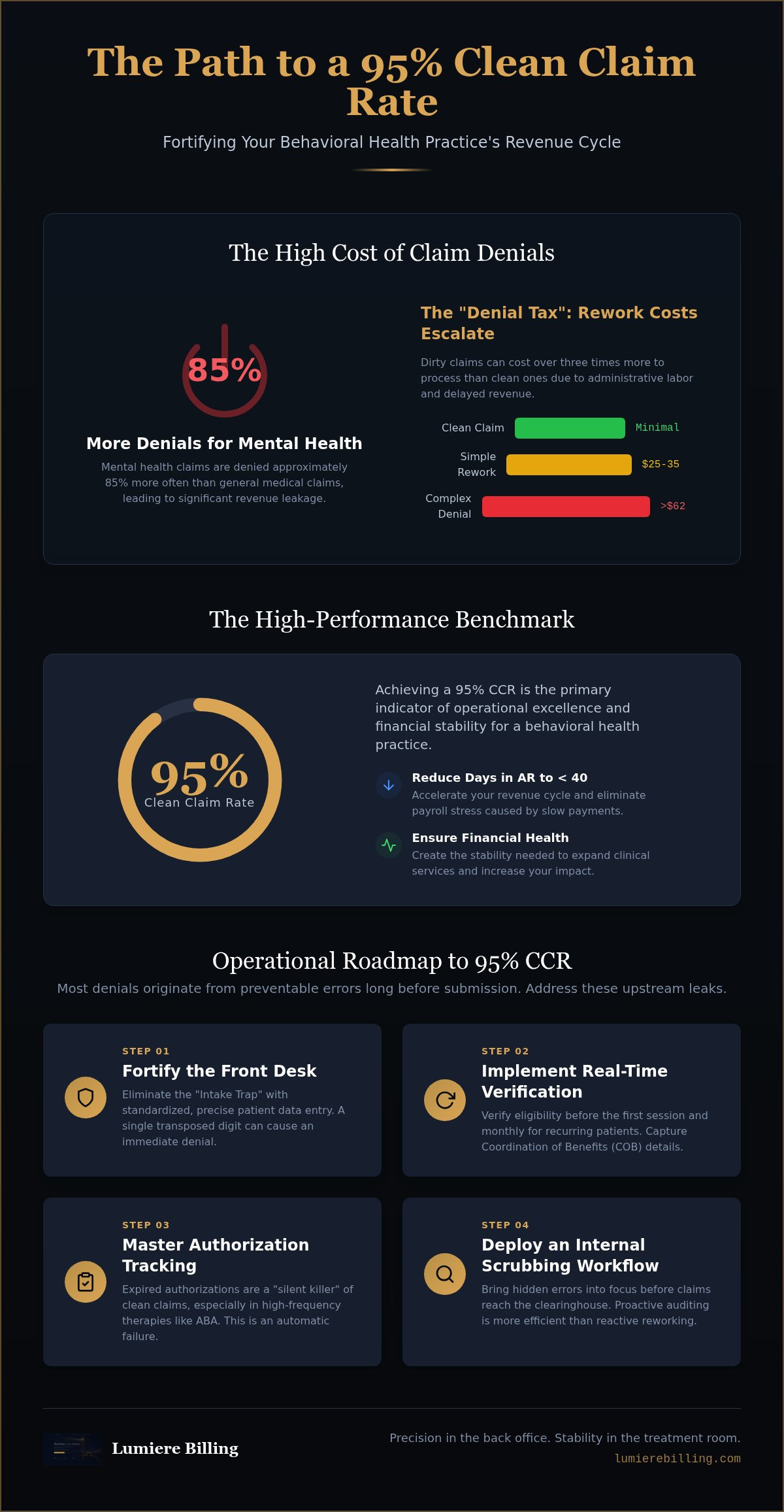
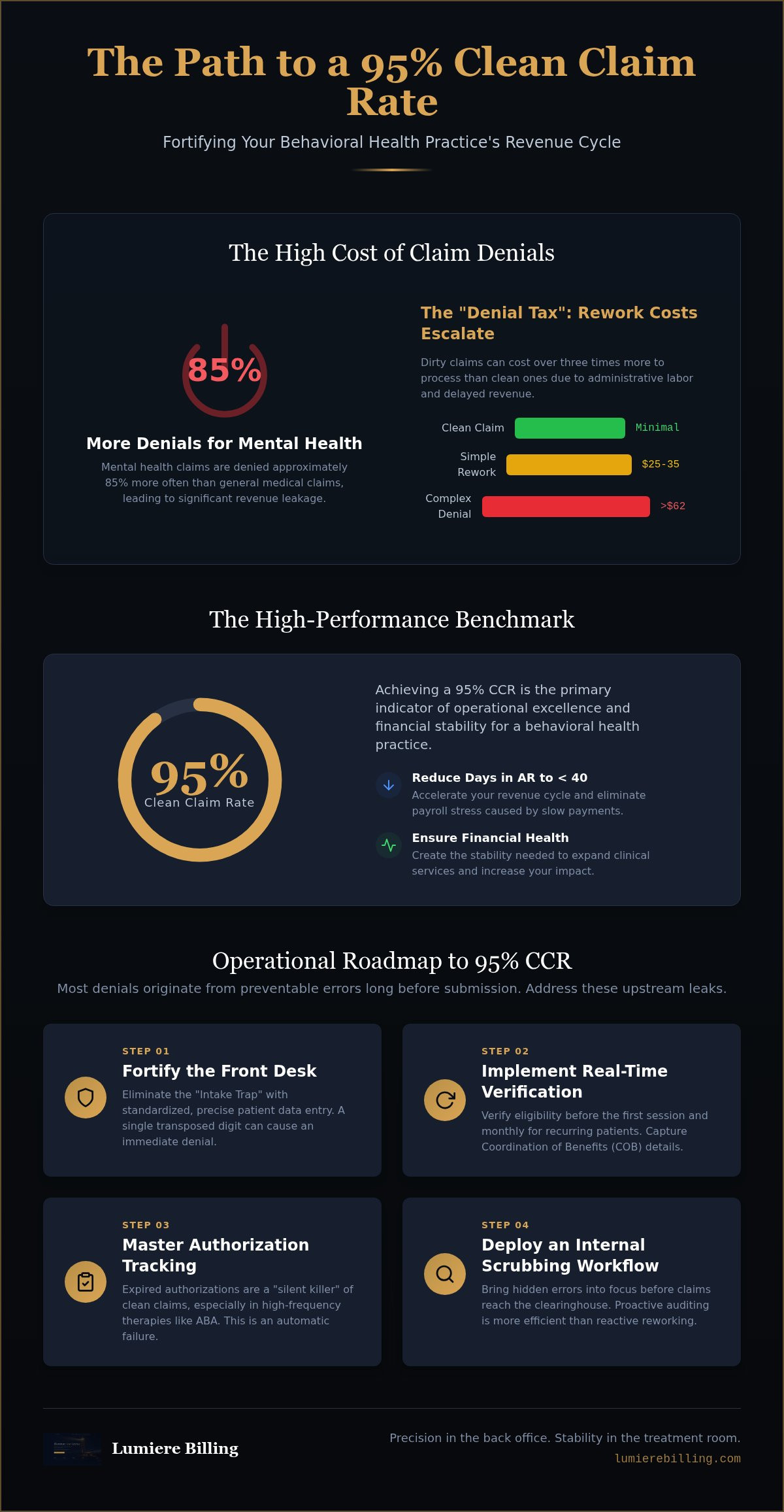
Mental health claims are denied approximately 85% more often than general medical claims. This discrepancy forces many practices to settle for a behavioral health clean claim rate that hovers in a danger zone, far below the 95% high-performance benchmark. You've likely experienced the fallout: payroll stress caused by slow AR cycles and the relentless complexity of ABA unit tracking. It's a systemic failure where simple administrative errors act as silent leaks, draining the revenue your clinical team worked hard to generate.
We believe that precision in the back office is just as vital as precision in the treatment room. You deserve a billing workflow that operates with total visibility and mechanical integrity. This article provides the exact tactical steps to audit your current systems, reclaim your lost revenue, and achieve a 95% clean claim rate. We'll explore how to reduce your days in AR to under 40 by streamlining everything from initial intake to final payment, ensuring your practice has the financial stability to expand its impact.
Key Takeaways
- Stop paying the "denial tax" by identifying why rejected claims cost significantly more to process than those accepted on the first pass.
- Secure your revenue at the front desk by eliminating the "Intake Trap" through standardized insurance verification and precise patient data entry.
- Benchmark your practice’s performance against 2026 industry standards to target a behavioral health clean claim rate of 95% or higher.
- Deploy an internal scrubbing workflow to bring hidden errors into focus before they reach the clearinghouse.
- Leverage specialized expertise to repair broken systems in ABA unit tracking and ensure your revenue cycle supports long-term clinical growth.
The Critical Link Between Clean Claim Rates and Behavioral Health AR
The financial health of your practice is visible in your data. Specifically, it's visible in the behavioral health clean claim rate. This figure represents the percentage of claims paid upon first submission, moving through the payer's system without rejection or manual intervention. In the specialized world of RCM, a clean claim is the primary indicator of operational excellence. By 2026, payers have transitioned to highly aggressive, automated scrubbing systems. These AI-driven tools identify even the smallest discrepancies in modifiers or unit counts, triggering immediate rejections that stall your cash flow.
Failing to hit precision targets results in what we call the "Denial Tax." While a simple coding fix might cost $25 to $35 in administrative labor, a complex behavioral health denial can cost over $62 to rework. When you factor in the time spent on phone calls and the opportunity cost of delayed revenue, dirty claims often cost three times more to process than clean ones. High-performing clinics maintain a CCR of 95% or higher. Falling below this benchmark creates a cascade of payroll stress and administrative friction that prevents you from scaling your clinical services.
Calculating Your Practice's Current CCR
CCR is the primary metric for revenue cycle integrity. To calculate your current performance, use this formula: (Total Clean Claims / Total Claims Submitted) x 100. You can usually find the necessary data within the billing or clearinghouse reports of specialized behavioral health practice management systems. Look for "First-Pass Acceptance" or "Clearinghouse Status" reports to extract these figures. Monitoring this monthly brings systemic failures into focus, allowing you to repair leaks before they become crises.
Why CCR Matters More in Behavioral Health
Behavioral health billing is inherently more complex than general medicine. You don't just bill for a procedure; you manage time-based CPT codes, multi-tiered authorizations, and the "Golden Thread" of documentation. Under the Mental Health Parity and Addiction Equity Act (MHPAEA), there's increased scrutiny on how mental health claims are processed. Payers now use natural language processing to scan for cloned notes and missing functional language. A low behavioral health clean claim rate often masks "silent denials." These are claims trapped in a cycle of requests for information, leading to long-term revenue leakage that is difficult to recover without specialized oversight.
Identifying Upstream Leakage: Why Claims Fail Before Submission
A high behavioral health clean claim rate is won or lost long before a biller clicks "submit." Most rejections originate at the point of intake. We call this the "Intake Trap." A single transposed digit in a member ID or a misspelled name creates an immediate mismatch in the payer's database. These administrative oversights are the primary drivers of revenue leakage. They aren't just errors; they're systemic failures that signal a lack of oversight. Technical denials also stem from provider roster neglect. If a new clinician starts seeing patients before their enrollment is finalized, every claim they generate will fail. Maintaining a disciplined approach to Mastering CAQH Enrollment: 2026 Behavioral Health Guide ensures your providers are visible to payers from day one.
The Insurance Verification Bottleneck
Real-time verification is the only way to safeguard your AR. Relying on an "active" status from a month ago is a gamble. In 2026, patient coverage changes frequently due to job transitions or plan updates. You must verify eligibility before every initial session and monthly for recurring patients. This process must also capture Coordination of Benefits (COB) details. If a patient has secondary insurance and the billing order is incorrect, the claim will be rejected immediately. This is a common failure point in mental health where patients often have coverage through multiple employers or family members. If your front-office staff is overwhelmed by these administrative demands, a Free Billing Audit can help identify exactly where your current workflow is leaking revenue.
Authorization and Unit Reconciliation
In ABA and other high-frequency therapies, authorization tracking is the "silent killer" of clean claims. An expired authorization is an automatic claim failure regardless of clinical quality. You cannot rely on manual spreadsheets to track thousands of units across dozens of patients. A proactive renewal strategy requires at least a 30-day lead time. This window ensures that re-evaluations are completed and new authorizations are secured before current units are exhausted. Without this mechanical precision, your behavioral health clean claim rate will inevitably plummet as authorizations lapse mid-treatment. It's about moving from a reactive stance to a proactive partnership with your payers.
Benchmarking CCR: Evaluating Your Practice Against 2026 Industry Standards
Benchmarking isn't just about comparison. It's about visibility. In the current landscape, a high-performing behavioral health clean claim rate stands at 95% or higher. Anything less indicates systemic friction that will eventually stall your growth. For solo practitioners, a single denial is a nuisance; for large group practices, a 2% drop in CCR across multiple locations represents a massive, compounding revenue leak. This drop is rarely a fluke. It's a signal that your front-end intake or back-end scrubbing has lost its mechanical integrity. High CCR directly correlates with a superior Net Collection Rate (NCR), ensuring that the money you "earn" on paper actually lands in your bank account.
The 2026 Behavioral Health KPI Dashboard
To evaluate your practice, you must move beyond surface-level metrics. Use these 2026 benchmarks to categorize your performance:
- Healthy: 95%+ CCR, Denial Rate below 5%, and Days in AR under 40.
- Warning: 90-94% CCR. This suggests minor leaks in insurance verification or modifier usage.
- Crisis: Below 90% CCR. Your practice is likely paying a significant "denial tax," losing time and labor to rework.
The cost of inaction is staggering. If you submit 500 claims a month with a 10% denial rate, you're reworking 50 claims. At an average administrative cost of $62.40 per appealed claim, that’s over $3,100 in wasted labor every month. This doesn't even account for the "charge lag"—the time between the session and the claim submission. High-performing practices keep charge lag under 48 hours to keep the cash cycle moving.
Modifier Accuracy: The Technical Benchmark
Technical precision is the bedrock of a clean claim. In 2026, payers have sharpened their focus on 90837 CPT codes and telehealth modifiers. Incorrectly using modifier 95 or GT is one of the fastest ways to trigger an automated rejection. These errors often stem from a lack of internal scrubbing before the claim reaches the clearinghouse. Payers use National Correct Coding Initiative (NCCI) edits to scan for mutually exclusive codes or improper time-based billing. Plugging these technical gaps requires a disciplined approach to Behavioral Health Billing Errors to Avoid. When your behavioral health clean claim rate hits that 95% target, your AR cycle naturally accelerates, reducing the payroll stress that keeps many practice owners awake at night.
Operational Roadmap: 5 Steps to Accelerate AR Through Clean Claims
Achieving a 95% behavioral health clean claim rate is not the result of a one-time adjustment. It is a discipline. To move from a state of crisis to operational excellence, your practice must implement a rigid, sequential workflow that prioritizes precision over speed. Standardizing the intake process is the first, non-negotiable step. By mandating insurance verification before the initial session, you eliminate the eligibility errors that account for a significant portion of rejections. Once the data is clean, you must implement internal scrubbing, perform weekly unit reconciliation, audit provider coding monthly, and eventually leverage a specialized RCM partner for end-to-end oversight. This roadmap transforms your billing from a reactive struggle into a proactive system of growth.
Step-by-Step Internal Scrubbing Procedures
Waiting for the clearinghouse to find errors is a costly mistake. Your internal team should act as the first line of defense. Develop a checklist that focuses on the high-failure points of behavioral services. Ensure the NPI and Tax ID are correctly aligned for the specific service location. Pay close attention to the CMS-1500 "Box 24" accuracy; this is where dates of service, CPT codes, and modifiers must align perfectly with the rendered units. You can use EHR automation to flag potential "dirty" claims before they are ever transmitted. For example, setting a system rule that prevents submission if a telehealth code lacks a GT or 95 modifier will immediately protect your cash flow. If you suspect your current scrubbing process is failing, a Free Billing Audit can bring these hidden issues into focus.
Unit Tracking and Reconciliation Tactics
In ABA and high-frequency therapy, unit tracking is often where the system breaks down. We recommend reconciling rendered units against authorized units every Friday afternoon. This cadence allows you to catch over-billing issues before they turn into technical denials. You must have a clear protocol for handling unit overlap in group therapy or concurrent ABA sessions. If two providers bill for the same child at the same time without the correct modifiers, the claim is doomed. Maintaining this level of mechanical integrity is essential for complex practices. For a deeper dive into these specialized requirements, consult our Mastering ABA Revenue Cycle Management: The 2026 Practice Guide. Implementing these reconciliation tactics ensures your behavioral health clean claim rate remains stable even as your patient volume increases. To ensure your practice achieves these benchmarks, consider a partnership for comprehensive Revenue Cycle Management.
The ROI of Precision: Why Specialized RCM Outperforms Generalist Billing
Generalist billing services often treat behavioral health claims as a mere subset of general medicine. This is a costly oversight. Behavioral health requires a level of mechanical integrity that standard systems aren't designed to handle. When specialized modifiers are missed or unit counts are miscalculated, your behavioral health clean claim rate suffers. We believe in a different approach. Specialized Revenue Cycle Management (RCM) brings hidden issues into focus, repairing broken systems before they impact your practice's growth. It's the difference between simply filing paperwork and actively protecting your financial health.
Our percentage-based fee model creates a total alignment of incentives. Unlike flat-fee vendors who get paid regardless of your collection success, specialized partners only win when you get paid. This model drives a level of focus that borders on the obsessive. It transforms a distant administrative service into a vigilant protector of your AR. By focusing on precision over volume, specialized RCM eliminates the "denial tax" that generalist services often accept as a cost of doing business.
The Specialized Advantage for ABA and Mental Health
ABA therapy and mental health clinics face unique hurdles like multi-tiered authorizations and complex provider credentialing. General medical billers often lack the deep domain expertise required to manage these nuances. They don't always understand the specific NCCI edits that trigger denials in behavioral services or the precise documentation required for parity compliance. By outsourcing to a specialist, you reduce the administrative burden on your clinicians. This allows them to focus on patient outcomes rather than unit reconciliation. We encourage you to request a Free Billing Audit to uncover current CCR deficiencies and see exactly where your revenue is stalling.
Building a Proactive Revenue Partnership
Transitioning from simple "billing" to Strategic Revenue Cycle Management changes the trajectory of your practice. Lumiere acts as an extension of your team, not a distant vendor. We provide specialized analytics that offer total visibility into your financial performance, identifying trends that generalist dashboards miss. This insight is essential for practice scalability and expansion. When your behavioral health clean claim rate is optimized, you gain the stability needed to open new locations or hire additional providers without the stress of payroll gaps. For more on this transition, read our Outsource Mental Health Billing: A Strategic Guide. Precision isn't just about getting paid; it's about building a foundation for long-term clinical impact.
Secure Your Practice's Financial Future Through Billing Precision
A high behavioral health clean claim rate is not a matter of luck; it is the outcome of a disciplined, specialized workflow. By auditing your intake process and implementing rigorous internal scrubbing, you move from a reactive state of payroll stress to a proactive model of growth. You've seen how upstream precision and technical modifier accuracy directly impact your bottom line. Now is the time to eliminate the "denial tax" and bring hidden revenue leaks into focus with a partner who understands the unique complexities of ABA and mental health billing.
At Lumiere Billing, we provide more than just administrative support. We offer specialized behavioral health expertise and a comprehensive analytics dashboard to give you total visibility into your financial health. Our percentage-based performance fees ensure we're fully invested in your success. Take the first step toward reducing your Days in AR and streamlining your operations today. Request Your Free Billing Audit to Accelerate Your AR and start building a more resilient, scalable practice. You have the clinical expertise; let us provide the mechanical integrity your revenue cycle deserves.
Frequently Asked Questions
What is a good clean claim rate for behavioral health?
A behavioral health clean claim rate of 95% or higher is the industry standard for high-performing practices. If your rate falls below this threshold, it is a signal of systemic friction within your intake or coding workflows. Falling into the 80% range often leads to significant revenue leakage. Maintaining this benchmark ensures your practice has the mechanical integrity to scale without the constant stress of delayed payments or administrative rework.
How do I calculate my practice's clean claim rate?
You calculate this metric by dividing the total number of claims paid on the first submission by the total number of claims submitted within a specific period. Multiply the result by 100 to find your percentage. Most specialized EHRs provide this data in their first-pass acceptance reports. Monitoring this figure monthly allows you to identify hidden failures in your billing cycle before they evolve into a full-scale financial crisis.
What are the most common causes of dirty claims in mental health billing?
Most dirty claims originate from administrative errors at the point of intake. Incorrect patient eligibility data, transposed member IDs, and outdated insurance information are primary culprits. In behavioral health, specific failures often involve missing telehealth modifiers or incorrect CPT codes for time-based services. Expired authorizations are another leading cause of failure. These errors act as silent leaks, draining your resources through the high cost of manual claim corrections.
How does a low clean claim rate affect my accounts receivable (AR)?
A low CCR directly inflates your Days in AR, often pushing them well beyond the 40-day target. When claims aren't clean, they require manual intervention, which stalls your cash flow and increases your denial tax. This administrative burden creates payroll stress and limits your ability to reinvest in clinical growth. Precision in your billing workflow is the only way to eliminate the revenue leakage that prevents your practice from reaching its full potential.
Can my EHR software improve my clean claim rate automatically?
While EHR platforms offer basic claim scrubbing, they don't provide the comprehensive oversight required for complex behavioral health modifiers. Automation can flag missing fields, but it often misses the nuances of concurrent ABA sessions or tiered authorization requirements. True optimization requires a blend of technology and specialized human expertise. Relying solely on software often leaves your practice vulnerable to technical denials that a specialized RCM partner would catch before submission.
What is the difference between a claim rejection and a claim denial?
A rejection occurs at the clearinghouse level before the payer ever receives the claim. This usually stems from simple formatting errors or invalid NPI numbers. A denial, however, happens after the payer processes the claim and finds a reason to withhold payment, such as a lack of medical necessity or an expired authorization. Both issues damage your behavioral health clean claim rate, but denials are significantly more expensive and time-consuming to appeal.
How often should I audit my behavioral health billing workflow?
You should monitor your high-level KPIs monthly to catch immediate trends. However, a comprehensive audit of your entire intake-to-payment workflow is necessary at least once a year. If you notice even a 2% dip in your clean claim rate, it is time for an immediate deep dive. These audits bring systemic leaks into focus and allow you to repair broken processes before they impact your long-term financial stability or practice scalability.
Why do ABA claims have lower clean claim rates than other specialties?
ABA claims are uniquely complex due to the high volume of time-based units and frequent authorization renewals. Tracking thousands of units across multiple providers for a single patient creates numerous opportunities for administrative friction. Concurrent sessions and group therapy rules further complicate the coding process. Without a specialized RCM strategy, these technical nuances often lead to a lower behavioral health clean claim rate compared to general outpatient therapy or standard medical procedures.
Frequently Asked Questions
A behavioral health clean claim rate of 95% or higher is the industry standard for high-performing practices. If your rate falls below this threshold, it is a signal of systemic friction within your intake or coding workflows. Falling into the 80% range often leads to significant revenue leakage. Maintaining this benchmark ensures your practice has the mechanical integrity to scale without the constant stress of delayed payments or administrative rework.
You calculate this metric by dividing the total number of claims paid on the first submission by the total number of claims submitted within a specific period. Multiply the result by 100 to find your percentage. Most specialized EHRs provide this data in their first-pass acceptance reports. Monitoring this figure monthly allows you to identify hidden failures in your billing cycle before they evolve into a full-scale financial crisis.
Most dirty claims originate from administrative errors at the point of intake. Incorrect patient eligibility data, transposed member IDs, and outdated insurance information are primary culprits. In behavioral health, specific failures often involve missing telehealth modifiers or incorrect CPT codes for time-based services. Expired authorizations are another leading cause of failure. These errors act as silent leaks, draining your resources through the high cost of manual claim corrections.
A low CCR directly inflates your Days in AR, often pushing them well beyond the 40-day target. When claims aren't clean, they require manual intervention, which stalls your cash flow and increases your denial tax. This administrative burden creates payroll stress and limits your ability to reinvest in clinical growth. Precision in your billing workflow is the only way to eliminate the revenue leakage that prevents your practice from reaching its full potential.
While EHR platforms offer basic claim scrubbing, they don't provide the comprehensive oversight required for complex behavioral health modifiers. Automation can flag missing fields, but it often misses the nuances of concurrent ABA sessions or tiered authorization requirements. True optimization requires a blend of technology and specialized human expertise. Relying solely on software often leaves your practice vulnerable to technical denials that a specialized RCM partner would catch before submission.
A rejection occurs at the clearinghouse level before the payer ever receives the claim. This usually stems from simple formatting errors or invalid NPI numbers. A denial, however, happens after the payer processes the claim and finds a reason to withhold payment, such as a lack of medical necessity or an expired authorization. Both issues damage your behavioral health clean claim rate, but denials are significantly more expensive and time-consuming to appeal.
You should monitor your high-level KPIs monthly to catch immediate trends. However, a comprehensive audit of your entire intake-to-payment workflow is necessary at least once a year. If you notice even a 2% dip in your clean claim rate, it is time for an immediate deep dive. These audits bring systemic leaks into focus and allow you to repair broken processes before they impact your long-term financial stability or practice scalability.
ABA claims are uniquely complex due to the high volume of time-based units and frequent authorization renewals. Tracking thousands of units across multiple providers for a single patient creates numerous opportunities for administrative friction. Concurrent sessions and group therapy rules further complicate the coding process. Without a specialized RCM strategy, these technical nuances often lead to a lower behavioral health clean claim rate compared to general outpatient therapy or standard medical procedures.