ABA Unit Tracking and Reconciliation: A Reference Guide

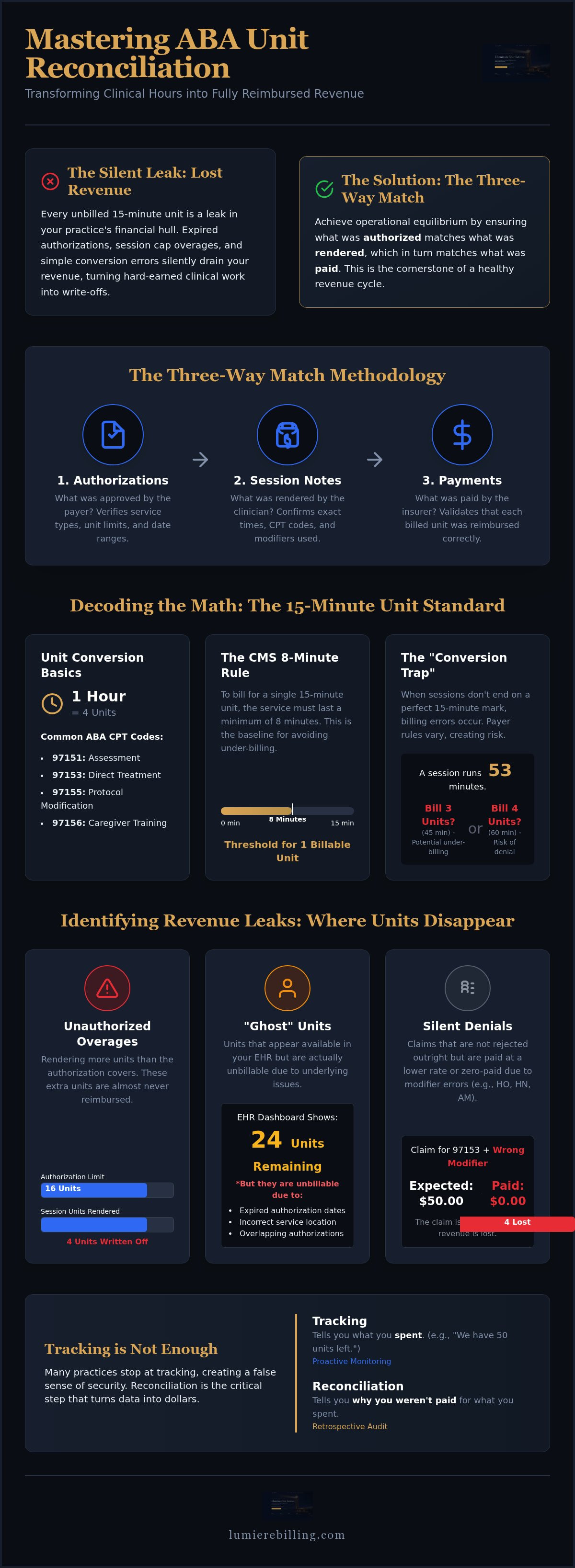
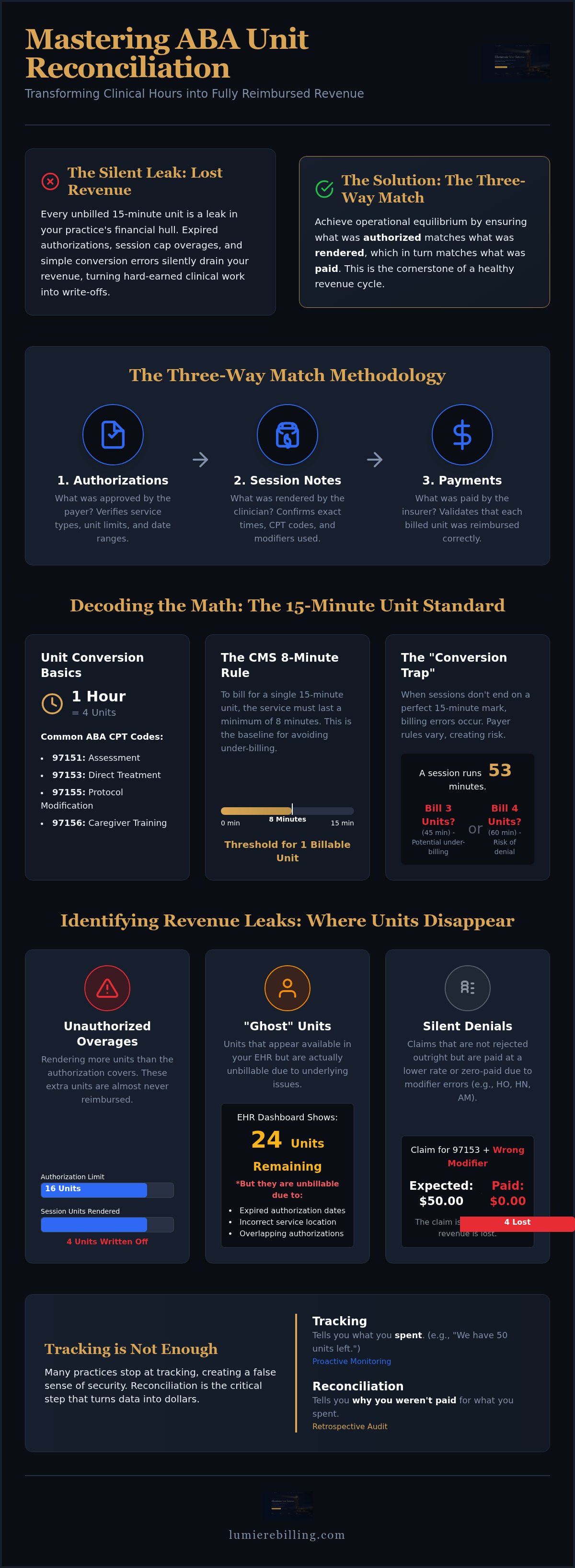
Every unbilled 15-minute unit is a silent leak in your practice's financial hull. You likely already feel the friction of authorizations that expire before they're utilized or the sting of "denied" stamps because a session exceeded a cap by a single unit. It's exhausting to provide life-changing therapy only to lose the reimbursement to a simple conversion error. Mastering ABA unit tracking reconciliation isn't just about administrative tidiness; it's about protecting the clinical work your team performs every day. You've seen how easily hours can get lost in translation when moving from a BCBA's schedule to a biller's ledger.
This guide will transform your reconciliation process from a reactive scramble into a precise "three-way match" between authorizations, session notes, and actual payments. We'll break down the 2026 CPT unit math and show you how to eliminate write-offs due to overages. You'll learn to treat authorized units as a finite currency, ensuring your cash flow remains predictable and your practice stays audit-ready. We're moving beyond basic tracking to a system of total financial visibility that secures every dollar rendered. By the end of this reference, you'll have the tools to ensure every minute of care is accounted for and fully reimbursed.
Key Takeaways
- Master the three-way match methodology to ensure your ABA unit tracking reconciliation captures every rendered session without exception.
- Decode the complex math of 2026 ABA CPT codes to translate clinical hours into precise 15-minute billing units with total accuracy.
- Plug the financial leaks caused by unauthorized overages and silent denials that compromise your bottom line and disrupt practice cash flow.
- Implement a methodical monthly framework to bridge the gap between authorization balances and clinical session notes for a clean audit trail.
- Transition toward a proactive revenue cycle model that treats authorized units as finite currency, protecting your practice's long-term financial health.
The Fundamentals of ABA Unit Tracking and Reconciliation
ABA isn't like general medicine. In most specialties, a visit is a single encounter with a fixed fee. In Applied Behavior Analysis (ABA), service is a fluid currency measured in 15-minute increments. This high-frequency model creates a unique administrative burden. Unit tracking is the proactive side of this burden; it's the ongoing monitoring of how many units remain in an authorization bucket. However, ABA unit tracking reconciliation is the retrospective audit that ensures those units actually turn into cash. It's the process of verifying that what was authorized matches what was rendered, which in turn matches what was paid.
The ultimate objective is the "Three-Way Match." This is a state of operational equilibrium where every authorized unit is accounted for, every rendered session is documented, and every claim is fully reimbursed. Achieving this requires a level of focus that borders on the obsessive. It means looking past the surface-level data to find the subtle discrepancies that lead to revenue leakage. By establishing ABA unit tracking reconciliation as a non-negotiable monthly ritual, you bring hidden issues into focus and repair the broken links in your revenue cycle.
Why Tracking Alone Is Not Enough
Tracking tells you what you spent. Reconciliation tells you why you weren't paid. Many practices rely solely on their EHR's "remaining units" dashboard, but these numbers are often deceptive. They create "ghost units." These are increments that appear available on a screen but are actually unbillable due to overlapping authorizations, incorrect modifiers, or expired dates. Without a formal reconciliation process, your AR projections become works of fiction. You see a healthy balance on paper, but the bank account remains stagnant because the underlying unit math is fractured. Tracking is the map, but reconciliation is the ground truth.
The Financial Impact of Unit Variance
Variance is a silent profit killer. When a technician renders 20 units but the authorization only covers 16, those four units are essentially a donation to the insurance company. This over-rendering leads to immediate revenue loss that is rarely recovered. Beyond the direct hit, the administrative cost of reworking "Units Exceeded" denials is staggering. It pulls your team away from growth to focus on repair. There's also a human cost. Clinicians feel the weight of administrative failure when their hard work is written off. It erodes trust between the clinical and billing departments, creating a culture of frustration rather than collaboration.
Decoding the Math: CPT Codes and the 15-Minute Unit Standard
Precision in ABA billing begins with a firm grasp of the 15-minute unit. While it sounds simple, translating hours into units is where most revenue leakage occurs. The core code set for 2026 includes 97151 (Assessment), 97153 (Direct Treatment), 97155 (Protocol Modification), and 97156 (Caregiver Training). Each follows the standard rule: one hour equals four units. However, the math becomes volatile when sessions don't end on a perfect 15-minute mark. This is the "Conversion Trap."
The CMS 8-minute rule serves as the industry baseline. To bill a single 15-minute unit, a service must last at least 8 minutes. If a session runs 53 minutes, do you bill three units or four? A mistake here triggers an immediate variance during ABA unit tracking reconciliation. Different payers interpret partial units through varying lenses. For instance, the Texas Medicaid Autism Services Billing Guidelines specify strict daily unit limitations, such as a 32-unit cap for certain services. If your rounding logic doesn't align with the payer's specific software, you'll face "Units Exceeded" denials even if your total hours are technically within the authorization limit.
The Role of Modifiers in Unit Calculation
A unit is not a static value; its definition changes based on who provides the service. Modifiers like HO (Master’s level), HN (Bachelor’s level), or AM (Physician) act as vital signals to the payer. Applying the wrong modifier to a 97153 claim can lead to a "Silent Denial," where the claim is paid at a lower rate or rejected entirely. Payer-specific rules often dictate which modifiers are compatible with 97155 vs. 97153. If you find your team constantly reworking claims due to modifier errors, a Free Billing Audit can help identify the specific logic gaps in your current system.
Managing Assessment vs. Treatment Units
Reconciling 97151 assessment units requires a higher level of vigilance. These units often have shorter utilization windows and stricter caps than treatment codes. A common mistake is "front-loading" these units, exhausting the assessment budget before the treatment plan is even finalized. This creates a gap in care and a hole in your budget. Mastering this balance is a core pillar of effective ABA revenue cycle management. By aligning your clinical scheduling with the specific unit math of each authorization, you ensure that ABA unit tracking reconciliation becomes a confirmation of success rather than a discovery of loss.
Identifying Revenue Leakage: Where Units Disappear
Revenue leakage in ABA practices is rarely a single catastrophic event. It's a slow, methodical bleed. Most practices lose revenue not because they fail to bill, but because they fail to reconcile. Unauthorized overages are the most common culprit. If an authorization allows 40 units per week and your technician renders 42, those two units are essentially a donation to the insurance company. This frequently occurs when a cap is hit on a Thursday, yet the clinical schedule continues through Friday without an automated alert to the provider.
The "Silent Denial" is a more insidious failure. A claim returns with a "Paid" status, so it escapes the standard denial workflow. However, the payer may have only reimbursed six units despite eight being rendered. Without ABA unit tracking reconciliation, these partial losses stay buried in your ledger, quietly eroding your profit margins. Supervision gaps add another layer of complexity. CPT 97155 is often dependent on the concurrent presence of the technician (97153). If a session is canceled or the tech is absent, the supervision units become unbillable. Documentation mismatches further complicate this; if a session note records 55 minutes but the claim lists four units, the discrepancy creates a massive audit risk.
The Danger of Concurrent Billing Errors
NCCI edits in 2026 have tightened the rules for concurrent billing. When a BCBA and a technician are both present, the unit math must be impeccable. Overlapping units that exceed specific payer thresholds trigger automatic rejections or partial payments. Avoiding these behavioral health billing errors to avoid requires a rigorous cross-reference between clinical logs and the billing software's output. You can't rely on the EHR to catch these nuances; you need a human-in-the-loop audit to ensure the units align with the most current 2026 compliance standards.
Payer-Specific Unit "Clawbacks"
Some payers systematically down-code units. They often assume a "standard" session length regardless of what was actually rendered. Your clinical documentation is your only defense against these clawbacks. If your notes don't explicitly justify the unit count through clear start and end times, the payer wins the dispute by default. It's vital to remember that units rendered do not always equal units billable. The bridge between the two is a disciplined ABA unit tracking reconciliation process that identifies patterns of down-coding before they become systemic financial drains.
A Step-by-Step Framework for Monthly Unit Reconciliation
Moving from reactive tracking to proactive ABA unit tracking reconciliation requires a disciplined, cyclical workflow. You cannot fix what you cannot see. By auditing your data at the end of every month, you transform your billing department from a processing center into a vigilant protector of practice revenue. This framework ensures that no unit is left behind and no session goes unpaid due to simple administrative oversight.
- Step 1: Export Authorization Balances. Pull your current authorization data to establish your "Source of Truth." This document defines the maximum billable currency for every client.
- Step 2: Aggregate Rendered Units. Collect all units recorded in clinical session notes. This represents the work actually performed by your technicians and BCBAs.
- Step 3: Map Against ERAs. Compare your rendered units against Payer Remittance Advice (ERAs). This identifies the gap between what you did and what the insurance company actually acknowledged.
- Step 4: Categorize Variances. Group discrepancies by root cause. Is the issue a rounding error, a missing modifier, or a session rendered after an authorization expired?
- Step 5: Execute Corrective Actions. Use your findings to file appeals, correct credentialing errors, or initiate clinical retraining to prevent repeat mistakes.
If your internal team is struggling to maintain this level of mechanical integrity, a Free Billing Audit can pinpoint exactly where your current workflow is fracturing.
The Monthly Variance Report
A simple dashboard helps your team visualize "Units at Risk" before they become lost revenue. This report should highlight the consumption speed of every authorization to prevent end-of-cycle exhaustion. Unit burn rate is the average weekly consumption of authorized units against the remaining balance. By monitoring this metric, you can identify which clients are trending toward an overage and adjust schedules before the cap is hit. This level of insight moves your practice away from the opaque nature of traditional billing toward a model of total financial transparency.
Closing the Loop with Clinical Teams
Data is only useful if it reaches the people making scheduling decisions. Communicating reconciliation findings back to BCBAs allows them to adjust therapy hours in real-time. This transparency reduces the friction between the front office and the clinical team by providing a logical, data-driven basis for scheduling changes. Furthermore, these reconciliation reports provide the concrete evidence needed to justify requests for additional units during the re-authorization process. You're no longer guessing; you're presenting a verified account of clinical necessity and utilization history.
Strategic Oversight: Moving to Proactive ABA RCM
True financial health for an ABA practice isn't found in a high volume of claims, but in the precision of their execution. Establishing ABA unit tracking reconciliation as a core pillar of your behavioral health revenue cycle management shifts your focus from recovery to prevention. Most administrative teams spend their days in a reactive loop of denial management, chasing payments for services rendered weeks or months ago. A proactive model stops the bleeding before the claim is even generated. It treats every authorization as a finite resource that requires vigilant protection. This transition is essential for any practice looking to move away from the opaque nature of traditional billing toward a system of total visibility.
Specialized billing partners like Lumiere Billing bring an obsessive level of detail to this process. We don't just watch your units; we engineer systems that automate the tracking of complex 2026 modifier rules and payer-specific caps. This specialized focus moves your practice away from the generalist approach that often ignores the subtle math of 15-minute increments. By implementing these rigorous standards, we transform your back-office from a cost center into a strategic asset. A Free Billing Audit is the most effective way to identify where your current system is failing to capture the full value of your clinical work.
The Role of Practice Advisory
Scaling a multi-location clinic requires more than just hiring more staff; it requires a repeatable, unit-aware workflow. Our Practice Advisory team helps you optimize EHR settings to mirror the specific unit rules of your top payers, ensuring that your behavioral health billing services are fully integrated with your clinical operations. We help you build a bridge between clinical scheduling and financial output, ensuring every hour of therapy is billable. This oversight prevents the administrative drift that often occurs as practices grow, keeping your unit math accurate across every site.
Visibility and Financial Integrity
A clean "Three-Way Match" represents the perfect alignment of authorizations, rendered sessions, and reimbursements. This is the ultimate marker of financial integrity. This level of transparency doesn't just improve cash flow; it significantly increases the valuation of your practice. When your data is clear and your ABA unit tracking reconciliation reveals zero variances, you build a foundation of trust with clinicians, investors, and payers alike. It proves that your practice is disciplined, methodical, and observant. Don’t let silent denials erode your mission; choose a partner that values precision over volume and partnership over mere transaction.
Securing Your Practice’s Financial Future
A leak-proof revenue cycle starts with a shift in perspective. You've seen how 15-minute increments and complex modifier rules can easily fracture your cash flow if left unmonitored. By implementing a disciplined framework for ABA unit tracking reconciliation, you ensure that every session rendered aligns perfectly with both authorizations and payments. This level of mechanical integrity protects your clinicians' hard work from being lost to silent denials or simple rounding errors.
You don't have to carry the burden of this obsessive detail alone. Lumiere Billing provides specialized behavioral health expertise and vigilant denial prevention strategies designed to protect your bottom line. Our percentage-based performance fees ensure our incentives are perfectly aligned with your collections. To identify hidden variances and optimize your unit management, Request a Free Billing Audit from Lumiere Billing today. It's time to bring your practice's financial health into focus and ensure every rendered minute is fully reimbursed. Your clinical mission deserves a partner that is just as dedicated to the details as your team is to their clients.
Frequently Asked Questions
How many units of ABA therapy are in one hour?
There are exactly four units of ABA therapy in one hour. This follows the 2026 standard for timed CPT codes, where each unit represents a 15-minute increment of service. Whether you are billing for direct treatment under 97153 or protocol modification under 97155, the math remains consistent. Maintaining this strict ratio is essential for accurate documentation and ensures that your clinical scheduling aligns with payer-authorized caps.
What is the difference between unit tracking and unit reconciliation?
Unit tracking is the ongoing monitoring of authorized balances, while ABA unit tracking reconciliation is the retrospective audit of those figures against rendered services and actual payments. Tracking tells you what you have left to spend; reconciliation confirms you were actually paid for what you did. This three-way match identifies hidden variances, such as silent denials or rounding errors, that tracking alone often misses during the billing cycle.
Why are my ABA claims being denied for "units exceeded" when I still have authorized hours?
These denials often occur because of payer-specific daily unit caps or conversion traps during the billing process. Even if your total authorization has hours remaining, a single session might exceed the daily limit, such as a 32-unit cap common in certain 2026 Medicaid guidelines. Discrepancies between your EHR's rounding logic and the payer's software can also trigger these rejections, making methodical oversight critical to preventing revenue leakage.
How do I handle rounding when a session is 50 minutes long?
Rounding follows the CMS 8-minute rule. For a 50-minute session, you would bill three units. The first 45 minutes account for three full units, leaving five minutes remaining. Since five minutes is less than the eight-minute threshold required to bill an additional increment, the final unit cannot be claimed. Precise time-stamping in your clinical notes is the only way to defend these calculations and maintain financial integrity during a payer audit.
Can I bill for supervision units (97155) if the direct therapist (97153) is not present?
Generally, CPT 97155 requires the concurrent presence of the technician rendering 97153 services. If the direct therapist is absent, the supervision units typically become unbillable under 2026 NCCI edits. Attempting to bill these units in isolation often results in immediate denials or future clawbacks. Your reconciliation process must cross-reference these two codes to ensure that supervision was actually provided alongside direct treatment as required by specific payer medical necessity rules.
What is a "unit burn rate" in ABA billing?
The unit burn rate is the average weekly consumption of authorized units compared to the remaining balance for a specific client. Monitoring this metric allows practices to move from reactive denial management to proactive oversight. If the burn rate is too high, you risk exhausting units before the authorization period ends. If it's too low, you face potential under-utilization, which may lead to reduced hours in your next authorization cycle.
How often should an ABA practice perform unit reconciliation?
Every ABA practice should perform ABA unit tracking reconciliation at least once per month. This frequency allows you to identify and resolve variances before they compound into systemic financial issues. Monthly audits ensure that your clinical team can adjust their schedules in real-time based on actual utilization data. Waiting longer than thirty days increases the risk of uncollectible overages and makes it significantly harder to file timely appeals for denied claims.
What happens if I render more units than were authorized?
Rendering more units than authorized results in immediate financial loss, as payers will not reimburse services provided beyond the approved cap. These overages essentially become uncompensated care that erodes your practice's profit margins. Beyond the direct revenue hit, consistent over-rendering can trigger audits or signal to payers that your clinical scheduling is not properly aligned with their medical necessity guidelines. It creates administrative rework that pulls focus from patient care.
Frequently Asked Questions
There are exactly four units of ABA therapy in one hour. This follows the 2026 standard for timed CPT codes, where each unit represents a 15-minute increment of service. Whether you are billing for direct treatment under 97153 or protocol modification under 97155, the math remains consistent. Maintaining this strict ratio is essential for accurate documentation and ensures that your clinical scheduling aligns with payer-authorized caps.
Unit tracking is the ongoing monitoring of authorized balances, while ABA unit tracking reconciliation is the retrospective audit of those figures against rendered services and actual payments. Tracking tells you what you have left to spend; reconciliation confirms you were actually paid for what you did. This three-way match identifies hidden variances, such as silent denials or rounding errors, that tracking alone often misses during the billing cycle.
These denials often occur because of payer-specific daily unit caps or conversion traps during the billing process. Even if your total authorization has hours remaining, a single session might exceed the daily limit, such as a 32-unit cap common in certain 2026 Medicaid guidelines. Discrepancies between your EHR's rounding logic and the payer's software can also trigger these rejections, making methodical oversight critical to preventing revenue leakage.
Rounding follows the CMS 8-minute rule. For a 50-minute session, you would bill three units. The first 45 minutes account for three full units, leaving five minutes remaining. Since five minutes is less than the eight-minute threshold required to bill an additional increment, the final unit cannot be claimed. Precise time-stamping in your clinical notes is the only way to defend these calculations and maintain financial integrity during a payer audit.
Generally, CPT 97155 requires the concurrent presence of the technician rendering 97153 services. If the direct therapist is absent, the supervision units typically become unbillable under 2026 NCCI edits. Attempting to bill these units in isolation often results in immediate denials or future clawbacks. Your reconciliation process must cross-reference these two codes to ensure that supervision was actually provided alongside direct treatment as required by specific payer medical necessity rules.
The unit burn rate is the average weekly consumption of authorized units compared to the remaining balance for a specific client. Monitoring this metric allows practices to move from reactive denial management to proactive oversight. If the burn rate is too high, you risk exhausting units before the authorization period ends. If it's too low, you face potential under-utilization, which may lead to reduced hours in your next authorization cycle.
Every ABA practice should perform ABA unit tracking reconciliation at least once per month. This frequency allows you to identify and resolve variances before they compound into systemic financial issues. Monthly audits ensure that your clinical team can adjust their schedules in real-time based on actual utilization data. Waiting longer than thirty days increases the risk of uncollectible overages and makes it significantly harder to file timely appeals for denied claims.
Rendering more units than authorized results in immediate financial loss, as payers will not reimburse services provided beyond the approved cap. These overages essentially become uncompensated care that erodes your practice's profit margins. Beyond the direct revenue hit, consistent over-rendering can trigger audits or signal to payers that your clinical scheduling is not properly aligned with their medical necessity guidelines. It creates administrative rework that pulls focus from patient care.