Mental Health Claim Denial Analysis: A 2026 Guide to Revenue Recovery

Your billing department isn't just a cost center; it's a diagnostic laboratory where every rejected claim reveals a systemic leak in your practice's survival. You're likely exhausted by the endless cycle of rework and the suffocating weight of unpredictable cash flow. It's frustrating to watch your clinical team provide life-changing care while your back-office struggles to identify which payers are systematically undermining your revenue. Mastering a rigorous mental health claim denial analysis transforms this administrative data into a strategic engine for growth.
We're moving beyond reactive fixes. This guide provides a systematic framework to identify root causes, establish clear KPIs for your billing staff, and secure the high clean claim rate necessary for your practice's financial future. By the end of this analysis, you'll have the visibility needed to stop chasing payments and start optimizing your entire revenue cycle. We'll examine the specific mechanics of payer behavior and the precise methodologies required to reclaim every dollar your clinicians have earned. It's time to replace administrative opacity with the clarity of a high-performing billing system.
Key Takeaways
- Understand why behavioral health denial rates frequently double the general medical average and how this systemic leakage impacts provider burnout.
- Execute a rigorous mental health claim denial analysis to categorize rejections into actionable technical, clinical, and contractual buckets.
- Identify "silent denials" and underpayments by auditing the gap between your contracted rates and the actual amounts paid by insurance carriers.
- Build a prevention-first revenue cycle through front-end insurance verification and training clinical staff on documentation for high-risk codes.
- Transform raw data from your EHR into clear KPIs that empower your billing team to focus on high-impact revenue recovery.
The Financial Impact of Mental Health Claim Denials in 2026
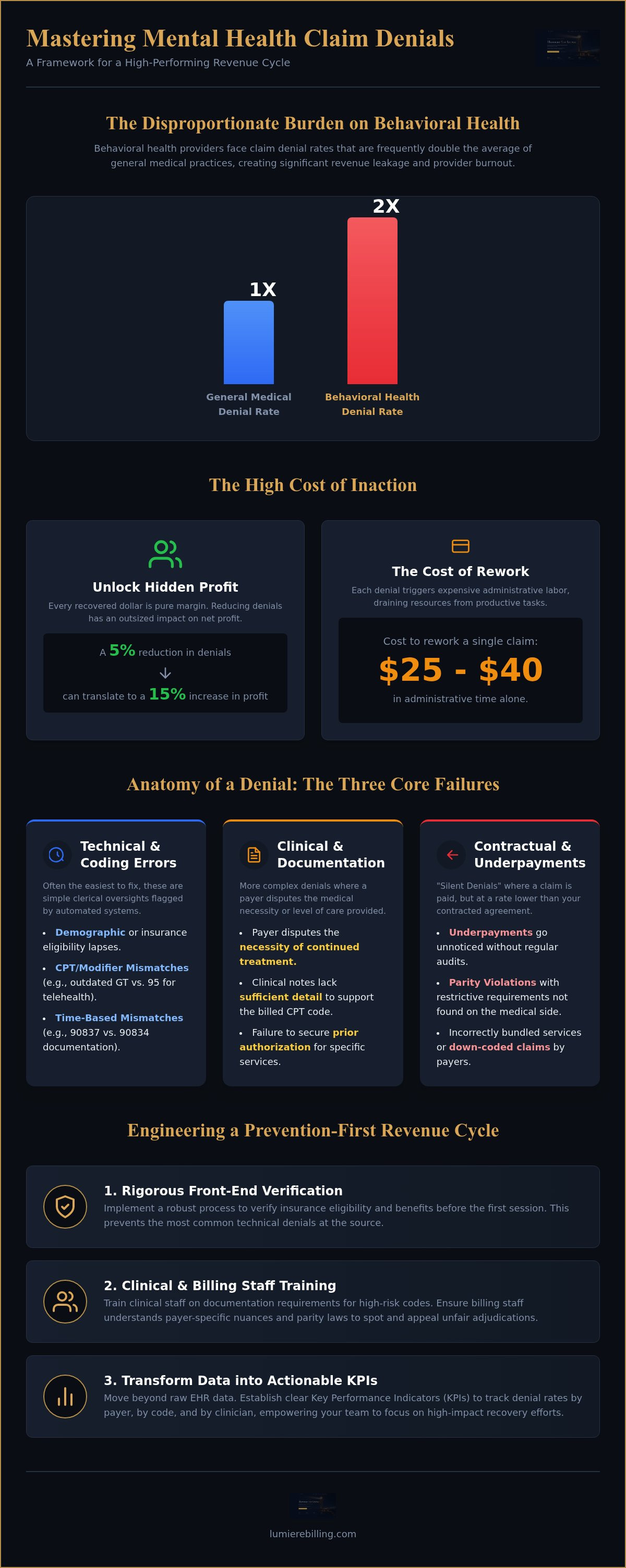
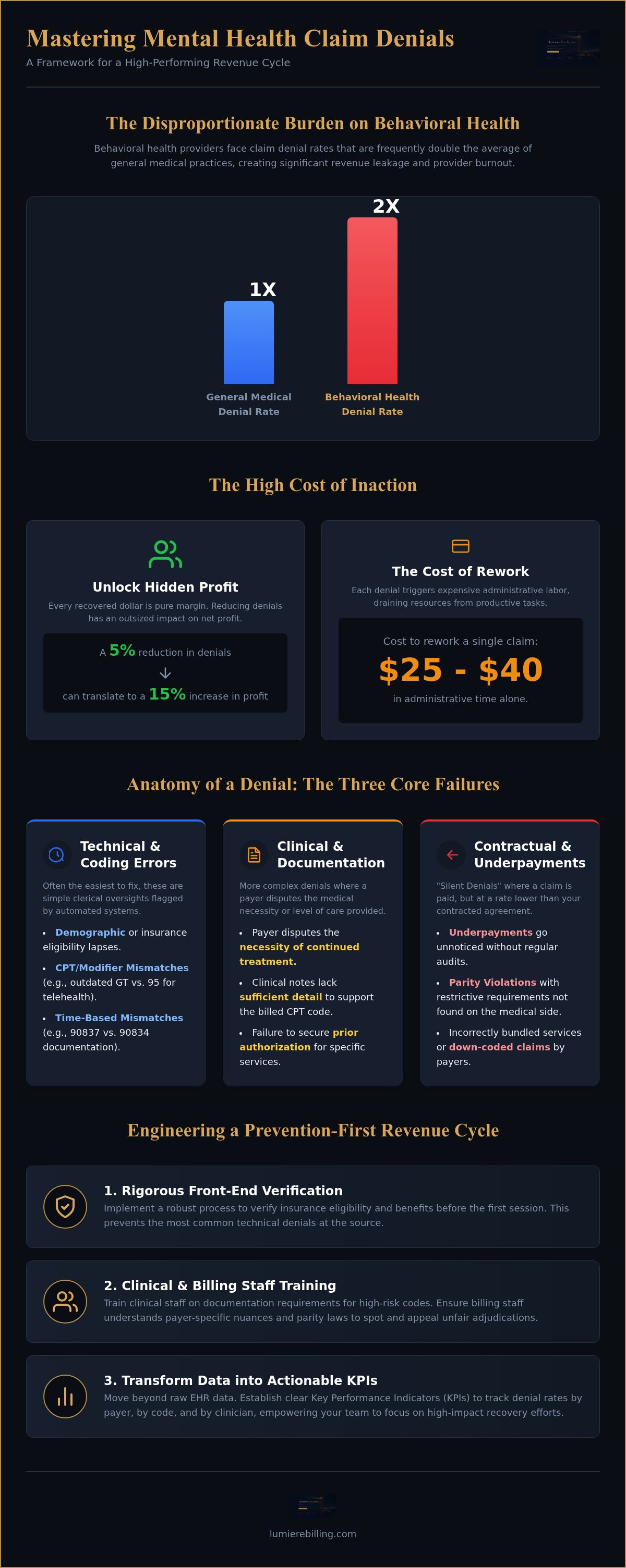
Revenue leakage in behavioral health isn't just a line item; it's a systemic failure that threatens the clinical mission of your practice. In 2026, the landscape has shifted significantly as payers deploy sophisticated AI-driven audits to scrutinize documentation gaps with surgical precision. These automated systems identify minute discrepancies between clinical notes and CPT requirements that human reviewers previously overlooked. For a typical practice, the stakes are high. Industry data suggests that a mere 5% reduction in denial rates can translate into a 15% increase in net profit. This leverage exists because every recovered dollar is pure margin, unencumbered by the initial cost of service delivery.
The gap between behavioral health and general medicine continues to widen. While general medical denial rates often hover in the single digits, behavioral health providers frequently face rejection rates that are double the industry average. This disparity stems from the inherent complexity of unit-based billing, specific modifier requirements, and the subjective nature of medical necessity. Without a rigorous mental health claim denial analysis, these losses remain invisible, buried under the weight of daily operations.
The High Cost of Administrative Rework
Every denied claim triggers a cascade of expensive manual labor. When a claim is rejected, your staff must stop productive billing tasks to investigate reason codes, gather documentation, and resubmit appeals. Industry estimates often place the cost of reworking a single claim between $25 and $40 in administrative time alone. Beyond the payroll expense, these delays create friction in the patient-provider relationship as clients receive confusing statements or unexpected balance bills. The denial death spiral occurs when administrative staff spend more time litigating past services than securing payment for current ones, effectively stalling the practice's momentum. This cycle drains resources and contributes to the high rates of billing staff burnout seen across the industry.
Payer Trends and Parity Challenges
The enforcement of the Mental Health Parity and Addiction Equity Act (MHPAEA) has entered a new phase in 2026. While regulations aim to ensure equity, many payers have responded by tightening their "gray area" clinical reviews. Identifying aggressive payer behavior requires longitudinal data that tracks denial patterns over months rather than weeks. General medical billing services often fail here because they lack the specialized expertise to recognize behavioral-specific parity violations, such as restrictive prior authorization requirements that don't exist on the medical-surgical side. A specialized mental health claim denial analysis brings these hidden biases into focus, allowing your practice to challenge unfair adjudications with data-backed authority rather than anecdotal complaints.
Anatomy of a Denial: Categories of Behavioral Health Failures
To repair a leaking revenue cycle, you must first understand the anatomy of the failure. Not all rejections are created equal. In the specialized field of behavioral health, denials generally cluster into three distinct buckets: technical, clinical, and contractual. A precise mental health claim denial analysis allows you to pinpoint whether a rejection is a simple clerical oversight or a more complex dispute over medical necessity. By categorizing these failures, you move from reactive guessing to methodical optimization.
Technical and Coding Errors (The Low-Hanging Fruit)
Technical failures are often the most visible but easiest to remediate. These include demographic errors, insurance eligibility lapses, and CPT/modifier mismatches. In 2026, the shift in telehealth regulations has made modifier usage a primary target for automated audits. Using an outdated GT modifier instead of the current 95 code can trigger an immediate, automated rejection. Similarly, payers frequently flag time-based mismatches between 90837 and 90834 codes. If your documentation doesn't explicitly support the higher-intensity 60-minute session, the claim is often down-coded or denied entirely. Understanding these nuances is critical for behavioral health billing errors to avoid when securing your practice's cash flow.
Medical Necessity and Clinical Documentation
Clinical denials are more insidious and often harder to appeal. These occur when a payer disputes the level of care or the necessity of continued treatment. One of the most common pitfalls in progress notes is the use of the word "stable." While it sounds positive in a clinical setting, payers often interpret "stable" as "no longer in need of intensive services," leading to a prompt denial of future sessions. To combat this, clinicians must link treatment plans directly to billed units, demonstrating ongoing functional impairment and the need for skilled intervention. Utilizing standardized assessment tools provides the objective data points that payers demand in 2026. If you're seeing a spike in clinical rejections, a Free Billing Audit can help identify where your documentation is failing to meet payer expectations.
Contractual denials represent the third pillar of revenue loss. These often stem from credentialing lapses, unrecognized payer carve-outs, or billing for non-covered services. In the context of MHPAEA enforcement, these denials can sometimes be challenged as parity violations. If a payer is applying more restrictive "fail-first" policies to mental health services than they do for medical-surgical care, it's a systemic failure, not a provider error. A rigorous mental health claim denial analysis brings these patterns to light, transforming a pile of EOBs into a powerful tool for advocacy and recovery. You aren't just fighting for a single claim; you're defending the integrity of your practice's contracts.
Systematic Mental Health Claim Denial Analysis: A 5-Step Framework
Data is the diagnostic tool of a healthy practice. To stop revenue leakage, you must move beyond anecdotal complaints and implement a rigorous, data-driven framework. A systematic mental health claim denial analysis transforms raw administrative output into a strategic roadmap for recovery. This process isn't about chasing individual checks; it's about identifying the structural flaws that allow money to slip through the cracks. By following these five steps, you can build a resilient revenue cycle that protects your practice's financial future.
- Data Aggregation: Export raw data from your behavioral health RCM platform or EHR system. Don't rely on high-level dashboards that often obscure the granular details needed for true root-cause identification.
- Categorization: Group rejections by payer, clinician, and specific reason codes. This reveals whether a problem is an isolated incident or a systemic failure across a specific service line.
- Root Cause Identification: Determine if the failure originated during intake and eligibility (front-end) or during the coding and documentation phase (back-end).
- Quantification: Rank your denial categories by total dollar value. A few high-value clinical denials often represent a greater threat to your margin than dozens of small technical errors.
- Action Plan: Implement systemic fixes, such as updating intake forms or retraining staff on specific behavioral health modifiers, to prevent future occurrences.
Step 1: Decoding CARC and RARC Codes
Payer responses are often intentionally opaque. Claim Adjustment Reason Codes (CARC) and Remittance Advice Remark Codes (RARC) provide the "why" behind every rejection. In 2026, codes related to telehealth unit-tracking and concurrent review have become increasingly common. A comprehensive denial map serves as the definitive translation layer between these opaque payer responses and your team's tactical workflow. Without this map, your billing staff is forced to guess, leading to inconsistent appeals and wasted labor. Decoding these codes is the first step in bringing hidden issues into focus.
Step 2: Identifying Payer-Specific Patterns
Not all payers play by the same rules. Some carriers may deny the 90837 code with aggressive frequency compared to others, regardless of the clinical documentation provided. You should track your First Pass Payment Rate (FPPR) for each major payer to establish a baseline of "payer health." If one payer's FPPR is significantly lower than the others, you've identified a strategic target for intervention. These patterns provide the objective evidence needed to negotiate better payer contracts or to decide which networks are no longer worth the administrative burden. Data doesn't just fix your billing; it empowers your business decisions.
The Danger of Silent Denials and Revenue Leakage
A formal rejection is easy to spot. A silent denial is a predator that bleeds your practice dry without ever triggering a reason code. These underpayments, partial payments, and lost claims create a false sense of security in your billing department. If you only look at whether a claim was "paid," you're missing the systemic leakage that occurs when a payer ignores your contracted rate. A rigorous mental health claim denial analysis must look beyond the simple EOB status and scrutinize the actual dollar value received versus the expected reimbursement. It's about visibility; you can't fix what you can't see.
The gap between the "allowed" amount and the "paid" amount is where most revenue vanishes. In ABA therapy, this often manifests as unit reconciliation failures. A payer may authorize ten units of service but only pay for eight, leaving two hours of clinical labor uncompensated without ever issuing a formal denial. Automated EHR reports often miss these subtle discrepancies because they're designed to track volume, not contractual integrity. Relying on basic software dashboards is a dangerous gamble that ignores the complexity of behavioral health contracts.
Detecting Underpayments and Contractual Variance
Auditing your top five CPT codes against current fee schedules is non-negotiable. Payers frequently bundle services that should remain separate, effectively forcing your clinicians to provide care for free. This level of oversight is a cornerstone of effective behavioral health revenue cycle management. If you aren't comparing every remittance to your signed contract, you're leaving significant margin on the table. We often find that practices are being paid at rates three to five years out of date simply because no one is checking the variance.
Uncovering the "Ghost" Claims
Ghost claims are submissions that vanish between your EHR and the payer's adjudication system. This Electronic Clearinghouse Gap is often only visible through a 30-60-90 day AR aging report analysis. If a claim hasn't been acknowledged within 30 days, it's likely stuck in a digital void, neither paid nor denied. Professional analytics find these claims that fall through the cracks of standard workflows, ensuring every session is accounted for and pursued. This level of scrutiny is the final stage of a comprehensive mental health claim denial analysis. To see exactly where your practice is losing ground to these hidden leaks, schedule a Free Billing Audit to bring your revenue into focus.
Engineering a Prevention-First Revenue Cycle
Fixing a denied claim is an expensive necessity; preventing one is a strategic advantage. A truly resilient practice doesn't just react to EOBs. It engineers a revenue cycle where failures are anticipated and neutralized before they impact cash flow. This shift requires moving beyond the "submit and pray" mentality toward a system built on front-end integrity and clinical-billing alignment. When you treat your billing process as a disciplined, observant system rather than an administrative chore, you protect the financial health of your practice with surgical precision.
Specialized mental health claim denial analysis reveals that most rejections aren't random. They are the predictable result of front-end data entry errors or clinical documentation gaps. By identifying these patterns, you can implement structural safeguards that ensure your clean claim rate remains high. This isn't about working harder; it's about building a better machine that brings hidden issues into focus and repairs broken processes at their source.
Front-End Integrity: Stopping Denials Before They Start
Intake is the most vulnerable point in your revenue cycle. A single digit error in a member ID or an overlooked prior authorization requirement can trigger a cascade of administrative rework. Implementing a "Clean Claim Checklist" for every new patient intake is a non-negotiable standard for high-performing practices. This checklist acts as a vigilant protector, ensuring that every piece of data required for adjudication is verified and accurate before the first session occurs.
For high-frequency services like ABA or intensive outpatient programs, 24-hour insurance re-verification is essential. Coverage can change mid-month without warning. Relying on a verification performed thirty days ago is a gamble that often results in uncollectable revenue. If your internal team is struggling to keep up with these demands, it may be time to outsource mental health billing to a partner that treats eligibility as a continuous process rather than a one-time event.
The Power of Practice Analytics
Generalist billing services often operate on "gut feelings" or surface-level reports. To thrive in 2026, your practice needs the visibility that only specialized analytics can provide. Moving from anecdotal complaints to data-driven decision making allows you to spot systemic payer trends that standard EHR dashboards frequently miss. These specialized tools highlight which providers struggle with documentation or which payers are moving the goalposts on medical necessity.
This level of insight transforms your billing department from a cost center into a strategic engine. You gain the clarity to see exactly where your revenue is leaking and the leverage to fix it. If you're ready to stop the cycle of unpredictable cash flow and administrative exhaustion, you need a partner that acts as an extension of your clinical team. Get a Free Billing Audit from Lumiere Billing to uncover your practice’s hidden revenue leaks and start your journey toward a prevention-first revenue cycle. Mastery of mental health claim denial analysis is the only way to secure the financial future your clinicians have worked so hard to build.
Securing Your Practice's Financial Legacy
Transitioning from reactive firefighting to a data-driven revenue engine is the only way to thrive in the complex 2026 payer landscape. You've learned how to categorize behavioral failures and implement a systematic framework that identifies root causes before they erode your margin. Silent denials and contractual variances no longer need to be invisible leaks in your cash flow. A rigorous mental health claim denial analysis is the definitive tool for bringing these hidden issues into focus and reclaiming every dollar your practice has earned.
Our behavioral health billing specialists understand the precise nuance of 90837 and ABA modifiers. We provide proactive denial management that targets root causes, not just symptoms, ensuring your practice remains financially resilient. Your clinical work is too important to be stalled by administrative opacity. It's time to build a revenue cycle that works as hard as your providers do. Request Your Free Behavioral Health Billing Audit to start optimizing your financial future today.
Frequently Asked Questions
What is the most common reason for mental health claim denials in 2026?
Technical mismatches and eligibility lapses remain the most frequent triggers for rejections. In 2026, payers have increased their use of automated AI audits to flag discrepancies in session timing and modifier usage. A consistent mental health claim denial analysis helps you identify if your staff is consistently missing insurance re-verifications or using outdated telehealth codes. Addressing these technical errors at the front-end provides the fastest path to stabilizing your cash flow.
How often should a behavioral health practice perform a denial analysis?
You should perform a high-level review of denial trends weekly, with a comprehensive root-cause analysis conducted every month. Weekly monitoring allows your team to catch sudden payer policy shifts before they impact an entire month of revenue. Monthly deep dives provide the longitudinal data needed to identify which providers require documentation training. This rhythm ensures your revenue cycle remains agile and responsive to the evolving requirements of behavioral health payers.
Can I appeal a mental health claim denied for medical necessity?
Yes, you can and should appeal medical necessity denials by providing objective clinical data and standardized assessment scores. Payers often deny continued care when progress notes suggest a patient is "stable" or "improving" without context. Your appeal should explicitly link the treatment plan goals to the billed units, demonstrating the ongoing functional impairment that requires skilled intervention. Providing a clear clinical narrative often overturns these subjective adjudications during the first level of appeal.
What is a "silent denial" in behavioral health billing?
A silent denial occurs when a payer underpays a claim or ignores your contracted rate without issuing a formal rejection code. These are dangerous because they don't appear on standard "denied claim" reports in your EHR. You must audit your top CPT codes against your current fee schedules to find these discrepancies. Detecting these leaks requires a specialized mental health claim denial analysis that compares the "allowed" amount on the remit to your signed contract.
How does Mental Health Parity (MHPAEA) help me fight claim denials?
MHPAEA provides legal leverage to challenge restrictive non-quantitative treatment limits (NQTLs) that aren't applied to medical-surgical services. If a payer requires more frequent prior authorizations or applies stricter medical necessity criteria for mental health care, they may be in violation of federal law. You can use your denial data to demonstrate these patterns of inequity. This evidence is a powerful tool when negotiating with payers or filing formal complaints with state regulators.
What is a healthy denial rate for a mental health group practice?
A healthy denial rate for a high-performing mental health group practice should remain below 5%. While behavioral health averages often climb to 15% due to unit-based complexities and modifier errors, this shouldn't be accepted as the status quo. If your rate exceeds 10%, it's a clear indicator of systemic failure in your front-end verification or back-end coding. Reducing this rate by even a few points can significantly increase your practice's net profit.
Should I use my EHR for denial analysis or a separate tool?
You should use your EHR for basic claim tracking, but a specialized analytics tool is often necessary for deep root-cause identification. Standard EHR reports frequently lack the visibility to connect denial reason codes with specific provider documentation habits or contractual variances. Specialized RCM platforms bring these hidden issues into focus, allowing you to see the dollar-value impact of each denial category. This transparency is what enables you to make informed, data-driven business decisions.
How do I track unit reconciliation for ABA services?
Tracking unit reconciliation for ABA services requires a three-way match between authorized hours, billed units, and actual payments received. You must identify any "authorized but unbilled" hours to ensure your clinical team isn't providing free labor. Similarly, you should audit for "billed but unpaid" units where a payer has partially adjudicated a claim. This level of scrutiny ensures that every hour of specialized care is accounted for and fully reimbursed.
Frequently Asked Questions
Technical mismatches and eligibility lapses remain the most frequent triggers for rejections. In 2026, payers have increased their use of automated AI audits to flag discrepancies in session timing and modifier usage. A consistent mental health claim denial analysis helps you identify if your staff is consistently missing insurance re-verifications or using outdated telehealth codes. Addressing these technical errors at the front-end provides the fastest path to stabilizing your cash flow.
You should perform a high-level review of denial trends weekly, with a comprehensive root-cause analysis conducted every month. Weekly monitoring allows your team to catch sudden payer policy shifts before they impact an entire month of revenue. Monthly deep dives provide the longitudinal data needed to identify which providers require documentation training. This rhythm ensures your revenue cycle remains agile and responsive to the evolving requirements of behavioral health payers.
Yes, you can and should appeal medical necessity denials by providing objective clinical data and standardized assessment scores. Payers often deny continued care when progress notes suggest a patient is "stable" or "improving" without context. Your appeal should explicitly link the treatment plan goals to the billed units, demonstrating the ongoing functional impairment that requires skilled intervention. Providing a clear clinical narrative often overturns these subjective adjudications during the first level of appeal.
A silent denial occurs when a payer underpays a claim or ignores your contracted rate without issuing a formal rejection code. These are dangerous because they don't appear on standard "denied claim" reports in your EHR. You must audit your top CPT codes against your current fee schedules to find these discrepancies. Detecting these leaks requires a specialized mental health claim denial analysis that compares the "allowed" amount on the remit to your signed contract.
MHPAEA provides legal leverage to challenge restrictive non-quantitative treatment limits (NQTLs) that aren't applied to medical-surgical services. If a payer requires more frequent prior authorizations or applies stricter medical necessity criteria for mental health care, they may be in violation of federal law. You can use your denial data to demonstrate these patterns of inequity. This evidence is a powerful tool when negotiating with payers or filing formal complaints with state regulators.
A healthy denial rate for a high-performing mental health group practice should remain below 5%. While behavioral health averages often climb to 15% due to unit-based complexities and modifier errors, this shouldn't be accepted as the status quo. If your rate exceeds 10%, it's a clear indicator of systemic failure in your front-end verification or back-end coding. Reducing this rate by even a few points can significantly increase your practice's net profit.
You should use your EHR for basic claim tracking, but a specialized analytics tool is often necessary for deep root-cause identification. Standard EHR reports frequently lack the visibility to connect denial reason codes with specific provider documentation habits or contractual variances. Specialized RCM platforms bring these hidden issues into focus, allowing you to see the dollar-value impact of each denial category. This transparency is what enables you to make informed, data-driven business decisions.
Tracking unit reconciliation for ABA services requires a three-way match between authorized hours, billed units, and actual payments received. You must identify any "authorized but unbilled" hours to ensure your clinical team isn't providing free labor. Similarly, you should audit for "billed but unpaid" units where a payer has partially adjudicated a claim. This level of scrutiny ensures that every hour of specialized care is accounted for and fully reimbursed.