Mastering the 90837 CPT Code: The 2026 Guide to Behavioral Health Reimbursement

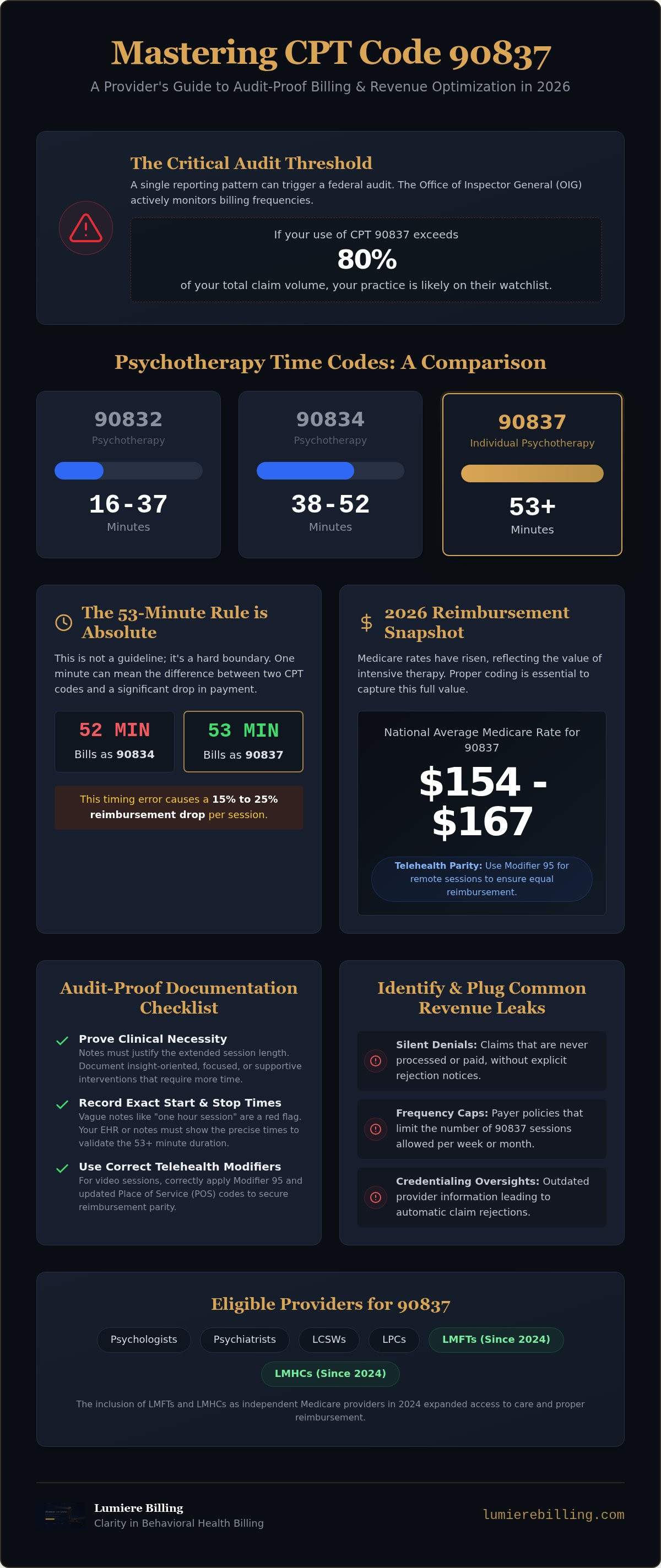
A single reporting threshold could trigger a federal audit of your entire practice. If your use of the 90837 cpt code exceeds 80% of your total volume, the Office of Inspector General is likely already watching. This is a frustrating reality for behavioral health providers. You provide intensive, 60-minute care because your patients require it, yet payers often treat high-frequency billing as a red flag rather than a clinical necessity. The result is a cycle of silent denials and hidden revenue leaks that compromise your financial health.
You deserve to be paid for every minute of care you provide. We'll show you how to master the complexities of the 90837 cpt code while insulating your practice from audit risks. This 2026 guide delivers total clarity on the latest Medicare reimbursement rates, which have risen to a national average of approximately $154 to $167. We'll also detail the precise documentation requirements for start and stop times to ensure your claims are bulletproof. By the end of this article, you'll have a clear roadmap to achieve 100% compliance and optimize your revenue cycle for individual psychotherapy.
Key Takeaways
- Master the technical "53-minute rule" and the specific clinical necessity logic required to bill the 90837 cpt code with total confidence.
- Navigate the 2026 telehealth landscape by correctly applying Modifier 95 and updated Place of Service codes to ensure parity in reimbursement.
- Build a defensive documentation strategy that goes beyond simple timestamps to prove the medical necessity of every extended session.
- Identify systemic revenue leaks caused by silent denials, frequency caps, and credentialing oversights that generalist billing services often miss.
- Utilize specialized behavioral health analytics to gain immediate visibility into your claim success rates and overall practice profitability.
Understanding the 90837 CPT Code: Definition and Scope in 2026
The 90837 cpt code represents the highest tier of standard individual psychotherapy. It's defined as 60 minutes of face-to-face time with a patient or family member. Within the Current Procedural Terminology (CPT) framework, this code is reserved for intensive clinical work that requires a specific time commitment. Unlike 90832, which covers 16 to 37 minutes, or 90834, which spans 38 to 52 minutes, the 90837 code captures the complexity of long-form therapeutic interventions. It's the engine of your practice's revenue cycle; it's the difference between a sustainable business and one struggling with overhead. Maintaining the integrity of this code is essential for any vigilant protector of a practice's financial health.
By 2026, the application of this code has matured alongside the industry. Telehealth parity is now permanent for Medicare, which means video sessions carry the same weight as in-person visits. Hybrid care models have made the documentation of "face-to-face" time more nuanced but no less critical. You must be vigilant. Payers look for precise start and stop times to validate the 53-minute threshold. Failing to capture these details leads to silent denials that drain your practice's potential over time.
The Clinical Threshold for 90837
Clinical work billed under 90837 must be insight-oriented, focused, or supportive. It's not just about the clock. It's about the depth. Insight-oriented therapy focuses on the psychological roots of emotional suffering, requiring a level of engagement that shorter sessions simply cannot accommodate. If a session involves an urgent assessment of a patient in distress with high-intensity intervention, you might look toward 90839 for crisis care instead. For most ongoing treatment plans, however, 90837 remains the standard. Eligible providers include Psychologists, Psychiatrists, LCSWs, and LPCs. Since 2024, LMFTs and LMHCs are also fully recognized as independent Medicare providers. This expansion allows a broader range of clinicians to utilize this code to its full potential while maintaining high standards of care.
90837 In the 2026 Behavioral Health Landscape
Value-based care initiatives now prioritize outcomes, yet the 60-minute session remains the primary vehicle for achieving those results in complex cases. In integrated care settings, where behavioral health is woven into primary care, 90837 acts as the deep-dive mechanism for high-acuity patients. Precision in using this code ensures that providers aren't just working hard; they're also being fairly compensated for their specialized expertise. This requires a shift from viewing billing as an administrative chore to seeing it as a clinical safeguard. Integrated care settings often use this code to address complex comorbidities where mental health and physical health intersect. As reimbursement models shift toward quality, the ability to document the value of a 60-minute session becomes your most powerful administrative asset. The 90837 cpt code is the gold standard for high-intensity outpatient therapy.
Technical Requirements: Time Thresholds and Modifier Logic
Precision is the only defense against claim recoupment. When you bill the 90837 cpt code, you're asserting that the session lasted at least 53 minutes of continuous, face-to-face clinical time. This isn't a suggestion; it's a hard boundary. If your documentation shows 52 minutes, the claim is technically a 90834. This small gap results in a significant reimbursement drop, often between 15% and 25% per session. Over a year, these minor timing errors create massive revenue leakage that threatens your practice's stability.
The 60-Minute Benchmark and Time Tracking
Understanding the specific CPT time ranges is vital for compliance. While 90832 covers 16 to 37 minutes and 90834 spans 38 to 52 minutes, the 90837 cpt code is reserved for sessions of 53 minutes or longer. There's no upper limit defined by the CPT, but sessions exceeding 90 minutes often require additional prolonged service codes. Documenting exact start and stop times is non-negotiable. Vague statements like "session lasted one hour" won't survive a focused payer review. To maintain standards compliant with HHS.gov guidelines, your records must reflect the actual time spent in the encounter. If you find yourself consistently losing revenue to these technicalities, a free billing audit can help identify where your time tracking is failing.
Essential Modifiers for Behavioral Health
Modifiers act as the signaling system for your claims. In 2026, Modifier 95 remains the standard for synchronous audio-visual telehealth sessions. However, the modifier must be paired with the correct Place of Service (POS) code. Use POS 10 if the patient is in their home, and POS 02 if they're at another location. Misaligning these codes is a frequent cause of immediate, automated rejections.
Complexity increases when billing multiple services. Modifier 59 is used to identify distinct procedural services performed on the same day, though it's rarely used with 90837 alone. More common is the use of add-on code 90833. This code is specifically for psychotherapy performed with an Evaluation and Management (E/M) service by a prescriber. It follows the same time thresholds as the standard codes but must be billed alongside the primary E/M code. Avoiding modifier errors requires a disciplined, methodical approach to every claim. One wrong digit can lead to a silent denial, leaving earned revenue sitting in the payer's accounts instead of yours.
Audit-Proof Documentation: Standards for Individual Psychotherapy
Documentation isn't just an administrative hurdle; it's the structural integrity of your practice's revenue. When you utilize the 90837 cpt code, you're signaling to payers that the patient's condition required an extended encounter. This claim must be supported by the AMA Definition of CPT Code 90837, which emphasizes clinical complexity and specific care components. Payers won't simply take your word for it. They look for the "Clinical Necessity" mandate, a clear explanation of why the session required 53 or more minutes instead of the standard 45. If your notes lack this justification, you're leaving the door wide open for recoupment efforts during a post-payment review.
The most common point of failure in an audit is the absence of exact start and stop times. A simple duration like "60 minutes" is a summary, not a record. Recoupment often hinges on this single technicality. Beyond the clock, your session content must reflect a dynamic exchange. You need to document the specific modalities used, the interventions applied, and the patient's immediate response. Every session must align with the current treatment plan. If you're billing for high-intensity therapy but the patient's goals are vague or outdated, the payer will view the session as medically unnecessary. Auditors look for active verbs like "restructured," "challenged," or "facilitated" to distinguish professional therapy from general supportive counseling.
The Anatomy of a Compliant Progress Note
A compliant note is a precise map of the therapeutic encounter. It must include the date of service, the exact duration, the location (or telehealth POS), and a valid provider signature. It's not enough to list what the patient said; you must document what you did. The "Golden Thread" of documentation for 90837 is the unbreakable logical link connecting the patient's diagnosis to specific treatment goals and the high-intensity interventions delivered during the session. This thread ensures that every claim is anchored in clinical reality rather than administrative habit.
Surviving Payer Audits and Post-Payment Reviews
Payers use sophisticated algorithms to identify "outlier" billing patterns. If your use of the 90837 cpt code is significantly higher than your peers, you'll likely face a Targeted Probe and Educate (TPE) review. One of the biggest red flags is "cloned" notes. Repetitive, copy-pasted documentation suggests that the sessions aren't tailored to the patient's evolving needs. This is a common trigger for a full-scale audit. Preparing for a review requires a disciplined approach to every single note. You aren't just writing for the patient; you're writing for the auditor who might review that note three years from now. Precision today prevents financial catastrophe tomorrow.
Common Denial Triggers and Revenue Leakage Patterns
Revenue loss in behavioral health is rarely a single, catastrophic event. It's usually a series of quiet, systemic failures that erode your practice's margin over time. When you bill the 90837 cpt code, you're operating in a high-scrutiny environment where payers use automated filters to trigger frequency limits. Some insurance carriers cap 60-minute sessions at once per week; others require explicit prior authorization that isn't necessary for the shorter 90834 code. If your administrative team isn't tracking these payer-specific hurdles, you'll face immediate rejections or, worse, "silent denials."
A silent denial occurs when a payer processes a 90837 claim but only reimburses at the lower 90834 rate. There's no rejection notice. There's just a smaller check. Without vigilant oversight, these underpayments go unnoticed, costing practices thousands in earned revenue every month. Credentialing gaps present another significant risk. If a provider isn't fully paneled with a specific carrier, any sessions conducted under the 90837 cpt code are essentially unbillable. Relying on "incident-to" billing for these sessions is a dangerous gamble that often ends in total recoupment during an audit.
Identifying Revenue Leakage in High-Volume Practices
Stopping the bleed requires a rigorous comparison of expected versus actual reimbursement. You must know the exact allowable rate for every contract you hold. If the numbers don't align, you're likely dealing with incorrect modifiers or systemic underpayments. Reviewing Behavioral Health Billing Errors to Avoid can help you identify these patterns before they become permanent losses. Visibility is your best defense. If you can't see the leak, you can't fix the system.
Effective Denial Management and Appeals
When a 60-minute session is denied, a generic appeal won't suffice. You need a root cause analysis to determine if the failure was technical or clinical. If the denial is based on medical necessity, your appeal must include the specific clinical interventions that justified the extended time. This process is a core component of comprehensive Behavioral Health Revenue Cycle Management: 2026 Guide. Don't let earned revenue sit in a payer's account. If you suspect your practice is suffering from hidden denials, schedule a free billing audit to bring these issues into focus and recover what you're owed.
Strategic RCM: Elevating 90837 Reimbursement with Lumiere Billing
Generalist billing services often treat the 90837 cpt code as a static line item. This oversight leads to systemic revenue loss. At Lumiere Billing, we view this code as a dynamic component of a complex revenue cycle that requires constant oversight. We bring hidden issues into focus through specialized analytics dashboards that track your 90837 performance in real-time. You gain immediate visibility into which payers are underpaying and which modifiers are failing to trigger the correct reimbursement. This level of insight moves your practice away from the opaque nature of traditional administrative services toward a model of total transparency.
Our approach is built on a foundation of proactive partnership. We utilize a percentage-based RCM fee model, which means our success is directly tied to yours. We're incentivized to capture every dollar you've earned, from navigating complex frequency caps to overturning clinical denials. While generalists might overlook a 15% underpayment on a 60-minute session, we view it as a systemic leak that needs immediate repair. We function as a disciplined, behind-the-scenes operator, ensuring the mechanical integrity of your billing system remains uncompromised.
Why Specialization Matters for Behavioral Health
Behavioral health RCM is fundamentally different from general medical billing. It requires a deep understanding of psychotherapy duration thresholds, "incident-to" complexities, and the specific documentation standards required by mental health payers. Lumiere acts as an extension of your clinical team, providing the specialized expertise that generalist firms lack. We understand the nuances of the 90837 cpt code because behavioral health is our only focus. For a deeper look at how this partnership transforms practice operations, see our Outsource Mental Health Billing: A Strategic Guide. We reject the "one-size-fits-all" identity in favor of a master-of-one approach that protects your bottom line.
Securing Your Practice's Financial Future
Proactive denial prevention is the hallmark of a healthy revenue cycle. We don't just react to rejections; we optimize your modifiers and documentation workflows to prevent them from occurring. This allows you to maintain your focus on patient care while we handle the intricate details of claim submission and follow-up. We're dedicated advocates who believe precision is the only path to long-term stability. Don't let your earned revenue sit in a payer's account due to avoidable technical errors. Request your Free Billing Audit today to uncover hidden losses and secure the financial health of your practice.
Securing Your Practice Revenue for 2026 and Beyond
Dominating the 90837 cpt code requires more than just clinical skill; it demands administrative precision. You've learned that the "53-minute rule" and meticulous start/stop time documentation are your strongest defenses against federal audits and payer recoupment. By identifying "silent denials" and frequency caps early, you can prevent the slow revenue leakage that compromises your practice's growth. Precision today is the only way to safeguard your clinical mission tomorrow.
We specialize exclusively in behavioral health to bring these hidden issues into focus. Our expert denial management ensures you aren't just billing for your time, but actually collecting what you're owed. Don't let administrative complexity drain your resources. Claim your Free Billing Audit and stop revenue leakage today. We provide this specialized oversight with no upfront cost to help you restore the mechanical integrity of your revenue cycle. Your focus belongs on your patients; our focus is on protecting the financial health of your practice. You've built a practice that changes lives, and we're here to ensure it remains financially robust.
Frequently Asked Questions
Can I bill 90837 every day for the same patient?
Billing the 90837 cpt code daily for one patient is a major audit trigger. Most payers, including Medicare, expect sessions to follow a standard clinical frequency such as weekly or bi-weekly. If a patient requires daily 60-minute intensive intervention, they likely meet the criteria for a more intensive level of care like PHP. Daily billing without an exceptionally documented clinical crisis will almost certainly lead to a manual review and potential recoupment.
What is the difference between 90834 and 90837 in terms of reimbursement?
The difference is defined by time and a 15% to 25% increase in reimbursement. While 90834 covers 38 to 52 minutes, 90837 requires a minimum of 53 minutes. In 2026, Medicare national averages for 90837 range from approximately $154 to $167. Choosing the longer code reflects a higher service intensity, but it also demands stricter documentation of start and stop times to survive a payer's post-payment review.
Do I need a specific modifier for 90837 telehealth sessions in 2026?
Yes, you must use Modifier 95 for synchronous audio-visual sessions in 2026. This must be paired with the correct Place of Service (POS) code, such as POS 10 for patients at home or POS 02 for other locations. Misaligning these codes is a frequent cause of silent denials, where the claim is processed but paid at a lower rate. Clear signaling ensures you receive the full allowable rate for every telehealth encounter.
Can unlicensed interns bill the 90837 CPT code?
Unlicensed interns generally cannot bill the 90837 cpt code directly. Their services are usually billed "incident-to" under a licensed supervisor who is paneled with the insurance carrier. However, many payers have specific restrictions against using high-intensity codes for intern-led sessions. You must verify individual payer contracts to ensure compliance. Relying on "incident-to" billing for interns is a common area where practices lose revenue during a manual audit.
What happens if my 90837 session only lasts 50 minutes?
You must bill 90834 instead. The CPT rules don't allow for rounding up. If a session lasts 50 minutes, it falls three minutes short of the 53-minute threshold required for the 60-minute code. Billing 90837 for a 50-minute session is considered upcoding and can lead to fraud investigations. Precise time tracking is your only defense. It's better to accept the lower rate than to risk your entire practice's credentialing.
How often do payers audit the 90837 code?
Payers monitor billing patterns continuously through automated algorithms. While random reviews occur, most audits are data-driven. If your use of the 60-minute code exceeds 80% of your total psychotherapy claims, you're significantly more likely to face a Targeted Probe and Educate (TPE) review. Payers look for outliers whose billing habits deviate from the national average for their provider type. Maintaining audit-proof documentation for every session is a non-negotiable requirement for financial health.
Is prior authorization required for 90837?
Prior authorization requirements vary by payer and specific plan. Some managed care organizations require approval for 90837 even if they don't require it for shorter sessions. Other payers only trigger authorization after a certain session count, such as 12 or 20 visits, is reached in a calendar year. You should always verify benefits before the first session to prevent unbillable time and ensure your practice's revenue cycle remains uninterrupted.
Can 90837 be billed alongside an E/M code?
No, you should use the psychotherapy add-on code 90833. When a psychiatrist or nurse practitioner provides both medical management and psychotherapy, they bill a primary E/M code plus the 90833 add-on. This add-on code follows the same 53-minute requirement as the standalone 60-minute code but indicates the service was performed with an evaluation. Billing 90837 and an E/M code together on the same day will result in a technical denial.
Frequently Asked Questions
Billing the 90837 cpt code daily for one patient is a major audit trigger. Most payers, including Medicare, expect sessions to follow a standard clinical frequency such as weekly or bi-weekly. If a patient requires daily 60-minute intensive intervention, they likely meet the criteria for a more intensive level of care like PHP. Daily billing without an exceptionally documented clinical crisis will almost certainly lead to a manual review and potential recoupment.
The difference is defined by time and a 15% to 25% increase in reimbursement. While 90834 covers 38 to 52 minutes, 90837 requires a minimum of 53 minutes. In 2026, Medicare national averages for 90837 range from approximately $154 to $167. Choosing the longer code reflects a higher service intensity, but it also demands stricter documentation of start and stop times to survive a payer's post-payment review.
Yes, you must use Modifier 95 for synchronous audio-visual sessions in 2026. This must be paired with the correct Place of Service (POS) code, such as POS 10 for patients at home or POS 02 for other locations. Misaligning these codes is a frequent cause of silent denials, where the claim is processed but paid at a lower rate. Clear signaling ensures you receive the full allowable rate for every telehealth encounter.
Unlicensed interns generally cannot bill the 90837 cpt code directly. Their services are usually billed "incident-to" under a licensed supervisor who is paneled with the insurance carrier. However, many payers have specific restrictions against using high-intensity codes for intern-led sessions. You must verify individual payer contracts to ensure compliance. Relying on "incident-to" billing for interns is a common area where practices lose revenue during a manual audit.
You must bill 90834 instead. The CPT rules don't allow for rounding up. If a session lasts 50 minutes, it falls three minutes short of the 53-minute threshold required for the 60-minute code. Billing 90837 for a 50-minute session is considered upcoding and can lead to fraud investigations. Precise time tracking is your only defense. It's better to accept the lower rate than to risk your entire practice's credentialing.
Payers monitor billing patterns continuously through automated algorithms. While random reviews occur, most audits are data-driven. If your use of the 60-minute code exceeds 80% of your total psychotherapy claims, you're significantly more likely to face a Targeted Probe and Educate (TPE) review. Payers look for outliers whose billing habits deviate from the national average for their provider type. Maintaining audit-proof documentation for every session is a non-negotiable requirement for financial health.
Prior authorization requirements vary by payer and specific plan. Some managed care organizations require approval for 90837 even if they don't require it for shorter sessions. Other payers only trigger authorization after a certain session count, such as 12 or 20 visits, is reached in a calendar year. You should always verify benefits before the first session to prevent unbillable time and ensure your practice's revenue cycle remains uninterrupted.
No, you should use the psychotherapy add-on code 90833. When a psychiatrist or nurse practitioner provides both medical management and psychotherapy, they bill a primary E/M code plus the 90833 add-on. This add-on code follows the same 53-minute requirement as the standalone 60-minute code but indicates the service was performed with an evaluation. Billing 90837 and an E/M code together on the same day will result in a technical denial.