Mastering ABA Authorization Tracking: 2026 Strategic Guide

Authorization-related issues account for a staggering 34% of all ABA claim rejections in 2026. That's more than a third of your potential revenue disappearing because of a broken administrative gear. You likely recognize the sinking feeling of discovering a therapist provided hours of service that exceeded an approved limit or occurred after an authorization expired. Managing ABA authorization tracking through manual spreadsheets is a recipe for human error and unit leakage. It's an exhausting cycle of playing catch-up with payers who are increasingly shortening their authorization windows to just three months.
We're here to help you regain control and bring clarity to your back-office operations. This strategic guide provides the blueprint to eliminate unpaid claims and stop unit leakage by implementing a proactive, fail-safe tracking system. You'll learn how to achieve 100% coverage for every session through real-time utilization visibility. We'll also break down the specific reauthorization workflows required to prevent service interruptions and protect your practice's financial health from silent denials. It's time to move away from reactive fixes and toward a system of mechanical precision.
Key Takeaways
- Identify and neutralize "silent denials" before they drain your revenue by monitoring approved versus utilized units.
- Establish a weekly reconciliation rhythm that maps authorized CPT codes to precise unit counts for clinical and billing alignment.
- Master a proactive 60-day reauthorization protocol to secure updated treatment plans and prevent service interruptions.
- Evaluate the limitations of standard EHR modules and learn why specialized human oversight is essential for effective ABA authorization tracking.
- Shift from administrative burden to strategic growth by leveraging an RCM partnership that prioritizes your practice's financial stability.
Beyond the Approval: Why ABA Authorization Tracking is Your Practice’s Financial Foundation
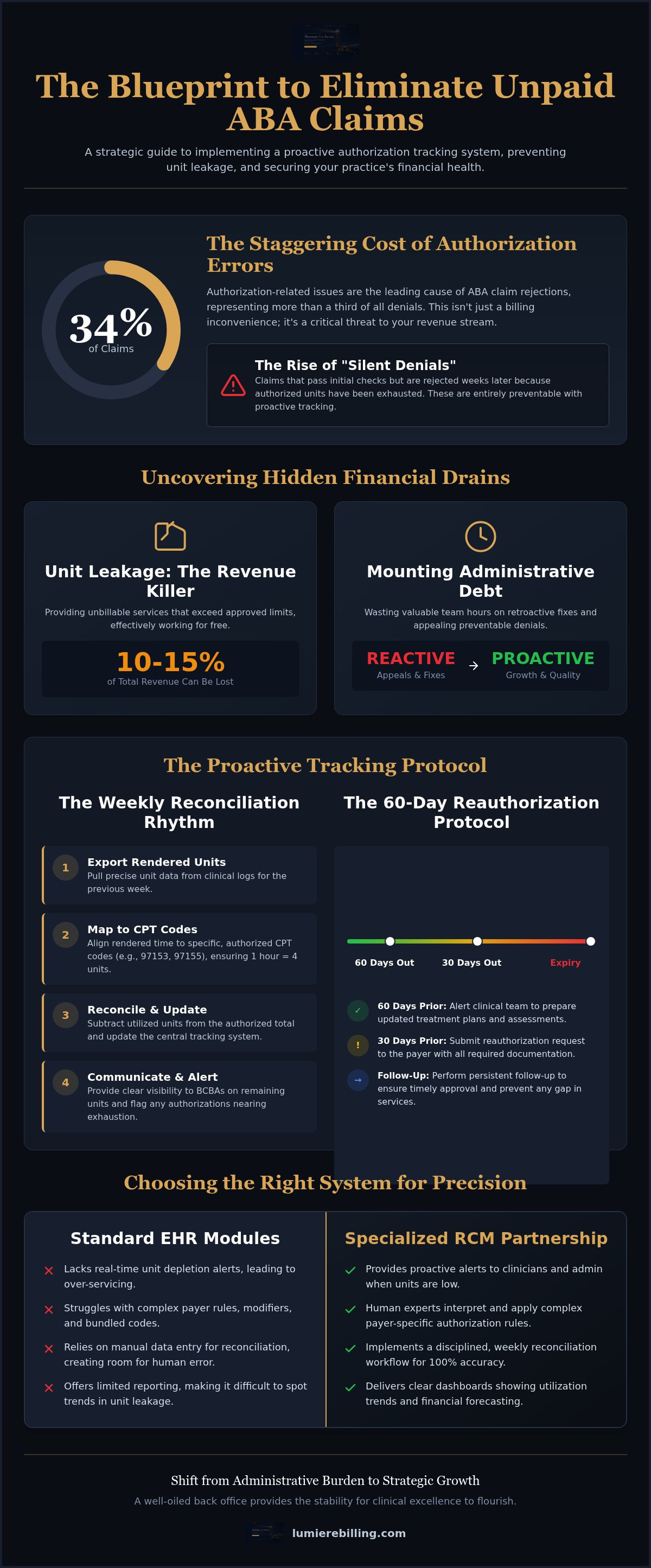
Securing an initial approval from a payer is often celebrated as a victory. In reality, it's merely the opening of a door. True financial stability for a practice specializing in Applied Behavior Analysis (ABA) depends on what happens after that letter arrives. ABA authorization tracking is the continuous, vigilant monitoring of approved versus utilized units throughout the entire care cycle. It's not a "set it and forget it" task; it's a dynamic reconciliation process. Without this oversight, you risk the "Silent Denial" phenomenon. These are claims that appear perfect on the surface and pass every initial clearinghouse check, only to be rejected weeks later because the authorized unit bucket is empty.
This failure point isn't just a billing issue. It's a clinical crisis. When a claim is denied due to unit exhaustion, the practice often has to pause services while scrambling for a retroactive fix. This disrupts the child's progress and erodes the hard-earned trust of the family. Robust tracking serves as your primary defense against common behavioral health billing errors to avoid. By maintaining a proactive stance, you ensure that every hour of care provided is backed by a valid, funded unit, protecting both your revenue and your reputation.
The Hidden Cost of Unit Leakage
Unit leakage is the provision of unbillable services that exceed the payer's approved limit, effectively resulting in free labor for the insurance company. Industry data suggests that unmonitored unit overages can drain 10-15% of an ABA practice's total revenue. This isn't just lost cash. It creates a massive "administrative debt" where your team spends hours trying to retroactively justify services or appealing denials that were entirely preventable. It's an inefficient use of talent that should be focused on growth or clinical quality.
Authorization as a Clinical Enablement Tool
We should view tracking as more than just a financial safeguard. It's a tool for clinical enablement. When ABA authorization tracking is handled with mechanical integrity, therapists can focus entirely on the learner without the nagging fear of non-payment. Clear visibility into remaining units allows BCBAs to manage their caseloads with precision. They can pace services according to the authorization's lifespan, ensuring care remains consistent throughout the six-month or three-month window. A well-oiled back office provides the structural stability that allows clinical excellence to flourish without administrative distraction.
A Step-by-Step Guide to ABA Unit Tracking and Reconciliation
Precision in the back office isn't an accident. It's the result of a rigorous, weekly reconciliation rhythm between clinical logs and billing data. Many practices falter by assuming their EHR handles this automatically. In reality, the prior authorization process only provides the framework; your tracking system provides the oversight. You must account for modifiers and concurrent service rules that can rapidly deplete your unit bucket if left unmonitored. Weekly checks prevent small leaks from becoming financial floods.
Mapping Units to CPT Codes
In the world of ABA, time is the primary currency. Standard Category I codes like 97153 and 97155 are billed in 15-minute increments. One hour equals four units. It sounds simple, but errors often arise when mapping the authorization to the clinical plan before the first session. You should verify that the approval includes specific codes for supervision and direct therapy, while also checking for "bundled" unit caps that limit total usage across multiple codes. A common failure point is over-billing 97155 relative to 97153. If a BCBA provides more direction than the payer approved for that specific RBT-led session, the claim will bounce. This is where a free billing audit can reveal hidden patterns of unit loss.
The Weekly Reconciliation Workflow
To maintain mechanical integrity in your ABA authorization tracking, implement a disciplined four-step weekly cycle. First, export "Units Rendered" from your EHR to see what actually happened on the ground. Second, compare these against "Units Authorized" in your billing dashboard to find the gap. Third, identify "Pending" units that are scheduled but not yet rendered. Finally, adjust clinical schedules immediately if the burn rate suggests you'll run out before the reauthorization window. This proactive adjustment is the only way to avoid unbillable labor.
We recommend a tiered alert system to stay ahead of the curve. Set internal notifications at 25% remaining to start the reauthorization paperwork. When you hit 10% remaining, perform a final check of all documentation and physician referrals. At 0%, implement a hard stop. This system ensures you never provide a minute of care that isn't backed by a funded unit. It transforms your ABA authorization tracking from a passive log into a vigilant revenue protection tool.
Evaluating Authorization Management Systems: EHR vs. Specialized RCM Dashboards
Practices often default to manual spreadsheets because they feel familiar. It's a dangerous comfort. Manual entry remains the primary cause of revenue leakage in behavioral health billing. While some graduate to standard EHR modules, they often find that "EHR visibility" is an illusion. Software is a tool, not a strategy. Effective ABA authorization tracking requires a synthesis of real-time data and expert human interpretation. If your data is lagging by even a week, you're already behind the payer's clock. You need a system that offers foresight, not just a digital paper trail.
The Limitations of EHR-Only Tracking
EHR systems are designed for clinical documentation, not rigorous financial oversight. They frequently lack the "hard stops" necessary to prevent billing when an authorization is exhausted. A clinician might continue logging sessions in good faith, unaware that the unit bucket is empty. This creates a data silo where the clinical team and the billing team are speaking different languages. Standard clinical platforms are often built for the clinician, not the biller. This fundamental design gap creates a scenario where authorized units are treated as a static field rather than a depleting resource. Software alone cannot account for the shifting, complex rules of individual payers in 2026. Without a vigilant eye to catch incorrect data entry at the source, the EHR simply automates your errors. It provides a record of the collapse rather than a mechanism to prevent it.
The Power of Specialized Billing Analytics
True mastery of ABA revenue cycle management demands a dedicated advocate who uses specialized analytics to see what software misses. A KPI dashboard for authorization health brings hidden issues into sharp focus. It moves your practice from reactive recovery to proactive protection. Specialized RCM partners act as an extension of your team, providing the mechanical integrity needed to repair broken systems. They don't just report on the status quo; they optimize it. A specialized dashboard doesn't just list numbers; it visualizes the burn rate of your revenue, allowing you to see which payers are creating bottlenecks before they result in a denial.
Lumiere Billing provides a Free Billing Audit to identify these systemic leaks before they impact your bottom line. It's the first step in gaining a clear vision of your practice's financial health. You don't need another software subscription; you need a partner who understands that ABA authorization tracking is a high-stakes game of precision. Real-time visibility ensures that every session is covered, every unit is accounted for, and every claim is positioned for first-pass acceptance. This level of oversight transforms your back office from a cost center into a vigilant protector of your revenue.
Preventing Service Gaps: The 60-Day Reauthorization Protocol
Waiting until the final weeks of an approval window is a high-stakes gamble with your practice's cash flow. A disciplined reauthorization protocol doesn't start at the finish line; it begins sixty days before the current window expires. This "Look Ahead" phase identifies upcoming expirations and triggers a precise sequence of administrative actions. Effective ABA authorization tracking ensures that no child's care is interrupted by a preventable paperwork delay. By the 45-day mark, your team should have all updated treatment plans and diagnostic referrals in hand. Submitting the request 30 days prior to expiration provides a necessary buffer for the inevitable payer delays and administrative friction that define the 2026 landscape.
Documentation Readiness Checklist
Success in reauthorization depends on the strength of your "Big Three" documents. You must secure an updated ASD diagnosis, a current progress report reflecting measurable gains, and a clear schedule of proposed treatment hours. Payers are increasingly scrutinizing "Clinical Necessity" language, looking for any reason to reduce unit counts. It's imperative to emphasize that all documentation must be audit-proof to satisfy the rigorous standards of current payer reviews. Missing even one signature or date on a referral can reset the entire clock, leading to unbillable sessions and family frustration.
Managing Payer Delays and Peer Reviews
Submitting your request is only half the battle. You must actively manage the "black hole" of payer processing times. Establish a follow-up cadence that keeps your request at the top of the pile without becoming white noise. If a payer misses their own deadline, trigger an emergency extension request immediately. Don't let their administrative failure become your financial loss. If you aren't seeing the coverage you expect, you should schedule a free billing audit to identify systemic friction in your submission process.
BCBAs play a critical role when a payer requests a peer-to-peer review. This isn't just a clinical discussion; it's a defense of your practice's revenue. The BCBA must be prepared with data-driven justifications for every requested unit, linking clinical progress directly to the proposed hours. In cases of "Partial Approvals," where a payer cuts requested hours, you must act fast. Appeal the reduction immediately while simultaneously adjusting the clinical schedule to fit the new authorized limit. This level of ABA authorization tracking and advocacy is what separates thriving practices from those struggling with constant service gaps.
Strategic Oversight: How Specialized RCM Partnerships Solve Authorization Complexity
Managing the labyrinth of payer requirements in 2026 is a burden no clinical team should carry alone. A specialized RCM partner acts as a vigilant protector of your practice's financial health, ensuring that administrative friction never compromises patient care. We align our success directly with yours through a percentage-based fee structure. This model creates a proactive partnership where the billing team only thrives when the practice is paid in full. It's a dedicated advocacy that treats your revenue cycle with the same level of care you provide to your learners.
Lumiere Billing integrates into your practice as a seamless extension of your team. We don't just process claims; we provide the mechanical integrity needed to sustain a high-growth ABA practice. By performing a comprehensive behavioral health billing audit, we identify specific authorization leaks that are currently draining your revenue. This diagnostic step brings light to opaque processes and sets the stage for a more resilient financial foundation.
Moving from Reactive to Proactive Billing
The status quo in many offices is a reactive cycle of fixing denials after they occur. This "Old Way" is expensive, exhausting, and inherently flawed. It relies on catch-up work that often results in permanent revenue loss. The Lumiere Way shifts the focus toward prevention. We establish professional authorization guardrails that catch unit discrepancies and modifier errors before the claim is ever submitted. This level of ABA authorization tracking provides the structural stability your practice needs to scale.
By implementing proactive oversight, you replace administrative debt with sustainable growth. You no longer have to wonder if a session will be paid or if a reauthorization window was missed. Data-driven decisions become your new baseline. This shift in strategy allows your clinical leadership to focus on outcomes and caseload management rather than chasing down missing units or arguing with payer representatives over expired approvals.
The Lumiere Advantage: Specialized ABA Expertise
Distractions are the enemy of precision. We reject the "generalist" identity, focusing exclusively on behavioral health to ensure we master the nuances of your specific field. We understand the unique challenges of ABA authorization tracking, from concurrent billing rules to the shifting requirements of state Medicaid programs. This specialized expertise means we anticipate changes in the industry before they impact your cash flow.
Visibility is the core of our approach. We bring hidden issues into focus through transparent analytics and real-time reporting. You'll have a clear view of your utilization rates, denial patterns, and reauthorization timelines. This transparency builds trust and ensures that you are always in control of your practice's financial destiny. Don't let your revenue remain in the dark. Schedule your free billing audit today and experience the clarity of specialized RCM oversight.
Securing Your Practice's Financial Future Through Precision
The complexity of 2026 payer requirements demands a shift from administrative hope to mechanical certainty. We've explored how a disciplined 60-day reauthorization protocol and weekly unit reconciliation can eliminate the "silent denials" that drain your revenue. True mastery of ABA authorization tracking is about more than just logging data; it's about creating a proactive revenue protection system that operates with absolute precision. By moving away from manual spreadsheets and optimizing your existing clinical platforms, you allow your clinical team to focus on what matters most: patient outcomes.
Lumiere Billing stands as a vigilant protector of your practice's financial health. Our specialized behavioral health focus ensures we understand the nuances of ABA billing that generalist firms miss. We operate on a percentage-based fee structure, meaning our success is directly tied to yours. It's time to bring light to your opaque back-office processes and repair the leaks in your revenue cycle. Stop the revenue leaks; get your free ABA billing audit from Lumiere Billing today. Your practice deserves a partner that values precision as much as you value care.
Frequently Asked Questions
What is the difference between prior authorization and a referral in ABA?
A referral is a clinical order from a physician, such as a pediatrician, stating that ABA is medically necessary. Prior authorization is the payer's administrative approval of specific CPT codes and unit counts for a set period. One validates the clinical need for care, while the other secures the funding for it. Mechanical integrity depends on the alignment of these two distinct approvals. You can't bill successfully without both documents being active.
How often should I reconcile my ABA authorization units?
You should reconcile your units weekly to maintain mechanical integrity in your revenue cycle. Monthly checks are too lagging; they allow unit leakage to compound until it's unrecoverable. Weekly reconciliation compares rendered units in your clinical logs against the approved balance in your billing dashboard. This frequency allows you to adjust schedules immediately if the burn rate is too high, preventing unbillable overages before they occur and protecting your revenue.
What happens if I provide ABA services without an active authorization?
Providing services without an active authorization results in a hard denial that is almost impossible to appeal. Payers view these sessions as unbillable "free" labor for the insurance company. It creates a massive financial leak and administrative debt as your team attempts to justify retroactive coverage. To protect your practice, implement a hard stop in your scheduling system that prevents therapists from logging time once an authorization expires or units are exhausted.
How do I handle a 'partial authorization' where the payer approves fewer hours than requested?
If a payer approves fewer hours than requested, you must immediately file an appeal while simultaneously adjusting the clinical schedule. This often requires a BCBA to provide additional data-driven justification during a peer-to-peer review. Do not continue providing the original requested hours if they aren't authorized. ABA authorization tracking ensures you only render services that have a guaranteed funding source while you fight for the necessary increase in care for the learner.
Can I bill for ABA services while a reauthorization is pending?
You cannot bill for services rendered while a reauthorization is pending unless the payer has granted a formal extension. Claims submitted during this "gap" period will be rejected for lack of authorization. Some practices choose to continue care at their own financial risk, but this often leads to permanent revenue loss. The only safe solution is our 60-day reauthorization protocol, which ensures new approvals are secured before the old ones expire, preventing cash flow gaps.
What are the most common reasons ABA authorizations are denied in 2026?
In 2026, several factors lead to frequent claim rejections. The most common denial triggers include:
- Unit exhaustion and over-utilization
- Modifier mismatches and concurrent billing errors
- Outdated diagnostic referrals or missing signatures
Payers are also scrutinizing "Clinical Necessity" language more aggressively. If your ABA authorization tracking fails to account for these nuances, the claim will bounce. These "silent denials" stem from a lack of specialized, vigilant oversight in the back office.
How long does the ABA prior authorization process typically take?
The prior authorization process typically takes between 14 and 30 days, though some commercial payers may take longer if a peer review is required. This timeframe is why we mandate a 30-day submission window. Waiting until the last two weeks of an approval period is a high-stakes gamble. Proactive submission accounts for administrative friction and allows your team to resolve documentation gaps without interrupting the child's care or your practice's cash flow.
Does my EHR software handle authorization tracking automatically?
Most EHR software provides basic visibility but rarely handles tracking with the precision required for denial prevention. Software is a passive tool; it often lacks the "hard stops" and complex logic needed to manage payer-specific rules or modifier accuracy. Effective tracking requires a synthesis of technology and expert human oversight. A specialized RCM partner brings the vision needed to catch the data errors that software alone typically ignores or automates.
Frequently Asked Questions
A referral is a clinical order from a physician, such as a pediatrician, stating that ABA is medically necessary. Prior authorization is the payer's administrative approval of specific CPT codes and unit counts for a set period. One validates the clinical need for care, while the other secures the funding for it. Mechanical integrity depends on the alignment of these two distinct approvals. You can't bill successfully without both documents being active.
You should reconcile your units weekly to maintain mechanical integrity in your revenue cycle. Monthly checks are too lagging; they allow unit leakage to compound until it's unrecoverable. Weekly reconciliation compares rendered units in your clinical logs against the approved balance in your billing dashboard. This frequency allows you to adjust schedules immediately if the burn rate is too high, preventing unbillable overages before they occur and protecting your revenue.
Providing services without an active authorization results in a hard denial that is almost impossible to appeal. Payers view these sessions as unbillable "free" labor for the insurance company. It creates a massive financial leak and administrative debt as your team attempts to justify retroactive coverage. To protect your practice, implement a hard stop in your scheduling system that prevents therapists from logging time once an authorization expires or units are exhausted.
If a payer approves fewer hours than requested, you must immediately file an appeal while simultaneously adjusting the clinical schedule. This often requires a BCBA to provide additional data-driven justification during a peer-to-peer review. Do not continue providing the original requested hours if they aren't authorized. ABA authorization tracking ensures you only render services that have a guaranteed funding source while you fight for the necessary increase in care for the learner.
You cannot bill for services rendered while a reauthorization is pending unless the payer has granted a formal extension. Claims submitted during this "gap" period will be rejected for lack of authorization. Some practices choose to continue care at their own financial risk, but this often leads to permanent revenue loss. The only safe solution is our 60-day reauthorization protocol, which ensures new approvals are secured before the old ones expire, preventing cash flow gaps.
In 2026, several factors lead to frequent claim rejections. The most common denial triggers include: Payers are also scrutinizing "Clinical Necessity" language more aggressively. If your ABA authorization tracking fails to account for these nuances, the claim will bounce. These "silent denials" stem from a lack of specialized, vigilant oversight in the back office.
The prior authorization process typically takes between 14 and 30 days, though some commercial payers may take longer if a peer review is required. This timeframe is why we mandate a 30-day submission window. Waiting until the last two weeks of an approval period is a high-stakes gamble. Proactive submission accounts for administrative friction and allows your team to resolve documentation gaps without interrupting the child's care or your practice's cash flow.
Most EHR software provides basic visibility but rarely handles tracking with the precision required for denial prevention. Software is a passive tool; it often lacks the "hard stops" and complex logic needed to manage payer-specific rules or modifier accuracy. Effective tracking requires a synthesis of technology and expert human oversight. A specialized RCM partner brings the vision needed to catch the data errors that software alone typically ignores or automates.