Counseling Center Revenue Optimization: The 2026 Strategic Framework

In 2026, behavioral health denial rates have spiked to 11.8%, nearly double the rate for general medicine. It’s a sobering reality for practice owners who see their clinicians fully booked yet find their bank accounts stagnant. You’ve likely dealt with the frustration of untracked ABA units leading to unbillable sessions or credentialing delays that keep new talent on the sidelines. It feels like you’re running a marathon with weights tied to your ankles, hampered by administrative friction you didn't create.
We understand that opaque billing reports and systemic leaks shouldn't be the price of doing business. This guide provides a definitive framework for counseling center revenue optimization, designed to move your practice from defensive, reactive billing to proactive financial mastery. You’ll discover how to identify hidden failure points and implement a specialized behavioral health RCM strategy that maximizes collections through clinical-financial synergy.
We’ll explore the impact of the $33.4009 Medicare conversion factor, the critical necessity of KX modifiers once the $2,480 therapy threshold is met, and the oversight required to eliminate silent denials. It’s time to stop guessing and start seeing your financial health with the absolute clarity your mission deserves.
Key Takeaways
- Identify the "silent denials" and subtle modifier errors that drain behavioral health revenue before claims are ever submitted.
- Implement a specialized 2026 framework for counseling center revenue optimization that transforms clinical documentation into a proactive financial tool.
- Discover why expert human oversight is critical to navigating the aggressive AI-driven audits payers now use to scrutinize time-based CPT codes.
- Learn how a percentage-based RCM model aligns incentives, focusing on clean claim rates and accelerated collections rather than mere billing volume.
- Uncover systemic leaks through a comprehensive billing audit to reclaim unbillable sessions and resolve credentialing delays.
The Anatomy of Revenue Leakage in Behavioral Health
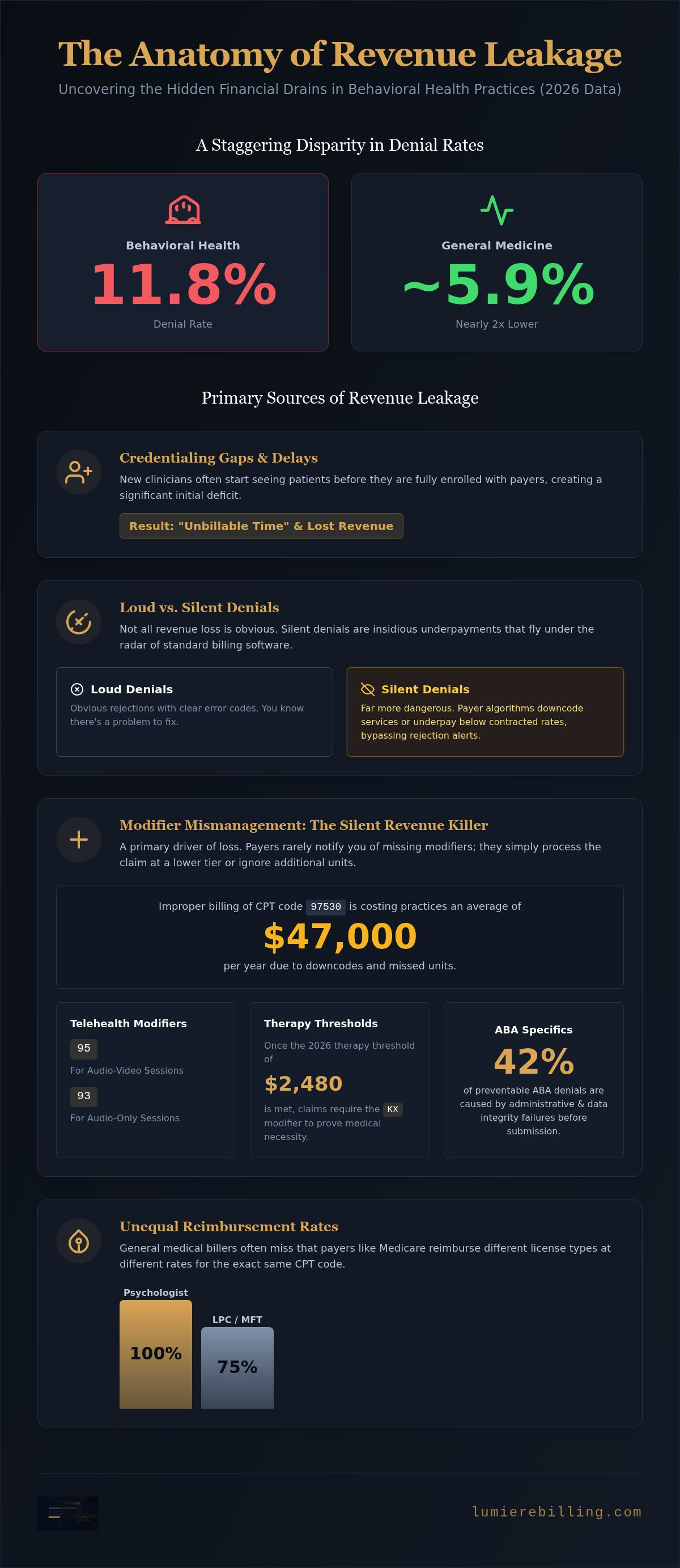
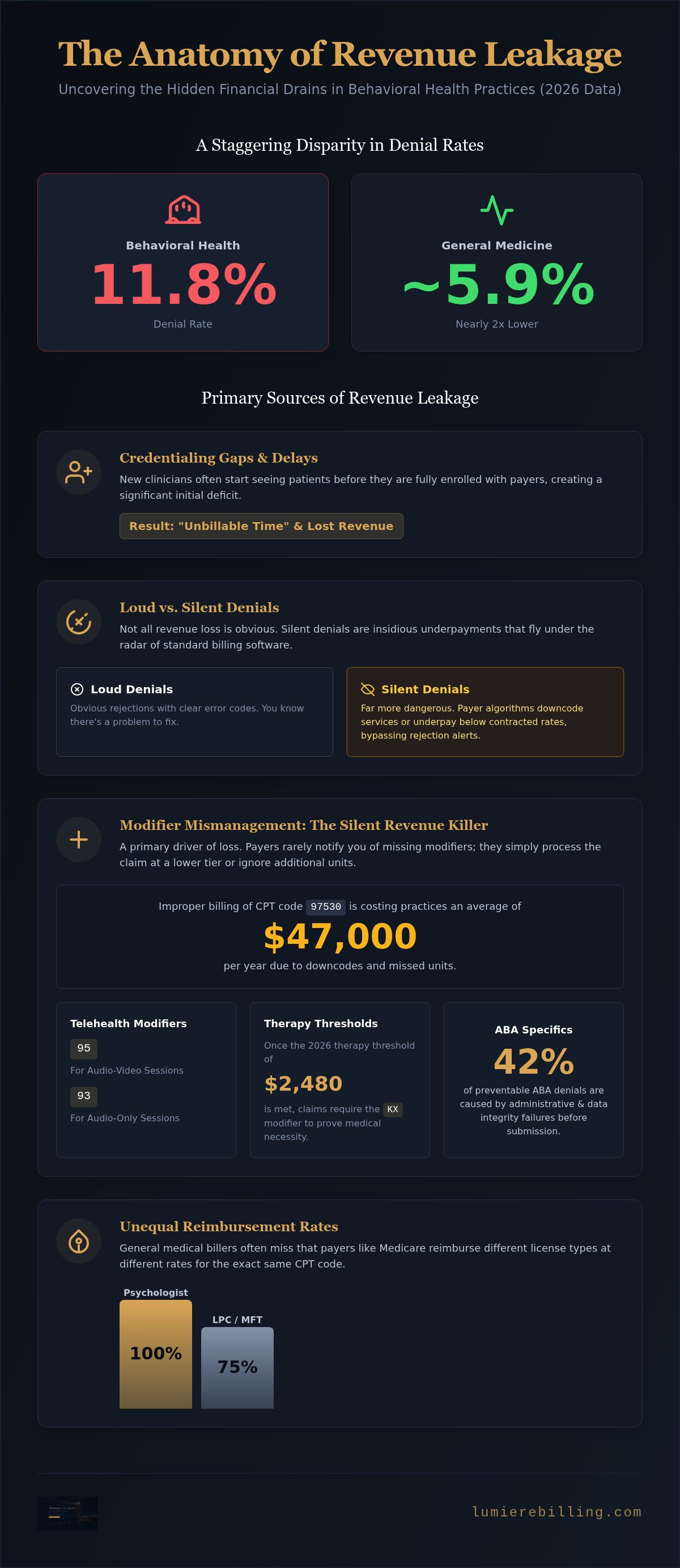
Counseling center revenue optimization isn't just about increasing session volume; it's about capturing every dollar your clinicians earn. Many practices suffer from a booked schedule that doesn't translate to a healthy bottom line. This happens because revenue leakage in behavioral health is often invisible. General medical billing firms frequently overlook these niche failure points because they lack specialized knowledge of ABA and mental health coding. They treat your claims like standard office visits, ignoring the complex credential-tier systems where Medicare pays LPCs and MFTs at 75% of the psychologist rate for the same CPT code.
In 2026, behavioral health denial rates are at 11.8%, nearly double the rate for general medicine. Much of this loss is driven by "unbillable time" caused by credentialing gaps. When a new hire starts but isn't yet enrolled with payers, every session they conduct is essentially free labor. These delays prevent new hires from billing immediately, creating a massive initial deficit. A vigilant protector of your financial health doesn't just wait for the hire to happen; they proactively manage the enrollment pipeline to ensure the "revenue engine" starts on day one.
The Hidden Cost of Silent Denials
A traditional denial is loud. You get a rejection code, and you know there's a problem to fix. Silent denials are far more dangerous because they involve underpayments that bypass standard rejection alerts. Payer algorithms exploit minor documentation gaps by downcoding services without triggering a hard stop in your EHR. To protect your practice, you must perform meticulous line-item reconciliation to catch where a payer processed a claim below your contracted rate. Without this visibility, these small discrepancies compound into significant annual losses that never appear on a basic aging report.
Modifier Errors: The Silent Revenue Killer
Improper modifier usage is a primary driver of revenue loss in behavioral health. In 2026, incorrect billing of CPT code 97530 is costing practices an average of $47,000 per year due to downcodes and missed units. Failing to attach the correct modifier to 90837 sessions or ABA units results in automatic underpayment. Payers rarely notify you that a modifier was missing; they simply process the claim at a lower tier or ignore the additional units entirely.
- Telehealth Modifiers: Using modifier 95 for audio-video or 93 for audio-only sessions is mandatory for Medicare compliance.
- Therapy Thresholds: The 2026 therapy threshold is $2,480. Once met, claims require the KX modifier to indicate medical necessity.
- ABA Specifics: Administrative and data integrity failures at the pre-submission stage cause 42% of preventable ABA denials.
Precision here is the difference between a thriving practice and one that is slowly bleeding out. You can find more details on these pitfalls in our guide to Behavioral Health Billing Errors to Avoid. Moving toward true counseling center revenue optimization requires a shift from passive billing to active, specialized oversight.
Clinical Documentation as a Financial Optimization Tool
Your clinical notes are the bedrock of your financial integrity. Many practitioners view documentation as a secondary administrative chore, yet in the current landscape, it is your most powerful revenue driver. True counseling center revenue optimization requires a shift in perspective. Documentation isn't just a record of care; it is the legal and financial evidence required to justify your reimbursement. When notes are vague or disconnected from the billed units, you invite retroactive clawbacks that can devastate a practice's cash flow months after the service was provided.
Precision in documentation reduces the time spent in the "denial-appeal" cycle. By correlating clinical hours with billed units with absolute accuracy, you eliminate the friction that causes payers to pause payments. Meticulous documentation audits ensure that every session meets the rigorous standards of medical necessity before the claim is even generated. This proactive stance transforms your back-office from a reactive cost center into a disciplined engine of growth.
Mastering the 90837 CPT Code and Beyond
In 2026, payers are increasingly leveraging AI and large language models to conduct large-scale audits of time-based CPT codes. The 90837 code is under intense scrutiny. To satisfy these strict audits, your documentation must clearly reflect the start and stop times, along with a narrative that justifies the extended session length. Over-billing this code without specific clinical justification creates a "red flag" profile. In ABA settings, the nuances of concurrent billing require even greater vigilance. You must document the distinct roles and interactions of each provider to prevent units from being flagged as duplicative or unbillable.
Medical Necessity: The Foundation of Reimbursement
Medical necessity is the primary filter payers use to deny ongoing care. To protect your revenue, your notes must include specific markers: measurable goals, progress toward those goals, and a clear rationale for the chosen intervention. Integrating clinical outcomes into your billing narrative proves that the patient requires the level of care you're providing. This is especially critical for prior authorization renewals. If your documentation doesn't show a logical progression of treatment, payers will likely truncate the authorization, leading to a sudden stop in billable sessions. A specialized billing partner can help you align these clinical narratives with financial requirements to ensure uninterrupted care and collections.
Once your therapy services reach the $3,000 threshold, CMS and other payers may trigger targeted medical reviews. Without a foundation of documentation that proves medical necessity, these reviews often lead to across-the-board denials. By treating every note as a financial document, you build a practice that is resilient against audit-driven revenue loss.
Technology vs. Human Oversight in Counseling RCM
Software is often sold as a silver bullet for administrative friction. While platforms like TherapyNotes provide robust infrastructure, they're only as effective as the human logic guiding them. True counseling center revenue optimization requires moving beyond the "set it and forget it" mentality. Automation handles repetitive data entry well, but it can't navigate the nuance of a contested claim or an incorrectly processed ABA modifier. Relying solely on EHR automation leads to revenue stagnation because these systems lack the critical eye required to spot emerging payer trends or subtle underpayments that bypass standard alerts.
Human oversight acts as a vigilant protector, catching the errors that algorithms ignore. Specialized billing experts provide the mechanical integrity that software lacks, ensuring your practice isn't just processing claims, but actually collecting the full value of its services. This synergy between technology and expertise is what separates a plateauing practice from one that scales with precision.
ABA Unit Tracking and Authorization Reconciliation
ABA practices face unique challenges that standard EHR logic often fails to address adequately. A primary failure point is the disconnect between authorized units and actual utilization. Software might track that a session occurred, but it rarely reconciles utilized units against the remaining authorization in real-time with total accuracy. This gap leads to unbillable sessions where clinicians provide care that the practice simply can't collect on. To prevent these leaks, implement a weekly reconciliation framework:
- Validate authorization balances against clinician schedules every Tuesday to ensure no one is over-scheduled.
- Identify "at-risk" units at least 14 days before expiration to allow time for re-authorization.
- Manually reconcile utilized units with payer portals to ensure your EHR data matches the payer's records.
Optimizing EHR Workflows for Cash Flow
Maximizing collections starts at the point of intake. You must configure your EHR alerts to catch insurance verification gaps before the first appointment happens. Clean data entry isn't just an administrative task; it's the foundation of a successful Behavioral Health Revenue Cycle Management: 2026 Guide. If a patient's ID number or authorization code is entered incorrectly, the most sophisticated automation will still produce a denial. Human oversight ensures these front-end alerts are respected and the "clean claim" path remains unobstructed. By prioritizing data integrity at the start, you reduce charge lag and ensure your days in A/R remain well below the 45-day industry target.
The 5-Step Revenue Optimization Framework for 2026
Achieving sustainable counseling center revenue optimization requires a disciplined, sequential approach rather than a collection of isolated tasks. It's about building a system that protects your earnings at every touchpoint. Step 1 begins with a comprehensive billing audit. This diagnostic phase identifies where money is being left on the table. We look for patterns in unpaid claims and unbilled units that have become "invisible" over time. Without this baseline, you're merely guessing where your leaks exist.
Proactive Verification and Authorization
Step 2 demands that insurance verification happens at least 48 hours prior to every session. Coverage is fluid; a patient's plan can change without notice. By verifying early, you allow your team time to pivot if an authorization has expired or a deductible has reset. Your system must track authorization expiration dates in real-time, alerting you 14 days before units run out. Specialized credentialing is the final piece of this puzzle. You must ensure every provider is fully eligible to bill before they enter the session room, preventing the "unbillable time" trap mentioned earlier.
Step 3 focuses on specialized coding and modifier application. This is the mechanical integrity of your billing. Every claim must be scrubbed for CPT accuracy and the correct attachment of modifiers like 95 for telehealth or KX for therapy thresholds. Precision here ensures that your first-pass resolution rate remains high, reducing the administrative burden of rework.
Aggressive Denial Management Strategies
Step 4 is where many practices falter. You must implement a "24-hour rule" for responding to claim rejections. The longer a denial sits, the less likely you are to recover those funds. Categorize every denial by payer and reason code to identify systemic trends. If a specific payer begins rejecting 90837 codes across your practice, you need to know immediately to adjust your documentation or appeal strategy. For a deeper look at managing these complexities, see our Outsource Mental Health Billing: A Strategic Guide.
Step 5 involves data-driven performance monitoring. You can't manage what you don't measure. Your KPI dashboards should focus on two primary metrics: keeping days in A/R below 45 and maintaining a clean claim rate above 95%. These numbers provide the visibility needed to scale your practice with confidence. If your current process feels opaque, start by requesting a Free Billing Audit to illuminate your systemic leaks and begin the path toward true counseling center revenue optimization.
Scaling with Precision: The Case for Specialized RCM
Scaling a behavioral health practice requires a financial infrastructure that expands as quickly as your clinical team. Many owners find that as they add locations, their administrative costs balloon and their oversight thins. True counseling center revenue optimization is only possible when your billing system is built for scale. Centralized RCM allows multi-location centers to maintain absolute visibility into their cash flow, ensuring that a leak in one office doesn't contaminate the entire practice's health.
By moving away from fragmented, location-specific billing, you gain a unified view of your performance. This centralized approach ensures that specialized knowledge, such as the nuances of the 2026 therapy thresholds or the complexities of ABA modifier application, is applied consistently across your entire organization. It transforms your back-office from a reactive cost center into a disciplined engine of growth.
The ROI of Specialized Behavioral Health Billing
The choice between an in-house billing department and a specialized RCM firm is often framed as a cost comparison, but it's actually an investment in precision. In-house teams require constant training on 2026 CMS updates and the evolving MHPAEA standards. They also come with fixed overhead like salaries, benefits, and software licensing. These costs remain static even if your collections dip.
In contrast, Lumiere Billing operates on a percentage-based fee structure. This model aligns our incentives perfectly with yours. We don't get paid until you collect. This creates a proactive partnership where our team is motivated to recover every single dollar, including those "silent denials" that in-house staff might overlook due to sheer volume. Clinicians gain the peace of mind to focus on patient outcomes, knowing that their financial protector is managing the back-office with obsessive attention to detail.
Practice Advisory: Beyond the Claims
Specialized RCM acts as a practice advisory partner, not just a vendor. We use the data from your revenue cycle to inform high-level decisions on practice expansion and payer contracting. If a specific payer's denial rate is climbing or their reimbursement for 90837 codes is no longer competitive, our analytics highlight these trends before they become crises. This level of insight is rarely available through traditional billing services.
This visibility allows us to consult on internal clinical workflows, ensuring your documentation remains audit-proof while maximizing billable units. We move beyond the transaction to help you build a more resilient business. The logical first step toward this level of control is a Free Billing Audit. This diagnostic tool uncovers immediate opportunities for counseling center revenue optimization by illuminating the gaps in your current system. It's time to stop accepting mediocrity and start scaling with the precision your mission requires.
Mastering the Financial Future of Behavioral Health
True counseling center revenue optimization requires a shift from passive observation to active, specialized oversight. We've explored how systemic leaks, silent denials, and unbillable ABA units can quietly erode your practice's health. By transforming clinical documentation into a financial tool and implementing a disciplined 5-step framework, you move beyond the "generalist" trap. You deserve a partner that understands the mechanical integrity of your revenue cycle and acts as a vigilant protector of your mission.
Lumiere Billing specializes exclusively in behavioral health and ABA. Our percentage-based fee model ensures our incentives are perfectly aligned with your success; we only get paid when you do. Beyond standard RCM, we provide expert practice advisory and consulting to help you navigate the complex payer landscape with total clarity. It's time to stop guessing and start scaling with precision. Request Your Free Billing Audit and Optimize Your Revenue. Your practice is built on helping others; let us build the financial foundation that allows you to do it at scale.
Frequently Asked Questions
What is the most common cause of revenue loss in counseling centers?
Administrative failures and data integrity errors at the pre-submission stage represent the most common causes of revenue loss. In behavioral health, this often manifests as missed modifiers or untracked therapy thresholds. For example, failing to apply the KX modifier once a patient hits the $2,480 therapy threshold results in immediate, preventable denials. These systemic leaks often go unnoticed until a comprehensive audit brings the mechanical failure points into sharp focus.
How does behavioral health revenue optimization differ from general medical billing?
Behavioral health requires a level of specialization that general medical billing simply doesn't possess. Successful counseling center revenue optimization depends on navigating credential-tier systems, where Medicare pays LPCs and MFTs at 75% of the psychologist rate for identical CPT codes. Additionally, the intensive unit tracking required for ABA and the nuance of time-based therapy codes like 90837 demand a specialized eye that generalists often lack, leading to significant underpayments.
What KPIs should I track to measure my counseling center’s financial health?
To maintain peak financial health, you should monitor five critical performance indicators. Your Days in A/R must remain below 45 days, while your Clean Claim Rate should exceed 95%. Aim for a Denial Rate below 5% and a First-Pass Resolution Rate above 90%. Finally, your Charge Lag should be less than three days. Tracking these metrics through comprehensive analytics provides the visibility needed to identify systemic leaks before they impact your practice's stability.
How long does it take to see results from a revenue cycle optimization project?
You can identify immediate opportunities for counseling center revenue optimization within the first week through a comprehensive billing audit. However, the full impact of a strategic RCM framework typically manifests within 30 to 90 days. This timeline allows for the clearing of aging A/R, the implementation of proactive verification workflows, and the stabilization of clean claim rates. As these refined processes take hold, you'll see a steady acceleration in cash flow and collections.
Can an EHR alone optimize my counseling center’s revenue?
An EHR is a powerful tool for infrastructure, but it cannot optimize your revenue in isolation. Software lacks the critical thinking required to navigate complex payer disputes or identify emerging audit trends. "Set it and forget it" automation often leads to stagnation because algorithms don't catch subtle underpayments or downcodes. True optimization requires human-led oversight to reconcile utilized units and ensure documentation satisfies the increasingly aggressive AI-driven audits used by payers.
What are silent denials, and how do I identify them in my practice?
Silent denials are underpayments where a payer processes a claim at a rate lower than your contracted amount without triggering a rejection alert. Unlike traditional denials, these don't appear on standard error reports. To identify them, you must perform meticulous line-item reconciliation, comparing every payment against your specific contract rates. This level of visibility is essential for capturing revenue that would otherwise be lost to subtle documentation gaps or payer algorithm errors.
Why is specialized credentialing important for revenue optimization?
Specialized credentialing is vital because it eliminates the "unbillable time" gap for new clinicians. If a provider isn't correctly enrolled with every payer before they start seeing patients, those initial sessions are essentially free labor. Proactive credentialing management ensures that new hires can bill from day one, protecting your practice's investment in new talent. It's a critical component of a proactive framework that treats every administrative step as a financial driver.
Is a percentage-based billing fee better than a flat monthly rate?
A percentage-based billing model is superior because it perfectly aligns the incentives of the RCM firm with your practice's success. Unlike flat-fee models that provide a fixed income regardless of performance, a percentage-based structure ensures your billing partner is motivated to recover every single dollar. This model encourages aggressive denial management and meticulous follow-up on aging A/R. We only get paid when you do, transforming the relationship into a proactive partnership.
Frequently Asked Questions
Administrative failures and data integrity errors at the pre-submission stage represent the most common causes of revenue loss. In behavioral health, this often manifests as missed modifiers or untracked therapy thresholds. For example, failing to apply the KX modifier once a patient hits the $2,480 therapy threshold results in immediate, preventable denials. These systemic leaks often go unnoticed until a comprehensive audit brings the mechanical failure points into sharp focus.
Behavioral health requires a level of specialization that general medical billing simply doesn't possess. Successful counseling center revenue optimization depends on navigating credential-tier systems, where Medicare pays LPCs and MFTs at 75% of the psychologist rate for identical CPT codes. Additionally, the intensive unit tracking required for ABA and the nuance of time-based therapy codes like 90837 demand a specialized eye that generalists often lack, leading to significant underpayments.
To maintain peak financial health, you should monitor five critical performance indicators. Your Days in A/R must remain below 45 days, while your Clean Claim Rate should exceed 95%. Aim for a Denial Rate below 5% and a First-Pass Resolution Rate above 90%. Finally, your Charge Lag should be less than three days. Tracking these metrics through comprehensive analytics provides the visibility needed to identify systemic leaks before they impact your practice's stability.
You can identify immediate opportunities for counseling center revenue optimization within the first week through a comprehensive billing audit. However, the full impact of a strategic RCM framework typically manifests within 30 to 90 days. This timeline allows for the clearing of aging A/R, the implementation of proactive verification workflows, and the stabilization of clean claim rates. As these refined processes take hold, you'll see a steady acceleration in cash flow and collections.
An EHR is a powerful tool for infrastructure, but it cannot optimize your revenue in isolation. Software lacks the critical thinking required to navigate complex payer disputes or identify emerging audit trends. "Set it and forget it" automation often leads to stagnation because algorithms don't catch subtle underpayments or downcodes. True optimization requires human-led oversight to reconcile utilized units and ensure documentation satisfies the increasingly aggressive AI-driven audits used by payers.
Silent denials are underpayments where a payer processes a claim at a rate lower than your contracted amount without triggering a rejection alert. Unlike traditional denials, these don't appear on standard error reports. To identify them, you must perform meticulous line-item reconciliation, comparing every payment against your specific contract rates. This level of visibility is essential for capturing revenue that would otherwise be lost to subtle documentation gaps or payer algorithm errors.
Specialized credentialing is vital because it eliminates the "unbillable time" gap for new clinicians. If a provider isn't correctly enrolled with every payer before they start seeing patients, those initial sessions are essentially free labor. Proactive credentialing management ensures that new hires can bill from day one, protecting your practice's investment in new talent. It's a critical component of a proactive framework that treats every administrative step as a financial driver.
A percentage-based billing model is superior because it perfectly aligns the incentives of the RCM firm with your practice's success. Unlike flat-fee models that provide a fixed income regardless of performance, a percentage-based structure ensures your billing partner is motivated to recover every single dollar. This model encourages aggressive denial management and meticulous follow-up on aging A/R. We only get paid when you do, transforming the relationship into a proactive partnership.