Behavioral Health Underpayment Recovery: A 2026 Guide to Reclaiming Lost Revenue

What if your most successful claims are actually hiding your biggest financial losses? While a denial triggers an immediate alert, "silent leaks" often slip through the cracks, making a robust behavioral health underpayment recovery strategy essential for survival in 2026. You likely feel the daily friction of manual ABA unit reconciliation or the confusion of applying modifier 95 correctly across different commercial payers. It's exhausting to provide high-quality care while watching your net collection rate hover around 91 percent due to contract misinterpretations you can't quite pin down.
This guide shows you exactly how to bring these hidden deficits into focus through specialized zero-balance audits and contract intelligence. You'll learn to identify reimbursement variances and recover back-pay that most practices simply write off as a cost of doing business. We'll preview the specific steps to fix systemic billing errors and leverage MHPAEA enforcement to ensure you're paid every dollar you're owed. It is time to move away from administrative opacity and toward a transparent, optimized revenue cycle that protects your practice's financial health.
Key Takeaways
- Identify the "silent denials" that bypass your EHR's standard work queues and leave earned revenue on the table.
- Execute a precision zero-balance audit to verify that commercial deposits align with your actual contracted fee schedules.
- Master the documentation requirements needed for effective behavioral health underpayment recovery to reclaim lost back-pay.
- Implement proactive contract modeling to predict reimbursement accuracy and prevent modifier-related leakage before it happens.
- Leverage a specialized billing audit to illuminate hidden financial gaps and restore the mechanical integrity of your revenue cycle.
Underpayments vs. Denials: Why Behavioral Health Revenue Silently Disappears
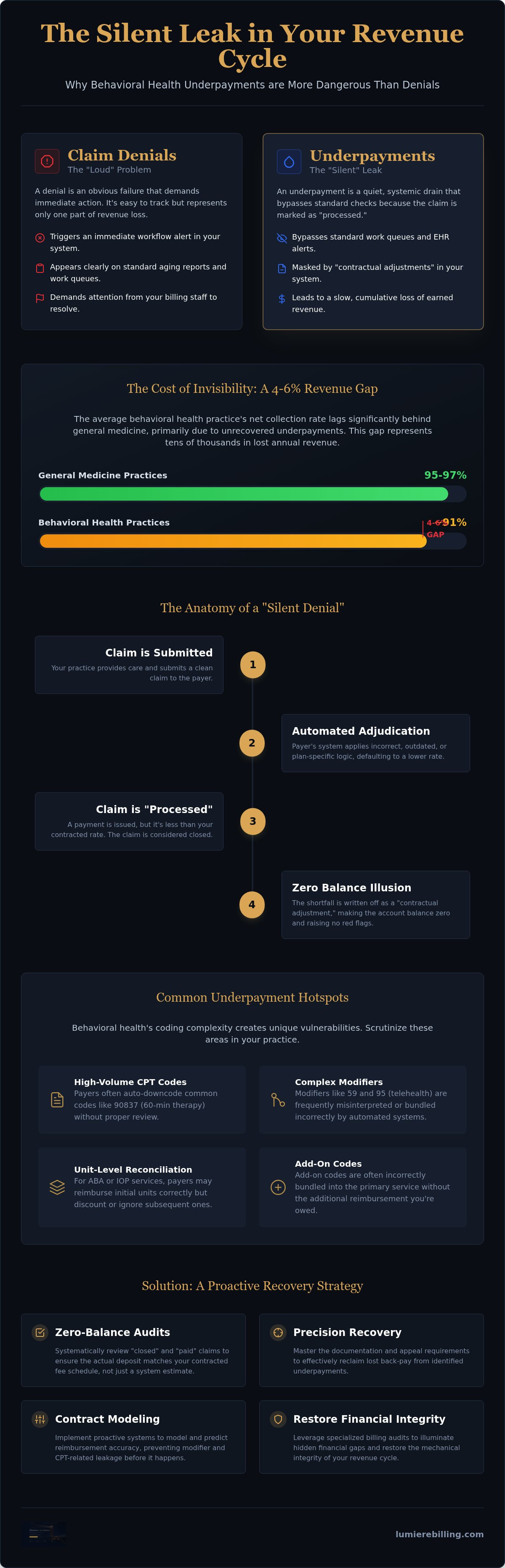
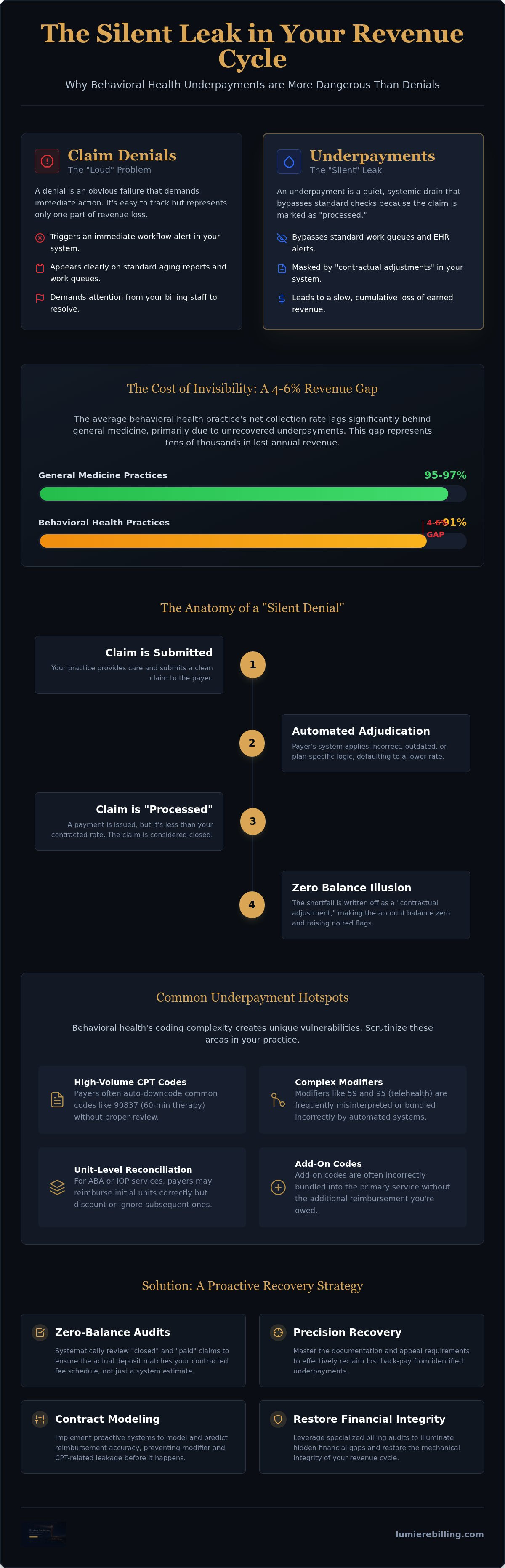
A denial is a loud, visible failure. It triggers a workflow, appears on a report, and demands immediate attention. An underpayment, however, is a quiet, systemic leak that often goes unnoticed until the practice's financial health is already compromised. We define these as "silent denials." They bypass standard work queues because the claim technically reaches a "processed" status. In the eyes of your front-office staff, the task is complete. In reality, your practice just lost 15 percent of its earned revenue.
The psychological trap is simple. Most administrators assume that if a claim is processed and the account balance in the EHR is zero, the payer has fulfilled its obligation. This is a dangerous misconception. A zero-balance account only indicates that the difference between the billed amount and the paid amount was moved to a "contractual adjustment" category. Without a rigorous behavioral health underpayment recovery protocol, you're essentially trusting the payer's automated systems to audit themselves. Data shows this trust is misplaced. The average behavioral health practice maintains a net collection rate of approximately 91 percent, while general medicine typically sees 95 to 97 percent. That 4 to 6 percent gap represents thousands of dollars in unrecovered care.
The Mechanics of a Behavioral Health Underpayment
Payers utilize sophisticated, automated adjudication engines to process high volumes of claims. These systems often apply incorrect, plan-specific logic that defaults to the lowest possible reimbursement rate. Because traditional revenue cycle management (RCM) workflows are designed to catch "unpaid" claims rather than "underpaid" ones, these discrepancies remain hidden. The contractual adjustment serves as a shroud, masking variances that should have been flagged as short-payments. When your system isn't programmed to cross-reference the actual deposit against your specific fee schedule, the machine wins and your practice loses.
The High Cost of Niche Complexity
Behavioral health is uniquely susceptible to these leaks due to its inherent coding complexity. Time-based CPT codes and high-sensitivity modifiers, such as 59 or 95, create endless opportunities for "small" errors. Generic RCM software often lacks the behavioral-specific logic required to track ABA units or verify modifier integrity across different commercial contracts. A $15 variance on a single unit of service might seem negligible. However, when multiplied across hundreds of sessions per month, the cumulative impact is a massive, unforced financial loss. You aren't just losing pocket change; you're losing the capital required to expand your services and support your providers.
How to Identify Behavioral Health Underpayment Patterns in Your Practice
Identifying underpayments isn't about searching for what is missing. It's about examining what is already there with a higher degree of scrutiny. Most EHR systems are configured to display "expected" reimbursement based on manual data entry. If your EHR expects $100 but the payer's outdated system only pays $85, the software won't flag it as a discrepancy if the parameters aren't perfectly synchronized. To achieve true behavioral health underpayment recovery, your team must perform a comprehensive zero-balance claims review. This process involves auditing "closed" accounts to ensure the actual bank deposit matches your master fee schedule, not just a digital estimate.
For specialized services like ABA or Intensive Outpatient (IOP) programs, the risk shifts to unit-level reconciliation. Payers frequently struggle with high-volume unit tracking. This leads to "silent" short-payments where the initial units are reimbursed correctly, but subsequent units are discounted or ignored. A rigorous approach to behavioral health underpayment recovery requires reconciling every individual unit against the specific authorization. If you don't, you're essentially allowing the payer to dictate your profit margins through administrative oversight.
Auditing Your Most Frequent CPT Codes
Focus on high-volume codes like 90837. Many commercial carriers utilize internal logic that flags 60-minute sessions for automatic downcoding to 90834. If you notice a consistent payment drop when using modifier 95 for telehealth, or if add-on codes are being bundled into the primary service without additional reimbursement, you've identified a systemic leak. Monitoring these specific codes across different carriers reveals "Payer Behavior Patterns" that generalist RCM tools typically overlook.
Spotting Payer Contract Misinterpretations
Carriers often fail to update their internal adjudication engines when a new fee schedule is negotiated. Your practice might be billing based on 2026 rates while their system remains anchored to 2024 values. Also, monitor for incorrect Multiple Procedure Payment Reductions (MPPR) in group therapy settings. While standard in physical medicine, applying these reductions to behavioral health groups is often a direct violation of your contract terms. If these patterns persist, a free billing audit can help bring these hidden financial blind spots into sharp focus.
Step-by-Step Guide to Recovering Lost Behavioral Health Reimbursement
Once you've identified the leaks, the transition from observation to action begins. You can't just ask for your money back. You must demand it with overwhelming evidence. The first step is gathering the "holy trinity" of documentation. This triad forms the foundation of every successful behavioral health underpayment recovery effort. Without these, the payer has the leverage to stall your progress indefinitely.
- The Original Contract: Your signed fee schedule is the ultimate source of truth.
- The Submitted Claim: Proof of the services rendered and codes utilized.
- The EOB or ERA: The payer’s own record of the short-payment.
Next, quantify the variance. Create a Recovery Opportunity Report that ranks underpayments by dollar value and carrier. This allows you to prioritize high-impact claims over low-value outliers. If a specific carrier has underpaid hundreds of claims for code 90837, don't file individual appeals. That's a waste of administrative resources. Instead, initiate a bulk appeal process. This forces the payer to address the systemic error rather than treating each claim as an isolated incident. If standard appeals are ignored, escalate the matter to Payer Provider Relations to signal that you are no longer willing to accept "silent denials" as a standard business practice.
Building Your Recovery Case
A successful appeal is a technical document, not a plea. Cite specific contract language and relevant CPT guidelines to leave no room for interpretation. Use data-driven evidence to prove a consistent pattern of underpayment rather than a one-off error. When you organize these into "batches" of underpaid claims, you change the power dynamic. You aren't just a provider asking for a correction; you're a business partner identifying a mechanical failure in the payer's adjudication system. This level of detail often forces a comprehensive payer-level audit that can result in significant back-pay.
Navigating the Payer Dispute Process
It's vital to distinguish between a clinical appeal and a contractual dispute. A clinical appeal argues medical necessity. A contractual dispute argues that the payer failed to follow the agreed-upon fee schedule. In 2026, timely filing limits are more aggressive than ever. You must act on 2025 data now before the window for behavioral health underpayment recovery closes. Leveraging state prompt-pay laws can also accelerate recovery efforts by mandating interest on incorrectly processed claims. This proactive oversight ensures your practice remains financially resilient.
Preventing Future Variance: Contract Modeling and Modifier Integrity
Recovery is vital, but prevention is the ultimate goal. If you only focus on behavioral health underpayment recovery after the fact, you're always playing defense. Contract modeling allows you to predict reimbursement before the first claim is ever transmitted. It creates a mechanical baseline for financial integrity. You must stop guessing what a payer might pay and start knowing what they must pay. Proactive oversight turns your billing department from a cost center into a vigilant protector of your practice's capital.
Refined clinical documentation is the backbone of this strategy. For time-based codes or high-intensity services, documentation must be beyond reproach. Implementing a "Pre-Bill Audit" catches modifier errors before they reach the payer's adjudication engine. This stops the leak at the source. It ensures that your modifier 59 or 95 applications are compliant with current standards. Addressing the human element of payer relationship management is also essential. You need staff who understand the nuances of payer-specific logic, not just generalists who follow a software prompt.
Mastering Payer Contract Intelligence
Most practices keep their contracts in unsearchable PDF files. This is a liability. You need to digitize and parse these documents into a searchable fee schedule repository. This allows your billing software to establish a "Golden Rule" for expected reimbursement. When your system knows the exact rate for every CPT code, it flags variances immediately. This level of visibility is the only way to ensure payers adhere to their negotiated rates. For a deeper look at establishing these systems, see our Behavioral Health Revenue Cycle Management: 2026 Guide.
Modifier and Coding Integrity
Clinicians must understand the financial weight of their documentation. In ABA therapy, accurate unit tracking isn't just a clinical requirement; it's a financial necessity. Regularly audit your internal modifier logic to ensure it aligns with 2026 CCI edits. This prevents the "silent" bundling where payers ignore add-on codes. It also protects you from future recoupments during a retrospective audit. You can learn more about specific pitfalls in our guide on Behavioral Health Billing Errors to Avoid. To see how these strategies apply to your specific ledger, request a free billing audit today.
Reclaiming Your Practice’s Financial Integrity with Lumiere Billing
Managing a behavioral health practice requires a level of focus that borders on the obsessive. When your team is stretched between clinical care and administrative hurdles, financial oversight often suffers. Lumiere Billing acts as an extension of your team to illuminate hidden revenue that generalist services simply cannot see. We reject the "general medical billing" identity. Instead, we project the persona of a master of one specific craft: behavioral health. Our systems are built to identify the subtle failure points in your revenue cycle and repair them with meticulous attention to detail.
General medical billing services often lack the specialized logic required for behavioral health underpayment recovery. They might successfully process a claim, but they rarely verify if the payment aligns with your specific, negotiated fee schedule. We bring these hidden issues into focus. Because we operate on a percentage-based fee structure, our success is tied directly to yours. We only win when you recover what you're owed. This aligns our incentives perfectly with your practice's financial health, positioning us as a vigilant protector of your capital.
The Lumiere Underpayment Recovery Process
Our approach is steady, logical, and purposeful. We begin with a methodical zero-balance review of your historical claims. This isn't a surface-level scan. We examine the mechanical integrity of every transaction to find where payers applied incorrect logic or ignored modifiers. Our technical expertise allows us to win complex ABA and mental health appeals that others write off as impossible. Once we've reclaimed your lost revenue, we help you transition to a specialized billing service that ensures long-term stability and prevents future leaks.
Start Your Recovery Journey Today
Waiting is a financial choice. In 2026, timely filing windows for behavioral health underpayment recovery are narrower than ever. Every day you delay is a day that earned revenue becomes unrecoverable. We offer a Free Billing Audit to provide a no-risk diagnostic of your practice’s financial health. This audit brings transparency to your ledger and identifies exactly where your revenue is leaking. We provide the vision; you get the results. Don't let commercial payers dictate your practice's future through administrative opacity. Schedule your Free Billing Audit with Lumiere Billing today.
Securing the Financial Future of Your Practice
The era of accepting "processed" claims at face value is over. You've seen how silent leaks in your revenue cycle are often disguised as standard contractual adjustments. By moving from reactive denial management to a proactive behavioral health underpayment recovery strategy, you reclaim the capital necessary for clinical growth. Specialized oversight in ABA unit tracking and high-volume codes like 90837 ensures that commercial payers respect the integrity of your contracts. We bring these hidden deficits into sharp focus so you can stop writing off earned income.
As an exclusively behavioral health specialized partner, we understand the mechanical nuances that generalist services miss. Don't let expiring timely filing windows dictate your margins. Get Your Free Behavioral Health Billing Audit today for a no-cost diagnostic of your practice’s revenue leakage. It's time to align your collections with the high level of care you provide. Your practice deserves a vigilant protector that values precision over volume. Take ownership of your financial health and secure the resources your patients depend on.
Frequently Asked Questions
What is the most common cause of behavioral health underpayments?
Payer contract misinterpretations and outdated fee schedules are the primary drivers of revenue loss. Payers often fail to update their adjudication engines when new rates are negotiated. This leads to automated short-payments on high-volume codes like 90837. Incorrect application of modifier logic or unit-level discounts in ABA therapy also causes significant revenue leakage. These errors bypass standard denial alerts because the claim technically reaches a "processed" status.
Can I recover underpayments on claims that are already closed at a zero balance?
Yes, you can recover these funds through a targeted zero-balance audit. A "closed" status in your EHR simply means the balance was shifted to a contractual adjustment, not that the payment was correct. By cross-referencing actual bank deposits against your master fee schedule, we identify these silent deficits. This allows us to initiate the behavioral health underpayment recovery process to reclaim the missing capital your practice earned.
How far back can a behavioral health practice go for underpayment recovery?
Recovery windows are typically dictated by individual payer contracts and state prompt-pay laws. Most commercial carriers allow for look-back periods ranging from 12 to 24 months. In 2026, timely filing limits are becoming increasingly aggressive across the industry. It's essential to act on 2025 data immediately before these contractual windows close forever. Once a window shut, that revenue becomes legally unrecoverable regardless of the payer's error.
Why do generic medical billing companies often miss these underpayments?
Generalist firms prioritize volume over the niche precision required for behavioral health. They often lack the specialized logic to track complex ABA units or verify the integrity of modifiers like 59 and 95. Because their systems aren't built for this specific craft, they assume any "processed" claim is a success. They miss the subtle variances that accumulate into massive systemic losses because they don't audit against your specific contracts.
How does a zero-balance audit differ from a standard billing audit?
A standard audit focuses on unpaid or denied claims, while a zero-balance audit scrutinizes claims that appear fully paid. We examine the mechanical integrity of accounts where the balance is zero to ensure the "contractual adjustment" wasn't used to hide a short-payment. This deeper level of vision brings hidden issues into focus. It reveals discrepancies that standard oversight routines naturally overlook, ensuring every dollar owed is actually in your bank account.
What is the difference between a denial and a payment variance?
A denial is an explicit refusal to pay that triggers a visible alert in your workflow. A payment variance occurs when a payer reimburses a claim at a rate lower than your agreed-upon fee schedule. Variances are more dangerous because they don't stop the claim's movement through your system. Without specialized behavioral health underpayment recovery efforts, these variances silently erode your practice's profit margins without ever appearing on a denial report.
How long does the underpayment recovery process typically take?
The timeline varies based on the volume of claims and the payer's internal dispute resolution speed. Initial identification via a Free Billing Audit happens quickly, but the actual recovery of funds usually takes between 60 and 120 days. This includes the time needed to gather the documentation, submit bulk appeals, and navigate the payer's provider relations escalation process. We manage this entire sequence to minimize the administrative burden on your team.
Will recovering underpayments damage my relationship with insurance payers?
No, demanding contractual compliance is a standard professional business practice. Payers expect sophisticated providers to audit their remittances and identify adjudication errors. By holding carriers accountable to your negotiated fee schedule, you establish your practice as a disciplined and observant partner. Professional advocacy for your earned revenue actually strengthens your position during future contract negotiations. It signals that you're a vigilant protector of your practice's financial health.
Frequently Asked Questions
Payer contract misinterpretations and outdated fee schedules are the primary drivers of revenue loss. Payers often fail to update their adjudication engines when new rates are negotiated. This leads to automated short-payments on high-volume codes like 90837. Incorrect application of modifier logic or unit-level discounts in ABA therapy also causes significant revenue leakage. These errors bypass standard denial alerts because the claim technically reaches a "processed" status.
Yes, you can recover these funds through a targeted zero-balance audit. A "closed" status in your EHR simply means the balance was shifted to a contractual adjustment, not that the payment was correct. By cross-referencing actual bank deposits against your master fee schedule, we identify these silent deficits. This allows us to initiate the behavioral health underpayment recovery process to reclaim the missing capital your practice earned.
Recovery windows are typically dictated by individual payer contracts and state prompt-pay laws. Most commercial carriers allow for look-back periods ranging from 12 to 24 months. In 2026, timely filing limits are becoming increasingly aggressive across the industry. It's essential to act on 2025 data immediately before these contractual windows close forever. Once a window shut, that revenue becomes legally unrecoverable regardless of the payer's error.
Generalist firms prioritize volume over the niche precision required for behavioral health. They often lack the specialized logic to track complex ABA units or verify the integrity of modifiers like 59 and 95. Because their systems aren't built for this specific craft, they assume any "processed" claim is a success. They miss the subtle variances that accumulate into massive systemic losses because they don't audit against your specific contracts.
A standard audit focuses on unpaid or denied claims, while a zero-balance audit scrutinizes claims that appear fully paid. We examine the mechanical integrity of accounts where the balance is zero to ensure the "contractual adjustment" wasn't used to hide a short-payment. This deeper level of vision brings hidden issues into focus. It reveals discrepancies that standard oversight routines naturally overlook, ensuring every dollar owed is actually in your bank account.
A denial is an explicit refusal to pay that triggers a visible alert in your workflow. A payment variance occurs when a payer reimburses a claim at a rate lower than your agreed-upon fee schedule. Variances are more dangerous because they don't stop the claim's movement through your system. Without specialized behavioral health underpayment recovery efforts, these variances silently erode your practice's profit margins without ever appearing on a denial report.
The timeline varies based on the volume of claims and the payer's internal dispute resolution speed. Initial identification via a Free Billing Audit happens quickly, but the actual recovery of funds usually takes between 60 and 120 days. This includes the time needed to gather the documentation, submit bulk appeals, and navigate the payer's provider relations escalation process. We manage this entire sequence to minimize the administrative burden on your team.
No, demanding contractual compliance is a standard professional business practice. Payers expect sophisticated providers to audit their remittances and identify adjudication errors. By holding carriers accountable to your negotiated fee schedule, you establish your practice as a disciplined and observant partner. Professional advocacy for your earned revenue actually strengthens your position during future contract negotiations. It signals that you're a vigilant protector of your practice's financial health.