Behavioral Health Billing Workflow Audit: The 2026 Optimization Template

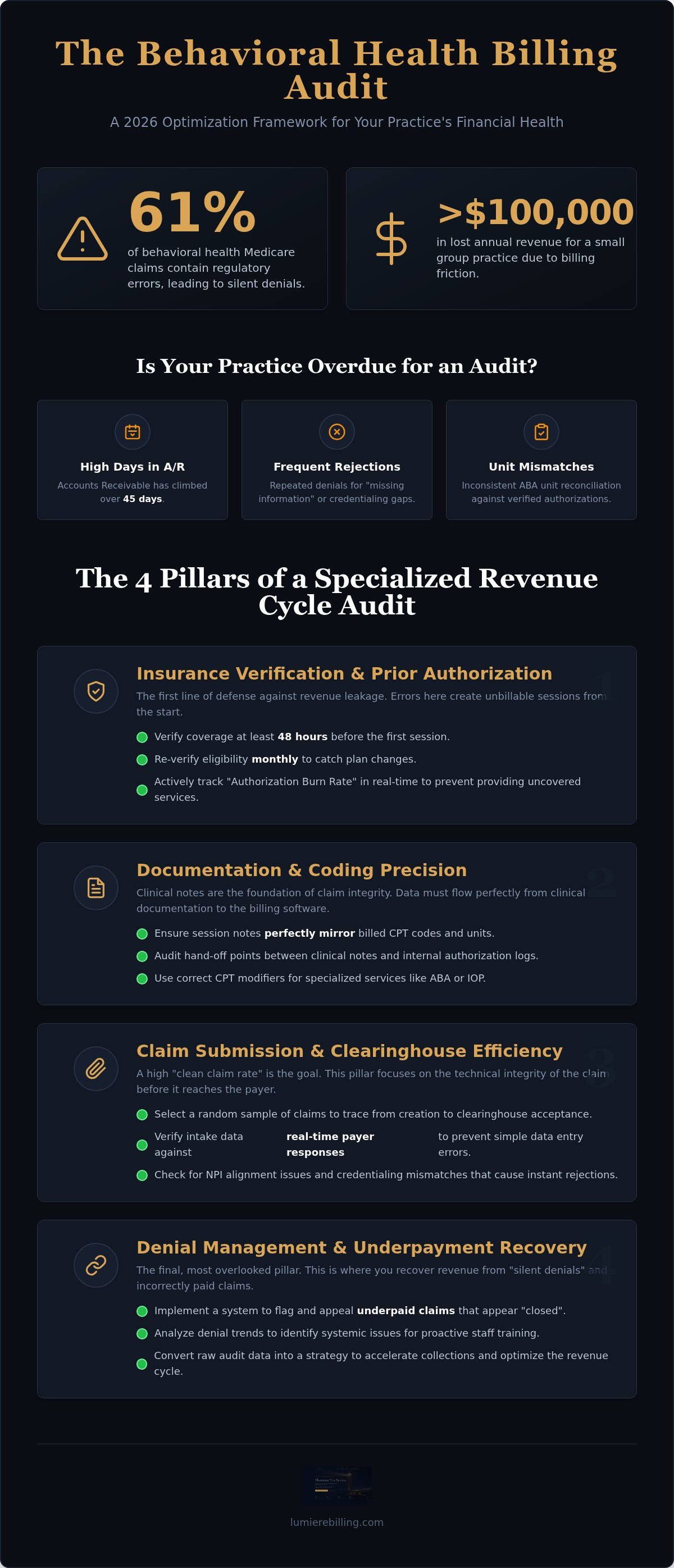
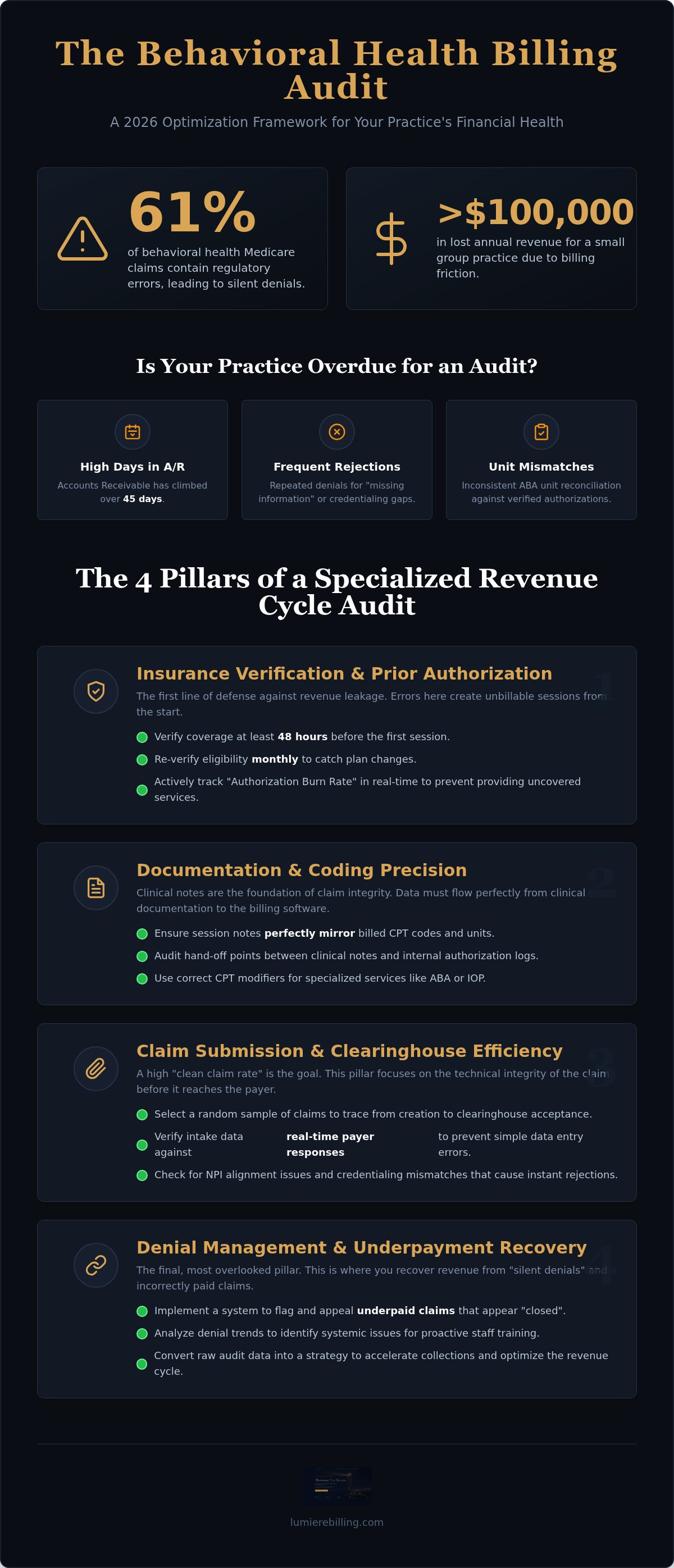
Did you know that 61% of behavioral health Medicare claims contain regulatory errors? For a small group practice, these invisible friction points translate to over $100,000 in lost annual revenue. It's a staggering figure that highlights why a standard financial check-up isn't enough. You need a rigorous behavioral health billing workflow audit to inspect the mechanical integrity of your clinical-to-claims bridge. We understand the drain of silent denials and the persistent headache of ABA unit tracking errors that refuse to reconcile. It feels like you're running a race with weights on your ankles.
This 2026 optimization template is designed to remove those weights. We'll show you how to identify specific leakage points, from credentialing gaps to NPI alignment issues, so you can stop the bleed. By mastering these mechanics, you'll move toward a clear map of your revenue cycle and significantly reduce days in A/R. We're moving past opaque administrative tasks and into a style of total visibility. This guide provides the framework to rebuild your workflow into a high-performance engine that protects your practice's financial health.
Key Takeaways
- Define the critical distinction between generic billing reviews and specialized audits that map the specific journey of a behavioral health claim.
- Utilize our 2026 behavioral health billing workflow audit template to systematically identify where your practice is losing money.
- Resolve systemic issues like ABA unit tracking reconciliation errors and credentialing gaps that cause otherwise billable sessions to be denied.
- Execute a rigorous auditing process including random sample selection and verification of intake data against real-time payer responses.
- Convert raw audit data into a proactive strategy for staff training and revenue cycle optimization to accelerate collections.
What is a Behavioral Health Billing Workflow Audit?
A behavioral health billing workflow audit is a systematic, granular review of the entire lifecycle of a claim. It tracks the trajectory from the initial patient intake to the final payment posting. While a standard medical billing process audit might look for general coding accuracy, a specialized behavioral health review focuses on the nuances of mental health documentation, authorization integrity, and unit-based tracking. It's a mechanical inspection of your practice's financial engine.
Most practices focus on hard rejections. However, "silent denials" are a more insidious threat to your practice solvency. These are claims that aren't technically rejected but remain unpaid, underpaid, or stuck in a payer's pending status indefinitely. A specialized behavioral health billing workflow audit brings these hidden leaks into focus. The objective is to transition your team from reactive firefighting to proactive revenue optimization. You stop wondering why cash flow is tight and start seeing exactly where the system is failing.
The Clinical-to-Billing Bridge
Clinical notes are the foundation of claim integrity. If a session note doesn't perfectly mirror the billed unit, the claim becomes fragile. We often see data lost at critical hand-off points. This typically happens when a clinician completes a note but fails to update the internal authorization log or when intake data doesn't flow correctly into the billing software. Behavioral health requires a unique audit lens because services often involve recurring authorizations and complex unit tracking that general medicine simply doesn't encounter. If your audit doesn't account for the specific requirements of ABA or intensive outpatient services, it isn't providing a true picture of your financial health.
Signs Your Practice is Overdue for an Audit
Waiting for a total cash flow stall is a dangerous strategy. You should look for subtle indicators that your workflow is deteriorating. If your days in A/R (Accounts Receivable) have climbed over 45 days, your system is leaking. Frequent rejections for "missing information" from payers like Optum or Aetna suggest that your front-end data collection is broken. Inconsistent unit reconciliation in ABA therapy sessions is another red flag. When billed units don't align with verified authorizations, you aren't just facing a delay; you're looking at a permanent loss of revenue. A proactive audit identifies these friction points before they become catastrophic deficits.
The 4 Pillars of a Specialized Revenue Cycle Audit
A specialized audit isn't a simple checklist; it's a structural assessment of your practice's financial health. While general medical billing often focuses on high-volume transactions, behavioral health requires a meticulous focus on duration, frequency, and regulatory nuance. We divide a behavioral health billing workflow audit into four distinct pillars to ensure no revenue is left behind. This framework moves beyond surface-level scanning to find the deep-seated friction points that stall your cash flow.
Pillar 1 focuses on verification and authorization integrity. Pillar 2 centers on documentation compliance and CPT accuracy. Pillar 3 examines claim submission and clearinghouse efficiency to ensure clean claim rates remain high. Finally, Pillar 4 addresses denial management and underpayment recovery. This last pillar is where most practices fail. They often ignore underpaid claims that look "closed" in the system but actually represent significant lost revenue. If you aren't sure where your leaks are, a Free Billing Audit can pinpoint these specific failures.
Insurance Verification and Prior Authorization
Revenue leakage often begins before the patient even enters the therapy room. You must audit the timing of eligibility checks to prevent unbillable intake sessions. We recommend verifying coverage at least 48 hours before the first session and monthly thereafter. This prevents the "silent" loss of revenue that occurs when a patient's plan changes mid-treatment without notice.
Tracking the "Authorization Burn Rate" is equally critical. This involves monitoring how quickly units are consumed compared to the authorized timeframe. If your team isn't reconciling sessions against the remaining balance in real-time, you'll inevitably provide services without coverage. Understanding these nuances is a core part of effective behavioral health revenue cycle management. Units aren't just numbers. They're revenue. Without a proactive tracking system, you're essentially working for free.
Coding Precision and Modifier Usage
Behavioral health coding is a minefield of "silent" underpayments. For instance, the usage of CPT code 90837 for psychotherapy is under constant payer scrutiny. You must audit your documentation to ensure it supports the extended time requirement of this code. Payers have implemented stricter rules for telehealth modifiers like 95 and GT as of 2026. Incorrect modifier usage doesn't always lead to a rejection; it often triggers a lower reimbursement rate that goes unnoticed.
Conducting regular behavioral health documentation audits ensures your clinicians are capturing the necessary details to justify these codes. Furthermore, with the 2026 UnitedHealthcare policy updates, ICD-10 "Excludes 1" enforcement is now automated. This means claims with conflicting diagnosis codes are rejected instantly. Identifying these patterns early prevents you from triggering automated payer audits that could jeopardize your entire practice's cash flow.
Identifying Behavioral Health Workflow Failure Points
Generic medical billing audits often overlook the structural nuances of mental health practices. They miss the subtle failures that occur when specialized workflows aren't perfectly aligned with payer expectations. A behavioral health billing workflow audit reveals these hidden fracture points that software alone cannot fix. We frequently see practices losing up to 15% of their potential revenue simply due to modifier mismanagement and software misconfigurations. These aren't just administrative errors; they're systemic leaks that drain your practice's vitality.
Modifier mismanagement is particularly destructive because it creates a pattern of automatic flags. An OIG report on psychotherapy billing errors confirms that high rates of improper payments stem from basic non-compliance with documentation and coding rules. Beyond coding, your EHR settings might be working against you. If your specialized behavioral health platforms aren't optimized to track your specific contract rates and unit limits, the software will continue to process flawed claims without warning. It's a mechanical failure of the system's logic that requires human oversight to correct.
ABA Unit Tracking and Reconciliation
The ABA Unit Tracking Trap is one of the most common causes of massive revenue leakage in specialized clinics. It occurs when there's a disconnect between rendered units in the field and the units actually submitted to the payer. In multi-provider environments, reconciliation errors are frequent. If your audit doesn't bridge the gap between your clinical schedule and your billing ledger, you'll likely find unbilled sessions or over-utilized authorizations that lead to automatic denials. For a more granular look at these specialized tracking strategies, refer to our guide on ABA revenue cycle management.
Credentialing and Roster Maintenance
Credentialing gaps are another silent killer of cash flow that an audit must address. "Out-of-Network" denials are rarely accidental; they're often a symptom of an outdated CAQH profile or a failure to update payer rosters when new providers join your team. Credentialing delays create a bottleneck that prevents sessions from being billed for months, creating a massive hole in your A/R that becomes harder to recover as time passes. Staying ahead of these administrative shifts is vital for long-term stability. You can find proactive maintenance tips in our overview of mental health provider credentialing.
Step-by-Step Behavioral Health Billing Audit Template
A manual behavioral health billing workflow audit isn't a luxury; it's a diagnostic necessity for practices that prioritize mechanical integrity over guesswork. Relying solely on software automation often masks systemic failures that occur during human hand-offs. You need a repeatable methodology to deconstruct your revenue cycle and expose the friction points that drain your cash flow. This template provides a structured approach to identifying those hidden leaks and repairing the clinical-to-billing bridge.
- Step 1: Random Sample Selection. Pull a sample of 25-50 claims across your top five payers from the last 90 days. This provides a statistically significant snapshot of your current performance without overwhelming your team.
- Step 2: Verification Audit. Match the intake data for these claims against the actual payer eligibility responses on file. Look for discrepancies in member IDs, coverage dates, or specific plan exclusions.
- Step 3: Documentation Review. Compare the progress notes against the billed CPT codes. Ensure the time spent, specific interventions, and medical necessity are clearly documented to support the level of service billed.
- Step 4: Payment Posting Analysis. Cross-reference the paid amounts on the EOBs against your contracted rates. This step identifies silent underpayments that often go unnoticed in high-volume practices.
- Step 5: Root Cause Mapping. Categorize every denial or underpayment into buckets like "Credentialing," "Authorization," or "Coding." Finding the "why" is the only way to stop the bleed permanently.
Analyzing the Sample Set
The Clean Claim Rate is the percentage of claims that are successfully processed and paid upon their first submission without any manual intervention or rejections. Achieving a high rate requires moving beyond isolated fixes. You must identify patterns of failure. If three out of ten claims for a specific payer are denied for "provider not found," you have a systemic roster issue, not a series of one-off errors. To perform this analysis effectively, you'll need three essential tools: your EHR's detailed aging reports, your current payer contracts, and the 2026 CPT manual. If your internal review reveals significant leakage, it's time to secure a Free Billing Audit to professionalize your recovery efforts.
The Underpayment Recovery Checklist
Underpayment is often more dangerous than a flat denial because it creates a false sense of completion. You must compare every EOB against your specific fee schedule to ensure you aren't being shortchanged. Look for codes that are consistently downcoded. For example, if a payer regularly converts your 90837 claims to 90834 without explanation, they're likely exploiting a documentation weakness. Flag these claims for aggressive A/R follow-up. Don't let underpaid sessions sit in your ledger as "closed" when there's still revenue on the table. A disciplined approach to A/R ensures that every unit rendered is a unit paid in full.
From Audit to Action: Optimizing Your Workflow
Identification is merely the diagnostic phase of the process. The true value of a behavioral health billing workflow audit is realized only when findings are translated into a disciplined execution of systemic repairs. Once you've mapped your root causes, you must overhaul the daily habits that led to those friction points. This involves targeted staff training that connects clinical documentation to financial outcomes. If your data reveals a recurring failure in authorization reconciliation, your team needs to see the direct correlation between those missing units and the practice's ability to scale. Data is the only objective repair manual for your revenue cycle.
A one-time audit is a snapshot, but the 2026 landscape is dynamic and unforgiving. With the industry steadily moving toward value-based payment models, the precision of your data now impacts your long-term reimbursement potential. You need continuous vigilance to stay ahead of automated payer enforcement and shifting telehealth requirements. Leveraging real-time analytics dashboards provides the visibility required to spot a spike in denials before it evolves into a cash flow stall. In a high-performance practice, visibility isn't a luxury; it's the primary defense against systemic revenue decay.
Implementing Workflow Repairs
Repairing your workflow requires you to hard-code accuracy into your clinical platforms. You should update your EHR settings to act as a digital gatekeeper, preventing the submission of claims that lack essential modifiers or valid authorization numbers. This creates a "pre-claim scrubbing" protocol that mirrors the rigorous standards of your audit. For many practices, maintaining this level of technical oversight internally is a distraction from patient care. You can outsource mental health billing to specialized partners who ensure these workflow repairs are permanently integrated into your revenue cycle. This strategic move converts your billing department from a cost center into a high-efficiency engine.
Partnering for Professional Oversight
Lumiere Billing acts as a vigilant protector of your practice's financial integrity. While an internal review is a necessary starting point, our Free Billing Audit provides a deeper mechanical inspection that standard software simply cannot replicate. We bring hidden issues into focus and repair broken systems using a level of focus that borders on the obsessive. Our percentage-based RCM fee structure ensures that our goals are perfectly aligned with yours. We are invested in your recovery, not just your transactions. Don't allow your revenue to leak through preventable gaps in your workflow. Schedule your professional behavioral health billing audit with Lumiere today to secure the financial health of your practice and return your focus to clinical excellence.
Securing Your Practice's Financial Integrity
Your practice's financial health depends on the mechanical integrity of its billing systems. We've explored how a specialized behavioral health billing workflow audit exposes the friction points that generic reviews miss. From reconciling ABA unit tracking to navigating the nuances of 2026 CPT updates, the path to a superior clean claim rate requires obsessive attention to detail. You don't have to navigate these complexities alone. Precision is the only antidote to the rising tide of payer scrutiny and automated rejections.
Lumiere Billing stands as a vigilant protector of your revenue cycle. We specialize exclusively in behavioral health, offering the deep domain expertise necessary to stop silent denials and accelerate collections. It's time to move away from the opaque stress of back-office operations and toward a future of total visibility and insight. Take the first step toward true optimization today. Request Your Free Behavioral Health Billing Audit to identify your specific leakage points and repair your system. Your commitment to clinical excellence deserves a revenue cycle that matches your professional standards. Let's build a more resilient practice together.
Frequently Asked Questions
What is included in a behavioral health billing workflow audit?
A comprehensive audit examines every mechanical hand-off point from patient intake to final payment posting. It includes a verification of insurance eligibility, a review of clinical documentation against CPT codes, and an analysis of authorization unit consumption. We also inspect your payment posting logs to identify underpayments against contracted rates. This process brings hidden leaks into focus, ensuring your practice's financial engine operates with total transparency and integrity.
How often should a mental health practice perform a billing audit?
We recommend performing a behavioral health billing workflow audit at least twice a year to maintain optimal revenue health. High-volume practices or those experiencing a spike in denials should transition to a quarterly schedule. Regular reviews are essential to catch shifting payer policies and 2026 regulatory changes before they impact your cash flow. Continuous vigilance prevents minor technical friction points from evolving into catastrophic financial deficits that threaten your practice's solvency.
Can an audit help identify why my claims are being downcoded?
An audit specifically targets the root causes of downcoding by comparing Explanation of Benefits (EOB) data against your clinical session notes. It identifies patterns where payers might be automatically reducing higher-level psychotherapy codes, such as 90837, to lower-reimbursement equivalents. By analyzing these discrepancies, you can determine if the issue stems from documentation gaps or aggressive payer tactics. This visibility allows you to implement precise workflow repairs that protect your earned revenue.
What is the difference between a financial audit and a billing workflow audit?
A financial audit focuses on the accuracy of your balance sheets and general ledger to ensure fiscal compliance. In contrast, a billing workflow audit is a mechanical inspection of the processes that generate those numbers. It tracks the movement of data across your revenue cycle to find where claims are stalling or leaking value. While financial audits confirm what you have, workflow audits identify exactly why you aren't collecting what you're owed.
How long does a typical behavioral health billing audit take to complete?
A typical behavioral health billing workflow audit takes between two and four weeks to complete, depending on the sample size and the complexity of your payer contracts. This timeframe allows for a meticulous review of 25 to 50 claims, including a deep-dive into documentation and authorization logs. We prioritize precision over speed to ensure every systemic leak is identified. The result is a clear map of your revenue cycle that serves as a blueprint for optimization.
Will a billing audit help with ABA-specific unit tracking issues?
Specialized audits are designed specifically to resolve the ABA unit tracking trap. We reconcile rendered units in the field against the units billed and authorized to find reconciliation errors that lead to massive revenue leakage. This process uncovers where units are being over-utilized or left unbilled due to scheduling disconnects. By repairing these specific failure points, your ABA clinic can stabilize its cash flow and maximize the value of every authorized session.
What documents are required to perform a comprehensive billing review?
You'll need to provide several key documents for a thorough review, including your current payer contracts and fee schedules. We also require a sample set of Explanation of Benefits (EOBs), clinical session notes for the corresponding claims, and your internal authorization logs. Access to your EHR's aging reports and provider roster is equally critical. These materials allow us to cross-reference your actual billing activity against your contractual expectations to find hidden underpayments.
How can an audit help prevent future claim denials?
An audit prevents future denials by identifying the systemic flaws that trigger payer rejections. By mapping the root causes of past failures, you can establish pre-claim scrubbing protocols that catch errors before they leave your office. This might include updating EHR settings for specific modifiers or refining your intake verification process. Transitioning to a proactive stance ensures your clean claim rate remains high, protecting your practice from the stress of reactive firefighting.
Frequently Asked Questions
A comprehensive audit examines every mechanical hand-off point from patient intake to final payment posting. It includes a verification of insurance eligibility, a review of clinical documentation against CPT codes, and an analysis of authorization unit consumption. We also inspect your payment posting logs to identify underpayments against contracted rates. This process brings hidden leaks into focus, ensuring your practice's financial engine operates with total transparency and integrity.
We recommend performing a behavioral health billing workflow audit at least twice a year to maintain optimal revenue health. High-volume practices or those experiencing a spike in denials should transition to a quarterly schedule. Regular reviews are essential to catch shifting payer policies and 2026 regulatory changes before they impact your cash flow. Continuous vigilance prevents minor technical friction points from evolving into catastrophic financial deficits that threaten your practice's solvency.
An audit specifically targets the root causes of downcoding by comparing Explanation of Benefits (EOB) data against your clinical session notes. It identifies patterns where payers might be automatically reducing higher-level psychotherapy codes, such as 90837, to lower-reimbursement equivalents. By analyzing these discrepancies, you can determine if the issue stems from documentation gaps or aggressive payer tactics. This visibility allows you to implement precise workflow repairs that protect your earned revenue.
A financial audit focuses on the accuracy of your balance sheets and general ledger to ensure fiscal compliance. In contrast, a billing workflow audit is a mechanical inspection of the processes that generate those numbers. It tracks the movement of data across your revenue cycle to find where claims are stalling or leaking value. While financial audits confirm what you have, workflow audits identify exactly why you aren't collecting what you're owed.
A typical behavioral health billing workflow audit takes between two and four weeks to complete, depending on the sample size and the complexity of your payer contracts. This timeframe allows for a meticulous review of 25 to 50 claims, including a deep-dive into documentation and authorization logs. We prioritize precision over speed to ensure every systemic leak is identified. The result is a clear map of your revenue cycle that serves as a blueprint for optimization.
Specialized audits are designed specifically to resolve the ABA unit tracking trap. We reconcile rendered units in the field against the units billed and authorized to find reconciliation errors that lead to massive revenue leakage. This process uncovers where units are being over-utilized or left unbilled due to scheduling disconnects. By repairing these specific failure points, your ABA clinic can stabilize its cash flow and maximize the value of every authorized session.
You'll need to provide several key documents for a thorough review, including your current payer contracts and fee schedules. We also require a sample set of Explanation of Benefits (EOBs), clinical session notes for the corresponding claims, and your internal authorization logs. Access to your EHR's aging reports and provider roster is equally critical. These materials allow us to cross-reference your actual billing activity against your contractual expectations to find hidden underpayments.
An audit prevents future denials by identifying the systemic flaws that trigger payer rejections. By mapping the root causes of past failures, you can establish pre-claim scrubbing protocols that catch errors before they leave your office. This might include updating EHR settings for specific modifiers or refining your intake verification process. Transitioning to a proactive stance ensures your clean claim rate remains high, protecting your practice from the stress of reactive firefighting.