ABA Claim Denial Appeals: The 2026 Provider Guide to Recovering Revenue

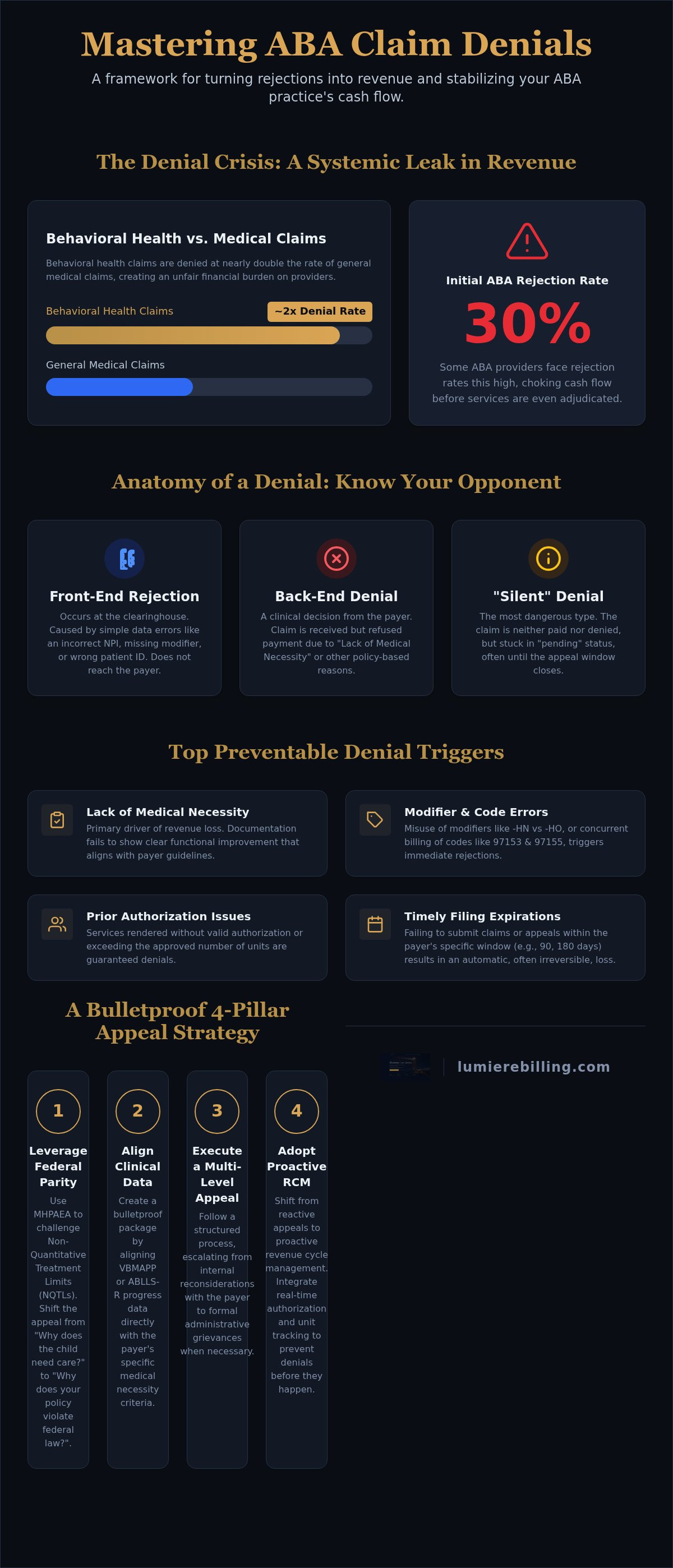
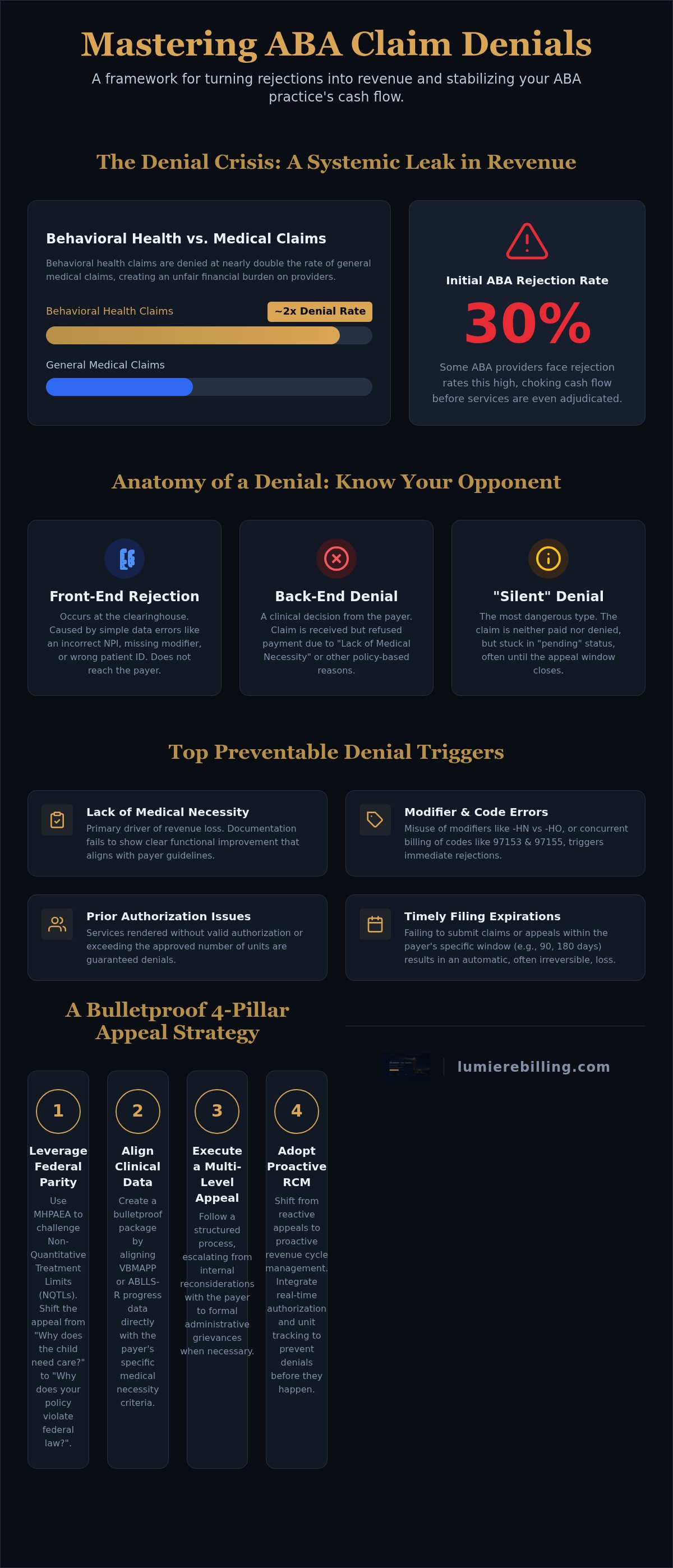
Did you know that behavioral health claims are denied at nearly double the rate of general medical claims, with some ABA providers seeing initial rejection rates as high as 30 percent? These are not just clerical errors. They are systemic leaks that drain your clinic's vitality and force BCBAs to spend more time on paperwork than on life-changing therapy. You did not enter this field to fight with algorithms or decode inconsistent medical necessity criteria. It is exhausting to watch "silent denials" choke your cash flow while your team burns out on administrative tasks.
We understand that your financial health is the foundation of your clinical impact. This guide provides the technical and clinical framework you need to master ABA claim denial appeals, turning those rejections into the revenue your practice deserves. We will explore the 2026 regulatory landscape, from MHPAEA parity protections to specific unit reconciliation strategies that satisfy rigorous payer audits. You will learn a repeatable system to reduce administrative burdens and stabilize your monthly revenue, ensuring your focus remains exactly where it belongs: on your patients.
Key Takeaways
- Leverage federal MHPAEA enforcement to challenge inconsistent payer criteria and secure equitable reimbursement for behavioral health services.
- Identify the specific clinical triggers and modifier errors that often lead to "silent denials" before they impact your cash flow.
- Execute a structured, multi-level strategy for ABA claim denial appeals that escalates from internal reconsiderations to formal administrative grievances.
- Align clinical progress data from VBMAPP or ABLLS-R with the payer’s specific medical necessity guidelines to create a bulletproof appeal package.
- Shift from reactive manual workflows to proactive revenue cycle management by integrating real-time authorization and unit tracking.
Understanding the ABA Denial Landscape in 2026
The financial health of an ABA practice depends on more than just clinical excellence. It requires a deep understanding of the specialized billing environment where Applied Behavior Analysis (ABA) is often scrutinized more heavily than traditional medical services. In 2026, the average in-network denial rate for behavioral health remains nearly double that of general medical claims. This disparity isn't accidental. It's the result of complex payer algorithms and shifting regulatory standards. To master ABA claim denial appeals, you must first distinguish between a simple technical error and a systemic clinical rejection.
The Role of Federal Parity in Modern Appeals
The Mental Health Parity and Addiction Equity Act (MHPAEA) has become the most powerful tool in the provider's arsenal. In 2026, federal enforcement has shifted focus toward Non-Quantitative Treatment Limits (NQTLs). These are the "hidden" rules insurers use to limit care, such as requiring more frequent prior authorizations for ABA than for physical therapy. If a payer denies a claim based on a criteria that feels more restrictive than medical counterparts, you likely have a parity violation. Using these violations as leverage in your appeal letters forces payers to justify their internal metrics against federal standards. It moves the conversation from "why this child needs therapy" to "why your policy violates federal law."
Your strategy also depends on the plan type. Fully insured plans must follow state autism mandates, which often provide broader protections. Self-funded (ERISA) plans, however, are governed by federal law and may have specific exclusions. Identifying the plan type at the verification stage is the first step in a proactive defense.
Distinguishing Between Rejections and Denials
Precision in terminology saves time and money. A front-end rejection occurs at the clearinghouse level. These are typically "hard" failures caused by simple data mismatches, such as an incorrect NPI or a missing modifier. They don't reach the payer's adjudication system. Back-end denials are far more complex. These are clinical decisions where the payer acknowledges the claim but refuses to pay based on "lack of medical necessity" or "experimental" designations.
The most dangerous threat to your cash flow is the "silent denial." This happens when a claim is neither paid nor officially denied but remains in a "pending" or "under review" status indefinitely. These systemic leaks often go unnoticed until the timely filing window for ABA claim denial appeals has already closed. Research indicates that 42 percent of ABA denials are preventable. When you factor in that the administrative cost to rework a single claim is $25 or more, the financial impact of manual, reactive billing becomes unsustainable. You aren't just losing the claim value; you're paying for the privilege of being ignored.
Decoding Common ABA Denial Reasons and Codes
Successful ABA claim denial appeals start with a precise diagnosis of the rejection code. Payers don't always make it easy. In 2026, "Lack of Medical Necessity" remains the primary driver of revenue loss. Payers now use increasingly sophisticated algorithms to determine if a child's progress justifies continued hours. If your documentation doesn't show a clear functional improvement or if it fails to meet the specific 2026 clinical guardrails set by state Medicaid or commercial plans, the claim will be rejected. This is often a paper-only review by someone who hasn't met the patient. You must counter with data that bridges the gap between clinical reality and payer criteria.
Technical errors are equally punishing. Mismanaging ABA modifier billing errors is a frequent failure point. For example, using -HN for bachelor's level staff when the payer requires -HO for master's level practitioners, or misapplying the -AM modifier for team meetings, triggers immediate denials. Similarly, concurrent billing for codes 97153 and 97155 often raises red flags. While supervising a technician (97153) and modifying a protocol (97155) can happen in the same session, many payers view this as "double dipping" unless the documentation explicitly separates the two distinct services.
Unit exhaustion is another preventable leak. If your rendered units exceed the authorized amount, the excess is simply lost. Identifying these systemic patterns often starts with a Free Billing Audit to pinpoint where your revenue is leaking before the damage becomes permanent.
The "Experimental" Designation Trap
Payers sometimes use the "experimental" or "investigational" label to avoid paying for specific ABA protocols, despite decades of evidence. This is a common tactic for newer or more intensive treatment models. To fight this, your appeal must cite peer-reviewed research and established clinical guidelines. You are proving that the service is standard of care. Understanding the internal and external appeals process allows you to move beyond the insurance company's initial refusal and seek an independent third-party review.
Timely Filing and Credentialing Gaps
Credentialing delays often masquerade as clinical denials. If a BCBA isn't properly loaded onto a payer's roster, every claim they touch will come back as "provider not found." This creates a massive administrative backlog. Effective mental health provider credentialing requires constant vigilance to ensure every practitioner is active before they render care. Missing a timely filing window because of a credentialing lag is an expensive mistake that is almost impossible to overturn.
The Multi-Level Appeal Framework: Internal vs. External
Success in ABA claim denial appeals requires a disciplined adherence to a three-tier hierarchy. You cannot treat an appeal as a one-time event; it is a progressive escalation. The clock starts ticking the moment you receive the denial notice. Under the Affordable Care Act (ACA), the standard deadline to file an internal appeal is 180 days. Missing this window effectively forfeits your right to the revenue. Your internal workflow must be designed to identify, categorize, and act on these denials within the first 30 days to allow ample time for escalation.
Level 1 is the Internal Appeal. This is your opportunity to correct the record by providing the clinical data the payer claims is missing. If this fails, you move to Level 2: The Formal Grievance. This stage shifts the focus from clinical nuances to administrative compliance. You are no longer just arguing about a child's progress; you are challenging the payer's adherence to their own written policies. If the internal process remains deadlocked, the final step is Level 3: The External Review. This is where an Independent Review Organization (IRO) evaluates the case, providing a neutral perspective that often bypasses internal payer bias.
When to Escalate to an External Review
An external review is often the most effective way to overturn denials based on medical necessity. In 2026, IRO decisions are legally binding on the insurance plan. While internal reviewers may have a financial incentive to uphold a denial, an IRO consists of independent clinicians who evaluate the case against standard-of-care benchmarks. Resources like the Autism Insurance Resource Center provide essential guidance on navigating these complex external pathways. The cost of pursuing an IRO review is typically borne by the payer, making it a high-value strategy for high-dollar claims that have been unfairly rejected.
State-Specific Mandates vs. Federal ERISA Oversight
One of the most common mistakes in ABA claim denial appeals is citing the wrong law. If you are dealing with a fully insured plan, state autism mandates offer significant protection. However, many large employers utilize self-funded plans governed by the federal Employee Retirement Income Security Act (ERISA). These plans are often exempt from state-level mandates. Your "secret weapon" in an ERISA appeal is the Summary Plan Description (SPD). You have a legal right to request the specific "Plan Document" used to justify the denial. If the payer cannot produce a written policy that supports their decision, they are in violation of federal fiduciary duties, providing you with significant leverage to secure reimbursement.
Step-by-Step: Constructing a Bulletproof ABA Appeal Package
Constructing a package for ABA claim denial appeals requires more than a standard template. It demands a surgical alignment between clinical data and insurance policy. You must build a case that makes it harder for the payer to uphold the denial than to simply pay the claim. High-volume clinics cannot afford to treat these as one-off tasks. They must follow a disciplined, five-step construction process.
First, request the "Claim File." Under ERISA, you have a legal right to the internal clinical criteria used to make the decision. You cannot fight an invisible enemy. Second, map your clinical progress data. Use objective scores from VBMAPP or ABLLS-R to demonstrate functional deficits that align with the payer’s specific written policy. Third, draft the Technical Appeal Letter. This document should use the language of the Mental Health Parity and Addiction Equity Act to challenge any inconsistent treatment limits. Fourth, attach the BCBA Medical Necessity Letter. Finally, follow up with a Payer Advocate or Provider Relations representative to ensure the package is being reviewed by a clinician, not just a clerk.
Anatomy of a Winning Medical Necessity Letter
"The child is improving" is a subjective observation, not a clinical argument. In 2026, payers look for "Amelioration" of symptoms and the "Maintenance of Function." Your letter must address the specific denial reason point-by-point. If the payer claims the service is "custodial," show the active protocol modifications that prove clinical oversight is required. If they claim it is "not medically necessary," provide the outcome-based evidence that proves the child's safety or independence depends on these specific units. Every letter must include a Plan of Care that explicitly links therapy goals to the reduction of maladaptive behaviors.
Technical Documentation: Beyond the Clinical Note
A clinical argument is only as strong as its technical foundation. Ensure your ABA unit tracking reconciliation is flawless. If the claim says 12 units but the session note only supports 10, the appeal will fail regardless of clinical progress. Include sign-in sheets and parent verification as auxiliary proof of service to prevent "ghosting" denials. Standardizing this "Appeal Packet" allows your administrative team to act with speed and precision, protecting your cash flow from preventable leaks. You can identify these systemic gaps in your own practice today with a Free Billing Audit.
Systemic Denial Prevention: Moving Beyond Manual Appeals
Winning individual ABA claim denial appeals is a vital skill, yet relying solely on appeals is a reactive strategy that signals a deeper systemic failure. A high-performing practice must shift its focus toward structural prevention. This involves moving beyond the "chase" of unpaid claims and identifying root causes before they enter the adjudication cycle. By utilizing sophisticated practice analytics, you can uncover Denial Clusters. These are patterns where specific payers or CPT codes consistently fail due to misaligned internal logic. If a certain payer rejects every instance of 97155 on a specific day, it is not a random error; it is a systemic mismatch that requires a structural fix rather than a manual letter.
Automating the Front-End Revenue Cycle
Structural prevention begins at the point of intake. Insurance verification is your first line of defense. In 2026, with individual out-of-pocket maximums reaching $10,600 and family limits at $21,200, patients are more sensitive to coverage gaps than ever. Real-time ABA authorization tracking is critical to ensure that rendered units never exceed the authorized amount. Many unit-based denials occur simply because a session was rounded up incorrectly or a technician worked an extra hour without prior approval. Automating this oversight ensures that modifiers are applied correctly at the point of entry, significantly reducing your Days in AR and eliminating the common submission errors that trigger silent denials.
The Lumiere Approach: Vigilant Oversight as a Service
Managing the complexities of behavioral health billing is a full-time discipline that often competes with clinical priorities. BCBAs should spend their time modifying protocols and training technicians, not drafting administrative grievances. Transitioning to an ABA-specialized Revenue Cycle Management firm is a strategic growth move that transforms your back office from a cost center into a disciplined engine of recovery. At Lumiere Billing, we act as a vigilant protector of your financial health. Our team handles the heavy lifting of ABA claim denial appeals while continuously monitoring payer policy shifts to pre-empt new trends. We reconcile every unit and modifier with obsessive focus, ensuring that your clinic’s revenue is as stable as your clinical outcomes. Your clinical impact should not be limited by administrative friction. Secure your free billing audit and stop the revenue leakage today.
Securing Your Clinic's Financial Future
Recovering lost revenue is not just about administrative persistence; it is about clinical precision. You've seen how aligning progress data with specific payer criteria and leveraging federal parity protections can turn the tide on rejections. Mastering ABA claim denial appeals requires a shift from reactive fire-fighting to a proactive, data-driven revenue cycle. By isolating denial clusters and automating front-end verifications, you protect both your cash flow and your team's clinical focus. Systemic leaks don't have to be the status quo for your practice.
You don't have to carry the burden of complex billing alone. Our specialized ABA Revenue Cycle Management team acts as a vigilant protector of your financial health, offering expert denial prevention strategies and national behavioral health coverage. We bring hidden issues into focus and repair the broken systems that slow you down. Get a Free ABA Billing Audit from Lumiere Billing to identify your specific failure points and stop the revenue leakage today. Your clinical impact is too important to be stalled by administrative friction. We are ready to help you recover what your clinic deserves.
Frequently Asked Questions
How long do I have to file an appeal for a denied ABA claim?
Under the Affordable Care Act, you typically have 180 days from the date you receive the denial notice to file an internal appeal. It's critical to verify the exact timeframe on the explanation of benefits (EOB), as some private or self-funded plans may have different requirements. Timely filing is the foundation of any successful strategy for ABA claim denial appeals, as missing this window usually results in a permanent loss of revenue.
What is the most common reason for ABA therapy denials in 2026?
Lack of medical necessity remains the most frequent reason for rejections in 2026. This often occurs when a payer's internal clinician or algorithm determines that the patient's progress doesn't justify the requested units. To counter this, your documentation must show clear functional deficits and how the proposed treatment plan directly leads to the amelioration of symptoms. Vague statements about general improvement are no longer sufficient to secure reimbursement from modern insurance carriers.
Can I appeal a partial authorization if the insurer cut the requested hours?
A reduction in requested hours is considered an adverse benefit determination, and you have the right to appeal this decision just as you would a total denial. You should immediately request the specific clinical criteria the payer used to justify the reduction. Mapping the child's behavioral data to these criteria allows you to argue that the lower hour count is insufficient to maintain clinical safety or achieve the established therapy goals.
What information must be included in an ABA medical necessity letter?
A robust letter must include objective data from standardized assessments like the VBMAPP or ABLLS-R. You need to highlight specific functional deficits and explain why the current level of care is the least restrictive environment capable of producing results. Focus on maintenance of function and amelioration of maladaptive behaviors. Including a clear Plan of Care that addresses the payer’s specific denial reason is essential for a successful outcome in any appeal package.
What is the difference between an internal appeal and an external review?
An internal appeal is a request for the insurance company to reconsider its own decision, and it is the first step in the process. An external review occurs after you have exhausted the payer's internal options. It involves an Independent Review Organization (IRO) that has no financial ties to the insurance company. In 2026, IRO decisions are legally binding on the plan, providing a neutral pathway to overturn clinical denials based on medical necessity.
How does the Mental Health Parity and Addiction Equity Act (MHPAEA) help with appeals?
MHPAEA prevents insurers from applying more restrictive Non-Quantitative Treatment Limits (NQTLs) to behavioral health than to medical or surgical care. If a payer requires more frequent authorizations or has stricter medical necessity criteria for ABA than for physical therapy, you can cite a parity violation. This federal law provides significant leverage during ABA claim denial appeals by forcing payers to prove their internal metrics are equitable and compliant with national standards.
Will appealing a claim cost my clinic money?
Payers generally don't charge a fee to process an appeal, but the internal cost to your clinic is measured in administrative time and labor. Industry data suggests it costs approximately $25 or more in staff resources to rework a single denied claim. This is why many practices choose specialized Revenue Cycle Management. Firms like Lumiere Billing align their success with yours through percentage-based fees, reducing the internal burden on your clinical team.
What happens if my internal appeal is denied a second time?
If your second internal appeal is denied, you typically move to the external review stage involving an independent third party. You may also have the option to file a formal grievance with the state insurance commissioner or the Department of Labor, depending on whether the plan is fully insured or self-funded under ERISA. At this point, the focus shifts from clinical data to administrative compliance and legal adherence to plan documents and federal oversight standards.
Frequently Asked Questions
Under the Affordable Care Act, you typically have 180 days from the date you receive the denial notice to file an internal appeal. It's critical to verify the exact timeframe on the explanation of benefits (EOB), as some private or self-funded plans may have different requirements. Timely filing is the foundation of any successful strategy for ABA claim denial appeals, as missing this window usually results in a permanent loss of revenue.
Lack of medical necessity remains the most frequent reason for rejections in 2026. This often occurs when a payer's internal clinician or algorithm determines that the patient's progress doesn't justify the requested units. To counter this, your documentation must show clear functional deficits and how the proposed treatment plan directly leads to the amelioration of symptoms. Vague statements about general improvement are no longer sufficient to secure reimbursement from modern insurance carriers.
A reduction in requested hours is considered an adverse benefit determination, and you have the right to appeal this decision just as you would a total denial. You should immediately request the specific clinical criteria the payer used to justify the reduction. Mapping the child's behavioral data to these criteria allows you to argue that the lower hour count is insufficient to maintain clinical safety or achieve the established therapy goals.
A robust letter must include objective data from standardized assessments like the VBMAPP or ABLLS-R. You need to highlight specific functional deficits and explain why the current level of care is the least restrictive environment capable of producing results. Focus on maintenance of function and amelioration of maladaptive behaviors. Including a clear Plan of Care that addresses the payer’s specific denial reason is essential for a successful outcome in any appeal package.
An internal appeal is a request for the insurance company to reconsider its own decision, and it is the first step in the process. An external review occurs after you have exhausted the payer's internal options. It involves an Independent Review Organization (IRO) that has no financial ties to the insurance company. In 2026, IRO decisions are legally binding on the plan, providing a neutral pathway to overturn clinical denials based on medical necessity.
MHPAEA prevents insurers from applying more restrictive Non-Quantitative Treatment Limits (NQTLs) to behavioral health than to medical or surgical care. If a payer requires more frequent authorizations or has stricter medical necessity criteria for ABA than for physical therapy, you can cite a parity violation. This federal law provides significant leverage during ABA claim denial appeals by forcing payers to prove their internal metrics are equitable and compliant with national standards.
Payers generally don't charge a fee to process an appeal, but the internal cost to your clinic is measured in administrative time and labor. Industry data suggests it costs approximately $25 or more in staff resources to rework a single denied claim. This is why many practices choose specialized Revenue Cycle Management. Firms like Lumiere Billing align their success with yours through percentage-based fees, reducing the internal burden on your clinical team.
If your second internal appeal is denied, you typically move to the external review stage involving an independent third party. You may also have the option to file a formal grievance with the state insurance commissioner or the Department of Labor, depending on whether the plan is fully insured or self-funded under ERISA. At this point, the focus shifts from clinical data to administrative compliance and legal adherence to plan documents and federal oversight standards.