Substance Abuse Treatment Center Credentialing: A 2026 Guide

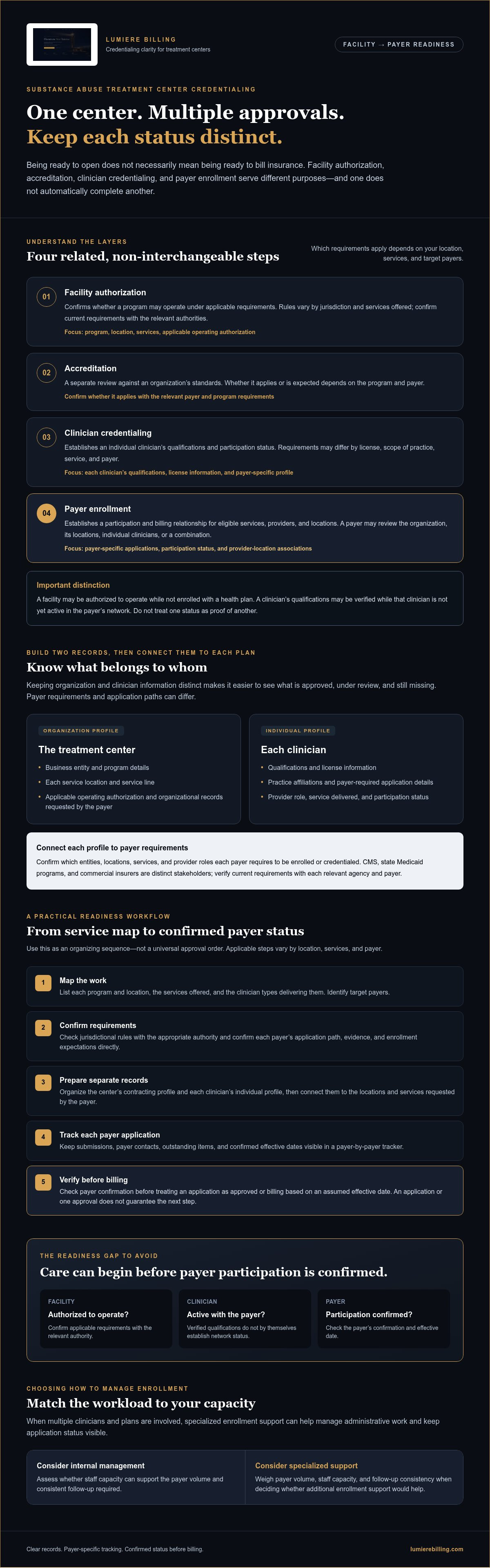
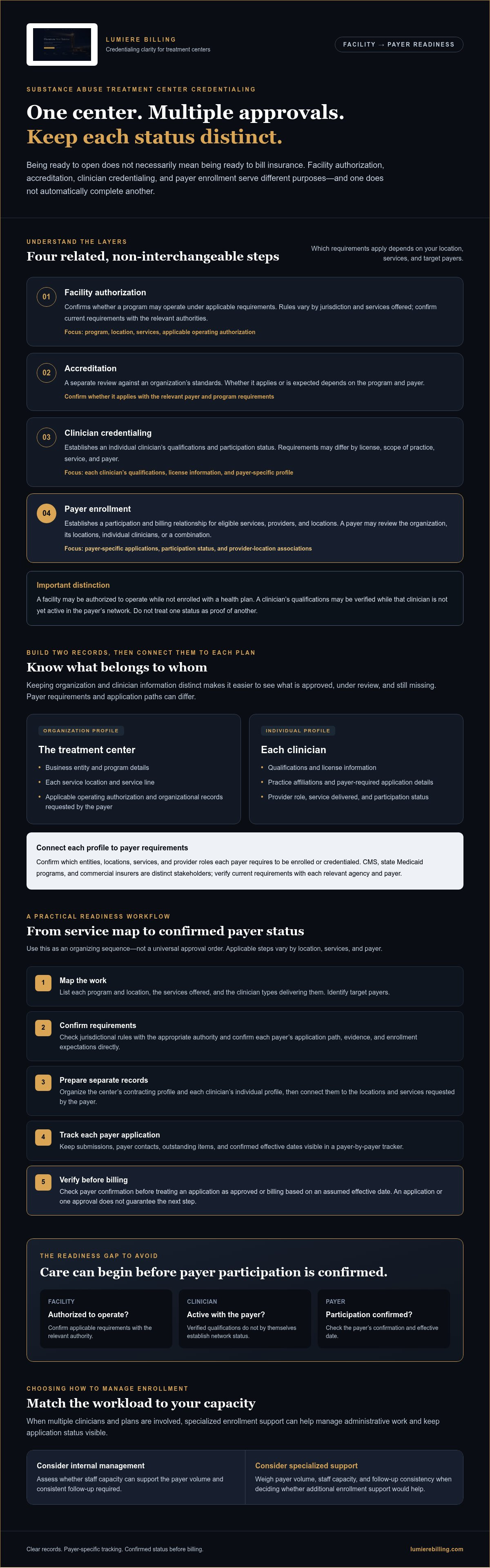
A treatment center can be ready to open and still not be ready to bill insurance. Substance abuse treatment center credentialing involves several connected approvals. Treating them as one process can leave a gap between providing care and receiving reimbursement.
The terminology can be confusing because facility licensing, accreditation, clinician credentialing, and payer enrollment serve different purposes. Which steps apply depends on your location, services, and target payers. One approval does not automatically complete the others.
This guide explains how these requirements fit together and outlines a practical sequence for facility and clinician readiness before claims are submitted. You’ll learn what to clarify with state authorities and payers, how provider records and enrollment status affect billing readiness, and how to track payer-specific applications and supporting documents. When multiple clinicians and plans are involved, specialized enrollment support can help manage the administrative work and keep application status visible. The goal is a clear path from facility authorization to payer participation, without assuming that an application or approval guarantees the next step.
Key Takeaways
- Separate facility licensing and accreditation from clinician enrollment. Each has different responsibilities and supporting evidence.
- Substance abuse treatment center credentialing is payer-specific, so map your services and target plans before preparing applications.
- Use a payer-by-payer tracker to monitor submissions, contacts, outstanding items, and confirmed effective dates.
- Check payer confirmation before treating an application as approved or billing based on an assumed effective date.
- Compare payer volume, staff capacity, and follow-up consistency when deciding whether to manage enrollment internally or seek specialized support.
What Does Substance Abuse Treatment Center Credentialing Actually Mean?
Substance abuse treatment center credentialing is the process of verifying a program’s and its clinicians’ eligibility and establishing participation with the payers relevant to the services they provide. This is a useful working definition, not a single universal approval. A payer may review the organization, its service locations, individual clinicians, or a combination of these before confirming participation.
The distinction matters. A facility may be authorized to operate but not enrolled with a health plan. A clinician may have verified qualifications but not yet be active in that payer’s network. Treating one status as proof of another can leave a gap between providing a service and being ready to bill for it.
Facility approval, accreditation, and payer enrollment are not interchangeable
Facility authorization concerns whether a program may operate under applicable requirements. Those requirements vary by jurisdiction and services offered, so confirm current rules with the relevant authorities. For example, the New York State Office of Addiction Services and Supports (OASAS) illustrates the role a state agency can play in overseeing addiction services.
Accreditation is a separate review against an organization’s standards. Whether it applies or is expected by a payer depends on the program and payer. Payer enrollment establishes a participation and billing relationship for eligible services, providers, and locations. Don’t assume any one of these steps replaces the others.
Which people and entities may need credentialing?
Think in terms of two related profiles. The organization’s contracting profile describes the business entity, program, locations, and services presented to a payer. Individual applications establish each clinician’s qualifications and participation status. A payer may require both, but the exact arrangement depends on its policies.
Provider role matters as well. Requirements may differ based on a clinician’s license, scope of practice, the service delivered, and the payer. Don’t assume every provider type follows the same application path or that a facility’s approval automatically covers every clinician working there.
- List each program and service location separately.
- Identify the clinician types involved in delivering each service.
- Confirm with each payer which entities, locations, services, and provider roles must be enrolled or credentialed.
This inventory clarifies what needs to be addressed before applications begin. Verify jurisdictional requirements with the appropriate authority and payer-specific criteria directly with each plan. A clear map of who delivers what, where, and under which organizational profile gives the application process a firmer foundation.
How Facility Requirements and Clinician Credentialing Fit Together
Build two records, then connect them to each payer’s requirements: one for the treatment organization and its programs, and another for each clinician delivering care. This separation makes it easier to see what is approved, what is under review, and which evidence belongs to each application.
Facility approval does not automatically enroll every clinician. Payers may assess the organization, locations, services, and individual providers through separate processes. CMS, state Medicaid programs, and commercial insurers are distinct stakeholders, and their enrollment pathways and documentation can differ. Verify current requirements with each relevant agency and payer.
| Layer | Typical owner | Tasks and evidence to confirm |
|---|---|---|
| Facility | Center administrator or organization | Confirm program and location details, applicable operating authorization, service lines, and requested organizational identifiers or records. |
| Clinician | Clinician and credentialing staff | Confirm individual qualifications, license information, practice affiliations, and any payer-required application or profile details. |
| Payer | Organization and payer enrollment team | Identify the payer’s application path, required evidence, contract or participation status, and provider-location associations. |
What belongs to the treatment center’s organizational file?
Check each application for the organization’s legal and ownership details, program name, locations, and services. Payers may also request organizational identifiers, licenses, policies, or accreditation evidence, but requirements vary by jurisdiction, program, and payer. Don’t assume one packet will work for every plan. If accreditation is relevant, review the CARF Behavioral Health Accreditation program information and confirm what the payer expects.
What belongs to each clinician’s enrollment record?
Keep an individual record for each clinician, including the professional credentials, license details, work history, and practice affiliations requested by the payer. Requirements may depend on provider role, scope of practice, service, and plan policy. CAQH profiles can support applications when a payer uses or accepts them, but they don’t replace payer-specific instructions. For more context, see Mental Health Provider Credentialing: 2026 Trends and Strategic Optimization.
Link each clinician record to the correct service location and organizational profile. A roster that lists the right clinician under the wrong location can obscure enrollment status. For behavioral health organizations coordinating provider records and payer applications, credentialing and enrollment support may help keep these administrative pieces aligned.
How to Prepare a Treatment Center Credentialing Application
A disciplined application process starts with scope, not paperwork. For substance abuse treatment center credentialing, confirm what each payer requires for your organization, locations, services, and clinicians before submitting. Document lists are starting points, not universal checklists. Follow each payer’s current instructions, and verify details directly when they’re unclear.
- 1. Map services and locations. Record the programs offered, services delivered, and locations where care takes place. Keep organizational details distinct from the clinicians providing each service.
- 2. Identify payer targets. List the commercial plans and Medicaid programs you intend to approach. Confirm whether each accepts your facility type, service lines, and provider roles, then identify its application pathway.
- 3. Assemble records. Build separate inventories for the organization and each clinician. Compare them with the payer’s current instructions, including requested forms, identifiers, and supporting documents.
- 4. Submit and capture proof. Record what was sent, when it was submitted, and any confirmation or reference number. Keep a copy of the application and supporting materials together.
- 5. Track follow-up to readiness. Log payer responses, outstanding items, contact details, follow-up dates, and confirmed effective dates. Confirm the enrolled providers, locations, and services before billing.
Create a center and provider document inventory
Keep organizational records, service details, and provider credentials in separate, clearly labeled files. Assign an accountable owner and review date to each document so outdated or incomplete records are identified before an application goes out. Credentialing files may contain sensitive business and provider information, so use secure storage and limit access to authorized staff. For profile-specific preparation, consult Mastering CAQH Enrollment: 2026 Behavioral Health Guide, then confirm whether the payer uses or accepts CAQH information.
Track submissions through approval and billing readiness
A payer-by-payer matrix makes application status visible across plans. Include the application status, assigned contact, outstanding items, submission and follow-up dates, reference numbers, payer responses, and confirmed effective date. Don’t treat a submitted application as approval. Before billing, verify that the payer’s confirmation matches the provider, location, and services involved. Keep roster details current as clinicians join, leave, or change locations. Mastering Behavioral Health Provider Rosters: 2026 Guide offers related roster guidance.
Close each application only when its next step is clear: awaiting review, responding to a request, confirming participation, or checking billing readiness. This creates a reliable handoff between enrollment tracking and the revenue cycle, while helping prevent a missed request or outdated record from stalling progress.
How to Prevent Credentialing Gaps From Disrupting Billing
Credentialing gaps can start with small record changes: a clinician joins a new location, a payer requests an updated document, or a roster no longer matches the enrollment record. If a discrepancy isn’t caught before billing, claims may be delayed or rejected. Strong substance abuse treatment center credentialing controls connect provider updates, payer confirmations, and billing checks in one visible process.
Set up a recurring review of provider changes, locations, payer notices, and document expirations. Choose a review frequency that fits your organization’s activity and payer requirements, and assign an owner to record what was checked and what needs follow-up. The goal isn’t more paperwork. It’s to find mismatches before they reach the claims workflow.
Build controls around provider, service, and location changes
Route hires, departures, leaves, and role or location changes to the credentialing owner promptly. Then reconcile the center’s current provider roster against payer records on a documented schedule. If a clinician is listed internally at one site but associated with another in a payer record, resolve the discrepancy before it moves downstream.
- Record the change, date received, responsible owner, and affected payers.
- Check whether the clinician’s role, service, or location requires a payer update.
- Escalate unresolved differences before affected claims enter the billing workflow.
Keep payer requests in a shared tracking process, with a named owner and follow-up date for each open item. A request in an individual inbox can disappear from view, even when the application itself looks complete. For a deeper discussion of how delays can affect clinics, see The Real Cost of Credentialing Delays for Clinics.
Set a clear handoff between credentialing and billing
Define who confirms participation status and the payer’s effective date, then make that confirmation available to authorized billing staff. A submitted application is not proof of approval. Before claims are released, verify that payer records align with the provider, service, location, and applicable effective date. Keep the supporting payer response accessible so staff can check the basis for billing readiness.
Use denial trends and aging reports as feedback, not just end-of-cycle metrics. Repeated enrollment-related denials or claims held for review can point to a provider record, location association, or payer response that needs attention. Route those patterns to the credentialing owner and document the resolution. For help coordinating enrollment status with revenue cycle processes, explore behavioral health credentialing and enrollment support.
When to Get Credentialing and Enrollment Support
Internal management can work well when application volume is manageable, responsibilities are clear, and staff can consistently track payer requests and provider updates. Support may be worth considering when the number of payers grows, applications overlap, follow-up slips, or no one has a reliable view of what’s pending. The question isn’t simply whether your team can submit forms. It’s whether it can maintain accurate records and connect enrollment status to billing workflows.
For substance abuse treatment center credentialing, compare the administrative load with your available capacity. Review active applications, payer-specific requirements, staff time, status visibility, and follow-up consistency. A specialist can provide focused administrative support, but no partner can guarantee payer approval, a specific timeline, or revenue outcomes.
Questions to ask a credentialing partner
Ask how the partner tracks applications, outstanding items, payer contacts, and status updates. Confirm which payer types, services, locations, and provider roles are within the proposed scope, since requirements and service coverage can vary. Also ask how enrollment information is handed off to insurance verification, claims, and denial workflows. Clear answers show whether the process is connected end to end or stops at submission.
Make the transition visible and accountable
Before work begins, agree on document ownership, access permissions, reporting cadence, and escalation paths. Request an inventory of active applications and unresolved payer requests, including who owns each next step. A shared view protects continuity and helps internal staff see what needs attention without relying on scattered emails or individual memory.
A billing audit can help identify enrollment-related workflow gaps and inform priorities. Lumiere Billing provides behavioral health credentialing and enrollment support, including payer contracting, CAQH maintenance, and enrollment applications. Its broader revenue cycle work connects enrollment information with processes such as insurance verification, claims submission, and denial prevention. Confirm that the proposed support covers your facility type, provider roles, and target payers.
Start by clarifying the current workload and what your team needs to keep visible. Explore credentialing and enrollment support.
Put a Clear Credentialing Process in Place
Strong substance abuse treatment center credentialing depends on keeping separate approval layers aligned. Facility requirements, clinician enrollment, and payer participation each have their own records and confirmation steps. A clear application tracker, accurate provider and location data, and a defined handoff to billing help your team spot gaps before they disrupt claims.
Credentialing is not a one-time task. Provider changes, payer requests, and effective dates need ongoing attention, guided by current payer requirements. When internal capacity is stretched, specialized support can improve visibility without promising payer decisions or timelines.
Lumiere Billing provides behavioral health-focused revenue cycle management and credentialing support, including payer contracting, CAQH maintenance, and enrollment applications. A free billing audit is also available to help identify workflow gaps. Explore Lumiere Billing’s credentialing and enrollment support and take a practical next step toward a more coordinated process. With clear ownership and reliable follow-through, your team can build billing readiness with greater confidence.
Frequently Asked Questions
Does a substance abuse treatment center need credentialing to accept insurance?
Usually, a center and the clinicians providing care must meet the relevant health plan’s requirements before billing for covered services. The exact arrangement varies by payer, service, location, and provider role. Substance abuse treatment center credentialing may involve organizational enrollment, clinician credentialing, contracting, or a combination. Confirm requirements and effective dates directly with the payer. Facility approval or a submitted application alone doesn’t establish participation.
Is facility licensing the same as payer credentialing?
No. Facility licensing or other required authorization concerns whether a program may operate under applicable jurisdictional rules. Payer credentialing and enrollment establish a relationship with a health plan for eligible providers, locations, and services. Accreditation is another distinct process, and whether it is required or requested depends on the program and payer. Confirm operating requirements with the relevant authority and enrollment criteria with each payer.
Can a treatment center bill insurance before its clinicians are enrolled?
Don’t assume it can. Whether claims may be submitted depends on the payer’s contract, enrollment rules, provider status, service, and applicable effective date. Before billing, verify that the specific clinician and location are recognized for the service being claimed. Keep the payer’s confirmation accessible to authorized billing staff. If enrollment is pending or unclear, contact the payer for direction rather than treating an application as approval.
What documents are commonly requested for treatment center credentialing?
Requests vary, so use each payer’s current checklist rather than relying on a universal packet. Common categories may include organization and ownership information, service and location details, organizational identifiers, applicable facility records, and clinician credentials, license details, work history, or practice affiliations. A payer may also ask for policies or accreditation evidence. Keep organization and clinician files distinct, check that details are consistent, and confirm which items apply before submitting.
How long does substance abuse treatment center credentialing take?
There isn’t one reliable timeline for every application. Processing can vary by payer, application type, provider and facility details, document completeness, and how quickly questions or missing items are addressed. Ask each payer how to check status and whether it can provide an estimated processing window. Track submission dates, reference numbers, follow-up dates, and confirmed effective dates. Don’t schedule billing around an assumed approval date.
Does CAQH credential a treatment center or enroll it with insurance?
No. CAQH doesn’t credential the treatment center or establish its participation with an insurance plan. A clinician profile may help provide professional information to a payer when that payer uses or accepts CAQH. The center still needs to follow the plan’s organizational and enrollment instructions, and clinicians may have separate application requirements. Confirm whether the payer uses CAQH and what additional forms or records it requires.
What happens if a clinician joins a center after its payer contract is approved?
The new clinician may need a separate application, credentialing review, or roster update before being recognized by the payer. An existing center contract doesn’t automatically confirm that every later hire is enrolled. Check the plan’s process for adding clinicians, provide requested records, and track the application through payer confirmation. Before billing for that clinician’s services, verify the applicable provider status, location, and effective date with the payer.
Frequently Asked Questions
Think in terms of two related profiles. The organization’s contracting profile describes the business entity, program, locations, and services presented to a payer. Individual applications establish each clinician’s qualifications and participation status. A payer may require both, but the exact arrangement depends on its policies. Provider role matters as well. Requirements may differ based on a clinician’s license, scope of practice, the service delivered, and the payer. Don’t assume every provider type follows the same application path or that a facility’s approval automatically covers every clinician working there. This inventory clarifies what needs to be addressed before applications begin. Verify jurisdictional requirements with the appropriate authority and payer-specific criteria directly with each plan. A clear map of who delivers what, where, and under which organizational profile gives the application process a firmer foundation. Build two records, then connect them to each payer’s requirements: one for the treatment organization and its programs, and another for each clinician delivering care. This separation makes it easier to see what is approved, what is under review, and which evidence belongs to each application. Facility approval does not automatically enroll every clinician. Payers may assess the organization, locations, services, and individual providers through separate processes. CMS, state Medicaid programs, and commercial insurers are distinct stakeholders, and their enrollment pathways and documentation can differ. Verify current requirements with each relevant agency and payer.
Check each application for the organization’s legal and ownership details, program name, locations, and services. Payers may also request organizational identifiers, licenses, policies, or accreditation evidence, but requirements vary by jurisdiction, program, and payer. Don’t assume one packet will work for every plan. If accreditation is relevant, review the CARF Behavioral Health Accreditation program information and confirm what the payer expects.
Keep an individual record for each clinician, including the professional credentials, license details, work history, and practice affiliations requested by the payer. Requirements may depend on provider role, scope of practice, service, and plan policy. CAQH profiles can support applications when a payer uses or accepts them, but they don’t replace payer-specific instructions. For more context, see Mental Health Provider Credentialing: 2026 Trends and Strategic Optimization. Link each clinician record to the correct service location and organizational profile. A roster that lists the right clinician under the wrong location can obscure enrollment status. For behavioral health organizations coordinating provider records and payer applications, credentialing and enrollment support may help keep these administrative pieces aligned. A disciplined application process starts with scope, not paperwork. For substance abuse treatment center credentialing, confirm what each payer requires for your organization, locations, services, and clinicians before submitting. Document lists are starting points, not universal checklists. Follow each payer’s current instructions, and verify details directly when they’re unclear.
Usually, a center and the clinicians providing care must meet the relevant health plan’s requirements before billing for covered services. The exact arrangement varies by payer, service, location, and provider role. Substance abuse treatment center credentialing may involve organizational enrollment, clinician credentialing, contracting, or a combination. Confirm requirements and effective dates directly with the payer. Facility approval or a submitted application alone doesn’t establish participation.
No. Facility licensing or other required authorization concerns whether a program may operate under applicable jurisdictional rules. Payer credentialing and enrollment establish a relationship with a health plan for eligible providers, locations, and services. Accreditation is another distinct process, and whether it is required or requested depends on the program and payer. Confirm operating requirements with the relevant authority and enrollment criteria with each payer.
Don’t assume it can. Whether claims may be submitted depends on the payer’s contract, enrollment rules, provider status, service, and applicable effective date. Before billing, verify that the specific clinician and location are recognized for the service being claimed. Keep the payer’s confirmation accessible to authorized billing staff. If enrollment is pending or unclear, contact the payer for direction rather than treating an application as approval.
Requests vary, so use each payer’s current checklist rather than relying on a universal packet. Common categories may include organization and ownership information, service and location details, organizational identifiers, applicable facility records, and clinician credentials, license details, work history, or practice affiliations. A payer may also ask for policies or accreditation evidence. Keep organization and clinician files distinct, check that details are consistent, and confirm which items apply before submitting.
There isn’t one reliable timeline for every application. Processing can vary by payer, application type, provider and facility details, document completeness, and how quickly questions or missing items are addressed. Ask each payer how to check status and whether it can provide an estimated processing window. Track submission dates, reference numbers, follow-up dates, and confirmed effective dates. Don’t schedule billing around an assumed approval date.
No. CAQH doesn’t credential the treatment center or establish its participation with an insurance plan. A clinician profile may help provide professional information to a payer when that payer uses or accepts CAQH. The center still needs to follow the plan’s organizational and enrollment instructions, and clinicians may have separate application requirements. Confirm whether the payer uses CAQH and what additional forms or records it requires.
The new clinician may need a separate application, credentialing review, or roster update before being recognized by the payer. An existing center contract doesn’t automatically confirm that every later hire is enrolled. Check the plan’s process for adding clinicians, provide requested records, and track the application through payer confirmation. Before billing for that clinician’s services, verify the applicable provider status, location, and effective date with the payer.