Provider Credentialing Timeline: How Long It Takes and Why

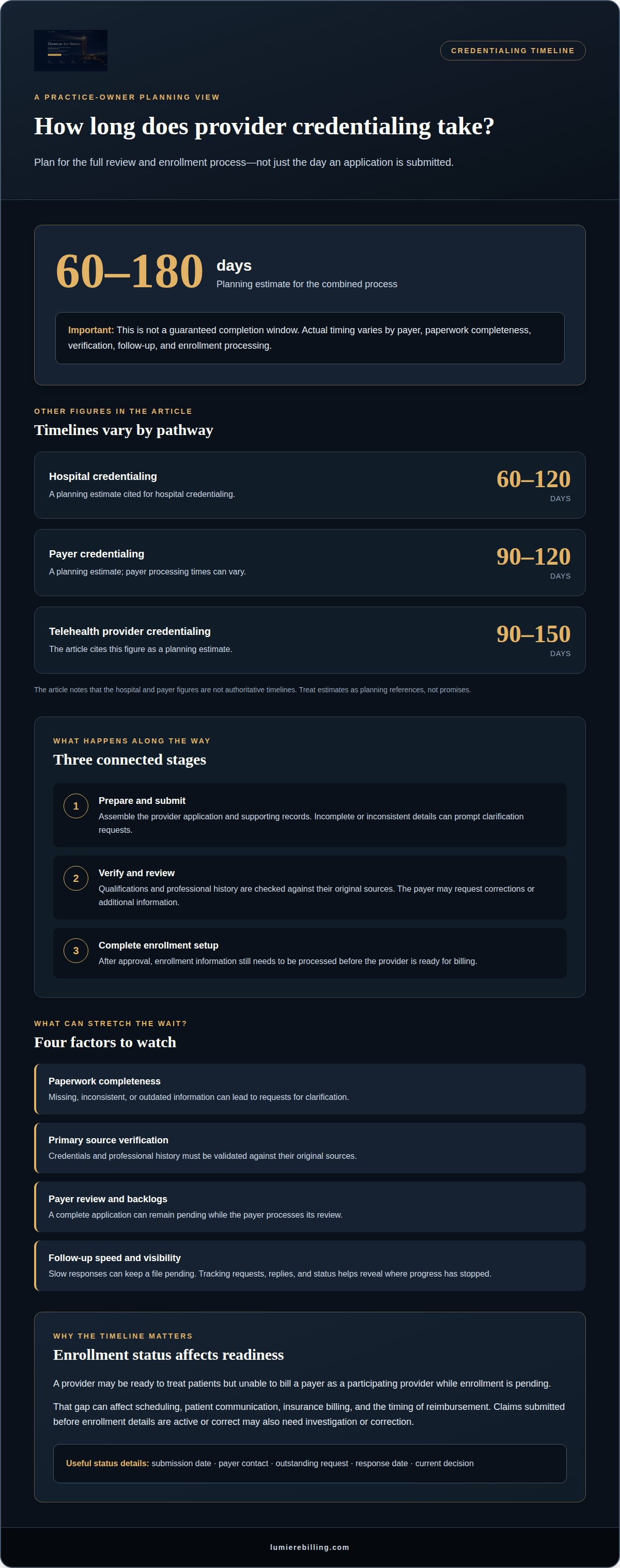
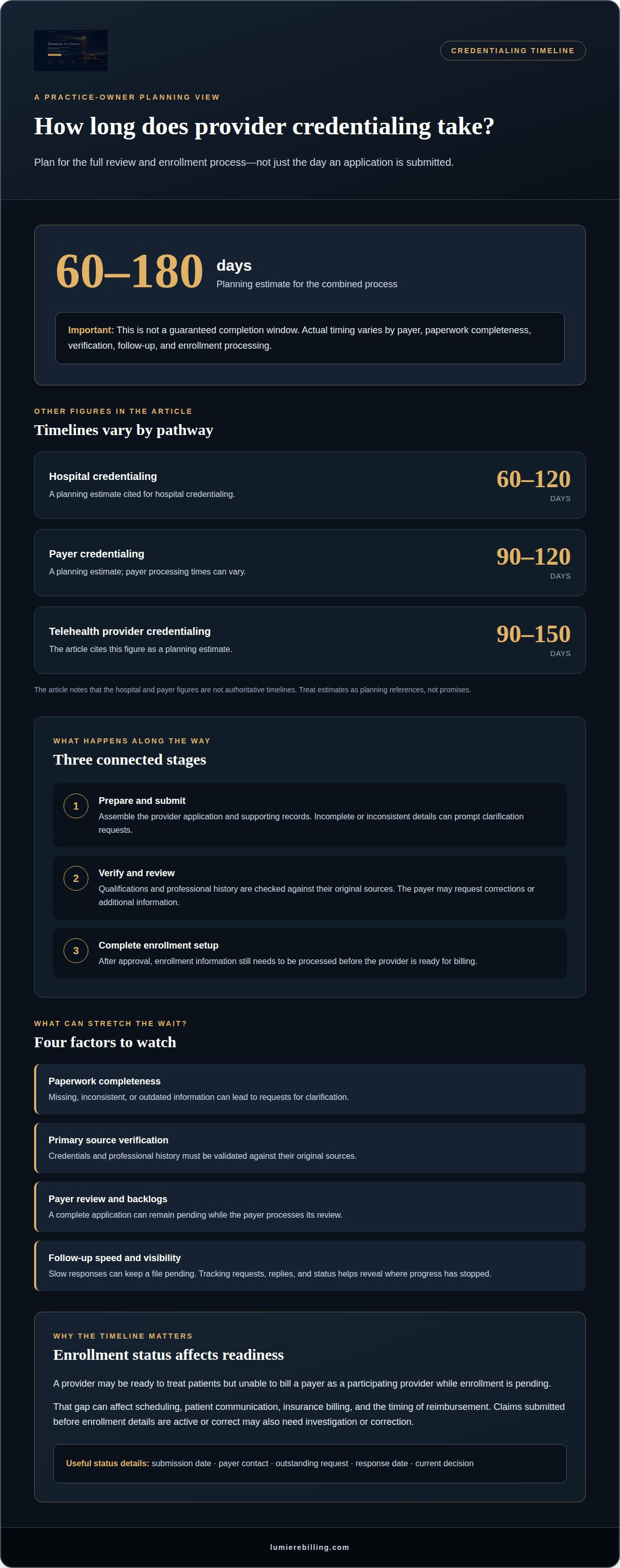
Provider credentialing commonly takes 60 to 180 days, so estimating how long provider credentialing takes means looking beyond the application date. A complete submission can still move slowly while payers verify qualifications, review records, and process enrollment.
If you’re waiting to bring a provider into your practice, the uncertainty is real: a delay can affect when they’re ready to see patients and when services can be billed to insurance. The timeline depends on the payer, the completeness of the paperwork, and how quickly verification and follow-up move forward.
This article explains what happens during credentialing, which steps can stretch the timeline, and how enrollment delays affect practice operations. You’ll also learn how organized workflow management can keep applications visible and prevent issues from lingering unnoticed. The goal is a clearer view of what’s driving the wait and what to plan for next.
Key Takeaways
- Credentialing timelines vary by payer and organization, so plan around the full review and enrollment process rather than application submission alone.
- Incomplete paperwork and slow responses to requests for information can add avoidable friction to an application.
- Primary source verification takes time because qualifications and professional history must be validated against their original sources.
- Enrollment delays can affect provider readiness, insurance billing, and the timing of reimbursement.
- Consistent follow-up and clear oversight help practices spot stalled applications and keep credentialing work moving.
What Are Credentialing Delays Actually Costing Your Practice?
Credentialing delays can leave a provider ready to treat patients but unable to bill a payer as a participating provider. A pending application can therefore affect both the practice’s schedule and its revenue cycle.
Application and Documentation Delays
Application and documentation delays happen when required information is missing, inconsistent, or awaiting verification. A payer may need clarification before it can continue its review.
A hypothetical behavioral health practice might submit an application with an outdated work history or a license record that doesn’t match the application. The payer’s request for clarification adds another step: staff must identify the discrepancy, obtain the correct information, and send it back. If the response is delayed, the file may remain pending instead of advancing through review.
Accurate application details and supporting records help prevent avoidable back-and-forth. Names, practice locations, license details, and work history should align. A mismatch doesn’t necessarily mean an application will be denied, but it can interrupt review and verification. Tracking each payer’s requests and responses makes the cause of a delay easier to identify.
Financial Effects of Delayed Credentialing
The financial effect is a gap between delivering care and being able to submit claims under the provider’s payer enrollment. During that gap, completed visits may not generate timely insurance revenue.
For example, a hypothetical practice hires a therapist whose application is pending with a commercial payer. The therapist may be ready to see patients, but the practice must account for the payer’s enrollment status before treating those visits as routinely billable through that network. The result can be delayed collections, extra administrative work, and less certainty in revenue forecasts.
Credentialing delays can also create downstream claims work. If staff submit claims before enrollment details are active or correct, claims may need investigation or correction. The practice then spends time tracing enrollment status, reviewing affected claims, and reconciling expected payments. Track credentialing separately from claim status to see whether the bottleneck is payer review, enrollment setup, or billing follow-through.
Operational Effects and Payer Backlogs
Operational delays occur when credentialing, payer enrollment, and scheduling are not ready at the same time. A provider’s start date may arrive before the practice can use its intended insurance workflow.
A payer backlog can keep a complete application pending even after the practice has supplied requested records. In a hypothetical behavioral health clinic, that uncertainty may affect appointment planning, patient communication, and which providers can accept particular insurance arrangements. Distinguish an internal paperwork hold from a payer-side wait, since each requires a different follow-up.
A clear status log can record the submission date, payer contact, outstanding request, response date, and current decision. This gives staff a concrete view of where an application stands and what action comes next. It also helps leaders assess readiness before adding appointments, rather than treating submission as completed enrollment.
What is Provider Credentialing and Why Does It Take So Long?
Provider credentialing verifies qualifications, while payer enrollment establishes participation and billing status. A practice may use 60 to 180 days as a planning estimate for the combined process, but this is not an authoritative timeline or a guaranteed completion window.
Credentialing costs depend on internal staff time or contracted support. The arrangement between the practice and provider determines who pays, so there is no single cost for every organization.
Credentialing Process Steps
Credentialing proceeds from application preparation through verification, payer review, and enrollment setup. Understanding each stage helps practices identify whether a delay involves missing information or a pending payer decision.
First, the provider’s application and supporting records are assembled and submitted. The payer then verifies credentials and reviews the file, sometimes requesting corrections or additional details. After approval, enrollment information must be processed before the provider is ready for billing. Each step depends on the one before it, so an incomplete submission can slow the entire sequence.
Timeline Differences by Provider and Organization
Credentialing timelines vary with provider records, payer requirements, and the organization’s workflow. An average can hide the specific steps affecting a practice’s start date.
A single-provider application may involve a different review path from a group enrollment or hospital appointment. The figures of 60 to 120 days for hospital credentialing and 90 to 120 days for payer credentialing should be treated as planning estimates, not authoritative timelines; actual processing times can vary. Organizations also differ in how quickly they assemble records, respond to payer requests, and track pending applications. The correct planning estimate accounts for both external review and internal processing.
Practices often ask, “How long does provider credentialing take?” The answer depends on the provider’s pathway and the organization reviewing the application.
Specialty and Enrollment Timelines
Specialty and enrollment timelines reflect the records and payer pathways required for each provider. For behavioral health practices, telehealth participation can involve distinct enrollment steps.
The figures of 90 to 150 days for telehealth provider credentialing, 60 to 90 days for Medicare credentialing, and 30 to 180 days for Medicaid enrollment are estimates, not authoritative timelines. Medicaid processing varies by state, and actual timelines depend on the payer and application. Those differences make the payer and state important parts of the estimate, not details to add after scheduling begins.
Typical Physician and Overall Timelines
The figures of 60 to 90 days for physician credentialing and 60 to 180 days for overall provider credentialing are planning estimates, not authoritative timelines. They do not guarantee an individual completion date.
For example, a hypothetical practice onboarding a physician with several payer applications may find that each payer reviews and processes enrollment on its own schedule. Even a correct application can move at different speeds across organizations. Track timelines by payer, not just by provider. Keeping the submission date, current status, and outstanding request visible helps teams distinguish active review from a stalled application and plan more realistically for start dates and billing.
To estimate how long provider credentialing will take for a specific hire, map each payer’s review and enrollment stages against the planned start date.
What Is Credentialing, and Why Does the Timeline Vary So Much?
Hospitals, commercial payers, Medicare, and Medicaid each review distinct requirements, so timelines differ. Separating qualification review from enrollment helps show where approval may be waiting.
Timelines by Organization and Payer
Organizations and payers follow different review processes, so one provider may have several applications moving at different speeds. Account for that difference when setting a realistic start date.
As planning estimates rather than guaranteed or official timelines, hospital credentialing and privileging may be estimated at 90 to 180 days, while hospital or ambulatory surgery center privileging may be estimated at 30 to 90 days. These ranges describe different settings and processes, not interchangeable steps. Commercial insurance credentialing may be estimated at 60 to 150 days. Actual timing depends on the organization or payer and its process. A practice enrolling with multiple payers should track each application separately rather than treating one approval as universal network readiness.
A payer committee schedule can also affect timing. If an application misses a committee’s monthly meeting, review may take longer. The key milestone is the payer’s decision, not simply the date paperwork was submitted.
Credentialing and Payer Enrollment
Credentialing evaluates a provider’s qualifications; payer enrollment establishes the provider’s participation with an insurance plan. Credential approval alone may not complete the steps required for billing.
After a payer approves a provider, the organization may still need to complete enrollment and ensure the provider’s information is loaded into the payer’s claims system. Some planning estimates put this final setup at 15 to 30 days, but that is not a guaranteed or official timeline. A practice that tracks only credentialing approval can therefore mistake a completed review for completed enrollment.
Operational status records should distinguish application review, credential approval, enrollment processing, and billing readiness. These milestones show which payer action remains outstanding and help prevent scheduling assumptions based on an incomplete status.
State and Payer Requirements
State Medicaid programs and individual payers can require different reviews, affecting how quickly enrollment reaches approval. This is especially relevant for practices operating across state lines or joining several networks.
Planning estimates sometimes place Medicaid enrollment at 60 to 180 days, depending on the state and application complexity, with some estimates extending to six months. Medicare group enrollment may be estimated at 60 to 120 days, while estimates for enrollment through PECOS may be 45 to 90 days. These are not official or guaranteed timelines; confirm requirements and processing expectations with the relevant program. The application pathway and the organization being enrolled both shape the expected schedule.
For example, a hypothetical multistate behavioral health organization may see one provider’s enrollment progressing while another remains pending with a different state program. A single practice-wide estimate can hide these differences, so track status for each provider and state payer.
Typical Payer Credentialing Duration
A planning estimate for payer credentialing may span 90 to 150 days, but this is not a universal or official timeline. Payer-specific review steps can shift the total. This range matters for workforce planning because credentialing and enrollment may not finish together.
Track the start date, submission status, requests for information, committee review, and final enrollment setup for each payer. If approval is delayed, these milestones help distinguish an incomplete application from a payer backlog. They also clarify whether the remaining work belongs to the practice, the payer, or post-approval processing.
For a provider joining several networks, readiness depends on the status of each relevant payer relationship. A completed application is progress, but it is not the same as approval or active enrollment. Keeping these stages distinct gives organizations a clearer view of timelines and billing readiness.
Primary source verification and documentation
Credentialing files combine provider records with verification from original sources. Applications may request licenses, training and work history, professional references, and malpractice claims history.
For a mental health provider, missing or mismatched records can prompt follow-up before a payer completes its review. Accuracy matters both at submission and throughout verification.
Application Preparation and Required Documents
Application preparation means assembling provider information and supporting records into a complete, consistent submission. It matters because missing details can prompt payer questions and interrupt review.
Document requests vary by payer. As examples, an application may ask for work history covering the past 5 to 10 years, 3 to 5 professional references, or malpractice claims history covering 10 years. A payer may request a continuous 10-year work history and written explanations for gaps longer than 30 days. License and training records may also support verification. The application’s specific document list guides preparation.
Organizing records together helps staff spot an expired license, an unexplained employment gap, or a missing reference before submission. These issues are easier to resolve before the file enters payer review.
Primary Source Verification
Primary source verification checks a provider’s credentials against the organizations that issued or maintain them. It matters because submitted copies alone don’t establish that a qualification is valid.
For example, a licensing board can serve as the original source for a license record, while a training institution may verify education. Verification deadlines depend on the applicable payer or credentialing standard; confirm the deadline directly rather than assuming a 120-day requirement. Verification can involve separate institutions, so a slow response from one source may hold up the file even when other records are complete.
Track which credentials have been verified, which source is still outstanding, and when follow-up occurred. This makes the pending step visible and helps distinguish verification delays from missing paperwork.
Provider Responses and Missing Documents
Provider response time is the interval between a request for information and the provider’s complete reply. It matters because an unanswered payer request can leave the application pending.
In a hypothetical case, a payer might ask for an explanation of a work-history gap or an updated license record. If the provider sends only part of the requested material, the credentialing team may need another exchange before the file can proceed. A practice may set an internal goal of responding to payer requests within 24-48 hours, but this is a recommendation, not a universal requirement. A shared record of the request, owner, and response date helps staff monitor outstanding items.
Document Accuracy and Application Mistakes
Document accuracy means application details agree with supporting records and verification sources. An incomplete or inconsistent file can lead to corrections or resubmission.
A difference in a provider’s name, license details, or employment dates can prompt a payer to request clarification. The claim that one in every three credentialing applications requires corrections or resubmission should not be treated as an established statistic without an authoritative source. A final review can compare application fields with source documents, confirm that requested attachments are present, and flag unexplained gaps. Clear records reduce avoidable back-and-forth and help keep the network application moving.
Managing credentialing and enrollment workflows
A controlled workflow makes each application’s owner, status, and next action visible. As an internal planning target, starting credentialing at least 120 days before a provider’s planned start date can give the practice time to coordinate applications, verification, and onboarding.
Begin with a provider-and-payer inventory. Record the intended start date, each network, the submission date, and the current stage. Separate credentialing review from enrollment and billing readiness: one approval doesn’t mean every payer relationship is active. For a behavioral health group, this view can show that one payer is reviewing a file while another still needs information.
- Prepare the provider record. Gather current licenses, work history, and supporting documents before staff submit applications. Keep the same provider details across payer forms and records.
- Track each submission. Log the payer, submission date, confirmation, and requested follow-up. An application marked pending should have a recorded next action, not just a status label.
- Monitor verification and requests. Assign responsibility for payer questions and source checks. Record when a request arrives, who owns the response, and when the completed information returns.
- Track approval and enrollment separately. Record the approval date, then continue monitoring until enrollment and billing readiness align for that payer.
Provider information also needs ongoing maintenance. Follow CAQH ProView’s current instructions for profile re-attestation; a practice might use 90-day checks as an internal reminder cadence. Practices can also set reminders 180 days before licenses or board certifications expire as an internal planning measure, not as a universal requirement. These recurring checks can help keep profile details current and surface upcoming expirations before they disrupt an application or renewal.
Recredentialing belongs on the same calendar as new-provider onboarding. A practice might use 90 days before a provider’s expiration date as an internal target for starting recredentialing, then track payer review and any outstanding requests separately. A quarterly audit of credentialing records can identify expired credentials, missing documents, and applications without recent activity. The audit should produce specific follow-up actions and assigned owners.
For multiple providers, keep a separate status record for each provider and payer rather than relying on one practice-wide progress note. This makes it easier to see whether a delay involves a license, payer review, or missing response. It also helps staff coordinate start dates with actual network readiness instead of assuming every application will finish together.
The operational takeaway is straightforward: plan early, keep recurring checks visible, and track every payer relationship through enrollment. A disciplined workflow can’t control a payer’s review speed, but it can make internal gaps and stalled steps easier to identify and address.
Lumiere Billing: Credentialing & Enrollment
Lumiere Billing provides Credentialing & Enrollment for behavioral health practices managing provider applications and payer participation. This service is a relevant next step when internal teams need help coordinating credentialing tasks, tracking application status, and connecting enrollment progress with billing readiness.
For practices facing unresolved application questions or unclear enrollment status, Lumiere Billing can bring these steps into one managed workflow. Credentialing affects when providers can participate in payer networks, so keeping application progress visible matters. Discuss Credentialing & Enrollment with Lumiere Billing for your practice.
Make Credentialing Part of Your Practice Plan
Knowing how long provider credentialing takes is useful when it informs hiring, scheduling, and revenue planning. Make ownership clear: decide who tracks each payer relationship, follows up on pending items, and connects enrollment status with billing readiness. A visible process gives your team a practical way to respond when an application stalls.
Lumiere Billing’s Credentialing & Enrollment can support practices that need help coordinating this work. If credentialing concerns also reveal wider billing workflow issues, a Free Billing Audit or Revenue Cycle Management may be relevant. The right next step depends on where your practice needs operational support.
Bring your current credentialing and enrollment priorities into focus, then contact Lumiere Billing to discuss support for your practice. A clearer process can help your team move forward with greater confidence.
Frequently Asked Questions
How Long Does the Credentialing Process Take?
Provider credentialing commonly takes 60 to 180 days from application through payer review and enrollment steps. The timeline can extend when a payer requests more information or a file waits for review. For example, a practice onboarding a clinician across several networks should track each application separately, since one payer’s approval doesn’t indicate that other applications are complete.
Does Medicare credentialing take longer than private insurance?
Medicare credentialing typically takes 60 to 90 days, while commercial payer credentialing is commonly estimated at 90 to 120 days. These ranges don’t make every private plan slower than Medicare. Each payer processes applications on its own schedule. For a provider joining both Medicare and a commercial network, separate status tracking helps the practice see which enrollment is holding up participation.
How Long Does Hospital Credentialing Take?
Hospital credentialing commonly takes 60 to 120 days, while credentialing and privileging together may extend to 90 to 180 days. Privileging involves the hospital’s review of the clinical services a provider may perform there. A clinician joining a hospital and an outpatient behavioral health practice may therefore have distinct approval tracks, even when both use the same underlying provider records.
How do credentialing delays impact healthcare organizations?
Delays can disrupt hiring plans, appointment schedules, network participation, and the timing of insurance claims. For instance, a practice may onboard a clinician as planned while one payer application remains pending. The organization then needs to distinguish which patients can be scheduled under active network participation and which payer relationship still needs follow-up. That visibility supports more accurate staffing and revenue planning.
How long does healthcare provider credentialing typically take?
Healthcare provider credentialing typically takes 60 to 180 days. That overall range includes different provider types and payer pathways, so it is more useful as a planning window than a firm completion date. A practice can make the estimate more actionable by recording each payer’s submission date, current review stage, and outstanding request, then revisiting the provider’s readiness as approvals progress.
What is the average provider credentialing timeline by insurance payer?
Commercial payer credentialing is commonly estimated at 90 to 120 days. Medicare credentialing typically takes 60 to 90 days, while Medicaid enrollment can take 30 to 180 days across states. These are different payer pathways, not one shared clock. For a provider applying to several networks, a payer-by-payer timeline helps identify which approval remains outstanding and informs onboarding plans.
How long does Medicare provider enrollment and credentialing take?
Medicare enrollment through PECOS is commonly reported at 45 to 90 days, while Medicare credentialing is often estimated at 60 to 90 days. The process may involve application review followed by enrollment setup. A group enrolling multiple clinicians should track each provider’s submission and status separately, so one completed file doesn’t obscure another application that still needs attention.
How long does Medicaid provider enrollment take in each state?
Medicaid enrollment timelines differ by state; a general reported range is 30 to 180 days. There isn’t one timeline that applies to every state program. For a behavioral health organization serving patients across state lines, maintain a separate status for each state’s application, including submission date and outstanding items. That record helps clarify which location’s enrollment is ready for payer participation.
Frequently Asked Questions
Provider credentialing commonly takes 60 to 180 days from application through payer review and enrollment steps. The timeline can extend when a payer requests more information or a file waits for review. For example, a practice onboarding a clinician across several networks should track each application separately, since one payer’s approval doesn’t indicate that other applications are complete.
Medicare credentialing typically takes 60 to 90 days, while commercial payer credentialing is commonly estimated at 90 to 120 days. These ranges don’t make every private plan slower than Medicare. Each payer processes applications on its own schedule. For a provider joining both Medicare and a commercial network, separate status tracking helps the practice see which enrollment is holding up participation.
Hospital credentialing commonly takes 60 to 120 days, while credentialing and privileging together may extend to 90 to 180 days. Privileging involves the hospital’s review of the clinical services a provider may perform there. A clinician joining a hospital and an outpatient behavioral health practice may therefore have distinct approval tracks, even when both use the same underlying provider records.
Delays can disrupt hiring plans, appointment schedules, network participation, and the timing of insurance claims. For instance, a practice may onboard a clinician as planned while one payer application remains pending. The organization then needs to distinguish which patients can be scheduled under active network participation and which payer relationship still needs follow-up. That visibility supports more accurate staffing and revenue planning.
Healthcare provider credentialing typically takes 60 to 180 days. That overall range includes different provider types and payer pathways, so it is more useful as a planning window than a firm completion date. A practice can make the estimate more actionable by recording each payer’s submission date, current review stage, and outstanding request, then revisiting the provider’s readiness as approvals progress.
Commercial payer credentialing is commonly estimated at 90 to 120 days. Medicare credentialing typically takes 60 to 90 days, while Medicaid enrollment can take 30 to 180 days across states. These are different payer pathways, not one shared clock. For a provider applying to several networks, a payer-by-payer timeline helps identify which approval remains outstanding and informs onboarding plans.
Medicare enrollment through PECOS is commonly reported at 45 to 90 days, while Medicare credentialing is often estimated at 60 to 90 days. The process may involve application review followed by enrollment setup. A group enrolling multiple clinicians should track each provider’s submission and status separately, so one completed file doesn’t obscure another application that still needs attention.
Medicaid enrollment timelines differ by state; a general reported range is 30 to 180 days. There isn’t one timeline that applies to every state program. For a behavioral health organization serving patients across state lines, maintain a separate status for each state’s application, including submission date and outstanding items. That record helps clarify which location’s enrollment is ready for payer participation.
Free billing audit
Find out what your billing is really costing you
We'll review your claims, denials and collections and show you exactly where revenue is leaking. Free, no obligation, no contract.
Schedule a Free Billing Audit