Five RCM Service Contract Red Flags to Check Before Signing

The clearest red flags in RCM service contracts are vague responsibility for aged claims, limits on denial appeals, unclear fee calculations, automatic renewals, and restrictive termination terms. Payer timely filing limits typically range from 90 to 180 days from the date of service, so a contract that leaves aged-claim follow-up undefined can put recoverable revenue at risk.
Choosing an RCM provider is about more than handing off billing tasks. You need clear accountability, visibility into claim work, and terms that make the relationship understandable before you sign. This article explains how to assess red flags in RCM service contracts, including provisions for aged accounts receivable, appeals, fees, renewals, and termination.
Key Takeaways
- Define who owns aged-claim follow-up, what actions are required, and how unresolved balances are escalated.
- Look for appeal terms that spell out responsibility, escalation paths, and how denial outcomes are tracked.
- Require reporting that makes claim status and performance visible, rather than relying on a single blended metric.
- Read renewal and termination clauses closely, including notice windows, cure periods, and access to claim-level records.
- Clarify how collections are calculated before agreeing to percentage-based fees, so the incentive structure is transparent.
1. Aged accounts receivable and timely filing limits
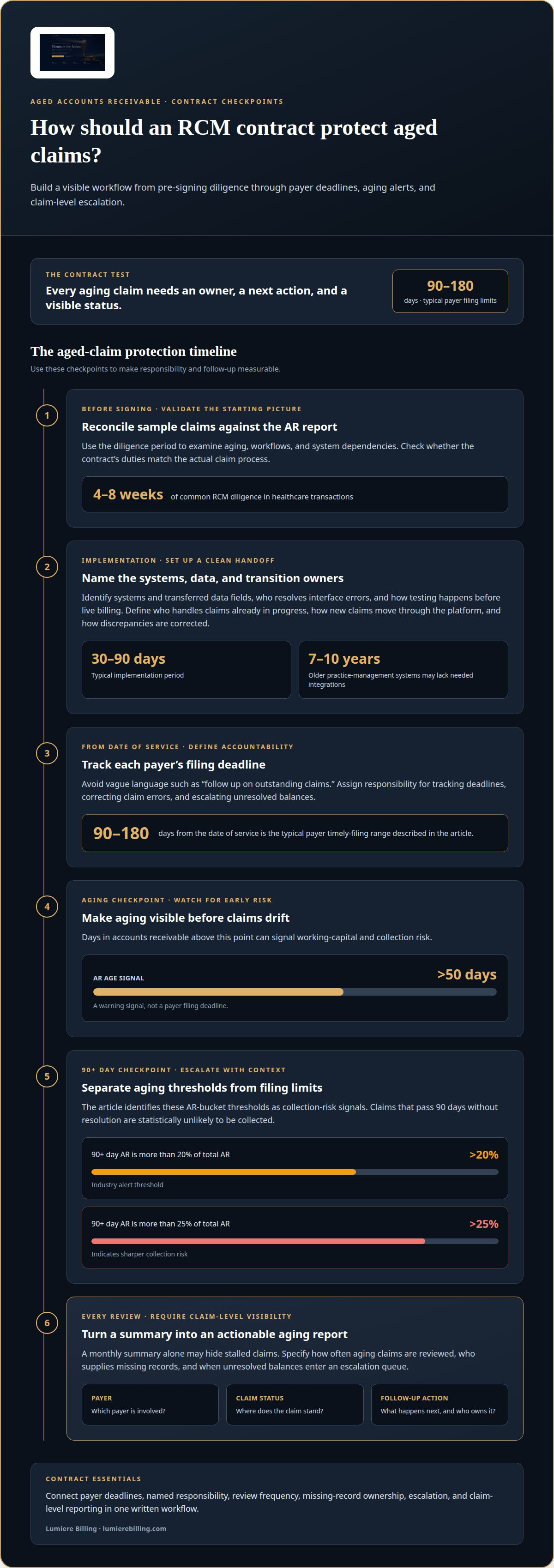
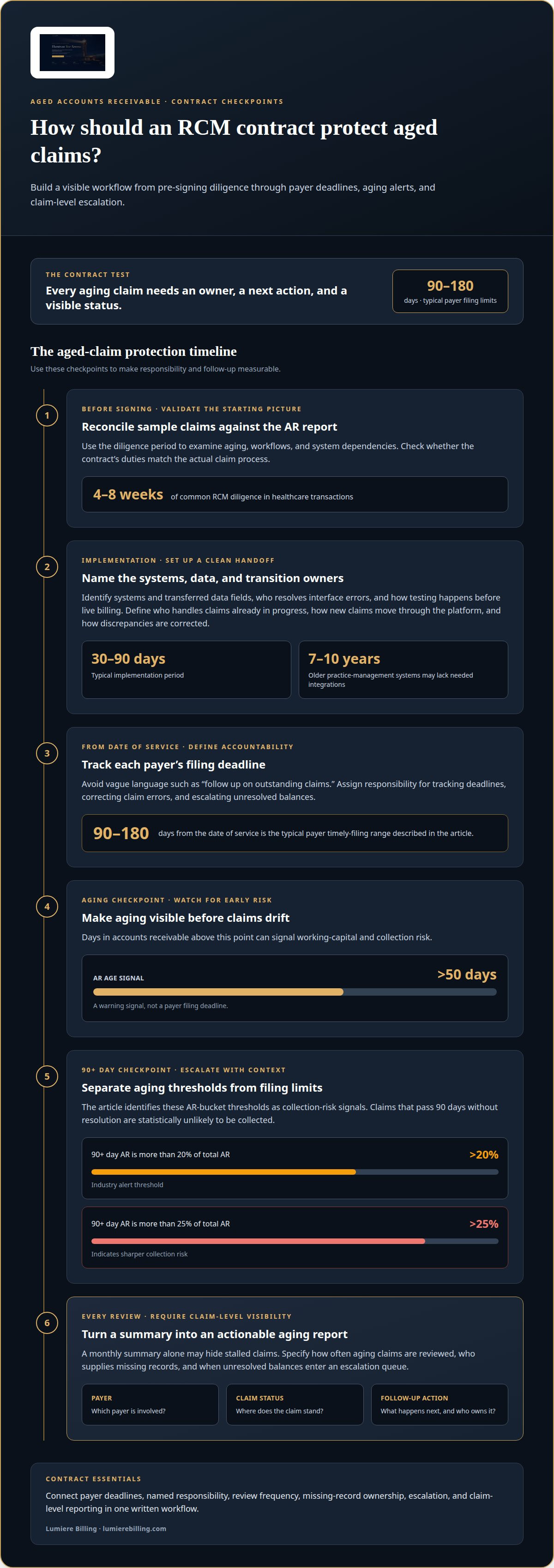
A contract that says “follow up on outstanding claims” leaves too much room for delay. Payer timely filing limits typically range from 90 to 180 days from the date of service. The agreement should assign responsibility for tracking each payer’s deadline, correcting claim errors, and escalating unresolved balances. Without named owners and defined actions, a claim can age while the billing function assumes someone else is handling it.
Age matters because unresolved claims become harder to recover. Days in accounts receivable above 50 days can signal working-capital and collection risk. A 90-plus-day AR bucket exceeding 20% of total AR is an industry alert threshold; above 25% indicates sharper collection risk. Claims that pass 90 days without resolution are statistically unlikely to be collected. A monthly summary alone may hide this pattern, so the contract should specify an aging report with payer, claim status, and follow-up action.
Make the workflow measurable. The contract should state how often the provider reviews aging claims, which party supplies missing records, and when unresolved claims move to an escalation queue. It should also explain how the practice can see claim-level activity, not just aggregate balances. For example, several older claims under one payer may be waiting on documentation, while others are nearing a filing deadline. A useful report distinguishes between them.
EHR integration adds another risk point. An RCM platform must receive accurate patient, coverage, and encounter data to support clean claim submission and timely follow-up. Contracts should identify the systems involved, the data fields transferred, who resolves interface errors, and how testing occurs before live billing. Practice management systems older than 7 to 10 years may lack integrations needed for centralized operations. Treat compatibility and data access as implementation requirements, not assumptions.
Implementation typically takes 30 to 90 days. During that period, define who handles claims already in progress, how new claims move through the platform, and how data discrepancies are corrected. A written transition plan should cover testing, staff responsibilities, reporting access, and the point when routine operations begin. Otherwise, a transition gap can leave older claims without clear ownership.
Allow diligence time before signing. RCM diligence commonly runs 4 to 8 weeks in healthcare transactions, giving teams time to examine aging, workflow, and system dependencies. Use that window to reconcile a sample of claims against the AR report and confirm that contract duties match actual processes. The strongest terms connect deadlines, responsible parties, reporting, and escalation into one visible workflow.
2. Denial appeals and escalation processes
An RCM contract should define a denial, assign appeal responsibilities, and explain how preventable lost revenue is handled. It should identify who reviews payer explanations, gathers documentation, files appeals, and escalates unresolved claims. If those duties are vague, a denial can sit untouched while each party assumes the other owns the next step.
Look for a workflow that classifies denials by reason and payer instead of combining every outcome into one figure. Eligibility issues, missing documentation, coding edits, and authorization problems each require different corrective actions. Payer-specific explanations matter because the same service can face different requirements across plans. The provider should record each denial reason, next action, responsible party, and appeal status in a format the practice can review.
Rates need context. Initial claim denial rates above 10 percent can indicate payer-specific operational problems, while a rate above 8% is also identified as a warning sign warranting an RCM audit. These thresholds differ, so a contract should state its own measurement method and reporting period. It should distinguish initial denials from repeated denials, and show root causes by payer instead of obscuring patterns in an overall average.
Appeal language deserves close attention. Some contracts limit denial management to one appeal per claim. That cap may leave a claim without further action even when new documentation or a corrected submission could support another step. Define what the service includes, which appeal stages are covered, who supplies clinical records, and how the practice approves information sent to the payer. A well-managed denial workflow resolves denials within 30-45 days of receipt.
- Classification: Record the payer, denial reason, claim status, and root cause.
- Ownership: Assign responsibility for records, corrections, appeal drafting, and submission.
- Escalation: Set a clear path for stalled claims and payer responses requiring practice input.
- Reporting: Track appeal filing and outcomes by payer and denial category.
Responsibility for lost revenue should follow the documented cause, not a blanket promise that every denial will be recovered. The agreement can distinguish provider processing errors from missing or inaccurate information supplied by the practice. It should explain how each category is investigated, documented, and escalated, rather than treating all unpaid claims as the same problem. This makes accountability visible and actionable.
For example, a typical practice might see recurring authorization denials from one payer. A useful review identifies the payer pattern, traces where authorization information dropped out, and assigns the process correction. If denial performance is difficult to interpret, revenue cycle management support can help bring claim follow-up and denial trends into view.
3. How to Choose the Right Revenue Cycle Management (RCM) Provider?
Transparent reporting makes the revenue cycle visible beyond the final reimbursement total. The contract should define which metrics the vendor reports, how often reports arrive, and what claim-level detail is available. A dashboard without definitions can conceal whether revenue is delayed by submission errors, payer processing, or unresolved balances. Set clear terms for report access, metric calculations, and follow-up discussions.
An accounts receivable aging report should be available on demand, segmented by payer, provider, and denial reason. A response that takes 48 hours is a warning sign when the practice needs to investigate a current claim. The report should let staff trace balances to individual claims and see status, action history, and next steps. Summary totals alone cannot show where a reimbursement delay began.
Clean claim rate reporting also needs a defined method. A clean claim is one accepted for processing without needing correction or resubmission; the contract should explain what counts in its calculation. The national median clean claim rate is 85-90%, while a rate below 92% is identified as a warning sign. These figures use different thresholds, so compare like-for-like definitions, payer mix, and reporting periods instead of treating one number as a verdict.
Use a report covering the previous 90 days to assess clean claim performance. The reporting package should connect submission results to denial categories, payer response, and correction activity. A single monthly average can hide a sudden change or a recurring issue with one payer. Trend views help identify whether a process adjustment improved the metric or merely shifted claims into another status.
- Claim submission: Track accepted, rejected, corrected, and resubmitted claims.
- Accounts receivable: Show balances by payer, provider, age, and denial reason.
- Denial performance: Separate root causes and appeal outcomes by payer.
- Reimbursement: Reconcile reported collections with remittance and claim activity.
Audit rights turn reporting into accountability. The agreement should describe how the practice can inspect supporting records, resolve metric disputes, and request corrections to inaccurate reports. It should also state who retains claim-level data and how long operational records remain accessible. These terms matter during a provider transition, when an incomplete history can interrupt follow-up.
For example, a practice might see a stable overall clean claim rate while one payer’s rejection pattern worsens. A useful report exposes that difference, identifies the affected claims, and records corrective action. Define the review schedule and follow-up owners before signing. Clear metrics make the relationship testable rather than dependent on broad assurances.
4. Automatic renewal and termination provisions
An automatic renewal can extend an outsourcing relationship before the practice has reviewed its performance. Some medical billing contracts require written termination notice 90 days before the term ends to prevent renewal. Put the renewal date, notice deadline, delivery method, and required recipient in a contract calendar. A clause buried in standard terms can turn a missed deadline into another contract period.
Compare the initial contract length with the options available after it ends. Contracts may allow month-to-month renewal after the initial term with 30 to 60 days’ notice. By contrast, some RCM outsourcing contracts require practices to provide 90 to 180 days' notice before termination. That difference affects how quickly a healthcare practice can act when service or business needs change.
Termination language should distinguish ordinary termination from termination for cause. The contract should state what qualifies as a material default, how the parties document it, and how a cure period works. One described provision gives the vendor a 30-day cure period after a material default. Define how notice is delivered and what happens if the issue remains unresolved after that period.
Transition clauses should identify the steps, owners, and records needed to keep accounts moving. Include cooperation during handoff, transfer of open claim status, access to payer correspondence, and a process for reconciling work in progress. Specify how the provider supports an orderly transition without suggesting that either party controls payer response times. The practice should retain ownership of claim-level data, authorization records, and remittance data.
Address operational questions directly: require advance notice of subcontracting and identify the provider’s accountability for subcontractor work. Set audit rights for relevant service records and reporting, and describe how the practice can review or challenge discrepancies. Business continuity terms should explain how work, records, and communication continue during service interruptions or a provider transition. These clauses preserve visibility and operational control.
A sound exit allows the practice to continue billing without losing access to essential records. The contract should state the format and timing for returning data, how copies are handled, and whether claim histories remain accessible after termination. Avoid language that makes transfer depend on an unresolved billing dispute unless the agreement clearly explains how disputed amounts are separated from practice records.
Before signing, map the contract end date, renewal notice deadline, and earliest termination date. Then trace a hypothetical exit from notice through final data transfer and account reconciliation. If any step lacks an owner, the termination clause leaves a gap. Clear terms make the relationship easier to manage, renew, or end deliberately.
5. Percentage-of-collections fee incentives
Percentage-based contracts charge a share of defined collections, while fixed-fee agreements charge a set amount for an agreed scope. Percentage-based pricing is commonly described as 4% to 10% of collections, but the fee policy for this service page prohibits quoting service prices. The contract should still make the calculation basis, excluded amounts, adjustments, and reporting method explicit.
Start with the word “collections.” Does it mean cash received during the contract period, or payments tied to claims the provider worked? The agreement should explain how refunds, recoupments, patient payments, and collections from work completed before the relationship began are treated. It should also state when the percentage is calculated and how the practice can reconcile each charge against actual deposits.
A percentage-based fee can align incentives with collections, but attribution still needs to be clear. For example, a practice might receive a payer payment after the provider’s work ends. The contract should explain whether that payment enters the fee calculation and how the practice can verify its source. Reporting should connect each charge to collection records, adjustments, and the agreed calculation period.
Collection promises need careful language. A headline percentage is not meaningful without a defined denominator, exclusions, timeframe, and payer mix. Net collection rate compares collected amounts with collectible amounts after contractual adjustments. The research benchmarks vary: a rate below 92 percent is flagged for lost revenue, below 90% is described as a warning sign, and national median performance is listed at 83-89%. Top-performing partners are described as reaching 93-95% or higher for physician groups with comparable payer mixes.
Benchmarks are not interchangeable guarantees. Specialty, payer mix, contractual adjustments, and the definition of collectible revenue all affect comparisons. Require reports that show the calculation and explain exclusions. A single net collection rate can conceal write-offs, delayed payments, or differences among payer groups. Compare periods using the same method, then assess whether changes reflect billing performance or shifts in the underlying claims.
- Calculation: Define collections, exclusions, adjustments, and the fee period.
- Attribution: Clarify treatment of payments received after vendor work ends.
- Reporting: Reconcile each charge with deposits and claim-level activity.
- Benchmarks: Compare net collection rates only with consistent definitions and payer mixes.
Before signing, test the language with a hypothetical payment scenario: a claim is submitted during the contract, adjusted by the payer, then paid after the reporting period. The agreement should make the fee treatment clear. If the calculation cannot be reproduced from the report and payment records, the incentive structure lacks transparency. Tie every percentage, exclusion, and charge to a documented method.
Lumiere Billing
Lumiere Billing provides revenue cycle management and practice advisory services exclusively for behavioral health providers. If contract concerns point to gaps in claim follow-up, denial prevention, or performance visibility, its Free Billing Audit can help clarify billing priorities. The findings can inform whether operational support or broader process guidance fits the practice’s needs.
For practices seeking ongoing support, Lumiere Billing’s Revenue Cycle Management covers the billing process, including insurance verification, prior authorization, claims submission, denial prevention, and analytics. This can be a practical next step when contract review reveals workflow concerns beyond contract language. Contact Lumiere Billing to discuss your practice’s revenue cycle needs.
Put contract clarity into practice
A signed agreement should support how your practice wants its revenue cycle to operate as staffing, payer relationships, and patient needs change. Treat contract review as an operational decision, not a one-time paperwork task. Keep a shared record of responsibilities, reporting expectations, and renewal dates so the people managing claims and practice leadership work from the same understanding.
The most useful response to red flags in RCM service contracts is a clear view of how the terms affect daily work. Lumiere Billing helps behavioral health practices assess revenue cycle needs through Revenue Cycle Management, Practice Advisory, and Credentialing & Enrollment. Its Free Billing Audit can also surface areas for review. These services address different needs, so the next step depends on where your practice needs greater clarity and operational support.
Contact Lumiere Billing to discuss your RCM needs and identify a practical next step for your practice. Clear terms can help your team move forward with greater confidence and focus.
Frequently Asked Questions
How to Choose the Right Revenue Cycle Management (RCM) Provider?
Choose an RCM provider whose process fits your specialty, systems, and staffing model. During evaluation, trace a patient account from eligibility review through payment posting, identifying who handles each handoff. Ask for a sample report and review how staff would use it to make decisions. This reveals whether the provider’s communication and reporting style suits your practice’s daily needs.
So What Now?
Turn your review into a concise decision record before signing. Note each unresolved term, its operational impact, the person responsible for resolving it, and the agreed contract language. Then have the people managing billing and practice finances review the final version together. A billing lead, for example, may spot a workflow gap that leadership missed. Resolve open issues in writing before approving the agreement.
What KPIs should buyers focus on during RCM diligence?
Focus on measures that connect operational activity to financial outcomes: claim acceptance, denial reasons, appeal outcomes, reimbursement patterns, and unresolved balances. During diligence, compare the provider’s definitions with your existing reports, since identical metric names can measure different things. Select completed accounts and trace the reported results back to source records. This helps show whether the dashboard reflects actual workflow performance or merely summarizes activity.
Which RCM red flags are actual dealbreakers?
Consider a term a dealbreaker when it prevents meaningful oversight or leaves essential work without an accountable owner. Examples include no access to supporting claim records, no defined escalation path, or restrictions that block an orderly data handoff. The practical test is whether your team can understand what happened to an account, who acts next, and how operations continue if the relationship ends. If not, resolve the gap before signing.
Why Choosing an RCM Partner Is Kind of a Big Deal?
An RCM partner affects the financial workflow behind patient care, not just administrative convenience. When responsibilities are unclear, billing staff may spend time reconstructing claim history instead of addressing current issues. A strong working relationship depends on shared definitions, accessible reporting, and communication that reaches the people who can act. Consider how changes in payer policy or practice operations will be communicated and incorporated into daily billing work.
What are the biggest red flags in medical RCM service contracts?
The most serious red flags in RCM service contracts are terms that obscure accountability, limit visibility, or make exit impractical. Look beyond headline promises and examine how the agreement handles exceptions, disputed work, data access, and unresolved accounts. A service description may sound comprehensive while an exhibit narrows what follow-up includes. Read schedules and attachments alongside the main agreement.
What contract terms govern RCM vendor performance, KPIs, and service-level agreements?
Performance terms often appear across the service scope, reporting schedule, KPI definitions, and remedies for missed obligations. Read those provisions together. A dashboard requirement has little force if the agreement does not define its metrics or explain how errors are corrected. Likewise, a service-level commitment needs a measurement method, reporting owner, and escalation route. Make sure the contract identifies which documents control if an exhibit conflicts with the main terms.
What hidden fees and pass-through costs should healthcare providers look for in RCM contracts?
Review every charge category and identify whether it is included, scoped separately, or passed through to the practice. Pay close attention to implementation work, system access, special reporting, postage, and transition assistance. These are categories to clarify, not assumed charges. The agreement should say who approves additional work, how the amount is documented, and whether the practice receives notice before a charge is incurred. Match invoices to the written approval trail.
Frequently Asked Questions
Choose an RCM provider whose process fits your specialty, systems, and staffing model. During evaluation, trace a patient account from eligibility review through payment posting, identifying who handles each handoff. Ask for a sample report and review how staff would use it to make decisions. This reveals whether the provider’s communication and reporting style suits your practice’s daily needs.
Turn your review into a concise decision record before signing. Note each unresolved term, its operational impact, the person responsible for resolving it, and the agreed contract language. Then have the people managing billing and practice finances review the final version together. A billing lead, for example, may spot a workflow gap that leadership missed. Resolve open issues in writing before approving the agreement.
Focus on measures that connect operational activity to financial outcomes: claim acceptance, denial reasons, appeal outcomes, reimbursement patterns, and unresolved balances. During diligence, compare the provider’s definitions with your existing reports, since identical metric names can measure different things. Select completed accounts and trace the reported results back to source records. This helps show whether the dashboard reflects actual workflow performance or merely summarizes activity.
Consider a term a dealbreaker when it prevents meaningful oversight or leaves essential work without an accountable owner. Examples include no access to supporting claim records, no defined escalation path, or restrictions that block an orderly data handoff. The practical test is whether your team can understand what happened to an account, who acts next, and how operations continue if the relationship ends. If not, resolve the gap before signing.
An RCM partner affects the financial workflow behind patient care, not just administrative convenience. When responsibilities are unclear, billing staff may spend time reconstructing claim history instead of addressing current issues. A strong working relationship depends on shared definitions, accessible reporting, and communication that reaches the people who can act. Consider how changes in payer policy or practice operations will be communicated and incorporated into daily billing work.
The most serious red flags in RCM service contracts are terms that obscure accountability, limit visibility, or make exit impractical. Look beyond headline promises and examine how the agreement handles exceptions, disputed work, data access, and unresolved accounts. A service description may sound comprehensive while an exhibit narrows what follow-up includes. Read schedules and attachments alongside the main agreement.
Performance terms often appear across the service scope, reporting schedule, KPI definitions, and remedies for missed obligations. Read those provisions together. A dashboard requirement has little force if the agreement does not define its metrics or explain how errors are corrected. Likewise, a service-level commitment needs a measurement method, reporting owner, and escalation route. Make sure the contract identifies which documents control if an exhibit conflicts with the main terms.
Review every charge category and identify whether it is included, scoped separately, or passed through to the practice. Pay close attention to implementation work, system access, special reporting, postage, and transition assistance. These are categories to clarify, not assumed charges. The agreement should say who approves additional work, how the amount is documented, and whether the practice receives notice before a charge is incurred. Match invoices to the written approval trail.
Free billing audit
Find out what your billing is really costing you
We'll review your claims, denials and collections and show you exactly where revenue is leaking. Free, no obligation, no contract.
Schedule a Free Billing Audit