In-House vs Outsourced Billing: Costs and Switch Signals

A larger billing team isn’t automatically a stronger billing operation. Deciding when to switch from in-house to outsourced billing depends on whether your current costs, claim volume, denial patterns, and accounts receivable performance still make sense for your practice. Consider a change when the workload is outgrowing your team or revenue-cycle problems keep recurring.
It’s reasonable to value the visibility and control of in-house billing. Those advantages matter, though, only when your team has the capacity and processes to keep claims moving and follow up consistently. Compare the full cost of each model, including work that would remain internal, alongside the performance behind the numbers.
This article explains how practice size and claim volume shape the decision, which billing indicators to monitor, and what to weigh when comparing in-house and outsourced operations. You’ll see how denials, accounts receivable, and staff capacity can reveal whether your current setup is sustainable or a different model could better support your practice.
Key Takeaways
- Compare the full cost of in-house billing with outsourcing, including technology, staff turnover, and work your practice will still handle internally.
- Use practice size and claim volume to assess whether your current staffing model can keep billing work moving consistently.
- Look beyond denial counts: recurring denial reasons, slow follow-up, and aging accounts receivable can signal deeper revenue-cycle issues.
- In-house billing may remain a good fit when the team is stable and performance is strong; persistent capacity or workflow problems may point toward outsourcing.
- Plan a billing transition around open claims, payment routing, data access, and clear responsibility for follow-up.
What does in-house medical billing actually cost?
In-house medical billing costs extend beyond a biller’s salary. Staffing, technology, workflow coverage, and turnover all affect the cost of running billing operations.
For a useful comparison, count direct expenses and interruptions that can delay claim submission or follow-up. The cost picture also depends on practice size and which billing tasks your team handles internally.
Billing Workflow, Staffing, and Software
In-house billing typically routes claims through practice staff, from submission and payment posting to denial follow-up.
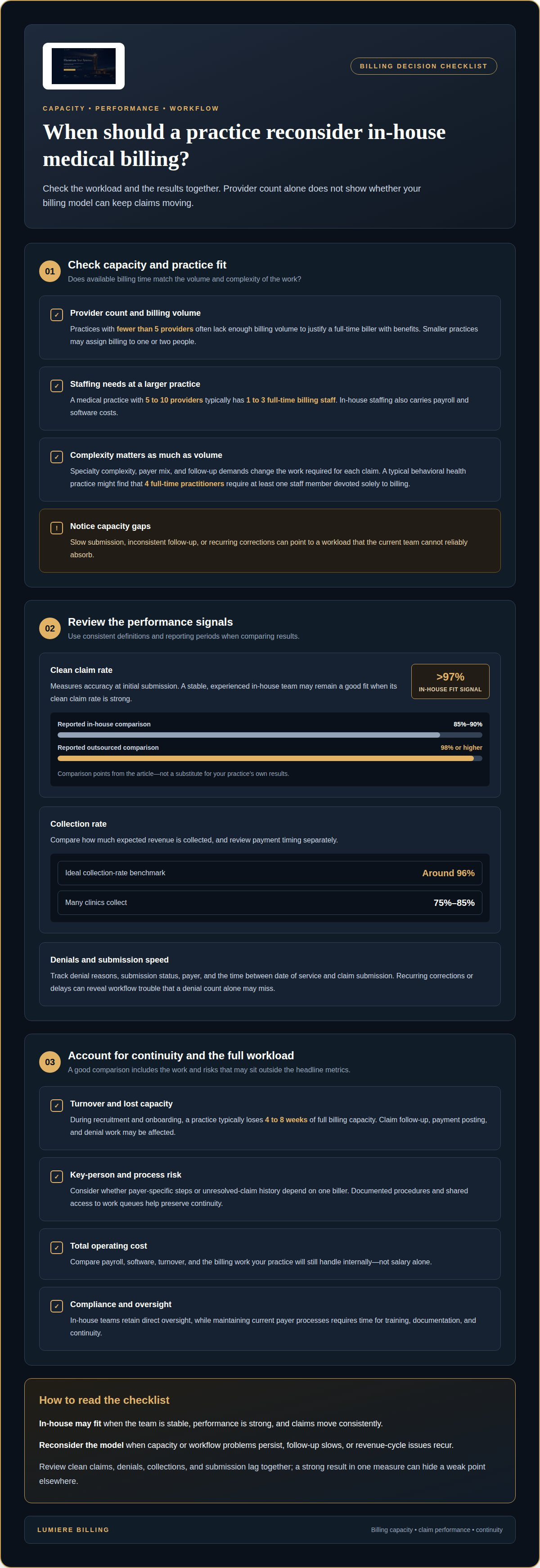
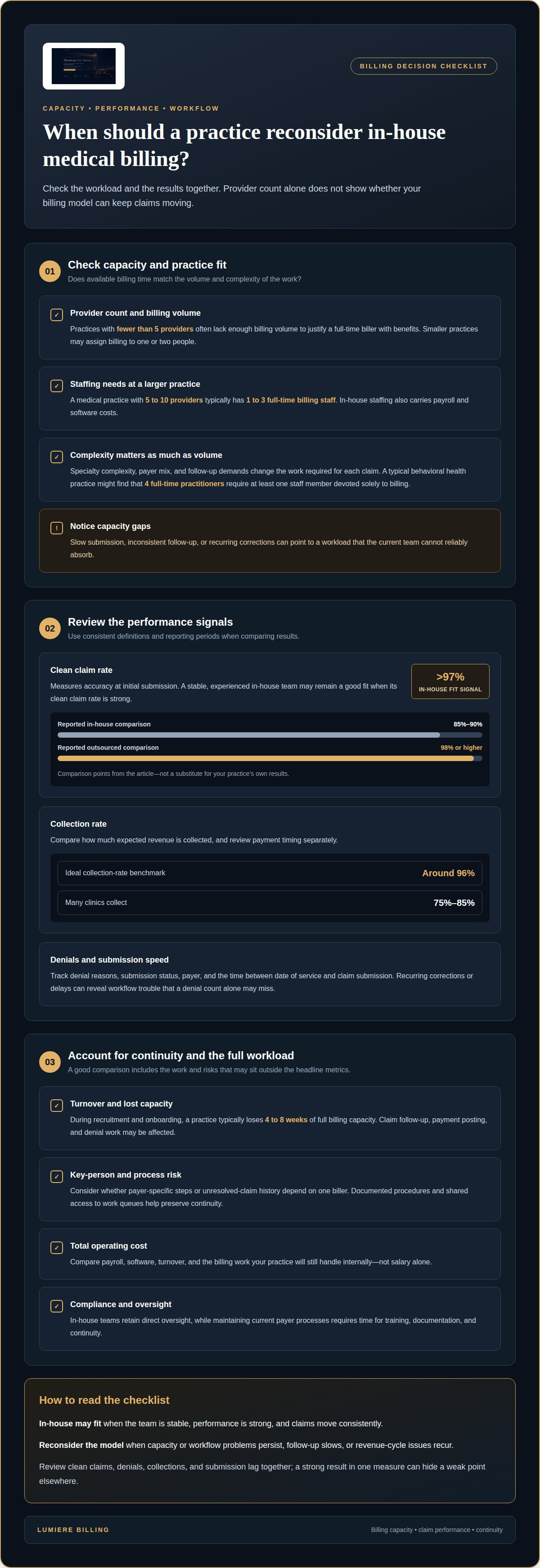
A billing team for a medical practice with 5 to 10 providers typically includes one to three full-time billing staff. That model offers direct staffing control, but the practice carries its own payroll and software costs.
Turnover and Revenue Cycle Impact
Turnover affects more than hiring costs. During recruitment and onboarding, a practice typically loses four to eight weeks of full billing capacity.
That interruption can leave less time for claim follow-up, payment posting, and denial work. The resulting pressure may slow revenue-cycle tasks and make rising denial rates harder to spot. A larger team can distribute the work, while a small team may lose a substantial share of its capacity when one biller leaves.
Compliance and Key-Person Risk
Compliance work relies on accurate, up-to-date processes across billing tasks. When payer requirements change, staff must apply relevant updates consistently to claims and follow-up. In-house teams retain direct oversight, but maintaining it takes time for training, process documentation, and continuity.
Key-person risk increases when one biller holds essential workflow knowledge, such as payer-specific steps or the history of unresolved claims. Documented procedures and shared access to work queues help preserve continuity. A team can distribute knowledge more easily than a single-biller setup, though added capacity also increases staffing costs.
| Billing option | Staffing | Cost factors | Continuity consideration |
|---|---|---|---|
| In-house biller | One full-time equivalent | Coverage may be vulnerable to one departure | |
| In-house team | One to three full-time staff for 5 to 10 providers | Labor, technology, and other operating expenses | Work can be shared across staff |
Choose by comparing total operating costs with the billing capacity and continuity your practice needs.
Practice size and claim volume decision factors
Practice size matters, but claim volume and billing performance show whether internal operations can keep pace. Assess service levels using clean claim rate, denial rate, collection rate, and days in accounts receivable, as well as timely submission and clear performance reporting.
Collection Rates and Payment Performance
Collection rate shows how much expected revenue the practice actually collects; payment timing shows how quickly it arrives. An industry benchmark places the ideal collection rate around 96%, while many clinics collect between 75% and 85%. Compare the same measures over consistent periods, and separate payer delays from work that remains unfinished internally.
Practice size affects the value of dedicated billing capacity. Practices with fewer than five providers often lack enough billing volume to justify a full-time biller with benefits. Smaller practices may assign billing tasks to one or two people, making dedicated staffing costly relative to collections when claim volume is low.
Volume alone doesn’t settle the decision. Specialty complexity, payer mix, and follow-up demands all affect the work required for each claim. A typical behavioral health practice might find that four full-time practitioners require at least one staff member devoted solely to billing. As the practice grows, examine how the workload is distributed.
In-house billing can suit a practice with a stable, experienced team and a clean claim rate above 97%. That benchmark helps distinguish a team that can manage its current volume from one whose operations may need added capacity. Strong collections and reliable submission performance matter more than provider count alone.
Denials, Accuracy, and Submission Speed
Clean claim rate measures accuracy at initial submission, while denial rate reveals claims that require correction or appeal. Reported comparisons put outsourced teams at clean claim rates of 98% or higher, versus 85% to 90% for in-house teams. Denial rates can vary between billing teams, so compare them using consistent definitions and your own results. Treat these as comparison points, not a substitute for your own results.
Track the time between the date of service and claim submission. Delays leave less time to resolve errors and respond to payer requests. Group claims by submission status, payer, and denial reason to see where the workflow slows or repeated mistakes occur.
Use the same reporting window and definitions when comparing internal results with a billing provider’s service levels. Review first-pass clean claims, denials, collections, and submission lag together: a strong result in one metric can mask a weak point elsewhere. Even modest claim volume can require specialized follow-up when a small practice handles varied payer rules or recurring corrections.
What’s the Difference Between In-House and Outsourced Billing?
In-house billing keeps claim work within the practice; outsourcing assigns agreed tasks to an external team. The right model depends on your practice type, growth plans, oversight needs, and the billing work your practice can sustain.
Growth and Billing Capacity
In-house operations give a practice direct control over staffing, coding workflows, and payment follow-up. Outsourcing can add capacity without requiring the practice to recruit and manage every billing role internally. If your practice is growing or operates across multiple locations, assess whether current workflows can absorb new providers, payer processes, and claim volume without delaying submission or follow-up.
When evaluating an outsourcing provider, assess its experience with behavioral health and the scope of billing work it handles. Agree on regular performance reports, transparent pricing terms, and responsibility for claims at each stage. A typical practice might compare whether its internal team can support new locations while maintaining consistent claim handling.
Compare total internal billing costs with the proposed outsourced expense to assess potential return on investment. Then account for retained staff work and transition costs, and evaluate denial follow-up, collections, and claim delays. A lower charge alone doesn’t establish value if responsibilities or reporting are unclear.
Responsibilities Retained by the Practice
Outsourcing changes who performs billing tasks, but the practice remains responsible for claims submitted in its name. The agreement should define who handles claim submission, denial management, payment posting, patient statements, and reporting. Clear ownership helps prevent open claims from falling between internal staff and the outsourced team.
Practice staff still provide accurate encounter information and support decisions that affect billing. The practice also needs visibility into payment activity and unresolved claims. When daily processing happens outside the organization, scheduled reporting and clear escalation paths help maintain oversight.
A transition requires planning for patient data, open claims, and system access. Set responsibilities for older claims, payment routing, and follow-up before changing workflows. Keep a dated inventory of open claims and assign each item to the internal team or outsourced provider so work continues through the handoff.
Practice type also matters. A solo practice may prioritize avoiding a dedicated internal billing role, while a larger group may value centralized processes across locations. Keeping some oversight in-house while outsourcing claim processing may suit a practice’s staffing capacity. Compare the work each model retains, not just its headline charge.
Denial-rate and accounts-receivable warning signs
Denials and aging receivables show where claims stop producing revenue. Review both trends together: a high denial rate creates rework, while delayed follow-up can leave collectible balances unresolved.
A medical practice should aim to keep days in accounts receivable at 35 or fewer. If days rise, examine which payer balances are aging, whether claims were submitted, and whether denials received timely follow-up. A single overall figure can hide a backlog concentrated in one payer or service line.
A denial rate above 5% on a major payer, combined with an appeal turnaround longer than 15 business days, signals that collectible revenue may be left uncollected. Repeated denials for the same reason also warrant attention. The rate identifies the scale of the problem; the denial reason points toward its cause.
Use a consistent review process to locate the breakdown:
- Group denials by payer, reason, and claim status.
- Identify recurring issues, such as missing information or inaccurate patient details.
- Assign each unresolved claim to a staff member and record its next action.
- Track appeal progress and compare turnaround times across payers.
A root-cause review distinguishes an isolated rejection from a process flaw affecting repeated claims. For example, a typical practice might find that the same denial reason recurs across claims sent through one clearinghouse; staff can inspect the relevant data and submission steps. Billing software and clear reporting can organize work queues, but staff still need to act on the patterns they reveal.
Accounts-receivable aging adds another layer. Monitor the percentage of receivables over 120 days, and track balances more than 90 days old in vendor reporting. Review unpaid claims every 30-45 days to surface stalled follow-up before balances age further. A patient balance and an unpaid payer claim require different follow-up paths, so reports should distinguish them.
Denial management supports collections through both correction and persistence. Correcting a claim addresses the immediate issue; recurring denials call for a workflow change. When appeals remain unresolved for weeks, document the delay, payer, claim status, and next step. This record can reveal whether delays stem from internal capacity, incomplete information, or ineffective follow-up.
Before changing billing models, establish a baseline for the same reporting period: denial rate, days in accounts receivable, aging balances, and appeal turnaround. Compare those measures after the change. If they worsen together, the pattern may indicate that the current process can’t keep denials and collections moving consistently.
Triggers for switching to outsourced billing
Deciding when to switch from in-house to outsourced billing comes down to whether your team can handle actual claim volume consistently. A single weak metric may call for closer review; recurring problems across denials, collections, and staffing make a stronger case for changing the model.
Look for patterns that point to a capacity or process problem:
- Persistent billing errors: A typical physical therapy practice might find that billing errors exceed 10% and consider outsourcing.
- Elevated denial rates: A denial rate above 8-10% is a signal that outsourcing may help.
- Growing receivables: More than 40-45 days in accounts receivable is another signal to examine.
- Insufficient billing capacity: Staff burnout, excessive rejected claims, or possible under-earning can indicate that current operations aren’t keeping pace.
These indicators point to different failure points. Repeated errors suggest accuracy or workflow issues; rising receivables point to follow-up delays. If both occur alongside increasing claim volume, your internal team may lack capacity to resolve current work and process new claims reliably.
Practice type also matters. For physical therapy practices, monthly collections under $300,000 are a stated reason to consider outsourced billing. In behavioral health, billing requires approximately 10 work hours for every 40 hours spent treating patients. These specialty-specific figures help frame workload, but they don’t replace examining your actual claim flow and staffing needs.
Before deciding, review performance over a consistent period and compare the current workload with your team’s available capacity. Separate one-time disruptions from recurring problems. Note whether denials repeat for the same reasons, follow-up keeps slipping, and billing staff can handle claims without neglecting other revenue-cycle tasks.
Then compare the cost and operational impact of keeping the current model with outsourcing. Include internal work that would remain, transition expenses, and the effect of unresolved claims. For a hypothetical physical therapy practice with billing errors above 10% and receivables beyond 40-45 days, multiple warning signs point toward a deeper workflow review, not just another round of short-term fixes.
Outsourcing isn’t automatically the right choice if your in-house team is stable, claims are handled on time, and performance is sound. But recurring errors, staff burnout, or rising receivables warrant action if they persist despite process changes. The key signal is a pattern your current operation can’t correct with its available capacity.
A Free Billing Audit can help clarify where denials, aging claims, and workflow gaps are affecting revenue, so the next step is grounded in your practice’s billing data.
Lumiere Billing
Lumiere Billing helps behavioral health practices assess whether their billing operation needs a different model. When denials, aging claims, or staffing pressure make the revenue-cycle picture difficult to see, its Revenue Cycle Management and Analytics & Compliance services support billing oversight and performance visibility.
A Free Billing Audit can identify workflow gaps and areas for closer review, while Practice Advisory can support decisions about billing capacity and operational changes. These options are most relevant when signals point to recurring process issues, rather than a temporary fluctuation in claim volume.
For practices weighing in-house billing against outsourcing, Lumiere Billing can help clarify the next steps. Contact Lumiere Billing to discuss your practice’s billing needs.
Make the Next Billing Decision With Clearer Information
Deciding when to switch from in-house to outsourced billing should lead to a practical next step: define what your practice needs its billing operation to handle and where internal oversight should remain. That clarity can guide a transition plan while preserving ownership of open claims, payment workflows, and practice decisions.
Lumiere Billing helps behavioral health practices assess revenue-cycle needs through Revenue Cycle Management, Practice Advisory, and Credentialing & Enrollment. The right starting point depends on the operational issue you want to address and the responsibilities your team plans to retain.
Bring your questions and priorities into a focused conversation. Contact Lumiere Billing to discuss your options and take the next step with a clearer view of your practice’s billing needs.
Frequently Asked Questions
How do you have control of your RCM when it is outsourced?
Maintain control by defining decision rights, reporting expectations, and escalation steps before work begins. Specify who approves adjustments, handles unusual payer issues, and communicates with patients about balances. Keep access to claim and payment information, then review exceptions and trends regularly. Outsourcing changes who performs agreed tasks; it shouldn’t leave your practice without visibility into revenue-cycle activity or unresolved work.
Can I switch back to in-house if outsourcing doesn't work?
Yes, a practice can plan to bring billing back in-house, but the agreement and transition plan shape the process. Document how open claims, pending appeals, payment records, and system access will be handed back. Before outsourced work ends, identify which staff will resume each task and how they’ll access current procedures. A staged handoff helps keep claim follow-up moving as responsibilities shift back to the practice.
Which billing model fits your practice?
Choose the model that best matches your workload, oversight needs, and available staff. In-house billing may fit a practice with experienced employees, stable processes, and enough capacity to manage its claims. Outsourcing may fit when your practice needs specialized support or flexible capacity. Compare the full internal workload with the tasks an outside team would perform, and decide which responsibilities must remain under direct practice control.
How do you know when it’s time to change your billing model?
Deciding when to switch from in-house to outsourced billing becomes clearer when operational problems persist despite targeted fixes. Compare performance across consistent reporting periods and separate payer-specific delays from internal workflow issues. If backlogs continue after assignments are adjusted or procedures documented, the current model may lack capacity. A temporary disruption tells you less than a recurring pattern across claims and follow-up.
What signs indicate it’s time to outsource billing?
Consider outsourcing when billing work repeatedly competes with essential practice operations. For example, a typical practice might find that staff postpone claim follow-up during busy scheduling periods, or that a new location adds payer workflows the existing team can’t absorb. Repeated hiring to cover routine turnover can also reveal a continuity gap. Look for recurring capacity problems, not a single difficult week or unusual batch of claims.
What are the pros and cons of in-house versus outsourced billing?
In-house billing offers direct day-to-day oversight and close coordination with practice staff, but the practice manages staffing, training, and workflow coverage. Outsourcing can add billing capacity and specialized support, while requiring clear reporting and coordination with an external team. Neither model removes the practice’s responsibility to monitor claims submitted in its name. The tradeoff is direct operational control versus delegated work with defined oversight.
How much does outsourced billing cost compared with an in-house billing team?
Compare total costs over the same period rather than comparing a vendor charge with salary alone. Include internal payroll, benefits, software, training, turnover, and tasks the practice will still perform. Then compare those expenses with the outsourced arrangement’s pricing structure and scope of work. Ask what work is included, what remains internal, and how transition work is handled before judging the financial difference.
What billing volume or company size makes outsourcing cost-effective?
There’s no single claim-volume cutoff that determines whether outsourcing is cost-effective. The answer depends on claim complexity, payer mix, follow-up demands, staff capacity, and the cost of maintaining internal coverage. A smaller practice with complex claims may need more billing attention than its volume suggests. A larger practice may retain in-house functions if its team can handle growth without backlogs or weaker oversight.
Frequently Asked Questions
Maintain control by defining decision rights, reporting expectations, and escalation steps before work begins. Specify who approves adjustments, handles unusual payer issues, and communicates with patients about balances. Keep access to claim and payment information, then review exceptions and trends regularly. Outsourcing changes who performs agreed tasks; it shouldn’t leave your practice without visibility into revenue-cycle activity or unresolved work.
Yes, a practice can plan to bring billing back in-house, but the agreement and transition plan shape the process. Document how open claims, pending appeals, payment records, and system access will be handed back. Before outsourced work ends, identify which staff will resume each task and how they’ll access current procedures. A staged handoff helps keep claim follow-up moving as responsibilities shift back to the practice.
Choose the model that best matches your workload, oversight needs, and available staff. In-house billing may fit a practice with experienced employees, stable processes, and enough capacity to manage its claims. Outsourcing may fit when your practice needs specialized support or flexible capacity. Compare the full internal workload with the tasks an outside team would perform, and decide which responsibilities must remain under direct practice control.
Deciding when to switch from in-house to outsourced billing becomes clearer when operational problems persist despite targeted fixes. Compare performance across consistent reporting periods and separate payer-specific delays from internal workflow issues. If backlogs continue after assignments are adjusted or procedures documented, the current model may lack capacity. A temporary disruption tells you less than a recurring pattern across claims and follow-up.
Consider outsourcing when billing work repeatedly competes with essential practice operations. For example, a typical practice might find that staff postpone claim follow-up during busy scheduling periods, or that a new location adds payer workflows the existing team can’t absorb. Repeated hiring to cover routine turnover can also reveal a continuity gap. Look for recurring capacity problems, not a single difficult week or unusual batch of claims.
In-house billing offers direct day-to-day oversight and close coordination with practice staff, but the practice manages staffing, training, and workflow coverage. Outsourcing can add billing capacity and specialized support, while requiring clear reporting and coordination with an external team. Neither model removes the practice’s responsibility to monitor claims submitted in its name. The tradeoff is direct operational control versus delegated work with defined oversight.
Compare total costs over the same period rather than comparing a vendor charge with salary alone. Include internal payroll, benefits, software, training, turnover, and tasks the practice will still perform. Then compare those expenses with the outsourced arrangement’s pricing structure and scope of work. Ask what work is included, what remains internal, and how transition work is handled before judging the financial difference.
There’s no single claim-volume cutoff that determines whether outsourcing is cost-effective. The answer depends on claim complexity, payer mix, follow-up demands, staff capacity, and the cost of maintaining internal coverage. A smaller practice with complex claims may need more billing attention than its volume suggests. A larger practice may retain in-house functions if its team can handle growth without backlogs or weaker oversight.
Free billing audit
Find out what your billing is really costing you
We'll review your claims, denials and collections and show you exactly where revenue is leaking. Free, no obligation, no contract.
Schedule a Free Billing Audit