Insurance Paneling: 2026 Strategic Credentialing Guide

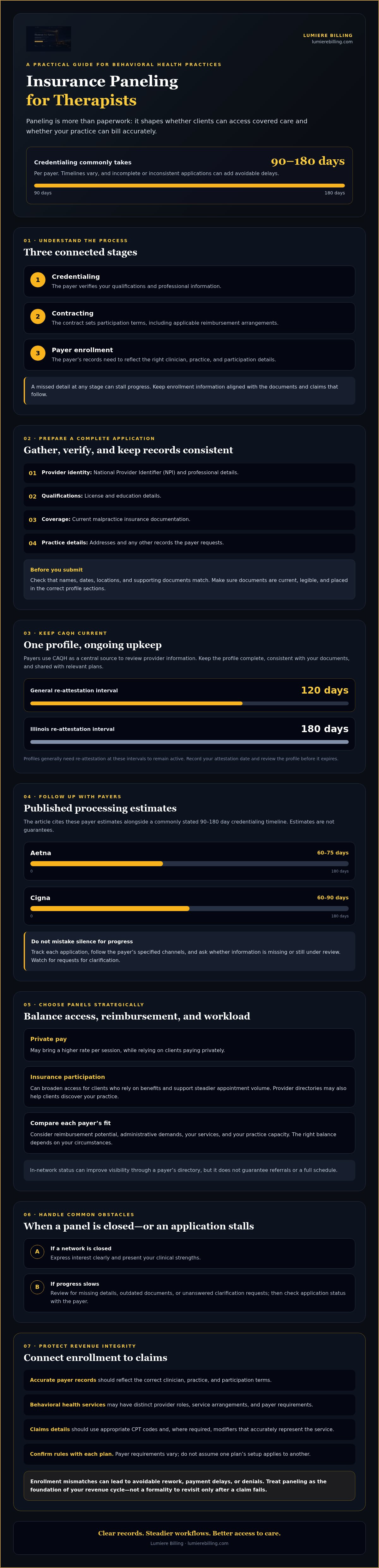
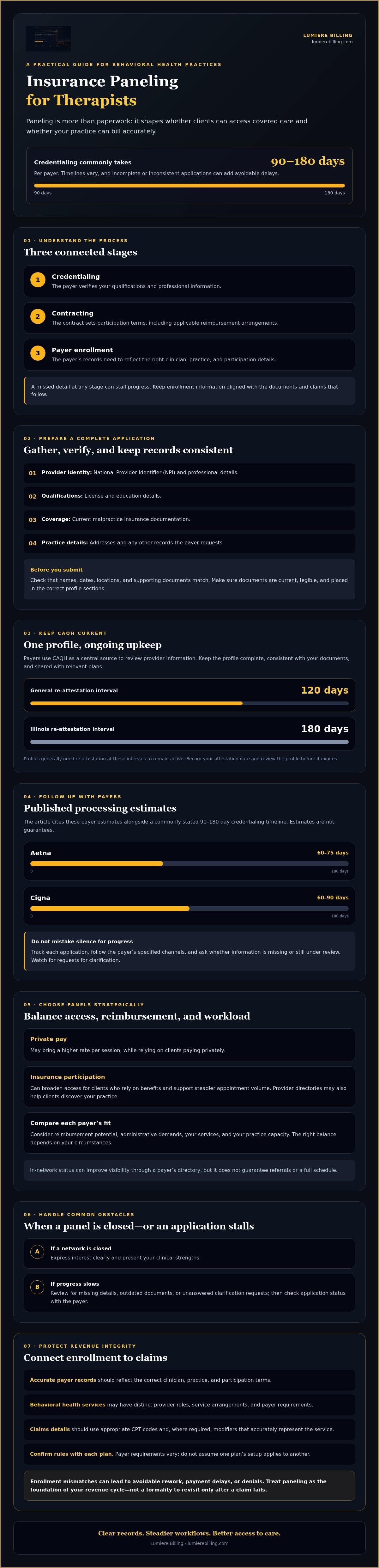
Insurance paneling isn’t a back-office chore. It’s part of the infrastructure that determines whether clients can access your care and whether your practice can get paid. For behavioral health clinicians, insurance paneling for therapists can take 90 to 180 days per payer. Incomplete or inconsistent applications can add avoidable delays.
If you’ve lost prospective clients who need to use insurance, waited months for a payer response, or had paperwork sent back for corrections, the frustration is justified. The process has distinct stages, from verifying your credentials to signing a contract and completing payer enrollment. A missed detail at any stage can stall progress.
This guide offers a practical roadmap for choosing panels, preparing complete applications, and following up effectively. You’ll also learn how CAQH profile maintenance, payer selection, and revenue cycle oversight support a growing practice. Clear steps can help you prevent avoidable delays and see what needs attention next.
Key Takeaways
- Build a reliable foundation for insurance paneling for therapists by organizing provider documents and keeping your CAQH profile current.
- Compare payer fit, reimbursement potential, and administrative demands before deciding which panels to pursue.
- Learn how to respond when a network is closed and present your clinical strengths clearly when expressing interest.
- Connect accurate enrollment details to revenue cycle workflows to help reduce avoidable claim issues.
- Identify where credentialing gaps may be disrupting practice growth and what to review next.
Understanding Insurance Paneling: Why Credentialing is the Bedrock of Practice Growth
Insurance paneling is the process of joining a health plan’s provider network so eligible clients can access covered care from you. It involves related steps, but credentialing and contracting aren’t the same. Credentialing verifies your qualifications and professional information. Contracting establishes participation terms, including applicable reimbursement arrangements. For a neutral overview of the verification process, see Understanding Credentialing.
Network status can also affect how clients find your practice. In-network clinicians may appear in a payer’s provider directory and become an option for members seeking covered care. In coordinated or integrated care settings, that access can help connect behavioral health providers with clients and referral pathways. It doesn’t guarantee referrals or a full schedule, but it can provide a visibility channel that private-pay-only practices may not have.
The Financial Logic of Going In-Network
Private-pay rates may be higher per session, while insurance participation can broaden access for clients who rely on benefits and support steadier appointment volume. The right balance depends on your services, payer terms, capacity, and administrative workload. Payer directories and insurance-based referrals may also help prospective clients discover you without relying entirely on paid advertising or individual outreach.
Revenue integrity starts before the first claim. If the payer’s records don’t accurately reflect the clinician, practice, or participation terms, a session may be difficult to bill or reimburse. Treat enrollment as the structural foundation of your revenue cycle, not a formality to revisit only after a claim fails.
Behavioral Health Specialization: Why Generic Credentialing Fails
ABA and mental health practices work with distinct provider roles, services, and payer requirements. A general credentialing workflow may overlook details that matter to a behavioral health clinician, such as whether the payer’s records reflect the correct practitioner and service arrangement. Claims also depend on using appropriate CPT codes and, where required, modifiers that accurately represent the service. Payer rules vary, so confirm requirements with each plan rather than assuming one plan’s setup applies to another.
Precision matters. A mismatch between enrollment data and a claim can create avoidable rework, payment delays, or denials. Strong behavioral health revenue cycle management connects accurate paneling with the steps that follow, helping align enrollment and claims. That coordination is important as a practice grows.
The Mechanics of the Paneling Process: A 2026 Step-by-Step Roadmap
A strong application starts before it reaches a payer. Gather your National Provider Identifier (NPI), current malpractice insurance documentation, license and education details, practice addresses, and any other records the payer requests. Check that names, dates, and locations match across documents. A discrepancy, such as an outdated address or insurance certificate, can send an otherwise complete application back for correction.
Phase 1: Preparation and CAQH Optimization
CAQH is a central source payers use to review provider information. Before applying, check that your profile is complete, consistent with your supporting documents, and shared with the relevant plans. Upload current documents, review practice locations and specialties, and complete your attestation. CAQH profiles generally need re-attestation every 120 days, or every 180 days in Illinois, to remain active. For a focused walkthrough, see Mastering CAQH Enrollment.
- Confirm your NPI and professional details match the information on payer applications.
- Review your license, malpractice coverage, education, and practice information for accuracy.
- Check that documents are current, legible, and uploaded to the correct profile sections.
- Record your attestation date and set a reminder to review the profile before it expires.
Phase 2: Application and Payer Follow-Up
Submit a complete application for each payer, then track its status rather than assuming silence means progress. Credentialing commonly takes 90 to 180 days per panel, though timelines vary. Published estimates cited here list Aetna at 60 to 75 days and Cigna at 60 to 90 days. Build a follow-up schedule, use the payer relations channels it specifies, and ask whether anything is missing or still pending review.
A “silent delay” can begin when a request for clarification goes unnoticed, a document is rejected without clear notice, or an application sits between processing stages. Keep a log of submission dates, reference numbers, contact names, and written responses. This gives you a clear record if you need to escalate an issue or ask for a decision to be reviewed.
The effective date is the date the payer recognizes your participation as active. It determines when you may begin billing as an in-network provider under that plan’s terms.
Accurate enrollment data carries forward into claims and payment workflows, a connection at the heart of Revenue Cycle Management. Behavioral health practices seeking support with credentialing details can consider Lumiere Billing’s Credentialing & Enrollment.
Strategic Payer Selection: Evaluating Reimbursement vs. Administrative Burden
Paneling isn’t a checkbox exercise. Each contract affects access, reimbursement, and the staff time needed to get claims paid. The “Big Five” label can obscure an important point: the best payer shortlist depends on your practice’s clients, services, and market. Compare the major plans your prospective clients actually use, including options such as Aetna, Cigna, UnitedHealthcare/Optum, and your regional Blue Cross Blue Shield plan. Don’t enroll broadly without a clear reason.
Look beyond the fee schedule. Frequent prior authorization requirements, slow responses, or recurring claim rework can reduce the practical value of an attractive rate. Track each payer’s allowed amounts, authorization workload, clean-claim performance, denial patterns, and the time spent resolving payment issues. Then assess revenue per clinical and administrative hour, not just the amount paid for one session. Analytics can help show when a lower-paying panel is efficient or when extensive follow-up offsets a higher rate.
Reimbursement Rate Analysis
Compare the allowed amount for the services you actually provide, using each payer’s fee schedule and your expected appointment mix. For CPT code 90837, for example, review the plan’s allowed amount for that code, its requirements, and how often your practice can bill it appropriately. A fee schedule is a comparison tool, not a revenue forecast. Actual results also depend on authorization, documentation, claim acceptance, and payment timing. For more ways to examine these operational factors, read behavioral health billing services and revenue optimization.
Network Adequacy and Market Opportunity
Look for gaps your practice can credibly address. A payer directory, referral conversations, and inquiries from prospective clients may reveal unmet demand for a specialty, language, or service format. When contacting a plan about network participation, explain the specific need you serve and provide clear information about your clinical focus and capacity. This can make your application more relevant, but it doesn’t guarantee that a closed panel will open or that contract terms will change.
Specialized services can strengthen the case you present during contracting, particularly when a payer’s network appears limited in a behavioral health niche. Keep your rationale concrete: who you serve, what care you provide, and how your practice may address an identified access gap.
Build a Balanced Payer Mix
Relying heavily on one insurer can leave a practice exposed to changes in reimbursement, policies, or network status. Review payer performance regularly and compare it with your capacity and client access goals. A deliberate mix of panels can help you pursue sustainable volume without allowing one contract to dictate the financial health of the entire practice. That’s the strategic value of insurance paneling for therapists: choose networks based on fit, then review their performance using data.
Navigating Common Paneling Obstacles and "Closed" Panels
When a payer says its network is “full,” it is signaling that it currently considers provider capacity adequate under its own criteria. That isn’t necessarily a permanent refusal, but it also isn’t an invitation to keep sending the same application. Ask whether the restriction applies to your specialty, provider type, or practice location, and when the payer will review network needs again. Request the response and next steps in writing.
A focused letter of interest can give the payer a reason to reconsider. State the population and services you provide, relevant language capabilities or specialized credentials, and your capacity to accept members. If you serve a need the plan appears to lack, describe it clearly and support the case with verifiable information, such as directory gaps or documented requests for care. Avoid claiming a shortage you can’t substantiate.
Strategies for Entering Restricted Networks
Look for gaps within behavioral health, not just general provider shortages. For example, a plan’s directory may show limited access to ABA services in rural communities or few clinicians with a particular specialty. A group practice can also ask whether the payer accepts applications under an organization’s NPI-2, the identifier associated with an organization, rather than only an individual NPI-1. Group paneling may offer another route to explore, but it doesn’t automatically override a closed network. Confirm whether the group can join and whether each clinician still needs individual credentialing and affiliation.
Lumiere’s Analytics & Compliance can support practices in reviewing information about payer performance and operations. Use documented access gaps and specialty availability when deciding what evidence to present to a payer.
Maintenance: The "Set It and Forget It" Trap
Approval isn’t the end of the work. Expired credentials, outdated provider rosters, or changes in practice information can disrupt participation and contribute to “silent denials,” where claims fail because payer records no longer support the provider or service. Keep a roster showing each clinician’s payer status, effective dates, credential expiration dates, and outstanding updates.
Set an internal alert 90 days before a re-credentialing deadline. Use it to confirm current documents, submit required updates, and follow up before the payer’s deadline. Treat that lead time as a practice-management safeguard, not a universal payer rule. For a closer look at the renewal process, read the mental health provider re-credentialing guide.
Strong insurance paneling for therapists depends on both access strategy and ongoing roster accuracy. If closed panels or credentialing lapses are creating uncertainty, explore Lumiere Billing’s Credentialing & Enrollment for behavioral health practice support.
Beyond the Contract: Linking Paneling to Revenue Cycle Excellence
A signed contract doesn’t complete the revenue cycle. It opens the door. For claims to move from a clinical session to payment, payer enrollment records must align with the provider, group, location, and services submitted on each claim. If a clinician is credentialed but not correctly loaded into the payer’s billing system, claims may reject or remain unpaid. That gap can turn completed care into work that is difficult to bill.
Insurance paneling for therapists is an operational starting point, not an isolated credentialing task. Once participation is active, practices need to monitor whether payer records remain accurate and claims process as expected. A clear connection between enrollment data, claim submission, and payment follow-up helps protect revenue integrity.
Visibility and Insight: The Lumiere Approach
Visibility makes problems easier to locate. A practice dashboard or regular performance review can help you see where applications are stalled, which payer records need attention, and whether claim issues may trace back to enrollment details. Track each provider’s status with each payer, along with recurring rejection or denial patterns. This shifts the question from “Are we paneled?” to “Is this panel functioning for the practice?”
Lumiere Billing focuses exclusively on behavioral health, including ABA and mental health, and offers Revenue Cycle Management, Credentialing & Enrollment, and Analytics & Compliance. Its services bring credentialing details into view alongside downstream revenue cycle performance. For related operational risks, explore behavioral health billing errors to avoid.
Use payer performance information to guide decisions over time. If a panel produces recurring enrollment-related claim problems, investigate the underlying records before treating each denial as a separate billing issue. If the data points elsewhere, focus on the relevant workflow instead. The goal is clearer insight, not more administrative noise.
The Path Forward: Your Free Billing Audit
A Free Billing Audit can help identify potential revenue leakage, including sessions that may be difficult to bill because a provider’s paneling or enrollment status wasn’t aligned with the work performed. It can also bring overlooked process gaps into focus. An audit won’t replace ongoing oversight, but it can help establish where to investigate and what needs attention.
Administrative complexity shouldn’t have to compete with your focus on care. Lumiere Billing’s behavioral health expertise can support a more coordinated approach to credentialing and revenue cycle management, while your team stays focused on clinical work.
Build a Stronger Foundation for Sustainable Practice Growth
Insurance paneling for therapists works best as an ongoing business strategy, not a one-time application. Choose payer networks based on fit, keep provider and enrollment information current, and review how each panel affects access, claims, and practice performance. Those habits make credentialing part of a more dependable revenue cycle.
The right operational support can make that work clearer. Lumiere Billing provides specialized behavioral health services, including denial prevention and practice analytics, to help practices review administrative details that can otherwise be hard to track. Better visibility can help you spot potential gaps, understand payer performance, and make informed decisions about your practice.
With the right systems and focused support, you can spend less energy untangling administrative issues and more energy building a practice that supports the care you provide. Request a Free Billing Audit to identify potential revenue leakage in your practice.
Frequently Asked Questions
How long does the insurance paneling process typically take for therapists in 2026?
Insurance paneling typically takes 90 to 180 days per payer, though timelines vary by insurer, application completeness, and provider circumstances. Some commercial payer estimates are shorter: Aetna is listed at 60 to 75 days and Cigna at 60 to 90 days. Track each application separately, respond promptly to requests, and follow up with the payer. Don’t assume that submitting an application means you’re approved or ready to bill in-network.
Can I see clients before my insurance paneling is officially completed?
You may be able to see clients before paneling is complete, but don’t assume you can bill their plan as an in-network provider. Confirm the payer’s participation and billing rules, including the effective date, before submitting claims. You may discuss private-pay or out-of-network arrangements with clients, but explain costs and coverage clearly and follow applicable payer terms. Keep records of what clients agreed to and verify benefits before care begins.
What is the difference between being "credentialed" and being "contracted"?
Credentialing verifies your qualifications and professional information. Contracting establishes your participation terms with the payer, which may include reimbursement arrangements. They’re connected but distinct steps. After these, enrollment typically means the payer has loaded the provider and relevant practice information into its system for billing. Confirm the status of each step with the plan. Credentialing approval alone doesn’t necessarily mean you’re contracted, fully enrolled, or authorized to submit in-network claims.
What are the most common reasons a therapist’s paneling application is denied?
Applications commonly stall or face rejection when information is incomplete, inconsistent, or outdated. Examples include mismatched practice addresses, missing documents, an expired malpractice insurance certificate, or an incomplete or unattested CAQH profile. A payer may also be closed to new providers for a particular network or specialty. Before submitting, compare every application field with your supporting records, confirm required documents are current, and track payer requests so a clarification doesn’t sit unanswered.
Do I need a separate NPI for my group practice when paneling?
A group practice generally uses an organizational NPI, known as an NPI-2, while individual clinicians use their own Type 1 NPIs. Whether you need an NPI-2 and how the payer links the group and clinicians depends on your structure and the payer’s enrollment requirements. Ask each plan which identifiers and affiliations it requires. Group enrollment doesn’t automatically replace individual credentialing or guarantee access to a network that is closed to new providers.
How often do I need to renew my insurance paneling credentials?
Renewal schedules vary by payer, so track each plan’s re-credentialing requirements and deadlines rather than relying on one universal interval. Separately, CAQH profiles generally require re-attestation every 120 days, or every 180 days in Illinois, to remain active. Keep licenses, malpractice documents, practice details, and provider rosters current. A calendar alert well ahead of each deadline gives you time to submit updates and confirm they’ve been received.
Is it possible to negotiate higher reimbursement rates during the paneling process?
You can ask the payer about reimbursement terms during contracting, but a rate increase isn’t guaranteed. Prepare a focused case using the services and specialties you provide, your documented capacity, and evidence of an access gap your practice may help address. Review the fee schedule for the specific codes you bill, not just a general rate. Compare the proposed terms with administrative requirements and expected workflow before deciding whether participation fits your practice.
What should I do if an insurance panel tells me they are currently closed?
Ask what the payer means by “closed,” including whether the restriction applies to your specialty, provider type, or practice, and whether it will reassess network needs. Request guidance on when and how to express interest again. You can submit a concise letter describing your services, relevant specialties, languages, and capacity, supported by credible evidence of an access gap. Don’t assume a group application bypasses the restriction. Verify the payer’s rules for both the group and individual clinicians.
Frequently Asked Questions
Insurance paneling typically takes 90 to 180 days per payer, though timelines vary by insurer, application completeness, and provider circumstances. Some commercial payer estimates are shorter: Aetna is listed at 60 to 75 days and Cigna at 60 to 90 days. Track each application separately, respond promptly to requests, and follow up with the payer. Don’t assume that submitting an application means you’re approved or ready to bill in-network.
You may be able to see clients before paneling is complete, but don’t assume you can bill their plan as an in-network provider. Confirm the payer’s participation and billing rules, including the effective date, before submitting claims. You may discuss private-pay or out-of-network arrangements with clients, but explain costs and coverage clearly and follow applicable payer terms. Keep records of what clients agreed to and verify benefits before care begins.
Credentialing verifies your qualifications and professional information. Contracting establishes your participation terms with the payer, which may include reimbursement arrangements. They’re connected but distinct steps. After these, enrollment typically means the payer has loaded the provider and relevant practice information into its system for billing. Confirm the status of each step with the plan. Credentialing approval alone doesn’t necessarily mean you’re contracted, fully enrolled, or authorized to submit in-network claims.
Applications commonly stall or face rejection when information is incomplete, inconsistent, or outdated. Examples include mismatched practice addresses, missing documents, an expired malpractice insurance certificate, or an incomplete or unattested CAQH profile. A payer may also be closed to new providers for a particular network or specialty. Before submitting, compare every application field with your supporting records, confirm required documents are current, and track payer requests so a clarification doesn’t sit unanswered.
A group practice generally uses an organizational NPI, known as an NPI-2, while individual clinicians use their own Type 1 NPIs. Whether you need an NPI-2 and how the payer links the group and clinicians depends on your structure and the payer’s enrollment requirements. Ask each plan which identifiers and affiliations it requires. Group enrollment doesn’t automatically replace individual credentialing or guarantee access to a network that is closed to new providers.
Renewal schedules vary by payer, so track each plan’s re-credentialing requirements and deadlines rather than relying on one universal interval. Separately, CAQH profiles generally require re-attestation every 120 days, or every 180 days in Illinois, to remain active. Keep licenses, malpractice documents, practice details, and provider rosters current. A calendar alert well ahead of each deadline gives you time to submit updates and confirm they’ve been received.
You can ask the payer about reimbursement terms during contracting, but a rate increase isn’t guaranteed. Prepare a focused case using the services and specialties you provide, your documented capacity, and evidence of an access gap your practice may help address. Review the fee schedule for the specific codes you bill, not just a general rate. Compare the proposed terms with administrative requirements and expected workflow before deciding whether participation fits your practice.
Ask what the payer means by “closed,” including whether the restriction applies to your specialty, provider type, or practice, and whether it will reassess network needs. Request guidance on when and how to express interest again. You can submit a concise letter describing your services, relevant specialties, languages, and capacity, supported by credible evidence of an access gap. Don’t assume a group application bypasses the restriction. Verify the payer’s rules for both the group and individual clinicians.